Halloween grew out of Samhain (say it SOW-in), the Irish festival that marked the start of winter on 1 November, with the big night on 31 October, Oíche Shamhna. Irish customs like turnip lanterns, guising, barmbrack and apple games travelled to America with emigrants in the 1800s, where the turnip became a pumpkin. Ireland still does Halloween properly, with festivals in Galway, Derry, Meath and Dublin.
Picture a farmhouse in rural Ireland on the last night of October, a couple of hundred years ago. The harvest is in, the evenings are drawing in, and winter starts tomorrow.
A small cross hangs over the door and someone goes round with the holy water. If you have to go out, you carry a black-handled knife and you give the fairy fort a wide berth. Tonight is Oíche Shamhna, and according to tradition the dead are coming home.
This is how the Irish invented Halloween, or near enough. I’m a Cork man, and I think the Irish version beats the plastic one: older, stranger and with more cake. Here’s the story, with folklore and history kept apart, plus the four best Halloween festivals in Ireland for 2026.
What was Samhain?
Samhain (say it SOW-in) fell on 1 November and marked the first day of winter. It was one of the four quarter days of the old Irish year, alongside Imbolc (St Brigid’s Day), Bealtaine and Lughnasa. As with most Irish festivals, the real celebrating happened the night before, Oíche Shamhna, which is still the Irish name for Halloween.
The name is often explained as “summer’s end”, even in medieval glosses. Language scholars aren’t convinced, and many linguists now link it to an old Celtic word for “assembly”.
Where the word Halloween comes from
The English name is Christian. In the eighth century Pope Gregory III dedicated a chapel in St Peter’s to all the saints, the “hallows”. By the ninth century 1 November was All Saints’ Day across much of Europe, so the evening before became All Hallows’ Eve, later Hallowe’en. All Souls’ Day, for remembering the dead, follows on 2 November, and the old Samhain customs blended into the Christian feasts.
Was Samhain the Celtic New Year?
You’ll read everywhere that Samhain was the Celtic New Year and a festival of the dead. The historian Ronald Hutton points out that medieval records give little evidence for either. He says the “Celtic New Year” idea owes a lot to Victorian scholars like John Rhys and James Frazer.
So “the Celts believed” often means “later writers believed the Celts believed”. Below, I’ll tell you what the stories say, and when it’s a story.
Tlachtga: the fire on the Hill of Ward
About 2km east of Athboy in Co. Meath there’s a low hill ringed by four circles of earthworks, roughly 150 metres across. This is Tlachtga, now the Hill of Ward. If Halloween has a birthplace, it’s the best-known candidate.
In the 1630s the historian Geoffrey Keating wrote that the druids of Ireland gathered at the Fire of Tlachtga on the eve of Samhain to offer sacrifice. Keating adds that every fire in the country was put out and relit from that one. His source is unknown and no earlier text describes a Samhain fire here, so treat it as tradition rather than proven history.
The hill’s own story is darker. It goes that Tlachtga was the daughter of the druid Mug Ruith, and that she died here giving birth to three sons.
What the archaeologists found
Dr Stephen Davis of UCD excavated the hill from 2014 to 2016. His team found activity from the late Bronze Age, around 1100 BC, into the early medieval period. There was large-scale burning, animal bone from feasting and an infant burial from about AD 450.
So there were big fires and big feeds here for a very long time. Davis warns that tying the burning to Samhain is tempting but hard to prove. I like that honesty.
If you’d rather watch than read, this short video runs from Samhain fires to turnip lanterns in under a minute and a half.
Ghost night: when the dead came home
People now talk about the “thin veil” at Halloween. The older Irish names were plainer: ghost night, or spirit night. According to tradition the souls of the dead came back to the family home, and it was not a night for walking the roads alone.
The National Museum of Ireland records that people kept away from fairy forts, and anyone who had to travel carried a black-handled knife or a steel needle for protection. Why the handle had to be black, the sources don’t say. I’d carry one anyway.
Nera and the gate to hell
In the medieval tale Echtra Nerai, the Adventure of Nera, a young man crosses into the Otherworld on Samhain night. He goes through the cave of Cruachan, usually identified with Oweynagat at Rathcroghan, Co. Roscommon.
The cave is still there, a limestone fissure about 37 metres long. A medieval text called it Ireland’s gate to hell, which is quite the review for a hole in a field. For more places like it, see my list of haunted places around Ireland.
The púca and the blackberries
The púca is one of the great shape-shifters of Irish folklore, often said to take the form of a dark horse or a goat, and rarely up to any good. Children were told that the púca went about on Halloween night spitting on the wild fruit, so nobody ate blackberries after that.
Local versions vary. A Kerry account in the Schools’ Collection moves the deadline back to Michaelmas in late September. Either way, the late blackberries were his.
Stingy Jack and the turnip jack-o’-lantern
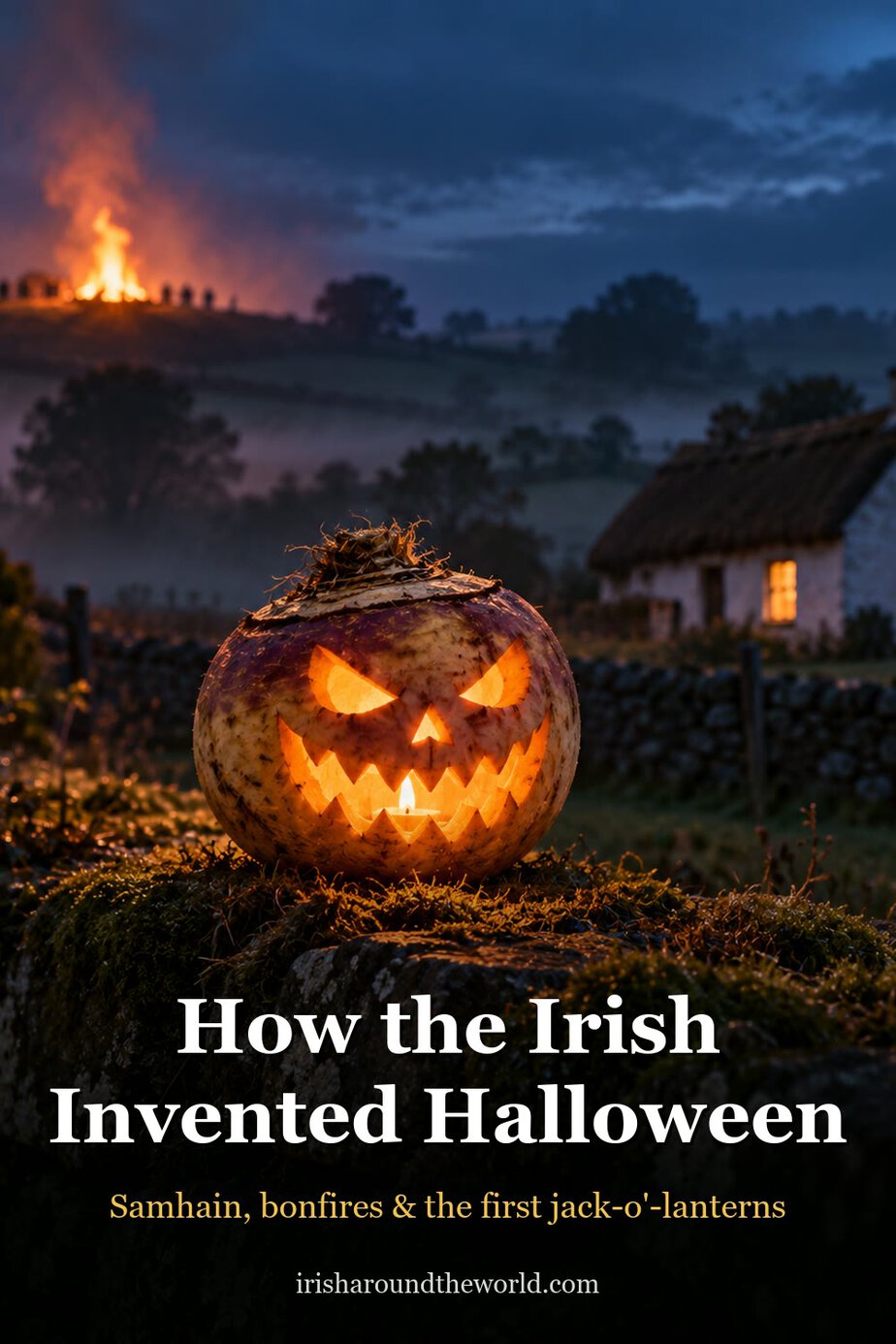
Before anyone carved a pumpkin, people in Ireland carved turnips. A face was cut into a hollowed-out turnip, a candle went inside, and the point, according to the National Museum, was to frighten people on 31 October.
The story of Stingy Jack
The folktale behind the lantern is Stingy Jack, known in Irish as Seán na Gealaí. In one telling, he talked the Devil into climbing a tree, then ringed the trunk with crosses so he couldn’t get down.
Jack only let him go once the Devil promised he would never take his soul. When Jack died, heaven wouldn’t have him, and hell couldn’t, because a promise is a promise. So Jack wanders the dark with a coal from hell in a hollowed-out turnip.
People linked Jack’s light to the will-o’-the-wisp over the bogs, which in English was also called a jack-o’-lantern. The name later passed to the carved lantern itself. The story turns up in print in the 19th century.
The ghost turnip from Donegal
In 1943 a schoolteacher called Rois Ní Braonáin, who was teaching near Fintown in Co. Donegal, gave the National Museum of Ireland a carved turnip lantern. It was the type made locally around 1900. Turnips don’t keep, so the museum artist Eileen Barnes made a painted plaster cast.
That “ghost turnip” is on display at the Museum of Country Life at Turlough Park in Co. Mayo. It is properly unsettling, and I mean that as praise.
How pumpkins took over in America
Pumpkins are native to the Americas, so Irish people carved what they had: turnips, and sometimes potatoes. In America, emigrants found a vegetable that was bigger, softer and far easier to carve.
The National Museum calls the modern pumpkin “an American development of this Irish tradition”, though its folklife curator Clodagh Doyle cautions that a direct line is hard to prove. Anyone who has carved a turnip with a kitchen knife will understand why nobody went back.
The horse skull in a white sheet
This one comes from my own county. In 1853 William Hackett recorded a Samhain eve procession in East Cork, between Ballycotton and Trabolgan. At its head was a man in a white sheet carrying a mare’s head: the Láir Bhán, or White Mare.
Young lads followed him blowing cow horns, going farm to farm collecting contributions in the name of “Muck Olla”.
Guising and mischief night
According to tradition, a disguise helped you pass unnoticed among the spirits out that night. What’s properly recorded is guising: men or children in masks going from house to house to frighten the neighbours, and giving a bit of entertainment in return for a treat. The National Museum says modern trick-or-treating comes from this.
It was also mischief night. The pranks were ambitious: knock-and-run, cabbage heads thrown at doors, and farm carts taken apart and rebuilt inside someone’s house.
Help the Halloween party
In Ireland, especially Dublin, children didn’t say “trick or treat”. They knocked and said “Help the Halloween party!”, hoping for apples, nuts or a few coins.
The earliest known printed use is “tricks or treats”, in the Sault Daily Star in Ontario on 1 November 1917. So the words are Canadian. The habit of knocking on doors in disguise is much older, and a good deal of it is ours.
Halloween bonfires
31 October is still bonfire night in many Irish towns and housing estates. In the west, midsummer fires on St John’s Eve were traditionally more common, but the Halloween bonfire has spread there too. Bonfires were lit for the community, for protection and to mark the start of the dark months.
How Irish emigrants brought Halloween to America
Irish and Scottish immigrants brought Halloween customs to America in the 19th century, and the Great Famine is usually named as the turning point. Between 1845 and 1852 about a million people died and more than a million emigrated, many of them to North America.
They brought very little with them, but they brought Halloween. Turnips became pumpkins and guising became trick-or-treating. If you’ve carved a pumpkin with your kids in Chicago or Philadelphia, you’ve kept a custom with Irish roots going.
Irish Halloween traditions to try at home this year
You don’t need to be in Ireland to do Halloween the Irish way. All it takes is a trip to the shops and a bit of nerve.
Barmbrack and its tokens
Barmbrack, from báirín breac, a speckled loaf, is the centre of any Irish Halloween table. Tokens were baked into it, and whatever turned up in your slice told your fortune.
- Ring: you’ll be next to marry.
- Coin: money is on the way.
- Rag: poverty, sadly.
- Thimble or button: you’ll stay a spinster or a bachelor.
- Stick: a quarrelsome, even violent, marriage.
- Crucifix: a life in religious orders.
Shop-bought brack in Ireland often still has a ring in it, though the other tokens have mostly gone.
If you bake your own, follow my easy barmbrack recipe, wrap the tokens in greaseproof paper and warn everyone. A cracked tooth is a poor way to find out you’re getting married.
Colcannon
Colcannon is mashed potato with cabbage or kale and onions. It was a Halloween dinner in plenty of Irish homes, sometimes with a ring or thimble hidden in it too.
Snap apple and bobbing for apples
In bobbing, you lift an apple out of a basin of water with your teeth. In snap apple, you try to bite an apple hanging on a string with your hands behind your back.
“Snap Apple Night” is still a name for Halloween in parts of Ireland and in Newfoundland. The Cork-born painter Daniel Maclise went to a Halloween party in Blarney in 1832, with the folklorist Thomas Crofton Croker. He showed the painting of it as Snap-Apple Night at the Royal Academy in 1833.
The four bowls
Halloween was the night for peeking at your future. Objects went under the pillow so you’d dream of your future spouse, and a blindfolded cabbage pull was said to show what your husband would be like.
My favourite is the four bowls: water, a ring, clay and food. Blindfolded, you picked one. Water meant emigration, the ring marriage, the clay death and the food prosperity. If you’re reading this in Boston, Sydney or Toronto, you know which bowl your family picked.
Carve a turnip
In Ireland a Halloween turnip usually means the big yellow swede, which Americans call a rutabaga. Hollow it out with a spoon and a lot of patience, then add a face and a tea light. It will look far scarier than a pumpkin, which is the point.
The best Halloween festivals in Ireland in 2026
Halloween in Ireland is big business now, and the country has leaned hard into its claim. The October bank holiday is Monday 26 October in 2026 and usually lands in the school mid-term, so book early.
This short video picks out the four festivals worth planning a trip around.
Bram Stoker Festival, Dublin (23 to 26 October)
Bram Stoker, author of Dracula, was born in Clontarf in 1847, so Dublin has every right to a gothic weekend. The festival runs from Friday 23 to Monday 26 October 2026, over the bank holiday weekend.
Many events are free, including Stokerland in St Patrick’s Park from 24 to 26 October, with street theatre, a carousel and food stalls. Macnas also brings its Galway parade, Fiáin, to Dublin’s North East Inner City on Monday 26 October, free as part of the festival. More than 60,000 people went in 2025.
Macnas Halloween Parade, Galway (Sunday 25 October)
Enormous puppets, strange creatures and street theatre take over Galway from 5.30pm on Sunday 25 October 2026. It’s free and usually winds from the University of Galway through the city centre to the Claddagh.
This year’s theme is Fiáin, Irish for “wild”, for Macnas’s 40th anniversary, and up to 80,000 people are expected.
Derry Halloween, Derry (28 October to 1 November)
Derry Halloween bills itself as the biggest Halloween festival in Europe, with more than 100,000 visitors a year. It started as a fancy dress night in a pub, and 2026 is its 40th anniversary.
Highlights include Awakening the Walled City, three nights of fire, folklore and street performance in and around the old walls, from 28 to 30 October. Part of the trail on the walls is expected to need a timed ticket this year, so check derryhalloween.com before you travel. The carnival parade and fireworks over the Foyle are on Saturday 31 October.
Púca Festival, Trim and Athboy, Co. Meath (29 October to 1 November)
Named after our shape-shifter, this is Halloween at its source. It runs in Trim and Athboy, close to Tlachtga. Expect the Púca Procession through Trim, projections on Trim Castle, the lighting of the Samhain fire, and fire and aerial shows at Trim Castle and Athboy Fairgreen.
The festival runs ticketed heritage tours of the Hill of Ward, with a shuttle bus from Athboy. Fáilte Ireland started it in 2019, after a 2018 study into staging a world-class Halloween festival. For all four, check the official programme before you book.
Irish Halloween FAQ
Did the Irish invent Halloween?
Not single-handedly, but Ireland has one of the strongest claims. Halloween grew from Samhain and the Christian All Hallows’ Eve, and Irish and Scottish emigrants took customs like guising and turnip lanterns to America in the 1800s.
How do you pronounce Samhain?
Samhain is pronounced roughly SOW-in, and in modern Irish it is also the word for November. Halloween night is Oíche Shamhna, meaning Samhain night, said roughly EE-ha HOW-na.
Why did the Irish carve turnips instead of pumpkins?
Pumpkins come from the Americas, so turnips and sometimes potatoes were what Irish people had. Emigrants in America switched to the pumpkin, which is bigger and easier to carve.
What does the ring in a barmbrack mean?
Whoever finds it is said to be next to marry. Other tokens included a coin for wealth, a rag for poverty and a stick for an unhappy marriage. Shop-bought bracks in Ireland often still contain a ring.
What is the biggest Halloween festival in Ireland?
Derry Halloween, which bills itself as Europe’s largest Halloween festival with more than 100,000 visitors a year. In 2026 it runs from 28 October to 1 November.
Is Halloween a bank holiday in Ireland?
Not Halloween itself, but in the Republic the October bank holiday is the last Monday of October, 26 October in 2026. It usually falls in the school mid-term. Northern Ireland has no October bank holiday.
Saving this for Halloween? Pin it for later.
More Irish folklore and traditions
- Samhain: The Night the Fairy Mounds Opened and How It Became Halloween
- Stingy Jack: The Irishman Who Tricked the Devil and Gave the Jack-o’-Lantern Its Name
- Bram Stoker: The Bedridden Dublin Boy Who Grew Up to Write Dracula
- Colcannon Recipe: The Irish Halloween Mash That Hides Your Fortune
- Irish Halloween Games: Snap Apple, Burning Nuts and the Old Spells to See Your Future Spouse
- Irish Mythological Creatures: 23 Fairies, Monsters and Death Omens
- 90 Irish Halloween Jokes, Puns and Riddles
- Cat Sìth: The Fairy Cat of Scottish and Irish Folklore
- The Dullahan: Ireland’s Headless Horseman and the Death Coach
- The Púca (Pooka): Ireland’s Shape-Shifter
- 10 Haunted Places Around Ireland That You Have To Visit
- The Banshee: The Bean Sí of Irish Folklore
- 10 Incredible Celtic Gods And Goddesses
- The High Kings Of Ireland: A Legacy Carved In Myth And Stone
- 5 Irish Myths You Probably Believe (But Are Totally False!)
- 18 Irish Christmas Traditions (Old And New) Explained
A little bit of Ireland in your inbox every Friday ☘️
The free Weekly Dose of Irish: an Irish joke, a Celtic symbol, an Irish fact, a poem and the week’s best articles in one short email. Join 9,600+ readers.
Free. One short email every Friday. Unsubscribe any time.