Did the Celts invade Ireland? Probably not, at least not the way it used to be taught. Archaeologists have found no clear sign of an Iron Age invasion, ancient DNA puts the big change in Ireland’s population much earlier, in the Bronze Age, and the ancient Irish are not known to have called themselves Celts at all. Irish is a Celtic language, but when Celtic speech reached Ireland is still argued over.
Watch: did the Celts really invade Ireland? Our animated answer in under 3 minutes, from our Irish History channel:
For generations, Irish schoolchildren learned a tidy story: some time in the Iron Age, Celtic warriors with iron swords crossed from Europe, conquered Ireland and made it Celtic. As one Irish Times review put it, the invasion was “almost an article of faith”.
Then archaeologists went looking for that invasion. Here is what they found, what the DNA says, and the Iron Age man with imported hair gel who sums it all up.
Jump to:
- The old story: a Celtic invasion with iron swords
- The sons of Míl: Ireland’s own invasion legend
- What archaeologists found (and didn’t)
- What ancient DNA says
- So when did Celtic speech reach Ireland?
- Did the ancient Irish call themselves Celts?
- The Iron Age man who wore hair gel
- A monkey at Emain Macha
- Rome never came
- Irish raiders and a boy called Patrick
- Celts in Ireland FAQ
- More ancient Ireland reading
The old story: a Celtic invasion with iron swords
The textbook version went like this. The Celts were a people from central Europe, famous for ironworking and swirling La Tène art. They spread west, and some time in the Iron Age they reached Ireland, conquered it and brought their language, which became Irish.
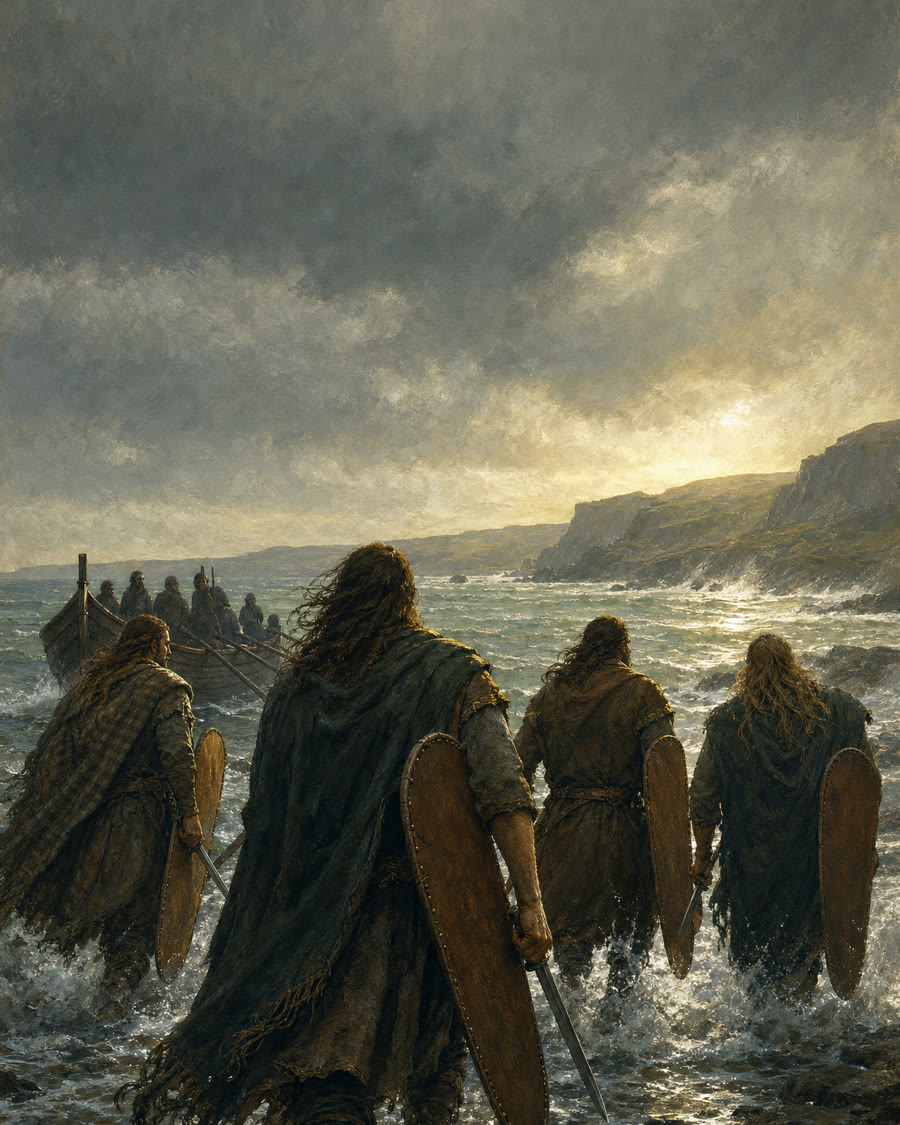
Illustration: the invasion that was taught for generations.
It is a neat story, and it shaped how Ireland saw itself in the 19th and 20th centuries. The problem is the evidence.
The sons of Míl: Ireland’s own invasion legend
Long before modern historians, medieval Irish writers had their own invasion story. In Lebor Gabála Érenn, the Book of Invasions, compiled late in the 11th century, Ireland is settled by wave after wave of peoples. The last are the sons of Míl, the Gaels, who sail from Spain and take the island from the Tuatha Dé Danann.
The Spanish origin is even older: the 9th-century Historia Brittonum already has Ireland settled from Iberia. Scholars treat it as myth. One likely reason it caught on: Hibernia, the Latin name for Ireland, sounds a lot like Iberia, and Míl Espáine looks like a Gaelic version of the Latin miles Hispaniae, “soldier of Spain”.
What archaeologists found (and didn’t)
If thousands of Celtic warriors had conquered Ireland, you would expect a sudden change in the ground: new kinds of houses, burials, weapons and pottery, all at once. Archaeologists have looked hard for that and have not found it.
The classic “Celtic” La Tène art style does turn up in Ireland, on objects such as the carved Turoe Stone in Co. Galway, from about 300 BC. But it is rare, and it is found mostly in the northern two-thirds of the island. Mallory, reviewed in the Irish Times, was unconvinced by any military invasion, though he left room for small groups or an incoming elite.
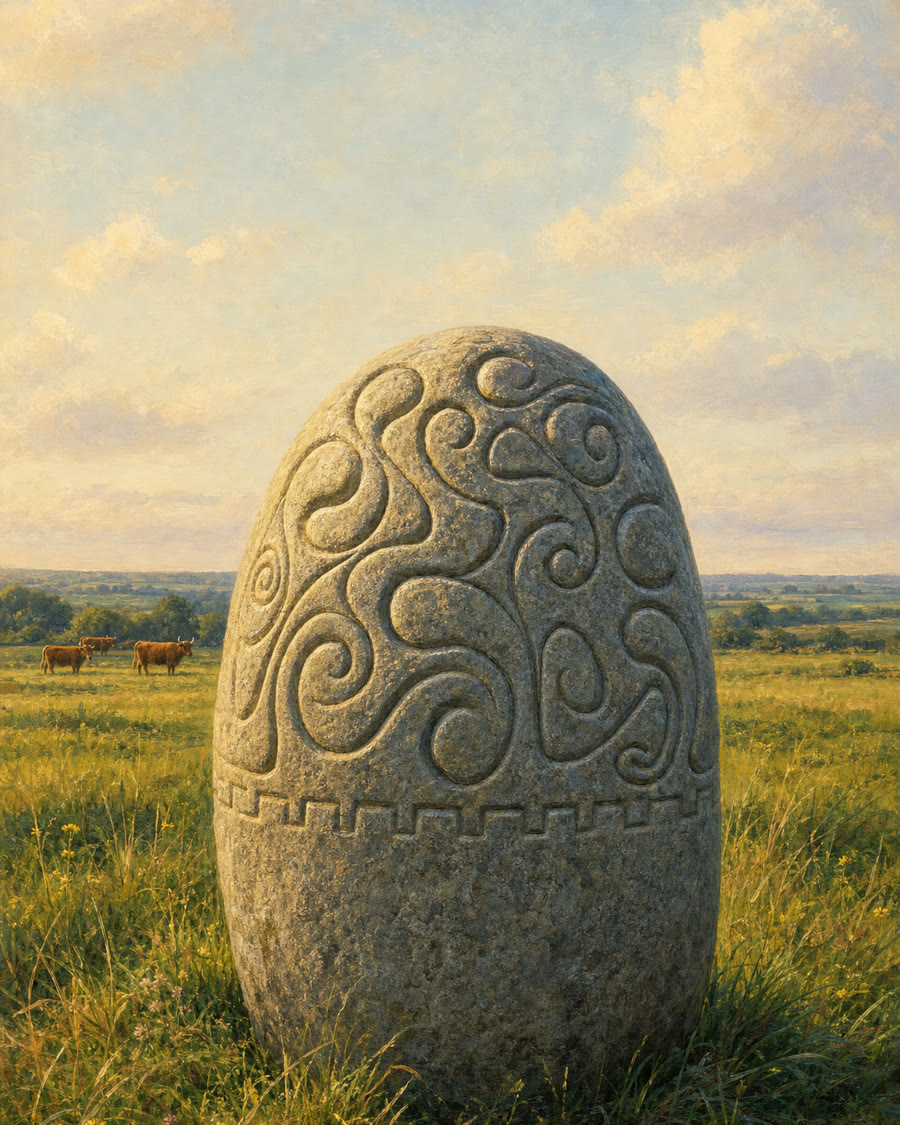
Illustration: a granite stone carved in the La Tène style, like the Turoe Stone in Co. Galway.
Most archaeologists now think the art and ideas came mostly through contact and trade with Britain and the Continent, maybe with some people moving too, rather than through conquest.
What ancient DNA says
Ancient DNA has changed the debate. In 2016, a Trinity College Dublin team (Lara Cassidy and colleagues) published genomes from an early Irish farmer and from three Bronze Age men buried on Rathlin Island, Co. Antrim, around 2000 BC.
Illustration: ancient DNA is read from bone in clean-room labs.
The Rathlin men carried a large share of ancestry from newcomers who reached Britain and Ireland at the start of the Bronze Age, with roots in the steppes north of the Black Sea. And the best-sequenced of them was genetically closest to people living in Ireland, Scotland and Wales today. In other words, a big change in Ireland’s population happened around 2500 to 2000 BC, more than 1,500 years before the supposed Iron Age invasion, with a lot of continuity since.
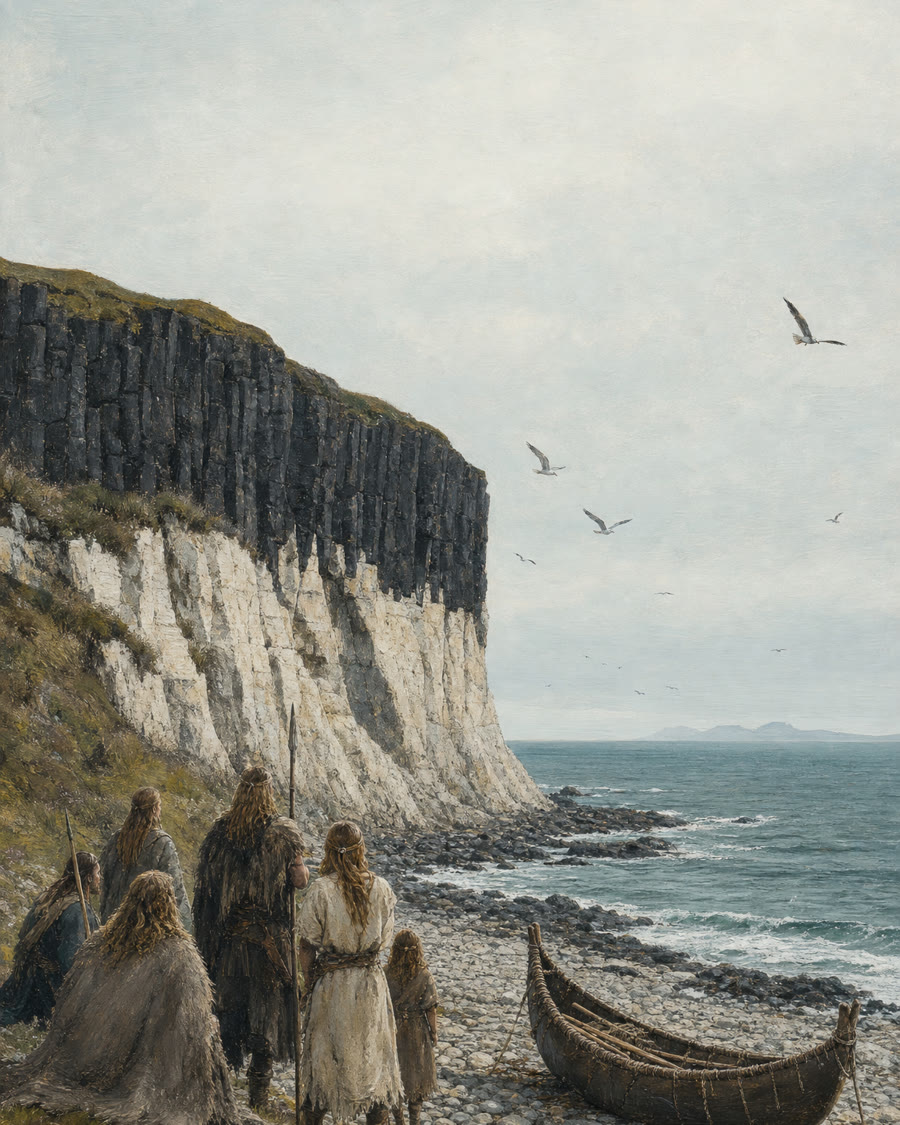
Illustration: Rathlin Island, where three Bronze Age men were buried around 2000 BC.
One big gap: hardly any Iron Age genomes from Ireland have been published yet, so the DNA story for the centuries around 500 BC is still thin. “So far” is the honest way to put it.
So when did Celtic speech reach Ireland?
Irish is a Celtic language, a cousin of Scottish Gaelic, Manx, Welsh, Cornish and Breton. That much is certain. When its ancestor arrived is not, and there are three main camps.
- With the Bronze Age newcomers, around 2500 BC. The Cassidy team suggested the Bronze Age turnover “invites the possibility” that an early Celtic language came with it.
- Celtic from the West. John Koch and Barry Cunliffe argue Celtic grew up along the Atlantic coasts, Ireland included, in the Bronze Age or even earlier.
- Later, from the Continent. Mallory’s best guess is around 1000 BC, and the linguist Patrick Sims-Williams argues for a later spread from central Europe.
Nobody has a written Irish sentence from those centuries, so this one may stay open for a long time.
Did the ancient Irish call themselves Celts?
As far as anyone knows, no. Greek and Roman writers used “Keltoi” and “Celtae” for peoples on the Continent, and most of them did not use it for the people of Britain or Ireland. Early Irish writers never linked themselves to those classical Celts either.
The label took off much later. In 1703 the Breton scholar Paul-Yves Pezron, and in 1707 the Welsh scholar Edward Lhuyd, grouped Irish, Welsh, Breton and their relatives together as “Celtic” languages. From there, “Celtic” spread to art, music and identity. It is a useful word for a family of languages, which is the safest way to use it.
If you love the knots and spirals, our guide to Celtic symbols covers how old each one really is.
The Iron Age man who wore hair gel
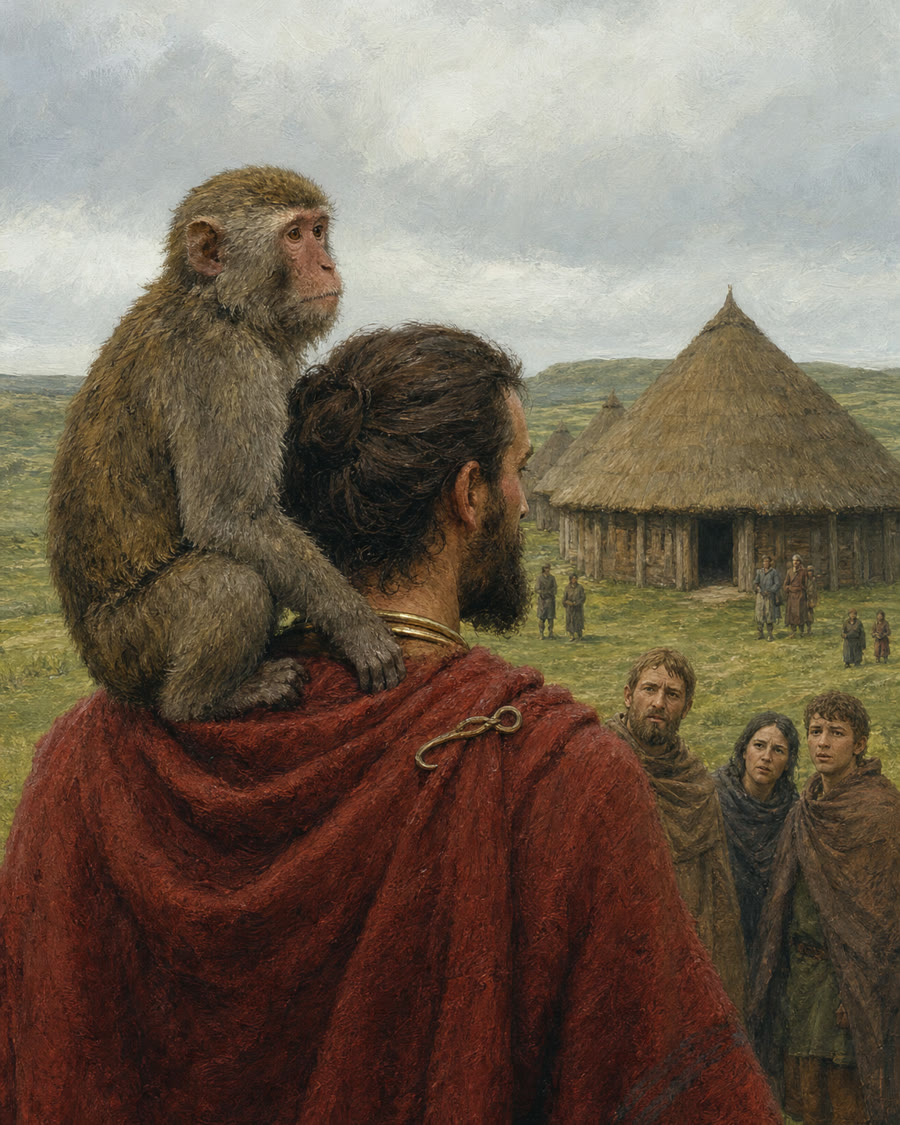
Illustration: Emain Macha, where the skull of a Barbary macaque was found.
In 2003, a body turned up in a bog near Ballivor, Co. Meath. Clonycavan Man was radiocarbon-dated to 392 to 201 BC, and his hair was still standing up in a sort of quiff. It was held in place with a gel made of plant oil and pine resin, and that resin, Archaeology magazine reported, probably came from south-west France or northern Spain.
So an Irishman in the Iron Age was wearing imported hair product. That is the real story of the period in one detail: Ireland was connected to Europe by trade, and ideas and fashions travelled along those routes.
He was also killed, with blows to the head, and placed in a bog. The National Museum of Ireland’s Ned Kelly suggested that bog bodies like him were failed kings, or would-be kings, sacrificed and buried on tribal boundaries. It is a theory, not a proven fact: critics point out that it leans on medieval kingship texts written about a thousand years later. You can see Clonycavan Man in the museum’s Kingship and Sacrifice gallery in Dublin.
A monkey at Emain Macha
Emain Macha, now Navan Fort near Armagh, was a great royal site of Iron Age Ulster. In the old Ulster tales, it is where the boy Cú Chulainn joined the king’s boy-troop.
Excavators there found the skull of a Barbary macaque, a monkey native to North Africa, from the 4th to 1st century BC. It had come at least as far as southern Iberia, probably as a prestige gift for someone very important.
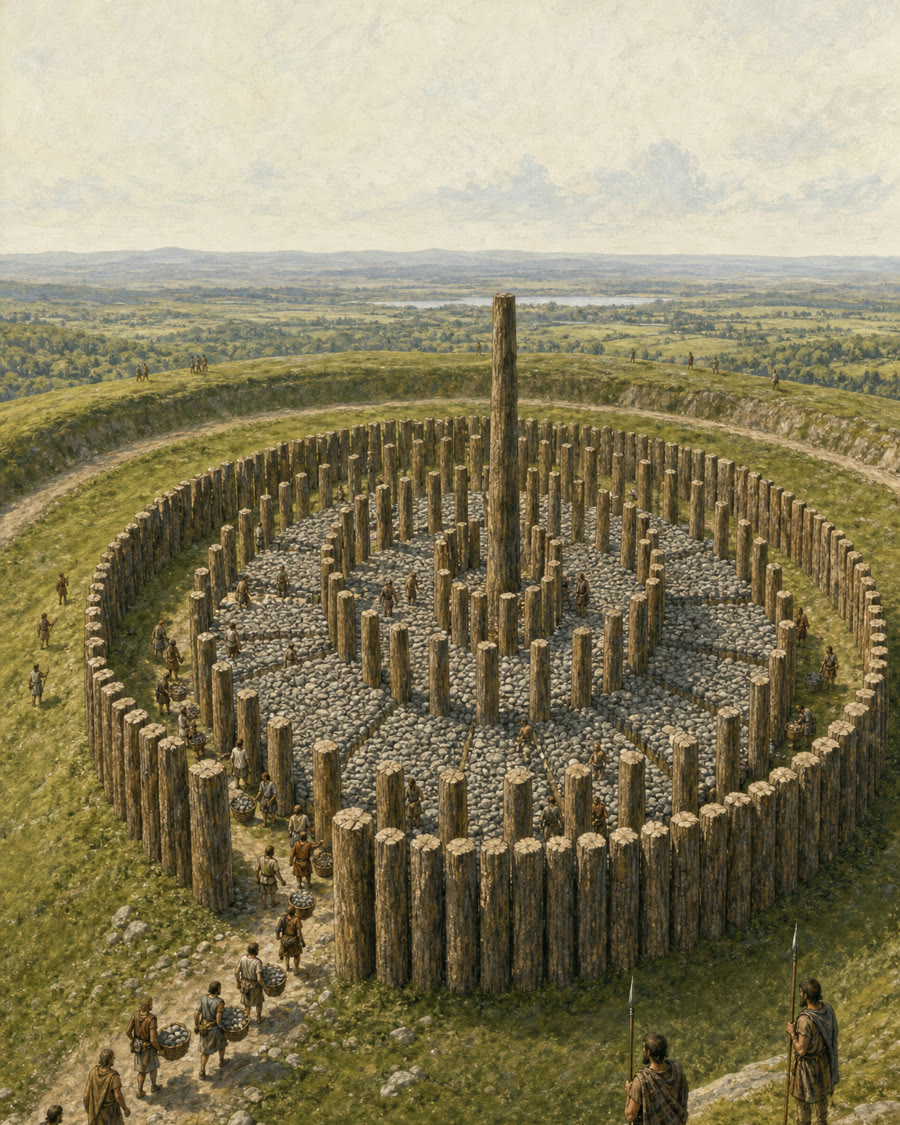
Illustration: the 40 m timber building at Emain Macha, built around 95 BC.
Even stranger: around 95 BC, the date of its great central oak post, the people of Emain Macha built a huge round timber building, about 40 metres across. Then they filled it with stones, burned it down and buried it under a mound. Nobody knows exactly why, but it looks like a ritual act on a grand scale.
Rome never came
The Romans conquered most of Britain, but never Ireland. The historian Tacitus, writing in AD 98, says he often heard his father-in-law, the general Agricola, claim that “a single legion and a few auxiliaries would be sufficient entirely to conquer Ireland” (Agricola 24). He never tried.
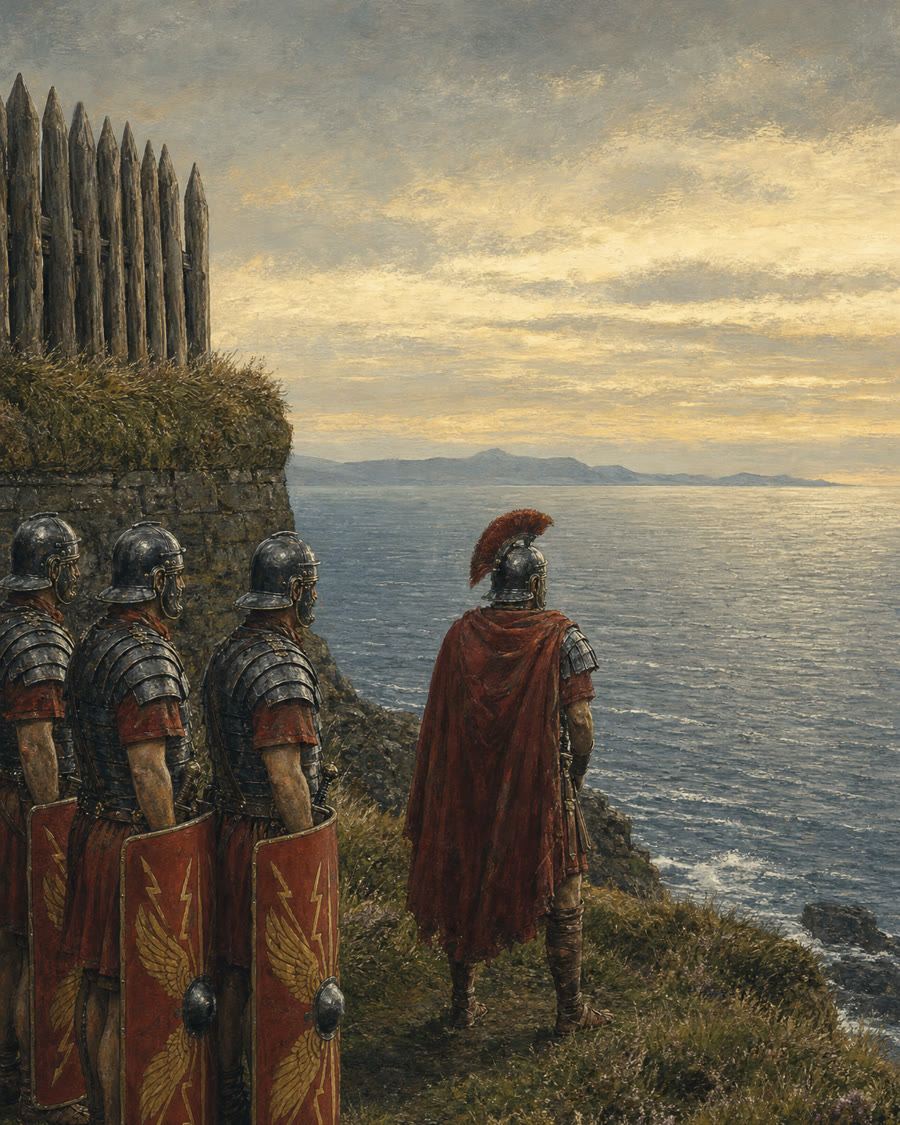
Illustration: Agricola looking across the sea towards Ireland.
Roman objects do turn up in Ireland, and finds at Drumanagh in north Co. Dublin have been read as a Roman fort, a trading post or an Irish trading centre. Experts still disagree, but there is no sign of a Roman conquest.
Irish raiders and a boy called Patrick
Instead, it went the other way. By the late 300s AD, Irish raiders, known to the Romans as Scoti, were attacking Roman Britain, and the raids went on into the 400s.
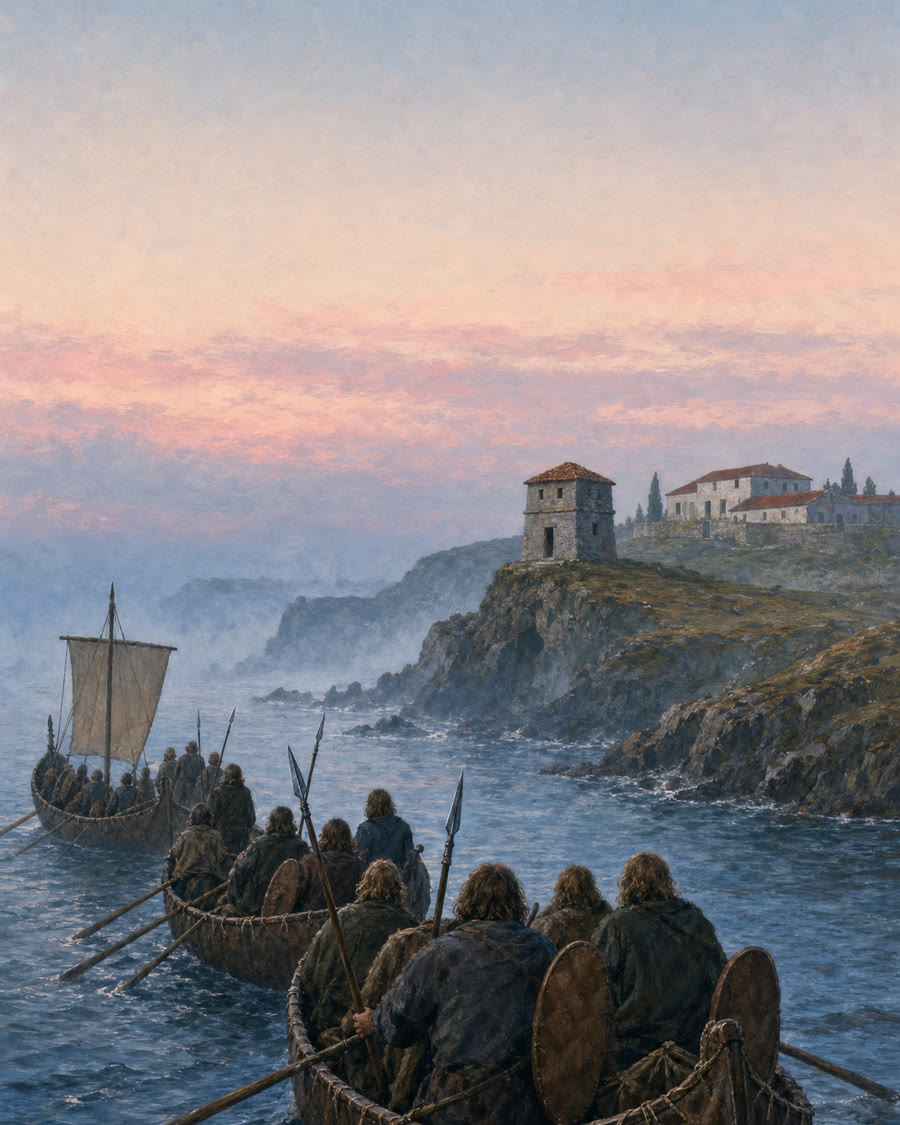
Illustration: Irish raiders rowing towards a Roman villa on the coast of Britain.
On one of those raids, they carried off a teenage boy of about sixteen from a family in Roman Britain. You know his name: he became Saint Patrick. His own story, in his own words, is in our guide to the real St Patrick.
Celts in Ireland FAQ
Were the ancient Irish Celts?
They spoke a Celtic language, so in that sense, yes. But there is no evidence they called themselves Celts, and the idea of a single Celtic people who invaded Ireland does not fit the archaeology or the DNA.
Did the Celts invade Ireland?
Archaeologists have found no clear evidence of an Iron Age Celtic invasion. Celtic-style art arrived from about 300 BC, but it is rare and probably came mostly through trade and contact, perhaps with some small groups of people.
When did the Celts come to Ireland?
If you mean the Celtic language, nobody knows for sure. Suggestions range from around 2500 BC, with Bronze Age newcomers, to around 1000 BC or later.
Is Irish a Celtic language?
Yes. Irish belongs to the Goidelic (Gaelic) branch of the Celtic languages, with Scottish Gaelic and Manx. Welsh, Cornish and Breton form the other living branch.
Are Irish people genetically Celtic?
There is no “Celtic gene”. Ancient DNA shows that much of today’s Irish ancestry was already in place by around 2000 BC, after a big Bronze Age influx of newcomers, long before the supposed Celtic invasion.
Who were the first people in Ireland?
Hunter-gatherers lived here by about 10,000 years ago, and farmers arrived around 6,000 years ago. Those farmers built Newgrange.
More ancient Ireland reading
- Newgrange: the Irish tomb older than the pyramids
- The Hill of Tara
- The Tuatha Dé Danann
- Irish mythology: where to start
- Celtic symbols and their real ages
- The real St Patrick
- Vikings in Ireland
Sources: National Museum of Ireland; Archaeology magazine (2010) and National Geographic (2006) on Clonycavan Man; Cassidy et al., PNAS 2016; Patterson et al., Nature 2022; J.P. Mallory, The Origins of the Irish (2013); Navan Fort excavation reports; Tacitus, Agricola 24.
A little bit of Ireland in your inbox every Friday ☘️
The free Weekly Dose of Irish: an Irish joke, a Celtic symbol, an Irish fact, a poem and the week’s best articles in one short email. Join 9,600+ readers.
Free. One short email every Friday. Unsubscribe any time.