Irish whiskey is whiskey distilled on the island of Ireland and aged there in wooden casks for three years or more. The name comes from uisce beatha, Irish for water of life, and the annals record a fatal drinking bout in 1405. Dublin’s great distilleries grew rich in the 1800s, but by the late 1970s only two distilleries were left on the island. Recent counts put the number at around 50. The four styles are single pot still, single malt, single grain and blended.
At Christmas in 1405, a Leitrim nobleman, Richard Mag Raghnaill (the name later became Reynolds), drank too much aqua vitae and died of it. The annalists couldn’t resist the joke. In Conell Mageoghagan’s 1627 English version of the Annals of Clonmacnoise, the water of life was “to him aqua mortis”: water of death.
It’s where the story of Irish whiskey usually starts. What follows is six centuries of taxes, smugglers, Dublin fortunes and a near-total collapse.
I’ve covered what to do with a bottle, from Irish coffee to homemade Irish cream, and the song Whiskey in the Jar. Here’s the drink itself: Irish whiskey history from the annals to today, the four styles, the differences from Scotch and bourbon, and how to enjoy it.
Jump to:
- What is Irish whiskey?
- Early history
- The 1608 Bushmills licence
- The 1779 still law
- The Coffey still
- Dublin’s distilling giants
- The collapse
- The comeback
- The 4 styles
- Vs Scotch and bourbon
- How to drink it
- FAQ
- More reading
What is Irish whiskey?
The legal answer is in the Irish Whiskey Technical File, dated October 2014. Irish whiskey must be distilled and aged on the island of Ireland, Northern Ireland included. It needs three years or more in wooden casks of up to 700 litres, and it’s sold at 40% alcohol or stronger. Nothing can be added except water and plain caramel.
Uisce beatha (roughly ISH-kuh BAH-huh) is Irish for water of life, a match for the Latin aqua vitae. English speakers wrote it as usquebaugh, and that wore down over time to whiskey. Ó Dónaill’s dictionary also gives fuisce (roughly FWISH-kuh) for the drink.
Watch the spelling: uisge beatha is the modern Scottish Gaelic form. Standard Irish is uisce beatha.
Whiskey or whisky? Ireland favours the e, but the legal name allows both. The Technical File credits 19th-century Dublin distillers with adding the e, yet their own 1878 book was called Truths About Whisky, so the spelling clearly took time to settle.
Early Irish whiskey history: did monks really make it in the 6th century?
The Technical File says Irish distilling “probably began” with monks in the 6th century. It’s a lovely story, but I can’t find early evidence for it, so treat it as tradition.
The Oxford Companion to Spirits and Cocktails gives the settled view that distilling alcohol reached Europe in the 12th century, though it cautions the evidence isn’t conclusive. Ireland’s oldest evidence is medical. The Red Book of Ossory, a Kilkenny manuscript mostly written in the 1300s, holds a long treatise on aqua vitae. When the Church of Ireland’s RCB Library put it online in 2017, the notice called this the earliest distilling recipe in any Irish manuscript, for “what we would call cognac”. So Ireland’s first aqua vitae may not have been a grain spirit at all.
By the 1500s it worried the government. An Irish Act of 1556 called it “nothing profitable to be daily drunken and used”, complained of the grain it ate up, and demanded a licence from the Lord Deputy, with exemptions for peers and the gentry. The Oxford Companion treats this as the earliest firm date for grain distilling in Ireland.
The English traveller Fynes Moryson wrote in his 1617 Itinerary that Irish usquebagh “is held the best in the World of that kind”. He praised the raisins and fennel seed mixed in: this was a sweetened, spiced drink, quite unlike today’s whiskey.
The 1608 Bushmills licence: what it was and wasn’t
Bushmills prints 1608 on its label. Here’s the document behind that date.
On 20 April 1608, Sir Thomas Phillips, a soldier and Plantation landholder, got a seven-year licence to make aqua vitae in Coleraine county and the Route, in north Antrim.
What it was: a regional permit. Samuel Morewood, an excise collector writing in the 1830s, lists matching grants for Connacht, Leinster and Munster from those same years. George Hill’s 1877 history of the Plantation quotes the reasoning: the 1556 law had failed, so the trade should sit in fewer hands.
What it wasn’t: a licence for a distillery at Bushmills. It names a county and a district, not a building or a village. Hill also says Phillips soon had to surrender the patent, as the London companies moved in on Coleraine.
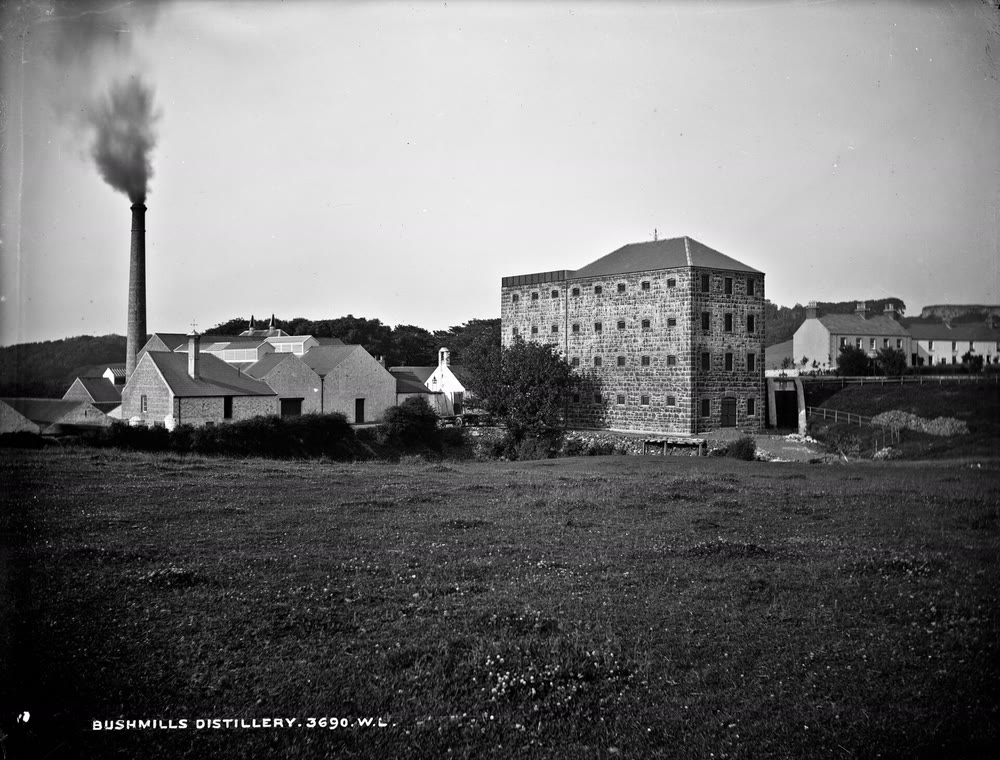
Bushmills Distillery, Co. Antrim, photographed by Robert French between 1865 and 1914. Lawrence Collection, National Library of Ireland. Public domain, via Wikimedia Commons
The usual first reference to Old Bushmills by name comes much later: an excise survey of 1784, which registers it to Hugh Anderson. The title of the world’s oldest licensed distillery is disputed too. Bushmills has claimed it, while historian Andy Bielenberg has argued for Kilbeggan in Co. Westmeath, licensed in 1757.
The 1779 law that drove distilling underground
Ireland’s first duty on spirits came in 1661, at fourpence a gallon. For over a century, what got collected leaned heavily on the local officer, and by 1780 corruption and inefficiency were eating into it.
In 1779, a bill drawn up by revenue commissioner John Beresford went before the Irish parliament. From September 1780, each licensed still paid a set duty based on what it could theoretically produce in 28 days. If you made less, you still owed the balance.
That suited big operators and crushed small ones. Beresford’s own figures show licensed stills falling from 1,212 in 1781 to 246 in 1790. By 1823, Ireland had just 40 distilleries. Patrick Given’s Maynooth study shows a scattered craft turning into a business for people with capital.
In the countryside, plenty of people simply carried on without a licence. That spirit is poitín (roughly puh-CHEEN, or PUTCH-een in Connacht and Ulster; poteen and potcheen are the English spellings), named for the small pot stills. As late as 1884, Ireland logged 829 detections of illegal distilling against Scotland’s 22. Poitín’s own technical file says it was illegal from 1661 until March 1997, when it came onto the Irish market legally.
Aeneas Coffey and the patent still
The Excise Act of 1823 halved the duty and made legal distilling worthwhile again. Ireland’s distilleries nearly doubled to 79 by 1830.
Then came the still that would do more for Scotch than for Irish whiskey. Aeneas Coffey had risen through the excise service to become inspector-general in Ireland. He left, bought the Dodder Bank Distillery, and in 1830 patented a continuous still, improving on a design by Robert Stein in Scotland.
A pot still works in batches: fill it, boil it, empty it, start again. Coffey’s two linked columns ran without stopping, burned less fuel and turned out a lighter, cheaper spirit.
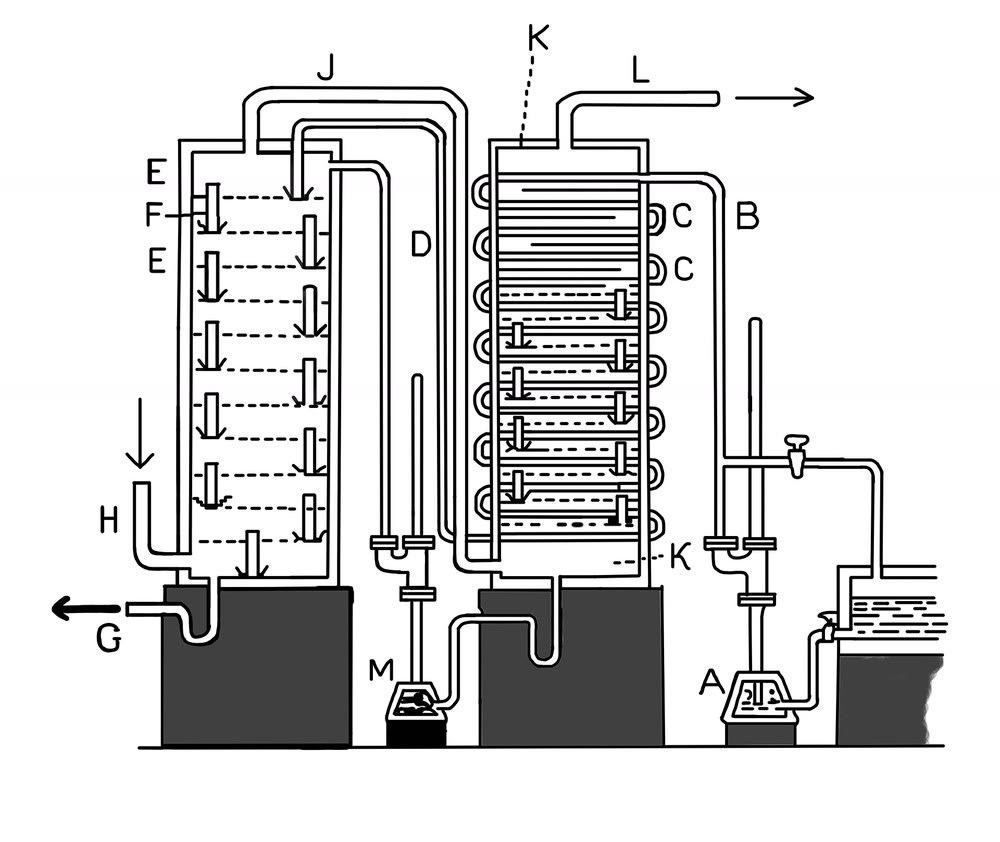
Diagram of a Coffey still, from Sydney Young’s Fractional Distillation (1903). Public domain, via Wikimedia Commons
You’ll often read that Irish distillers snubbed Coffey and handed the future to Scotland. That’s only half the story. In 1840, Ireland had 13 patent stills to Scotland’s two, according to Michael Connolly’s 2025 study.
But Dublin’s biggest houses stayed loyal to the pot still, and the Scots pulled ahead by mid-century. Ireland’s patent stills clustered in the north: by 1900, Belfast was shipping about four times as much whiskey as Dublin, much of it grain spirit probably bound for Scotch blends.
Dublin’s distilling giants
In the 1880s the writer Alfred Barnard toured the distilleries of the United Kingdom, visiting 28 or 29 in Ireland, depending on the count. Dublin had the so-called big four: John Jameson at Bow Street, John Power at John’s Lane, George Roe at Thomas Street and William Jameson at Marrowbone Lane. Between them they employed about 1,000 people on more than 40 acres and made close to 5 million gallons a year.
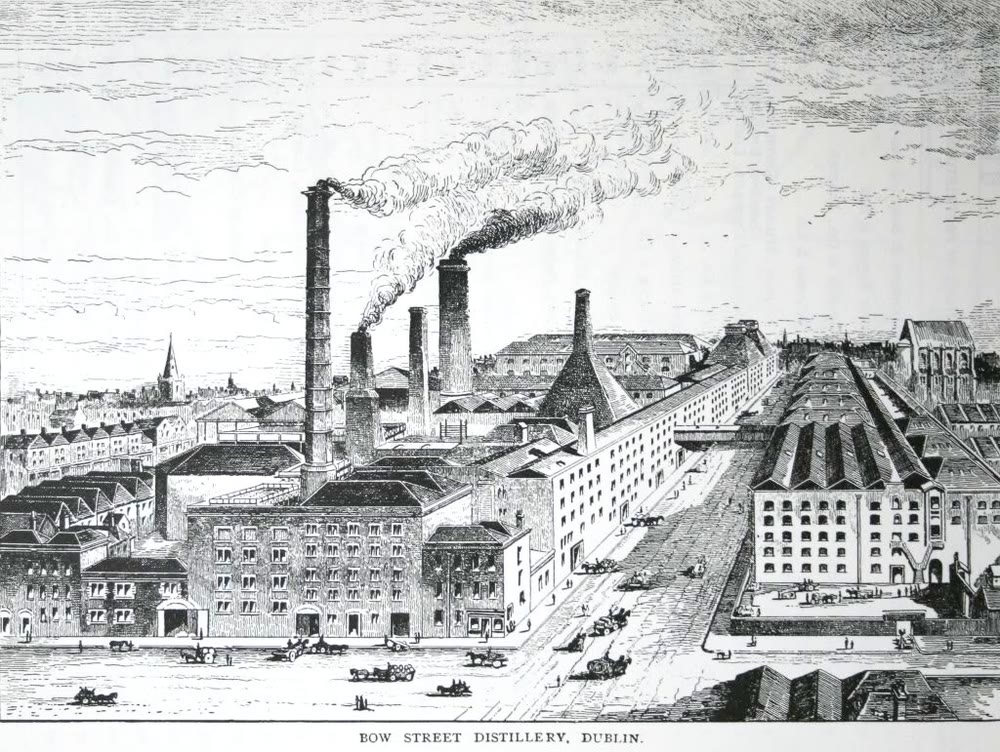
Bow Street Distillery, Dublin, from Alfred Barnard’s The Whisky Distilleries of the United Kingdom (1887). Public domain, via Wikimedia Commons
Their pride was pot still whiskey, made mostly from malted and unmalted barley and sold at a premium. To them, Coffey-still spirit was “silent spirit” or “sham whiskey”, and in 1878 they published Truths About Whisky to say so.
They lost the argument. A Royal Commission reported in 1909 without requiring a pot still, so patent-still spirit counted as whisky. Lighter, cheaper Scotch blends were already winning over English drinkers. In Barnard’s day, Scotland was making about 18 million gallons a year to Ireland’s 11 million.
Be wary when you read that Irish whiskey once held 80% of world sales. The figure is widely repeated, usually without a source, and hard to square with output like this.
How Irish whiskey collapsed
The usual story blames American Prohibition and the trade war with Britain. Both hurt, but there were more causes, and much of the damage came fast.
- Tax: duty jumped from under 15 shillings a proof gallon in 1909 to more than 72 shillings by 1920.
- Prohibition: from 1920 to 1933 the US market was shut. The Technical File calls it the biggest export market for pot still whiskey, and says bootleggers selling poor liquor as Irish damaged the name.
- Takeover: in 1922, United Distilleries, the Ulster patent-still group, sold to Scotland’s Distillers Company amid falling sales and unrest. Its Irish plants were shut by the end of the decade.
- Trade war: the dispute with Britain ran from 1932 to 1938. The Technical File says it shut Irish distillers out of a quarter of world markets.
The key number, from Connolly: Irish output was more than 11 million gallons in 1920 and less than 1 million by 1926, before the trade war began. And when Prohibition ended, the Scots had aged stock ready to sell, while Irish distillers had run theirs down.
By the early 1950s only a handful of distilleries were left, and by 1966 just four distilling firms.
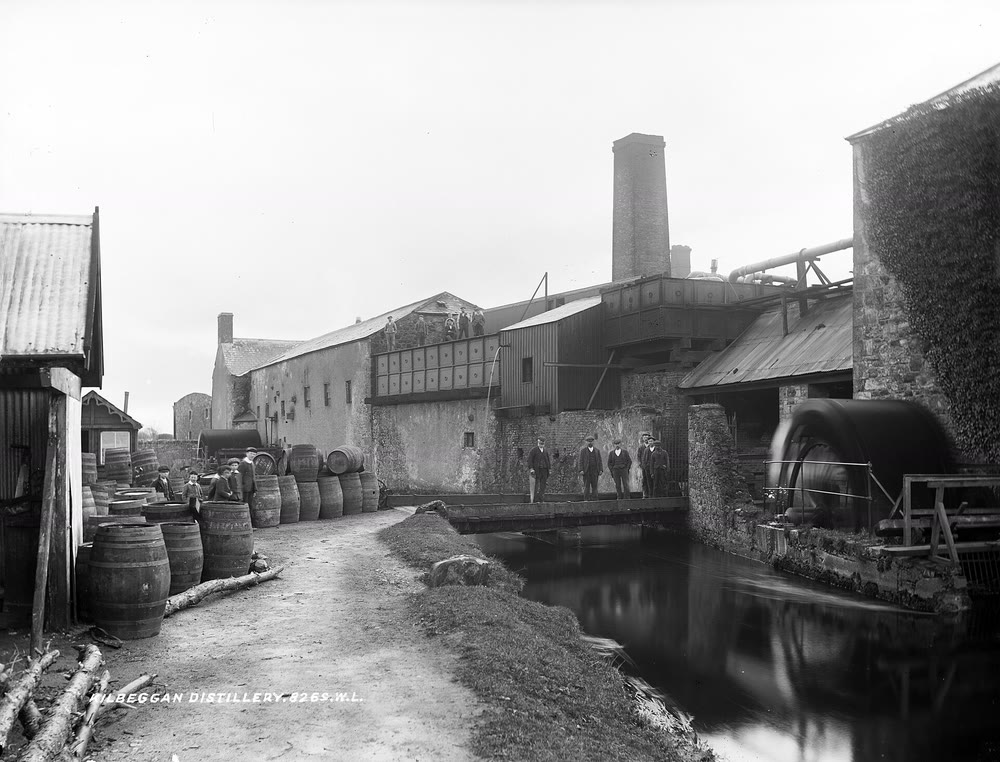
Kilbeggan Distillery, Co. Westmeath, around 1900, photographed by Robert French. Distilling stopped here in 1954 and restarted in 2007. Lawrence Collection, National Library of Ireland. Public domain, via Wikimedia Commons
The 1966 merger and the comeback
To survive, John Jameson, the Cork Distilleries Company and John Power merged in 1966. The new firm became Irish Distillers. Bushmills joined it in the early 1970s.
Bow Street stopped in 1971, a new distillery opened at Midleton, Co. Cork, in 1975, and John’s Lane followed in 1976. By the end of the decade, that left two working distilleries on the whole island, Midleton and Bushmills, with one owner. The Technical File puts the low point at about 400,000 cases a year in the 1970s.
In 1987, John Teeling and Willie McCarter set up Cooley in an old State-owned alcohol factory in Co. Louth, the first challenge to Irish Distillers. They’d hatched the plan in a bar in Cambridge, Massachusetts, back in 1971. Cooley also bought Kilbeggan and restarted distilling there in 2007.
Then, in 1988, France’s Pernod Ricard bought Irish Distillers and put serious money behind its brands, Jameson above all.
The boom followed. The island went from 4 distilleries in 2010 to 42 in 2022 and around 50 in recent years. Lately it’s been harder. Bord Bia says exports fell 5% to €930 million in 2025, a year the Irish Whiskey Association says brought production pauses and some closures. In September 2026, President Trump said he’d lift the 10% US tariff on Irish whiskey, but gave no date, and I found no confirmation by early November.
The 4 styles of Irish whiskey
The Technical File sets out three varieties, plus blends of them.
Single pot still
This is Ireland’s signature. The mash must be at least 30% malted barley and at least 30% unmalted barley, with other cereals such as oats or rye capped at 5%, and it’s distilled in pot stills. The unmalted barley brings spice and a creamy feel in the mouth. Redbreast, Green Spot and Powers John’s Lane are well-known examples.
Single malt
This is 100% malted barley, distilled in pot stills. The barley can be peated or not, and the whiskey can be double or triple distilled. Bushmills and Dingle both make one.
Single grain
This one comes from column stills, using no more than 30% malted barley alongside other whole grains, typically maize, wheat or barley. It’s usually the lightest in flavour. Teeling and Kilbeggan both bottle a single grain.
Blended
A blend mixes two or more of the styles above, often a light grain whiskey with pot still or malt for character. Blends make up over 90% of sales, Teagasc and TU Dublin researchers wrote in 2023. Standard Jameson is a blend of pot still and grain whiskey.
“Single” doesn’t mean one grain or one cask. It means all the whiskey in the bottle was distilled at one distillery.
These rules may change. A public consultation on the Technical File ran from June to September 2026. The Irish Whiskey Association wants other cereals in pot still raised from 5% to 30%. Irish grain isn’t required, which frustrates many tillage farmers. I found no published outcome by early November.
Irish whiskey vs Scotch and bourbon
Here’s what the law says, from the Technical File, the Scotch Whisky Regulations 2009 and the US federal standards.
| Irish whiskey | Scotch whisky | Bourbon | |
|---|---|---|---|
| Where | Island of Ireland | Scotland | United States |
| Grain | Malted cereals, with or without other whole grains | Malted barley, plus other whole cereals if used | At least 51% corn |
| Casks | Wooden, up to 700 litres, new or used | Oak, up to 700 litres | New charred oak |
| Minimum age | 3 years | 3 years | None set (2 years for straight bourbon) |
| Added colour | Plain caramel allowed | Plain caramel allowed | Not allowed |
On paper, Irish and Scotch are close. The real difference is recipe and habit, above all the unmalted barley in pot still whiskey.
Is Irish whiskey always triple distilled? It’s the tradition, but the Technical File allows double distillation, and some Scotch is triple distilled. Is Irish whiskey never smoky? Most of it is made with unpeated malt, but peated Irish whiskey exists, and plenty of Scotch isn’t peaty at all.
Bourbon is a different animal, led by corn and aged in new barrels, and it can be made anywhere in the United States, not only Kentucky. Once used, those barrels go on the market, and Irish distillers are glad of them.
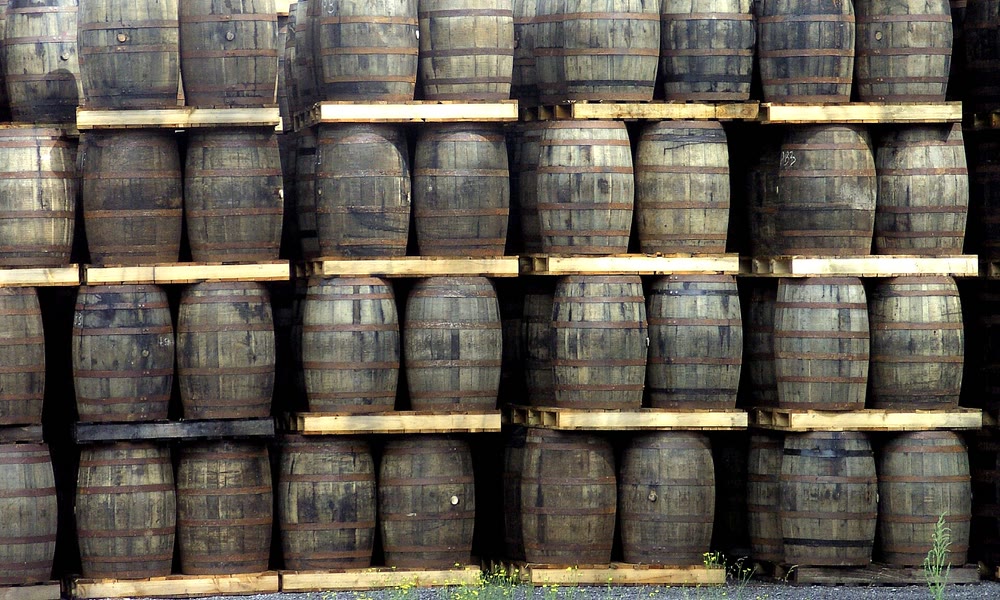
Whiskey casks at Kilbeggan Distillery, Co. Westmeath. Photo: High Contrast, CC BY 3.0 DE, via Wikimedia Commons
How to drink Irish whiskey
There’s no single right way, whatever anyone at the bar tells you. Good whiskey is for sipping slowly, so start small.
- Neat: pour a small measure, let it sit for a minute and take your time. Standard bottles are about 40% alcohol, and cask-strength ones can be 50% or more.
- With water or ice: both are fine, says Irish Times drinks writer John Wilson, and a little water can bring out aroma. A 2017 computer simulation from Sweden suggests why: a flavour compound, guaiacol, sits nearer the surface at lower strengths.
- Hot: on a cold night, try an Irish hot toddy or an Irish coffee.
- In the kitchen: a modest blend is all you need to feed an Irish Christmas cake.
Buying a bottle as a gift? Read the label. Look for the style first, then any age statement, which by law refers to the youngest whiskey in the bottle. There are more ideas in my Irish Christmas gifts guide, and you won’t need anything like the bottle that sold for millions.
Whatever’s in the glass, raise it and say sláinte (SLAWN-cha), which means health.
Irish whiskey FAQ
What makes Irish whiskey different from Scotch?
Location, first of all: the island of Ireland or Scotland. Beyond that, Irish whiskey is usually unpeated and traditionally triple distilled, and its pot still style uses unmalted barley. None of those habits is universal.
What are the 4 types of Irish whiskey?
Single pot still, single malt, single grain and blended.
What does uisce beatha mean?
Water of life. It’s the Irish phrase behind the English word whiskey.
What is single pot still whiskey?
An Irish style made at one distillery from a mash of malted and unmalted barley, distilled in pot stills. It tends to taste spicy and feel creamy.
Is Bushmills the oldest distillery in the world?
That’s disputed. Its 1608 date comes from a licence for a whole district, and the usual first reference to Old Bushmills by name dates from 1784. Kilbeggan, licensed in 1757, is the rival claimant.
Love this? Save it to your Pinterest board for later.
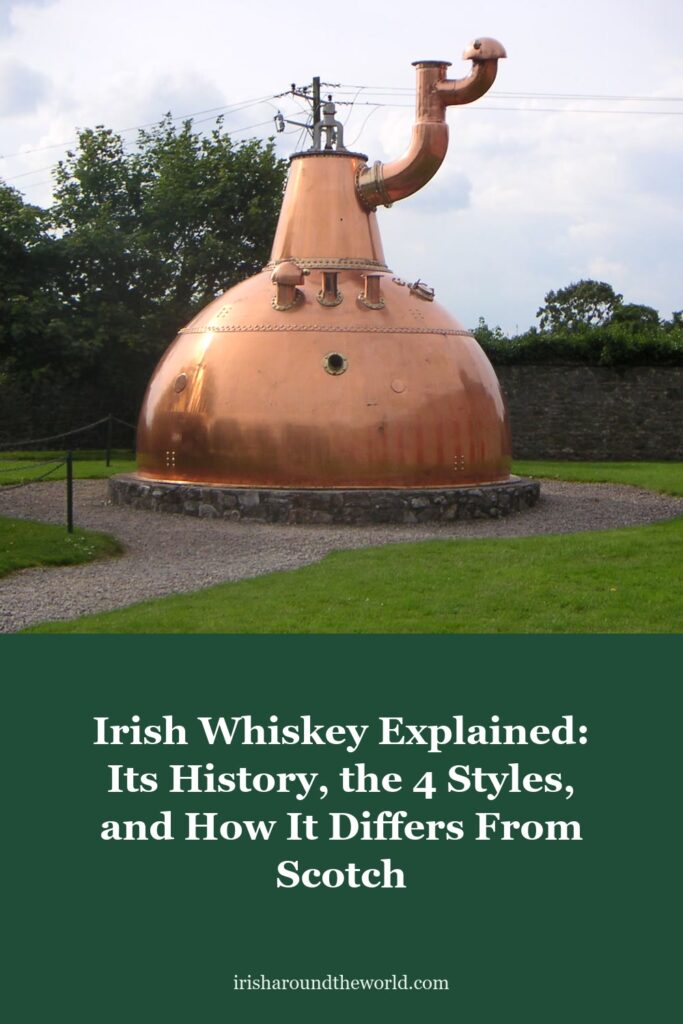
Pin image: A historic copper pot still on display at the old Midleton distillery, Co. Cork. Photo: Stephan Schulz, CC BY-SA 3.0, via Wikimedia Commons
A little bit of Ireland in your inbox every Friday ☘️
The free Weekly Dose of Irish: an Irish joke, a Celtic symbol, an Irish fact, a poem and the week’s best articles in one short email. Join 9,600+ readers.
Free. One short email every Friday. Unsubscribe any time.
More Irish heritage reading
- Irish Coffee Recipe: How to Make It Properly (and Stop the Cream Sinking)
- Irish Hot Toddy Recipe: The Old Cold Cure Every Irish Granny Swears By
- Homemade Irish Cream: The 5-Minute Christmas Gift (and the Story of How Baileys Was Invented)
- An Old Irish Pub Song Won Metallica a Grammy. This Is the Story of Whiskey in the Jar.
- How to Say Cheers in Irish: Sláinte, Meaning and Pronunciation
Featured image: A historic copper pot still on display at the old Midleton distillery, Co. Cork. Photo: Stephan Schulz, CC BY-SA 3.0, via Wikimedia Commons.