
Homemade Irish cream is a sweet liqueur you make in a blender from Irish whiskey, cream, condensed milk, chocolate, coffee and vanilla. This recipe takes 5 minutes, plus chilling, and makes about 1 litre (1 quart) at roughly 16% alcohol, close to Baileys at 17%. Unlike a shop bottle it must stay in the fridge, and the cautious advice is to finish it within 2 weeks. Baileys is one brand of Irish Cream, a drink first mixed in London in 1973 and launched in Dublin in 1974.
That bottle on the Christmas sideboard feels as old as the crib. It isn’t. As one of its inventors tells it, Irish cream was born on a May morning in 1973, when two advertising men in Soho, London, stirred whiskey and cream together in their office kitchen, added sugar and drinking chocolate and poured the result into an old tonic bottle.
It took them about 45 minutes. Your version takes five, and a bottle with a handwritten label makes a lovely gift. The recipe comes first, then the variations, how long it really keeps, and who really invented Baileys. If you’d rather your whiskey hot, see my Irish coffee recipe and Irish hot toddy.
Jump to:
- Homemade Irish cream recipe
- Without condensed milk, with eggs, without alcohol and as a creamer
- How long does homemade Irish cream last?
- Gift bottles and labels
- How Baileys was invented
- Why Irish Cream is a protected name
- Irish cream vs Baileys
- Homemade Irish cream FAQ
- More Irish Christmas reading
Homemade Irish cream recipe
This is the standard blender formula found in many published recipes. It isn’t any brand’s secret recipe, so taste and adjust before you bottle it.
Prep: 5 minutes | Chill: a few hours, or overnight | Makes: about 1 litre (1 quart), or 20 small glasses
Ingredients
- 400ml (1⅔ US cups) Irish whiskey
- 1 can (397g, 14 oz) sweetened condensed milk
- 250ml (1 generous US cup) heavy cream (fresh whipping cream in Ireland, whipping or double cream in the UK)
- 2 tbsp chocolate syrup, or 2 tbsp drinking chocolate powder
- 1 tsp instant coffee or espresso powder
- 2 tbsp boiling water
- 1 tsp vanilla extract
- Optional: ¼ tsp almond extract (leave it out for nut allergies)
Method
- Stir the coffee, and the drinking chocolate if you’re using powder, into the boiling water until dissolved. Leave it to cool while you measure everything else.
- Put the condensed milk, cream, coffee mixture and vanilla in the blender, with the chocolate syrup and almond extract if you’re using them. Blend on low for about 20 seconds, until smooth.
- With the motor on low, pour in the whiskey in a slow stream. Stop as soon as it’s combined, after 10 to 15 seconds.
- Taste it. Add a little more whiskey, coffee or chocolate if you like, then blend for a few seconds more.
- Pour into clean bottles, seal and chill for a few hours or overnight, so the flavours settle.
- Keep it in the fridge and shake before pouring.
Tips
Go easy on the blender. Olive magazine warns that too much blending starts to whip the cream.
Use full-fat cream and cool the coffee. Milk proteins curdle when acid meets heat, says Harold McGee in On Food and Cooking, and heavy cream has so little casein that you won’t notice it.
Don’t waste your best whiskey. Any standard blended Irish whiskey will do. At 40%, simple arithmetic puts the batch at about 16% alcohol.
No blender? Shake everything in a big jar with a tight lid.
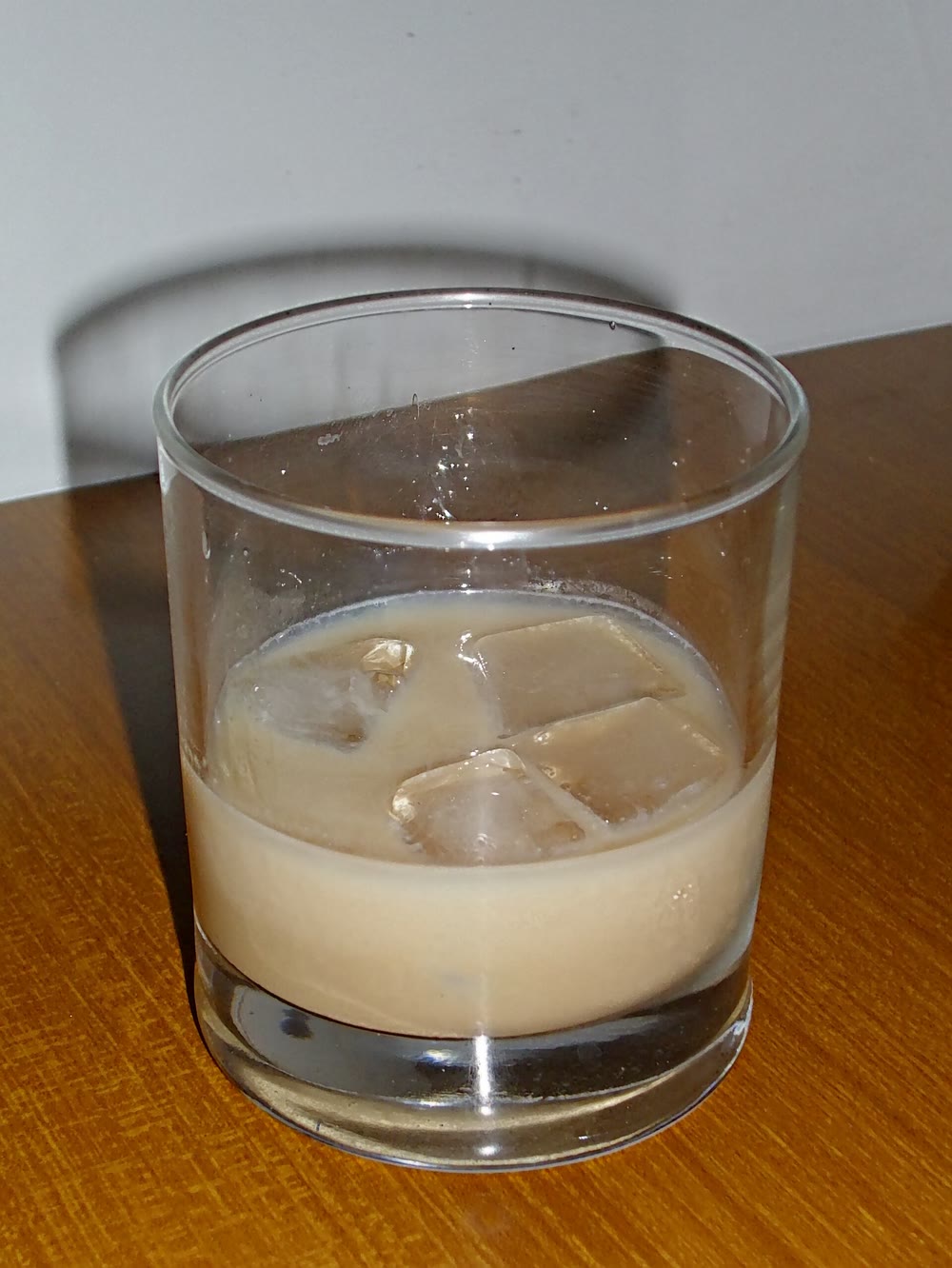
Without condensed milk, with eggs, without alcohol and as a creamer
The main recipe has no egg in it. These versions are starting points, so taste as you go.
Without condensed milk
Warm 200ml (a generous ¾ US cup) whole milk with 150g (¾ US cup, packed) light brown sugar, 1 tsp instant coffee and 2 tbsp drinking chocolate, stirring until dissolved. Don’t let it boil. Chill it completely, then blend with 300ml (1¼ US cups) cream, 1 tsp vanilla and 350ml (1½ US cups) whiskey. It’s thinner and less sweet, at roughly 15% alcohol.
With eggs, the safe way
Some recipes blend in raw eggs for richness. It’s a risk worth skipping. The US Food and Drug Administration (FDA) says even clean, uncracked eggs can carry Salmonella, and its advice on eggnog is plain: you can’t rely on the alcohol to kill the bacteria.
The FDA prefers a cooked base. Whisk 2 eggs into the cream, heat gently while stirring to 71°C (160°F), chill completely, then carry on with the recipe. Pasteurised eggs are safer than raw, though the FDA still recommends cooking the base. Put “contains egg” on the label and finish it within 3 to 4 days, the FDA’s limit for leftover cooked egg dishes.
Without alcohol
Swap the whiskey for 350ml (1½ US cups) cold whole milk and double the coffee. A few drops of almond extract or non-alcoholic whiskey flavouring help. Standard vanilla extract contains alcohol, so choose an alcohol-free one if that matters. It’s now simply a sweet dairy drink, so treat it like leftovers: the Food Safety Authority of Ireland (FSAI) says 2 to 3 days in the fridge.
As a coffee creamer
Shake one can of condensed milk, 400ml (1⅔ US cups) whole milk or half-and-half, 2 tbsp chocolate syrup, 1 tsp vanilla and ¼ tsp almond extract in a big jar. Add a tablespoon or two to each mug. The same 2 to 3 days applies.
Stir your Irish cream into coffee by all means, but don’t call it Irish coffee, which is whiskey, sugar and floated cream.
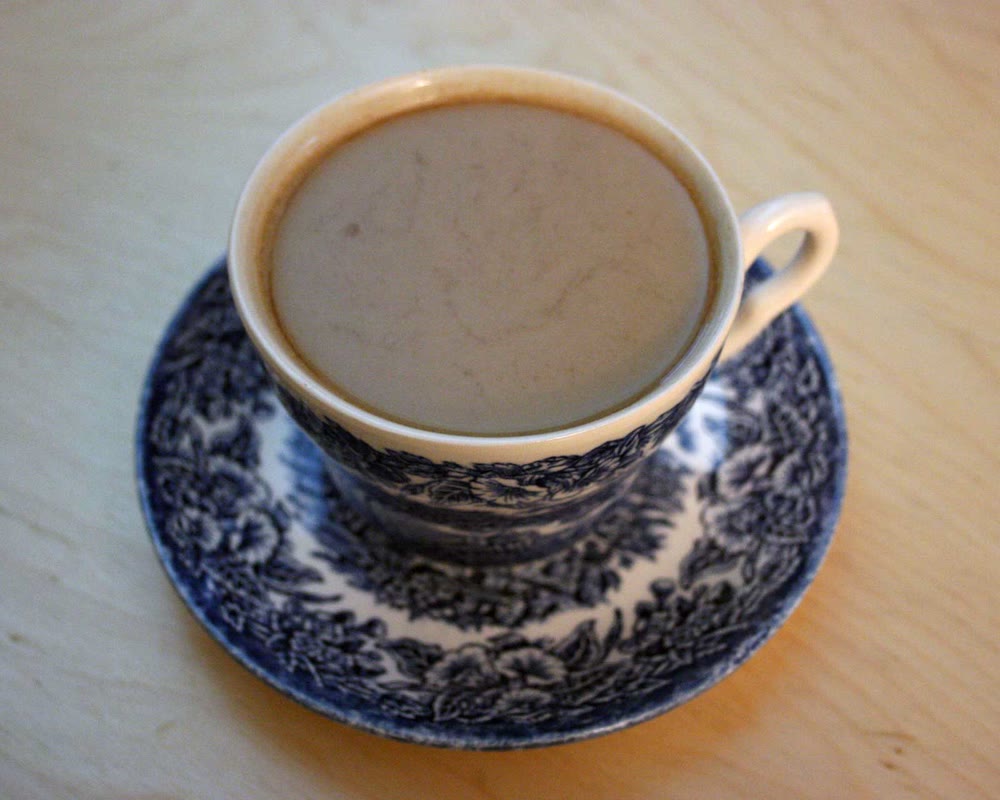
How long does homemade Irish cream last?
There’s no official answer. As far as I can find, no Irish, UK or US food safety body gives a shelf life for homemade Irish cream, and recipes disagree: Tasting Table says 2 weeks, The Modern Proper 6 weeks and Olive magazine 2 months.
Don’t go by the shop bottle. Baileys’ own FAQ gives Baileys Original 2 years after bottling, whether you’ve opened it or not, kept between 0 and 25°C (32 and 77°F), and says it doesn’t need a fridge. The official rules for Irish Cream show how that’s done: factories use proteins and emulsifiers to shield the cream from the alcohol, then homogenise it until the fat globules average under 5 microns. Your blender can’t do that.
So I’d go with the shortest of those recipe figures:
- Keep it cold: 0 to 5°C, says the FSAI, or 40°F or below, says the FDA.
- Finish it within 2 weeks, and start with the freshest cream you can buy. Alcohol and sugar slow spoilage, but nobody has tested your batch.
- Don’t leave it out: US food safety advice is to throw out perishable food after 2 hours at room temperature. Pour a glass, then put the bottle back.
- Shake before pouring. Some separation is normal.
- Throw it out if it smells sour, shows mould or has lumps that won’t shake out.
Gift bottles and labels
Buy your bottles now, but blend late: in the last week or so before you hand it over, so your friend gets most of the 2 weeks.
- Bottles: one batch fills about four 250ml (8.5 oz) swing-top bottles, with a little left for the cook. Wash them in hot soapy water, then sterilise the glass by starting it in hot water and boiling for 10 minutes, as the US National Center for Home Food Preservation advises for jars. Wash rubber seals separately.
- Headspace: leave a finger’s width at the top for shaking.
- Keep it cold: use a cool bag on long trips, and tell them it goes straight in the fridge, not under the tree.
- Don’t post it: US Postal Service rules make alcoholic drinks nonmailable, and it wouldn’t stay cold anyway.
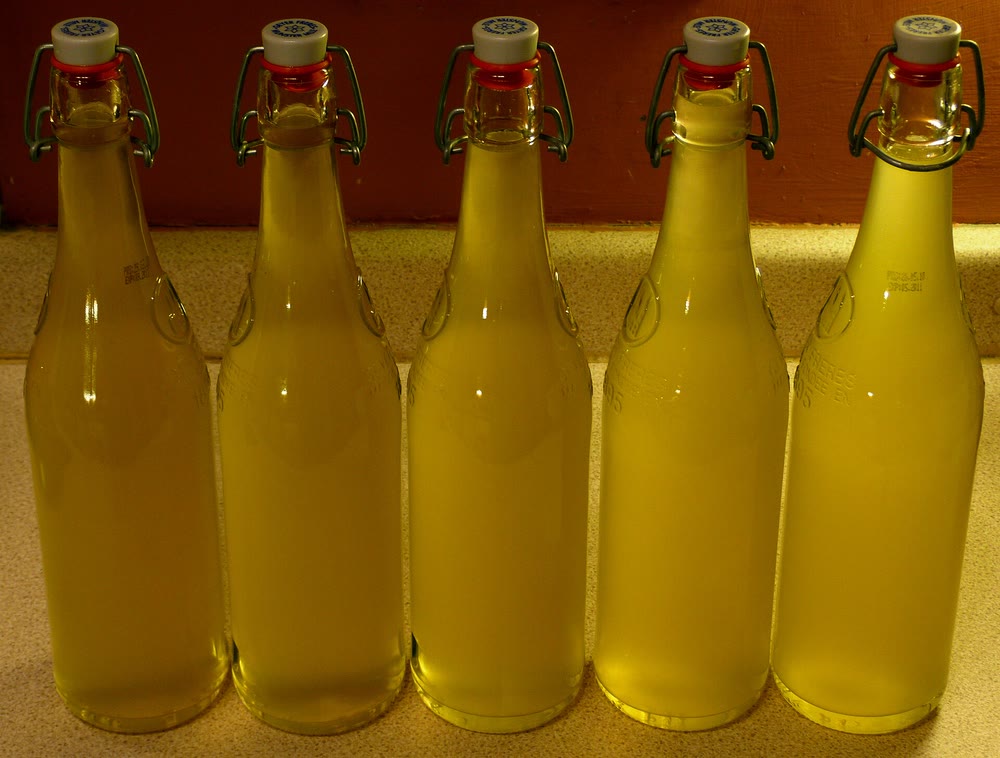
Swing-top bottles like these, shown with homemade elderflower cordial, make good gift bottles. Photo: Jim Champion, CC BY-SA 2.0, via Wikimedia Commons
What to write on the label
Whoever gets this needs the facts:
- Homemade Irish cream, and who made it
- Made on (date) and use by (2 weeks later, or 3 to 4 days with egg)
- Keep refrigerated, shake well
- Contains alcohol (about 16%) and milk, plus almond or egg if you used them
Then add a line of Irish. Nollaig Shona duit (NULL-ig HUN-a ditch) is Merry Christmas to one person, and Nollaig Shona daoibh (NULL-ig HUN-a DEEV) suits a couple or family. Sláinte (SLAWN-cha), meaning health, is the toast. Whiskey itself comes from uisce beatha (ISH-ka BAH-ha), “water of life” (uisge is the Scottish Gaelic spelling), and cream is uachtar (OO-ukh-tur).
Tuck the bottle into a basket next to some Irish Christmas cake, or browse my Irish Christmas gifts guide for something to go with it.
How Baileys was invented
The official rules for the drink call Irish Cream “a relatively recent addition to the pantheon of traditional Irish drinks”. Its story starts with a tax break, not a granny’s recipe.
In 1973, Gilbeys of Ireland, the Irish arm of International Distillers & Vintners (IDV), wanted a new drink to export. IDV’s new-products man, Tom Jago, turned to two consultants: David Gluckman, a South African adman who had worked on Kerrygold butter, and Hugh Seymour-Davies, a copywriter from Eton and Oxford. The lure was an Irish tax break on exports, though Gluckman remembered it as 10 years and Jago as 15.
In his account in The Irish Times, Gluckman dates the moment to May 1973. Seymour-Davies wondered aloud how Irish whiskey and cream might go together. They bought Jameson and single cream at a Soho supermarket and tried it. It tasted awful. Sugar helped. A second shopping trip turned up Cadbury’s drinking chocolate, and suddenly they had something.
There was never a Mr Bailey
While viewing offices on Greek Street, Gluckman spotted a restaurant called Baileys Bistro beside the Pillars of Hercules pub. He rang Jago, who took the name on the spot. The “R&A” came in July 1974, when Gilbeys’ chief executive, David Dand, wanted initials. Gluckman was reading about the Open and borrowed them from golf’s governing body. The first label even gave an address at a dairy distillery in County Monaghan. He made that up too.
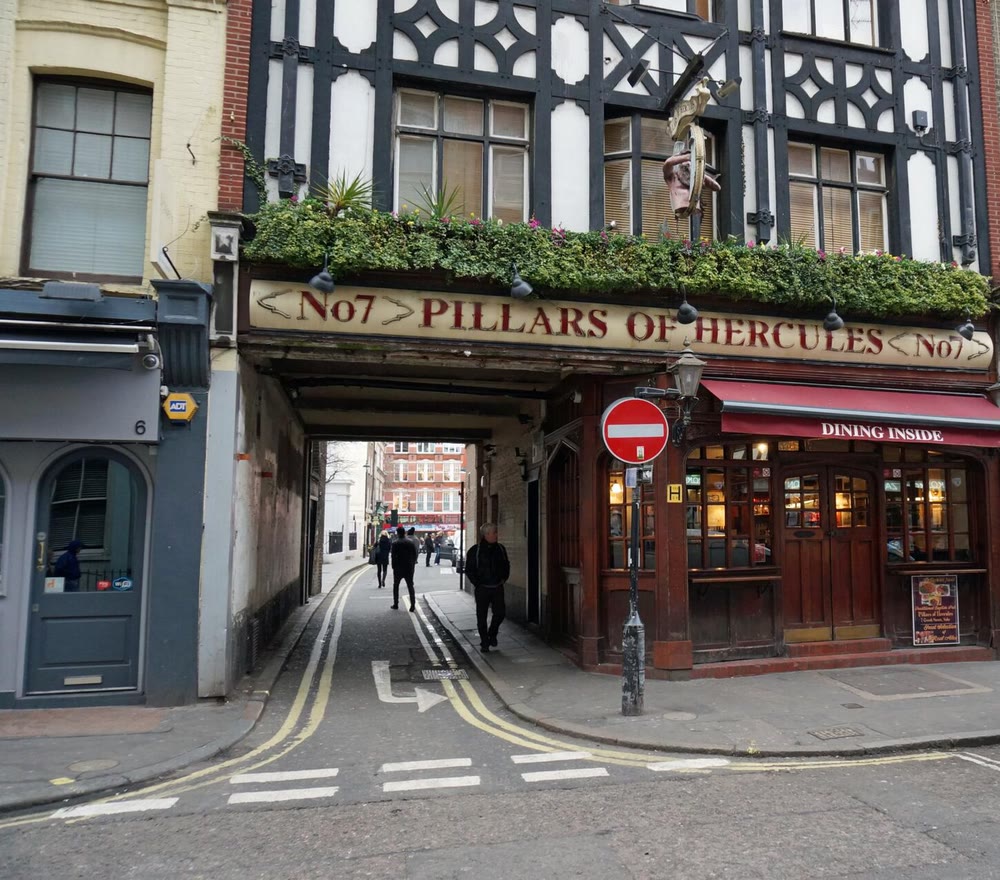
The Pillars of Hercules on Greek Street, Soho, in 2013. Baileys Bistro, which gave the drink its name, stood alongside it in the 1970s. Photo: David, CC BY 2.0, via Wikimedia Commons (cropped)
Tasters hated it
Men in a focus group called it a girl’s drink, though they emptied their glasses, and a woman compared it to Kaolin & Morphine, a stomach medicine. The team buried the results. A pub trial cheered them up: Gluckman remembered two policemen finishing a bottle, Jago three men from a patrol car.
Making it last was the real work. Mac Macpherson and his colleagues at the company’s laboratory in Harlow, Essex, built a stable formula, though Jago admitted early bottles could turn to butter in transit. A version meant to mix with lemonade failed so badly that a barman nicknamed the result Gorilla Snot.
The launch party was at Tailors’ Hall in Dublin. Tommy Murray, who says he ran operations at Gilbeys, gives the date as 26 November 1974 in a comment under a Drinks Business article. Gluckman says he was introduced there as “a man who helped out with the label design”. He and Seymour-Davies were paid about £3,000 in all.
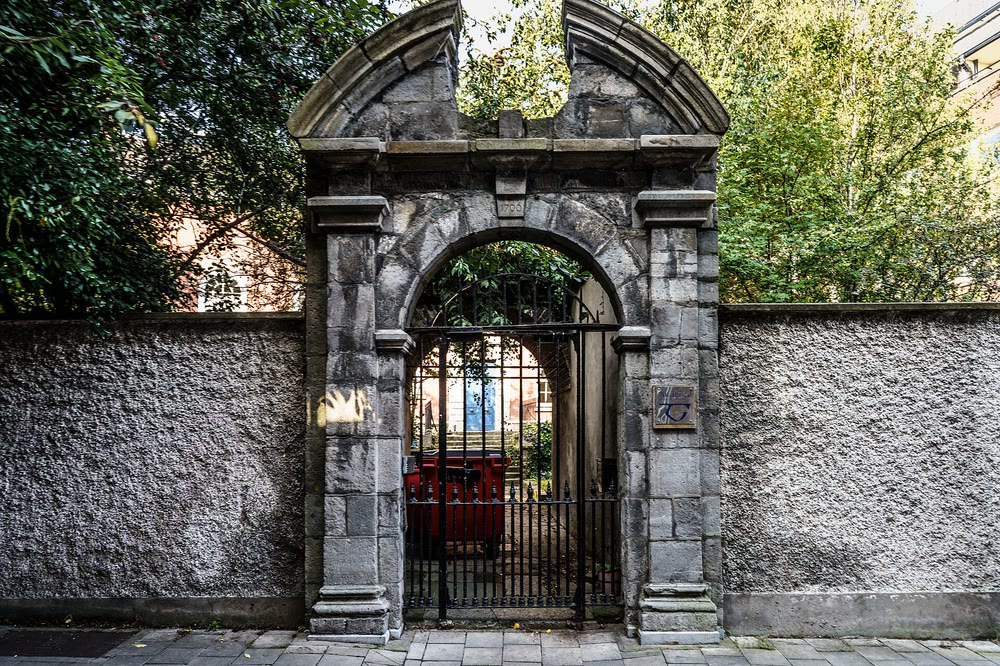
The gateway to Tailors’ Hall on Back Lane, Dublin, where Baileys had its launch party. Photo: William Murphy, CC BY-SA 2.0, via Wikimedia Commons
So who actually invented it?
That depends who you ask. Baileys’ own history page names no one. It speaks of founders marrying the treasures of their country after “two years of trial and error”, though the first mix was made in London. A trade obituary credited Jago with creating it, and his business partner James Espey says he deserves the real credit. Yet Jago’s own account, published after his death, says “David was the man who took the idea forward”.
You’ll also read online that the search began in 1971 and the chocolate was Nesquik. Gluckman and Jago both start in 1973, and Gluckman names Cadbury’s.
The fairest answer is a team. Seymour-Davies asked the question, Gluckman mixed and named it, Jago backed it, Macpherson made it stable and Gilbeys in Dublin took the risk. The idea took 45 minutes. The science took much longer.
Why Irish Cream is a protected name
Irish Cream is a protected geographical indication, the same status as Irish whiskey. The UK register dates its original EU registration to 12 June 1989, and it covers the whole island of Ireland, north and south. Under the official specification:
- It’s made on the island of Ireland, though bottling can happen elsewhere under official checks.
- It has at least 15% alcohol and 10% milk fat, from fresh Irish dairy cream.
- It has at least 100g of sugar per litre.
- It contains Irish whiskey, but the minimum is just 1% of the alcohol.
That last line surprises people, and it may be why homemade versions taste more of whiskey: all of yours is. The trade body Drinks Ireland says labels like “Irish style cream” aren’t allowed, and the name is also protected through EU agreements abroad, including one with China.
This recipe lands close on paper, with around 12% milk fat, but the rules cover drinks placed on the market, not a gift from your kitchen. Selling it is another matter.
Irish cream vs Baileys: what’s the difference?
Irish cream is the category, and Baileys is one brand of it, made by Diageo and the first on the market. Others include Carolans, first produced in 1978, plus Five Farms, Merrys, Molly’s, Feeney’s, Saint Brendan’s and The Irishman.
- Homemade: about 16% alcohol, all of it whiskey, tastes fresh, lives in the fridge for 2 weeks.
- Baileys: 17% alcohol, Irish whiskey plus neutral spirit, built to last two years.
Homemade Irish cream FAQ
Does homemade Irish cream need to be refrigerated?
Yes, always. It’s fresh cream with none of the factory processing that lets Baileys sit on a shelf.
Why did my Irish cream curdle?
Usually acid. Citrus, lemonade, tonic or very hot coffee can split it. Cool the coffee before blending, use full-fat cream and keep it away from sharp mixers.
Can I use bourbon or Scotch?
Yes, though it won’t taste the same and it won’t really be Irish cream.
What do you serve Irish cream with?
Pour it over ice, stir it into coffee or hot chocolate, or spoon it over ice cream or a slice of Christmas pudding.
Love this? Save it to your Pinterest board for later.
Pin image: Dairy cows on pasture in Ireland. Photo: Martin Abegglen, CC BY-SA 2.0, via Wikimedia Commons
A little bit of Ireland in your inbox every Friday ☘️
The free Weekly Dose of Irish: an Irish joke, a Celtic symbol, an Irish fact, a poem and the week’s best articles in one short email. Join 9,600+ readers.
Free. One short email every Friday. Unsubscribe any time.
More Irish Christmas reading
- Irish Coffee Recipe: How to Make It Properly (and Stop the Cream Sinking)
- Irish Hot Toddy Recipe: The Old Cold Cure Every Irish Granny Swears By
- Irish Christmas Pudding Recipe: The Guinness Pud With a Coin Inside (Make It on Stir-Up Sunday)
- Irish Christmas Cake Recipe: The Whiskey-Fed Fruit Cake You Make Weeks Ahead
- 12 Pubs of Christmas Rules: The Full List, Where It Came From and How to Survive It
- 18 Irish Christmas Traditions, From the Candle in the Window to the 12 Pubs
- Irish Christmas Gifts 2026: Authentic Ideas From Ireland for Her, Him and Mam
Featured image: Dairy cows on pasture in Ireland. Photo: Martin Abegglen, CC BY-SA 2.0, via Wikimedia Commons.