Irish (Gaeilge) and Scottish Gaelic (Gàidhlig) are two separate languages that grew out of the same medieval Gaelic, along with Manx on the Isle of Man. In Ireland it’s Irish in English, while in Scotland “Gaelic” on its own means Scottish Gaelic. Gaelic football keeps the word because there it describes the Gaels and their culture, not the language. The two share their grammar and many words, but spelling, sounds and everyday phrases differ, so speakers understand each other only in part. Ulster Irish shares a few features with Scottish Gaelic that the rest of Ireland lacks. Ireland’s 2022 census counted 1,873,997 people able to speak Irish, by their own account; Scotland’s counted 69,701 able to speak Gaelic.
Go raibh maith agat, says Ireland. Tapadh leat, says Scotland. Both mean thank you. Yet in southern Argyll and on Arran, the Gaelic scholar Richard Cox notes, the usual thanks was gun robh math agad, almost word for word the Irish.
That’s the story in miniature: close cousins, easy to mix up, not quite the same. It matters when you order a tattoo, a gift or a name “in Gaelic” online, because the seller may not know which language you mean. Here’s how the two compare, with an honest answer on whether speakers understand each other.
Jump to:
- Irish, Gaeilge or Gaelic: what’s the right name?
- Why Gaelic football keeps the word
- How Irish, Scottish Gaelic and Manx split
- Common phrases side by side
- Spelling: the quickest way to tell them apart
- Pronunciation: where they sound different
- Can speakers understand each other?
- How many people speak them? The census figures
- Which is easier to learn?
- Tattoos and gifts: check which Gaelic you’re getting
- Irish vs Scottish Gaelic FAQ
- More Irish language reading
Irish, Gaeilge or Gaelic: what’s the right name?
In English, the language of Ireland is Irish. In Irish it’s Gaeilge (roughly GWAYL-geh). In Munster you’ll also hear Gaelainn (roughly GAY-lin), one of several regional forms listed in Ó Dónaill’s Irish-English dictionary.
The Constitution of Ireland calls Irish “the national language” and the first official language, ahead of English. Since 1 January 2022 it has also been one of the European Union’s full official languages.
Outside Ireland you’ll often see “Irish Gaelic”, and it isn’t wrong. When Douglas Hyde and Eoin MacNeill founded their language society in 1893, its English name was the Gaelic League, though in Irish it was Conradh na Gaeilge (KUN-ruh nuh GWAYL-geh). In Ireland today, people simply say Irish.
In Scotland it works the other way round. “Gaelic” on its own means Scottish Gaelic, Gàidhlig (roughly GAH-lik). In the Highlands the English word has long been said GAL-ik: the Scottish National Dictionary says that older sound always held on there, while GAY-lik spread through the Lowlands after the 1700s.
Lowland Scots once called Gaelic Ersche or Erse, a shortened form of “Irish”, recorded from the 1400s in the Dictionary of the Older Scottish Tongue; “Gaelic” had largely replaced it by the early 1800s. Scots itself is a different language again: the Dictionary of the Scots Language traces it to Old English.
In Irish, Scottish Gaelic is Gaeilge na hAlban (GWAYL-geh nuh HAL-uh-bun), literally “the Irish of Scotland”, and Manx is Gaeilge Mhanann. Scottish Gaelic calls Irish Gaeilge, and Manx Gaelg.
Why Gaelic football keeps the word
If the Irish call their language Irish, why is it Gaelic football, Gaelic games and the Gaelic Athletic Association? Because in those names, Gaelic describes the Gaels, the people and their culture, not the language.
The GAA was founded on 1 November 1884, when Michael Cusack called a meeting in Hayes’s Commercial Hotel in Thurles, Co. Tipperary, as the GAA’s own history records. Its Irish name, Cumann Lúthchleas Gael (roughly KUM-un LOO-khlass GAYL), means the athletics association of the Gaels.
Ó Dónaill’s dictionary gives two meanings for Gael: an Irish person, and a Scottish Highlander. The adjective Gaelach covers Irish or Gaelic culture in general, so Gaelic games are na cluichí Gaelacha and Gaelic football is peil Ghaelach (roughly pell GHAY-lukh). In everyday Irish English the sport is simply “Gaelic”.
The GAA still lists the Irish language among its aims, alongside hurling, football, handball and rounders. There’s more on its oldest game in my guide to hurling.
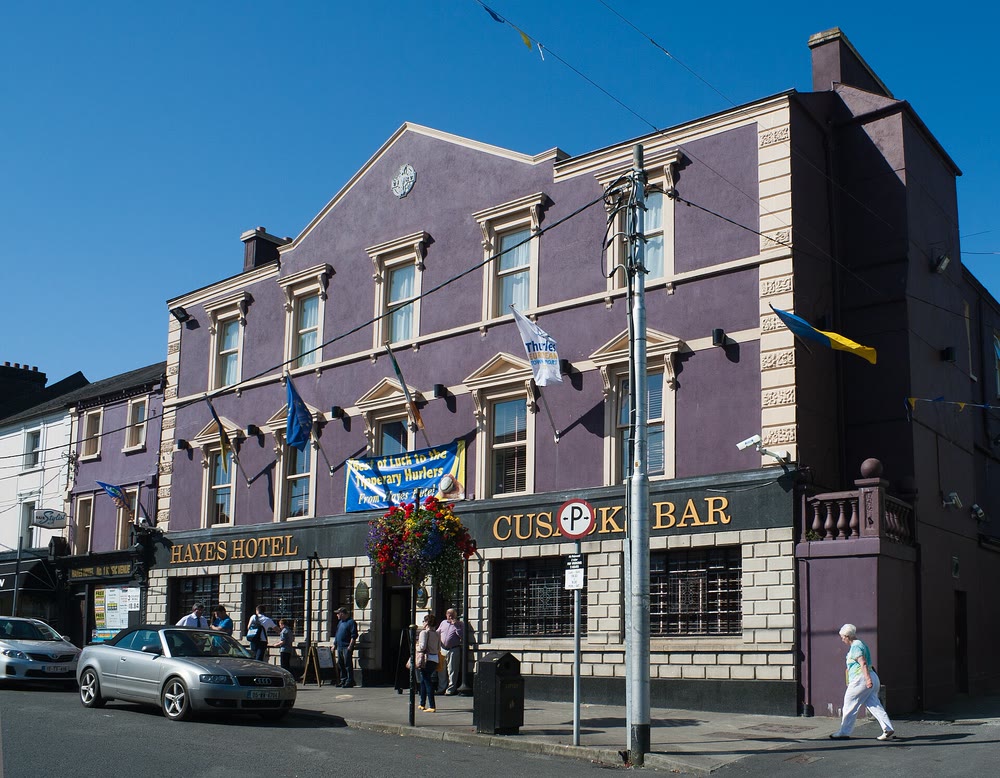
Hayes Hotel on Liberty Square in Thurles, Co. Tipperary, where the Gaelic Athletic Association was founded on 1 November 1884. The bar on the ground floor carries Michael Cusack’s name. Photo: Andreas F. Borchert, CC BY-SA 4.0, via Wikimedia Commons
How Irish, Scottish Gaelic and Manx split
Irish, Scottish Gaelic and Manx are the three Goidelic, or Gaelic, languages, one of the two surviving branches of the Celtic family. All three began in Ireland, in the language scholars call Old Irish (about 600 to 900) and Middle Irish (about 900 to 1200).
How Gaelic reached Scotland
Encyclopaedia Britannica dates Gaelic’s arrival in Scotland from Ireland to about AD 500. The traditional story credits Irish settlers who founded the kingdom of Dál Riata (roughly dawl REE-uh-duh) in Argyll early in the sixth century.
In 2001 the University of Glasgow archaeologist Ewan Campbell challenged that. He argued that the migration was an origin myth of the ruling families, with no support in the archaeology, and that the people of Argyll may already have been Gaelic speakers, closely tied to north-east Antrim across the sea. Either way, the early medieval Latin word for the Irish, Scoti, ended up naming Scotland, as I explain in what Ireland’s names mean.
When did they split?
Nobody can point to a year. In an influential 1951 lecture, the Celtic scholar Kenneth Jackson argued that Gaelic in Ireland, Scotland and Man showed no sign of splitting until the 10th century at the earliest, and more likely the 13th.
His “Common Gaelic” picture held for about 50 years. Since then, as Thomas Owen Clancy of the University of Glasgow explains in a 2009 British Academy lecture, Roibeard Ó Maolalaigh and Breandán Ó Buachalla have argued that some key Scottish features are older than the 12th century, and that Gaelic’s main dialect divide was between north and south, not between Ireland and Scotland.
One written language until the 1600s
Writing held the Gaelic world together long after speech drifted. Gaelic notes added to the Book of Deer, a gospel book named after the monastery of Deer in north-east Scotland, most of them after 1130, are catalogued by the CELT project at University College Cork as Middle Irish.
Ireland and Gaelic Scotland also shared one literary language, often called Classical Gaelic, which Britannica says was used in both countries until the 17th century. The first book ever printed in a Gaelic language, John Carswell’s Foirm na n-Urrnuidheadh (Edinburgh, 1567), still followed it. Manuscripts in a clearly Scottish form of Gaelic only start to appear in the 1500s.
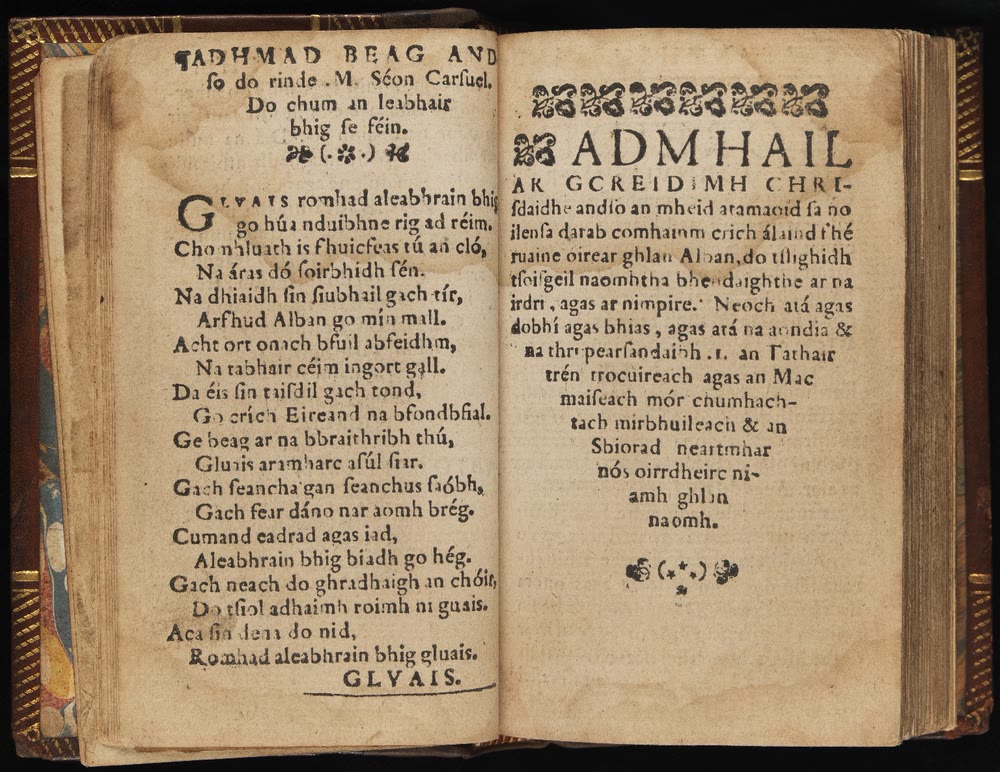
Two pages from John Carswell’s Foirm na n-Urrnuidheadh (Edinburgh, 1567), the first book printed in a Gaelic language. In the verses on the left, Carswell sends his little book across Scotland and then over the waves to Ireland. Photo: University of Edinburgh Heritage Collections, CC BY 3.0, via Wikimedia Commons
Manx: the Gaelic of the Isle of Man
Manx grew from the same root, and Britannica says it is closely related to Scottish Gaelic and to the most easterly Irish dialects. Its oldest record is the Book of Common Prayer, which a Welsh bishop translated in 1610 using English spelling habits, so Manx looks very different from Irish on the page.
Thank you in Manx is gura mie ayd (roughly gurr-uh-MY edd), “may there be good at you” in LearnManx’s translation: the same wish as the Irish, as my guide to thank you in Irish explains.
Ned Maddrell, remembered as the last native speaker, died in December 1974. In July 1947, Éamon de Valera met him at the folk museum in Cregneash: Maddrell spoke Manx and the Taoiseach answered in Irish, the National Folklore Collection at UCD recounts. The following spring, the Irish Folklore Commission sent Kevin Danaher to record eight of the last native speakers. Manx has since been revived.
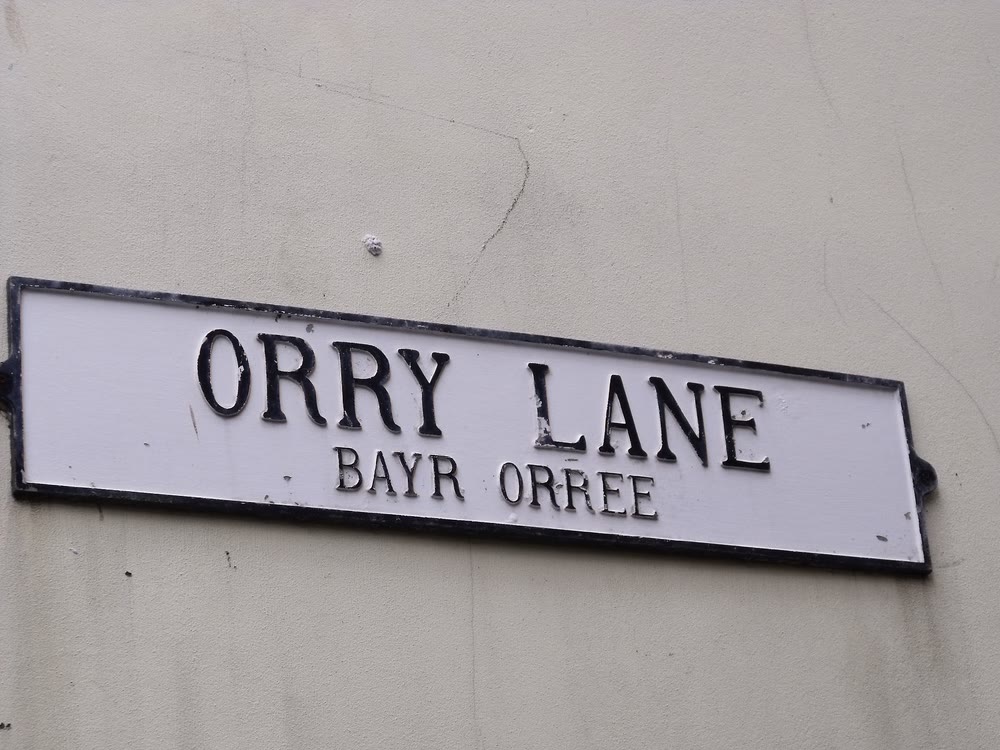
A bilingual street sign in Peel, Isle of Man: Orry Lane, Bayr Orree. Archibald Cregeen’s 1835 Manx dictionary defines bayr as a way, avenue or lane. Photo: Malost, CC BY-SA 3.0, via Wikimedia Commons
Common phrases side by side
The Irish below comes from focloir.ie and teanglann.ie, the Scottish Gaelic from the LearnGaelic dictionary. The respellings are rough, and both languages vary from place to place. For more everyday Irish, see my Irish greetings.
| English | Irish | Scottish Gaelic |
|---|---|---|
| Hello | Dia duit (DEE-uh gwitch), often written Dia dhuit | Halò (ha-LOH) |
| How are you? | Conas atá tú? (KUN-us uh-TAW too), or Cén chaoi a bhfuil tú? or Cad é mar atá tú?, depending on the dialect | Ciamar a tha thu? (KIM-ur uh HA oo) |
| Good morning | Maidin mhaith (MAD-jin WAH) | Madainn mhath (MAT-in VAH) |
| Good night | Oíche mhaith (EE-huh WAH) | Oidhche mhath (OY-khyuh VAH) |
| Thank you | Go raibh maith agat (guh rev MAH AG-ut) | Tapadh leat (TAH-hpuh let), or gun robh math agad |
| Welcome | Fáilte (FAWL-chuh) | Fàilte (FAAL-chuh) |
| Cheers | Sláinte (SLAWN-chuh) | Slàinte mhath (SLAAN-chuh VAH) |
| Goodbye | Slán leat (slawn lyat) | Beannachd leat (BYAN-ukhk let) |
| I love you | Tá grá agam duit (taw GRAW AG-um ditch) | Tha gaol agam ort (ha GOOL AH-kum orsht), or tha gràdh agam ort |
| Is not | Níl (neel) | Chan eil (kha NYEL) |
| Scotland / Ireland | Albain (AL-uh-bin) / Éire (AIR-uh) | Alba (AL-uh-buh) / Èirinn (AY-rin) |
| House / dog | Teach (chakh) / madra (MAD-ruh) | Taigh (tie) / cù (koo) |
| Whiskey | Uisce beatha (ISH-kuh BAH-huh) | Uisge-beatha (OOSH-kyuh BEH-huh) |
Many words are the same under the spelling: maith and math (good), mór and mòr (big), beag in both (small). Some everyday words part company: a Scottish cù is a dog, while an Irish cú is a hound and a dog is a madra. Some older scholars traced tapadh to Old Norse happ, good luck, but Cox, who studies Norse loanwords in Scottish Gaelic, thinks it more likely grew from a native Gaelic word, with the Norse link doubtful.
Even the little words move. Irish says love is at me for you (agam duit), Scottish Gaelic that it’s at me on you (agam ort). There’s more in my guides to I love you in Irish and how to say cheers in Irish.
Spelling: the quickest way to tell them apart
The fastest clue is the accent. Irish marks long vowels with the síneadh fada, an acute accent that leans right: á, é, í, ó, ú. Scottish Gaelic uses a grave accent that leans left: à, è, ì, ò, ù. Scotland’s Gaelic Orthographic Conventions, first published in 1981 and revised in 2009, say only the grave should be used.
Next, look for silent letters. Irish spelling was simplified in the 20th century, and its official standard, An Caighdeán Oifigiúil (un KYE-jawn IF-ig-yool), first appeared in 1958. Scottish Gaelic kept more of the older spellings. Ó Dónaill lists Gaedhilg and Gaedhilge as old forms of Gaeilge, and you can see the same dh in Gàidhlig.
The pattern repeats: night is oíche in Irish and oidhche in Scottish Gaelic, a heart is croí or cridhe, and the fairy cat is cat sí in modern Irish but cat-sìth in Scotland, as my Cat Sìth guide explains.
Irish also writes more of its consonant changes. Glasgow is Glaschú in Irish, so “in Glasgow” becomes i nGlaschú, with an n added to the front. Scottish Gaelic writes ann an Glaschu. Edinburgh is Dún Éideann (doon AY-jun) in Irish and Dùn Èideann in Scottish Gaelic, and both call Dublin Baile Átha Cliath (BAL-yuh AW-huh KLEE-uh), with a grave accent in Scotland. More in my guide to Irish place names.
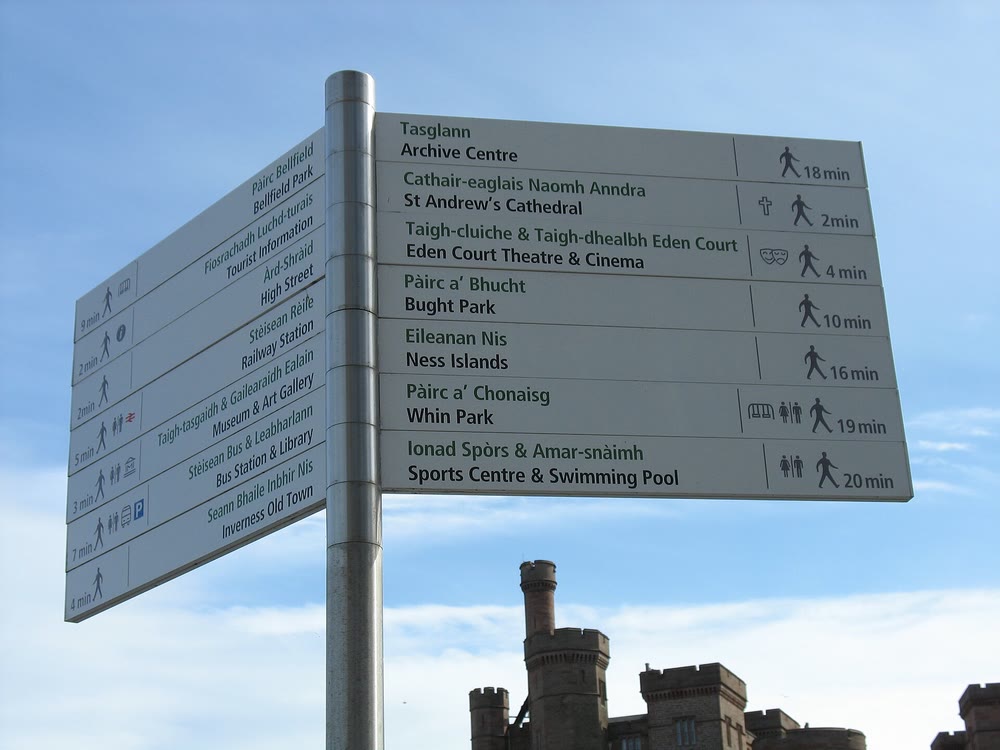
A bilingual signpost in Inverness, Inbhir Nis in Gaelic. Look for the grave accents: Pàirc (park) would be páirc in Irish. Photo: Akerbeltz, CC BY-SA 3.0, via Wikimedia Commons
Pronunciation: where they sound different
Spoken, the gap is wider than on the page. The best-known difference is preaspiration. In most Scottish Gaelic, a p, t or c after a vowel comes with a puff of h, or even a throaty ch, in front of it, so tapadh sounds roughly like TAH-hpuh.
Pavel Iosad of the University of Edinburgh calls it obligatory in most Scottish Gaelic but weak and optional in the Irish where it’s been heard. Scottish b, d and g are also voiceless, closer to the p in “spin” than the b in “bin”.
Ulster Irish sits in between. Iosad notes that in 1986 the phonetician Ailbhe Ní Chasaide recorded a weak form of preaspiration in the Irish of Gaoth Dobhair (Gweedore) in Donegal. In 1906 the scholar E. C. Quiggin, who went to Donegal looking for links with Scottish and Manx Gaelic, found one family near Glenties whose usual word for “not” was cha, as in Scottish Gaelic, where most of Ireland says ní.
Can Irish and Scottish Gaelic speakers understand each other?
Partly, and it depends a great deal on who’s talking. There’s no reliable percentage. Wilson McLeod, Professor of Gaelic at the University of Edinburgh, wrote in a 2020 study that how far Irish readers can follow Scottish Gaelic on the page is “somewhat unclear”. He warned that hopes of a pan-Gaelic kinship can colour people’s answers, and that separate standardisation has widened the gap over the last century.
Here’s the honest picture:
- On the page: shared words like maith and math, or uisce and uisge, are easy to spot once you know the spelling rules.
- In speech: the commonest phrases often differ (go raibh maith agat and tapadh leat), and so do the sounds.
- Dialect matters: Donegal Irish shares some features with Scottish Gaelic that other Irish dialects lack, such as cha for “not”.
- A head start: the grammar and much of the core vocabulary are shared, so a speaker of one is well placed to learn the other.
Viral “untranslatable Irish words” can be Scottish Gaelic in disguise, as my list of Irish words with no English translation shows. English borrowed from both: slogan and clan came through Scotland, as I explain in English words from Irish.
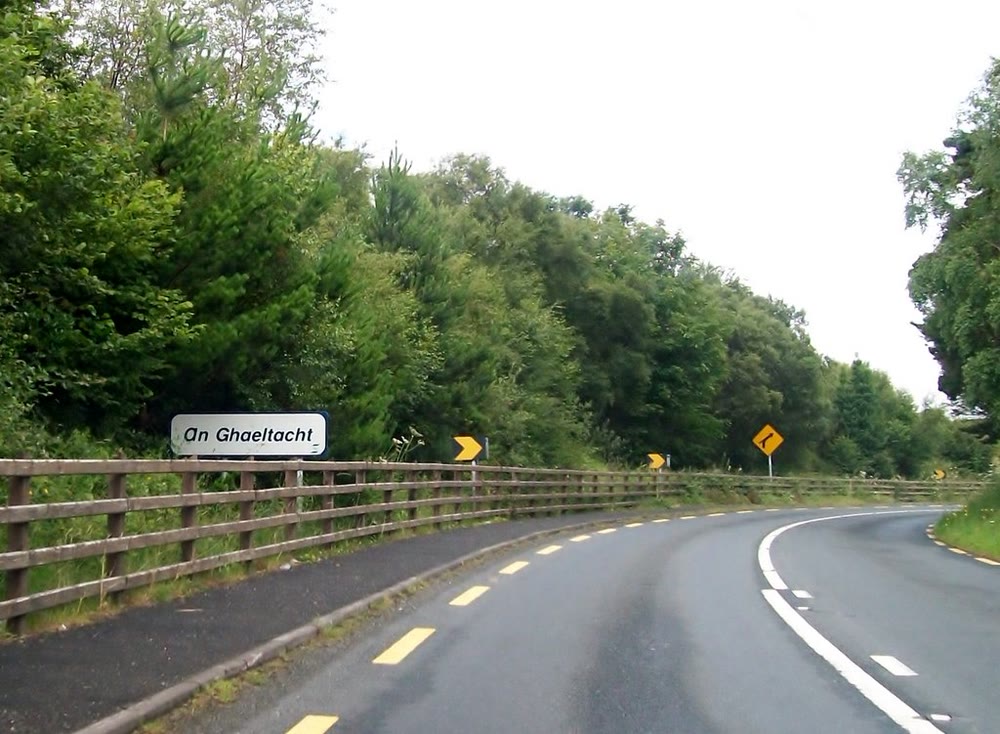
An Ghaeltacht: a sign on the N56 in Co. Donegal reminding drivers they’re in an Irish-speaking area. Scottish Gaelic calls the Highlands the Gàidhealtachd. Photo: Eric Jones, CC BY-SA 2.0, via Wikimedia Commons
How many people speak them? The census figures
The latest figures come from censuses taken in 2021 and 2022. They record what people said about their own ability, not fluency.
| Place and census | What it found |
|---|---|
| Ireland, 2022 | 1,873,997 could speak Irish, by their own account, 40% of those aged 3 and over who answered; 71,968 spoke it daily outside the education system |
| Northern Ireland, 2021 | 228,617 had some ability in Irish, 12.4% of those aged 3 and over |
| Scotland, 2022 | 69,701 could speak Gaelic (1.3%), up from 57,375 in 2011; 130,161 had some Gaelic skills (2.5%) |
| Isle of Man, 2021 | 2,223 had some understanding of Manx |
Ireland counts about 27 times as many self-reported speakers as Scotland, but many learned at school and rarely use it: the CSO found that 55% of Irish speakers said they didn’t speak it well, and almost 473,000 never spoke it. In the Gaeltacht, just over 65,000 people could speak Irish and just over 20,000 spoke it daily.
In Scotland the number with Gaelic skills grew by 43,100 since 2011, says Scotland’s Census. In the Western Isles, the heartland, 44.7% could speak Gaelic, down from 52.3%, so speakers are no longer a majority there, though 57.2% still have some Gaelic skills. A 2005 Act set out to secure Gaelic’s status as an official language, and the Scottish Languages Act 2025 gave Gaelic and Scots official status on St Andrew’s Day 2025.
Which is easier to learn?
I haven’t found a study that ranks one as easier, and they share the hard parts: sentences that start with the verb (tá and tha in the table), first letters that change (maith becomes mhaith, math becomes mhath) and spelling that looks odd until it clicks.
- Irish has far more speakers, TG4 and Raidió na Gaeltachta, and three main dialects plus a written standard.
- Scottish Gaelic has a smaller community but one spelling standard used in schools and exams, the free LearnGaelic dictionary with sound clips, and a Duolingo course launched on St Andrew’s Day 2019. Duolingo has taught Irish since 2014.
The best choice is usually personal. If your family came from Ireland, learn Irish. If your roots are in the Highlands, the Hebrides or Gaelic Nova Scotia, Scottish Gaelic will feel like home. Either one makes the other easier later. My guide to learning Irish online has the best free and paid courses.
Tattoos and gifts: check which Gaelic you’re getting
Before anything goes on skin, silver or stone, run three checks:
- Accents: Irish uses á, é, í, ó, ú; Scottish Gaelic uses à, è, ì, ò, ù. A mix of both is a mistake.
- Telltale words: “my heart” is mo chroí (muh KHREE) in Irish but mo chridhe (muh KHREE-uh) in Scottish Gaelic; cheers is sláinte in Ireland and slàinte mhath in Scotland.
- Source: ask the seller which language it is, then look it up yourself in focloir.ie or teanglann.ie for Irish, or the LearnGaelic dictionary for Scottish Gaelic.
For names, see my guide to the real meanings of Irish names.
Irish vs Scottish Gaelic FAQ
Is Irish Gaelic the same as Scottish Gaelic?
No. They’re separate languages from the same medieval root, with different spelling, pronunciation and everyday phrases. Manx is the third member of the family.
Can Irish speakers understand Scottish Gaelic?
Partly. Many words and most of the grammar are shared, but everyday phrases and sounds differ. Donegal Irish shares a few extra features with Scottish Gaelic.
Is it wrong to call Irish “Gaelic”?
Not wrong, and the Gaelic League used it in 1893, but at home the Irish name their language Irish in English and Gaeilge in Irish. In Scotland, Gaelic on its own means Scottish Gaelic.
How do you pronounce Gaelic?
GAY-lik is the first pronunciation in American dictionaries such as Merriam-Webster. In Scotland many people say GAL-ik, closer to the Gaelic word Gàidhlig.
Which is older, Irish or Scottish Gaelic?
Neither, strictly: both come from Old Irish. Irish has the longer written record; a clearly Scottish written form only appears in the 1500s.
Love this? Save it to your Pinterest board for later.
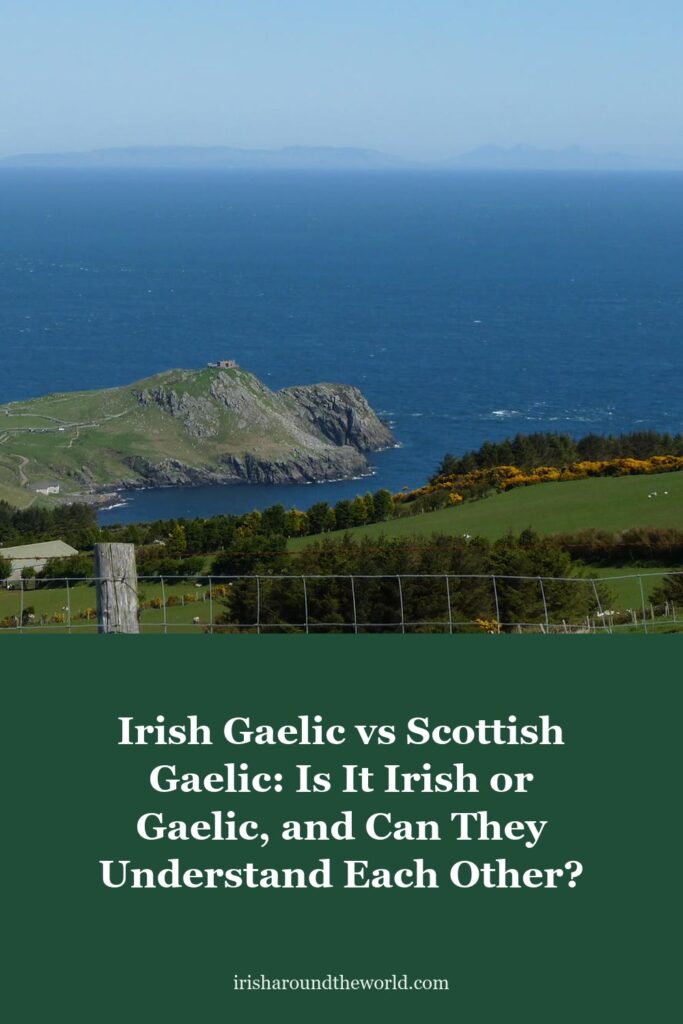
Pin image: Torr Head, Co. Antrim, with the hills of Scotland on the horizon across the North Channel. Photo: Michael Clarke (michael clarke stuff on Flickr), CC BY-SA 2.0, via Wikimedia Commons
A little bit of Ireland in your inbox every Friday ☘️
The free Weekly Dose of Irish: an Irish joke, a Celtic symbol, an Irish fact, a poem and the week’s best articles in one short email. Join 9,600+ readers.
Free. One short email every Friday. Unsubscribe any time.
More Irish language reading
- How to Learn Irish Online in 2026: The Best Free and Paid Options
- Thank You in Irish: How to Say Go Raibh Maith Agat (and What It Really Means)
- I Love You in Irish: How to Say It, 27 Pet Names and the Film That Misspelled One
- How to Say Cheers in Irish: Sláinte, Meaning and Pronunciation
- English Words From Irish: 27 You Use Every Day (and the Famous Fakes)
- Irish Words With No English Translation: 20 Real Ones and the Viral Fakes
Featured image: Torr Head, Co. Antrim, with the hills of Scotland on the horizon across the North Channel. Photo: Michael Clarke (michael clarke stuff on Flickr), CC BY-SA 2.0, via Wikimedia Commons.