
“A pint of plain is your only man” is the refrain of “The Workman’s Friend”, a comic poem in Flann O’Brien’s 1939 novel At Swim-Two-Birds. A character credits it to Jem Casey, a made-up poet. Every verse lists a hardship, and the answer is always the pint: the one friend you can count on. “Plain” was plain porter, Guinness’s lighter beer, last brewed in Ireland in the early 1970s.
This poem comes in at number 49 on my list of top 100 Irish poems, as voted by Irish Times readers.
It certainly is lighter than previous poems I have shared, such as Death of an Irishwoman and The Stolen Child.
One thing first. You won’t find the full poem here. Brian O’Nolan died in 1966, so his work stays in copyright in Ireland until the end of 2036.
Jump to:
- What “The Workman’s Friend” poem is about
- Watch it performed
- Jem Casey and At Swim-Two-Birds
- How the novel was received
- Who was Flann O’Brien?
- What is a pint of plain?
- Where you’ll meet the line today
- How to read it aloud or use it as a toast
- FAQ
What “The Workman’s Friend” poem is about
“The Workman’s Friend” is a working man’s list of complaints. Each verse picks a fresh trouble and piles it on.
Between them, the verses cover:
- things going wrong, no matter how hard you try
- money worries, and a horse that lets you down
- bad health, and a doctor ordering a rest cure
- hunger, and an empty cupboard
- trouble and strife in general, and still having one good plan
Every verse lands in the same place. Whatever the problem, the answer is the pint.
That’s the whole joke. The cure never changes, however serious the complaint. A doctor’s warning gets the same reply as an empty stomach.
It’s also a parody. O’Brien was sending up the earnest, sentimental verse that praised the honest labourer. Inside the novel, the poem is meant to be bad.
Why the refrain stuck
It’s short. It has a good thump to it. You can say it across a crowded bar and be understood.
Under the joke, it’s affectionate. Plenty of real workmen would have nodded along.
Watch it performed
The piece appears in The Dubliners’ Dublin, a film portrait of the city presented by Ronnie Drew and released on video by 1989. Its track list calls it “Pint of Plain” and marks it as a poem, not a song.
This 70-second clip, uploaded to YouTube in 2009, is credited to Ronnie Drew and The Dubliners. It certainly makes me want a pint right now.
Where it comes from: Jem Casey and At Swim-Two-Birds
The poem lives inside O’Brien’s first novel, At Swim-Two-Birds. Longmans, Green published it in London on 13 March 1939.
Britannica describes it as a book about books, set inside a book. Dublin City Council’s 2006 guide sums up the plot:
- A lazy student lives with his uncle in Dublin.
- He is writing a novel about Dermot Trellis, a publican and would-be author.
- Trellis’s characters rebel, and in the end they take their revenge on him for his bad writing.
- The cast includes cowboys called Slug and Shorty, Finn MacCool, Sweeney, the Pooka (a sort of Irish devil) and a Good Fairy.
Among the characters are three Dublin men, Shanahan, Furriskey and Lamont. Shanahan recites “The Workman’s Friend” to the other two.
He credits it to Jem Casey, the Poet of the Pick, a labourer who writes verse. The listeners greet it with wildly over-the-top praise, as if it were a masterpiece.
Was Jem Casey a real poet?
No. Casey is O’Brien’s invention, and so is the poem.
The name may hide a further joke, though. In a 2005 note in the journal Notes and Queries, the scholar John Foley argued that Casey echoes Fr James Casey (1824 to 1909).
Fr Casey was a Roscommon priest whose popular verse included temperance poems. If Foley is right, O’Brien named his porter-praising poet after a man who wrote against the drink. It’s one scholar’s reading, but a good one.
How the novel was received
Graham Greene was a reader for Longmans at the time. He recommended the book, and that’s how it got published.
James Joyce liked it too. He is quoted as saying: “That’s a real writer, with the true comic spirit. A really funny book.”
Dublin City Council’s 2006 guide has Greene likening the book to watching china smashed on a stage. He also counted it among the best books of his century.
Dylan Thomas is often quoted as saying it was just the book to give your sister, if she was a loud, boozy sort.
Praise didn’t make it a hit. The war came within months, and only 244 copies had sold when Longmans’ London premises were bombed in 1940. Most of the unsold stock was destroyed.
Britannica says the book only became famous after it was republished in 1960. TIME magazine later included it in its 2005 list of the 100 best English-language novels since 1923.
Who was Flann O’Brien?
Flann O’Brien was one of the pen names of Brian O’Nolan. He was born on 5 October 1911 on Bowling Green in Strabane, Co. Tyrone.
He went to Blackrock College and University College Dublin. In 1935 he joined the civil service, in the Department of Local Government and Public Health.
Within two years he was private secretary to the Minister for Local Government. The ministers he served in that role included Seán T. O’Kelly and Seán MacEntee.
He also had a second life in print. As Myles na gCopaleen he wrote Cruiskeen Lawn, a column in the Irish Times. It began on 4 October 1940, at first in Irish and under another pen name, and ran until his death.
He used the column to mock all sorts, his bosses included. According to the Irish Times, his drinking and his digs at senior politicians forced him out of the civil service in 1953.
| Year | Book | What to know |
|---|---|---|
| 1939 | At Swim-Two-Birds | His first novel, and home of the Workman’s Friend |
| 1941 | An Béal Bocht | Written in Irish; translated as The Poor Mouth in 1973 |
| 1964 | The Dalkey Archive | His last novel published in his lifetime |
| 1967 | The Third Policeman | Written in 1939 and 1940, published after his death |
The Third Policeman has its own sad story. Longmans turned it down in 1940 as too fantastic. He then claimed he had lost it.
Brian O’Nolan died in a Dublin hospital on 1 April 1966, April Fool’s Day. He was being treated for throat cancer, but it was a heart attack that killed him.
What is a pint of plain? The meaning of “plain”
A pint of plain is a pint of plain porter. It was Guinness’s ordinary, everyday porter, lighter than stout.
Porter began in London in the early 1700s. Beer writer Roger Protz says it was named after the market and dock porters who drank it.
Arthur Guinness signed his 9,000-year lease at St James’s Gate on 31 December 1759, at £45 a year. He was selling porter by 1778, according to his descendant Patrick Guinness. By 1799, says Protz, he had stopped brewing ale altogether.
The stronger version was called “stout porter”, later just “stout”. The ordinary porter became known in Dublin as “plain”, to tell it apart.
Protz calls plain the drink of the Dublin working class. It was lighter than stout. That’s the man in the poem.
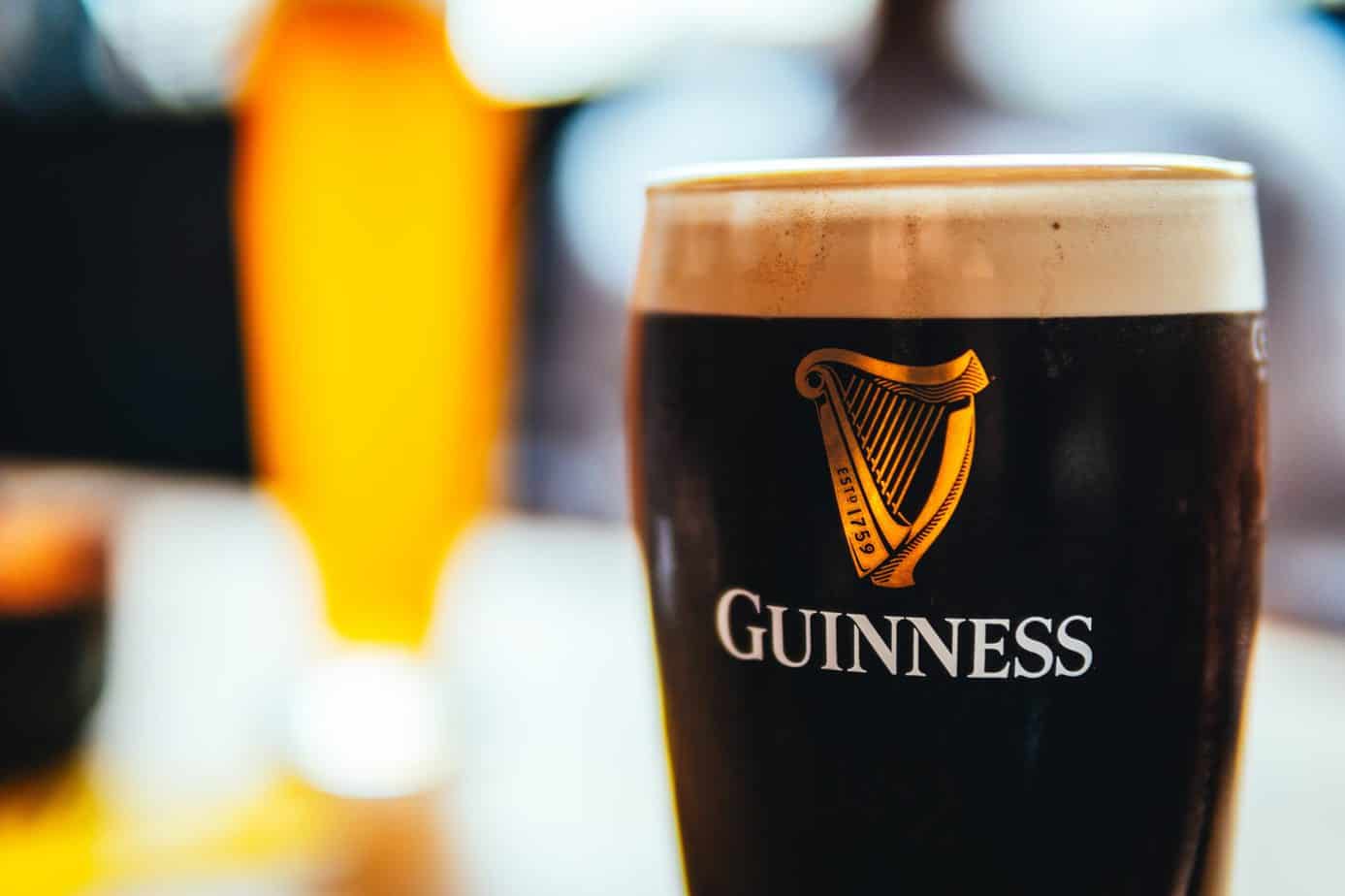
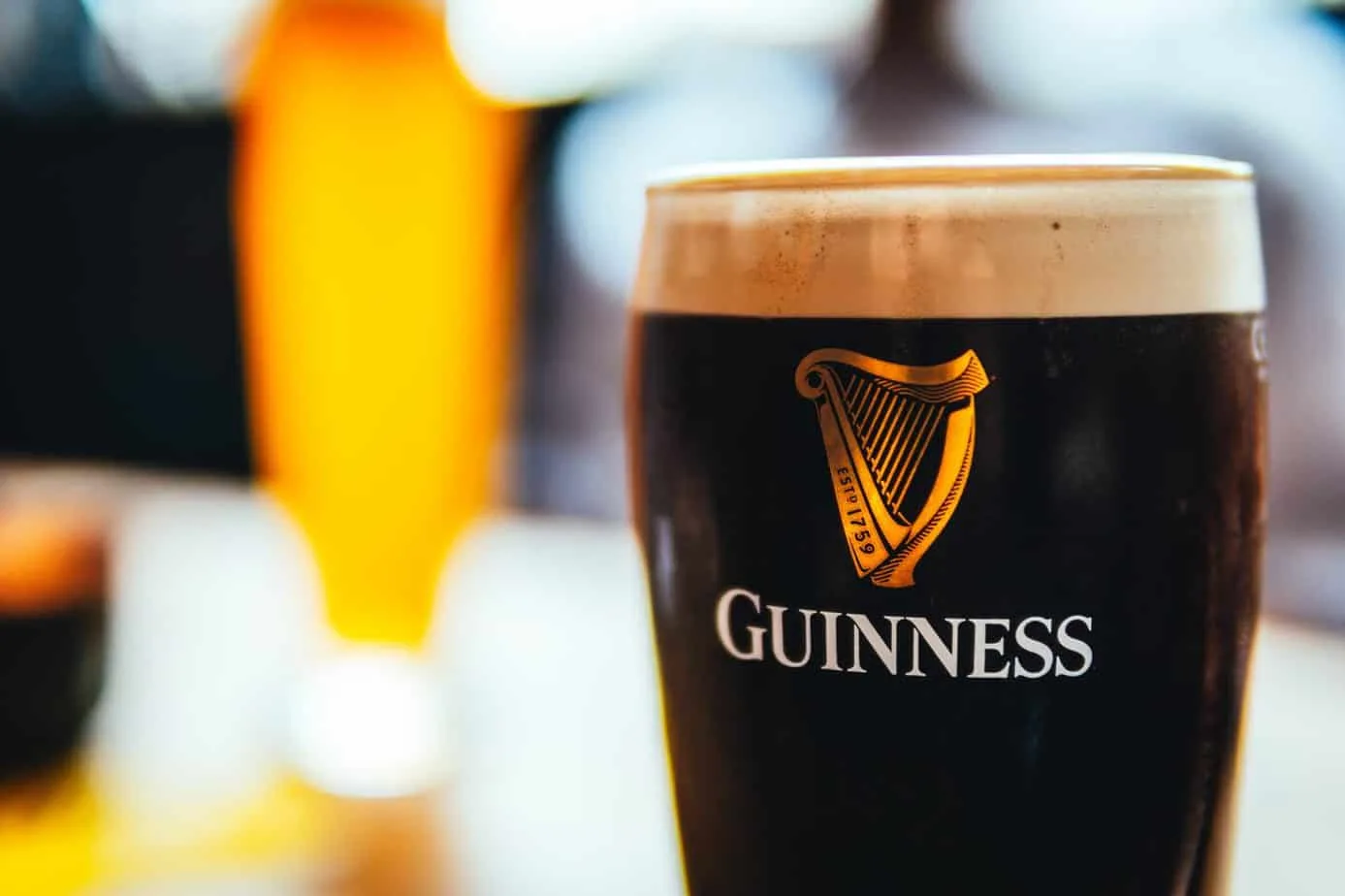
A pint of Guinness stout today. The plain porter of O’Brien’s Dublin was a lighter cousin.
When did plain porter disappear?
Beer writer Michael Jackson dated Guinness’s last Irish porter to 1973. Some accounts say 1974.
These days, people often use “plain” loosely for any pint of Guinness. Strictly speaking, the pint in your hand is stout.
The 2014 revival
In September 2014 Guinness brought porter back at St James’s Gate, reported beer writer Roger Protz. Both new beers drew on old brewing records.
| Beer | Strength | The story |
|---|---|---|
| Dublin Porter (2014) | 3.8% | Based on a 1796 recipe |
| West Indies Porter (2014) | 6% | Based on an 1801 brewers’ diary entry |
West Indies Porter is still listed on the Guinness Ireland website. I can’t promise you’ll find Dublin Porter, so ask before you get your hopes up. Neither is quite the plain of O’Brien’s day.
Where you’ll meet the line today
Mostly, you’ll hear it in pubs. Somebody orders a pint, somebody quotes the refrain, and somebody else groans.
It has had grander outings too:
- One City, One Book, 2006. Dublin chose At Swim-Two-Birds that year. A group called the Jem Casey Society toured the city on a vintage bus, reading from the book.
- The Strabane statue. A bronze by the artist Holger Lönze, called Myles after Myles, stands on Railway Street. O’Brien, in coat and fedora, leans on giant copies of three of his books, At Swim-Two-Birds among them.
- The blue plaque. The Ulster History Circle unveiled a blue plaque at 17 Bowling Green on 1 October 2011, for his centenary.
- The scholars. The International Flann O’Brien Society, founded in 2011, holds regular conferences on his work.
Dublin has no statue of him, but there is a small bronze plaque to him in the pavement outside the Palace Bar on Fleet Street.
For literary Dublin in the flesh, the Dublin Literary Pub Crawl meets at The Duke on Duke Street. Actors perform from Joyce, Beckett, Behan and others, though I can’t promise Jem Casey gets a turn.
How to read it aloud or use it as a toast
Get a copy of At Swim-Two-Birds. It’s in Penguin Modern Classics, with the poem in full. Then:
- Play it dead straight. It’s funnier read like a solemn ballad.
- Slow down before each refrain. Let the room see it coming.
- Get the crowd to join in. By the second verse, everyone knows the last line.
- Raise the glass on the final refrain. That’s your toast, built in.
It suits a retirement do, a birthday or a wake for someone who loved a pint. Just read the room first.
At a wedding, I’d save it for late in the night. For the speeches, my top 10 Irish toasts has warmer options.
FAQ
What does “pint of plain” mean in the poem?
Whatever goes wrong, a pint of plain porter is the only friend you can rely on. In the poem it’s the cure for every trouble, and the joke is that the cure never changes.
What is a pint of plain? Is it Guinness?
It was plain porter, Guinness’s lighter everyday porter, as opposed to stronger stout. It ended in Ireland in the early 1970s. Today people use “plain” loosely for a pint of Guinness.
Who wrote “The Workman’s Friend”?
Flann O’Brien, the pen name of Brian O’Nolan (1911 to 1966). In his novel, a character credits it to Jem Casey, the Poet of the Pick. Casey is fictional.
Which book is the pint of plain poem from?
At Swim-Two-Birds, O’Brien’s first novel, published in 1939. Shanahan recites it to Furriskey and Lamont.
Can you still order a pint of plain in Ireland?
Not the original, which ended in 1973 or 1974, depending on the source. Guinness revived porter in 2014, and West Indies Porter is still listed on its Irish site.
More Irish poems and sayings
- Ireland’s top 100 Irish poems
- Top 10 Irish toasts
- Seamus Heaney poems
- Irish sayings
- Irish proverbs
- How to make a proper Irish coffee
Love this? Save it to your Pinterest board for later.
A little bit of Ireland in your inbox every Friday ☘️
The free Weekly Dose of Irish: an Irish joke, a Celtic symbol, an Irish fact, a poem and the week’s best articles in one short email. Join 9,600+ readers.
Free. One short email every Friday. Unsubscribe any time.
Joe Glaysher
Friday 23rd of December 2022
"Flann O’Brien(also known as Brian O’Nolan). He lived from 1911 to 1966 O’Brian was an alcoholic for much of his life and suffered from ill-health in his later years." This is a bit of an injustice to a man who was a senior and highly regarded civil servant, wrote a weekly newspaper column and was Ireland's most inventive novelist (though perhaps James Joyce has a claim there too).
Nicholas Dunne-Lynch
Friday 22nd of July 2022
Indeed, Kathleen. Taking refuge in alcohol is certainly an Irish solution. However, O'Brien wasn't the only poet. Welshman Dylan Thomas claimed he never wrote a line when the pubs were open, while Persian Omar Khayyam resolved to 'cast vain barren reason from my bed and take the daughter of the vine to spouse,' or words to that effect. Alcohol is highly romanticized in poetry, but how many poems discuss dying of alcoholism? The list of poets that over indulged is very long.
Colin Kerrick
Friday 15th of April 2022
Definitely makes you want a pint
Kathleen Gatta
Friday 17th of September 2021
In theory, O'Brien may be right but, it was a major part of his health problems.