
Eanáir 1991 (January 1991) is a short poem in Irish by Biddy Jenkinson, first published in her collection Dán na hUidhre in 1991. In 23 short lines, the speaker, usually read as a woman, refuses her lover’s kisses, touch and talk of spring, and asks that they stand among the dead, under the bombs, to show this is not done with their consent. The title is read as pointing to the Gulf War, whose air campaign began on 17 January 1991. It is one of the five additional poems for Leaving Cert Irish Higher Level, Section 3(b), in June 2027 and June 2028.
Most love poems ask for a kiss. This one refuses.
Eanáir 1991 is barely two dozen lines long, yet it sets a love affair beside a war and lets the war win. While bombs are falling somewhere, every gesture of love seems impossible.
Jenkinson’s poem on the old course, examined up to June 2026, was Éiceolaí. From June 2027, Eanáir 1991 takes its place among the five additional poems for Higher Level Irish.
The poem is in copyright, and Biddy Jenkinson has long preferred not to be translated into English in Ireland, so I won’t print the poem or translate it. Instead, here’s a plain-English guide to it. For the whole course, see my guide to the Leaving Cert Irish poems.
Jump to:
- Eanáir 1991 at a glance
- What happens in the poem
- January 1991: the Gulf War behind the title
- The wren, the lark and St Stephen’s Day
- Themes: war, love and bearing witness
- Imagery and techniques
- Tone and feelings
- Key Irish words in the poem
- Exam notes and useful Irish phrases
- Who is Biddy Jenkinson?
- Eanáir 1991 FAQ
- More Leaving Cert Irish and folklore
Eanáir 1991 at a glance
- Title: Eanáir 1991 means January 1991. Eanáir sounds roughly AN-awr in Connacht and Ulster Irish, and uh-NAWR in Munster.
- Poet: Biddy Jenkinson, the pen name of a poet born in Dublin in 1949.
- First published: in Dán na hUidhre (Coiscéim, 1991); reprinted in her selected poems, Rogha Dánta (Cork University Press).
- Length: 23 short lines in six stanzas, with no regular rhyme.
- Course: Higher Level only, Section 3(b), the Dánta Breise (DAWN-tuh BRESH-uh), June 2027 and 2028.
- Where to read it: the Department’s list names Leabhar na hAthghabhála, edited by Louis de Paor (Bloodaxe Books, 2016), a bilingual anthology subtitled Poems of Repossession. Bloodaxe’s contents list puts the Irish text on page 432 and an English version on page 433, which the University of Galway’s Republic of Conscience database lists as a prose translation by de Paor. Online, the poetry site Lyrikline has the Irish text with an audio recording and a German version by Dorothea Grünzweig.
Spelling it right
Watch the fada: it’s Eanáir, not “Eanair”. The anthology’s title has an h before the A and a gh in the middle: Leabhar na hAthghabhála. Athghabháil means recapture or recovery, close to the “repossession” of the English subtitle.
What happens in Eanáir 1991 (summary in plain English)
This is a summary in my own words, not a translation. The speaker talks to her lover, and most of the poem is a string of refusals.
Each of the first five stanzas opens with “don’t”. It’s January, and she won’t be kissed. She won’t have her hand held or her heart softened, and she won’t have her lover look into her eyes.
Every refusal comes with a picture of what would happen if she gave in, and every picture is cold or broken. A kiss would lift no lark into the sky; instead, the torn wrens of St Stephen’s Day would drop to the ground between the two of them. Her hand, her heart and her eyes are so frozen that any touch or look would only snap, burst or freeze something.
The fifth stanza shuts out comfort. She doesn’t want to be told that life is only lying low, or that spring will bring growth, kisses and birds again.
Then the poem turns. After all the “don’ts” comes a “let us”. With no kisses and no hope, she wants the two of them to stand among the dead, beneath the bombs, as living proof that none of this has their consent.
Notice what’s missing. No country, army or leader is named. Only the title and the falling bombs tell us there’s a war at all.
January 1991: the Gulf War behind the title
The title is a date, and January 1991 was the month the bombing of the Gulf War began.
On 2 August 1990, Iraq invaded Kuwait. In Resolution 678, the UN Security Council gave Iraqi forces until 15 January 1991 to leave, and authorised a US-led coalition to force them out if they didn’t. In the early hours of 17 January 1991, Operation Desert Storm opened with a huge air assault, which Imperial War Museums counts among the biggest bombing campaigns in military history. The bombing went on for weeks. A ground offensive followed on 24 February, and the fighting was over by 28 February 1991.
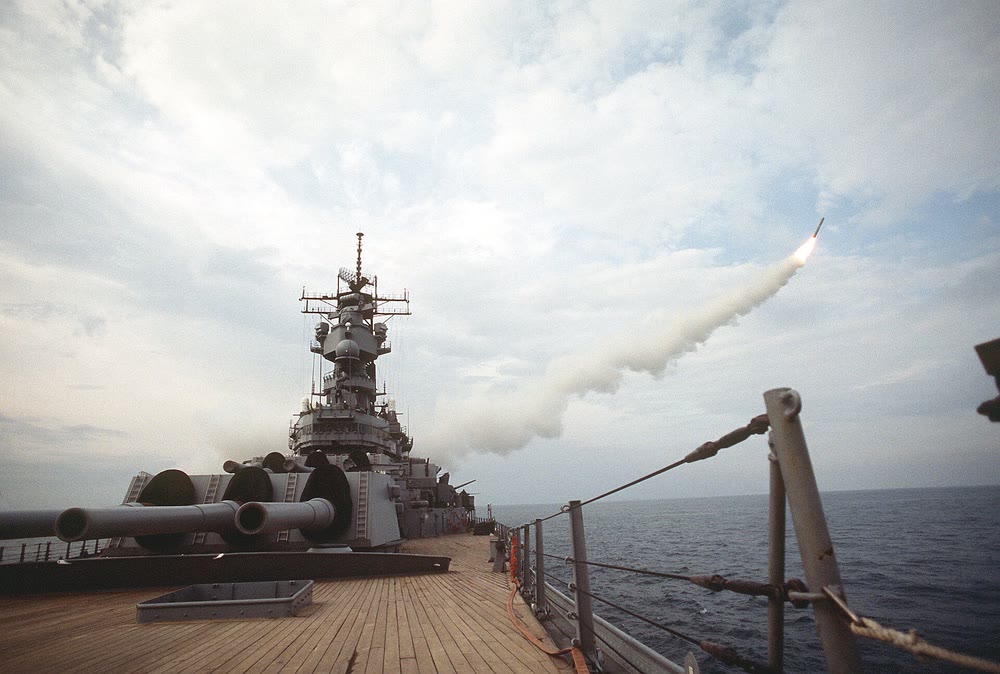
A Tomahawk missile is launched from the battleship USS Missouri towards a target in Iraq as Operation Desert Storm began, 17 January 1991. US Navy photo by PH3 Brad Dillon. Public domain, via Wikimedia Commons
Even so, the University of Galway’s Republic of Conscience database, which records how modern Irish poems deal with human rights and war, reads the title as pointing to the Gulf War. It calls Eanáir 1991 an anti-war poem in which the speaker holds back her love to show her opposition.
The war was debated in Ireland too. On 18 January 1991, RTÉ News reported on the government’s decision to let US aircraft bound for the Gulf refuel at Shannon Airport. In the report, TDs from Fianna Fáil and Fine Gael backed it, while Labour and the Green Party opposed it. The poem never mentions Shannon, so treat this as background only.
The wren, the lark and St Stephen’s Day
The strangest image in the poem comes in the first stanza: “dreoilíní coscartha Stiofáin” (Biddy Jenkinson). Word by word, dreoilíní are wrens, Stiofáin means “of Stephen”, and coscartha comes from the verb coscair, which Ó Dónaill’s dictionary defines first as to cut up, rend or mangle.
These are the wrens of St Stephen’s Day, 26 December. In the old custom, wren boys went out that day with a wren they had caught or killed, and carried it from house to house. Today the bird is fake, or there’s no bird at all, as I explain in my guide to Wren Day. One folk legend blamed the wren for betraying St Stephen to his enemies. Ó Dónaill even gives Lá an Dreoilín, the wren’s day, as a name for St Stephen’s Day.
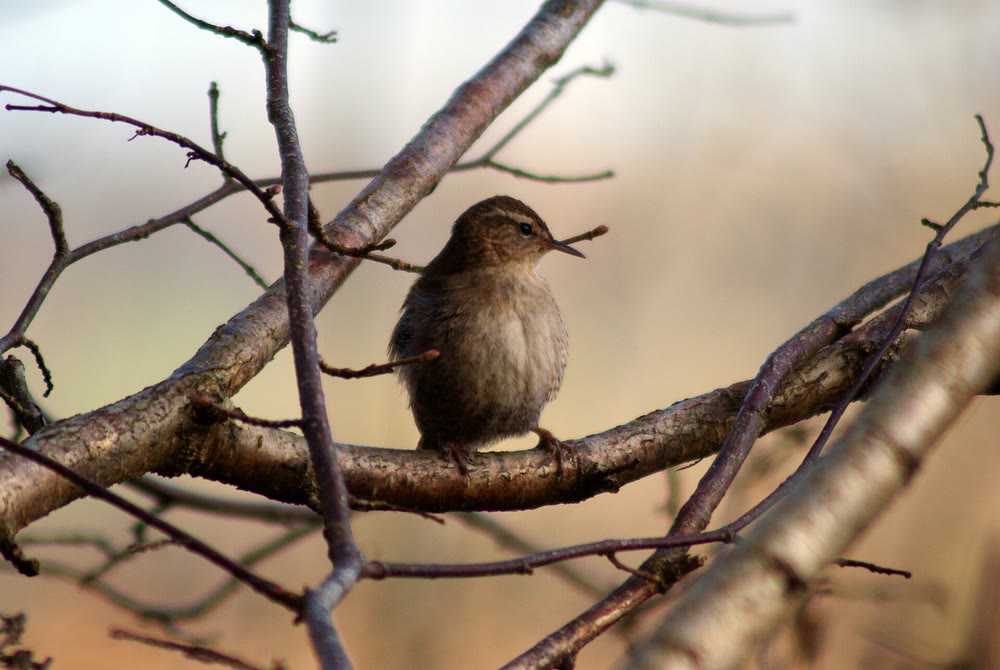
A wren on a bare branch in winter light at Leighton Moss, Lancashire, in January 2009. Photo: Gidzy, CC BY 2.0, via Wikimedia Commons
The wren could be an omen, too: in Carrowmore, Co. Donegal, it was the bird that foretold a death, as my guide to Irish superstitions records.
So the poem’s wrens are small, harmless creatures killed by custom just after Christmas. Falling between two lovers in a January of war, they’re easy to read as a picture of the innocent dead. That’s an interpretation, not the poet’s own explanation, but it makes a strong exam point.
Ó Dónaill also gives “thaw” as a meaning of coscair. In a poem built of frost and ice, you could hear both senses at once, though that’s only a possible reading.
The lark and the flock of birds
A kiss, the speaker says, would raise no fuiseog (FWISH-ohg; fwish-OHG in Munster), the lark. Ó Dónaill gives the phrase éirí leis an bhfuiseog, to rise with the lark. In poetry, a lark climbing the sky often stands for joy and fresh beginnings, so a kiss that can’t raise one is a cold kiss.
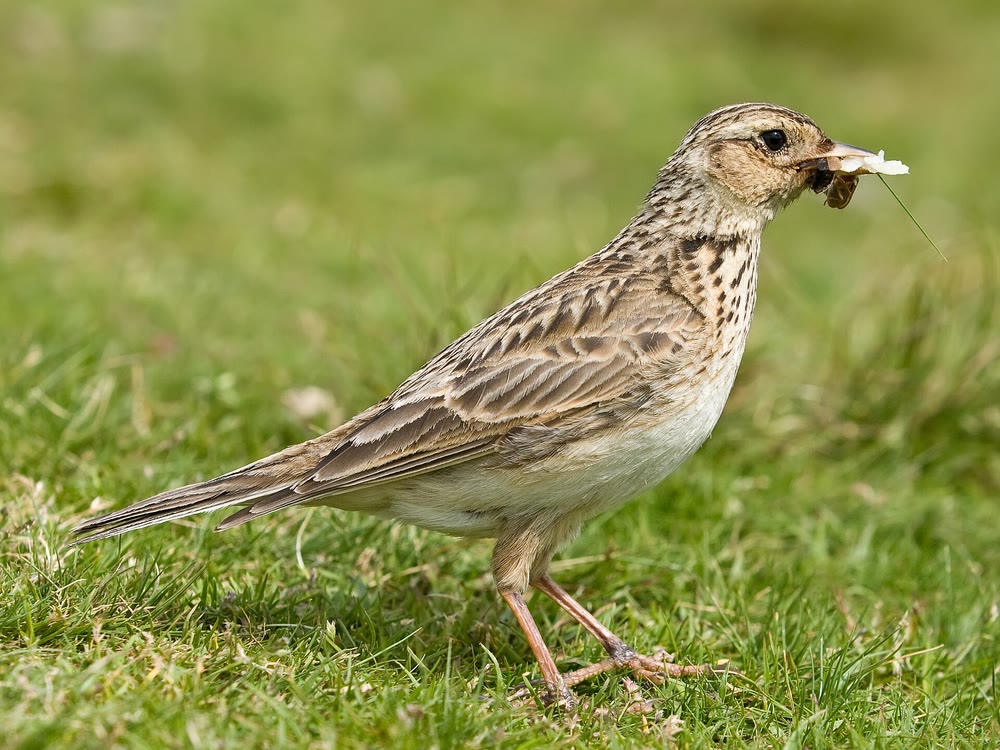
A skylark with insects in its beak near Derwent Water in the Lake District, England. Photo by David Iliff, CC BY-SA 3.0, via Wikimedia Commons
Later, she refuses to hear that spring kisses will bring flocks of birds. In the old Irish calendar, spring begins on 1 February, St Brigid’s Day, so a January poem is still deep in winter. The birds tell the story: no lark, dead wrens, and a flock she won’t let herself imagine.
Themes: war, love and bearing witness
War and conscience
Eanáir 1991 is an anti-war poem, but a quiet one, with no slogans and no battlefield. The war arrives only as falling bombs, and as a cold that has got into everything, even a kiss.
Love held back
Love isn’t dead here. She is refusing it on purpose, and that’s the central paradox: turning down love becomes a moral act. How can two people enjoy each other while others are being bombed? Her answer seems to be that they can’t.
Standing with the dead
The last stanza turns a private refusal into a public act. The key word is fianaise (FEE-un-ish-uh), which Ó Dónaill defines as witness, testimony or evidence. The lovers will stand as living proof that the bombing doesn’t have their consent.
Look at where they stand, too. The phrase in áit can mean “in the place of”, and focloir.ie also gives it for “instead of”. So the lovers stand where the dead are, and perhaps, in a sense, in their place. It’s a good detail for a Higher Level answer on solidarity, dlúthpháirtíocht (DLOO-fawr-chee-ukht).
Winter and hope
Winter here isn’t just weather. It’s her state of mind. Hope, dóchas (DOH-khus), is given up by name in the last stanza. Spring may well come, but she won’t let talk of it soften the deaths.
Imagery and techniques (teicníochtaí fileata)
- Commands (an modh ordaitheach, the imperative mood): five negative commands, each starting with Ná (NAW), don’t: don’t kiss, don’t take, don’t soften, don’t look, don’t say. The repetition (athrá, AH-raw) builds a wall of refusals.
- The turn to “we”: the last stanza opens with Seasaimis (SHASS-uh-mish), let us stand. The poem moves from “you” and “I” to “us”.
- The conditional mood (an modh coinníollach): the first stanzas imagine what would happen after a kiss or a touch: no lark would rise, wrens would fall, fingers would break off. Later verbs move into the future tense (an aimsir fháistineach), and préachfar, “will be perished with cold”, is an autonomous verb (saorbhriathar).
- Imagery of cold (íomhánna an fhuachta): icicles, glazed frost, refreezing and a cold that would perish the lover. Feelings are shown as weather.
- Echoes of frost: reo (ryoh), frost, turns up inside three words in two stanzas: coinlín reo (icicle), fliuchreo (glazed frost) and athreo (refreezing). The cold keeps coming back.
- The body: the lover’s mouth, then her own hand, heart and eyes. Every part that could express love is shut down, stanza by stanza.
- Contrast (codarsnacht, KUD-ur-snukht): love and war, warmth and cold, spring and winter, the living and the dead.
- A compound word: for the touch of a kiss, the poem joins béal (BAYL; closer to BEE-ul in Munster), mouth, to béim (BAYM), which Ó Dónaill defines first as a blow or stroke. You could say a kiss is made to sound almost like a blow.
- Form: free verse, very short lines and plain words. One line is a single verb, Thitfeadh, “would fall”, standing on its own, so the wrens seem to drop down the page.
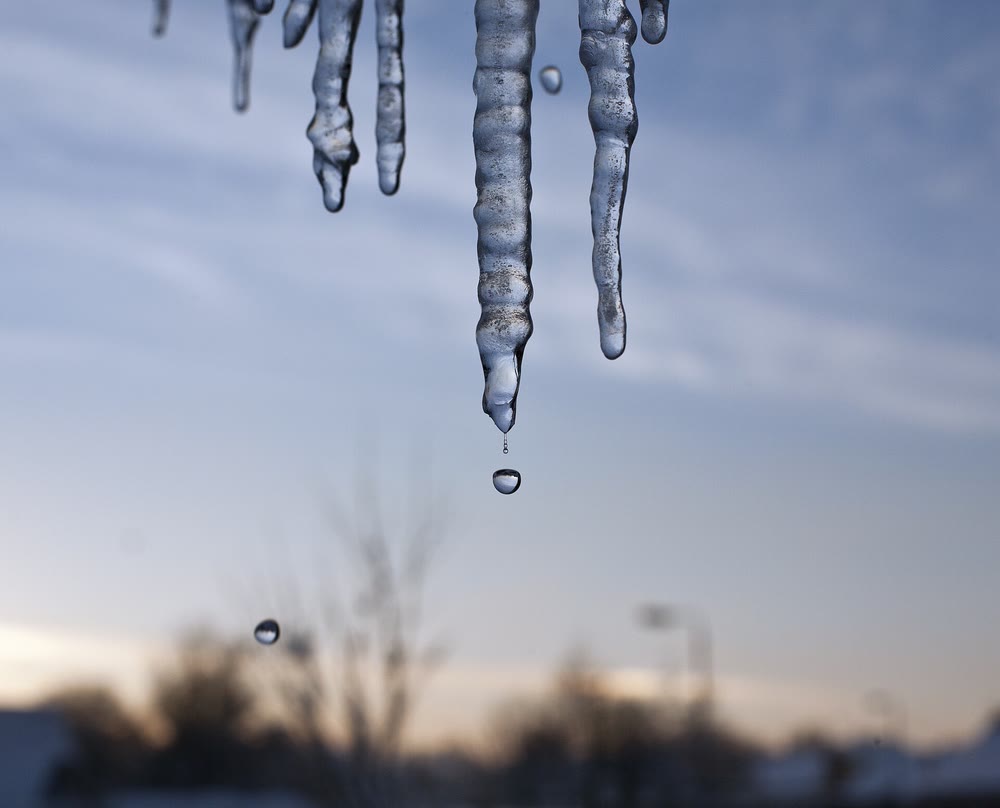
Melting icicles in Limavady, Northern Ireland, in December 2010. Photo: john.purvis, CC BY 2.0, via Wikimedia Commons
Tone and feelings (mothúcháin)
The tone is cold, stern and controlled, with short, blunt sentences and not one exclamation mark. Under that control lies strong feeling:
- Brón (BROHN), grief: for the dead, in the wrens and the closing stanza.
- Éadóchas (AY-doh-khus), despair: she gives up hope in so many words.
- Grá (GRAW), love: held in check. Her refusals only make sense if she loves.
- Defiance: the ending is a protest, quiet but firm.
Key Irish words in Eanáir 1991
Words are in dictionary form, with meanings from Ó Dónaill’s Foclóir Gaeilge-Béarla on teanglann.ie (the name Stiofán apart). The respellings are only a rough guide.
| Irish | Say it roughly | Meaning |
|---|---|---|
| póg, plural póga | POHG, POH-guh | a kiss; also the verb to kiss |
| fuiseog | FWISH-ohg (fwish-OHG in Munster) | lark, skylark |
| dreoilín, plural dreoilíní | DROH-leen (dryoh-LEEN in Munster) | wren |
| coscair, coscartha | KUS-kir, KUS-kur-huh | cut up, rend, mangle; break up, shatter; defeat; also thaw |
| Stiofán, genitive Stiofáin | SHTIF-awn (shtif-AWN in Munster) | Stephen; Lá Fhéile Stiofáin is St Stephen’s Day |
| coinlín reo | KUN-leen ryoh (kun-LEEN in Munster) | icicle (coinlín is a stalk or straw, reo is frost) |
| flichreo | FLIKH-ryoh | glazed frost, silver thaw (the poem spells it fliuchreo) |
| athreo | AH-ryoh | refreezing (Ó Dónaill: regelation) |
| préach | PRAYKH | to perish with cold |
| faoi choim | fwee KHUM | under cover, in secret |
| péac | PAYK | to sprout, shoot |
| ealta | AL-tuh | a flock; ealta éan is a flock of birds |
| fianaise | FEE-un-ish-uh | witness, testimony, evidence |
| deoin | roughly JOAN (closer to DYOHN in Munster) | will, consent |
For warmer words, póg and póga turn up in my guide to saying I love you in Irish.
Exam notes and useful Irish phrases
Eanáir 1991 is item (ii) of the additional poetry, 3(b), in Department of Education and Youth circular 0041/2026, for Higher Level in June 2027 and June 2028. If your class takes the poetry option, all five poems are prescribed: Trén bhFearann Breac by Colm Breathnach, Eanáir 1991, Ag Tiomáint Siar by Nuala Ní Dhomhnaill, Dijeridiú by Louis de Paor and Anthony Daly by Raftery.
The alternative is one prose work under 3(a). Students may study both, but only one of the two sections is answered in the exam. The circular also warns that Higher Level papers can include short questions on a work’s author, background and context, so know the Gulf War background and a little about Jenkinson.
Nobody can predict the paper, but prepare the theme, two or three images, two or three techniques, the feelings with a short quote for each, and your own response.
Useful Irish phrases for your answer
- Is dán in aghaidh an chogaidh é Eanáir 1991. (Eanáir 1991 is an anti-war poem.)
- Is é cúlra an dáin ná Cogadh na Murascaille. (The background of the poem is the Gulf War.)
- Diúltaíonn an reacaire do gach comhartha grá óna leannán. (The narrator refuses every sign of love from her lover.)
- Úsáideann an file an modh ordaitheach arís agus arís eile. (The poet uses the imperative mood again and again.)
- Tá codarsnacht ghéar idir an grá agus an cogadh sa dán. (There’s a sharp contrast between love and war in the poem.)
- Léiríonn an dán dlúthpháirtíocht leis na daoine a maraíodh sa chogadh. (The poem shows solidarity with the people killed in the war.)
- Cuireann íomhá na ndreoilíní marbha uafás orm. (The image of the dead wrens horrifies me.)
Who is Biddy Jenkinson?
Biddy Jenkinson is a pen name. Her profile on Portráidí, the portrait archive of Irish-language writers, says she was born in Dublin in 1949 and studied at University College Cork. Its playful Irish-language note says she uses a pen name because she feels the author doesn’t really exist.
She writes poems, short stories and plays in Irish. Her poetry collections from Coiscéim include Baisteadh Gintlí (1986), Uiscí Beatha (1988), Dán na hUidhre (1991), Amhras Neimhe (1997) and Oíche Bhealtaine (2005). She has also written detective stories starring An tAthair Pádraig Ó Duinnín, the real-life priest and dictionary maker, and she edited Poetry Ireland Review in 2000 and 2001.
In her 2017 Trinity College Dublin doctoral thesis on Jenkinson’s work, Caitlín Nic Íomhair counts Eanáir 1991 among the most important poems the poet has written.
She is known for her stand on translation. In a 1991 letter published in the Irish University Review, she wrote, “I prefer not to be translated into English in Ireland.” Portráidí says she doesn’t want her work translated into English but makes French versions available, and Ellen Corbett notes in Wasafiri that her poems have appeared in French, German and other languages.
For more modern poets in Irish, see my guide to famous Irish poets.
Eanáir 1991 FAQ
What is Eanáir 1991 about?
Eanáir means January. In the poem, a woman refuses her lover’s kisses, touch and talk of spring because bombs are falling. She chooses to stand with the dead, without hope, as proof that the bombing isn’t done with their consent.
Is Eanáir 1991 about the Gulf War?
The poem doesn’t name it, but the title and the bombs point to it, and the University of Galway’s Republic of Conscience database reads it that way. The coalition began bombing Iraq on 17 January 1991.
Is Eanáir 1991 on the Leaving Cert in 2027?
Yes, for Higher Level only. It’s one of the five additional poems in Section 3(b) for June 2027 and June 2028, for students who take the poetry option rather than the prose.
Is Biddy Jenkinson her real name?
No. It’s a pen name used by a poet born in Dublin in 1949, and she has kept her personal identity out of the spotlight.
Is there an English translation of Eanáir 1991?
Leabhar na hAthghabhála prints a prose English version facing the Irish. Jenkinson prefers not to be translated into English in Ireland, so this page summarises it instead.
Where can I read Eanáir 1991?
In Leabhar na hAthghabhála (Bloodaxe Books, 2016), the book on the Department’s list, or in her Rogha Dánta. Lyrikline has the Irish text online, with audio.
What are the main techniques in Eanáir 1991?
Repeated negative commands, a turn to “let us”, the conditional mood, imagery of cold, ice and birds, the echo of reo (frost), contrast between love and war, and short lines in free verse.
Love this? Save it to your Pinterest board for later.
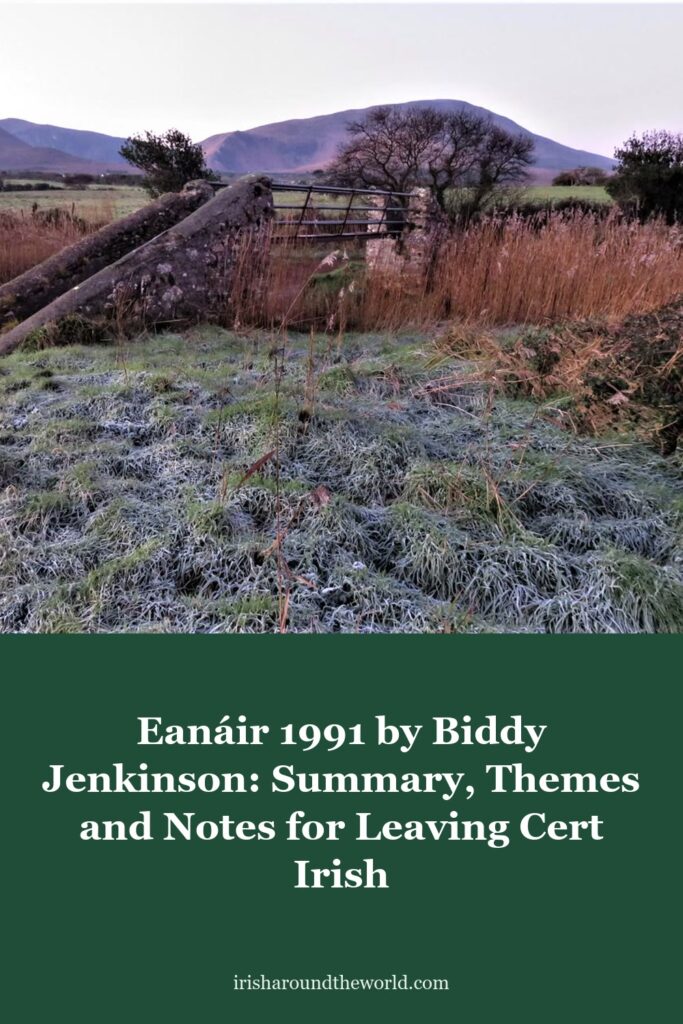
Pin image: Winter frost by an old footbridge over the Owennamallagh river at Aughacasla, near Castlegregory on the Dingle Peninsula, Co. Kerry, with Beenoskee behind. Photo: Maoileann, CC BY-SA 4.0, via Wikimedia Commons
A little bit of Ireland in your inbox every Friday ☘️
The free Weekly Dose of Irish: an Irish joke, a Celtic symbol, an Irish fact, a poem and the week’s best articles in one short email. Join 9,600+ readers.
Free. One short email every Friday. Unsubscribe any time.
More Leaving Cert Irish and folklore
- Leaving Cert Irish Poems 2027 and 2028: The Full List, Explained
- Anthony Daly by Raftery: The Poem, a Translation and Notes for Leaving Cert Irish
- Dínit an Bhróin by Máirtín Ó Direáin: Summary, Themes and Notes for Leaving Cert Irish
- Wren Day: The Irish Tradition of Straw Suits, Wren Boys and the King of All Birds
- Irish Superstitions: 40 Old Beliefs About Luck, Death, Birds and the Fairies
- St Brigid’s Day: Imbolc, the Goddess, the Saint and How Ireland Celebrates 1 February
- Famous Irish Poets: The Greatest of All Time, in Order
Featured image: Winter frost by an old footbridge over the Owennamallagh river at Aughacasla, near Castlegregory on the Dingle Peninsula, Co. Kerry, with Beenoskee behind. Photo: Maoileann, CC BY-SA 4.0, via Wikimedia Commons.