Trén bhFearann Breac (Through the Speckled Land) is a poem in four short numbered parts by the Cork poet Colm Breathnach, first published in his 1992 collection An Fearann Breac. Travelling through a country where every town has two names, one Irish and one English, the speaker feels his own place has stopped speaking to him. He becomes a chess knight boxed in on a black-and-white board, living between two of everything. It is one of the five additional poems for Leaving Cert Irish at Higher Level, Section 3(b), in June 2027 and June 2028, with Tírdhreacha (Leabhair COMHAR, 2015) named as the source.
Drive west out of Dublin and the signposts speak twice. Claonadh and Clane. Cill Dara and Kildare. The Irish name comes in slanting italics, the English in plain upright letters.
Colm Breathnach turned those signs into a short, clever poem about living between Irish and English, and in 2005 the scholar Máirín Nic Eoin borrowed its title for a whole book.
The poem is in copyright, so I won’t print it here. Instead, here’s a plain-English summary, the themes, the chess game explained, key words and exam pointers. For the whole course, see my guide to the Leaving Cert Irish poems.
Jump to:
- Trén bhFearann Breac at a glance
- What happens in the poem
- The signposts: why every town has two names
- Themes: identity, loss and the land
- The chess game in part three
- Imagery, techniques and tone
- Key Irish words in the poem
- Exam notes and useful Irish phrases
- Who is Colm Breathnach?
- Trén bhFearann Breac FAQ
- More Irish poetry
Trén bhFearann Breac at a glance
- Title: roughly trayn VAR-un BRAK. TG4’s notes call trén a Cork dialect form of tríd an, “through the”. After it, fearann (land, territory) is eclipsed to bhFearann, said with a v sound. Breac means speckled or dappled. Breathnach’s own English version is called Through the Speckled Land.
- Poet: Colm Breathnach (roughly KUL-um BRAH-nukh), born in 1961 near Carrigrohane, Co. Cork.
- First published: in An Fearann Breac (Coiscéim, 1992), his second collection.
- Prescribed text: Tírdhreacha (Leabhair COMHAR, 2015), “landscapes”, which mixes new poems with poems from seven earlier collections.
- Shape: four numbered parts, about 40 short lines in all.
- Level: Higher Level only, Section 3(b), June 2027 and June 2028.
- Where to read it: TG4 Foghlaim’s free Trén bhFearann Breac lesson has an analysis video and notes that print the Irish text, and Poetry International shows the 1992 text beside Breathnach’s own English translation.
Spelling it right
It’s Trén bhFearann Breac: a fada on the é of Trén, a small bh and a capital F. Watch for slips like “Tren bhFearann Breac” (no fada) or “Trén Bhfearann Breac” (capital in the wrong place).
Printed versions also differ by a word or two. Where the 1992 text on Poetry International has muirín (family, brood), the text printed in TG4’s notes has muirnín (darling). Learn the text in Tírdhreacha or the one your teacher gives you.
What happens in Trén bhFearann Breac (summary in plain English)
Part one: the land stops talking
The speaker says that this place no longer speaks to him, and his language has lost its lasting hold there. The place is “she”. Áit, place, is a feminine noun in Irish, but the poem goes further and makes her a mother.
Then comes the soil. His roots only reached so deep, and without her support they are rotting. Salt was thrown on the top layer of sod and ploughed down to the bottom. She can’t nurse her young any more, and on his own ground he has become a foreign growth.
Part two: the road and the signs
He’s travelling between two cities, each with two names. Reading the signs, he says every town in this speckled land has two names as well, and he lists four of them as pairs, Irish then English, among them Clane, Kildare and Portarlington.
Then he looks at how the Irish name is printed. In italics, it gives a slanted account of the place’s history. In the smaller lettering, it’s a feeble account, slipping out of earshot.
Part three: the chessboard
Still travelling, he crosses from black to white. His journey runs on a slant and his road is crooked. He is the knight who takes the roundabout route, hoping to strike from an unexpected side. But there are castles he won’t attack, proud clerics in his way, a queen he fears he can’t protect, and pawns hemming him in on the road.
Part four: between two of everything
The last part is a list: between two colours, two words, two names, two minds, two places. It ends with the lines “idir dhá theanga / a chaithim mo shaol / idir dhá shaol” (Colm Breathnach). Between two languages, he spends his life between two lives.
The signposts: why every town has two names
The signs in the poem are real. Road traffic regulations signed in November 1988 said that on information signs put up after 1 January 1989, place names should appear in italics in Irish and in ordinary upright type in English, as the Irish Statute Book records. An Fearann Breac came out three years after that rule took effect.
Most English spellings of Irish places were settled by the Ordnance Survey’s maps in the 1800s, as I explain in my guide to Irish place names.
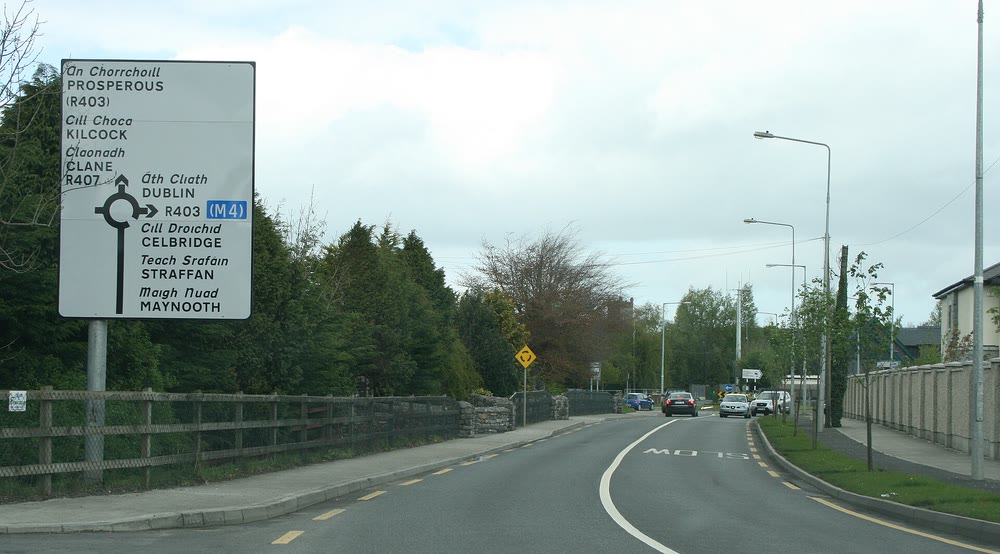
A direction sign near Clane, Co. Kildare, in 2009, with each Irish place name in italics above the English one in capitals. Photo: Sarah777, CC BY-SA 2.0, via Wikimedia Commons (Geograph)
Look at the first name on Breathnach’s list. Claonadh, the Irish name of Clane, is also an ordinary word. Ó Dónaill’s dictionary gives it as an inclination or tendency, and even a perversion, as in claonadh fírinne, a twisting of the truth. So the list opens on a name that already leans, like the italic letters and the slanted history.
Themes: identity, loss and the land
Living between two languages
TG4 Foghlaim’s lesson describes the poem as the poet’s personal journey and his experience of his own identity, féiniúlacht (FAY-nyoo-lukht) in Irish.
Máirín Nic Eoin’s 2005 book, Trén bhFearann Breac: An Díláithriú Cultúir agus Nualitríocht na Gaeilge (Cois Life), studies cultural displacement in modern Irish writing. Reviewing it in The Irish Times that June, Fionntán de Brún said the poem’s subject is a basic truth about a minority community: it has no choice but to live between two cultures.
Breathnach told Eimear Nic Conmhaic, in an interview for her 2020 Trinity College Dublin PhD thesis on his poetry, that his roots are in a language rather than a district. That makes the rotting roots of part one sharper still.
Loss
TG4’s notes name loss, caillteanas (KAL-chun-us), as the main theme: of a relationship, of identity, of culture and of language. The roots rot, the soil is salted, the Irish name fades out of hearing, and the knight can’t move.
In the 2022 census, 1,873,997 people said they could speak Irish, but only 71,968 spoke it daily outside the education system (Central Statistics Office).
The land as a woman
TG4’s notes call the poem a modern take on the aisling, the old vision poem in which Ireland appears to the poet as a beautiful woman in distress. Here the woman has stopped talking and can no longer feed her children.
Picturing Ireland as a woman is an old habit. The name Éire goes back to Ériu, a goddess, as I explain in what Ireland’s name means, and James Clarence Mangan’s Dark Rosaleen is a love song to Ireland. Breathnach’s woman is silent, and her son feels like a stranger.
Names, history and who tells the story
Nic Conmhaic points to the weight the poem puts on dinnseanchas, the lore of places, with the Irish and English names set side by side. She reads it as the poet moving between two tellings of history while voices like his own fade away.
Compare Deireadh na Feide, on the same course, about a whistled language nobody can whistle any more. Breathnach’s Irish is only growing faint.
TG4’s notes also offer a hopeful reading: the variety in the world makes speckled people of us all, a reason for sadness and for celebration.
The chess game in part three
The speckled land becomes a chessboard, and the poet a ridire (RID-ir-uh), a knight.
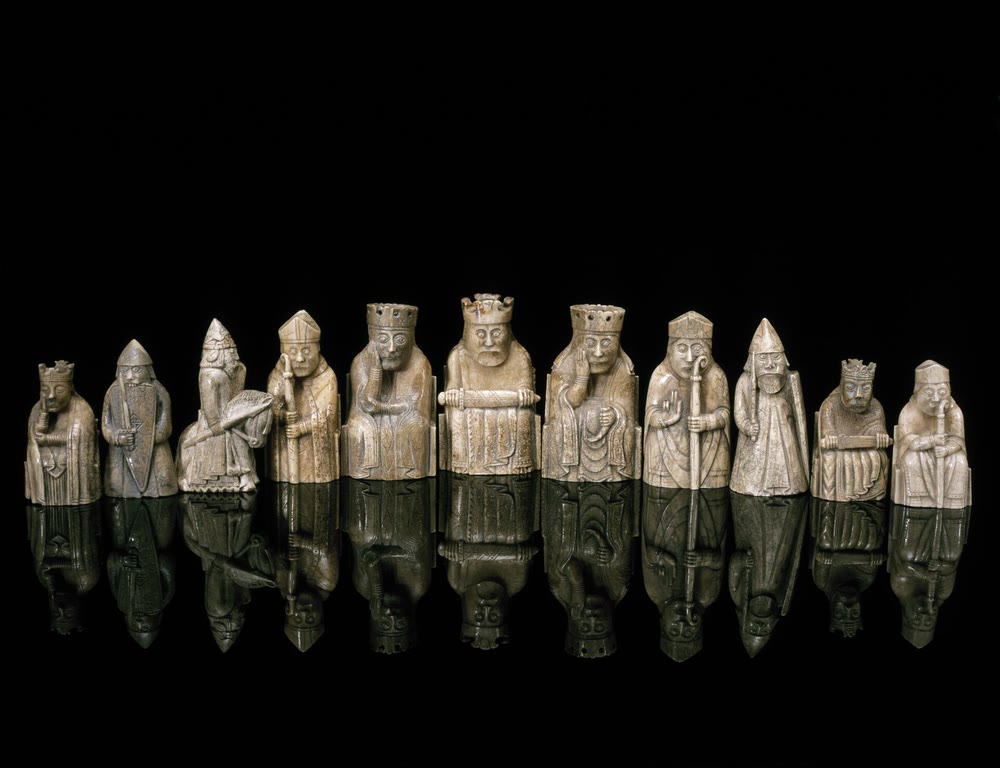
Some of the Lewis chessmen, carved from walrus ivory in the late 12th century and found on the Isle of Lewis in 1831, with a knight on horseback third from the left and bishops in mitres. National Museum of Scotland. Photo: National Museums Scotland, CC BY-SA 4.0, via Wikimedia Commons
- From black to white: under the FIDE Laws of Chess, a knight jumps to a nearby square that isn’t on its own row, column or diagonal, the familiar L shape. Every such jump lands it on a square of the other colour.
- The long way round: an timpeall a ghabháil means to take the roundabout way, as a knight always does.
- The slant: fiar (FEE-ur) means slanting, diagonal or crooked, and claon (KLAYN) means a slope or slant. In chess the bishops move on the diagonals.
- The surprise attack: aniar aduaidh literally means from the west and the north. Ó Dónaill’s example, tháinig siad aniar aduaidh orm, means “they took me unawares”.
- The other pieces: caisleáin (castles, as English speakers often call rooks), cléirigh (clerics; the Irish chess bishop is usually easpag), the queen, and ceithearnaigh, pawns.
The words do double duty. Ceithearnach (KEH-hur-nukh) is the chess word for a pawn, but its first meaning in Ó Dónaill is a light-armed foot soldier, and focloir.ie gives it for the kern of Irish history. TG4’s notes read the castles, clerics and queen as society’s hostility towards anyone trying to speak Irish.
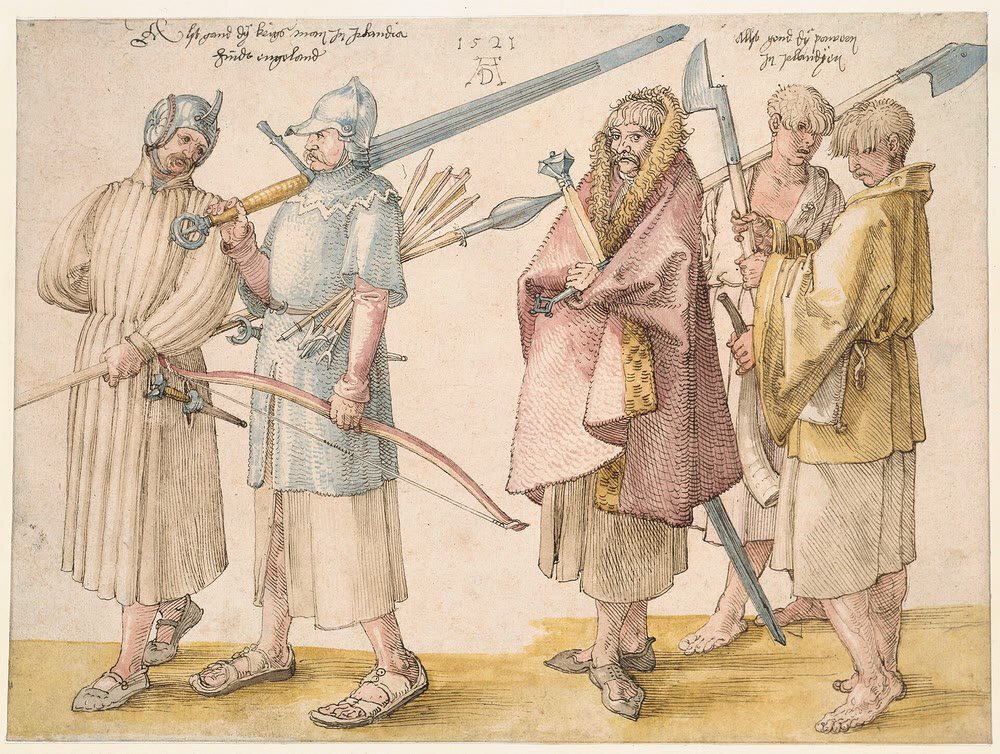
Irish soldiers and peasants, a pen and watercolour drawing by Albrecht Dürer, 1521. Kupferstichkabinett, Staatliche Museen zu Berlin. Public domain, via Wikimedia Commons
Imagery, techniques and tone
- Metaphor (meafar, MAF-ur): a chain of them: roots in soil, salted ground, a mother who can’t feed her child, a journey, a chessboard.
- Personification (pearsantú, PAR-sun-too): the place is a woman who no longer speaks to him.
- Contrast (codarsnacht, KUD-ur-snukht): Irish and English, black and white, italic and roman, large print and small.
- Wordplay (imeartas focal, IM-ur-tus FUK-ul): TG4’s notes single out the matching pair claoninsint and faoninsint. Claoninsint is a grammar word in Ó Dónaill, indirect speech, but taken apart it’s a “slant-telling”, perfect for italics. Faoninsint isn’t in the dictionary: it looks like Breathnach’s own coinage from faon, limp or languid, and insint, a telling.
- The autonomous verb (saorbhriathar, SAYR-vree-uh-hur): the salt was thrown (caitheadh) and ploughed in (treabhadh), but the poem never says by whom.
- Repetition (athrá, AH-raw): idir dhá, “between two”, runs through part four, and the line about travelling through the speckled land returns, slightly changed, to open part three.
- Rhyme (rím, REEM): the last four lines of part three all end in -ód, among them bród (pride) and ród (road). TG4’s notes pick out this rhyme too.
- Alliteration (uaim, OO-im): the s sounds of salann (salt) and scraith (sod).
- Structure: the four parts narrow down, from two-line stanzas about soil, to a road, to a board, to a last part of three or four words a line, as if nothing is left but the split.
The tone is sad and frustrated, but sharp rather than self-pitying. The main feelings (mothúcháin) are brón (BROHN), sorrow; frustrachas (FRUS-trukh-us), frustration; and uaigneas (OOIG-nus), loneliness. There’s greann (GRAN; GROWN in Munster), humour, too, in the puns.
Key Irish words in Trén bhFearann Breac
Meanings are from Ó Dónaill’s Foclóir Gaeilge-Béarla on teanglann.ie. Respellings are rough, and dialects differ.
- fearann (FAR-un): land, territory, domain; also a farm or grounds.
- breac (BRAK): speckled, dappled. As a noun it’s a trout, and the verb breac means to dot or to cover a page with writing. A Breac-Ghaeltacht is a district where both Irish and English are spoken.
- préamhacha (PRAY-vukh-uh): roots; préamh is a form of fréamh.
- scraith (SKRAH): a scraw, a strip of sod; the top layer of soil.
- tál (TAWL): to give milk or suckle; also to pour out.
- coimhthíoch (roughly KO-hee-ukh): alien, foreign, strange; as a noun, a stranger.
- ríon (REE-un): a queen. Banríon is the everyday word and the chess term.
- teanntaithe (roughly CHOWN-tih-huh): hemmed in, cornered.
- saol (SAYL; SEEL in Connacht): life, and also the world. TG4’s notes point out that the last line can mean between two worlds.
Exam notes and useful Irish phrases
In the Department of Education and Youth’s circular 0041/2026, Trén bhFearann Breac is item (i) of 3(b), Additional Poetry, for Higher Level only in June 2027 and June 2028, with Tírdhreacha as the source.
Section 3 is an either/or: one prose work from 3(a), or all five poems in 3(b). You can study both, but only one section is answered in the exam. The other 3(b) poems are Eanáir 1991 by Biddy Jenkinson, Ag Tiomáint Siar by Nuala Ní Dhomhnaill, Dijeridiú by Louis de Paor and Anthony Daly by Raftery.
The circular adds that short questions about the poet, the background and the context can come up.
TG4 Foghlaim’s practice questions (not official papers) are worth 40 marks a set, split 20, 10 and 10, and ask about the theme, feelings, metaphors, place names, repetition and particular lines. Prepare:
- the main theme, with two or three ways the poet shows it;
- the chess metaphor, piece by piece;
- the place names and the italic print;
- two or three feelings, with a short quote for each;
- a paragraph on Breathnach’s life;
- your own response: did the poem speak to you?
Useful Irish phrases for your answer
- Caillteanas is ea príomhthéama an dáin: caillteanas teanga, áite agus féiniúlachta. (Loss is the main theme of the poem: loss of language, place and identity.)
- Mothaíonn an file gur strainséir é ina thír féin. (The poet feels he’s a stranger in his own country.)
- Samhlaíonn an file an tír le bean nach labhraíonn leis níos mó. (The poet likens the country to a woman who no longer speaks to him.)
- Úsáideann an file meafar na fichille chun a chás a léiriú. (The poet uses the chess metaphor to show his situation.)
- Cuireann an t-athrá béim ar an scoilt i saol an fhile. (The repetition emphasises the split in the poet’s life.)
Who is Colm Breathnach?
Colm Breathnach was born in 1961 near Carrigrohane, Co. Cork, says Portráidí, the portrait archive of Irish-language writers; TG4’s lesson page and Poetry International say Cork city. He grew up beside the River Lee in a home where both Irish and English were spoken, according to Nic Conmhaic, and holidayed every year as a child in Corca Dhuibhne, the Gaeltacht of Kerry’s Dingle Peninsula, whose Irish and landscape he says have marked his poetry.
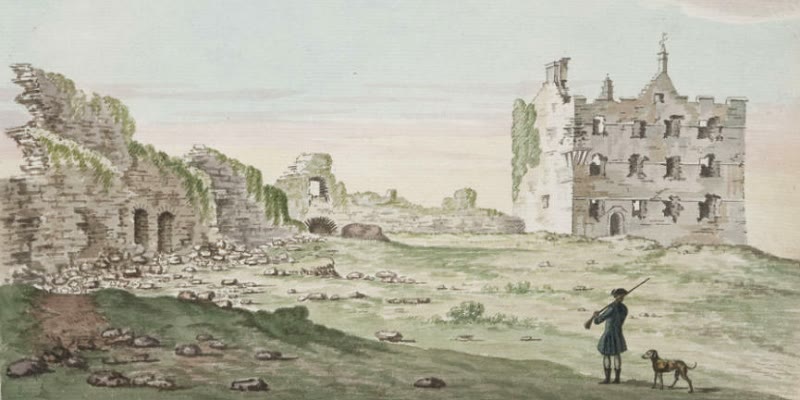
Carrigrohane Castle, Co. Cork, in an 18th-century watercolour by Gabriel Beranger (about 1729 to 1817). Royal Irish Academy. Public domain, via Wikimedia Commons
He studied Irish and philosophy at University College Cork and took a master’s degree in Modern Irish under Professor Seán Ó Tuama. His working life was spent on Irish: first on terminology, as terminologist and secretary of An Coiste Téarmaíochta, then as an Oireachtas translator, until he retired early as Assistant Chief Translator to write full time, according to Portráidí.
His collections include Cantaic an Bhalbháin (1991), An Fearann Breac (1992), Scáthach (1994), An Fear Marbh (1998), Chiaroscuro (2006) and Tírdhreacha (2015). Nic Conmhaic notes that the cover of An Fearann Breac sets a white dove against a black crow. Colm, his first name, means dove.
Four times he has taken the top poetry prize in the Oireachtas literary competitions, and in 1999 he received the Butler Literary Award from the Irish American Cultural Institute. He also wrote a novel, Con Trick “An Bhalla Bháin” (2009), and translated Günter Grass’s Katz und Maus into Irish with Andrea Nic Thaidhg. TG4’s notes say he lives in Co. Kildare, a county the poem names.
He isn’t the first Cork poet to write about this split. Nic Conmhaic compares him with Seán Ó Ríordáin, who wrestled with Irish and English in poems such as Fill Arís, though she notes that Breathnach, unlike Ó Ríordáin, doesn’t fret about the standard of his own Irish. Compare, too, Glaoch Abhaile, whose young Irishman is sleeping rough in London; Breathnach’s speaker is a stranger without leaving home.
Trén bhFearann Breac FAQ
What is Trén bhFearann Breac about?
A man travelling through Ireland reads the two-language signposts and feels cut off from his own place and language. He pictures himself as a trapped chess knight, living between two languages and two lives.
What does Trén bhFearann Breac mean in English?
Through the speckled land, which is also the title of the poet’s own English translation.
Is Trén bhFearann Breac on the Leaving Cert in 2027?
Yes, at Higher Level only. It’s one of the five additional poems in Section 3(b) for June 2027 and June 2028, for students who take the poetry option rather than the additional prose.
What is the main theme of Trén bhFearann Breac?
Identity and loss: living between Irish and English, feeling a stranger in your own country, and watching the Irish names of places fade.
What is the chess metaphor in Trén bhFearann Breac?
In part three the speckled land becomes a chessboard. The poet is a knight moving from black to white by roundabout routes. He faces castles he won’t attack and proud clerics, fears for his queen, and is hemmed in by pawns.
Where can I read the full poem?
In Tírdhreacha (Leabhair COMHAR, 2015), the book named in the circular, or your class anthology. TG4 Foghlaim’s free notes print the Irish text, and Poetry International shows the 1992 version with Breathnach’s English translation.
Love this? Save it to your Pinterest board for later.
Pin image: A dark sheep and a white sheep on the Curragh, Co. Kildare. Photo: Eoghan888, public domain, via Wikimedia Commons
A little bit of Ireland in your inbox every Friday ☘️
The free Weekly Dose of Irish: an Irish joke, a Celtic symbol, an Irish fact, a poem and the week’s best articles in one short email. Join 9,600+ readers.
Free. One short email every Friday. Unsubscribe any time.
More Irish poetry
- Leaving Cert Irish Poems 2027 and 2028: The Full List, Explained
- Anthony Daly by Raftery: The Poem, a Translation and Notes for Leaving Cert Irish
- Deireadh na Feide by Ailbhe Ní Ghearbhuigh: Summary, Themes and Notes for Leaving Cert Irish
- Glaoch Abhaile by Áine Ní Ghlinn: Summary, Themes and Notes for Leaving Cert Irish
- Irish Place Names Meaning: What Bally, Kil, Drum, Knock and Your County’s Name Really Mean
- What Does Ireland Mean? The Meaning of Éire and Ireland’s Other Names
- Famous Irish Poets: The Greatest of All Time, in Order
Featured image: A dark sheep and a white sheep on the Curragh, Co. Kildare. Photo: Eoghan888, public domain, via Wikimedia Commons.