
Dijeridiú is a short Irish-language poem by the Cork poet Louis de Paor, written during the years he lived in Australia (1987 to 1996) and first published in 1996. It is about listening to the didgeridoo, the wind instrument of Aboriginal northern Australia, and not quite understanding it. The music won’t do what an Irish listener expects, but heard with enough patience it carries the painful history of the player’s people, a history the Irish in Australia had a part in as settlers. It is a Higher Level poem for Leaving Cert Irish in June 2027 and June 2028, in section 3(b), the additional poetry.
Of all the new Leaving Cert Irish poems, this is the surprise: an Irish poem named after an Australian instrument.
It makes sense once you meet the poet. Louis de Paor left Ireland for Australia in 1987 and stayed nine years. Dijeridiú grew out of that time, and it asks an awkward question of any Irish person abroad: what do you really hear when you listen to someone else’s music?
The poem is in copyright, so it isn’t printed here. Instead you’ll find its story in plain English, the background, themes, techniques, key words and exam angles, and where to read and hear it. The rest of the course is in my guide to the Leaving Cert Irish poems.
Jump to:
- Dijeridiú at a glance
- What happens in the poem
- The didgeridoo: what it is and where it comes from
- Louis de Paor in Australia
- Themes: listening, colonisation and history
- Imagery and techniques
- Tone and feelings
- Key Irish words for Dijeridiú
- Exam notes and Irish phrases
- Who is Louis de Paor?
- Dijeridiú FAQ
- More Irish poetry
Dijeridiú at a glance
- Title: Dijeridiú, roughly DIJ-er-ee-DOO: the didgeridoo.
- Poet: Louis de Paor (LOO-ee duh PAYR), born in Cork on 27 June 1961.
- Written: in Australia; first published in 1996 in his Irish collection Seo. Siúd. Agus Uile (Coiscéim) and, with his own English version, in Gobán Cré is Cloch (Black Pepper, Australia).
- Prescribed text: Leabhar na hAthghabhála: Poems of Repossession, which de Paor edited himself (Bloodaxe Books with Cló Iar-Chonnacht, 2016). The poem is on pages 470 to 471, with an English translation by Kevin Anderson.
- Course: Higher Level only, additional poetry, section 3(b), June 2027 and June 2028.
- Form: a short free-verse lyric in short lines.
Spelling it right
The circular spells the title Dijeridiú, with a fada on the last ú, not “Dijeridiu”. De Paor’s books and his publisher, Bloodaxe, call it Didjeridu in both languages, and focloir.ie spells the instrument didiridiú. In the exam, Dijeridiú is the safe choice.
What happens in Dijeridiú (summary in plain English)
The poem talks to “you”, someone listening to a didgeridoo, and it begins with what this music won’t do.
It won’t coax a snake up out of a wicker basket, the way a snake charmer’s pipe is meant to. It won’t get your feet going to a hornpipe or a slide, or have you step-dancing on a flagstone floor either. Came for something exotic, or a session tune? Wrong instrument.
Then it turns to what the music does do. The drone fills your head with birds: a flock of lyrebirds settles to nest in the curls of your hair, and parrots flash red, green and blue. They’re an ancient people of the air, talking in a language your heart can’t follow. In de Paor’s own 1996 English version, quoted by the critic John McLaren, it is a colonial heart.
After that comes the big claim. Stand and listen for two hundred years, the poem says, and you’ll hear what the player is really playing: “ceol stair a chine” (Louis de Paor), the music of his people’s history, dripping from wounded insides.
The poem never spells that history out. But two hundred years is about how long Europeans had been in Australia when de Paor arrived: the First Fleet landed in 1788, and Australia marked the Bicentenary in 1988. Critics read the poem’s wound as the damage colonisation did to Aboriginal people.
A note on sources: no authorised text of the poem is online, so this summary is pieced together from de Paor’s comments, reviews that quote the poem and a 2004 Maynooth thesis. Read the whole poem in your anthology, closing lines included, and quote from there.
The didgeridoo: what it is and where it comes from
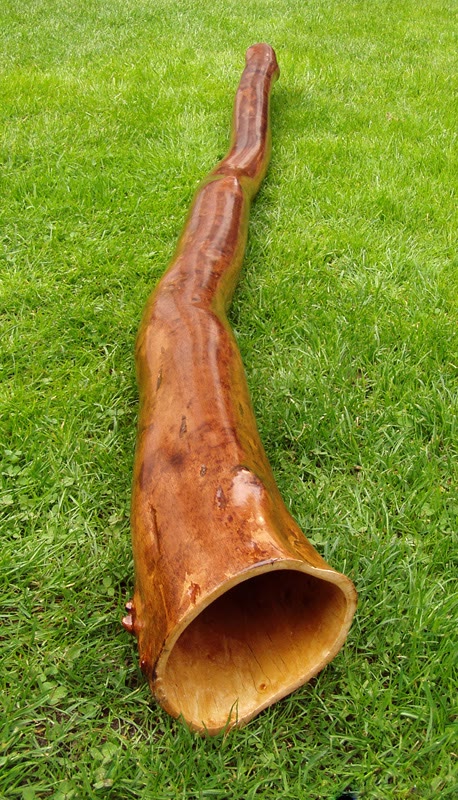
The didgeridoo is a tube of wood roughly 1.2 to 1.5 metres long, traditionally a slender eucalypt trunk or branch hollowed out by termites, with a beeswax ring at the mouthpiece, say acoustics researchers at the University of New South Wales (UNSW).
The Australian National Dictionary Centre says that at first it belonged to Arnhem Land alone, in the Northern Territory. To the Yolngu people of north-east Arnhem Land it is the yidaki, a name the band Yothu Yindi, formed in 1986, helped to spread. “Didgeridoo” itself isn’t an Aboriginal word: the centre says it probably began as non-Aboriginal Australians copying the sound, and its earliest printed examples come from 1918 and 1919.
Players use circular breathing, breathing in through the nose while the cheeks push air out, so the drone needn’t stop. UNSW says it usually plays just one note, yet a good player draws a startling range of sounds from it by shaping the mouth and throat and adding the voice. De Paor puts it at two notes. Either way, without an ear for it you hear very little, and with one you hear a whole world.
UNSW notes that the designs painted on one can carry real cultural weight, so the photo below shows a plain instrument.
Louis de Paor in Australia
De Paor moved to Australia in 1987. Over the next nine years he taught at the University of Sydney, presented an Irish programme on Melbourne radio and won Australia Council scholarships in 1990, 1991 and 1995, according to the writers’ portrait site Portráidí. By 1996 he was living in Brunswick, in Melbourne.
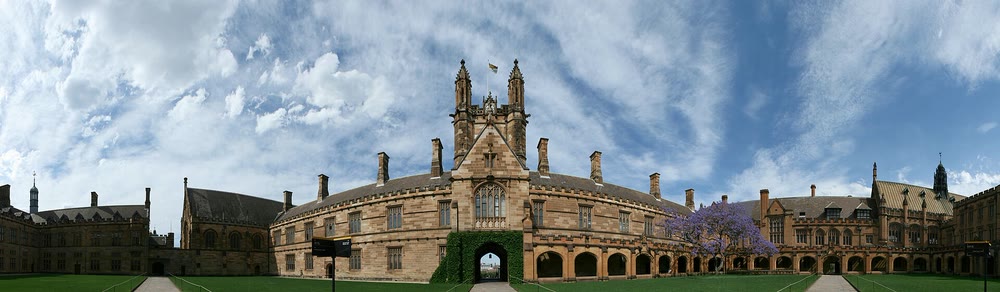
The Main Quadrangle at the University of Sydney, where de Paor lectured during his Australian years. Photo: Toby Hudson, CC BY-SA 3.0, via Wikimedia Commons
He published two bilingual books there: Aimsir Bhreicneach / Freckled Weather (1993) and Gobán Cré is Cloch / Sentences of Earth and Stone (1996). In the second, Didjeridu sits between two more Australian poems: a long one about the convict dead, Irish among them, on the Isle of the Dead at Port Arthur in Tasmania, and An Dubh ina Gheal (Assimilation), about an Aboriginal parent whose son has been taken away by the police.
Those poems put the Irish on both sides of Australia’s story: as convicts shipped out by the British Empire, and as settlers on Aboriginal land. Many Irish people also came as assisted emigrants, like the 4,114 workhouse girls and young women sent out in 1848 to 1850 (see my guide to the Irish Potato Famine).
De Paor returned to that history in An Dubh ina Gheal (Assimilation), a 2013 TG4 documentary by Paula Kehoe that he presented. It opens with him reciting Didjeridu as the Aboriginal singer-songwriter Kev Carmody plays. The film asks how far Irish settlers shared in Aboriginal dispossession, and it centres on the Stolen Generations: the Aboriginal and Torres Strait Islander children removed from their families, whose story the 1997 Bringing Them Home report set out.
Themes: listening, colonisation and history
Listening, and the limits of understanding
Talking to Shannon Heaton for her Irish Music Stories podcast, de Paor called Dijeridiú “a poem about not understanding the music” (Louis de Paor, 2017). Unless your ear is tuned to the instrument, he said, you hear only its notes; tuned in, you hear the sounds of nature in them.
Past a certain point, he argued, nobody can fully step inside a culture they didn’t grow up in, or claim it as their own. He doesn’t see that as shutting people out, but as respect for real difference: we may share one house, but not every door in it is fully open.
Colonisation, with the Irish on both sides
Irish poems about colonisation usually cast the Irish as the colonised, and Dijeridiú turns that round. The University of Galway’s Republic of Conscience database of human rights in Irish poetry reads it as a poem about white settlers, the Irish among them, dominating Aboriginal cultures: a reminder that the Irish were colonisers too. A 2013 preview of the TG4 film said the poem admits that the Gael, one of the founding peoples of white Australia, shared in Aboriginal dispossession.
Critics have also found fellow feeling in it. In the Irish Examiner in 2016, Colette Sheridan saw a parallel with the long suppression of Irish at home, and Simon Caterson wrote in 2001 that de Paor felt an affinity with Aboriginal Australians as an indigenous Irishman. A strong answer can hold both: kinship and responsibility.
Music as history, and the land
In the poem, a tune is a people’s memory, wounds and all, an idea Irish students know from laments such as Caoineadh Airt Uí Laoghaire and from rebel ballads. Here, though, the poet admits he can’t read someone else’s record. Reviewing the 1996 book, the Tasmanian writer Pete Hay praised the way the poem binds the instrument to the physical and spiritual life of an ancient landscape, and ranked it among the collection’s best.
Imagery and techniques (teicníochtaí fileata)
- Contrast (codarsnacht, KUD-ur-snukht): the poem opens with what the music is not, a snake charmer’s tune or Irish dance music, before it shows what it is.
- Irish music as a yardstick: the hornpipe (cornphíopa, KORN-fee-puh) and the slide (sleamhnán, SHLOW-nawn) are Irish dance tunes. Slides and polkas are the signature tunes of Sliabh Luachra, on the border of Cork and Kerry, as the Irish Examiner noted in 2020. Judged by Irish rules, the didgeridoo makes no sense, which is the point. For Irish step dancing in action, see my pick of the best Irish dancing videos.
- Bird and colour imagery (íomhánna): lyrebirds nesting in your hair; parrots in red, green and blue. About 80% of what a superb lyrebird sings is mimicry of the sounds around it, says the Australian Museum, so the bird is a living echo of the bush, much like the didgeridoo.
- Talking to “you”: addressing the listener as tú puts the reader in the listener’s place, and the settler’s.
- Hyperbole (áibhéil, AW-vayl): nobody can listen for two hundred years; real understanding takes far longer than a visit. In de Paor’s own 1996 English version, a line break even stretches what looks like a minute or so into two hundred years, as McLaren noted in 1999.
- Metaphor (meafar, MAF-ur): the music drips from wounded insides, so the people’s history becomes an injury that is still bleeding. In de Paor’s English version the wound is in the lung, which suits an instrument that runs on breath.
- Short, broken lines: some lines are a single word, such as the parrots’ colours. Bláithín Ní Liatháin’s Maynooth thesis argues that their broken rhythm answers the broken rhythm of the didgeridoo as outsiders hear it, and notes that, like most of de Paor’s work, the poem is in free verse.
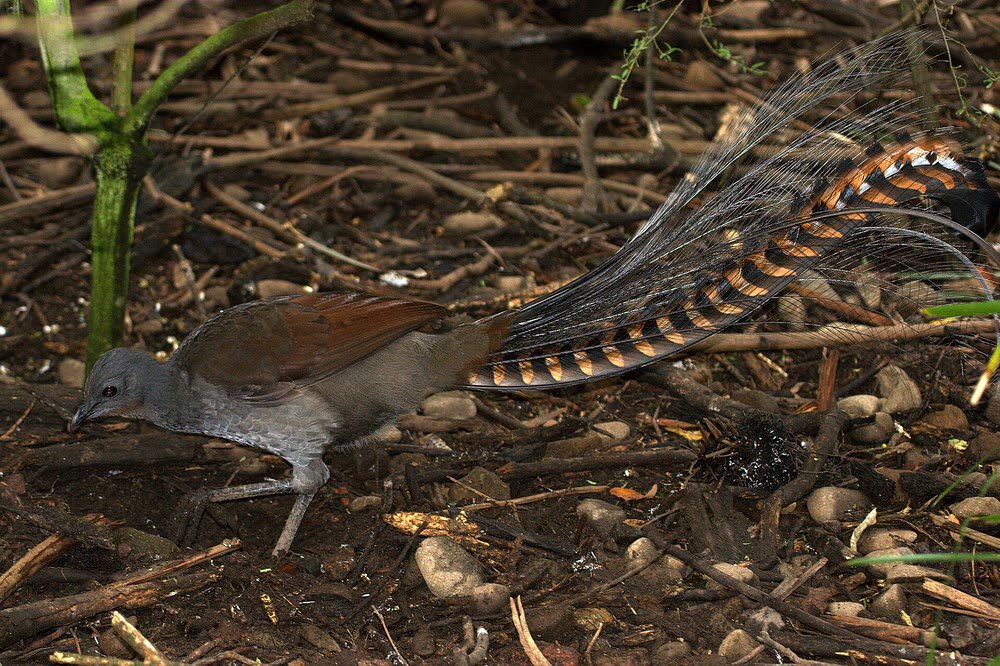
A superb lyrebird at Mount Buffalo, Victoria. Photo: John Manger, CSIRO, CC BY 3.0, via Wikimedia Commons
Tone and feelings (mothúcháin)
The tone moves from wry to grave: a joke at the listener’s expense, then wonder, then the sombre image of a wound.
- Iontas (EEN-tus), wonder: at sounds the listener has never heard before.
- Umhlaíocht (OOL-ee-ukht), humility: the poet owns up to what he can’t understand.
- Ómós (OH-mohss), respect: for a culture that doesn’t owe outsiders an explanation.
- Brón (BROHN) and náire (NAW-ruh), sorrow and shame: at a colonial history in which the Irish had a share.
Key Irish words for Dijeridiú
Meanings are from Ó Dónaill (teanglann.ie) or focloir.ie. Respellings are rough and lean towards de Paor’s Munster Irish, where a long second syllable often takes the stress. The first group comes from lines critics have quoted, so check them against your anthology.
- ceol (KYOHL): music. Ceol éan is birdsong.
- stair (STAR): history; also a story or account.
- cine (KIN-uh): race, people. A chine (uh HIN-uh) means “of his people”.
- sil (SHIL): drip or trickle. Ag sileadh (eg SHIL-uh) is dripping; ag sileadh fola, dripping blood.
- ionathar (UN-uh-hur): entrails, bowels, insides.
- pollta (roughly POWL-tuh): pierced, holed, from poll, to pierce or puncture.
- éist (AYSHT): listen. Ag éisteacht (eg AYSH-chukht) means listening.
- dhá chéad bliain (ghaw hyayd BLEE-in): two hundred years.
- liréan (LIR-ayn; lir-AYN in Munster): lyrebird.
- pearóid (PAR-ohj; pa-ROHJ in Munster), plural pearóidí: parrot.
- croí (KREE): heart.
And for writing about the poem:
- bundúchasach (bun-DOO-khuh-sukh): an Aboriginal person, or Aboriginal. Dúchasach alone means native or indigenous.
- coilíneach (kil-EE-nyukh): a colonist, or colonial. Coilíneachas is colonialism.
- díshealbhú (DEE-hal-uh-voo): dispossession, eviction.
- nathair (NA-hir): snake. A ciseán (kish-AWN) is a wicker basket.
Exam notes and Irish phrases
Dijeridiú is poem (iv) of the additional poetry, section 3(b), in circular 0041/2026 from the Department of Education and Youth: Higher Level only, June 2027 and June 2028. The other four are Trén bhFearann Breac by Colm Breathnach, Eanáir 1991 by Biddy Jenkinson (also in Leabhar na hAthghabhála), Ag Tiomáint Siar by Nuala Ní Dhomhnaill and Raftery’s Anthony Daly.
Higher Level students must study either one prose work from 3(a) or all five 3(b) poems. You can do both, but the exam has you answer on just one. The whole list is new for 2027; up to June 2026, the additional poems included Caoineadh Airt Uí Laoghaire.
Short questions on an author, background and context may also be asked, says the circular, so know de Paor’s life and Australian years. Worth having ready:
- the main theme, and two or three images that carry it;
- the contrast between Irish music and the didgeridoo;
- each feeling, backed by a brief quote from your anthology;
- your own response: did the poem’s honesty about not understanding work for you?
Irish phrases to use in your answer
- Seasann an dijeridiú do chultúr na mBundúchasach. (The didgeridoo stands for Aboriginal culture.)
- Tá codarsnacht ghéar idir ceol na hÉireann agus ceol an dijeridiú. (There’s a sharp contrast between Irish music and the music of the didgeridoo.)
- Admhaíonn an file nach féidir le duine ón taobh amuigh cultúr eile a thuiscint go hiomlán. (The poet admits that an outsider can’t fully understand another culture.)
- Admhaíonn sé freisin go raibh na hÉireannaigh páirteach i ndíshealbhú na mBundúchasach. (He also admits that the Irish had a part in dispossessing Aboriginal people.)
- Thaitin an dán liom toisc go spreagann sé ceisteanna faoi chultúr agus faoi stair. (I liked the poem because it raises questions about culture and history.)
Who is Louis de Paor?
Cork is his home city (more in my facts about Cork), and he was born there on 27 June 1961. He studied Irish and folklore at University College Cork, then wrote a doctorate on the short stories of Máirtín Ó Cadhain, awarded in 1986.
Bloodaxe calls him a key figure in the renaissance of poetry in Irish in the 1980s and 90s. He edited the journal Innti, which gave its name to that generation, among them Michael Davitt and Nuala Ní Dhomhnaill, who appears among my famous Irish poets.
His first collection, Próca Solais is Luatha (1988), won Duais an Ríordánaigh, the Oireachtas prize named for Seán Ó Ríordáin, poet of Cúl an Tí, and he has won it three more times since. In 2000 the Lawrence O’Shaughnessy Award for poetry went to him, the first Irish-language poet to receive it, and he became director of the Centre for Irish Studies at what is now the University of Galway. His bilingual books with Bloodaxe include Crooked Love / Grá fiar (2022).
His anthology Leabhar na hAthghabhála, 25 poets and a century of poetry in Irish with translations, follows on from An Duanaire: Poems of the Dispossessed, 1600 to 1900 (1981), says Bloodaxe. Athghabháil means recapture or recovery: poems taken back, after poems taken away.
Dijeridiú FAQ
What is Dijeridiú about?
A listener, plainly an Irish one, hears a didgeridoo in Australia and can’t fully understand it. Only a very patient listener could hear in it the painful history of the player’s people, a history the Irish shared in as settlers.
Is Dijeridiú on the Leaving Cert in 2027 and 2028?
Yes, but only at Higher Level, as one of the five additional poems in section 3(b). If your class takes the additional prose in 3(a) instead, you won’t need it, and it isn’t on the Ordinary Level course.
Where can I find the poem?
In Leabhar na hAthghabhála (2016), the book named in the circular, on pages 470 to 471 with Kevin Anderson’s translation, and in de Paor’s bilingual The Brindled Cat and the Nightingale’s Tongue (2014). On the anthology’s page at Bloodaxe Books you can watch him perform it: with Kev Carmody in the TG4 film, and in a 2017 reading at his home.
Is “didgeridoo” an Irish word?
Probably not. A theory that turns up online says it comes from the Irish dúdaire dubh, supposedly a black trumpeter. But the Australian National Dictionary Centre says the word most likely began as an imitation of the instrument’s sound, and Ó Dónaill’s dictionary gives dúdaire as a hummer or crooner, an eavesdropper, a long-necked person or a dolt.
Love this? Save it to your Pinterest board for later.
Pin image: Evening light over the floodplain below the rocks at Ubirr, Kakadu National Park, Northern Territory. Photo: Dietmar Rabich / Wikimedia Commons / CC BY-SA 4.0
A little bit of Ireland in your inbox every Friday ☘️
The free Weekly Dose of Irish: an Irish joke, a Celtic symbol, an Irish fact, a poem and the week’s best articles in one short email. Join 9,600+ readers.
Free. One short email every Friday. Unsubscribe any time.
More Irish poetry
- Leaving Cert Irish Poems 2027 and 2028: The Full List, Explained
- Anthony Daly by Raftery: The Poem, a Translation and Notes for Leaving Cert Irish
- Caoineadh Airt Uí Laoghaire: The Greatest Lament in the Irish Language
- Cúl an Tí by Seán Ó Ríordáin: Meaning and Analysis
- Famous Irish Poets: The Greatest of All Time, in Order
- The Irish Potato Famine (An Gorta Mór): Ireland’s Great Hunger, 1845 to 1852
- Facts About Cork, Ireland: Why We Call It the Real Capital
Featured image: Evening light over the floodplain below the rocks at Ubirr, Kakadu National Park, Northern Territory. Photo: Dietmar Rabich / Wikimedia Commons / CC BY-SA 4.0.