
Irish trifle is the sherry trifle served at Christmas in many Irish homes: sponge or Swiss roll soaked in sweet sherry, fruit set in raspberry or strawberry jelly (or a layer of jam instead), then custard and whipped cream, finished with toasted almonds, glacé cherries or hundreds and thousands. It is essentially the same dish as the English sherry trifle, and cooks on both sides of the Irish Sea argue about the jelly. This recipe serves 10 to 12 and needs at least 5 hours in the fridge.
Some desserts get the good glass bowl. In Darina Allen’s childhood home, the Christmas trifle was served in “a special cut glass bowl kept especially for the purpose”. Her mother, Elizabeth O’Connell, ended up hiding the bowl in her wardrobe so the boys of the house couldn’t get at it after a night out.
That’s the point of a trifle: everyone should see the layers. The recipe comes first, in metric and US measures.
Jump to:
- Irish trifle recipe
- US measures and swaps (Jell-O, pound cake, Bird’s)
- Alcohol-free trifle for the kids
- Make-ahead timing and how long it keeps
- Irish trifle vs English trifle: jelly or no jelly?
- A short history of trifle
- How to say trifle in Irish
- Irish trifle FAQ
- More Irish Christmas reading
Irish trifle recipe
This version has a jelly layer. For the jam-only kind, see Variations.
Prep: 45 minutes | Cook: 15 minutes | Chill: at least 5 hours, ideally overnight | Serves: 10 to 12 | You’ll need: a 2.5 to 3 litre (about 3 US quart) glass bowl
Ingredients
- 1 jam Swiss roll, about 250 to 300g (9 to 10½ oz), or 250g (9 oz) plain sponge or 8 trifle sponges, spread with 4 tbsp raspberry jam
- 120ml (½ US cup) sweet or medium sherry, such as a cream sherry
- 300g (about 2½ US cups) raspberries, fresh or frozen, or a 400 to 425g (14 to 15 oz) tin of peaches or fruit cocktail, drained
- 1 packet (135g) raspberry or strawberry jelly, or one 3 oz (85g) box of raspberry or strawberry Jell-O
- 600ml (2½ US cups) whole milk
- 4 large egg yolks
- 60g (5 US tbsp) caster sugar (superfine or granulated sugar in the US)
- 2 tbsp cornflour (cornstarch)
- 1 tsp vanilla extract
- 400ml (1⅔ US cups) double or whipping cream (heavy cream in the US)
- 1 tbsp icing sugar (powdered sugar), optional
- To decorate: 2 tbsp toasted flaked almonds (sliced almonds), 6 to 8 glacé cherries (candied cherries), halved, and a shake of hundreds and thousands (nonpareils)
Short on time? Swap the milk, yolks, sugar, cornflour and vanilla for 600ml (2½ US cups) of ready-made custard, or packet custard made up as the label says.
Method
- Slice the Swiss roll into rounds about 1.5cm (½ inch) thick. Pack them over the base of the bowl and press a few against the sides so the spirals show through the glass. For plain sponge, split it, spread it with jam, sandwich it back together and cut it into fingers.
- Spoon the sherry evenly over the sponge and leave it to soak for 10 minutes. Scatter the fruit on top.
- Make up the jelly. For a 135g packet, dissolve the cubes in boiling water up to the 285ml mark on a jug, then add cold water up to 570ml (1 pint). For a 3 oz box of Jell-O, stir it into 1 cup of boiling water for 2 minutes, then add 1 cup of cold water. Let it cool to room temperature, pour it over the fruit and sponge, and chill for about 4 hours, until firm.
- Meanwhile, make the custard. Heat the milk in a heavy pan until it steams. In a bowl, whisk the yolks, sugar and cornflour until smooth, then whisk in the hot milk a little at a time.
- Pour it back into the pan and stir constantly over a medium-low heat for 5 to 8 minutes, until it thickens and the first bubbles break the surface. The cornflour keeps it from curdling. Stir for 1 minute more, then remove from the heat and add the vanilla.
- Pour the custard into a jug, press baking paper or cling film onto the surface so no skin forms, and leave it until completely cold. Warm custard will melt the jelly.
- Once the jelly has set, stir the cold custard and spread it over the top. Cover and chill for at least an hour, or overnight.
- Shortly before serving, whip the cream (with the icing sugar, if using) to soft peaks and spread or pipe it over the custard. Scatter over the almonds and cherries, and add the hundreds and thousands at the very last minute.
Tips
Which sherry? Darina Allen asks for the best sweet or medium sherry you can get, and in A Simply Delicious Christmas she says her family uses Bristol Cream. Skip cooking sherry.
Fruit that won’t set. The Chivers jelly packet warns that fresh kiwi, pineapple or papaya will stop jelly setting, so keep them out of the jelly layer.
Sprinkles go last. Hundreds and thousands can bleed colour into whipped cream as they sit, so add them just before the bowl goes to the table.
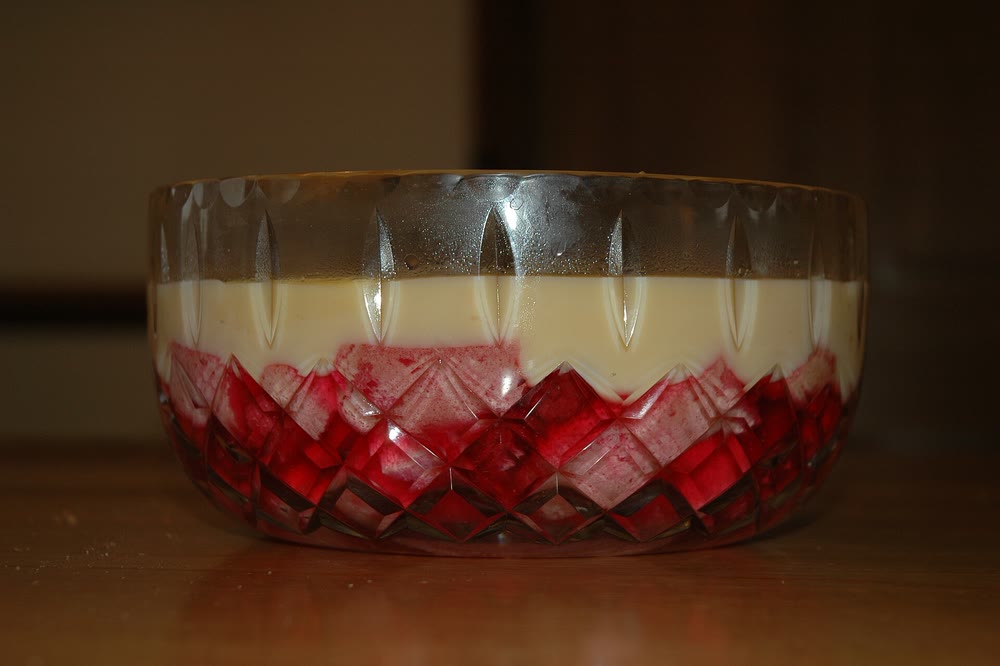
A trifle at the custard stage, before the cream goes on. Photo: Benjah-bmm27, public domain, via Wikimedia Commons
Variations
- Jam, no jelly: Darina Allen’s family trifle has no jelly at all: sponge sandwiched with raspberry jam, plenty of sherry, two layers of homemade egg custard and whipped cream.
- Port: Neven Maguire suggests port as an occasional swap for the sherry in his mother Vera’s trifle.
- Irish whiskey: Eunice Power’s mandarin trifle in The Irish Times uses a whiskey syrup, and Colm O’Gorman’s in the Irish Examiner puts whiskey in the cream. Or mix 3 tbsp whiskey with orange juice to make 120ml.
- Irish cream top: fold 2 or 3 tablespoons of homemade Irish cream into the whipped cream.
- Glasses: Rory O’Connell of Ballymaloe Cookery School layers his in individual glasses.
US measures and swaps: Jell-O, pound cake and Bird’s custard
- Jelly is Jell-O. In Ireland, jelly means the wobbly dessert (the American spread is closer to Irish jam). A 3 oz box of Jell-O sets 2 cups of liquid, a little less than an Irish 135g packet’s 570ml, and needs about 4 hours to firm up.
- Swiss roll is jelly roll. Pound cake works well too: slice it, spread it with raspberry jam and cut it into fingers. Crisp Italian ladyfingers (savoiardi) soak up sherry nicely as well.
- Custard. Bird’s custard powder is sold online and in shops that stock British and Irish groceries, or use the homemade custard or a cooked vanilla pudding.
- Cream and toppings. Use heavy cream. Hundreds and thousands are nonpareils, flaked almonds are sliced almonds, and glacé cherries are candied cherries, often in the baking aisle around the holidays.
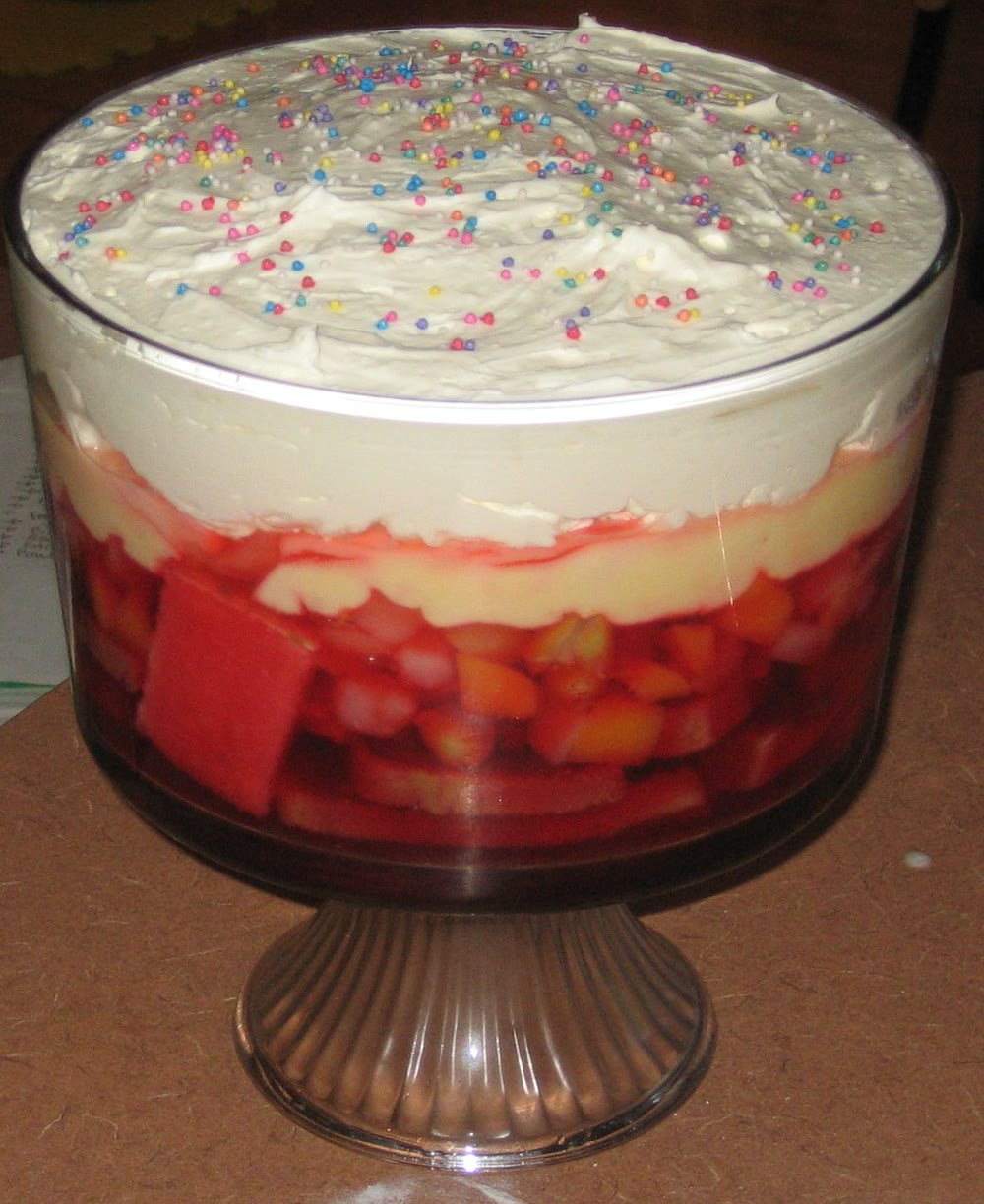
A family trifle made with pound cake, fruit cocktail and Jell-O. Photo: Dlublink, CC BY 3.0, via Wikimedia Commons
Alcohol-free trifle for the kids
The sherry in a trifle is never cooked, so the alcohol stays in. If children or non-drinkers are at the table, swap the sherry for the same amount of orange juice, apple juice or juice from the tinned fruit.
Making both? Use two bowls and label the sherry one.
Make-ahead timing and how long trifle keeps
Trifle is better made ahead: Darina Allen and Rory O’Connell both prefer to leave theirs overnight to mature, adding the cream just before serving.
Christmas Day 2026 falls on a Friday. Here’s a timetable:
- Christmas Eve (Thursday 24 December), morning: sponge, sherry, fruit and jelly. Chill.
- Christmas Eve, evening: make the custard, cool it and spread it over the set jelly. Cover and chill overnight.
- Christmas Day: whip the cream and decorate just before dinner.
For Thanksgiving (Thursday 26 November 2026), start on the Wednesday.
Keeping it safe. Keep the trifle covered in the fridge and put it back after dessert: safefood advises against eating food left at room temperature longer than 2 hours.
The Food Safety Authority of Ireland says leftovers belong in the fridge at 0 to 5°C (FoodSafety.gov says 40°F or below) and should be used within 2 to 3 days. The Chivers packet says 2 days for made-up jelly, so aim for 2.
Don’t freeze it. FoodSafety.gov’s storage chart says not to freeze custard pies, and a trifle’s custard layer is best treated the same way. Freeze a plain sponge ahead instead.
Irish trifle vs English trifle: jelly or no jelly?
Honestly, they’re the same dessert. Alan Davidson’s Oxford Companion to Food calls trifle a traditional English sweet: sponge moistened with sherry or white wine, a rich custard, jam or fruit, and whipped cream, often decorated with almonds, glacé cherries or angelica. That’s exactly what goes into the Irish Christmas bowl.
The real argument is about jelly, and it runs in both countries.
- In The Irish Times in 2023, Beth O’Brien described the classic Christmas trifle as sherry-soaked sponge with fruit and jelly, then custard and whipped cream. Her family still makes a small one for her dad, who insists Christmas isn’t Christmas without it.
- Marie Claire Digby, also in The Irish Times, said most Christmas tables have a trifle, and listed “jelly or no jelly” among its great debates, along with Bird’s or homemade custard.
- Some of Ireland’s best-known cooks leave the jelly out. Darina Allen’s family recipe uses raspberry jam, as does Rory O’Connell’s on RTÉ, and Neven Maguire’s (his mother Vera’s) uses fruit poached in sherry.
- In Britain, Helen Saberi and Alan Davidson note in their history of the dish, Trifle, that whether jelly belongs has been debated, sometimes heatedly: is it traditional, or a vulgar mistake that purists should avoid?
Jelly isn’t a modern shortcut, though: Hannah Glasse set a trifle on jelly around 1760. Use it if your family always did.
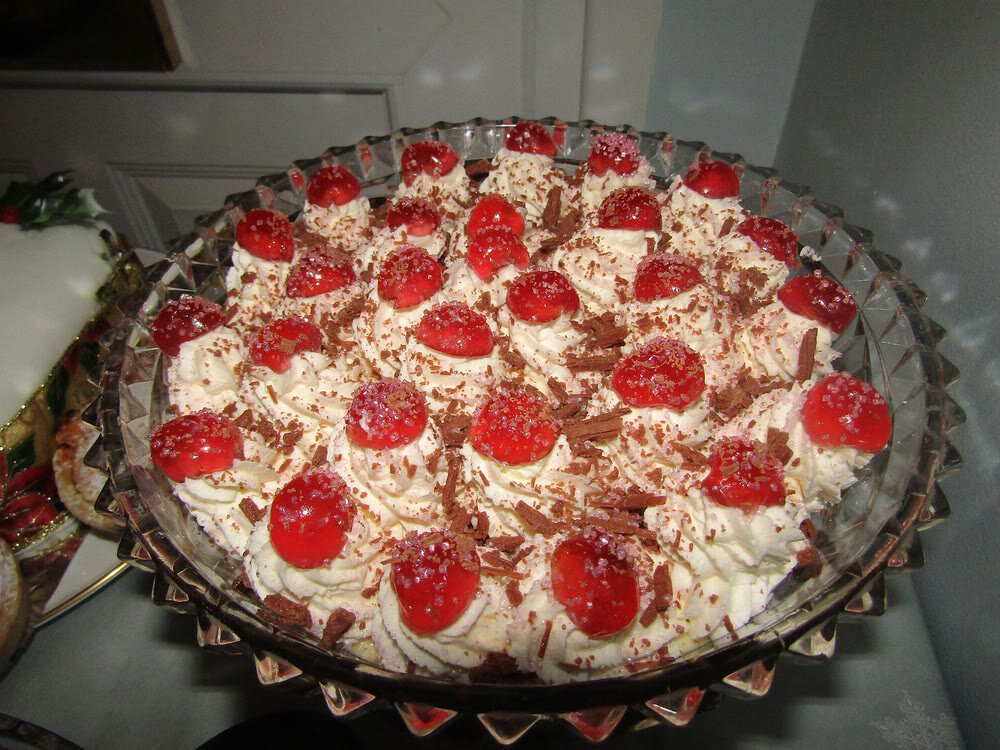
A sherry trifle made for a New Year’s Eve party in Cromer, Norfolk, England. Photo: Kolforn, CC BY-SA 4.0, via Wikimedia Commons
Neven Maguire remembers his mother’s trifle as a lighter choice than Christmas pudding. The rest of the spread is in my Irish Christmas pudding, Irish Christmas cake and porter cake recipes, and the customs around the meal are in my guide to Irish Christmas traditions.
A short history of trifle
1596: a bowl of warm cream
The earliest known trifle recipe comes from Thomas Dawson’s English cookbook The Good Huswifes Jewell, in 1596. It’s a pint of thick cream seasoned with sugar, ginger and rosewater, warmed until lukewarm over a chafing dish and served in a silver dish or bowl. Saberi and Davidson call this early kind the “fool-trifle”: sweet cream, with no cake in sight.
1750s: biscuits, wine, custard and syllabub
The trifle we’d recognise turns up in the mid-18th century. The earliest written recipe of this kind that Saberi and Davidson found is in a manuscript recipe book thought to come from Devon, dated 8 May 1750 and credited to “Sister Nanny”: Savoy biscuits wetted with white wine, a cold custard and syllabub on top.
The first printed recipes followed in 1751, in The Lady’s Companion and in the fourth edition of Hannah Glasse’s The Art of Cookery Made Plain and Easy. Glasse broke Naples biscuits, macaroons and ratafia cakes into a bowl and told the cook to “Just wet them all through with Sack”, then added boiled custard and syllabub.
Around 1760, in The Compleat Confectioner, she published “A grand trifle”: a deep dish half filled with calves’-foot jelly, with biscuits and macaroons pushed in before it set, then cream and a heaped froth of lemon cream. Saberi and Davidson think it’s the first trifle built on jelly.
1861: Mrs Beeton’s sherry and brandy trifle
Isabella Beeton’s Book of Household Management (1861) soaks sponge cakes, macaroons and ratafias in sherry or sweet wine with six tablespoons of brandy, adds jam, almonds and lemon rind, then a rich custard and a whipped topping made the day before. Small coloured comfits on top, she wrote, were “now considered rather old-fashioned”.
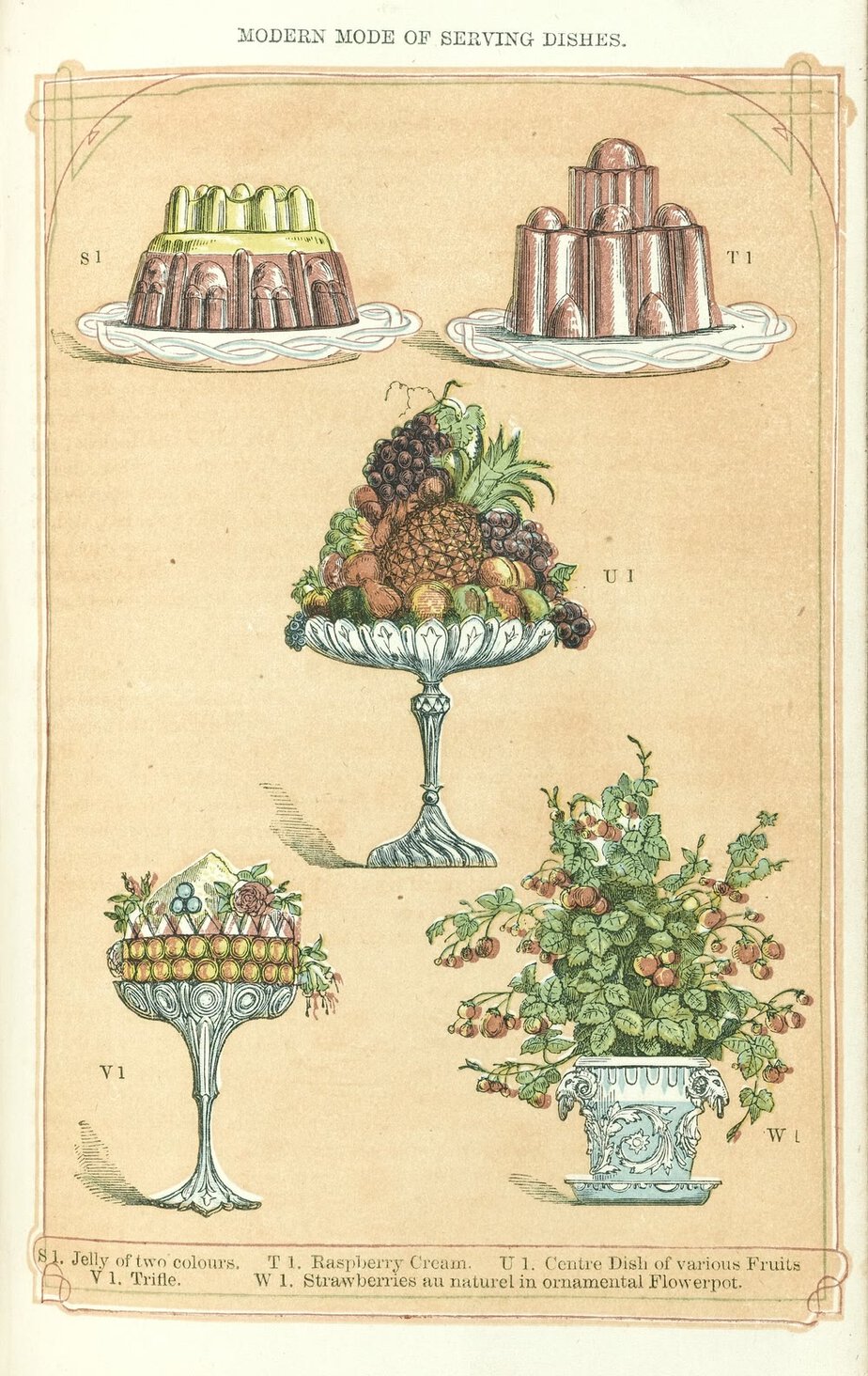
Mrs Beeton’s trifle (V1, bottom left) on a colour plate from The Book of Household Management, 1861. Wellcome Collection, CC BY 4.0, via Wikimedia Commons
Custard powder and packet jelly
Two factory shortcuts helped. Alfred Bird, a Birmingham chemist, is said to have created egg-free custard powder because his wife couldn’t eat eggs; the usual date is 1837, and Grace’s Guide has him making it on a large scale from 1843. Mass-produced jelly, Gerry Godley notes in The Irish Times, saved cooks from boiling calves’ feet.
Trifle in Ireland
Glasse had Irish links. Her husband, John Glasse, was an Irish soldier, and a Dublin edition of The Art of Cookery, printed by E. and J. Exshaw, appeared in 1748, the year after the first London edition. Saberi and Davidson’s book includes Irish recipes and stories too, from Myrtle Allen of Ballymaloe and Monica Sheridan.
Trifle the dessert is rare in the transcribed pages of the 1930s Schools’ Collection. One account from Rathkeale, Co. Limerick, puts it on the Halloween party supper, with jam tarts, jellies, nuts and fruit.
How to say trifle in Irish
The Irish for trifle is traidhfil (roughly TRY-fil), which Ó Dónaill’s dictionary marks as a cookery word. Foras na Gaeilge’s English-Irish dictionary gives sherry trifle as traidhfil seirise (TRY-fil SHER-ish-eh).
- seiris (SHER-ish): sherry
- glóthach (GLOH-hukh): jelly, the dessert
- custard (KUS-tard): custard, spelled the same in Irish
For Nollaig Shona Duit and more words for the day, see my guide to Merry Christmas in Irish.
Irish trifle FAQ
What is Irish trifle made of?
Sponge or Swiss roll soaked in sherry, fruit set in jelly (or a layer of raspberry jam), custard and whipped cream, decorated with almonds, glacé cherries or hundreds and thousands.
What is the difference between Irish trifle and English trifle?
Essentially none. Both are sherry trifles, and cooks in both countries argue over whether jelly belongs.
Do you put jelly in a sherry trifle?
Many families do and many don’t. Darina Allen’s mother used jam instead. Trifles built on jelly go back to about 1760.
Can you make trifle the day before?
Yes, and it’s better for it. Build everything up to the custard the day before, chill it overnight, and add the cream and decorations on the day.
How long does trifle last in the fridge?
Covered in the fridge, aim to finish it within 2 days, and don’t leave it out for more than 2 hours.
Can you freeze trifle?
Best not, once it’s assembled. FoodSafety.gov advises against freezing custard pies. Freeze a plain sponge ahead instead.
Love this? Save it to your Pinterest board for later.
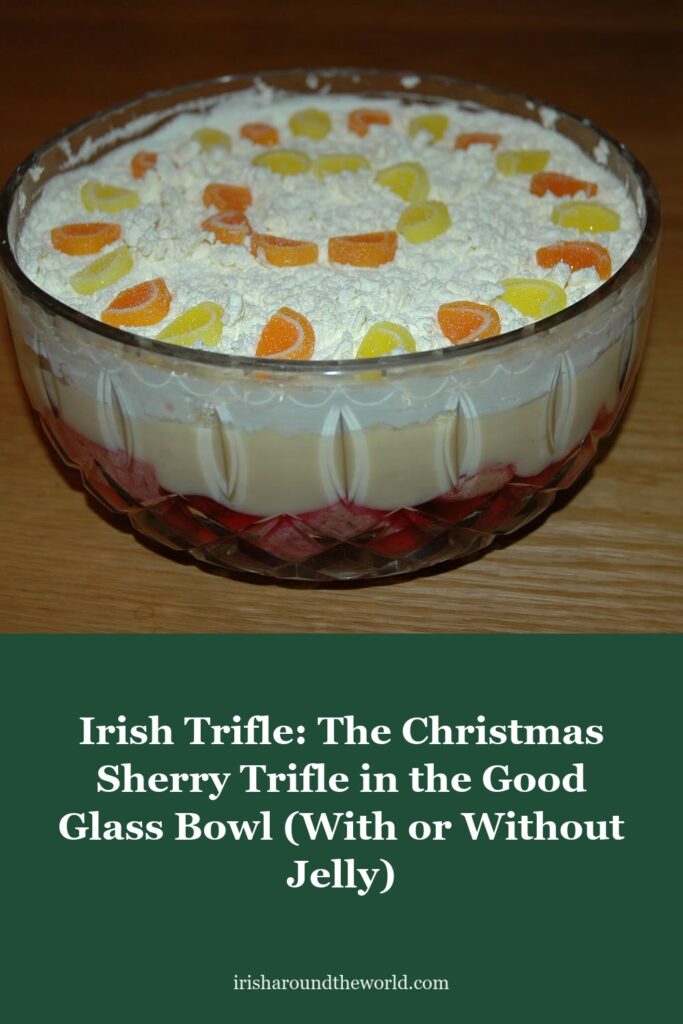
Pin image: A raspberry sherry trifle in a cut-glass bowl. Photo: Benjah-bmm27, public domain, via Wikimedia Commons
A little bit of Ireland in your inbox every Friday ☘️
The free Weekly Dose of Irish: an Irish joke, a Celtic symbol, an Irish fact, a poem and the week’s best articles in one short email. Join 9,600+ readers.
Free. One short email every Friday. Unsubscribe any time.
More Irish Christmas reading
- Irish Christmas Pudding Recipe: The Guinness Pud With a Coin Inside (Make It on Stir-Up Sunday)
- Irish Christmas Cake Recipe: The Whiskey-Fed Fruit Cake You Make Weeks Ahead
- Irish Porter Cake Recipe: The Stout-Soaked Fruit Cake You Never Have to Ice
- Homemade Irish Cream: The 5-Minute Christmas Gift (and the Story of How Baileys Was Invented)
- Irish Potato Stuffing: The Traditional Turkey and Goose Stuffing Made With Mashed Potatoes
- 18 Irish Christmas Traditions, From the Candle in the Window to the 12 Pubs
- The Irish 12 Days of Christmas: Frank Kelly’s Christmas Countdown, Where Every Gift Makes Things Worse
- Christmas Markets in Ireland 2026: Dates, Where to Go and What to Expect
- Merry Christmas in Irish: How to Say Nollaig Shona Duit (Plus 35 Christmas Words)
Featured image: A raspberry sherry trifle in a cut-glass bowl. Photo: Benjah-bmm27, public domain, via Wikimedia Commons.