Here’s how to pronounce the Irish boy names people get wrong most. Tadhg is TIE-g, one syllable. Oisín is UH-sheen or OSH-een. Eoghan is OH-in, like Owen. Cathal is KAH-hal, Domhnall is DOH-nal, Caoimhín is KEE-veen (kwee-VEEN in Cork), Dáithí is DAH-hee, Ruairí is ROO-ree and Comhghall is COW-al. Three short videos below let you hear all nine said out loud.
I’m Stephen, from Co. Cork, and I run Irish Around The World. Maybe somebody in Sydney or Boston has a new nephew called Tadhg and the whole office is saying ‘Tad-g’. Or you’re about to name the baby Oisín and want to know two things: how do you say it, and will anyone outside Ireland manage it? Don’t worry; you are not the first person to Google this. Irish spelling looks like a cat walked across the keyboard until you know a few rules.
An H after a letter changes it. Bh and mh come out as V or W, or disappear and stretch the vowel next to them. Dh and gh usually go quiet and stretch the vowel too. Th is nearly always a plain H (Cathal, Dáithí), never the English ‘th’, and sometimes it vanishes altogether, as in Bláthnaid (BLAW-nid).
The fada, the little accent, makes a vowel long: á is AH, í is EE, ó is OH. Ao is usually EE (Aoife, Caoimhín), though in Munster it’s often AY, which is why Aodh is AY. In Cork we also slip a W in after the C, so Caoimhín becomes kwee-VEEN. Put an S beside an E or an I and it turns into SH, which is what’s going on in Oisín. The other vowels are there for grammar, not for you. Don’t try to say every letter.
Stress nearly always lands on the first syllable, except in Munster, where we throw it onto the long one. That’s why both KEE-veen and kwee-VEEN are right for Caoimhín. These are all approximate, mind. Say any of them in a different county and somebody will tell you you’re wrong.
| Name | Say it | English version |
|---|---|---|
| Domhnall | DOH-nal | Donal (Donald in Scotland) |
| Eoghan | OH-in (like Owen) | Owen, Eugene |
| Oisín | UH-sheen or OSH-een | Ossian |
| Caoimhín | KEE-veen or kwee-VEEN | Kevin |
| Tadhg | TIE-g | Tim, Thady (sound-alikes) |
| Dáithí | DAH-hee | David |
| Ruairí | ROO-ree | Rory |
| Cathal | KAH-hal | Charles (traditional stand-in) |
| Comhghall | COW-al (KOH-al further south) | Cole, Cowal |
Domhnall, Eoghan, Oisín, Caoimhín and Tadhg
In this first video you’ll hear five Irish boy names that trip up almost everyone outside Ireland, including Tadhg (8th in Ireland in 2025) and Oisín (5th).
1. Domhnall
Say it DOH-nal, rhyming with ‘tonal’. The mh is silent and just lengthens the O, so there is no M sound. It’s the same name as Donald, which is how the Scots anglicised it, but in Ireland it became Donal. Whichever spelling, there is no D on the end when you say it. It means ‘world ruler’. Domnall mac Áedo, who died in 642, was one of several High Kings to carry it. Daniel O’Connell, the Liberator, is Dónall Ó Conaill in Irish. The actor Domhnall Gleeson has joked about being called ‘Dom-nom-nall’. It’s rare now: Domhnall, Dónal and Donal together came to just 16 boys in Ireland in 2025.
2. Eoghan
Say it OH-in, basically Owen. The gh is silent and the eo is a long O, so it is not YO-han. The meaning is uncertain: possibly ‘born of the yew tree’, though some trace it to the Latin Eugenius, ‘well-born’. Eógan Mór was an early king of Munster, and Tyrone (Tír Eoghain) is named after another Eógan. It sounds the same as Eoin, but Eoin is John. Different name. Eoghan was 132nd in Ireland in 2025.
3. Oisín
Say it UH-sheen or OSH-een (as in ‘gosh’). Down here in Cork and Kerry we say uh-SHEEN, with the stress on the end. The S is SH and the ‘oi’ is never the English ‘oy’, so OY-sin is out. It means ‘little deer’. Oisín was the son of Fionn mac Cumhaill and Sadhbh, who had been turned into a deer. Niamh took him to Tír na nÓg, the Land of the Young. He stayed what felt like three years. It was 300. He rode home on her white horse, touched the ground, and aged on the spot. It was 5th in Ireland in 2025 and has been a top-20 name for over 15 years. Champion jockey Oisín Murphy is one.
4. Caoimhín
Say it KEE-veen in most of Ireland and kwee-VEEN in Munster, where we slip in the W and push the stress onto the long end. The ao is EE and the mh is a V. It is the Irish form of Kevin and means ‘beloved birth’ or ‘gentle birth’, from Old Irish cóem (dear, gentle) and gein (birth). St Caoimhín founded the monastery at Glendalough in the sixth century and is a patron saint of Dublin. The goalkeeper Caoimhín Kelleher is a Cork man, so at home it’s kwee-VEEN, and even Liverpool struggled with it during his years there. The name has crept up from 10 boys in 2020 to 23 in 2025, and he may have something to do with that.
5. Tadhg
Say it TIE-g, one syllable, like the TIGE in tiger. The dh is silent and turns the A into a long ‘eye’ sound, so it is not TAD-g. It means ‘poet’ (and, going back far enough, possibly ‘badger’). Tadg mac Nuadat was the druid grandfather of Fionn mac Cumhaill. ‘Tadhg an mhargaidh’ (Tadhg of the market) means the man in the street. ‘Taig’ is a sectarian slur in the North, so leave that spelling alone. Tadhg was 8th in Ireland in 2025, up from 92nd in 2000. Tadhg Furlong has it, and so does Tadhg Kennelly, who won an AFL premiership with the Sydney Swans in 2005 and an All-Ireland with Kerry in 2009.
Dáithí, Ruairí and Cathal
The second video takes three names that all belonged to kings of Connacht: Dáithí, Ruairí and Cathal.
6. Dáithí
Say it DAH-hee, or DAW-hee in a broad Munster mouth. The th is a plain H and the á is AH, never AY. It means ‘swiftness’, and since the Gaelic Revival it has served as the Irish for David, though the two are unrelated. The original was Nath Í, a fifth-century King of Connacht, and in some old tellings the last pagan High King. Tradition says he was killed by lightning in the Alps, though scholars suspect ‘Alps’ was really Alba, meaning Britain. Dáithí Ó Sé of the Rose of Tralee is the one from the telly. Counting Dáithí and Daithí together, about 180 boys got the name in Ireland in 2025, roughly top 30.
7. Ruairí
Say it ROO-ree, stress on the first syllable. The ua glides ROO-uh, and the rest is just REE; don’t lean on an AIR sound. It means ‘red king’, from ruadh (red) and rí (king). Ruaidrí Ua Conchobair, King of Connacht, was the last High King of Ireland, and was on the throne when the Normans landed in 1169. Ruaidhrí is the older spelling, said the same way. Rory is the English version, handy for coffee cups, so Rory McIlroy is a Ruairí whether he likes it or not. Ruairí was 67th in Ireland in 2025 and Rory 60th; counted together they’d be around 27th.
8. Cathal
Say it KAH-hal. The th is a plain H, and nobody in Ireland says KATH-al. In Dublin you’ll often hear it rounder, closer to KAW-hul. It means ‘battle ruler’. Cathal Crobhdearg, Cathal of the Red Hand, was King of Connacht from 1189 (unchallenged from 1202) until his death in 1224. He was a brother of that last High King, and he founded Ballintubber Abbey in 1216. Cathal Brugha, first President of Dáil Éireann in 1919, has a Dublin street and a barracks named after him. Cathal was 90th in Ireland in 2025, still solidly top 100.
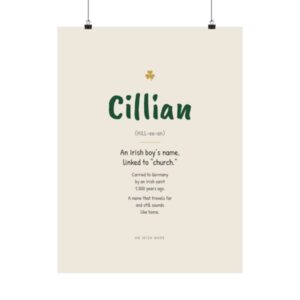
Love Irish names? We made prints of them.
Our Irish name meaning prints show the name, how to say it and what it means. There are 26 names so far, from Cillian and Darragh to Setanta and Fionnbarra.
From our own little Etsy shop. Or see all 26 Irish name prints.
Comhghall, the name that catches everyone out
The last video is a single name, because it deserves the time: listen for how little of the spelling you actually hear.
9. Comhghall
Say it COW-al, the way you hear it in the video. The mh and the gh between the vowels are a soft breath or nothing, so neither the M nor the G is heard, and com-GALL is wrong.
This is the one name where the sources disagree, and it comes down to region. St Comgall was an Ulster man, and in Ulster Irish the mh comes out through the nose, which gives you that COW sound. The Cowal peninsula in Scotland takes its name from another Comgall and keeps the same sound. Further south you will hear it closer to KOH-al, run together almost to KOHL, and Woulfe’s 1923 book anglicises it as Cole. The Donegal surname Mac Giolla Chomhghaill (‘servant of Comgall’) gave Cole and MacCole but also MacCool and Coyle, which shows how much the sound moved around. If the video and your granny disagree, they are both right.
It means ‘fellow hostage’ or ‘co-pledge’, from com (together) and gíall (hostage). The famous bearer is St Comgall, an Antrim man who founded Bangor Abbey in Co. Down in the 550s. Columbanus and Gall trained there, and Comgall was a close friend of Colmcille. His feast day is 10 May. As a first name it’s all but gone. It has never appeared in the CSO baby-name lists, which go back to 1964 and only count names given to three or more boys a year. If you meet one, buy him a pint.
Questions people ask about Irish boy names
How do you pronounce Tadhg?
TIE-g, one syllable, the first bit of tiger. The dh is silent and stretches the A into a long ‘eye’ sound. In Donegal you may hear TAYG.
Is Oisín pronounced Osheen or Usheen?
Both are right. Connacht says OSH-een, most of English-speaking Ireland says UH-sheen, and Cork and Kerry say uh-SHEEN with the stress at the end. The only wrong one is OY-sin.
Is Eoghan pronounced the same as Eoin?
Yes, both are OH-in, like Owen. They are different names, though. Eoghan possibly means ‘born of the yew tree’, though some trace it to the Latin Eugenius, ‘well-born’. Eoin is the Irish for John.
How do you pronounce Caoimhín?
KEE-veen in most of Ireland, kwee-VEEN in Cork and Kerry. It is the Irish for Kevin.
Why are Irish names spelled so differently from how they sound?
The letters are not really silent; they are instructions. An H after a consonant tells you to soften or drop that consonant, and the vowel beside it often gets longer. Extra vowels tell you how to say the letter beside them, like the I that turns the S in Oisín into SH. Read them as signals and Tadhg stops looking like a typo.
More Irish names and words
That’s the nine. Owen, Rory, Kevin and David do the heavy lifting overseas for Eoghan, Ruairí, Caoimhín and Dáithí. Tadhg and Oisín take one explanation and then stick, because they are short. Comhghall you will be explaining at every parent-teacher meeting until he is 18. If you got through those without needing a drink, my 300 Irish baby names post has plenty more to trip you up, and the girls’ names are worse. Slán ☘️
- How to pronounce Irish girl names
- 300 Irish Baby Names: Boys, Girls and Their Meanings
- How to Say Cheers in Irish (Sláinte)
- 25 Easy Irish Greetings With Pronunciation
- Top 100 Irish Surnames From Each County
- 131 Top Irish Slang Words
- 150 Irish Sayings and Blessings
Love this? Save it to your Pinterest board for later.
A little bit of Ireland in your inbox every Friday ☘️
The free Weekly Dose of Irish: an Irish joke, a Celtic symbol, an Irish fact, a poem and the week’s best articles in one short email. Join 9,600+ readers.
Free. One short email every Friday. Unsubscribe any time.