Tír na nÓg (teer nuh NOHG), the Land of Youth, is the Otherworld of Irish legend, a country over the western sea where nobody grows old. In the best-known story, Niamh of the Golden Head carries Oisín, son of Fionn mac Cumhaill, there on her white horse. After 300 years he rides home, warned never to touch the ground. He falls, turns into a blind old man and tells his tale to St Patrick. That version comes from a poem of about 1750; the timeless land over the sea is far older.
A misty morning by the lakes of Killarney. Fionn mac Cumhaill (Finn McCool) and the last of his warriors are hunting when a rider comes at them out of the west: a young woman in a royal crown, on a white horse shod with gold. She has crossed the sea for one man.
So begins the legend of Oisín and Niamh, the most famous journey to Tír na nÓg. It’s a love story with one of the saddest endings in Irish mythology.
I’ve told the darker side of Fionn’s later years in Diarmuid and Gráinne. Here’s the Tír na nÓg story, retold from the Irish poem it comes from, plus the older tales behind it and how to say the names.
Jump to:
- What is Tír na nÓg?
- The story of Oisín and Niamh
- Who were Oisín and Niamh?
- Where the legend comes from
- The Otherworld in older Irish tales
- Where the versions differ
- How to pronounce Tír na nÓg and Oisín
- Places linked to the legend
- Tír na nÓg today
- Tír na nÓg FAQ
- More Irish mythology reading
What is Tír na nÓg?
Tír na nÓg is the Irish Otherworld at its most inviting: a country of feasting, music and fruit trees where nobody ages, sickens or dies. Most stories put it across the sea to the west.
The name means “the land of the young”. Tír is land, and óg is young, or as a noun a young person, so na nÓg is “of the young ones”. Ó Dónaill’s Irish dictionary translates it as the Land of Youth, or Elysium, and gives a second form, Tír na hÓige (teer nuh HOH-gyuh), from óige, youth.
People pointed to its doorways long after the old tales were written. In 1858 the Clare scholar Bryan O’Looney wrote about Cill Stuifín, a city said to lie sunk beneath the breakers between Lahinch and Liscannor. Locals believed it was a gateway to the Land of Youth, seen once every seven years, and that whoever saw it would leave this world within seven more, not to die, but to move there.
The story of Oisín and Niamh
This retelling follows the Irish poem as O’Looney printed and translated it, in my own words. His 1859 edition of the poem is on the Internet Archive, Irish and English on facing pages.
A rider from the west
The poem opens with St Patrick asking an old man how he lived on after the Fianna, Fionn’s band of warriors. Oisín begins after the battle of Gabhra, where his son Oscar was killed. One misty morning the last of the Fianna were chasing a deer by Loch Léin (lokh LAYN), the lakes of Killarney, when a rider appeared from the west, in a silk cloak sprinkled with red-gold stars.
She was Niamh Chinn Óir, Niamh of the Golden Head, daughter of the King of the Land of Youth. She had turned down kings’ sons, she told Fionn, for one man whose fame had reached her: his son, Oisín.
Oisín fell for her on the spot, but she still laid geasa (GASS-uh) on him, bonds no true hero could refuse, to ride away with her. She promised him a land of fruit and blossom, honey and wine, music and feasting, where the years would never wear him down.
He climbed up behind her. At the shore the horse shook itself, neighed three times and galloped out over the waves, while the Fianna raised three cries of grief and Fionn wept.
Over the sea
The sea drew back ahead of them and rolled in again behind. They saw a red-eared white hound chasing a hornless fawn, and a girl with a golden apple riding over the waves, followed by a horseman with a gold-hilted sword. Niamh told Oisín to pay no heed until they reached her father’s land.
On the way he freed a princess held captive by a giant, after a fight of three days and nights.
Three hundred years in the Land of Youth
After a storm that hid the sun, they reached a country in full bloom and a royal fort of every colour, where 150 champions, 100 young women and the king and queen came out to greet them.
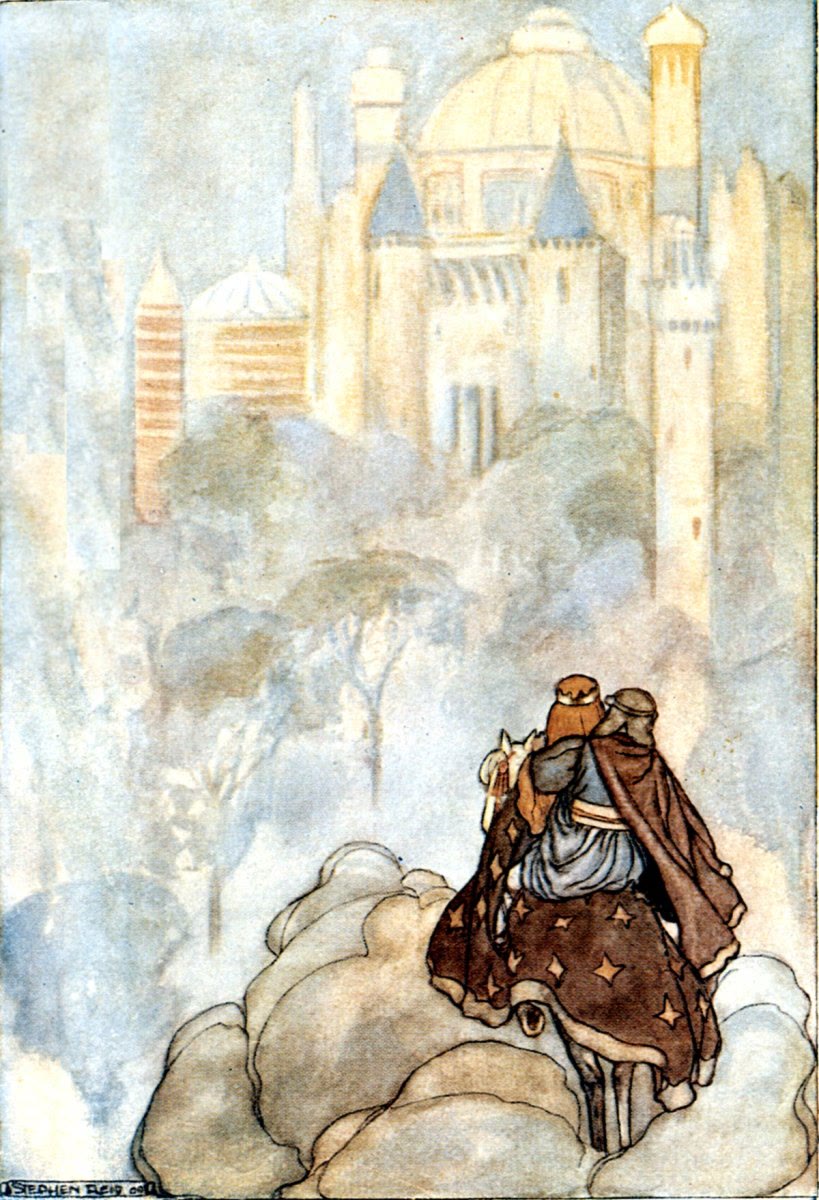
They rode up to a stately palace: Oisín and Niamh reach the Land of Youth. Stephen Reid, from T. W. Rolleston, The High Deeds of Finn and Other Bardic Romances of Ancient Ireland (1910). Public domain, via Wikimedia Commons
The king welcomed Oisín as Niamh’s husband and told him he would stay young here forever. The wedding feast lasted ten days and ten nights.
They had three children: two sons, named Fionn and Osgar after Oisín’s father and son, and a daughter Oisín called Plúr na mBan (ploor nuh MAN), the Flower of Women.
He stayed, in O’Looney’s translation, “three hundred years and more”. Then homesickness took hold: he longed to see Fionn and the Fianna again.
Niamh’s warning
Niamh let him go, full of dread. Three times she warned him: if he set foot on level ground or got down from the white horse, he could never come back, and he would be an old man, withered and blind. Ireland had changed, she said. Fionn was gone, and the country now belonged to a churchman and his saints.
Oisín promised, kissed his wife and children goodbye and rode back across the sea.
The stone in Glenasmole
The riders he met in Ireland stared at the size of him. They had heard of Fionn, they said, from old books, and of a son of his who went off with a woman to the Land of Youth.
Oisín rode to Almhain, Fionn’s fort on the Hill of Allen in Co. Kildare, and found only weeds and nettles.
At Gleann an Smóil, Glenasmole in the Dublin mountains, he came on more than 300 men struggling under a great marble slab that was crushing the ones beneath.
Oisín was ashamed for them. His son Oscar, he said, would have thrown it over their heads with one hand. He leaned from the saddle and flung the slab seven perches, well over 30 metres (100 feet).
The strain snapped the horse’s golden girth, and Oisín landed on both feet on the grass. The horse bolted. His sight went, then his looks and his strength, and he was a poor, blind old man.
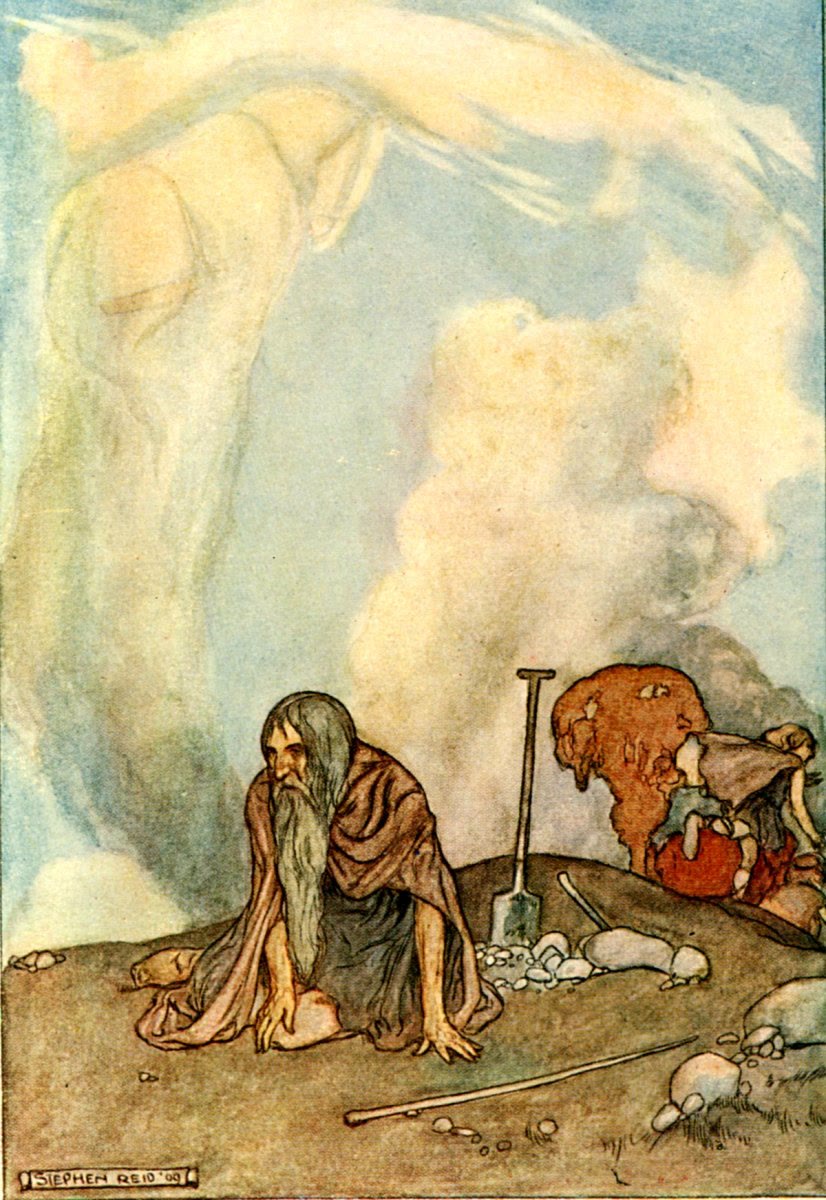
The white steed had vanished from their eyes like a wreath of mist. Stephen Reid, from T. W. Rolleston, The High Deeds of Finn and Other Bardic Romances of Ancient Ireland (1910). Public domain, via Wikimedia Commons
Oisín and St Patrick
That’s the tale Oisín tells Patrick, and they argue along the way. When Patrick says Fionn and the Fianna are in hell, Oisín won’t have it: if Oscar were there, no host in hell or heaven could hold him.
Folk versions end more gently. A 1930s account from Kiskeam, Co. Cork, in the National Folklore Collection’s Schools’ Collection, says Patrick cared for the old warrior until he died.
Who were Oisín and Niamh?
Oisín is the poet of the Fianna, son of Fionn and father of Oscar. His name means little deer: his mother, called Blaí in the older sources, could turn into a doe, as the Dictionary of Irish Biography explains. In later retellings, such as Lady Gregory’s (1904), she is Sadhbh (SIVE, rhymes with five).
Ó Dónaill’s dictionary still lists oisín as a word for a fawn, along with a phrase that sums up the legend: tá sé ina Oisín i ndiaidh na Féinne, literally “he’s an Oisín after the Fianna”, said of someone whose people are all gone.
Niamh (NEEV) means brightness or sheen, and Chinn Óir means “of the golden head”. In the poem her father is simply the King of the Land of Youth. You’ll often read that she’s a daughter of Manannán mac Lir, the sea god in my guide to the Celtic gods, but the poem never says so.
Where the legend comes from
Acallam na Senórach, about 1200
Oisín has been talking to Patrick in Irish literature for more than 800 years. The great frame for Fianna stories is Acallam na Senórach (modern Irish Agallamh na Seanórach), the Colloquy of the Ancients, written down around 1200. Oisín and his comrade Caoilte (KEEL-chuh) have outlived the Fianna, and Caoilte tours Ireland with Patrick, telling the story behind each place while Patrick’s scribe writes it down.
Oisín’s journey to Tír na nÓg is not in it, though the Acallam has plenty of Otherworld visits, including a voyage to Manannán’s Land of Promise. In Standish Hayes O’Grady’s 1892 translation, the two survivors simply part: Oisín heads off to his mother’s fairy mound, and Caoilte goes to Patrick, whose clerics are frightened by these huge men from another age.
The Oisín and Patrick ballads
Between the 11th and 18th centuries, Britannica says, a huge body of Fianna ballads grew up in Ireland and Gaelic Scotland, usually opening with Oisín and Patrick in conversation. Here Oisín mourns the old days and scorns the new, and Patrick often comes across as a narrow-minded cleric.
Mícheál Coimín’s lay, about 1750
The white horse, the warning and the fall come from Laoi Oisín ar Thír na nÓg, the Lay of Oisín on the Land of Youth, also printed as Laoi Oisín i dTír na nÓg (in the Land of Youth). It is credited to Mícheál Coimín, or Michael Comyn (about 1680 to 1760), who farmed at Kilcorcoran, Co. Clare. Unlike the poets in his circle, he belonged to the established Protestant church, says his Dictionary of Irish Biography entry.
O’Looney, another Clare man, first printed it in 1859 and dated it to about 1749. He knew a man who called it “Comyn’s Lay” and whose father had it from Comyn’s own manuscript.
The Clare historian Brian Ó Dálaigh has questioned Coimín’s authorship, and the Dictionary of Irish Biography calls the evidence largely circumstantial, though it still finds the attribution plausible.
The Otherworld in older Irish tales
The happy land beyond time is far older than Coimín. Early Irish stories call it Mag Mell, the Plain of Delight; the Land of the Living; Tír Tairngire, the Land of Promise; or the Land of Women. It can lie across the sea, under a lake or inside a fairy mound.
The Voyage of Bran
The closest early parallel to Oisín’s story is Immram Brain, the Voyage of Bran, an Old Irish tale usually dated between the late 600s and the 800s. Its oldest surviving copy, only the last part of the story, is in Lebor na hUidre, the Book of the Dun Cow, written at Clonmacnoise before 1106. The full text survives in later manuscripts.
A woman brings Bran a silver apple branch and sings of islands without grief or death. At sea he meets Manannán mac Lir driving a chariot over the waves: what Bran sees as sea, Manannán sings, is to him a flowering plain.
Bran’s crew spend what feels like a year in the Land of Women. It is really many years. Sailing home, they’re warned not to touch land, but one man, Nechtan son of Collbran, jumps ashore and crumbles into ashes, as if he had been centuries in the grave. The people on shore know Bran only from their old stories. Kuno Meyer’s 1895 translation is on the Internet Archive.
The same sudden ageing ends the Children of Lir, whose swans become withered old people when their spell breaks.
Connla and Nera
In Echtrae Chonnlai, the Adventure of Connla, a woman from the Land of the Living leaves the son of Conn of the Hundred Battles an apple that feeds him for a month without shrinking. Then he leaps into her boat of glass and is never seen again.
Time in the human world doesn’t always race ahead, though. In Echtra Nerai, the Adventure of Nera, a young man spends what seems like three days inside the fairy mound of Cruachan, yet comes home to find his people still round the same cauldron. There’s more on Nera in how the Irish invented Halloween.
Where the versions differ
- Three years or three hundred? In Coimín’s poem, Oisín knows he has been gone over 300 years. P. W. Joyce’s retelling in Old Celtic Romances (1879) says it seemed like only three, and some later retellings follow him.
- What makes him fall. A folk legend sent to the Ossianic Society in 1859 puts Oisín’s Otherworld in a cave near Mitchelstown, where he thinks he has spent a few days. He gets down to help a carter lift a fallen bag of sand. Yeats’s Oisín, too, lifts a sack of sand. In Lady Gregory’s version there’s no heavy lifting: Oisín sees the Fianna’s old stone water trough, forgets the warning and climbs down.
- The journey. Yeats sends Oisín to three islands, of dancing, victories and forgetfulness, for a hundred years each, while noting that the Gaelic poems have only one.
How to pronounce Tír na nÓg and Oisín
- Tír na nÓg: teer nuh NOHG. The n before Óg is spoken. Ulster speakers say Óg closer to NAWG, and in some Mayo and Donegal Irish the t of tír sounds close to the ch in cheer.
- Oisín: UH-sheen or OSH-een in most of Ireland. In Munster Irish a long vowel pulls the stress towards it, so in Cork and Kerry you’ll hear uh-SHEEN. Never OY-sin. Some editions of Yeats’s poem spell it Usheen. More in my guide to pronouncing Irish boy names.
- Niamh Chinn Óir: NEEV heen OHR in Munster and Connemara Irish, NEEV hin OHR in Ulster and Mayo. The ch is soft and breathy, like the h in huge.
- Fianna: FEE-uh-nuh.
Places linked to the legend
- Lough Leane, Co. Kerry: the poem’s Loch Léin, where Niamh finds the hunters. See things to do in Killarney.
- The Hill of Allen, Co. Kildare: Almhain, Fionn’s fort.
- Glenasmole, Co. Dublin: where the poem has Oisín fall.
- Ossian’s Grave, Co. Antrim: a Neolithic court tomb near Cushendall, far older than any Oisín but named after him. The Department for Communities looks after it, and a stone nearby remembers the poet John Hewitt, who loved the place.
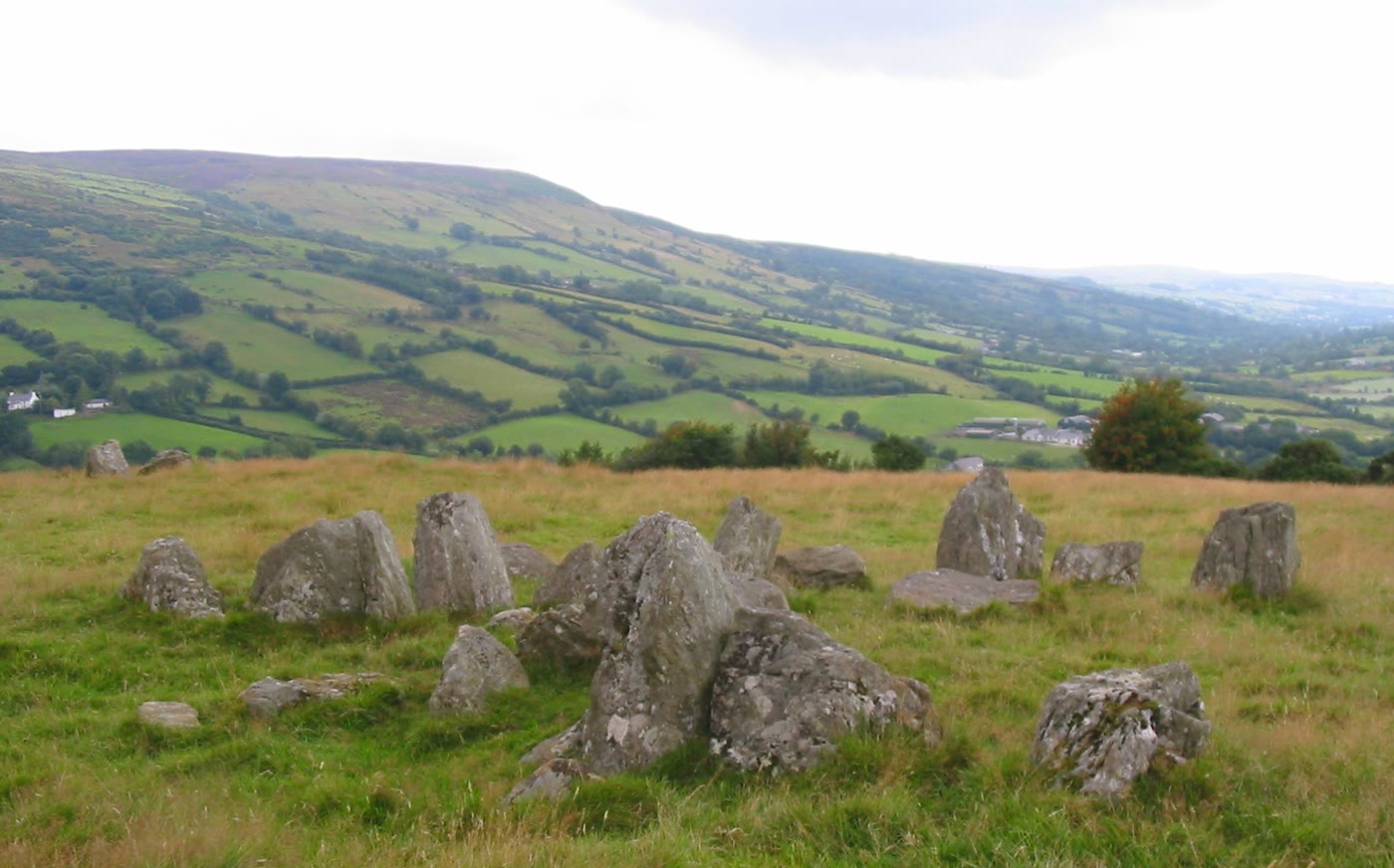
Ossian’s Grave, a Neolithic court tomb near Cushendall, Co. Antrim. Photo: Man vyi, public domain, via Wikimedia Commons
Tír na nÓg today
W. B. Yeats made the legend the title poem of The Wanderings of Oisin and Other Poems (1889), the book that also held The Stolen Child. He said it drew on the old dialogues and “a certain Gaelic poem of the last century”, almost certainly Coimín’s.
Oisín had already conquered Europe as Ossian, the bard of James Macpherson’s 1760s “translations”, which Britannica notes were largely Macpherson’s own invention.
In the 1992 film Into the West, two Irish Traveller boys run away from Dublin on a magical white horse called Tír na nÓg. In 2003 Ian Chambers, a Scottish scientist in Edinburgh, named a newly found gene Nanog after the legend, because it lets embryonic stem cells keep renewing themselves.
And Oisín was Ireland’s fifth most popular boys’ name in 2025, says the Central Statistics Office: see my roundup of Irish baby names.
Tír na nÓg FAQ
What does Tír na nÓg mean?
“The land of the young”, usually translated as the Land of Youth: the Irish Otherworld, where nobody grows old.
How long was Oisín in Tír na nÓg?
Over 300 years in Coimín’s poem. Some later retellings, such as P. W. Joyce’s (1879), say it felt like only three.
Why did Oisín age when he touched the ground?
Niamh had warned him three times: if he got down from the white horse, he could never go back, and he would be old, withered and blind. The much older Voyage of Bran has the same rule.
Is Tír na nÓg a real place?
No, it’s a legend, though people once claimed to know its doorways, like Cill Stuifín in Liscannor Bay.
Love this? Save it to your Pinterest board for later.
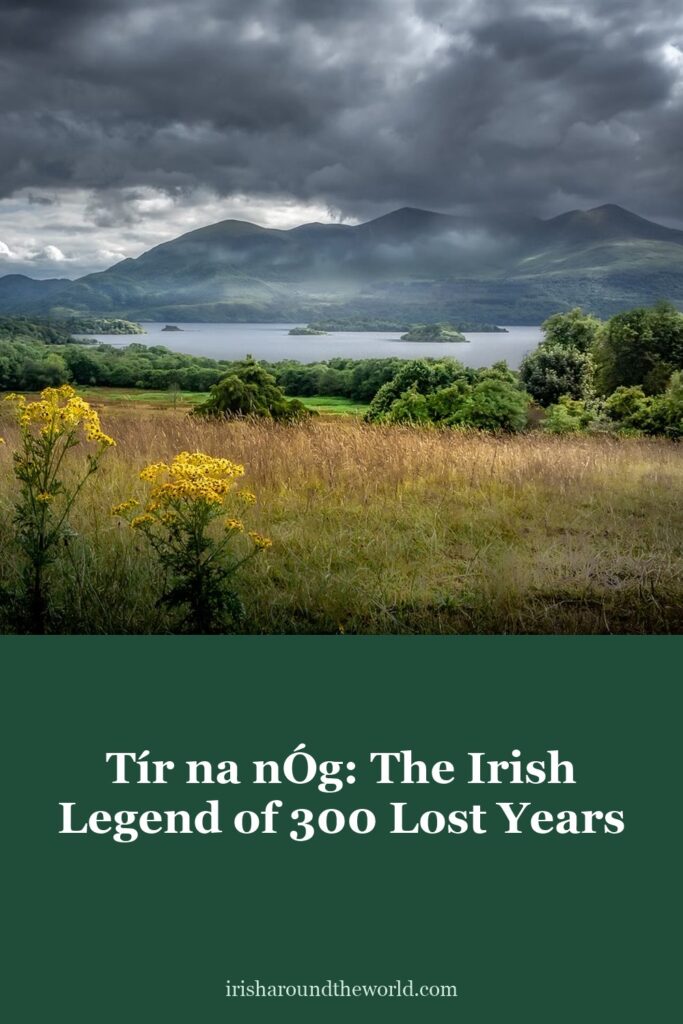
Pin image: Lough Leane, Killarney. Photo: Bernd Thaller, CC BY 2.0, via Wikimedia Commons.
A little bit of Ireland in your inbox every Friday ☘️
The free Weekly Dose of Irish: an Irish joke, a Celtic symbol, an Irish fact, a poem and the week’s best articles in one short email. Join 9,600+ readers.
Free. One short email every Friday. Unsubscribe any time.
More Irish mythology reading
- The Children of Lir: The Irish Legend of Four Swans and 900 Years
- Diarmuid and Gráinne: Ireland’s Great Runaway Love Story
- Celtic Gods and Goddesses: 15 Irish Deities and Their Stories
- The Stolen Child by W. B. Yeats: Irish Poem and Meaning
- How to Pronounce Irish Boy Names: Tadhg, Oisín, Eoghan and More
Featured image: Lough Leane, the Loch Léin of the legend, near Killarney, Co. Kerry. Photo: Bernd Thaller, CC BY 2.0, via Wikimedia Commons.