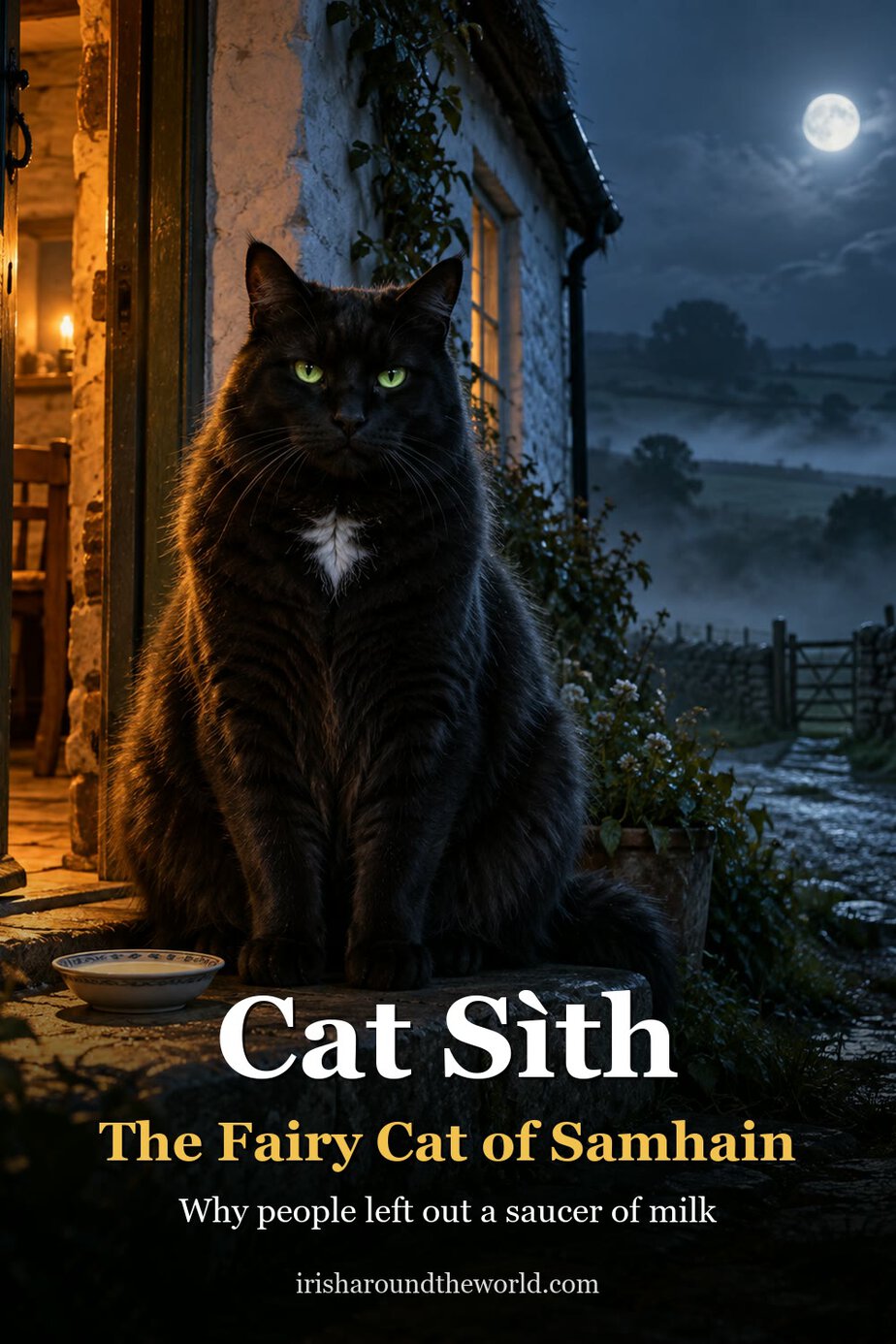
The Cat Sìth (said “cat shee”) is a fairy cat from Scottish Highland folklore, with a few Irish parallels under the name cat sí. It was pictured as a black cat as big as a dog, with a white spot on its chest. Later retellings say it could steal a soul before burial. Another strand says it was a witch whose ninth change left her a cat for good.
Every October the black cat turns up on Halloween cards, and hardly anyone asks where it came from. Part of the answer lies in the Gaelic world, with a fairy cat that sat somewhere between a pet, a spirit and a witch.
I’ll be straight with you. The Cat Sìth belongs mainly to Scottish Highland folklore. Ireland has its own cat legends, and some are brilliant, but a full Irish “cat sí” tradition is thin on the ground. Think of them as cousins.
What is the Cat Sìth?
The Cat Sìth is a supernatural cat from the fairy world. The usual picture is a large black cat, as big as a dog, with a single white spot on its chest.
Some modern retellings add that it walks on its hind legs when nobody is watching. That alone would put me off leaving the back door open.
What does Cat Sìth mean?
In Scottish Gaelic it is cat-sìth. In Irish it would be cat sí, older spelling cat sidhe. Both are said roughly “cat shee”.
Sí means the fairy mound. It is the same word you find in bean sí, the banshee, so the name simply means “fairy cat”. If you’ve read about the banshee, you’ve already met its relations.
Is the Cat Sìth Irish or Scottish?
Mostly Scottish. It is recorded far more in the Highlands and islands than anywhere in Ireland.
The standard Irish dictionary, Ó Dónaill, doesn’t even have an entry for “cat sí”. It lists the cat crainn (the pine marten) and the fia-chat (a wildcat), but no fairy cat. Ireland and Gaelic Scotland shared a great many stories, but if someone tells you the Cat Sìth is purely Irish, take it with a pinch of salt.
The earliest full description: a minister on Tiree
The best early account comes from John Gregorson Campbell, a Gaelic-speaking minister on the island of Tiree. He began gathering his material from oral sources before 1860 and kept at it as minister of Tiree until his death in 1891. His Superstitions of the Highlands and Islands of Scotland came out in 1900.
Campbell describes the elfin cats as a wild breed, “as large as dogs”, black with a white spot on the breast, arched backs and bristles standing up. Many people, he adds, held that they had nothing to do with the fairies and were really witches in disguise.
Campbell says nothing about stealing souls, wakes or saucers of milk. Those turn up in later retellings, so treat them as later lore rather than ancient fact.
Stealing souls and the Late Wake
According to later retellings, the Cat Sìth could take the soul of someone who had just died. All it had to do was pass over the body before burial.
So people kept watch. The vigil was called the Late Wake, the Fèill Fhadalach (often written Feill Fadalach). The story goes that mourners distracted the cat with music, leaping and wrestling games, riddles and catnip.
They also kept fires away from the body, because the cat was said to be drawn to heat. Anyone who has watched a cat claim the spot by the fire will find that easy to believe.
Samhain and the saucer of milk
The other famous custom belongs to Samhain, the Gaelic festival at the start of winter that fed into Halloween. Again, it comes from modern retellings rather than Campbell.
According to tradition, a house that left out a saucer of milk for the Cat Sìth on Samhain night was blessed. A house that didn’t would find its cows’ milk dried up. One saucer against a winter of dry cows seems a fair trade to me.
The witch who turned into a cat nine times
One strand of the folklore says the Cat Sìth was never a fairy at all. It was a witch who could turn into a cat and back eight times, but on the ninth she stayed a cat for good.
That is the link to “nine lives”, and our short video walks through it in under a minute.
As the video itself admits, whether this is the true origin of the saying is another matter. But the witch and cat idea is older than you might think.
Heywood and Baldwin, the 1500s
One of the earliest English records of nine lives is in John Heywood’s proverbs of 1546: “a woman hath nine lives like a cat”. No witches yet, just a dig at women.
William Baldwin’s Beware the Cat, written in 1553 and sometimes called the first English novel, goes further. It explains the nine lives proverb: a witch could take her cat’s body nine times. It also has a tale set in Ireland about a cat called Grimalkin.
Cat Nights, 17 August
The Old Farmer’s Almanac marks 17 August as “Cat Nights”, which it calls an obscure Irish legend. A witch could become a cat eight times, but on the ninth, on 17 August, she couldn’t change back.
No older Irish source for Cat Nights has turned up. Most modern retellings trace back to the Almanac, so I’d call it folklore about folklore.
Is the Cat Sìth real? The Kellas cat
In Moray, in north-east Scotland, there were long stories of big black cats, and most people dismissed them as myth. Then in 1984 a gamekeeper snared one.
The Kellas cat, named after a village in Moray, turned out to be a hybrid of the Scottish wildcat and the feral house cat. It was large and black, and at least one had a white patch on its chest. The zoologist Karl Shuker suggested a folk memory of cats like these could lie behind the Cat Sìth. It’s a theory, not a proof, but it fits the description rather well.
Why the theory fits Scotland better than Ireland
The Scottish wildcat barely hangs on. A 2019 review by IUCN cat experts found the wild population no longer viable, and captive-bred cats have been released in the Cairngorms since 2023.
Ireland did once have wildcats. A wildcat around 5,500 years old from Glencurran Cave in Co. Clare was confirmed by radiocarbon dating and DNA.
Nobody knows when Irish wildcats died out. Medieval writers mention wild cats, but those may have been feral house cats. Scotland had a living big black cat to explain the legend. Ireland, as far as we know, didn’t.
Ireland’s own cat legends
Ireland may not have much of a Cat Sìth, but it has cats worth knowing.
Irusan, the King of the Cats
In the medieval tale Imtheacht na Tromdhaimhe, the bard Seanchán Torpéist mocks the cats at the court of King Guaire. Irusan, King of the Cats and the size of a bullock, carries him off, and St Ciarán kills the great cat at Clonmacnoise. Lady Wilde retold the story in 1887.
Cat lore from West Cork
Closer to home, the West Cork folklorist Eugene Daly has collected the old greeting “God save all here, except the cat”. Black cats were thought the most powerful for magic and superstition, and a stray cat coming into the house was said to bring luck.
There’s a proverb too: “Briseann an dúchas trí shúile an chait”, roughly “nature breaks out through the cat’s eyes”. You can dress a cat up, but you can’t hide what it is.
The Cat Sìth and Halloween
Samhain was the night the boundary between this world and the other was thought to be thin. An Irish fairy cat, or a Scottish one, that could bless or curse a house fits right in.
Add the witch who became a cat and the saucer of milk on Samhain night, and much of the modern Halloween cat is already in place. For the bigger picture, see how the Irish invented Halloween.
So if a large black cat with a white spot on its chest turns up at your door this October, I’d leave out the milk. Just in case.
Cat Sìth FAQ
Is the cat sidhe the same as the Cat Sìth?
Yes. Cat sidhe is the older Irish spelling, cat sí the modern one, and cat-sìth the Scottish Gaelic. All mean fairy cat.
How do you pronounce cat sith or cat sidhe?
Both are said roughly “cat shee”. The spelling catches out most English speakers.
Is the Cat Sìth good or evil?
Neither, really. It could bless a house that left out milk at Samhain or dry up the cows of one that didn’t. Later retellings also have it stealing souls, which is why people guarded the dead.
Why do cats have nine lives in Irish folklore?
One legend says a witch could turn into a cat eight times, but on the ninth she stayed a cat forever. A link between witches and a cat’s nine lives was written down in England in 1553, though nobody can prove it is the true origin of the saying.
Is Cait Sith from Final Fantasy based on the Cat Sìth?
The name certainly is. Cait Sith in Final Fantasy VII borrows the Gaelic fairy cat’s name. Square Enix’s official English pronunciation is “Kate Sith”, though Naoki Hamaguchi, director of the remake series, has said “cat shee”.
Are there wildcats in Ireland?
Not today. A 5,500-year-old wildcat from a cave in Co. Clare proves they once lived here, but nobody knows when they died out.
Saving this for Halloween? Pin it for later.
More Irish folklore and traditions
- The Banshee: The Bean Sí of Irish Folklore
- The Dullahan: Ireland’s Headless Horseman and the Death Coach
- The Púca (Pooka): Ireland’s Shape-Shifter
- How the Irish Invented Halloween: Samhain, Turnip Lanterns and Barmbrack
- 10 Haunted Places Around Ireland That You Have To Visit
- What the Heck Is a Selkie? Selkie Mythology
- 20 Things You Didn’t Know About Leprechauns
- 20 Celtic Symbols and Their Meanings
A little bit of Ireland in your inbox every Friday ☘️
The free Weekly Dose of Irish: an Irish joke, a Celtic symbol, an Irish fact, a poem and the week’s best articles in one short email. Join 9,600+ readers.
Free. One short email every Friday. Unsubscribe any time.