The best-known Irish Christmas songs run from the Wexford Carol, an old carol from Enniscorthy, to Fairytale of New York, the 1987 duet by the Pogues and Kirsty MacColl. Between them sit the Kilmore Carols, sung in a Wexford parish for about 300 years, the Irish-language carol Don Oíche Úd i mBeithil, the Wren Song, and Enya’s Oíche Chiúin, which is Silent Night in Irish. Two famous carols, While Shepherds Watched and Once in Royal David’s City, also have Irish writers.
An Irish Christmas playlist is a strange and lovely thing. It can take you from a parish church in south Wexford to a Bing Crosby session in Los Angeles, then on to a drunk tank in New York.
Some of these songs are hundreds of years old. Some are younger than your good tablecloth. And one that’s often listed as an old Irish carol turns out to have a very different birthplace.
Here are 15 of the best carols, ballads and pub favourites, with the story behind each one. Where an official video exists, you can play it as you read. So put the kettle on, cut a slice of porter cake and press play.
Jump to:
- The 15 songs at a glance
- Old carols and traditional songs
- Famous carols with Irish writers
- Modern favourites, from Killarney to New York
- Where these songs live
- Irish Christmas songs FAQ
- More Irish Christmas reading
The 15 songs at a glance
| Song | Who | When |
|---|---|---|
| The Wexford Carol | Traditional, Co. Wexford | Printed 1928, older in origin |
| The Kilmore Carols | Luke Waddinge, William Devereux | 1684 and about 1728 |
| Don Oíche Úd i mBeithil | Irish-language carol | Printed as a song 1966 |
| The Wren Song | Traditional; the Clancy Brothers | Recorded 1969 |
| Curoo Curoo | John Jacob Niles; the Clancy Brothers | 1941; recorded 1969 |
| While Shepherds Watched | Nahum Tate, Nicholas Brady | 1700 |
| Once in Royal David’s City | Cecil Frances Alexander | 1848 |
| Christmas in Killarney | Bing Crosby and others | 1950 |
| A Spaceman Came Travelling | Chris de Burgh | 1975 |
| Do They Know It’s Christmas? | Band Aid (Bob Geldof, Midge Ure) | 1984 |
| Fairytale of New York | The Pogues, Kirsty MacColl | 1987 |
| St Stephen’s Day Murders | The Chieftains, Elvis Costello | 1991 |
| Oíche Chiúin | Enya | 1988 |
| Christmas 1915 | Cormac MacConnell | About 1990 |
| An Irish Christmas | Moya Brennan | 2005 |
Old carols and traditional songs
1. The Wexford Carol (Carúl Loch Garman)
This is the Irish carol the wider world knows best. In Irish it’s Carúl Loch Garman (roughly KAR-ool lokh GAR-mun), and it’s also called the Enniscorthy Carol, after the Co. Wexford town it’s tied to.
William Grattan Flood, organist at St Aidan’s Cathedral in Enniscorthy, took it down from a local singer and got it into The Oxford Book of Carols in 1928. Its English words begin:
Good people all, this Christmas time,
Consider well and bear in mind
You’ll often read that it’s 12th-century, but the evidence isn’t there. The National Library of Ireland says only that its origins may reach back to the 15th century. The full story is in my guide to the Wexford Carol.
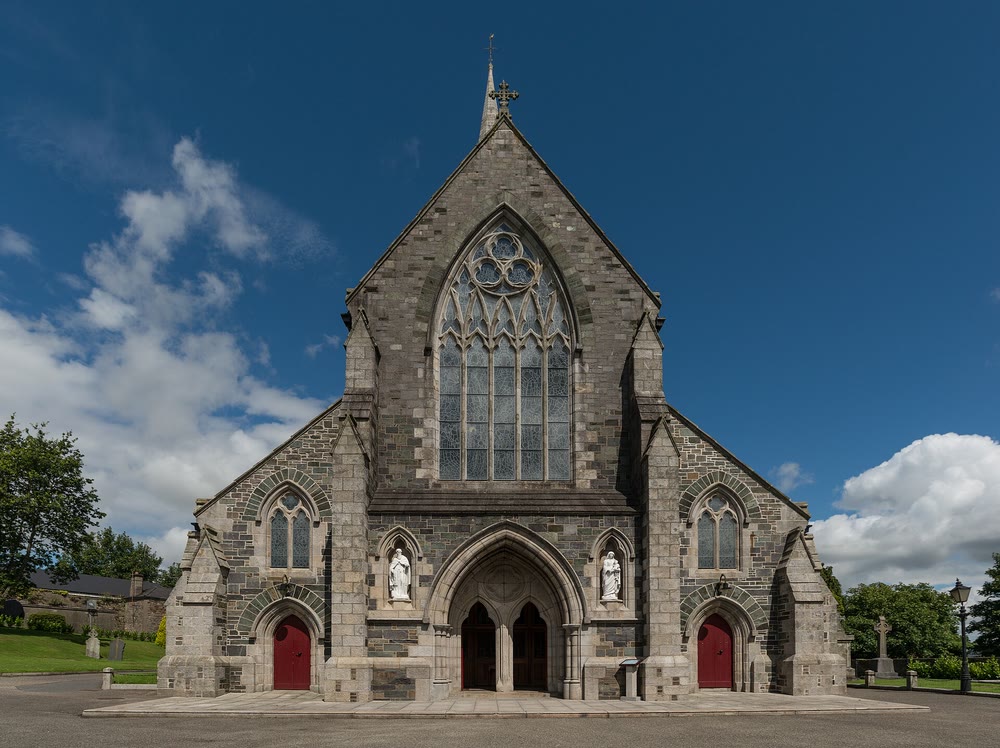
St Aidan’s Cathedral, Enniscorthy, where William Grattan Flood was organist. Photo: DXR, CC BY-SA 4.0, via Wikimedia Commons
Yo-Yo Ma and Alison Krauss put it on his 2008 album Songs of Joy & Peace. Here’s the official video.
2. The Kilmore Carols
This tradition began with Luke Waddinge, a Wexford man who became Catholic bishop of Ferns. His father died when Cromwell’s forces stormed Wexford town in 1649, and he wrote his carols at a time when Catholic worship was restricted.
His little book, A Smale Garland of Pious and Godly Songs, was printed in Ghent in 1684. In a poem for Christmas Day 1678, he put the pain of it in two lines:
On Christmas to have no mass
Is our great discontent
Around 1728 a Wexford priest, Fr William Devereux, put his own carols and others into a manuscript, A New Garland. The songs were copied by hand and spread across south Wexford, says the scholar Ciarán Mac Murchaidh. Then the custom faded, parish by parish, until only Kilmore was left.
The choir at St Mary’s Church in Kilmore is six men, singing without instruments over the Twelve Days of Christmas. The job passes down through families, and one singer told The Irish Times in 1998: “A Devereux has always sung the carols.”
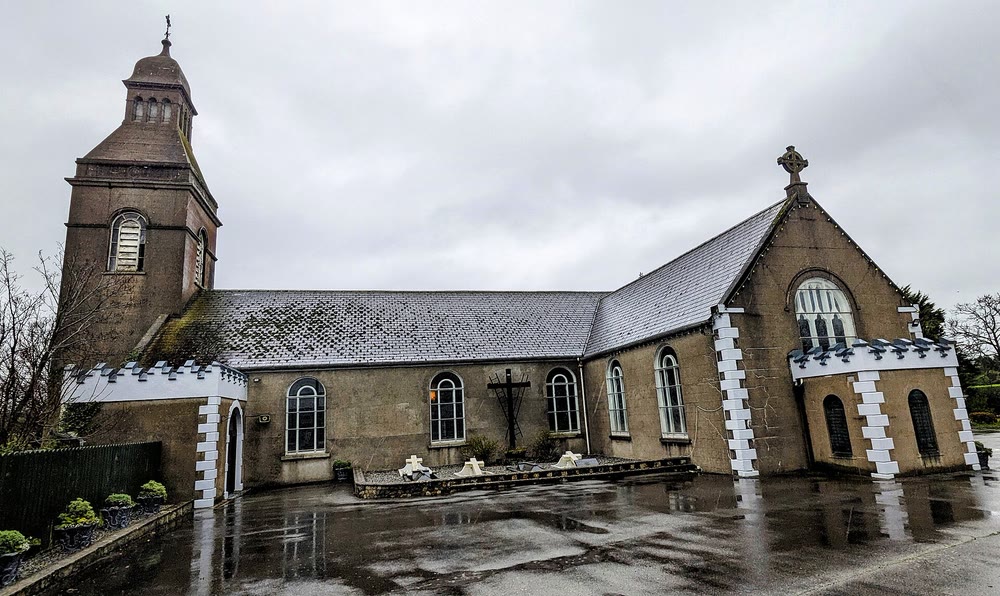
St Mary’s Church, Kilmore, Co. Wexford, where the carols are sung. Photo: Rogue29567, CC BY-SA 4.0, via Wikimedia Commons
You can watch them in this 1977 RTÉ Archives clip. In 2014 the singer Caitríona O’Leary carried the carols further afield on her album The Wexford Carols, with Rosanne Cash, Rhiannon Giddens and Tom Jones.
3. Don Oíche Úd i mBeithil
Mac Murchaidh counts this Irish-language carol, which he calls An Oíche Úd i mBeithil, among Ireland’s childhood favourites. Say the usual title roughly dun EE-ha ood uh MEH-hil. It means “to that night in Bethlehem”, and it usually goes by That Night in Bethlehem in English. Online you’ll see it without its fadas, or in the older spelling Don Oidhche Úd i mBeithil.
Its origins are murky. You may read that it dates from the 7th century, but I found nothing to support that. The words are usually credited to Aodh Mac Aingil (roughly AY mock ANG-gil), a Franciscan scholar who lived from 1571 to 1626, though that credit seems to come from a modern songbook. His better-documented Christmas poem is a different one, Dia do bheatha, a naoidhe naoimh (“welcome, holy child”).
Old Bridge Music, which publishes the harper Máire Ní Chathasaigh’s arrangement, says its first printing as a song came in 1966, in a booklet edited by Seán Óg Ó Tuama. Its note adds that the melody seems to be his own, and that his sister-in-law later confirmed it. So that ancient-sounding tune may be only about 60 years old.
The Chieftains recorded it for The Bells of Dublin in 1991, and Celtic Woman for A Christmas Celebration in 2006. This is Celtic Woman’s 2025 version, with the singer Sibéal.
4. The Wren Song
Ireland’s oddest Christmas song belongs to 26 December, St Stephen’s Day, or Lá an Dreoilín (law un DROH-leen), the Day of the Wren. Wren boys went from house to house with a holly bush, singing for coins. The words change from place to place, but J. J. Marshall’s Popular Rhymes and Sayings of Ireland (1924) prints the famous opening:
The wren, the wren, the king of all birds,
On St. Stephen’s day was caught in the furze
The Clancy Brothers closed their 1969 Christmas album with it. The straw suits and the rest are in my guide to Wren Day.
5. Curoo Curoo (The Carol of the Birds)
This one needs an honest note. Curoo Curoo turns up on plenty of lists of old Irish carols, and one choral publisher says it probably began in 18th-century Ireland. The Clancy Brothers sang it on that same 1969 album.
But the trail leads to America. The folk singer and composer John Jacob Niles wrote in a sleeve note that he composed The Carol of the Birds for his son, who turned two on 22 September 1941. Song sites credit Curoo Curoo to Niles, and the Clancys’ version names the lark, the dove, the owl and the redbird, an American name for the cardinal. Niles also recorded the carol for Tradition, the label Paddy Clancy ran.
So as far as I can trace it, this is an American carol that Irish singers took to their hearts. It’s still a lovely thing to hear.
Famous carols with Irish writers
6. While Shepherds Watched Their Flocks
Nahum Tate was born in Dublin in 1652, studied at Trinity College and became England’s Poet Laureate in 1692. He’s also the man who gave Shakespeare’s King Lear a happy ending, in a 1681 rewrite.
The carol first appeared in 1700, in a supplement to the New Version of the Psalms that he made with Nicholas Brady. It’s normally credited to Tate alone, but the Hymnology Archive says the case for that is unproven, and the credit belongs to the pair.
Either way, it’s Irish. Brady was born in Bandon, Co. Cork, in 1659.
7. Once in Royal David’s City
Since 1919, the Christmas Eve service from King’s College, Cambridge, has opened with this carol, and today one chorister sings the first verse alone. Tradition says the soloist is picked moments before it starts. The words came from an Irishwoman.
Cecil Frances Alexander was born in Dublin in 1818. She wrote it for children, to explain a line of the Apostles’ Creed, and put it in her Hymns for Little Children in 1848. The same small book gave the world All Things Bright and Beautiful and There Is a Green Hill Far Away. Henry Gauntlett wrote the tune a year later.
Modern favourites, from Killarney to New York
8. Christmas in Killarney
Here’s the great Irish-American party piece. John Redmond, James Cavanaugh and Frank Weldon wrote it, and Remick Music published it in New York in 1950. Bing Crosby recorded it in Los Angeles on 1 October 1951.
It’s a postcard of a Kerry that never quite existed, and it’s none the worse for that.
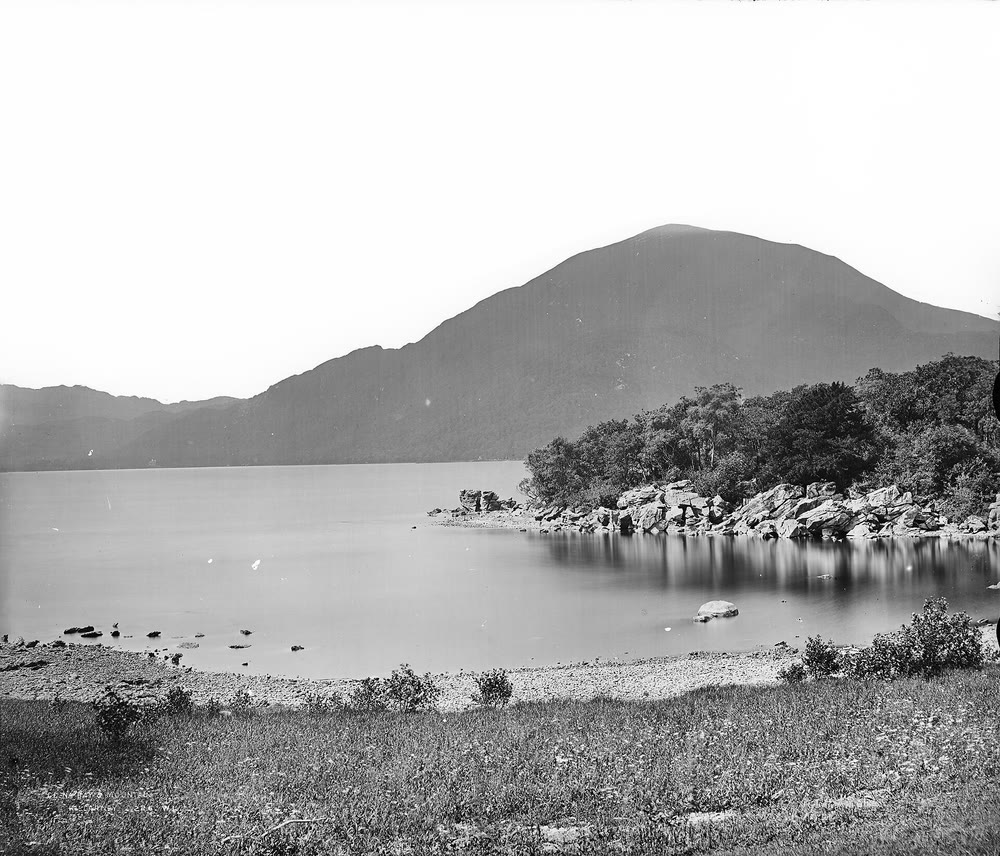
A lake near Killarney, Co. Kerry, photographed by Robert French between about 1865 and 1914. Lawrence Collection, National Library of Ireland, via Wikimedia Commons
9. A Spaceman Came Travelling
Chris de Burgh was born in Argentina and grew up at Bargy Castle in Co. Wexford, the same corner of the county that produced Luke Waddinge. In August 1974, as he recalls it, he was broke, staying in a friend’s flat and reading Chariots of the Gods? by Erich von Däniken.
He told the BBC it set him wondering “what if the star of Bethlehem was a space craft”. Yeats’s poem The Second Coming fed into it too. The result, on his 1975 album Spanish Train and Other Stories, is a nativity story with a visitor from the stars.
It missed the UK chart at first. After the success of The Lady in Red, a 1986 reissue paired with The Ballroom of Romance reached No. 40 in the UK and No. 15 in Ireland. This is his 2010 re-recording, with a competition-winning fan video.
10. Do They Know It’s Christmas?
Bob Geldof, the Boomtown Rats singer born in Dún Laoghaire, wrote this with Midge Ure after a BBC report showed the famine in Ethiopia. It was recorded at Sarm Studios in London on 25 November 1984, with U2’s Bono and Adam Clayton among the singers and players.
It spent five weeks at No. 1 in the UK and was the Irish Christmas No. 1 too. The Official Charts Company calls it the second-best-selling song in UK chart history.
It has its critics. Mary Robinson, the former Irish president, said in 2021 that it had done much good but called it “patronising” and a thing of its time. In 2024 Ed Sheeran said he’d have declined the use of his voice on a new anniversary mix, and reposted the Ghanaian-British musician Fuse ODG’s argument that such projects harm Africa. Geldof’s answer: “This little pop song has kept millions of people alive.”
11. Fairytale of New York
This is the big one. Shane MacGowan and Jem Finer wrote it, the Pogues recorded it with Kirsty MacColl, and it came out in late 1987. It’s a row between two Irish emigrants on Christmas Eve, with a stubborn bit of love left at the end.
It stalled at No. 2 in the UK behind the Pet Shop Boys, but it was the Irish Christmas No. 1. On 8 December 2023, the day of MacGowan’s funeral, it went back to the top in Ireland, 36 years after it first got there. In 1987 the Pogues also took The Irish Rover to No. 1 in Ireland with The Dubliners.
The word everyone argues about. One word in MacColl’s verse is a homophobic slur, and I won’t print it. In December 2018 the 2FM presenter Eoghan McDermott objected to it, and RTÉ said the song would keep playing “without any omissions”. MacGowan said the word suited a character who was never meant to be nice, that no offence was intended, and that he had no objection to it being bleeped.
In 2020 BBC Radio 1 switched to an edited version, while 6 Music left it to its presenters. Radio 2 kept the original until 2022, then moved to the edit too, saying many of its listeners found some of the lyrics jarring. RTÉ said in 2019 that its position also covered television and still stood. It didn’t comment when The Irish Times asked in 2020, and I found no newer statement from it. Listeners are still divided.
The whole story, from Elvis Costello’s bet to the funeral in Nenagh, is in my guide to Fairytale of New York.
12. St Stephen’s Day Murders
This one’s for anyone who has survived a long family Christmas. Elvis Costello and the Chieftains’ Paddy Moloney wrote this black comedy for the band’s 1991 album The Bells of Dublin. Moloney described it as a comment on the rows that can brew in a family on St Stephen’s Day.
The album opens and closes with the bells of Christ Church Cathedral in Dublin, recorded from the cathedral roof.
13. Oíche Chiúin (Silent Night)
Silent Night is Austrian. Joseph Mohr and Franz Xaver Gruber first sang it at Oberndorf on Christmas Eve 1818. Oíche Chiúin (roughly EE-ha HYOON) is the Irish version: oíche is night, and ciúin means calm or still. You’ll see it misspelled online as Oíche Chiún, or with no fadas at all.
The best-known recording is probably Enya’s. She grew up in the Irish-speaking district of Gweedore in Co. Donegal. She first released the carol in 1988, as a B-side to her single Evening Falls…, and it was on The Christmas EP in 1994. She came back to it in 2008 with a choral version on And Winter Came…, her winter album.
14. Christmas 1915
The Irish writer Cormac MacConnell said he wrote this after watching a TV documentary on the Christmas truce of the First World War, when soldiers stopped fighting, sang carols and met in No Man’s Land. Many young Irishmen died in those trenches, and the song came to him in a couple of hours. His columns over the years put that at around 1990.
Jerry Lynch recorded the first version. Daniel O’Donnell, Tommy Fleming and Celtic Thunder have sung it since. The famous truce was in 1914, a year before the date in the title. It’s also in my round-up of Irish Christmas videos.
15. An Irish Christmas (Moya Brennan)
The last pick is a whole album. Moya Brennan, lead singer of Clannad and Enya’s older sister, released An Irish Christmas in 2005, and it became a live show she took out year after year. The video below gathers songs from it, including the Wexford Carol.
In 2023 she re-recorded some of the songs as Nollaig Ghaelach (roughly NULL-ig GHAY-lukh), “a Gaelic Christmas”, shaped by all those years on stage.
Moya Brennan died in Donegal on 13 April 2026, aged 73. This will be the first Christmas without her.
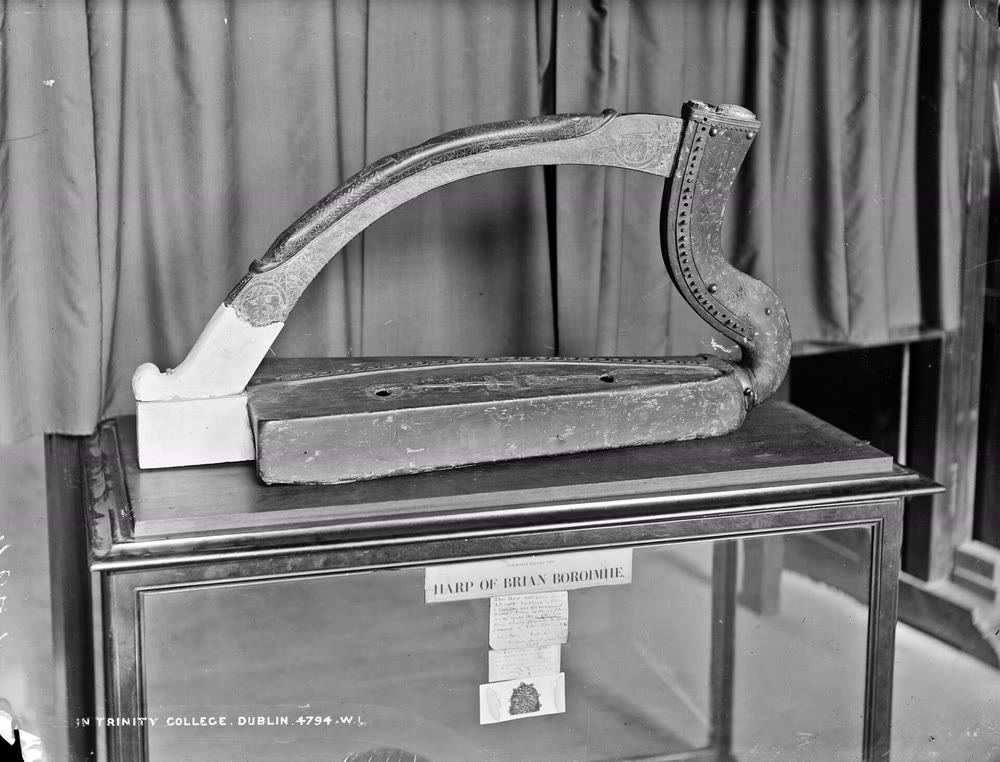
The old harp in Trinity College Dublin, long called Brian Boru’s harp, photographed by Robert French. Lawrence Collection, National Library of Ireland, via Wikimedia Commons
Where these songs live
Some of these belong in a quiet church, some in a loud pub at closing time. They sit alongside the candle in the window and the rest of the Irish Christmas traditions.
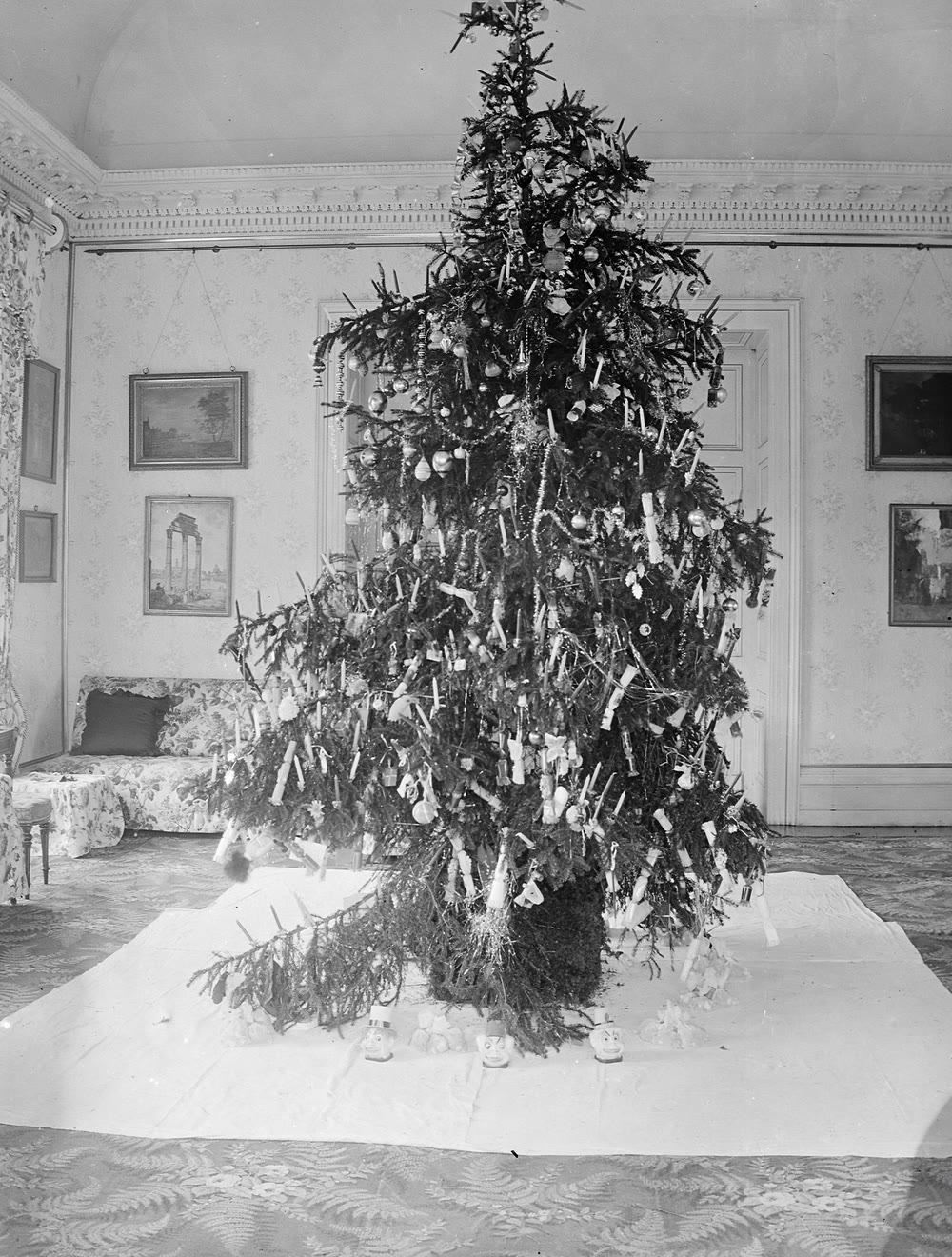
A Christmas tree at Clonbrock House, Co. Galway, about 1900, photographed by the Dillon family. Clonbrock Collection, National Library of Ireland, via Wikimedia Commons
Glen Hansard began his Christmas Eve busk on Grafton Street in 2010, raising money for the Dublin Simon Community. It later settled outside the nearby Gaiety Theatre. In 2023, weeks after MacGowan’s death, Hansard and Imelda May got the crowd singing Fairytale of New York. Hansard died in July 2026, aged 56. At the time of writing, in November, I haven’t seen plans for this year’s busk, so check with Dublin Simon before you travel.
Want to join in as Gaeilge? Start with Nollaig Shona duit (NULL-ig HUN-a ditch), Merry Christmas to one person, and see my guide to Merry Christmas in Irish.
Irish Christmas songs FAQ
What is the most famous Irish Christmas song?
Fairytale of New York by the Pogues and Kirsty MacColl. Among the traditional carols, it’s the Wexford Carol.
What is the oldest Irish Christmas carol?
It’s hard to be sure. Of the songs here, the oldest that can be firmly dated are Luke Waddinge’s, printed in 1684. The Wexford Carol may be older, but nobody has proved it.
Are there Christmas carols in the Irish language?
Yes. Don Oíche Úd i mBeithil is the best known, and Oíche Chiúin is Silent Night in Irish. The Wexford Carol has an Irish name, Carúl Loch Garman, but its best-known words are English.
How do you say Silent Night in Irish?
Oíche Chiúin, roughly EE-ha HYOON.
Is Curoo Curoo an Irish carol?
Probably not. It’s often listed as one, but the evidence points to the American composer John Jacob Niles, who wrote The Carol of the Birds in 1941.
Was Fairytale of New York banned?
Not outright, but it has been edited. BBC Radio 1 cut words in 2007, then reversed the decision, and used an edited version from 2020. Radio 2 followed in 2022. RTÉ said in 2018 that it would keep playing the original.
Love this? Save it to your Pinterest board for later.
Pin image: Adapted from photo by David Iliff, CC BY-SA 3.0, via Wikimedia Commons
A little bit of Ireland in your inbox every Friday ☘️
The free Weekly Dose of Irish: an Irish joke, a Celtic symbol, an Irish fact, a poem and the week’s best articles in one short email. Join 9,600+ readers.
Free. One short email every Friday. Unsubscribe any time.
More Irish Christmas reading
- The Wexford Carol: The Centuries-Old Irish Christmas Carol That Yo-Yo Ma Made Famous Again
- Fairytale of New York: The Story Behind Ireland’s Christmas Song
- Bono, Hozier and a Bucket: The Christmas Eve Busk Glen Hansard Gave Dublin
- 8 Irish Christmas Videos That Will Have You Crying Into Your Tea
- Wren Day: The Irish Tradition of Straw Suits, Wren Boys and the King of All Birds
- 18 Irish Christmas Traditions, From the Candle in the Window to the 12 Pubs
Featured image: The nave of Christ Church Cathedral, Dublin, whose bells open the Chieftains’ album The Bells of Dublin. Photo by David Iliff, CC BY-SA 3.0, via Wikimedia Commons.