
Porter cake is a dark Irish fruit cake made with stout or porter, and it never needs marzipan or icing. This porter cake recipe soaks 560g (1¼ lb) of fruit in 300ml (1¼ US cups) of stout overnight, then bakes it in a lined 23cm (9 inch) tin for 1¾ to 2 hours at 160°C, 140°C fan, 325°F or gas mark 3. It keeps for weeks in a tin. Nobody knows who invented it: the oldest recipe found so far is from London in 1897, the oldest Irish one I’ve found from Belfast in 1924.
No marzipan. No royal icing. No weeks of spooning whiskey into a cake in a tin. Porter cake asks for one thing: a night’s head start, with the fruit sitting in a bowl of stout.
It’s the fruit cake for anyone who doesn’t want to ice a Christmas cake, and it never needed Christmas anyway. Darina Allen’s recipe in the Irish Examiner says it “used to be offered to callers in most houses in Ireland”.
The recipe comes first, with proportions worked out from published Irish recipes by Odlums, Darina Allen and Eunice Power. Then comes what porter was, how Dublin took it over from London, and what the records show about the cake. The oldest recipes found so far aren’t even Irish.
Jump to:
- Porter cake recipe
- Tin sizes and baking times
- How to tell it’s done
- Storing and feeding porter cake
- Alcohol-light and gluten-free versions
- Troubleshooting
- Porter cake or Christmas cake?
- What was porter?
- How porter became the drink of Dublin
- What’s actually documented about porter cake
- Porter cake FAQ
- More Irish baking reading
Porter cake recipe
Prep: 25 minutes | Soak: overnight | Bake: 1¾ to 2 hours | Rest: 1 to 4 days, if you can wait | Makes: 1 large cake, about 20 slices
Tin: 23cm (9 inch) round cake tin, at least 7.5cm (3 inches) deep. Oven: 160°C, 140°C fan, 325°F, gas mark 3.
Ingredients
For the soak
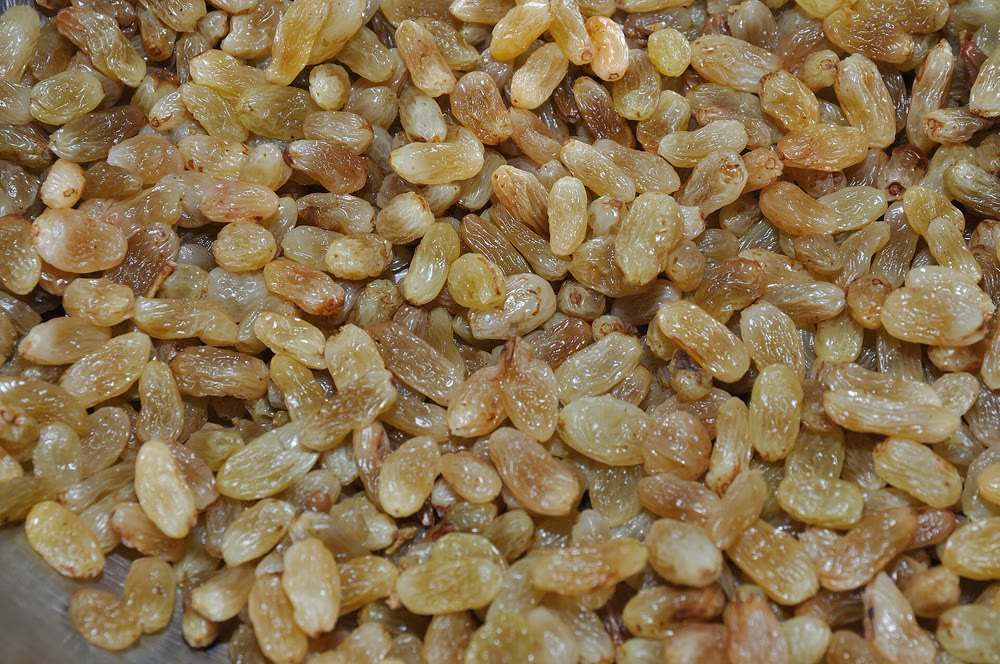
- 225g (8 oz, 1½ US cups) sultanas (golden raisins)
- 225g (8 oz, 1½ US cups) raisins
- 110g (4 oz, a scant ¾ US cup) chopped mixed peel
- Finely grated zest of 1 orange
- 300ml (½ imperial pint, 1¼ US cups) stout or porter
For the cake
- 450g (1 lb, 3¾ US cups) plain (all-purpose) flour
- 1 level tsp baking powder
- 2 tsp mixed spice, or pumpkin pie spice in the US
- A pinch of salt
- 225g (8 oz, 2 US sticks) cold butter, diced
- 225g (8 oz, 1 US cup, packed) soft brown sugar
- 3 large eggs (Irish or UK large; 3 extra-large in the US)
- 110g (4 oz, a generous ½ US cup) glacé cherries, halved (optional)
To finish (optional)
- 4 tbsp (60ml) stout
Method
- The night before, put the sultanas, raisins, peel and zest in a large bowl. Pour over the stout, stir, cover and leave overnight, or for up to 24 hours.
- Next day, grease the tin and line the base and sides with baking paper (parchment). Heat the oven to 160°C (140°C fan, 325°F, gas mark 3), with a shelf in the middle.
- Sift the flour, baking powder, spice and salt into your biggest bowl. Rub in the butter with your fingertips until it looks like fine breadcrumbs, then stir in the sugar.
- Beat the eggs and add them with the soaked fruit, any stout left in the bowl and the cherries, if using. Stir with a wooden spoon until no dry flour is left. The mixture should be thick and drop slowly off the spoon. If it’s too stiff to stir, add a splash more stout.
- Spoon it into the tin, level the top and press a slight hollow into the centre.
- Bake for 1¾ to 2 hours, until a skewer pushed into the middle comes out clean. If the top is dark after an hour, lay a double layer of baking paper over it.
- For the optional finish, prick the hot cake all over with the skewer and spoon over the 4 tbsp of stout.
- Leave the cake to go completely cold in the tin, then lift it out with its paper on and store it as below. Leave it 1 to 4 days before slicing, if you can.
Tips
Which stout? Any dry Irish stout works, and a 440ml can covers the soak and the finish. For actual porter, Guinness lists a 6% West Indies Porter.
Rub-in or creaming? Rubbing in needs no mixer, and it’s how Odlums and Maura Laverty do it. To cream instead, beat soft butter and sugar until pale, beat in the eggs, then fold in the dry ingredients and soaked fruit.
Forgot to soak? Use Allen’s boiled method: give the stout, butter, sugar, zest and fruit (not the cherries) 3 or 4 minutes on the boil in a big saucepan. Cool to lukewarm, then mix it into the dry ingredients and eggs.
Bread soda instead? Allen’s Examiner recipe uses ½ tsp of bread soda (baking soda), the raising agent in my Irish soda bread.
Tin sizes and baking times
These times are starting points, so trust the skewer.
- 23cm (9 inch) round, at least 7.5cm (3 inches) deep: 1¾ to 2 hours. Allen’s size.
- 20cm (8 inch) round, at least 7.5cm (3 inches) deep: 2 to 2¼ hours. The Odlums size, and a fuller tin.
- Two 900g (2 lb, 9 x 5 inch) loaf tins: 1¼ to 1½ hours, checking from 1 hour.
Many US cake pans are only 2 inches deep, too shallow for this much batter, so use a springform or two loaf pans.
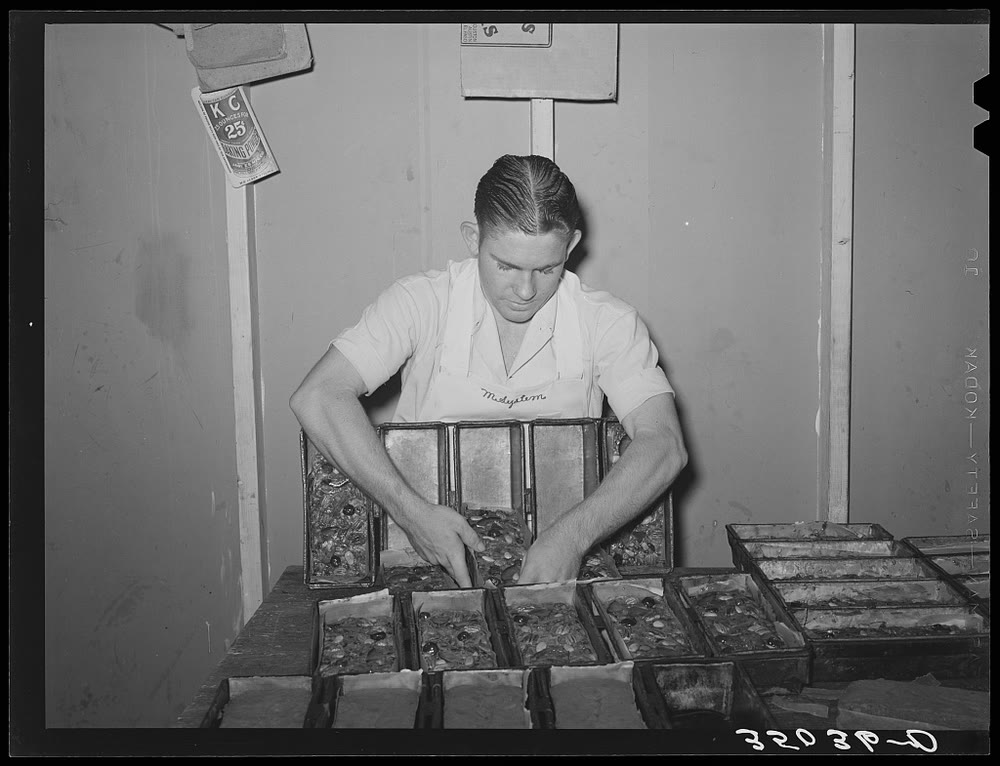
Fruit cakes coming out of their tins at a bakery in San Angelo, Texas, in November 1939. Photo: Russell Lee, Library of Congress, no known copyright restrictions, via Wikimedia Commons
How to tell it’s done
Push a thin skewer into the very centre. If it comes out clean, the cake’s done. If there’s wet batter on it, give it another 10 to 15 minutes and test again. Sticky fruit doesn’t count, so try a second spot.
Storing and feeding porter cake
Wrap the cold cake in baking paper, then foil, and keep it in an airtight tin somewhere cool. The paper keeps the acidic fruit off the foil.
It improves with a rest. Allen rests hers for 1 to 4 days, and Theodora FitzGibbon says to make hers at least a week ahead. Allen gives it several weeks in a tin, and a 1924 Belfast recipe promised a month to six weeks.
It doesn’t need feeding the way a Christmas cake does: Allen’s optional pour of stout is plenty. If you do feed it later, stick to a spoonful or two. At about 4% alcohol, against 40% or so for whiskey, stout adds moisture rather than keeping power.
In a hot, humid climate, use the fridge or freezer. If you ever see mould, throw the cake out.
Alcohol-light and gluten-free versions
Less alcohol, or none
Guinness Draught is 4.2%, so 300ml holds about 13ml of pure alcohol for the whole cake, and USDA tables suggest 10 to 20% of the alcohol stirred into a dish stays after 1½ to 2 hours of baking.
That’s small but not zero, and stout poured on afterwards isn’t cooked at all. For children, in pregnancy or for anyone avoiding alcohol, skip the finish and soak the fruit in one of these:
- Alcohol-free stout: Guinness lists its 0.0 at 0%.
- Fruit juice: Eunice Power’s RTÉ recipe replaces the porter with the juice of a lemon and an orange. For this bigger cake, make it up to 300ml with orange juice.
- Cold strong tea: the soak from the tea brack in my barmbrack recipe.
It probably won’t keep as long, so store it in the fridge.
Gluten-free
Ordinary stout is out: Coeliac UK rules out beer, lager, stout and ale on a gluten-free diet. Use a stout labelled gluten free, or the tea or juice above, with a plain gluten-free flour blend. Check the labels on the baking powder, spice and peel. I haven’t found a published Irish version, so treat this as a guide.
Troubleshooting
- The fruit sank. The batter was probably too loose, or the pieces too big. Nigella Lawson’s website says a fairly stiff batter helps, so next time add leftover soaking stout gradually. Silver Spoon suggests halving cherries and tossing them in flour.
- The middle sank. It most likely came out too soon.
- It’s dry. It was in too long or too hot. To rescue it, prick the top, spoon over a little stout and wrap it for a day.
Porter cake or Christmas cake?
My Irish Christmas cake recipe packs 900g of fruit into 225g of flour, bakes for over 4 hours, gets fed whiskey for weeks and ends up under marzipan and royal icing. Porter cake has twice the flour, much less fruit and about 2 hours in the oven. It’s a plainer cake, ready within days.
So if icing is the chore you’re dodging, bake this one any time in December. It sits well beside an Irish Christmas pudding, which takes stout too, and my Irish Christmas traditions guide has the rest of the season.
What was porter?
Porter was a dark beer that took off in London in the early 1700s. The name is usually traced to the market and dock porters who drank it.
You’ll often read that a Shoreditch brewer, Ralph Harwood, invented it to replace a blend of three beers. The late beer historian Martyn Cornell rejected that, seeing it as a stronger version of existing brown beers, aged in wood. Its strongest form was “stout porter”, later just stout.
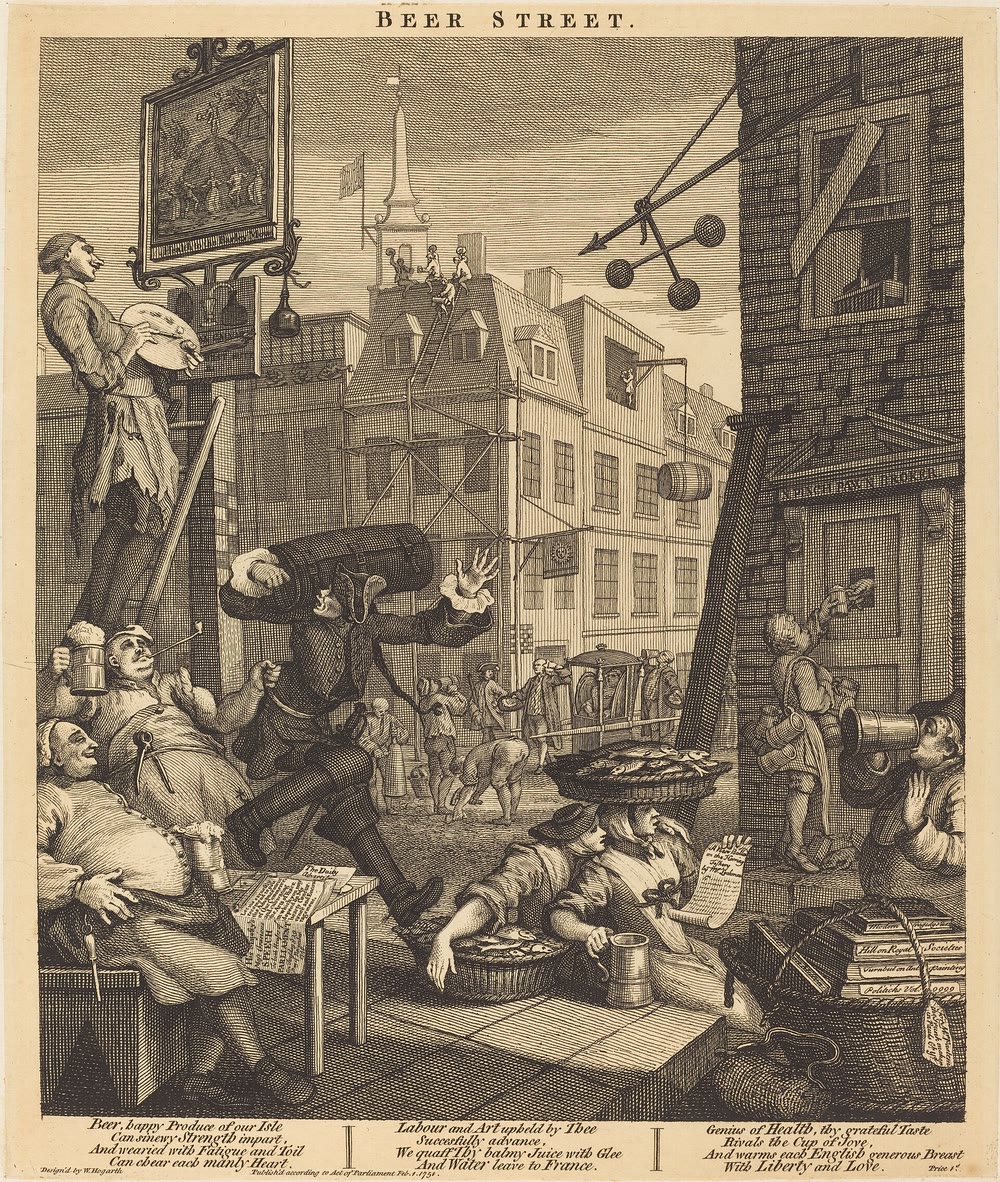
Beer Street, William Hogarth’s 1751 print of London. At lower right, a porter has set down his load for a drink. National Gallery of Art, Washington, CC0, via Wikimedia Commons
So stout and porter are close family, which is why recipes swap them. In Irish, porter is pórtar (POHR-tur) and a pint of it is pionta pórtair (PYUN-tuh POHR-tir). Either drink can be leann dubh (roughly lyan DUV), black ale. In Munster, leann sounds closer to “lyown”; in Connacht and Ulster, dubh is closer to “doo”.
How porter became the drink of Dublin
Dublin knew porter by the 1740s: “London Porter” was advertised there in 1749, and by 1762 the brewers Thwaites had “Irish Porter” on draught, the IrishBeerHistory blog found. But by one account, only 3 of Dublin’s 33 brewers made porter in 1773, and London held about 80% of the city’s porter market.
Arthur Guinness signed his St James’s Gate lease on 31 December 1759 and started out on ale. When he moved to porter is disputed. Guinness’s own history says the 1770s, the Oxford Companion to Beer says 1778, and the Dictionary of Irish Biography cautions it may have been the 1780s. He didn’t invent it, and he wasn’t the first in Dublin to brew it. The ending is firmer: the last ale was brewed in 1799, and St James’s Gate stuck to porter.
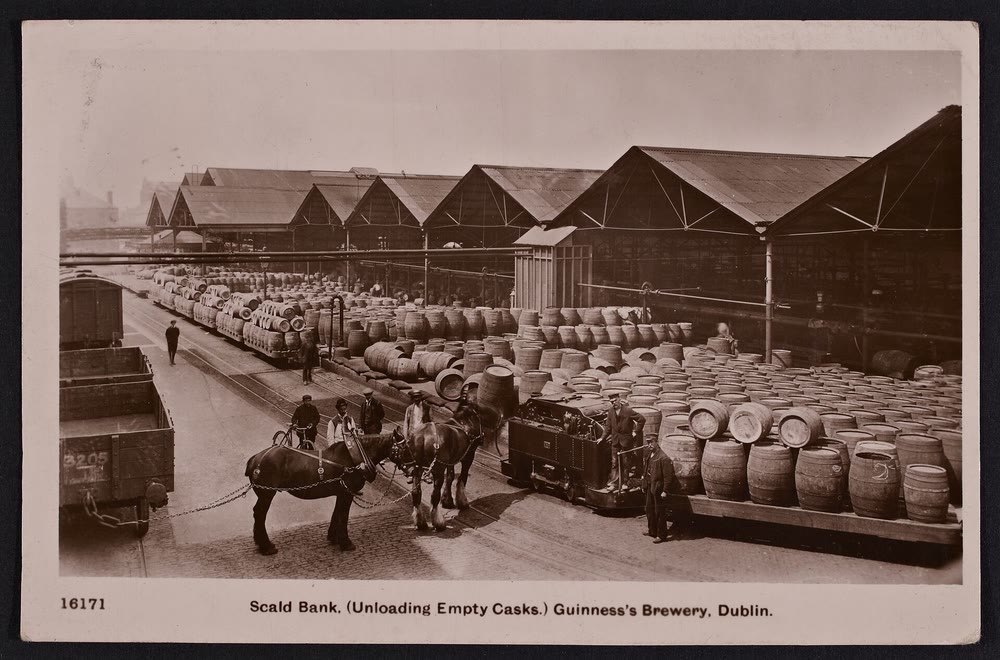
Unloading empty casks at the Scald Bank, Guinness’s Brewery, Dublin, on a postcard of about 1912. National Library of Ireland, no known copyright restrictions, via Wikimedia Commons
Then English imports fell steeply, one brewing history says, partly through the wars with France, and Irish brewers finally got good at it. By the early 1800s Dublin alone had 55 breweries, says the Oxford Companion. Porter became the everyday pint of working Dublin, and the ordinary strength came to be called plain, as in Flann O’Brien’s pint of plain.
Guinness stopped brewing plain in 1973 or 1974, depending on the source. But Irish cooks still say porter cake, even as they reach for a can of stout.
What’s actually documented about porter cake
Less than you’d expect, and the trail doesn’t start in Ireland. You’ll read that it goes back to the 1700s, but I can’t find evidence for that, or name an inventor or a birthplace. The best digging so far is a 2022 article on the IrishBeerHistory blog, which found the name no earlier than the 1890s. Here’s the record as it stands:
- 1897: the oldest recipe found so far is in a London paper, The Queen. A reader asked for one, the editor didn’t know it, and other readers sent it in, with a quarter pint of heated porter but no sugar listed.
- 1907 and 1913: two more turn up in the Northern Weekly Gazette, sent in by readers in the north of England.
- 1918: the English magazine Country Life prints an “American Porter Cake” from Lady Tredegar, with half a pint of warmed porter. It doesn’t say why American.
- 1924: the first Irish one I’ve found is in the Belfast News-Letter, transcribed by Foods of England. It’s far richer, with a pound of butter and 2 lb or more of fruit. By 1930 the same paper was offering porter cake as a fruit cake for Christmas.
- 1960: Maura Laverty’s Full and Plenty has the modern pattern: a pound of flour, half a pound of fat, a pound of sultanas, two eggs and a cup of porter or stout.
- 1969: Elizabeth Craig’s The Art of Irish Cooking prints a note from Margaret Cochrane of Co. Wicklow: after October harvest services in the West of Ireland, parishioners had tea and porter cake before “a long and often lonely journey home”.
Foods of England says Ireland knew the cake by the 1880s, but gives no source, and I couldn’t find one.
The IrishBeerHistory author suspects it started in England and came to Ireland by way of the north, helped along by a Laverty book of 1946. He calls the evidence circumstantial, and an older Irish recipe could still turn up.
So it may never have been Irish alone. But it settled into Irish kitchens for good, and a US reprint of Allen’s recipe says tins have even been shipped to emigrants in America.
Porter cake FAQ
Can you use Guinness in porter cake?
Yes. Guinness Draught is a stout, and most modern recipes, including Allen’s, simply call for stout.
Is porter cake Irish?
Its origin is unknown. The oldest recipes found so far are English, and the oldest Irish one I’ve found dates from 1924.
How long does porter cake keep?
Several weeks in an airtight tin, says Allen. Leave it at least a day before cutting.
Is there alcohol in porter cake?
A little. Most of it goes in the oven but not all, and stout added after baking stays.
What is porter cake in Irish?
Císte pórtair (KEESH-tyeh POHR-tir), the name FitzGibbon gives it. Watch the fada: ciste without one means a chest or a fund.
Love this? Save it to your Pinterest board for later.
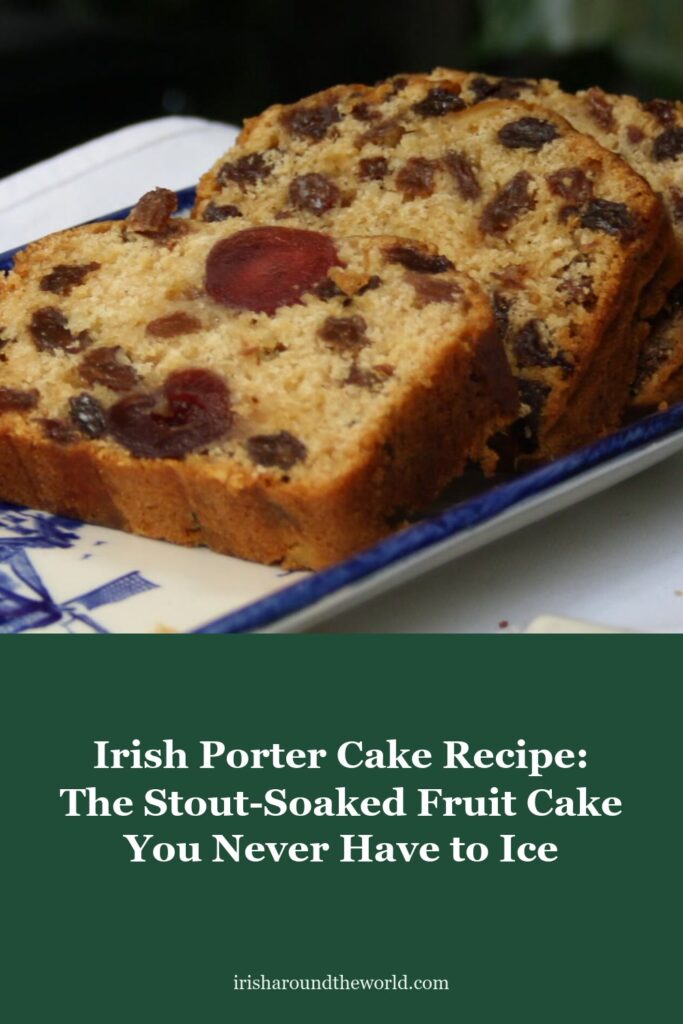
Pin image: Slices of an English fruit cake, a lighter bake than this one. Photo: TheMightyGrog, CC BY-SA 4.0 (cropped), via Wikimedia Commons
A little bit of Ireland in your inbox every Friday ☘️
The free Weekly Dose of Irish: an Irish joke, a Celtic symbol, an Irish fact, a poem and the week’s best articles in one short email. Join 9,600+ readers.
Free. One short email every Friday. Unsubscribe any time.
More Irish baking reading
- Irish Christmas Cake Recipe: The Whiskey-Fed Fruit Cake You Make Weeks Ahead
- Irish Christmas Pudding Recipe: The Guinness Pud With a Coin Inside (Make It on Stir-Up Sunday)
- 18 Irish Christmas Traditions, From the Candle in the Window to the 12 Pubs
- Barmbrack Recipe: The Irish Halloween Bread That Predicts Your Future
- Irish Soda Bread Recipe: The 4-Ingredient Loaf With a Cross to Keep the Fairies Away
- Irish Brown Bread Recipe: The No-Yeast Wholemeal Loaf (Plus a Guinness and Treacle Version)
- A Pint of Plain Is Your Only Man: Flann O’Brien’s “The Workman’s Friend” Explained
Featured image: Slices of an English fruit cake, a lighter bake than this one. Photo: TheMightyGrog, CC BY-SA 4.0 (cropped), via Wikimedia Commons.