One of the best-known Irish New Year traditions is banging a loaf or cake of bread against the door on New Year’s Eve to drive out hunger. Families also ate a big supper, opened the doors at midnight to let the old year out, and threw nothing out on New Year’s Day. Happy New Year in Irish is Athbhliain faoi mhaise duit.
New Year’s Eve in Ireland now means fireworks, a countdown on the telly and a few too many. In the 1930s it could mean a loaf of bread hitting the door.
Many of these Irish New Year traditions will surprise you. They did me, although some I not only knew but experienced growing up in Ireland.
Most of the old customs below come from the Schools’ Collection on Dúchas.ie, written down by schoolchildren in the late 1930s. I’ve linked the pages so you can read them yourself.
Jump to:
- The Irish names
- Bread against the door
- The big supper
- Opening the doors
- Cleaning the house
- Nothing leaves the house
- First footing
- Wind lore
- Bells, Mass and torches
- New Year in Ireland today
- Happy New Year in Irish
- FAQ
What New Year’s Eve is called in Irish
New Year’s Eve is Oíche Chinn Bliana (EE-ha hin BLEE-uh-na), the night at the head of the year. New Year’s Day is Lá Caille, often spelt Lá Coille in older sources, as in Ballyferriter, Co. Kerry. Oíche chinn bliana is in Ó Dónaill’s entry for oíche.
Some Gaeltacht areas still call it Oíche na Coda Móire, the night of the big portion, says NÓS. Schoolchildren recorded the name in Ballyferriter, Co. Kerry and Dungarvan, Co. Waterford.
Dungarvan also had Oíche an Dóthain Mhóir, the night of the big fill. In Askeaton, Co. Limerick, girls recorded “the night of the big enough”.
Irish New Year traditions at a glance
| Custom | What you do | Recorded in |
|---|---|---|
| Bread at the door | Throw a loaf at the door | Glin, Co. Limerick |
| Big supper | Eat your fill | Dunmanway, Co. Cork |
| Doors open | Open both doors at midnight | Carrick-on-Shannon, Co. Leitrim |
| Clean house | Clean before midnight | Drumshanbo, Co. Leitrim |
| Nothing out | No ashes, water or money out | Belcarra, Co. Mayo |
| First foot | A dark-haired man enters first | Uragh, Co. Cavan |
| Wind watch | Check the wind at midnight; west is lucky | Dungarvan, Co. Waterford |
Banging bread against the door
This is the one most people have heard of. On New Year’s Eve, someone struck a loaf or cake of bread against the door. The aim: drive hunger out for the year ahead.
The Schools’ Collection has it again and again in Cork, Kerry and Limerick:
- In Glin, Co. Limerick, a loaf was thrown against the main door to ward off hunger.
- In Ballyduff, Co. Kerry, the woman of the house threw a cake of bread at the door and called out three times, “Hunger keep away for the year”.
- Near Ballycotton, Co. Cork, the head of the house beat the door with a loaf, saying “Buailfaimíd na gorta amach”, as the pupil wrote it. In standard Irish that’s Buailfimid an gorta amach, “we’ll beat out the hunger”.
- At Baile na Manach, Co. Cork, the woman threw a big bastable cake at the back door while the family prayed.
NÓS adds a nice touch: the youngest threw the loaf at the door three times, then took a bite.
Was it barmbrack?
You’ll read online that the bread was a barmbrack. None of the 1930s accounts I’ve found say so.
They say a loaf, a cake of bread or a bastable cake, the round soda bread baked in a pot over the fire. In Ballycotton, the barm brack was kept for Hallowe’en. Use a brack if you like. Just don’t call it the rule.
The big supper
New Year’s Eve was a night to eat well, because how you ate that night was how you’d eat all year.
In Dunmanway, Co. Cork it was “Big Supper Night”, and children who didn’t eat enough were warned they’d go short all year. In Carndonagh, Co. Donegal, whoever went hungry that night stayed hungry for the year.
These children were writing less than a century after the Great Famine. A full table on New Year’s Eve was not a small thing.
Opening the doors at midnight
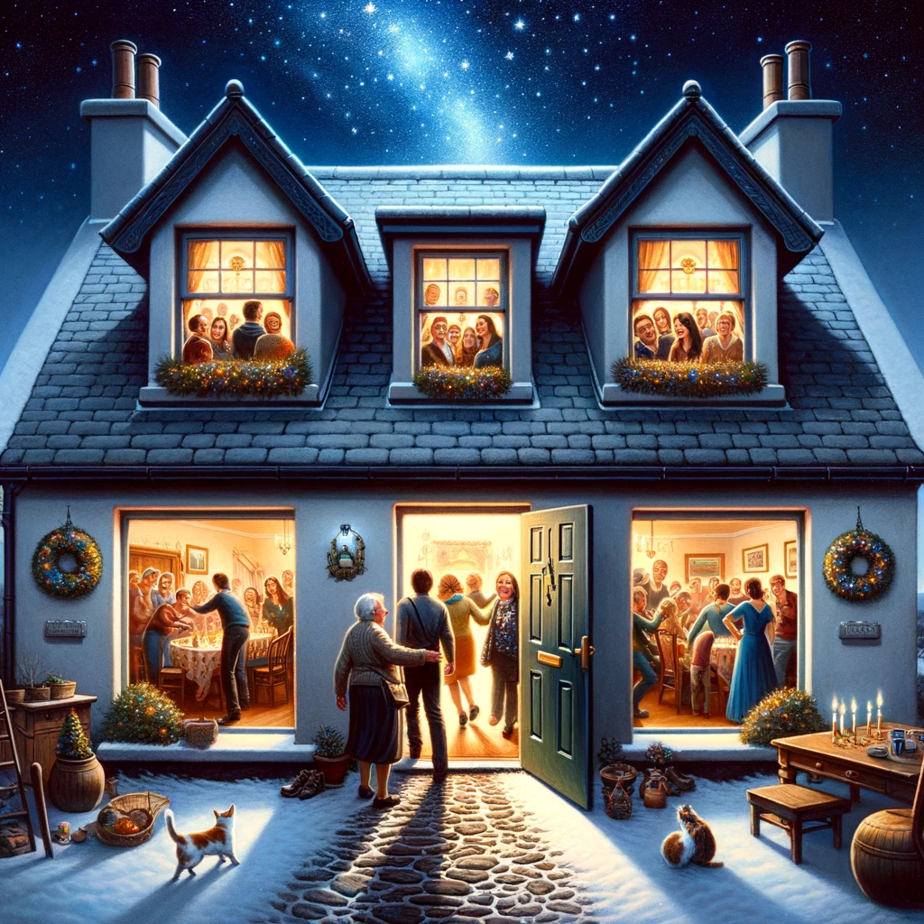
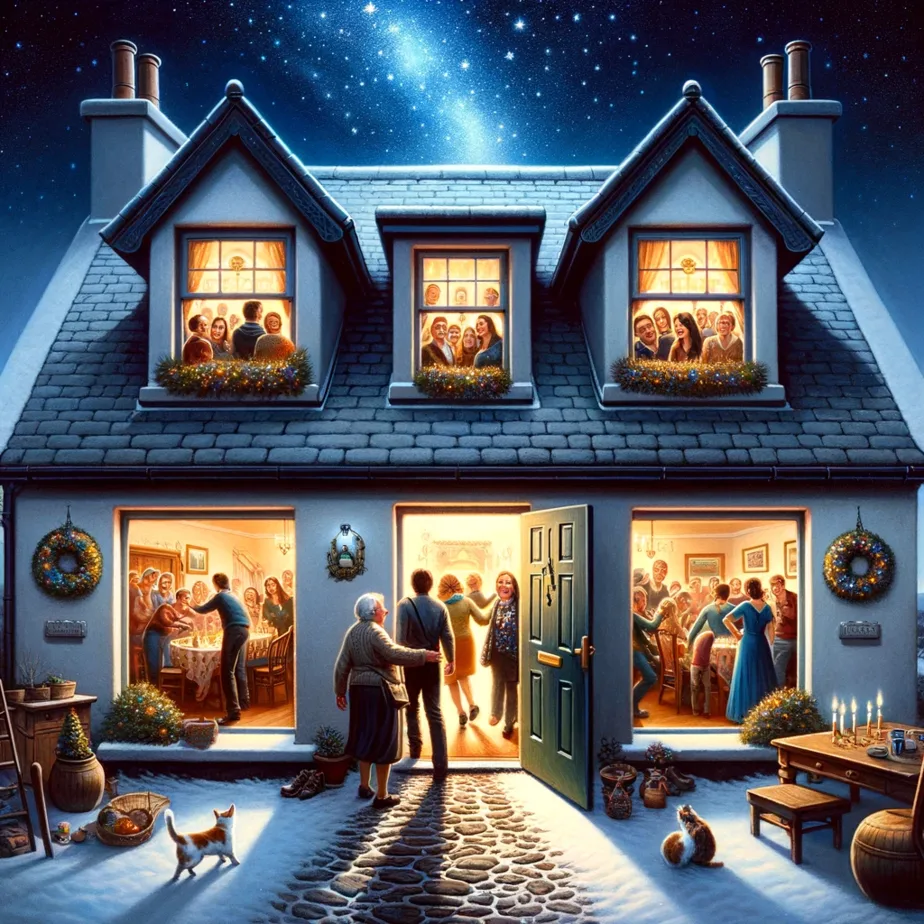
An illustration of a New Year’s Eve party with the front door thrown open
At midnight, many houses opened the doors, back and front, to let the old year out and the new year in. In Dunmanway, Co. Cork, one of the family might instead go out one door and come back in by the other.
In Carrick-on-Shannon, Co. Leitrim, people opened both doors at twelve. They said “out with the old year and in with the new” and thanked God on the doorstep.
Have you ever tried this? Let me know in the comments below!
You’ll see it claimed online that the Irish set a place at the table for the dead at New Year. I said it myself in an older version of this page. The old records don’t show it.
The closest is Carndonagh, where some said the dead came back that night, as on November night, so doors were opened and fires left burning.
Cleaning the house
The house had to be clean before midnight. In Drumshanbo, Co. Leitrim, a house not cleaned before New Year’s Day would stay dirty all year.
In Cluain, Co. Leitrim, the cleaning and the rubbish were done on the Eve, so nothing had to leave on the Day.
Nothing leaves the house on New Year’s Day
Whatever left your house on 1 January took your luck with it.
- In Belcarra, Co. Mayo: no dirty water or ashes out, because “you throw out the luck”. No paying out money and no work.
- In Birr, Co. Offaly: don’t arrive at a house empty-handed. Fresh bread should come in.
Same idea every time. In Mell, Co. Louth, whatever you did on New Year’s Day, you’d do all year. In Enniscrone, Co. Sligo, cry on New Year’s Day and you’d cry all year. So, no tears and no bills.
First footing in Ireland
First footing means the first person to cross your threshold after midnight. Their looks decided your luck for the year.
It’s best known from the Scottish Hogmanay. Britannica describes the lucky first foot as a tall, dark-haired man with a gift such as coal or salt. In Ireland, the Schools’ Collection records it in the Ulster counties of Cavan and Donegal, and as far south as Kerry.
- Uragh, Co. Cavan: a dark-haired man brings luck. A fair-haired man or a red-haired woman is unlucky.
- Cashen, Co. Kerry: a dark-haired man first in brings luck, and gets a glass of whiskey for his trouble.
- Birr, Co. Offaly: a dark-haired man first in on New Year’s Day is a lucky sign.
- Kilbeggan, Co. Westmeath: dark hair means luck, red means rows, fair means a marriage and grey means sickness.
Yes, red-haired women got a raw deal. In fairness, it wasn’t universal. In Carndonagh, a black-haired girl was sent in first to bring the luck.
Which way the wind blows
On New Year’s night, someone went out to check the wind. This one had a political edge.
In Dungarvan, Co. Waterford, the man of the house stayed up till midnight to check. A west wind meant luck for the Irish that year. An east wind meant a year of trouble from the English.
The same idea turns up in Mayo and Louth.
Bells, Mass and torches
In St Johnston, Co. Donegal, the chapel bell rang from a quarter to twelve to ring out the old year. It stopped at one minute past.
In Drumshanbo, Co. Leitrim, all the church bells rang to beat out the old year. People also walked in procession with pitchforks topped by hollowed turnips, each holding a lit candle.
Around Aughrim, Co. Galway, there were bells, candles in the windows and Midnight Mass. In Carndonagh, the old year was rung out with tin pans, cans and basins, and a few rockets for good measure.
In Ballyferriter, Co. Kerry, boys paraded with music and lit turf or sheaves on pikes. In Drumsna, Co. Leitrim, they marched with blazing turf to beat out the old year.
None of the 1930s accounts I’ve read mention New Year bonfires, so I’ll leave those to the Scots. Britannica notes the burning of the clavie at Burghead.
New Year resolutions, Irish style
Resolutions aren’t new. In Foxrock, Co. Dublin, a child wrote in the 1930s that “nearly everybody makes a New Year Resolution”.
In St Johnston, a pupil noted the classic one: getting up at six every morning. No word on how long it lasted.
The Irish twist is that Mell rule: whatever you do on New Year’s Day, you’ll do all year. So choose carefully. A walk beats a hangover.
New Year in Ireland today
NYF Dublin
Dublin’s big event is NYF Dublin. Its 2025/26 programme, says Tourism Ireland, included early-evening fireworks at Howth and Dún Laoghaire. Inhaler headlined the Countdown Concert at Dublin Castle.
NYF Dublin 2026/27 is confirmed for 30 December 2026 to 1 January 2027, says Visit Dublin. It promises concerts, a music trail and a street procession. The line-up hadn’t been published when I wrote this.
The countdown on RTÉ
Plenty of us ring in the year from the couch. For 2025/26, RTÉ One’s Late Late Show New Year’s Eve Show with Patrick Kielty was billed to end with a live countdown from Dublin Castle. Inhaler were on the bill.
The New Year’s Day swim
New Year’s Day has its own sea swims. On 1 January 2026, the PA news agency reported dozens of dips from Co Antrim to Co Cork. They included Bray, Benone Beach and a harbour jump at Carnlough. Bring a flask. Bring two.
How to say Happy New Year in Irish
Happy New Year in Irish is Athbhliain faoi mhaise duit, said roughly AH-vleen fwee VASH-a ditch. To a group, swap duit for daoibh (deev).
In Munster, faoi sounds more like “fay”, and in Connacht and Ulster mhaise starts with a “w” sound.
Ó Dónaill gives athbhliain as the coming year and faoi mhaise as “greatly prospering”.
The reply is Gurab amhlaidh duit, “the same to you”, per teanglann.ie.
| Irish | Say it | English |
|---|---|---|
| Athbhliain faoi mhaise duit | AH-vleen fwee VASH-a ditch | Happy New Year (one person) |
| Athbhliain faoi mhaise daoibh | AH-vleen fwee VASH-a deev | Happy New Year (a group) |
| Gurab amhlaidh duit | GUR-ub OW-lee ditch | The same to you |
For a few words to go with the glass, see my Irish New Year blessings and toasts. My personal favourite wishes you a light heart and a coin or two in your pocket.
Nollaig na mBan: the end of the season
In Ireland, New Year isn’t the end of Christmas. The season runs to 6 January, Little Christmas, also called Nollaig na mBan or Women’s Christmas.
That’s when the decorations traditionally come down. In Foxrock in the 1930s, everything but the holly came down that day.
Irish New Year FAQ
Why do Irish people bang bread against the door on New Year’s Eve?
To drive hunger out of the house for the coming year. 1930s accounts from Cork, Kerry and Limerick describe a loaf or cake of bread thrown or beaten against the door.
How do you say Happy New Year in Irish?
Athbhliain faoi mhaise duit, said roughly AH-vleen fwee VASH-a ditch. The reply is Gurab amhlaidh duit, “the same to you”.
What is New Year’s Eve called in Irish?
Oíche Chinn Bliana. An old name, still heard in some Gaeltacht areas, is Oíche na Coda Móire, the night of the big portion.
Is first footing an Irish tradition?
It’s best known in Scotland, but 1930s records show it in Cavan, Donegal, Kerry, Mayo, Offaly and Westmeath. A dark-haired man as first visitor was lucky.
More Irish Christmas and New Year reading
- Irish New Year Blessings and Toasts
- Nollaig na mBan: Women’s Christmas
- Irish Christmas Traditions
- Wren Day
- How to Say Cheers in Irish
- Irish Greetings
Sláinte,
Stephen
A little bit of Ireland in your inbox every Friday ☘️
The free Weekly Dose of Irish: an Irish joke, a Celtic symbol, an Irish fact, a poem and the week’s best articles in one short email. Join 9,600+ readers.
Free. One short email every Friday. Unsubscribe any time.
Patricia Maria Attwood
Friday 31st of December 2021
I Love the New Years Tradition and the Blessing .I love your columm Thanks for the laughter and the history Wishing you and your family the best off health for 2022