“May the road rise up to meet you” opens a six-line blessing for a good journey. The first line comes from the Irish “Go n-éirí an bóthar leat” (guh NYE-ree un BOH-har lat), which really means “may your journey go well”. It was recorded as an old farewell in 1930s Ireland. A short English version was printed in a US newspaper in 1946. Nobody knows who wrote it.
“May the road rise up to meet you” is a line you’ve probably heard at a wedding, a funeral or a going-away party. It’s arguably the best-known Irish blessing in the world.
But how much of it is really Irish? The first line is. The rest is a bit of a mystery.
Jump to:
- The full blessing (the complete poem)
- May the road rise to meet you meaning, line by line
- In Irish: Go n-éirí an bóthar leat
- Where it really comes from
- How it’s used today
- Songs and choir settings
- Similar Irish blessings and farewells
- May the road rise FAQ
- More Irish blessings and sayings
The full blessing (the complete poem)
This is the version you’ll see on most cards, plaques and memorial cards. It’s anonymous and traditional, so here it is in full.
May the road rise up to meet you.
May the wind be always at your back.
May the sun shine warm upon your face,
and the rains fall soft upon your fields.
And until we meet again,
may God hold you in the palm of His hand.
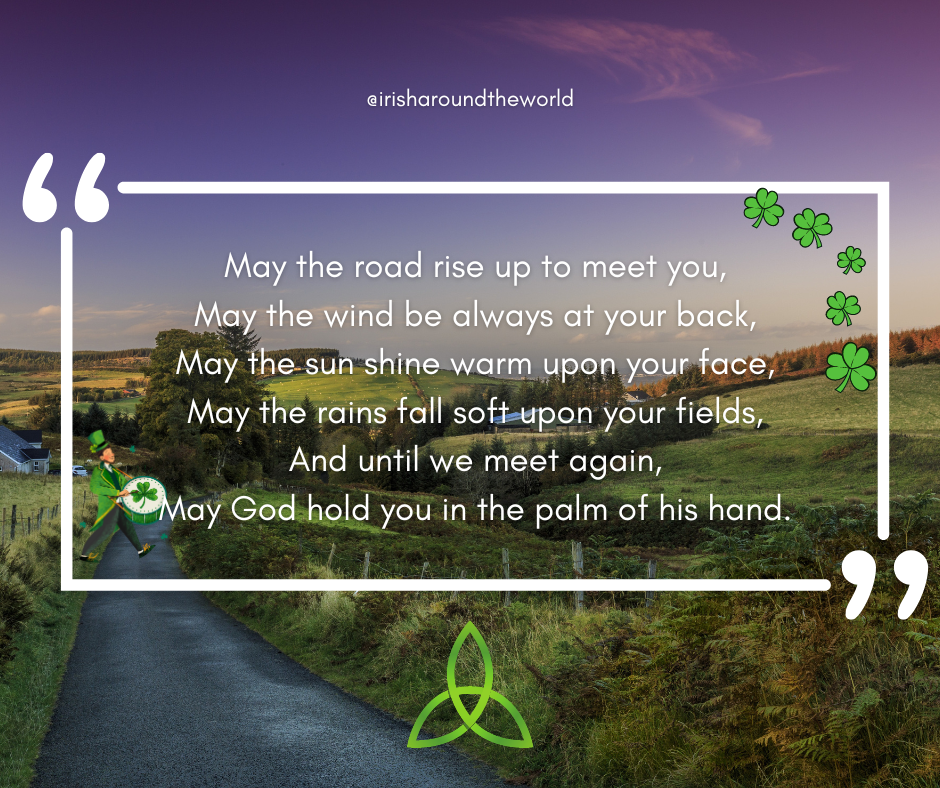
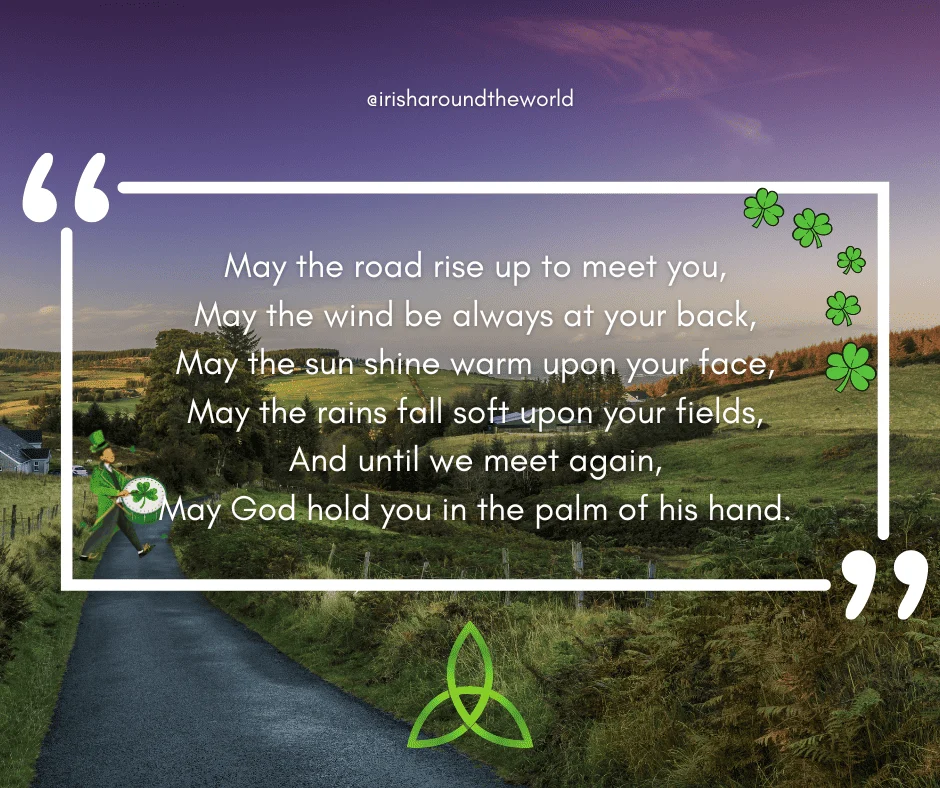
The full six-line blessing on one of my Irish Around The World quote cards
Small differences are normal. Some say “rain” or “softly”. Older versions say “the hollow of His hand” instead of “the palm”. None is the one “correct” version.
May the road rise to meet you meaning, line by line
At heart, it’s a wish for a safe journey and a good life.
“May the road rise up to meet you”
Read in English, it pictures the road coming up to meet your feet. That’s a nice image, but it’s really a word-for-word rendering of an Irish idiom meaning “may your journey go well”. More on that below.
“May the wind be always at your back”
Walking with the wind behind you pushes you along. Anyone who has cycled into a west of Ireland headwind will understand why this one made the cut. It’s a wish for help on the way.
“May the sun shine warm upon your face”
In a country where the sun is a rare visitor, this is a generous wish. It means happiness, warmth and good days.
“And the rains fall soft upon your fields”
This is a farmer’s wish. Gentle rain grows crops. Heavy rain flattens them. In Ireland a mild, drizzly day is still called “a soft day”, so “soft” rain is the good kind. It’s a wish for a good harvest and a comfortable living.
“And until we meet again”
This is the farewell. The person is leaving, and you hope to see them again.
“May God hold you in the palm of His hand”
The last line asks God to keep the person safe while you’re apart. The older wording, “the hollow of His hand”, is King James Bible language. Isaiah 40:12 speaks of God measuring “the waters in the hollow of his hand”.
In Irish: Go n-éirí an bóthar leat
The first line comes from a real Irish phrase: Go n-éirí an bóthar leat. Irish is the country’s own Gaelic language.
Word by word:
- Go n-éirí: may (it) rise, or may (it) succeed
- an bóthar: the road
- leat: with you
The key is the verb. Éirigh does mean “rise”, but éirigh le means “succeed”. Ó Dónaill’s Irish-English Dictionary, on teanglann.ie, gives “D’éirigh leis” as “he succeeded”.
The same entry gives a wish for “your day, your journey, your marriage” to be a success: Go n-éirí do lá, do thuras, do phósadh, leat. So the honest translation is “may the road go well with you”, or simply “may you succeed”.
It even has a road example: “D’éirigh a bhóthar leis”, which Ó Dónaill translates as “he prospered on his way”.
The dictionary also gives the plain sense, a road that climbs: “where the road ascends”. That’s how a literal English rendering got the road rising.
How to say Go n-éirí an bóthar leat
Say it guh NYE-ree un BOH-har lat.
- The “n-” joins on to éirí, so it sounds like “nye-ree”.
- The “th” in bóthar is a soft “h”.
- The “l” in leat is soft, so some hear it closer to “lyat”.
Dialects differ. In Munster, which takes in my own Co. Cork, the stress moves to the end: “guh nye-REE”. Ulster speakers say something nearer “guh NAY-ree”.
You can hear native speakers from all three main dialects say éirí and bóthar on teanglann.ie. Worth a listen before a wedding speech.
“Go n-éirí leat” today
Cut the road out and you get Go n-éirí leat, the everyday Irish for “good luck”. The Foras na Gaeilge dictionary at focloir.ie lists it for “good luck!”.
You’ll hear it before exams, interviews and driving tests.
Where it really comes from
Many websites say the blessing is ancient, or that St Patrick wrote it. There’s no evidence for either. Here’s what is documented.
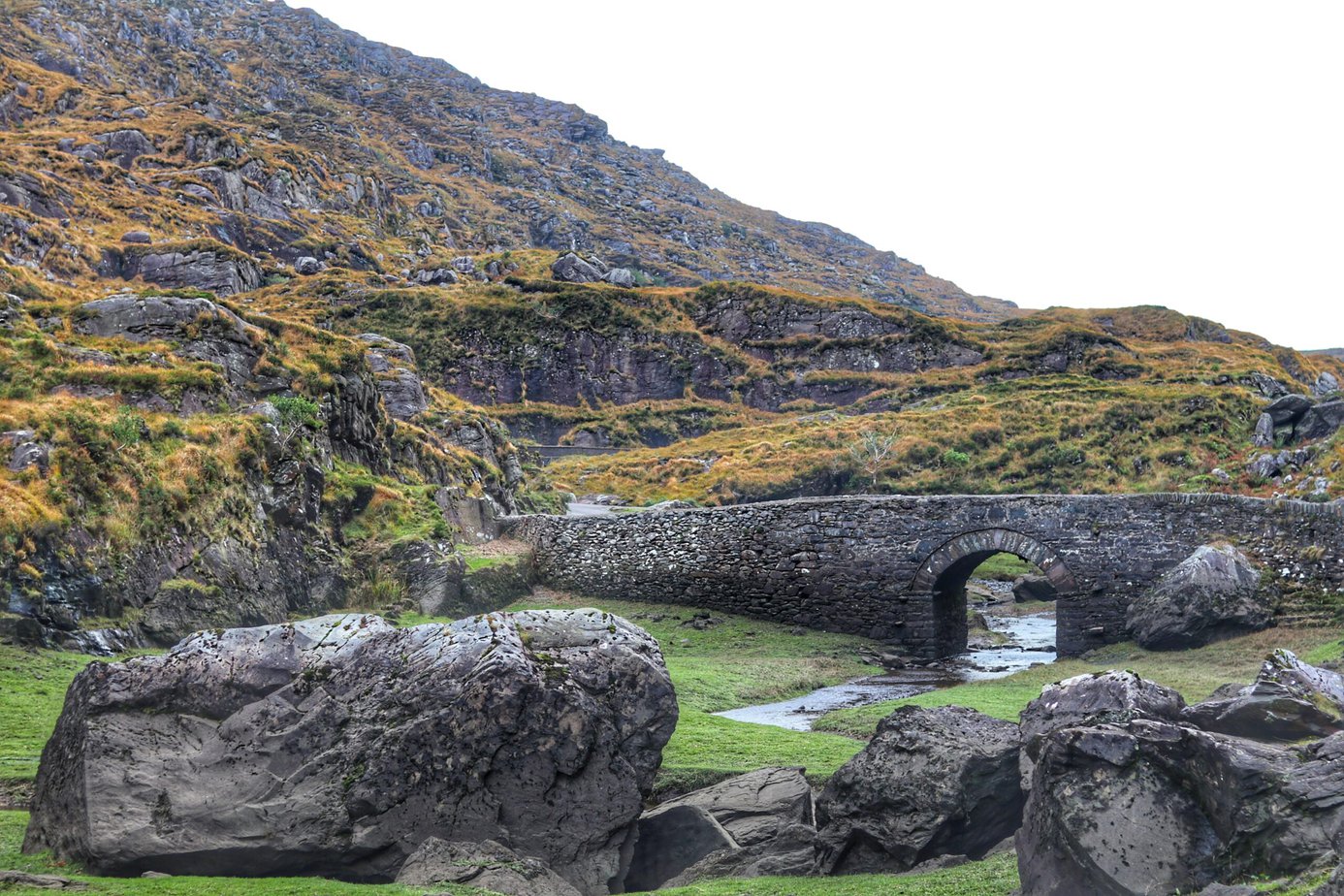
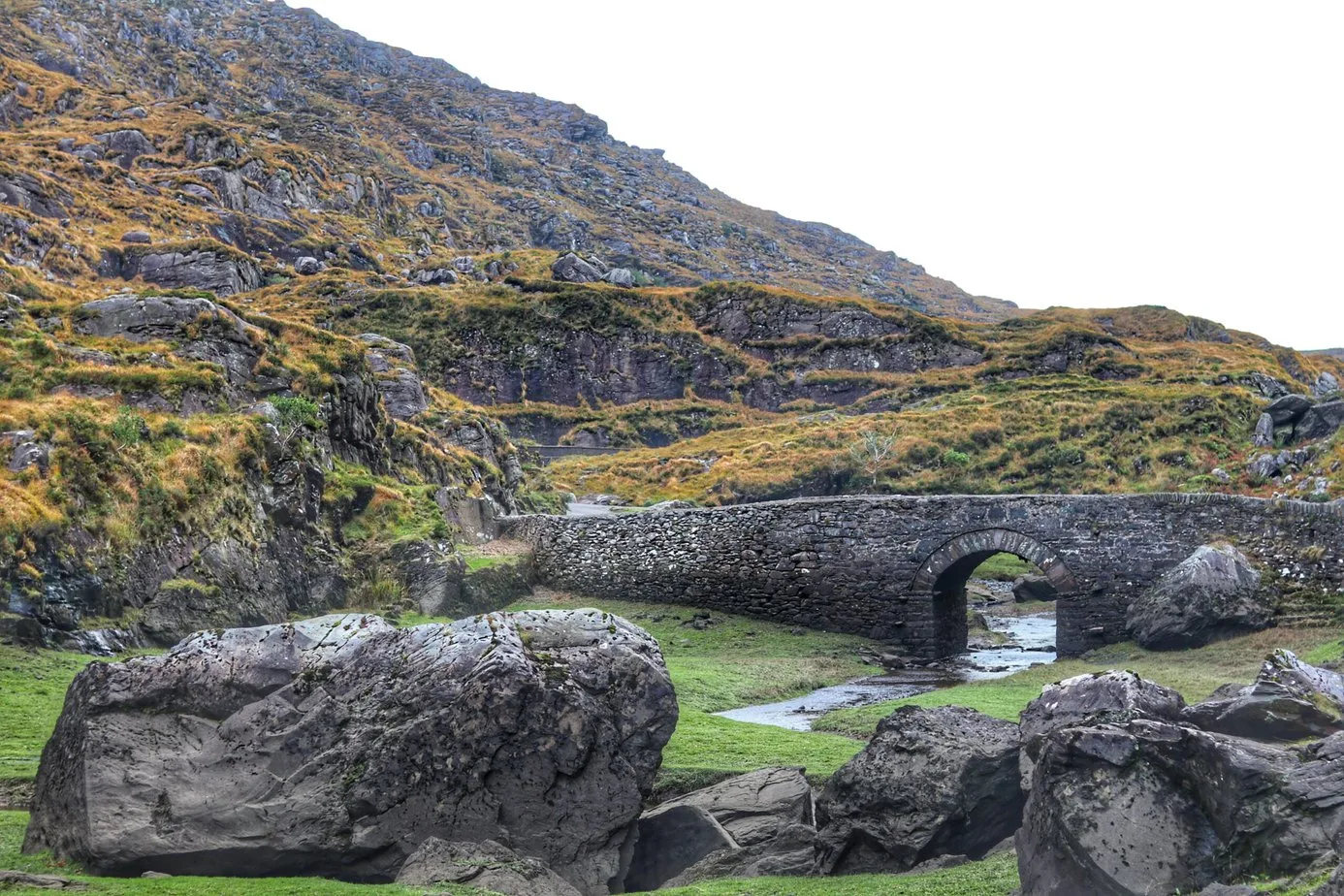
An old stone bridge on a mountain road in the Irish countryside
1930s: an Irish farewell
The best evidence comes from the Schools’ Collection. In 1937 to 1939, schoolchildren across the 26 counties wrote down lore from older people. The records sit in the National Folklore Collection at UCD.
In the Millstreet area of Co. Cork, a pupil wrote that the old people had “a beautiful prayer” for a journey: Go n-eirigh an bóthar leat. You can read the page on dúchas.ie.
It turns up elsewhere too:
- Castletownshend, Co. Cork: in a list of blessings, next to “Go n-éirighidh an lá leat” (may the day go well with you).
- Rylane, Co. Cork: in a collection of prayers, spelled “Go ndeirigeadh an bóthar leat”.
- Mallaranny, Co. Mayo: a king in a folktale sends a couple off with “go n-éirighidh an bóthar libh”. Libh is “with you” for more than one person.
- Dundalk, Co. Louth: a pupil records, in English, a send-off for a long journey that ends “may the road rise with you”.
So the opening wish was a living farewell in at least three provinces, and its literal English form was already in use. But none of these records has the wind, the sun, the rain or God’s hand. Only the road.
1946: the verse appears in print
The earliest printing found so far is in the Pittsburgh Sun-Telegraph on 17 March 1946. The quotation researcher Barry Popik traced it in newspaper archives.
It sat at the end of a St Patrick’s Day column by Harry H. Schlacht, a New York author and publisher. He called it “an old-fashioned Irish prayer”. It was just four short lines: the road, the wind, and God holding you “in the hollow of His hand”.
He used it again in 1947, and in a 1949 column in the San Francisco Examiner.
How the verse grew
Other papers soon printed their own versions:
- 1953: a Missouri paper ran “An Irish Wish”, with extra lines about a warm hearthstone and the poor.
- 1954: Redbook magazine printed “rise up” and “palm of His hand”, the earliest of those wordings in Popik’s list.
- 1955: a Binghamton, New York, paper labelled it “An Irish Prayer”.
- 1962: when a reader asked who wrote it, a Washington paper replied only that it was “an old Gaelic blessing”.
The six-line version with the sun and rain is printed as “another version” in Respectfully Quoted, a quotation dictionary compiled at the Library of Congress (first published 1989). Its main entry is the hearthstone “Irish Wish”, which it traces to a 1970 anthology.
What nobody knows
Let me be plain about the gaps:
- Nobody knows who wrote the English verse. Schlacht may have found it, adapted it or written it himself.
- Nobody has yet found an Irish-language original of the full verse.
- Nobody has pinned down when the sun and rain lines were added.
As Popik puts it, “it is not known if an original Gaelic blessing exists in this form.” The full six-line Irish versions you see online look like translations from the English, not the other way round.
My best reading of the evidence: a real Irish farewell, probably carried over by emigrants, became an English verse in America. Then it came home. By 1988 it was on postcards in Ireland, as the German song below shows. Plenty of Irish traditions took the long way round.
For more legend versus record, see the real story behind St Patrick’s Day.
How it’s used today
The blessing works for almost any parting, happy or sad. That’s why it lasts.
Funerals and memorial cards
“Until we meet again” suits a funeral. It’s a common choice for memorial cards, the small cards with a photo and prayer handed out at Irish and Irish-American funerals. One New York funeral home’s list of memorial card prayers puts “An Old Irish Blessing” first.
Weddings
You’ll often hear it as a reading, a toast or the last line of a best man’s speech. For more ideas, see my Irish sayings about love and Irish toasts.
Farewells, graduations and St Patrick’s Day
It’s the classic line for someone emigrating, retiring or heading off to college. And it’s a popular framed print or plaque for the home, often bought as an Irish gift.
Songs and choir settings
The blessing has been set to music many times. Here are some well-known ones.
- James E. Moore Jr., “An Irish Blessing” (1986): a short unaccompanied setting for four-part choir, published by GIA.
- Bob Chilcott, “Irish Blessing” (1997): published by Oxford University Press in versions for mixed choir and upper voices.
- Markus Pytlik, “Möge die Straße uns zusammenführen”: a German church song. Pytlik came home from Ireland in 1988 with a postcard of the blessing. It became his first verse, and the rest draws on other Irish toasts. It’s in regional editions of the Catholic Gotteslob hymnal, and is sung at partings and even funerals.
- Roma Downey, “An Irish Blessing” (1999): the final track on her album Healing Angel, produced by Phil Coulter.
One common mix-up: John Rutter’s choral piece “A Gaelic Blessing” is a different text altogether. The road never appears in it.
Similar Irish blessings and farewells
Irish has dozens of short blessings for comings and goings. Here are some you’ll still hear, plus a few from the 1930s records.
- Go n-éirí an lá leat (guh NYE-ree un law lat): may the day go well for you.
- Go n-éirí an t-ádh leat (guh NYE-ree un taw lat): may luck be with you.
- Slán abhaile (slawn uh-WAL-yeh): safe home. You’ll still hear it leaving the pub.
- Go dté tú slán (guh JAY too slawn): may you go safely.
- Go dtuga Dia slán abhaile thú (guh DUG-uh DEE-uh slawn uh-WAL-yeh hoo): may God bring you home safe. The Rylane record spells it the old way, “Go dtugaidh”.
- Dia is Muire duit (DEE-uh iss MWIR-uh ditch): God and Mary be with you. It’s the reply to “Dia duit”, the Irish for hello.
- “God save all here”, answered with “God save you kindly”. The Dundalk record gives this as the greeting on entering a house.
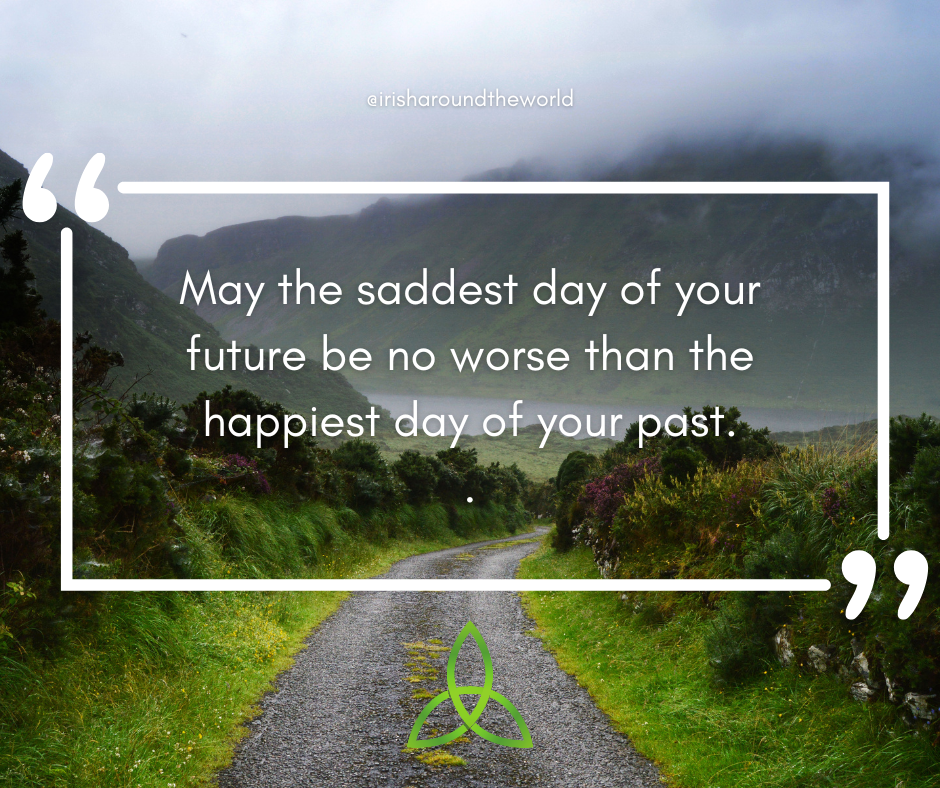
Another popular blessing, often shared as an Irish one: “May the saddest day of your future be no worse than the happiest day of your past”
I’ve gathered many more in my St Patrick’s Day blessings and Irish sayings collections.
Do you have a favourite Irish blessing? Tell me in the comments.
May the road rise FAQ
Who wrote “May the road rise up to meet you”?
Nobody knows. A short English version first appears in a 1946 Pittsburgh newspaper column, which gives no author for the verse. The six-line version with the sun and rain came later, and the opening line is an older Irish farewell.
What does “may the road rise to meet you” actually mean?
It means “may your journey go well”. It’s a literal English rendering of the Irish “Go n-éirí an bóthar leat”. The verb can mean “rise”, but in this phrase it means “succeed”.
Is there a full Irish version of the blessing?
Only the first line has a documented Irish history. The six-line Irish versions online appear to be modern translations from the English. Nobody has yet found an older Irish original.
Is it “palm of His hand” or “hollow of His hand”?
Both are correct. “Hollow” appears in the earliest printings from 1946. “Palm” shows up from 1954 and is far more common today.
Is it suitable for a funeral?
Yes. It’s a common choice for Irish and Irish-American memorial cards. The line “until we meet again” suits a funeral as well as a wedding.
Did St Patrick write the blessing?
There’s no evidence he did. The Irish phrase is folk speech, and the English verse is first printed in 1946, about 1,500 years after Patrick.
More Irish blessings and sayings
- St Patrick’s Day Blessings
- Irish Sayings
- Top 10 Irish Toasts
- Irish Proverbs
- Irish Sayings About Love
- St Patrick’s Day Music
- Irish Gifts
A little bit of Ireland in your inbox every Friday ☘️
The free Weekly Dose of Irish: an Irish joke, a Celtic symbol, an Irish fact, a poem and the week’s best articles in one short email. Join 9,600+ readers.
Free. One short email every Friday. Unsubscribe any time.