The best Irish toast is one word: sláinte (SLAWN-cha), Irish for “health”. The classic long one is “May you be in heaven half an hour before the devil knows you’re dead.” Below are 63 Irish toasts for friends, weddings, wakes and birthdays, plus toasts in Irish and which “old Irish toasts” are really American, Scottish or English.
Raise a glass in any pub in Ireland and you’ll hear one word. Sláinte. That’s it. Nobody stands up and recites four rhyming lines on a Tuesday.
The longer toasts come out for weddings, wakes and birthdays. A fair few “old Irish toasts” turn out to be American, Scottish or English, and I flag those as we go.
They’re grouped by occasion, with the Irish words and how to give a toast without making a show of yourself.
Jump to:
- Classic Irish toasts
- Short Irish toasts
- Toasts in Irish, with pronunciations
- Funny Irish toasts and drinking toasts
- Irish toasts for friends
- Toasts for friends departed and wakes
- Irish wedding toasts
- Irish birthday toasts
- Toasts for St Patrick’s Day
- Christmas and New Year toasts
- How to give an Irish toast
- Which Irish toasts are really Irish?
- Irish toasts FAQ
- More Irish sayings and blessings
Classic Irish toasts
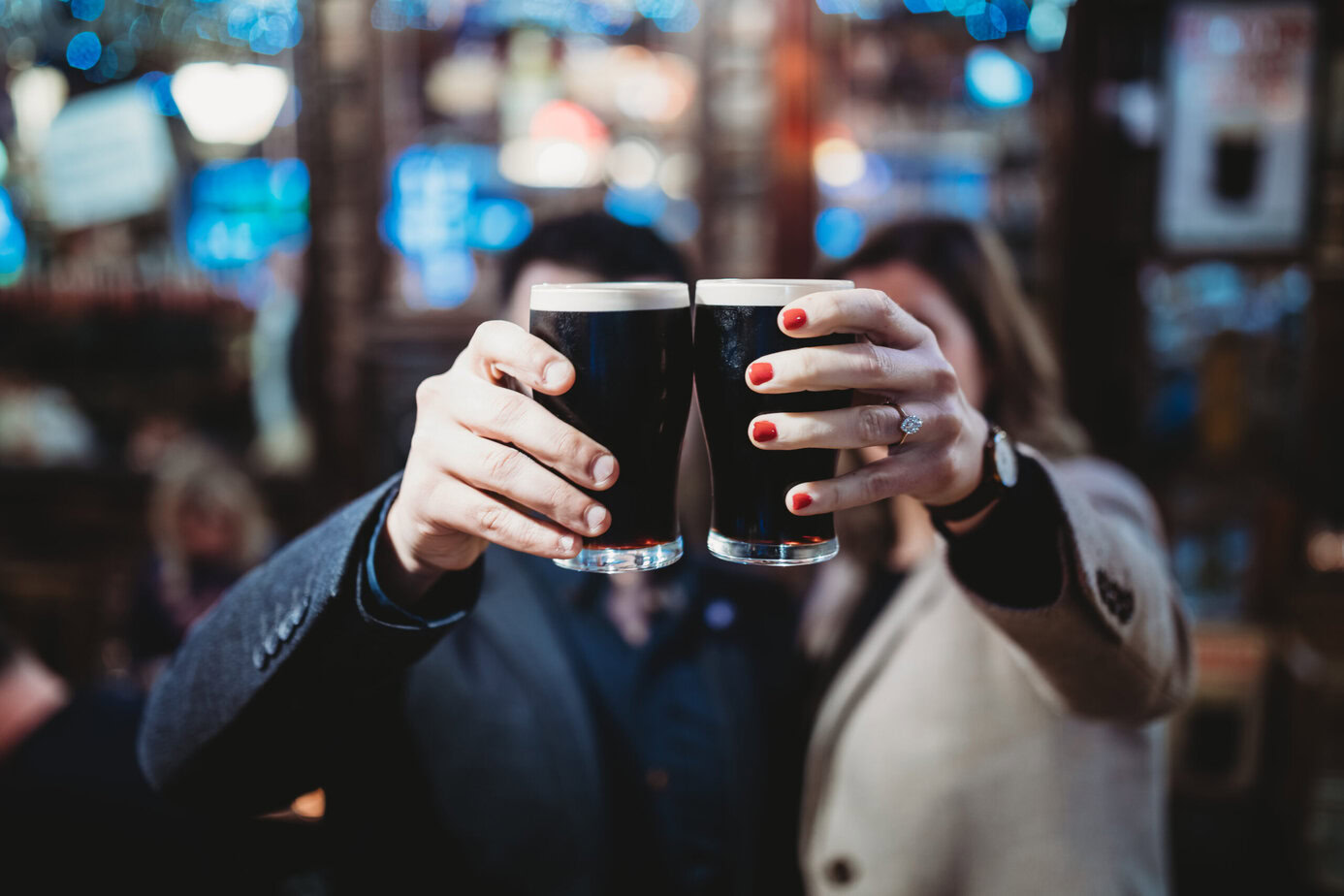
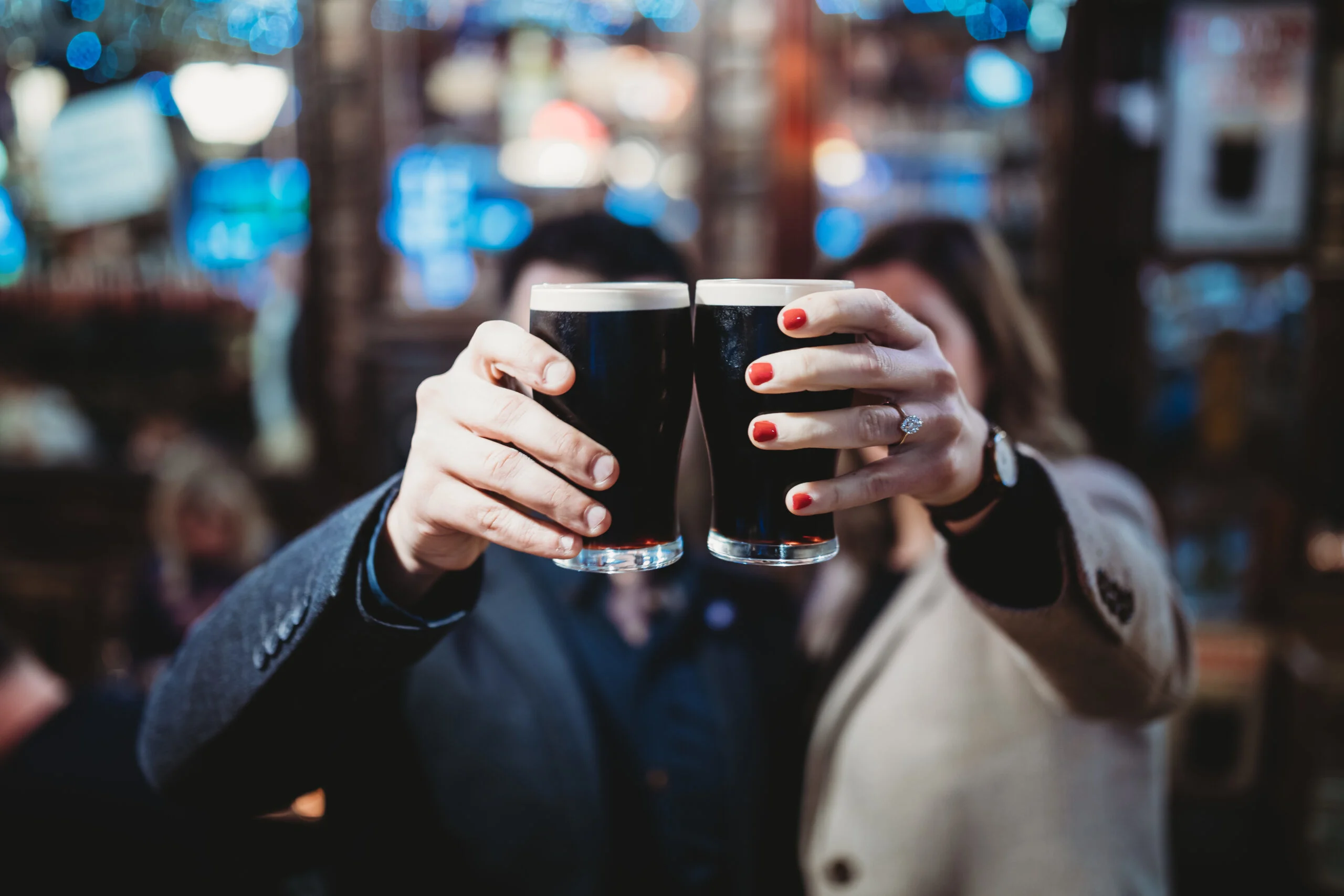
Two pints of stout and a clink. Add “sláinte” and you’ve given an Irish toast.
These are the ones you’ll see framed on pub walls from Boston to Brisbane. Most are anonymous.
- “Sláinte!”
Irish for “health”. Say it SLAWN-cha. If you learn one toast, learn this one. - “May your glass be ever full. May the roof over your head be always strong. And may you be in heaven half an hour before the devil knows you’re dead.”
My favourite. Dark and cheeky, but kind with it. - “May the roof above us never fall in, and may we friends gathered below never fall out.”
First found in 1912, credited to a London paper and billed in Chicago as an old English toast. - “May your home always be too small to hold all your friends.”
- “May your troubles be less and your blessings be more, and nothing but happiness come through your door.”
- “May your pockets be heavy and your heart be light, and may good luck pursue you each morning and night.”
- “May the lilt of Irish laughter lighten every load. May the mist of Irish magic shorten every road. And may all your friends remember all the favours you are owed.”
- “May you have warm words on a cold evening, a full moon on a dark night, and a smooth road all the way to your door.”
Reading a toast is one thing, but hearing a few said out loud gives you the rhythm before you stand up.
Short Irish toasts
For when you’ve a full glass, a noisy room and about four seconds of attention.
- “May you never forget what is worth remembering, nor remember what is best forgotten.”
- “May the best day of your past be the worst day of your future.”
- “May you have the hindsight to know where you’ve been, the foresight to know where you’re going, and the insight to know when you’ve gone too far.”
- “If we ever disagree, may you be in the right.”
- “May the Lord keep you in His hand, and never close His fist too tight.”
- “Here’s to us. Who’s like us? Damn few, and they’re all dead.”
A great toast, but it’s Scottish. More on that below.
Toasts in Irish, with pronunciations
This is what you’ll actually hear in Ireland. Most are in Ó Dónaill’s dictionary on teanglann.ie or on focloir.ie. The sounds are plain-English guides, and they vary by county.
- Sláinte mhaith (SLAWN-cha WAH, some say VAH)
“Good health.” - Sláinte agatsa (SLAWN-cha AG-ut-sa)
“Your health too.” This is everyday speech rather than a dictionary phrase, and the usual reply. - Seo do shláinte (shuh duh LAWN-cha)
“Here’s to your health.” - Go bhfága Dia do shláinte agat (guh WAW-guh JEE-uh duh LAWN-cha AG-ut)
“God keep you in good health.” Ó Dónaill gives it as a thank-you, so it’s the perfect reply when someone buys you a drink. - Sláinte agus saol chugat (SLAWN-cha AH-gus SAYL HUG-ut)
“Health and long life to you.” - Sláinte agus táinte (SLAWN-cha AH-gus TAWN-cha)
“Health and wealth.” Táinte meant herds of cattle, which was wealth in old Ireland. There’s a proverb too: “Is fearr an tsláinte ná na táinte”, or “Health is better than wealth”. - Sláinte na mban (SLAWN-cha nuh MAHN)
“The health of the women.” - Sláinte na bhfear, agus go maire na mná go deo (SLAWN-cha nuh VAR, AH-gus guh MAR-eh nuh m-NAW guh JOE)
“Health to the men, and may the women live forever.” The men raise the first half. The women answer with the second, which is the better deal. You’ll also hear “Sláinte chuig na fir” (SLAWN-cha hig nuh FIR).
Funny Irish toasts and drinking toasts
Keep these Irish drinking toasts for the pub, the stag or the hen. Maybe not the christening.
- “As you slide down the banister of life, may the splinters never point the wrong way.”
- “Here’s to the whiskey, so amber and bright, not as sweet as the lips I kissed last night.”
- “Here’s to you, and here’s to me, and friends we’ll always be. But if we ever disagree, to hell with you and here’s to me.”
Number 12’s evil twin. - “May the winds of fortune sail you,
May you sail a gentle sea.
May it always be the other guy
Who says, ‘This drink’s on me.'” - “May you die in bed at ninety-five, shot by a jealous husband (or wife).”
- “Here’s to absent friends, and here’s twice to absent enemies.”
- “Here’s to a long life and a merry one. A quick death and an easy one. A pretty girl and an honest one. A cold pint, and another one.”
Often sold as the great Irish drinking toast. It’s American. - “Here’s to our wives and sweethearts. May they never meet.”
Royal Navy, not Irish. Read the room first. - “Champagne to our real friends, and real pain to our sham friends.”
- “If all be true that I do think,
There are five reasons we should drink:
Good wine, a friend, or being dry,
Or lest we should be by and by,
Or any other reason why.”
An English version of an old Latin epigram, usually credited to Henry Aldrich, Dean of Christ Church, Oxford, in the 1600s.
Irish toasts for friends


Cheers to good friends. A toast for friends works best said looking at them, not at your glass.
The best toasts for friends are a bit soppy and a bit cheeky. Pick one that sounds like you.
- “Here’s to good friends. Never above you, never below you, always beside you.”
Modern and anonymous. - “May your heart be light and your glass be full, with friends by your side and laughter in your soul.”
- “Here’s to a sweetheart, a bottle and a friend. The first beautiful, the second full, the last ever faithful.”
- “Here’s to friends and family who know us well but love us just the same.”
- “The Lord gives us our relatives, but thank God we can choose our friends.”
An American quip from about 1903, credited to the writer Ethel Watts Mumford. - “Here’s to you and yours, and to mine and ours.
And if mine and ours ever come across you and yours,
I hope you and yours will do as much for mine and ours,
As mine and ours have done for you and yours.”
Try saying that at speed. - “May the hinges of our friendship never grow rusty.”
Lovely, but it started in Scotland.
Toasts for friends departed and wakes
An Irish wake is sad, but rarely solemn the whole way through. There are stories, tea and sandwiches, and often a drink.
My own county has a record of this. In the 1930s, schoolchildren wrote down local customs for the National Folklore Collection. A pupil at Corravoley school near Skibbereen, Co. Cork, described a West Cork wake.
The family got in pipes, tobacco and whiskey. Every guest was offered a clay pipe, smoker or not, and refusing was an insult. Then whiskey went round to those who took a drink. You can read the record on dúchas.ie, in the Schools’ Collection.
I can find no set “wake toasts” in any old source. Keep it gentle: a story first, then the glass.
- “To absent friends.”
- “To absent friends. May we always remember them with a smile.”
- “To the friends who have stood by us, and the friends who have gone before us. We remember them all.”
- “May the earth rest lightly on them.”
It’s Roman. They carved “sit tibi terra levis” on gravestones. - Ar dheis Dé go raibh a anam (er yesh JAY guh rev uh AN-um)
“May his soul be at God’s right hand.” For a woman, say “a hanam” (uh HAN-um). You’ll hear this at every Irish funeral. - “May the road rise up to meet you.”
A blessing rather than a toast, in print since at least 1946 and often read at funerals. I’ve a whole page on where “May the road rise up to meet you” comes from.
Irish wedding toasts
A wedding toast should be warm, short and safe for the granny in the front row. Number 46 is the crowd-pleaser, and it ends on a laugh.
- “May you never lie, steal, cheat or drink.
But if you must lie, lie in each other’s arms.
If you must steal, steal kisses.
If you must cheat, cheat death.
And if you must drink, drink with us, your friends.” - “May you be poor in misfortune, rich in blessings, slow to make enemies and quick to make friends. But rich or poor, quick or slow, may you know nothing but happiness from this day forward.”
- “Here’s to the husband, and here’s to the wife. May they remain lovers for life.”
- “May you have many children, and may they grow mature in taste, healthy in colour, and as sought after as the contents of this glass.”
- Go maire sibh bhur saol nua (guh MAR-eh shiv vur SAYL NOO-uh)
“May you enjoy your new life.” Ó Dónaill’s dictionary gives it as congratulations on a marriage. - Go maire tú do shláinte (guh MAR-eh too duh LAWN-cha)
“May you enjoy good health.” Ó Dónaill gives it as the reply to congratulations, so it suits the couple.
Irish birthday toasts
Short, warm and in Irish if you can manage it. The family will be impressed.
- Go maire tú an céad (guh MAR-eh too un KAYD)
“May you live to be a hundred.” The Irish birthday toast. - Go maire tú an lá (guh MAR-eh too un LAW)
“Many happy returns of the day.” - “May you live to be a hundred years, with one extra year to repent.”
- “May you live as long as you want, and never want as long as you live.”
“Happy birthday” itself is lá breithe sona (law BREH-heh SUN-uh).
Toasts for St Patrick’s Day
On 17 March, half the world is Irish and wants a toast. Most of these are anonymous.
- “May your blessings outnumber the shamrocks that grow, and may trouble avoid you wherever you go.”
- “May the luck of the Irish lead to happiest heights, and the highway you travel be lined with green lights.”
- Go maire tú i bhfad (guh MAR-eh too ih VAHD)
“Long life to you!” - “Here’s to the land of the shamrock so green, here’s to each lad and his darling colleen. Here’s to the ones we love dearest and most. May God bless old Ireland, that’s this Irishman’s toast.”
- Lá Fhéile Pádraig sona duit (law AY-luh PAW-drig SUN-uh ditch)
“Happy St Patrick’s Day.” Say “daoibh” (DEEV or YEEV) instead of “duit” to a crowd.
For the rest of the night, try my best St Patrick’s Day jokes.
Christmas and New Year toasts
These have their own pages, so here are just three Irish lines. Strictly they’re greetings, but raise a glass and they do the job.
- Nollaig shona (NUL-ig HUN-uh)
“Happy Christmas.” - Athbhliain faoi mhaise (AH-vleen fwee WASH-uh)
“Happy New Year.” In Ulster you’ll also hear “Bliain úr mhaith”. - Go mbeirimid beo ar an am seo arís (guh MER-im-id byoh er un OWM shuh uh-REESH)
“May we be alive this time next year.” A lovely one for the last glass of the year.
For more, see my Irish Christmas blessings and my Irish New Year blessings and toasts.
How to give an Irish toast
The secret of a good toast is that it’s short. Nobody ever complained that a toast ended too soon.
- Wait for quiet. Stand up and raise your glass. Tapping it with a knife works, if you don’t mind buying a new glass.
- Say one line about the person first. A short, true story beats any verse off the internet.
- Pause, then finish with “Sláinte”. Everyone answers “Sláinte” and drinks.
- Skip the accent. Your own voice is grand. A bad Irish accent at an Irish wedding is a brave move.
- Know your room. The “wives and sweethearts” toast at a wedding is how you end up sleeping in the car.
- Not drinking? Raise it anyway. Water, tea or a mineral all count. It’s the company being toasted, not the drink.
Which Irish toasts are really Irish?
Most of the tracing below comes from Barry Popik, an American word historian who digs through old newspapers.
Sláinte is as Irish as it gets. The word goes back to Old Irish, built on slán, meaning whole or healthy.
“In heaven before the devil knows you’re dead” is old, and Irish in voice. The earliest printings Popik found are American, from 1869, but both put it in an Irish mouth. One calls it “a benediction from your Emerald Isle”.
The temperance lecturer J. B. Gough gives “a fortnight” and a Boston paper gives “three weeks”. Later versions say six months, then seven. In his citations, “half an hour” first appears in a 1998 book of Irish wit.
“A long life and a merry one” is American. Popik’s earliest citation is an Indiana paper from 1890, crediting the Clover Club, a Philadelphia dining club.
“May the roof above us never fall in” was sold as an old English toast in 1912.
“May your troubles be less” is young. The earliest record Popik found is a 1991 New York Times report, which saw it framed on a living-room wall in the Bronx.
“May your home always be too small” first turns up in an American “Hints from Heloise” column, in 1966.
Popik traces “May your pockets be heavy” back only to 1999, and “May your blessings outnumber the shamrocks” to an Indiana paper in 1985.
“The hinges of friendship” is Scottish. Dean Edward Ramsay listed “May the hinges o’ freendship never rust” among old Scottish toasts in the 1874 edition of his Reminiscences.
“Here’s to us, who’s like us” is Scottish too. The Dictionaries of the Scots Language quote “Our noble sells; and wha’s like us?” as a toast in The Laird of Logan, a west of Scotland book from 1837.
“Our wives and sweethearts” is the Royal Navy’s traditional Saturday toast. In 2013 the Navy changed it to “Our families”, as the BBC reported. Their Sunday toast is “Absent friends”.
“Champagne to our real friends” appears in The Royal Toast Master, printed in London in 1791, says Quote Investigator. A 1992 Los Angeles Times tribute recorded the Dublin-born painter Francis Bacon using it.
Now you can win the argument at the bar.
Irish toasts FAQ
What does sláinte mean?
Sláinte is Irish for “health”, and you say it SLAWN-cha. Ó Dónaill’s dictionary also gives it as the word for a toast itself. Sláinte mhaith means “good health”.
What is the most famous Irish toast?
Sláinte, by a mile. Of the longer ones, “May you be in heaven half an hour before the devil knows you’re dead” is the best known. It’s been printed in some form since 1869.
What is a good Irish toast for the dead, a funeral or a wake?
Keep it simple: “To absent friends”, or the Irish “Ar dheis Dé go raibh a anam”. Tell a short, kind story about the person first, then raise the glass.
What is a good Irish wedding toast?
“May you never lie, steal, cheat or drink” (number 46) ends with a laugh. In Irish, finish with “Go maire sibh bhur saol nua”, meaning “May you enjoy your new life”.
Why is it called a toast?
People once put spiced toast in their wine for flavour. The idea was that naming a lady flavoured the drink the same way. A 1709 story in The Tatler, set in Bath, tells it like that.
More Irish sayings and blessings
- Irish Sayings
- Irish Proverbs
- May the Road Rise Up to Meet You: Meaning and Origin
- Irish Greetings
- Irish New Year Blessings and Toasts
- Irish Christmas Blessings
- Funny Irish Jokes
- A pint of plain is your only man: the story behind the line
Love this? Save it to your Pinterest board for later.
A little bit of Ireland in your inbox every Friday ☘️
The free Weekly Dose of Irish: an Irish joke, a Celtic symbol, an Irish fact, a poem and the week’s best articles in one short email. Join 9,600+ readers.
Free. One short email every Friday. Unsubscribe any time.