The Irish Brigade was a Union brigade of mostly Irish immigrant soldiers in the American Civil War. Its core was three New York regiments: the 63rd, the 88th and the 69th, the “Fighting 69th”. The 28th Massachusetts and 116th Pennsylvania joined in 1862. First led by the exiled Irish rebel Thomas Francis Meagher, it fought under green flags at Antietam, Fredericksburg and Gettysburg and, by one 1889 count, lost over 4,000 men killed and wounded.
On a cold December day in 1862, outside Fredericksburg, Virginia, an Irish general had sprigs of boxwood handed along the ranks. Every man tucked a bit of green into his cap. By nightfall, hundreds lay dead or wounded in front of a stone wall.
They were the Irish Brigade. Many were Famine-era emigrants, from the same Ireland that held an American wake for sons and daughters leaving for good. Here’s their story, and how to find an ancestor who served.
Jump to:
- What was the Irish Brigade?
- Thomas Francis Meagher
- Why Irish immigrants enlisted
- Antietam: the Sunken Road
- Fredericksburg and the boxwood
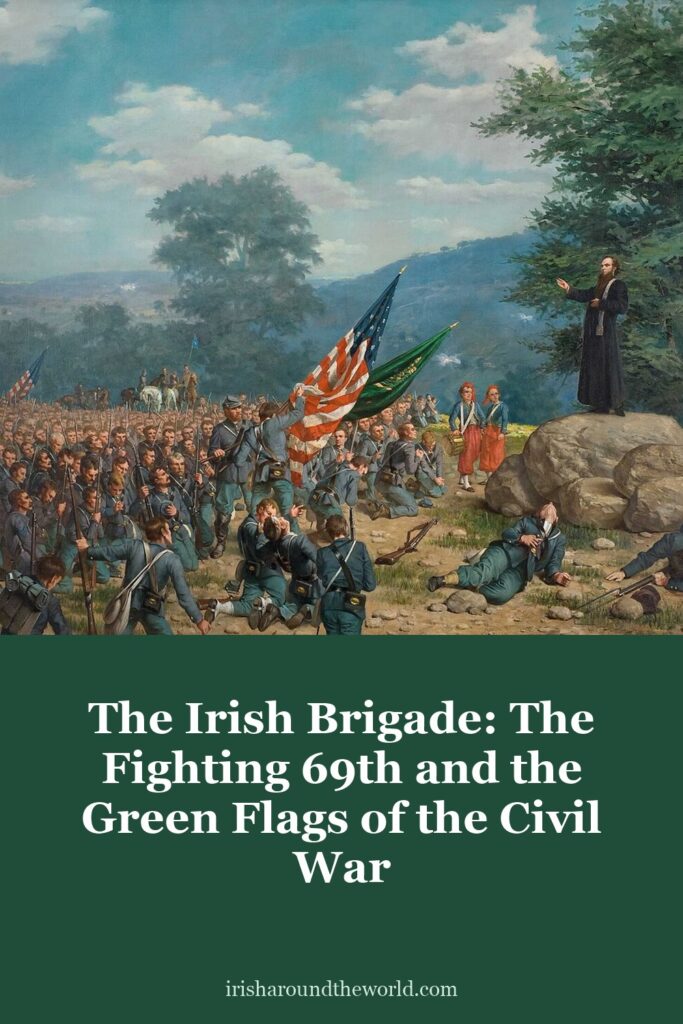
- Gettysburg: Father Corby’s absolution
- How many men did it lose?
- The Irish who fought for the South
- The 1863 draft riots
- Legacy and the 69th today
- How to find a Civil War ancestor
- Irish Brigade FAQ
- More Irish heritage reading
What was the Irish Brigade?
The Irish Brigade was a Union infantry brigade raised in the autumn of 1861, mostly among Irish immigrants in New York City.
Its heart was three New York regiments, the 69th, the 63rd and the 88th, which each left the city with about 800 men, says William F. Fox’s Regimental Losses in the American Civil War (1889).
In the autumn of 1862 two more regiments joined: the 116th Pennsylvania, from Philadelphia, and the 28th Massachusetts, a Boston regiment made up mostly of Irish-born men. Before that, the 29th Massachusetts served with the New Yorkers, including at Antietam.
The green flags
Alongside the Stars and Stripes, each New York regiment carried a deep green flag embroidered with an Irish harp, a sunburst and a wreath of shamrocks, Fox writes.
The 28th Massachusetts had its own green colours and took as its motto the battle cry Faugh a Ballagh. That’s an old spelling of the Irish Fág an bealach (fawg un BYAL-ukh), “clear the way”.
Thomas Francis Meagher, from Young Ireland to Union general
The brigade’s founder was Thomas Francis Meagher, usually said MAR. He was born in Waterford city on 3 August 1823, a merchant’s son, says the Dictionary of Irish Biography.
As a young man he joined Young Ireland, the radical wing of the campaign to repeal the union with Britain. An 1846 speech defending the right to take up arms earned him the nickname Meagher of the Sword. In 1848 he came home from revolutionary Paris with a green, white and orange tricolour, the flag that became the Irish flag.
After the failed rising that summer, he was sentenced to death for high treason, a sentence commuted to transportation for life. In 1849 he was shipped to Van Diemen’s Land, now Tasmania. In January 1852 he escaped by ship, and that May he landed in New York, where crowds greeted him as a hero.
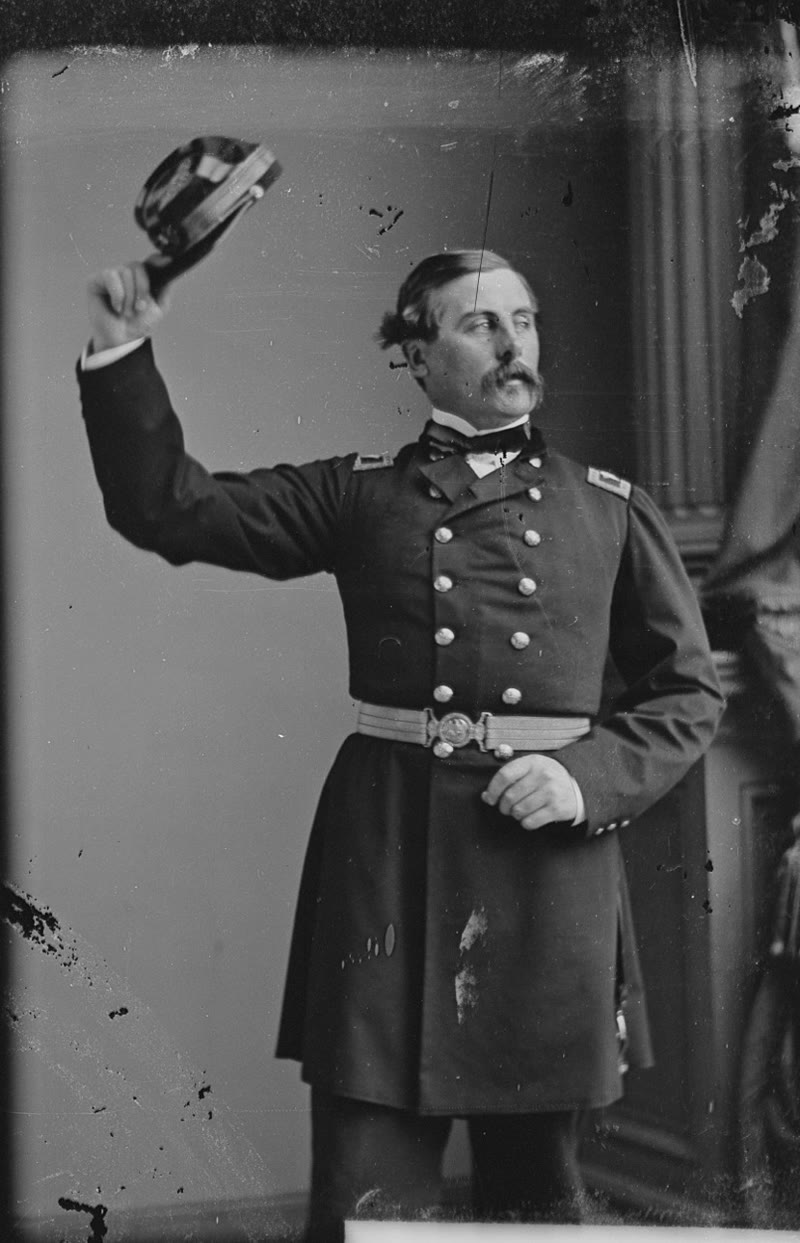
Brig. Gen. Thomas Francis Meagher, about 1862 to 1865. Brady National Photographic Art Gallery, U.S. National Archives
In New York he became a lawyer and popular lecturer. He was a loyal Democrat, and the DIB notes that he went along with his party’s hands-off stance on slavery. He hesitated over the war at first, then committed fully, fighting at the first battle of Bull Run in July 1861 as a captain in the 69th New York State Militia. He then raised the Irish Brigade, and became a brigadier general on 3 February 1862.
Why Irish immigrants enlisted
Why would men who’d escaped hunger in Ireland go to war in America? Reasons varied.
- Money. Many were labourers without steady work. Recruiters offered bounties, cash for signing up, and many recruits hoped to send money home, the National Park Service notes.
- Acceptance. Irish Catholics faced hostility from nativists like the Know-Nothing party, and service was a way to prove loyalty. (See my piece on No Irish Need Apply.)
- Training for Ireland. Some were Fenians, sworn to free Ireland by force, who wanted military skills for a future fight with Britain. Michael Corcoran, the Sligo-born colonel of the 69th militia, was a leading Fenian, the DIB says.
- The Union itself. Historian Damian Shiels, who studied letters from nearly 400 Irish American servicemen for his book Green and Blue (LSU Press, 2025), concludes most joined from economic need and real patriotism, seeing America as their best future home.
The traditional estimate is about 150,000 Irish-born men in the Union army. Shiels puts the number of Irish and Irish Americans who served at 250,000 or more, once you count the regular army, the navy and emigrants’ sons. Most served in ordinary regiments, not the Irish Brigade.
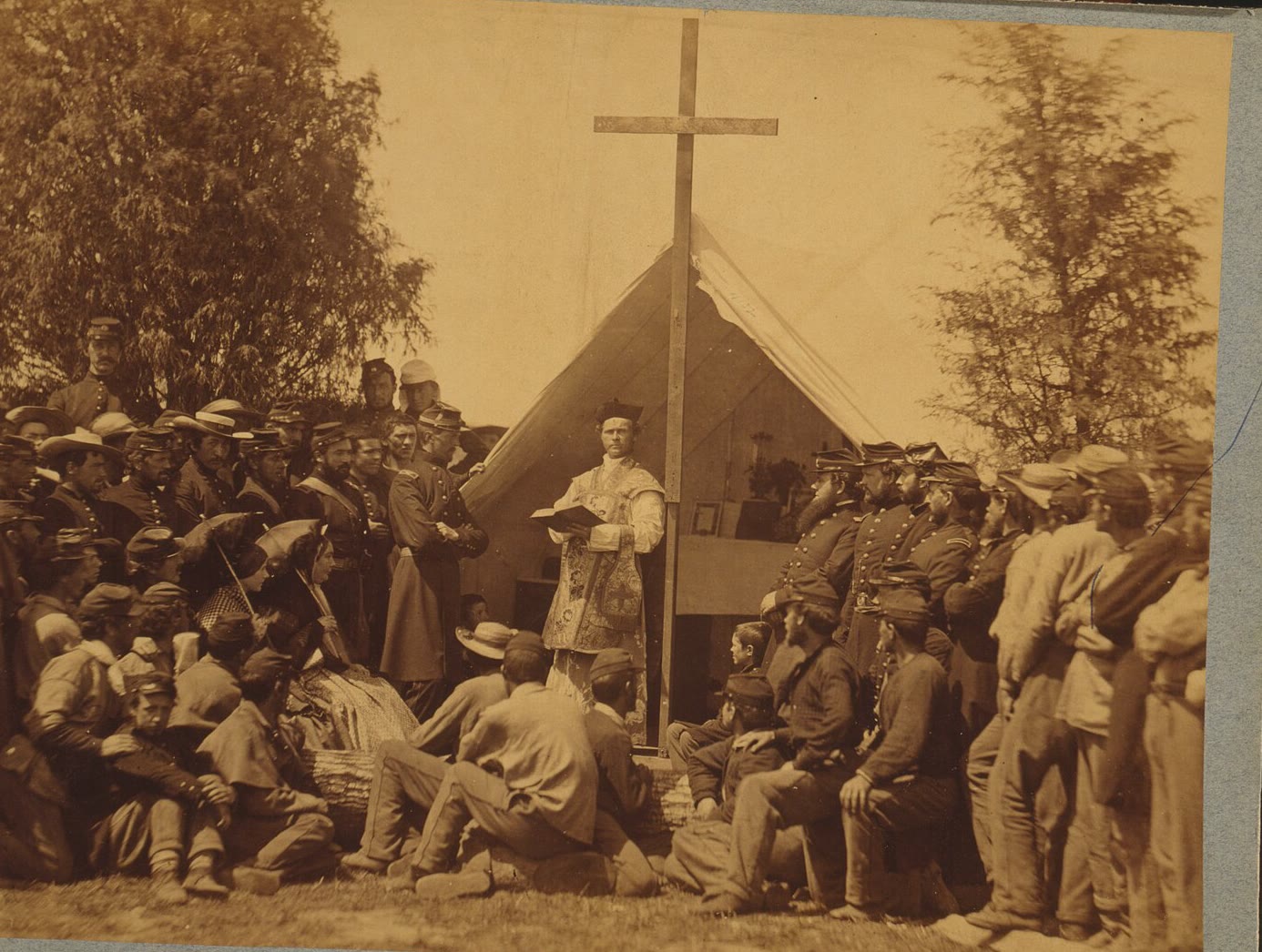
Sunday morning Mass in the camp of the 69th New York State Militia, Fort Corcoran, Virginia, 1861. Library of Congress Prints and Photographs Division
Antietam: the Sunken Road
On 17 September 1862, at Antietam, near Sharpsburg, Maryland, about 23,000 soldiers were killed, wounded or missing in twelve hours.
As the brigade formed up, Father William Corby, chaplain of the 88th New York, rode down the ranks giving the men absolution.
Under heavy fire, the Irish tore down a rail fence, then traded volleys at close range with North Carolina troops holding a sunken farm lane. Their old smoothbore muskets fired “buck and ball”, a musket ball plus buckshot, brutal at close range. When their ammunition ran low, another brigade passed through their ranks to relieve them.
The lane has been called Bloody Lane ever since. The National Park Service counts 540 Irish Brigade casualties there: 113 killed, 422 wounded and 5 missing. Fox records that the 69th New York had eight colour bearers shot down one after another.
Meagher was hurt in a fall from his horse. Father Corby and General McClellan’s official report say it was shot under him; critics claimed he was drunk, a charge never proved.
Fredericksburg: Marye’s Heights and the boxwood
On 13 December 1862, the Union army attacked Fredericksburg, Virginia. Below a ridge called Marye’s Heights, Confederate infantry waited behind a stone wall along another sunken road, with artillery above. Brigade after brigade, the Irish among them, was sent across open ground towards that wall.
Sprigs of boxwood
By then the New York regiments’ tattered green flags had gone home for repair, and the 28th Massachusetts carried the brigade’s only green flag that day. So Meagher and his staff gathered boxwood, an evergreen shrub, and every man put a sprig in his cap.
After the attack, Fox wrote, the brigade’s dead lay in a line near the Confederate works, and “by each pale dead face was a sprig of Irish green.”
None of them reached the wall. Out of roughly 1,200 men, the brigade lost 545 killed, wounded or missing. In the 69th, 16 of the 18 officers were killed or wounded.
Irish against Irish? Mostly a myth
Films and popular histories say Irish Confederates behind the wall grieved as they shot down their countrymen. That’s mostly a myth.
The defenders were Thomas Cobb’s Georgia brigade. The colonel of its 24th Georgia, Robert McMillan, was Irish-born, and one company bore his name. But historian Ryan Quint, writing for Emerging Civil War, shows that only one company in the whole brigade, the Lochrane Guards of Phillips’ Legion, was mostly Irish.
The Irish-against-Irish idea goes back to a Union officer, St Clair Mulholland, whose later history of the 116th Pennsylvania has the Georgians crying out in pity. Confederate accounts show no such reluctance. The weeping came later still, in the 2003 film Gods and Generals.
Gettysburg: Father Corby’s absolution
Fredericksburg left the brigade a shell, and Chancellorsville in early May 1863 thinned it further. Meagher asked for it to be withdrawn to rebuild. When that was refused he resigned, and the resignation was accepted on 14 May 1863, says the DIB.
At Gettysburg, Pennsylvania, each New York regiment had shrunk to two companies, and the whole brigade, under Colonel Patrick Kelly, numbered about 530 men. On the afternoon of 2 July 1863, they were ordered forward to prop up a crumbling Union line near a wheatfield.
First, Father Corby climbed onto a large rock and gave general absolution, forgiveness for every man truly sorry for his sins.
In his Memoirs of Chaplain Life (1893), Corby quotes St Clair Mulholland, who was there: “every man, Catholic and non-Catholic, fell on his knees”. Corby adds that he meant the absolution for all who were about to die on that field, North or South.
Minutes later the brigade was fighting in the Wheatfield and the woods beyond, until it was outflanked and fell back. It lost about 200 men, nearly two in five.
The Corby statues
Corby, a Holy Cross priest from Detroit, later twice served as president of Notre Dame. In 1910 Samuel Murray’s bronze statue of him, right hand raised, was unveiled at Gettysburg. A copy went up outside Corby Hall at Notre Dame in 1911. Students call it “Fair Catch Corby”, because the raised hand looks like a punt returner signalling a fair catch.
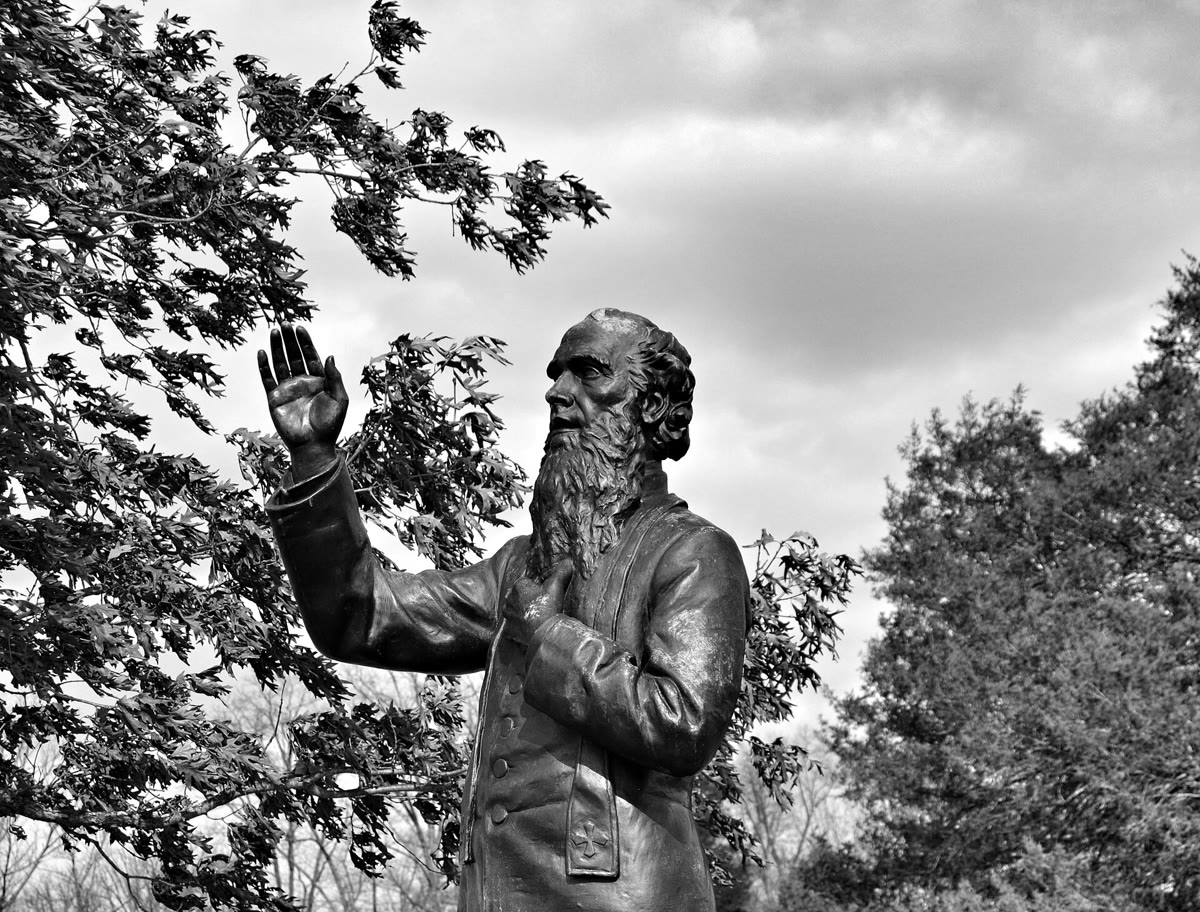
Samuel Murray’s 1910 statue of Father William Corby at Gettysburg. Photo: Marla Venable, CC BY-SA 4.0, via Wikimedia Commons
How many men did the Irish Brigade lose?
Counting each regiment’s whole war, Fox reckoned that 961 men of the brigade’s five regiments were killed or mortally wounded:
- 69th New York: 259
- 28th Massachusetts: 250
- 63rd New York: 156
- 88th New York: 151
- 116th Pennsylvania: 145
Among the brigades Fox treated as continuous, unchanged organisations, only the Vermont Brigade (1,172) and the Iron Brigade (1,131) lost more men killed. With the wounded, Fox put the brigade’s losses at over 4,000, more than ever served in it at one time. No New York regiment, he added, lost more men killed and wounded in action than the 69th.
The Irish who fought for the Confederacy
The Irish fought on both sides, though far fewer wore grey, because far fewer lived in the South. Of 1.6 million Irish-born people in the US in 1860, only about 85,000 lived in the future Confederate states. Historian David T. Gleeson, in The Green and the Gray (2013), puts Irish-born Confederate soldiers at about 20,000, the Irish Echo reports.
The best-known Irish Confederate was Patrick Cleburne, born in Co. Cork on St Patrick’s Day 1828. A former British soldier who settled in Helena, Arkansas, he rose to major general and was called the Stonewall Jackson of the West, the DIB says.
In January 1864 Cleburne proposed arming enslaved men and promising freedom to all enslaved people who stayed loyal to the Confederacy, as a way to win Southern independence. The paper was suppressed, and it’s thought to have cost him promotion. He was killed at the battle of Franklin, Tennessee, on 30 November 1864.
The 1863 draft riots
By May 1863, after Fredericksburg and Chancellorsville, many Irish Americans had soured on the war. Boston’s Irish Catholic paper, the Pilot, declared “the Irish spirit for the war is dead”. Many Irish New Yorkers also opposed the Emancipation Proclamation, fearing freed Black workers would move north and compete for their jobs.
Then came the draft, which let a man buy his way out for $300. When the draft lottery resumed in New York City on 13 July 1863, rioting raged until troops restored order on 16 July, say the New York City Municipal Archives. Toby Joyce, in History Ireland, concludes the rioters were mainly Irish.
Mobs hunted down Black New Yorkers, beating and murdering them, and burned the Colored Orphan Asylum on Fifth Avenue, though more than 200 children escaped. The death toll is disputed: 119 is often cited, though some put it far higher. Most of the dead were probably rioters killed by police and troops, but Black New Yorkers were the mob’s deliberate targets.
Irish New Yorkers stood on both sides. Joyce counts more than 300 Irish-born men in the Metropolitan Police, about a fifth of the force. The officer running the city’s draft was the 69th’s own Colonel Robert Nugent, a Co. Down man. None of that softens what was done to Black New Yorkers.
Legacy and the Fighting 69th today
Meagher went back into the army in 1864 and later became acting governor of Montana Territory. On 1 July 1867 he fell from a steamboat into the Missouri River at Fort Benton. His body was never found, and some friends believed he’d been murdered. Statues of him stand in Helena, Montana, and Waterford.
At Gettysburg, the New York regiments’ monument, dedicated in 1888, is a Celtic cross with a life-sized bronze Irish wolfhound at its foot. Its inscription calls the breed extinct, though breeders were already reviving it, as my piece on the Irish wolfhound explains.
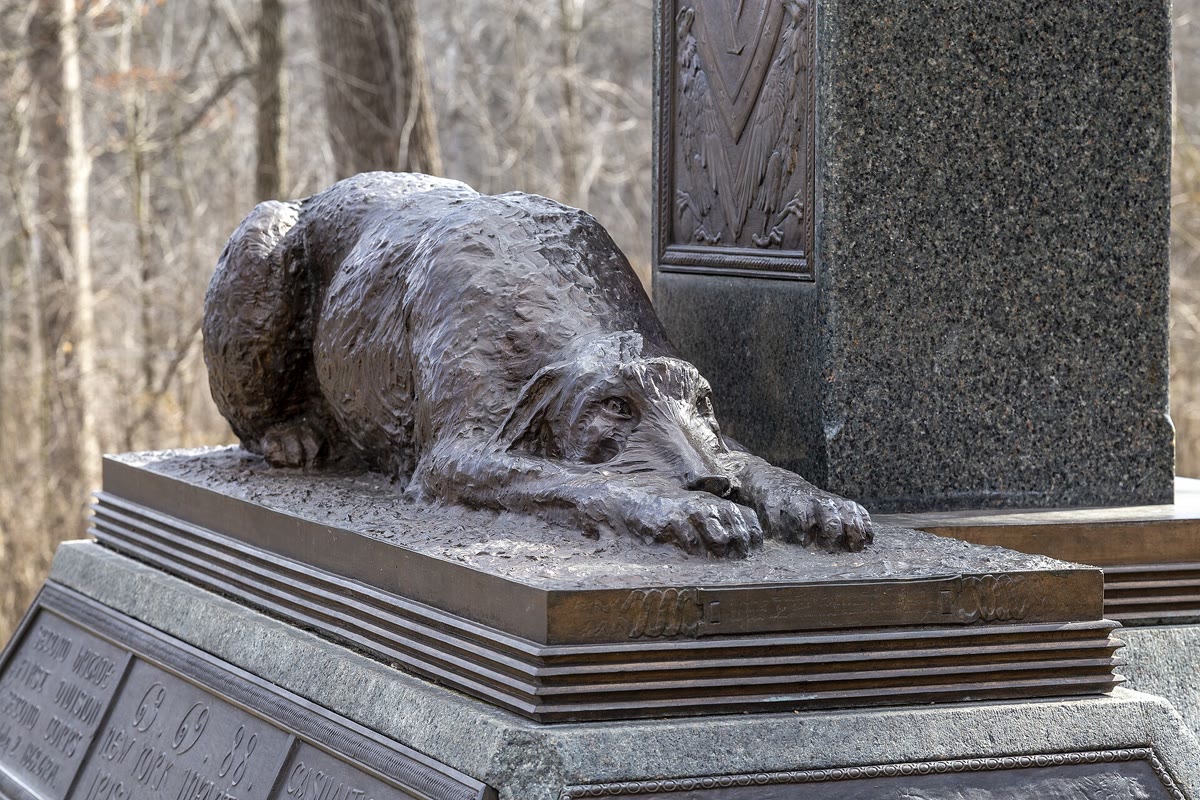
The bronze wolfhound on the Irish Brigade monument at Gettysburg, by William R. O’Donovan, 1888. Photo: Acroterion, CC BY-SA 4.0, via Wikimedia Commons
On 28 June 1963, President John F. Kennedy presented a green flag of the 69th New York to the Irish people, in a speech to the Oireachtas in Dublin. It still hangs in Leinster House.
The regiment today
The regiment lives on as the 1st Battalion, 69th Infantry, New York Army National Guard. By regimental tradition, Robert E. Lee himself named it “the Fighting 69th” after Fredericksburg.
It has led New York’s St Patrick’s Day Parade since 1851, the New York National Guard says. On the day, soldiers wear a sprig of boxwood for Fredericksburg, officers carry blackthorn sticks, and two Irish wolfhounds march as mascots.
In the First World War the regiment fought in France as the 165th Infantry, a story told in the 1940 James Cagney film The Fighting 69th. The poet Joyce Kilmer died serving with it.
How to find an Irish Civil War ancestor
About one in four New York City residents was Irish-born in 1860, so many Irish American families may have a Civil War soldier in the tree. Here’s how to look.
- Search the database. The National Park Service’s free Soldiers and Sailors Database covers over 6 million service records, Union and Confederate. It’s no longer updated but still useful.
- Order the service record. Each Union volunteer has a compiled military service record at the National Archives. Where it gives a foreign birthplace, it names only the country, so expect “Ireland”, not a county.
- Find the pension file. Most Union soldiers or their widows applied for a pension, and the files can hold marriage proofs, comrades’ statements and letters. Confederate pensions are with the Southern states.
- Take it back to Ireland. Once you have a county or parish, Irish church and civil records open up. My guide to Irish surnames shows where many family names cluster.
Irish Brigade FAQ
What was the Irish Brigade in the Civil War?
A Union infantry brigade of mostly Irish immigrants, built around three New York regiments, the 63rd, 69th and 88th. It fought from 1862 to 1865.
Who led the Irish Brigade?
Thomas Francis Meagher, a Waterford-born Young Irelander, from February 1862 to May 1863. Robert Nugent of the 69th led it at the war’s end.
Why is it called the Fighting 69th?
Regimental tradition says Confederate general Robert E. Lee gave the 69th that name after its charge at Fredericksburg. Today’s National Guard battalion still uses it.
Did Irish soldiers fight for the Confederacy?
Yes, about 20,000 Irish-born men, against 150,000 or more in the Union army. The best known was Major General Patrick Cleburne from Co. Cork.
Love this? Save it to your Pinterest board for later.
A little bit of Ireland in your inbox every Friday ☘️
The free Weekly Dose of Irish: an Irish joke, a Celtic symbol, an Irish fact, a poem and the week’s best articles in one short email. Join 9,600+ readers.
Free. One short email every Friday. Unsubscribe any time.
More Irish heritage reading
- The American Wake: Ireland’s All-Night Farewell for Emigrants to America
- No Irish Need Apply: Were the Signs Real? What the Old Newspapers Show
- The Irish Diaspora: Influence and Impact on Modern America
Featured image: Absolution Under Fire, by Paul Henry Wood, 1891. Raclin Murphy Museum of Art, University of Notre Dame. Public domain, via Wikimedia Commons.