
In short: start free with Duolingo and DCU’s Irish 101 course on FutureLearn, use Teanglann.ie to hear real pronunciation, then book a tutor on italki when you’re ready to speak. TG4 and Raidió na Gaeltachta are free and great for listening practice.
This page contains affiliate links. If you book a lesson through one, I may earn a small commission at no extra cost to you.
Fáilte, welcome! So you want to learn Irish online?
Here’s a confession most Irish people will make: we studied Irish at school for well over a decade, and plenty of us came out unable to hold a proper conversation. So if you’re starting from scratch abroad, you’re in good company.
The good news is that it has never been easier to learn. Irish became a full official working language of the EU on 1 January 2022, and in the 2022 census about 1.9 million people in the Republic said they could speak some Irish. Around 72,000 said they speak it every day outside the classroom. There are more free tools and real teachers online than ever.
Here are the best ways to learn Irish online in 2026, free and paid, and how to combine them.
The best ways at a glance
| Option | Cost | Best for |
|---|---|---|
| Duolingo | Free | Daily vocabulary habit |
| Irish 101 (DCU, FutureLearn) | Free, paid certificate | A structured start with culture |
| italki tutor | Pay per lesson | Actually speaking |
| Gaelchultúr or Ranganna | Paid courses | A teacher and classmates |
| Teanglann, Focloir, Abair | Free | Pronunciation and meaning |
| TG4, Raidió na Gaeltachta | Free | Listening and immersion |
Jump to
- Duolingo: the free place to start
- Irish 101 from DCU: a free university course
- A private tutor on italki: the fastest way to speak
- Structured online courses: Gaelchultúr and Ranganna
- Free dictionaries and pronunciation tools
- Watch and listen: TG4, Raidió na Gaeltachta and Cúla4
- Which dialect should you learn?
- Five phrases to start with
- FAQ
1. Duolingo: the free place to start
Duolingo has offered an Irish course since 2014, and it’s still the easiest free way to begin. Ten minutes a day on your phone builds vocabulary and basic sentences, and the streaks keep you coming back.
Its limits are real, though. You won’t learn to hold a conversation from an app alone, and the audio can’t fully show you the differences between the dialects. Use it as a habit, not your whole plan. Duolingo Irish
2. Irish 101 from DCU: a free university course
Dublin City University runs Irish 101: An Introduction to Irish Language and Culture on FutureLearn. It takes about four weeks at a few hours a week, and you can join for free, with a paid upgrade if you want a certificate.
It’s the best free structured start I know of, because it teaches the language alongside the culture and history behind it.
3. A private tutor on italki: the fastest way to speak
If you actually want to talk, you need someone to talk to. On italki you can book one-to-one video lessons with Irish tutors, many of them native speakers from the Gaeltacht. You choose the tutor, the time and the dialect, and you pay per lesson, so there’s no long contract.
A good plan is one lesson a week, with Duolingo or a course in between to keep the vocabulary coming. Tell your tutor which dialect you want, whether that’s Munster, Connacht or Ulster, especially if your family comes from a particular county.
Try it: find an Irish tutor on italki.
4. Structured online courses: Gaelchultúr and Ranganna
If you like a teacher, a timetable and classmates, two Irish organisations run live online classes for adults, from complete beginner upwards:
- Gaelchultúr, based in Dublin, runs online Irish courses at several levels.
- Ranganna offers online Irish classes and resources.
These cost more than an app, but a weekly class with other learners is how many adults finally stick with it.
5. Free dictionaries and pronunciation tools
Irish spelling looks scary until you learn how the sounds work. These free tools from Irish institutions help a lot:
- Teanglann.ie: dictionaries plus a pronunciation database with recordings in all three dialects. My first stop for “how do you say that?”
- Focloir.ie: the New English-Irish Dictionary from Foras na Gaeilge, with example phrases.
- Abair.ie: speech technology from Trinity College Dublin that reads Irish text aloud.
6. Watch and listen: TG4, Raidió na Gaeltachta and Cúla4
Once you know the basics, surround yourself with the real thing.
- TG4 is the Irish-language TV channel, with dramas, documentaries and sport on its player, many with subtitles.
- RTÉ Raidió na Gaeltachta broadcasts in Irish, and you can listen online from anywhere.
- Cúla4 is TG4’s service for children. Kids’ shows are surprisingly good for adult beginners too, because the language is simple and clear.
Which dialect should you learn?
Irish has three main dialects, named after the provinces where they’re spoken: Munster (Kerry, Cork and Waterford), Connacht (mainly Galway and Mayo) and Ulster (Donegal). They differ in pronunciation, some vocabulary and a few grammar points. There’s also a written standard, An Caighdeán Oifigiúil, used in schools and official documents.
My advice: if your family comes from a particular area, learn that dialect. If not, pick whichever one your tutor or course uses and stick with it. Irish speakers from different areas understand each other fine.
Five phrases to start with
The pronunciations below are rough English-sound guides. Check them on Teanglann.ie, as they vary by dialect.
| Irish | Say it like | Meaning |
|---|---|---|
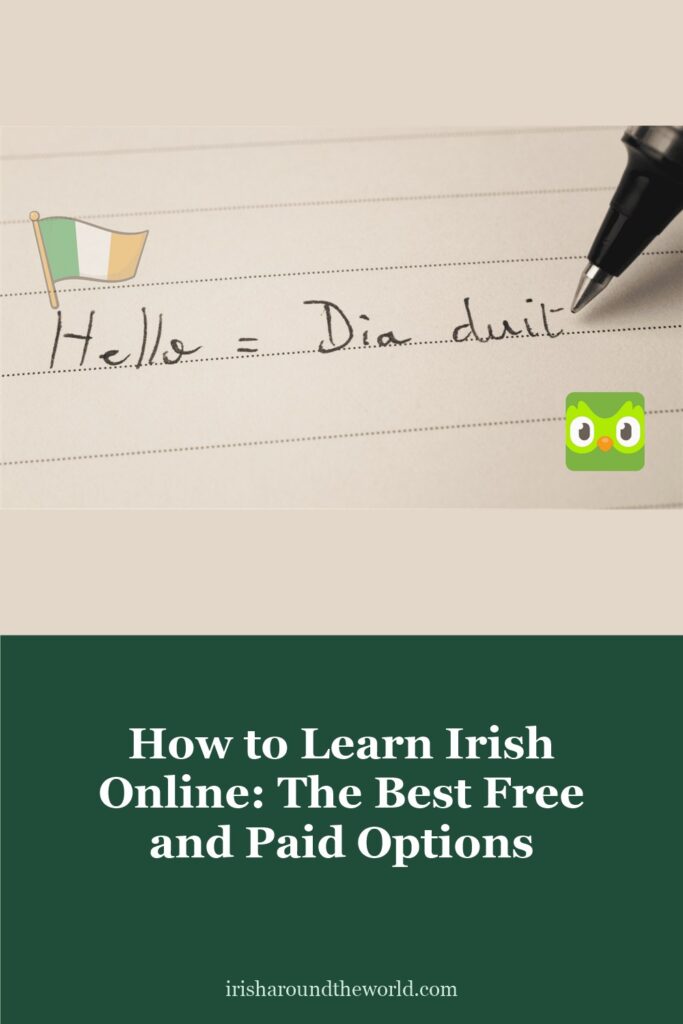
| Dia duit | DEE-ah gwitch | Hello |
| Conas atá tú? | KUN-us ah-TAW too | How are you? (Munster and Connacht) |
| Go raibh maith agat | guh rev mah AH-gut | Thank you |
| Sláinte | SLAWN-cha | Cheers, health |
| Slán | slawn | Goodbye |
For more, see how to say cheers in Irish, Merry Christmas in Irish and our Irish sayings. And if you want to know how Irish shaped English, read about the English words that come from Irish.
Tips that make it easier
- Learn the sounds early. The accent on a vowel, the síneadh fada, changes the sound and often the meaning. Consonants also come in “broad” and “slender” pairs. Once that clicks, spelling starts to make sense.
- Little and often. Ten minutes a day beats two hours once a week.
- Speak early. Book a tutor before you feel ready. Nobody ever feels ready.
- Use names you know. Our audio guides to Irish girl names and Irish boy names are a fun way to practise the sound rules.
FAQ
Is Irish hard to learn?
It’s different rather than impossible. The spelling and the way words change at the start (called mutations) take getting used to, but the grammar is regular once you see the patterns. Learners who practise speaking from early on progress fastest.
Is it called Irish or Gaelic?
In Ireland, people call it Irish in English, or Gaeilge in Irish. “Gaelic” on its own can be confused with Scottish Gaelic, a related but different language, so “Irish” is the safer word.
Can I learn Irish for free?
Yes. Duolingo, DCU’s Irish 101 course, Teanglann.ie, TG4 and Raidió na Gaeltachta are all free. Most people add a paid tutor or class when they want to start speaking.
How long does it take to learn Irish?
It depends on how much you practise. With a few hours a week, many learners can manage simple everyday conversations within a year.
Keep reading
Love this? Save it to your Pinterest board for later.
A little bit of Ireland in your inbox every Friday ☘️
The free Weekly Dose of Irish: an Irish joke, a Celtic symbol, an Irish fact, a poem and the week’s best articles in one short email. Join 9,600+ readers.
Free. One short email every Friday. Unsubscribe any time.
Mary E. Dineen
Saturday 5th of February 2022
BITESIZE IRISH is very good as well.
Irish Around The World
Thursday 10th of February 2022
Ah yes, great one! Thanks