The Molly Maguires were a secret society among Irish immigrant mineworkers in Pennsylvania’s anthracite coalfields, blamed for 16 killings between 1862 and 1875. Their name came from rural secret societies in Ireland. A Pinkerton detective, James McParlan, went undercover among them, and trials led largely by company lawyers sent 20 men to the gallows from 1877 to 1879, ten of them on a single day. Historians still argue over their guilt and the fairness of the trials.
On Thursday 21 June 1877, ten Irish Catholic men were hanged in two Pennsylvania county jails: six at Pottsville and four at Mauch Chunk. People in the coal region have called it Black Thursday, or the day of the rope, ever since.
The men died as Molly Maguires, members of a secret society accused of murdering mine bosses. Their story has Famine emigrants, a railroad baron, an undercover detective, a handprint said to defy every coat of paint, and a pardon that came a century too late.
I’ve written about how the Irish shaped modern America. This is one of the darker chapters. Here’s what happened, what’s legend, and why historians still disagree.
Jump to:
- Who were the Molly Maguires?
- The Irish origins of the name
- Life in the anthracite coalfields
- Two waves of violence
- The Ancient Order of Hibernians link
- Franklin Gowen and the Reading Railroad
- James McParlan, the Pinkerton spy
- The trials: company lawyers as prosecutors
- Black Thursday and the 20 hangings
- The handprint in Cell 17
- Jack Kehoe and the 1979 pardon
- Guilty or framed? What historians think
- Visiting Molly Maguire country
- Molly Maguires FAQ
- More Irish heritage reading
Who were the Molly Maguires?
The Molly Maguires were Irish immigrant mineworkers in the anthracite coalfields of north-east Pennsylvania, mainly in Schuylkill and Carbon counties. From the Civil War to 1875 they were blamed for threatening “coffin notices”, beatings and assassinations.
The historian Kevin Kenny, whose Making Sense of the Molly Maguires (1998) is widely seen as the best modern study, counts 16 men killed, from mine owners and bosses to ordinary workers and local officials. Twenty men were hanged for the killings.
Almost nothing survives from the Mollies themselves. Apart from two letters, one only a fragment, nearly all the evidence comes from their enemies, Kenny writes in a 2023 essay for Oxford University Press. The Pennsylvania State Archives goes further: in its view, no primary document has yet shown that a coordinated Molly Maguire society ever existed.
The Irish origins of the name
The name came from Ireland. The Molly Maguires first appeared there in the 1840s and 1850s, Kenny explains, following older rural secret societies such as the Whiteboys, the Oakboys and the Ribbonmen.
Their members, mostly young men, blackened their faces, dressed in women’s clothes and swore loyalty to “Mistress Molly Maguire”, a mythical woman who stood for resistance to landlords and injustice. Popular accounts sometimes turn her into a real evicted widow, but historians treat her as a symbol, not a person.
The land agent W. Steuart Trench faced them on the Shirley estate around Carrickmacross, Co. Monaghan, in 1843. In Realities of Irish Life (1868) he described them as “stout active young men, dressed up in women’s clothes”, who ducked rent officials and process-servers in bog holes or beat them until nobody would take the work. Trench was hardly a neutral witness.
In June 1845 the Armagh Guardian complained of almost nightly Molly Maguire raids in west Cavan, as the Anglo-Celt recalled in 2024. In west Donegal, the historian Breandán Mac Suibhne shows in The End of Outrage (2017), armed, masked Mollies punished neighbours they accused of exploiting the poor, from the potato blight of 1845 into the 1850s.
That’s the thread to Pennsylvania. Many of the men later convicted as Molly Maguires came from Donegal, Kenny writes, and, unlike most Irish emigrants of the day, they grew up speaking Irish. In America they did not dress as women, Kenny notes, though some blackened their faces.
Life in the anthracite coalfields
Irish immigrants poured into the hard-coal region of north-east Pennsylvania in the mid-1800s, many of them in the years after the Great Famine. British immigrants held most of the skilled jobs in the mines, and Irish workers tended to be labourers, near the bottom of the ladder.
Families lived in patch towns, small villages built by the coal companies beside their mines. The company owned the houses and often the store, so the same employer could be landlord, shopkeeper and boss.
Boys worked in the breakers, the great sheds where coal was crushed and sorted, picking slate out of the coal by hand. Underground, fire, gas and roof falls killed men every year.
The most notorious disaster came on 6 September 1869, when fire swept the shaft of the Avondale colliery near Plymouth, the only way out for the men below. The state historical marker records 110 dead, among them five boys aged 12 to 17.
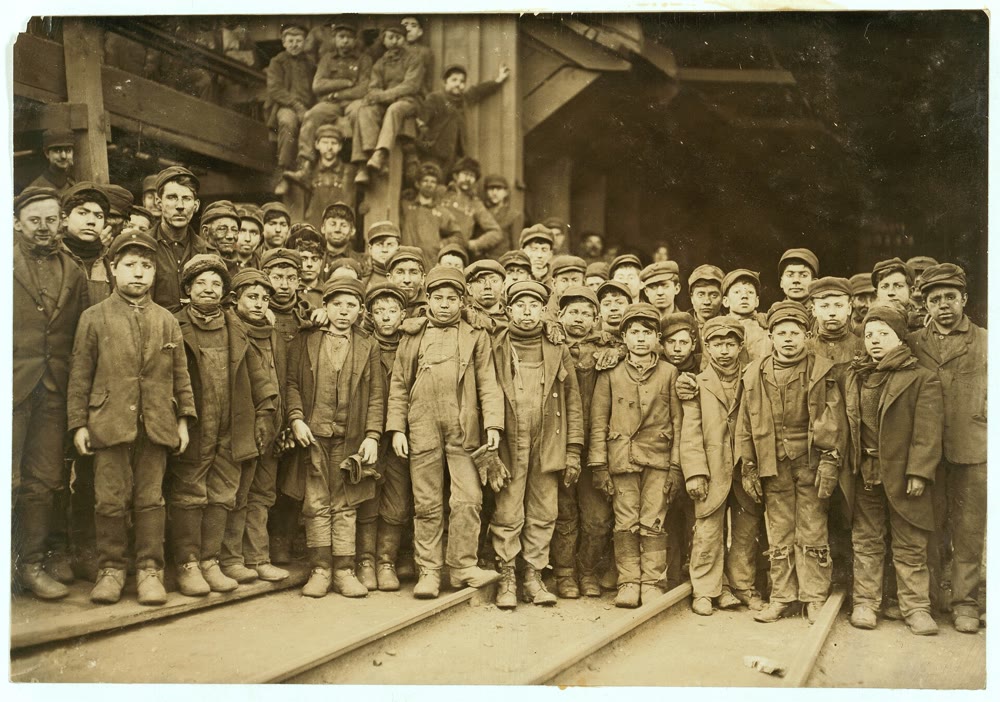
Breaker boys of the Pennsylvania Coal Co. in 1911, a generation after the Molly Maguire trials. Photo: Lewis Hine, National Child Labor Committee Collection, Library of Congress. Public domain, via Wikimedia Commons
Kenny writes that the Mollies often targeted bosses who paid Irish miners lower rates than others doing the same job, or kept the better jobs for British miners. A warning came first, then a coffin notice, then perhaps a beating. Killing was the last resort.
Two waves of violence
The first wave came during the Civil War, when anger at the military draft ran high among Irish workers, the same anger behind New York’s 1863 draft riots. Six mining officials and supervisors were assassinated between 1862 and 1868, the State Archives says.
Then came a union. The Workingmen’s Benevolent Association, founded in 1868 and led by the Irish-born John Siney, brought about 35,000 men of every background into one organisation. Its leaders condemned violence, and the attacks fell away.
It didn’t last. The coal operators, led by Franklin Gowen of the Reading Railroad, crushed the union’s Long Strike of 1875, and the killings resumed. Kenny puts six of the 16 assassinations in the summer of 1875 alone.
The Ancient Order of Hibernians link
This is the most argued-over part of the story. McParlan claimed the Molly Maguires operated behind the Ancient Order of Hibernians, or AOH, an Irish Catholic fraternal society with branches in Ireland, Britain and the United States. Jack Kehoe was a leading figure in the Schuylkill County AOH.
Kenny accepts that the killers worked within some local AOH branches. But the order was officially a benefit society, and its national convention condemned the Mollies to separate itself from the murders, according to the Catholic Historical Research Center of Philadelphia.
The Church was hostile too. In 1876 Archbishop James Frederic Wood of Philadelphia denounced the Mollies as “evil associations” and linked them with the AOH. Kenny sees the Mollies as outcasts, disowned by both the union and the Church.
Some descendants and writers go further. They argue that “Molly Maguires” was a label pinned on ordinary AOH members to discredit Irish miners and their union.
Franklin Gowen and the Reading Railroad
Franklin B. Gowen, a Philadelphia-born lawyer and former Schuylkill County district attorney, took charge of the Philadelphia and Reading Railroad in 1869. Under him the Reading bought up vast coal lands.
Gowen blamed the violence on the union and treated the two as one. Destroying both, Kenny writes, left him with a monopoly on mining and shipping coal across the lower anthracite region.
He had muscle to do it. In 1873 he hired Allan Pinkerton’s detective agency, and the railroad had its own armed private police, the Coal and Iron Police.
Gowen was forced out of the Reading in 1886. In December 1889 he was found shot dead in a Washington hotel, an apparent suicide, though rumours of Molly revenge went round for years.
James McParlan, the Pinkerton spy
Pinkerton’s man was James McParlan (also spelled McParland), an Irish Catholic from Co. Armagh. He arrived in the coal region in October 1873, posing as James McKenna, a drifter who hinted at a criminal past.
He joined the AOH, became secretary of his local branch at Shenandoah, and for more than two years sent regular reports to his Pinkerton bosses, until suspicion fell on him in early 1876.
Was he only a witness, or did he stir up some of the violence he reported? Kenny concludes that McParlan was very probably an agent provocateur.
In December 1875 masked men burst into the O’Donnell family’s boarding house at Wiggans Patch, near Mahanoy City, and shot dead Charles O’Donnell and his pregnant sister, Ellen McAllister. Jack Kehoe was married to their sister. Kenny attributes this raid on a family suspected of sheltering Mollies to Pinkerton agents; other accounts blame local vigilantes.
The trials: company lawyers as prosecutors
The Pinkertons and the Coal and Iron Police arrested some 50 suspected Molly Maguires and handed them over for trial, Kenny writes. The trials began in 1876.
They were not ordinary trials. Most of the prosecuting lawyers worked for railroad and mining companies. Gowen himself led the prosecution in several cases, then printed his speeches to the jury as pamphlets. No Irish Catholics sat on the juries.
The cases rested on McParlan’s testimony and on accused men who saved their own necks by turning state’s evidence. The historian Harold Aurand later judged it an extraordinary surrender of state power: a private company investigated, its police made the arrests and its lawyers prosecuted, while the state supplied little more than the court and the gallows.
It all happened in a climate of open hostility to Irish Catholics, the world of No Irish Need Apply.
Black Thursday and the 20 hangings
The ten hangings of 21 June 1877 were the largest mass execution in Pennsylvania’s history, says the state historical marker at Jim Thorpe. The marker gives the date as 22 June, but contemporary reports and historians agree on the 21st, a Thursday.
- Pottsville, Schuylkill County: James Boyle, James Carroll, Thomas Duffy, Hugh McGehan, Thomas Munley and James Roarity.
- Mauch Chunk (now Jim Thorpe), Carbon County: Alexander Campbell, John Donahue, Michael Doyle and Edward Kelly.
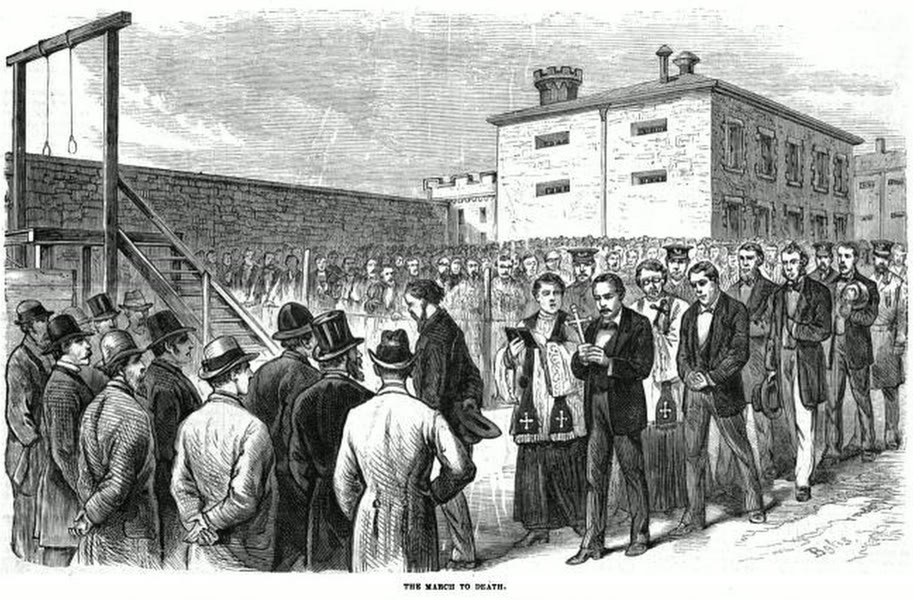
“The March to Death”, from Frank Leslie’s Illustrated Newspaper, 7 July 1877. Public domain, via Wikimedia Commons
Ten more men were hanged by October 1879, at Pottsville, Mauch Chunk, Bloomsburg and Sunbury. Patrick Hester, Patrick Tully and Peter McHugh died together at Bloomsburg on 25 March 1878 for the 1868 murder of Alexander Rea. The last, Peter McManus, was hanged at Sunbury on 9 October 1879.
The handprint in Cell 17
The old Carbon County Jail in Jim Thorpe, built in 1869 and 1870, held prisoners until 1995 and is now the Old Jail Museum. Four of the Black Thursday men were hanged inside its cell block.
Its most famous feature is a handprint on the wall of Cell 17. The legend says a condemned Molly Maguire, usually named as Alexander Campbell, pressed his dirty hand to the wall before his execution and declared that the mark would stay as proof of his innocence. Washing, painting and even rebuilding part of the wall, the story goes, have never got rid of it.
That is folklore, and even the museum now says some research points to another condemned man, Thomas Fisher, rather than Campbell. In 1994 two forensic scientists working for the TV series Unsolved Mysteries took paint samples and infrared photos, the Associated Press reported. One admitted they probably couldn’t prove the story either way.
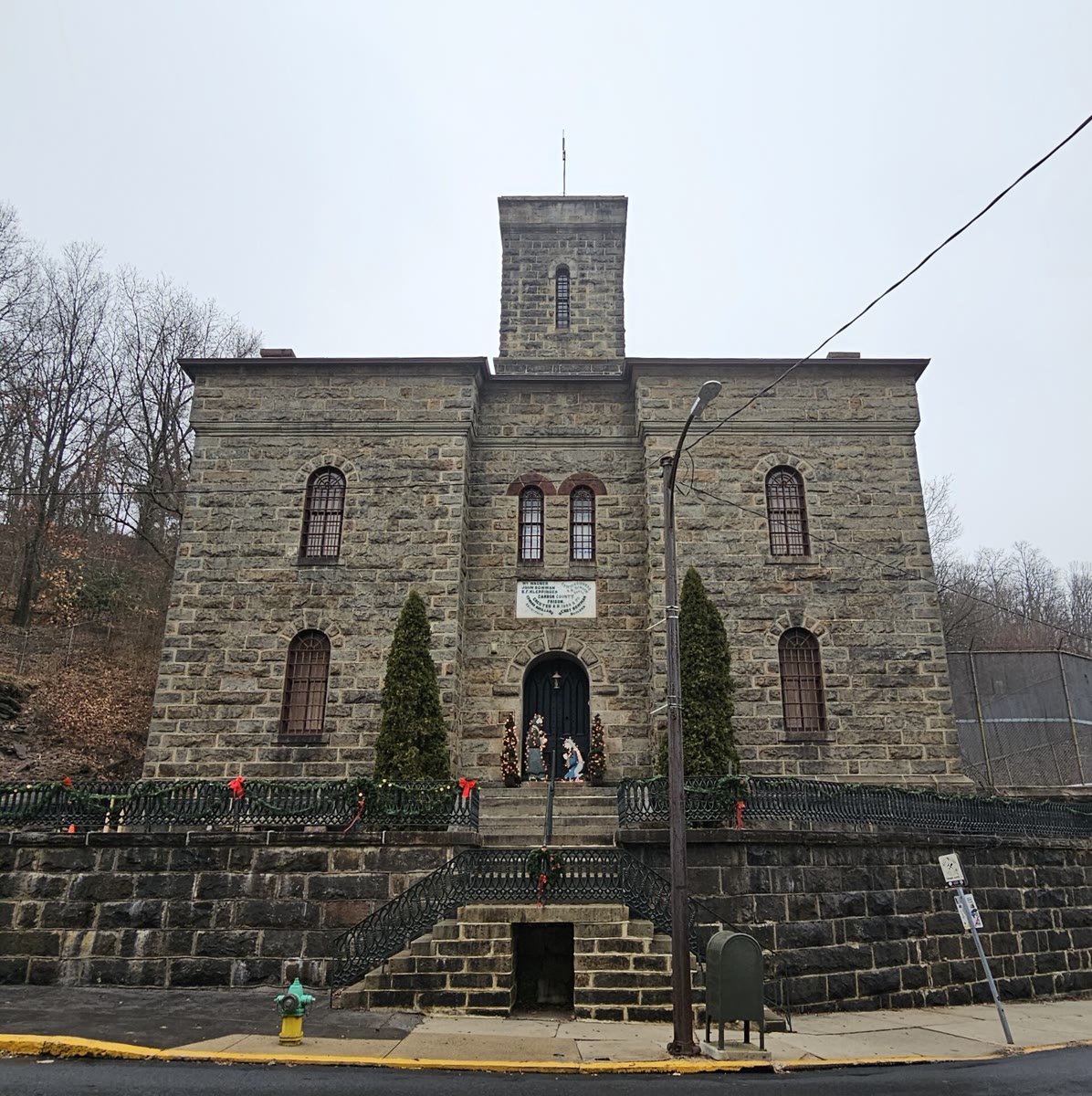
The old Carbon County Jail, now the Old Jail Museum, Jim Thorpe, Pennsylvania. Photo: JJonahJackalope, CC BY-SA 4.0, via Wikimedia Commons
Jack Kehoe and the 1979 pardon
John “Black Jack” Kehoe, a native of Co. Wicklow, was a former miner who bought the Hibernian House tavern in Girardville in 1873. Gowen called him the “King of the Mollies”, and the prosecution cast him as their leader.
He was convicted of the 1862 killing of Frank Langdon, largely on evidence that he had threatened Langdon at a patriotic gathering in Audenried, after a row over the American flag. No testimony placed him at the attack, notes the Pennsylvania Historical and Museum Commission.
Governor John Hartranft wanted Kehoe punished but not hanged. Once the Board of Pardons refused clemency, he was advised he could only set the date. Kehoe was hanged at Pottsville on 18 December 1878, still insisting he was innocent.
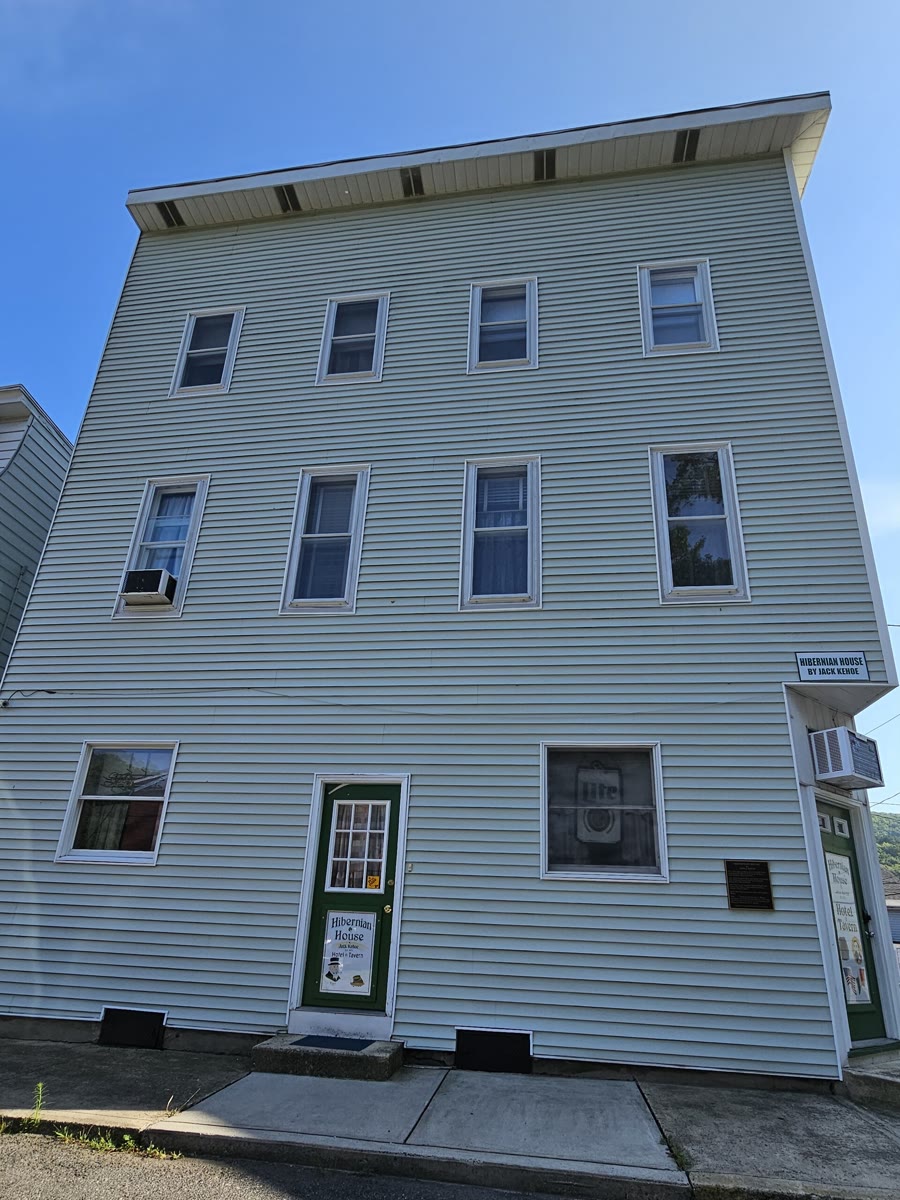
The Hibernian House in Girardville, the tavern Jack Kehoe bought in 1873. Photo: JJonahJackalope, CC BY-SA 4.0, via Wikimedia Commons
Kenny calls Kehoe “almost certainly innocent” of the Langdon killing. A century later, after a long campaign by his great-grandson Joseph Wayne, Governor Milton Shapp granted him a full posthumous pardon in January 1979.
A review of the case found the trial had been held in “an atmosphere of religious, social, and ethnic tension”, according to the Times News. Such pardons are rare. In 2006, when a descendant of John “Yellow Jack” Donahue sought one for him, officials told the Philadelphia Inquirer it would be only the second posthumous pardon in Pennsylvania’s history.
Guilty or framed? What historians think
For decades the detective was the hero. Allan Pinkerton published The Mollie Maguires and the Detectives in 1877, and Arthur Conan Doyle borrowed the story for the Sherlock Holmes novel The Valley of Fear (1915).
J. Walter Coleman’s The Molly Maguire Riots (1936) treated McParlan’s evidence with more scepticism. Wayne G. Broehl’s The Molly Maguires (1964), long seen as the standard account, took the more conventional line that the Mollies were terrorists and the Pinkertons heroes, the labour historian James R. Barrett noted in a review of Kenny’s book.
Hollywood flipped the story. The 1970 Paramount film The Molly Maguires, directed by Martin Ritt and written by Walter Bernstein, starred Sean Connery as Kehoe and Richard Harris as McParlan, and made the informer the villain.
Kenny rejects both myths: the nativist picture of murderous Irish thugs and the counter-myth of innocent martyrs. In his view the Mollies were never the huge, organised conspiracy their enemies described, yet some of them were killers. He also shows how heavily the trials were stacked against the accused. Explaining the violence, he stresses, is not the same as excusing it.
Visiting Molly Maguire country
- Old Jail Museum, Jim Thorpe: Cell 17 and the cell block where four Black Thursday men died, with a state historical marker outside. Tours are seasonal and guided, so check times before you go.
- Eckley Miners’ Village, near Hazleton: a patch town founded in 1854 and now run as a museum by the Pennsylvania Historical and Museum Commission. Paramount filmed The Molly Maguires there in 1968 and built a two-thirds scale wooden coal breaker for the set.
- Girardville and Tamaqua: Kehoe’s Hibernian House still stands in Girardville, and he is buried in Old St Jerome’s Cemetery, Tamaqua.
- Pottsville: the Gothic-style Schuylkill County Prison, where six men died on Black Thursday and Kehoe in 1878, still stands. It is still a working jail, so you can only see it from the street.
If a Molly Maguire turns up in your family tree, the State Archives guide lists the names in its clemency, death warrant and trial records. My guide to Irish surnames explains how to trace a family name back to its county in Ireland.
Molly Maguires FAQ
Who were the Molly Maguires?
A secret society among Irish immigrant mineworkers in Pennsylvania’s anthracite coalfields, blamed for 16 killings between 1862 and 1875. The name came from agrarian secret societies in Ireland.
How many Molly Maguires were hanged?
Twenty, between June 1877 and October 1879. Ten died on 21 June 1877, Black Thursday: six at Pottsville and four at Mauch Chunk, now Jim Thorpe.
Were the Molly Maguires guilty?
Some of them did kill people. But the trials relied on a Pinkerton spy, informers and company lawyers, with no Irish Catholics on the juries. In Kenny’s judgement at least one of the hanged men, Jack Kehoe, was almost certainly innocent of the killing he died for.
Was any Molly Maguire pardoned?
Yes. Governor Milton Shapp pardoned John “Black Jack” Kehoe in January 1979, a century after he was hanged.
Is the Molly Maguire handprint real?
There is a handprint on the wall of Cell 17 at the Old Jail Museum in Jim Thorpe. The story that a condemned man left it as proof of his innocence is a legend.
Love this? Save it to your Pinterest board for later.
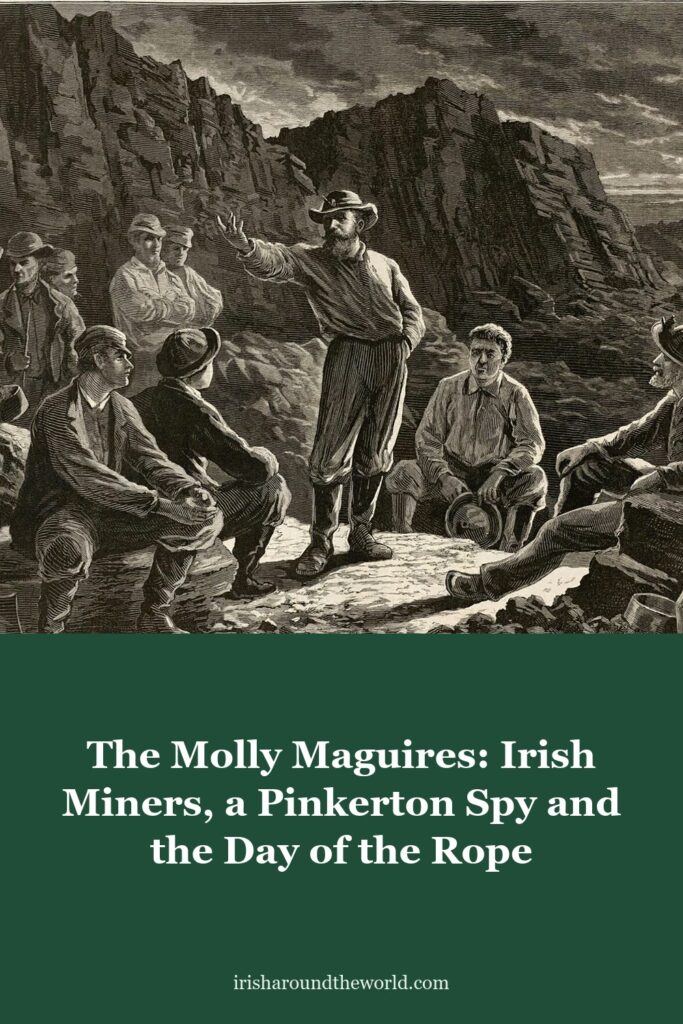
Pin image: Harper’s Weekly engraving by Paul Frenzeny and Jules Tavernier, 1874. Public domain, via Wikimedia Commons.
A little bit of Ireland in your inbox every Friday ☘️
The free Weekly Dose of Irish: an Irish joke, a Celtic symbol, an Irish fact, a poem and the week’s best articles in one short email. Join 9,600+ readers.
Free. One short email every Friday. Unsubscribe any time.
More Irish heritage reading
- No Irish Need Apply: Were the Signs and Ads Real?
- The Irish Diaspora: How the Irish Shaped Modern America
- Irish Potato Famine: Ireland’s Great Hunger, 1845 to 1852
- The Irish Brigade in the Civil War: Meagher and the 69th
- The American Wake: Ireland’s Farewell for the Living
- Irish Surnames: Meanings, Origins and the Top 100 Names
Featured image: “The Strike in the Coal Mines: Meeting of ‘Molly M’Guire’ Men”, drawn by Paul Frenzeny and Jules Tavernier for Harper’s Weekly, 31 January 1874 (restored by Adam Cuerden). Public domain, via Wikimedia Commons.