Irish round towers are tall, slender stone towers built beside churches at early medieval monastic sites, mostly in the 10th to 12th centuries. Their Irish name, cloigtheach (KLIK-hakh), means bell house, and most scholars agree their main job was to hold a bell, though the annals show people and treasures sheltered inside too. About 65 survive in some form, and only around 13 still stand complete to their conical stone caps.
Drive through almost any part of Ireland and sooner or later one rises over the trees: a stone tower, thin as a pencil, with a pointed cap and a door stranded well above the ground.
For centuries nobody could agree what they were. Fire temples, said one antiquarian. Giant phallic symbols, said another. Watchtowers built by the Danes, said a third.
I’ve covered the carved high crosses that often stand beside them in my guide to the Celtic cross. Here’s what the round towers really were, how to say their Irish name, and the best ones to see, including two you can still climb.
Jump to:
- What is an Irish round tower?
- Cloigtheach: the Irish name and how to say it
- When were the round towers built?
- How they were built
- Why is the door so high up?
- What were round towers for?
- Fire temples and phallic symbols: the wild theories
- Famous Irish round towers to see
- The round tower as a national symbol
- Irish round towers FAQ
- More Irish heritage reading
What is an Irish round tower?
A round tower is a tall, free-standing circular tower of stone, tapering gently as it rises and usually topped by a cone-shaped stone cap. Each one stands at a church site, normally an important monastery, close to the main church.
The complete towers range from about 23 to 34 metres (75 to 111 feet) tall, writes Roger Stalley, emeritus professor of the history of art at Trinity College Dublin, in his overview for Columbia University. The top floor, the bell floor, usually has four or more windows, often facing the points of the compass.
How many are left? Around 65 is the accepted figure, the Irish Times reported in 2014, plus traces of about 25 that have vanished, though Christiaan Corlett, author of Round Towers of Ireland, counts over 70. Only around 13 still stand complete to the cap, one 1999 count found, and most of those caps were partly or wholly rebuilt in modern times.
They’re almost unique to Ireland. Historic Environment Scotland knows of only three outside the island: Brechin and Abernethy in Scotland, and Peel on the Isle of Man.
Cloigtheach: the Irish name and how to say it
The Irish word is cloigtheach (KLIK-hakh), plural cloigthithe. Ó Dónaill’s Irish-English dictionary translates it as “round tower; belfry”.
It’s a compound of cloig, from clog, a bell (the same word also means a clock), and teach (chakh), a house. In the compound the th is said as an h, and the g hardens to a k sound in front of it. So you say KLIK-hakh, with the kh like the ch in Scottish loch. The teanglann.ie recordings by Ulster, Connacht and Munster speakers all sound close to that.
The medieval annals use the same word, often spelled cloictheach, and people living near the towers still used it in the early 1800s, Corlett notes for RTÉ. In modern Irish you’ll also meet túr cruinn, simply round tower.
When were the round towers built?
The first written mention comes in 950, when Norse raiders from Dublin burned the bell house at Slane, Co. Meath, with the founder’s crozier, the lector Caenachair and many others inside, the Annals of Ulster record. The Four Masters, who date it 948, add that it was full of relics and call the lost bell “a bell which was the best of bells”.
The last on record went up at Annaghdown, Co. Galway, in 1238, though it’s not certain that one was a round tower. So Stalley dates the towers from 948 to 1238; Historic Environment Scotland suggests about 900 to 1200.
By the 11th and 12th centuries, towers stood beside many of Ireland’s most important churches, Corlett writes. Glendalough, Ardmore and Devenish all date from around then.
How they were built
With no tradition of tall building behind them, Stalley points out, Irish masons took a bold leap. In their day these were the tallest buildings in the country, Corlett adds.
- The taper. The walls lean in gently as they rise: at Glendalough, Stalley notes, by as little as 1 in 77, and many stones are shaped to follow the curve.
- The floors. Timber floors rested on ledges or projecting stones inside. Rattoo, Co. Kerry, has six floors on rings of corbels, according to Heritage Ireland.
- The cap. The stone cone was corbelled, each ring of stones overlapping the one below. Storms took their toll: a December gale in 1121 knocked the cap off Armagh’s tower, the Four Masters record.
- The proportions. Glendalough’s tower is 100 feet (30.5 m) tall and just over 50 feet round, which Stalley doubts is a coincidence.
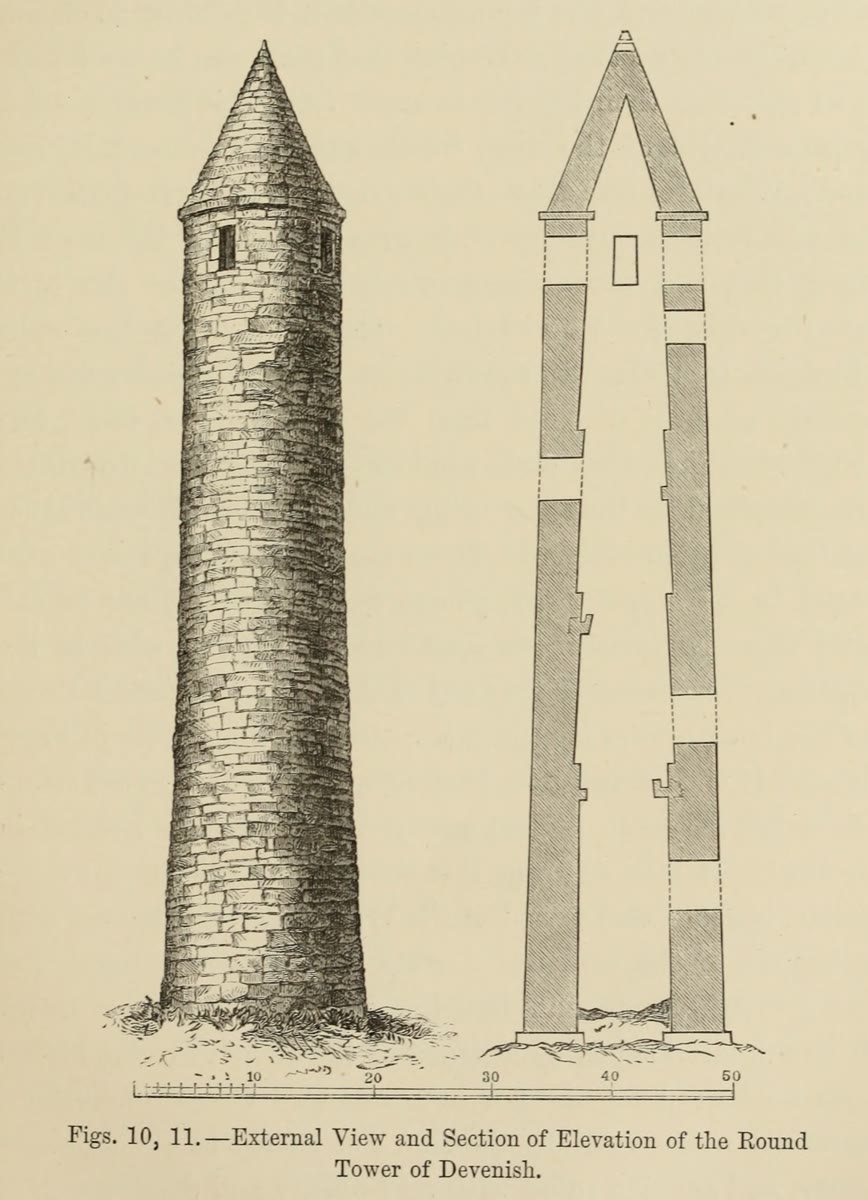
The round tower on Devenish Island, outside and in section, from Joseph Anderson, Scotland in Early Christian Times (1881). Public domain, via Wikimedia Commons
Why is the door so high up?
The single doorway is almost always well off the ground: about 1.5 metres up at Kells and 2.8 metres at Rattoo, according to Heritage Ireland, and many are higher. Monks reached it by a ladder or steps. There are two main explanations.
- Defence. The classic picture has monks climbing in and pulling the ladder up as raiders approached. The archaeologist Liz FitzPatrick, writing in History Ireland, saw the raised doors as evidence that towers were refuges, though not very effective ones.
- Engineering. Round towers stand on shallow foundations, and a large ground-floor opening might have weakened the whole structure, Corlett explains. The Irish Times writer George Cunningham also doubted the ladder story: hauling one up under attack would have been hard.
There may have been a ceremonial side too: most doors face the west end of the main church, Cunningham notes, and the archaeologist Peter Harbison suggested relics may have been displayed at tower doorways by the 12th century. The height probably did several jobs.
What were round towers for?
A home for the bell
The name says bell house, and Stalley believes holding a bell was their main purpose. Monastic life ran on the bell, which called monks to prayer at set hours, and early Irish rules punished latecomers. As monasteries grew into busy settlements, he suggests, a bell rung high in a tower would carry much further.
A strongroom and a refuge
The annals show towers used for safety, not always successfully: Stalley counts six entries where people were killed inside a tower as they tried to escape an enemy.
- Kells, 1076: Murchadh Ua Maeleachlainn, three days after claiming the kingship of Tara, was murdered in the bell tower by the lord of Gaileanga, the Four Masters record.
- Monasterboice, 1097: the tower burned “with its books and many treasures”.
So towers clearly served as strongrooms and emergency shelters, but Stalley doubts they were designed for defence.
Were they built to hide from the Vikings?
That’s the popular story, but most surviving towers seem to be later than the main Viking raids, Cunningham notes, and Vikings were not the only raiders. The archaeologist A. T. Lucas counted 309 attacks on Irish church sites between 600 and 1163, FitzPatrick writes. The Irish themselves carried out half of them, and in 19 the Irish and Norse joined forces.
Something more symbolic?
The archaeologist Tadhg O’Keeffe, in his 2004 book Ireland’s Round Towers, argues for their role in church ritual. Corlett suggests towers at pilgrimage sites such as Glendalough may have guided pilgrims on the last leg of their journey. And a tower was a status symbol: having one meant a monastery was very wealthy, Heritage Ireland says of Ardmore.
Fire temples and phallic symbols: the wild theories
Before the 1830s, the towers attracted spectacular guesses, from astronomical observatories to penitential prisons, as the antiquarian George Petrie catalogued in 1845. Three stand out.
- Danish watchtowers. In 1662 the historian John Lynch reported that the Danes were said to be the first builders of the towers.
- Fire temples. In a 1772 essay, General Charles Vallancey traced the towers to Phoenician or Persian settlers and made them temples of a sacred fire. Petrie blamed the notion on “the fanciful brain of General Vallancey”.
- Phallic monuments. Henry O’Brien, a young Kerryman, went further. His 1834 book The Round Towers of Ireland claimed the Tuatha Dé Danann, whom he took to be early colonists from India, raised them as phallic temples honouring the “fructifying principle of nature”.
O’Brien’s book grew out of a competition. The Royal Irish Academy offered a gold medal and £50 for the best essay on the towers. Petrie won it. O’Brien received a lesser prize of £20 and died in London in 1835, aged just 27.
Petrie’s prize essay grew into his great 1845 book, The Ecclesiastical Architecture of Ireland. Using the annals and the buildings themselves, he showed the towers were Christian, built as belfries and as keeps, “places of strength” for a monastery’s books, relics and treasures, where clergy could shelter from a sudden raid.
His dates were too early: he allowed for towers as old as the fifth century. But his central argument, Christian bell towers that doubled as strongrooms, still holds.
Famous Irish round towers to see
Glendalough, Co. Wicklow
St Kevin founded his monastery in this Wicklow valley at the end of the 6th century. Its round tower, among Ireland’s tallest and best-preserved, was built around 1100 to be seen from much of the valley, the National Monuments Service says. In the 1770s it stood without its cap, which the Office of Public Works restored in 1876, the National Library of Ireland notes. It’s an easy day trip from Dublin.
Clonmacnoise, Co. Offaly: O’Rourke’s Tower
St Ciarán’s 6th-century monastery on the Shannon has two round towers. The larger one is called O’Rourke’s Tower, because a late medieval record of the monastery credits it to Fergal O’Rourke, a 10th-century king of Connacht. The annals say instead that the great bell tower was completed in 1124 by the abbot, Gilla Críst Ua Maíleoin, and Turlough O’Connor, king of Connacht, though Petrie thought that may have been a rebuilding. In 1135 lightning struck off its top. Heritage Ireland lists works and closures there until January 2027, so check before you go.
Kilmacduagh, Co. Galway: the leaning tower
At 34.3 metres (about 112 feet), Kilmacduagh is the tallest of the medieval towers, with seven storeys. It also leans, “like the tower of Pisa”, says Heritage Ireland; the Office of Public Works restored it in 1878 and 1971. In July 2025 a local senator urged the OPW to assess its worsening lean, Galway Bay FM reported.
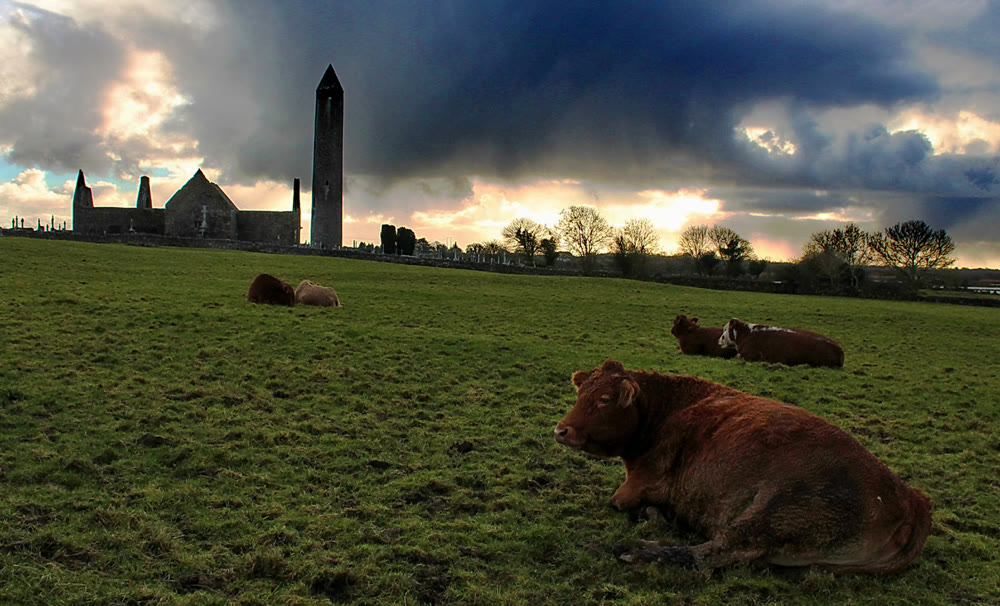
Kilmacduagh round tower and cathedral, Co. Galway. Photo: Martin P. Whyte, CC BY-SA 4.0, via Wikimedia Commons
Ardmore, Co. Waterford
Overlooking the bay at Ardmore, St Declan’s monastery has a 12th-century tower about 30 metres tall, according to Heritage Ireland. Projecting stone bands ring the outside, and inside, some of the stones supporting the floors are carved with grotesque faces. The original cap is kept in the ruined cathedral next door. Heritage Ireland says conservation work is under way, so check before you go.
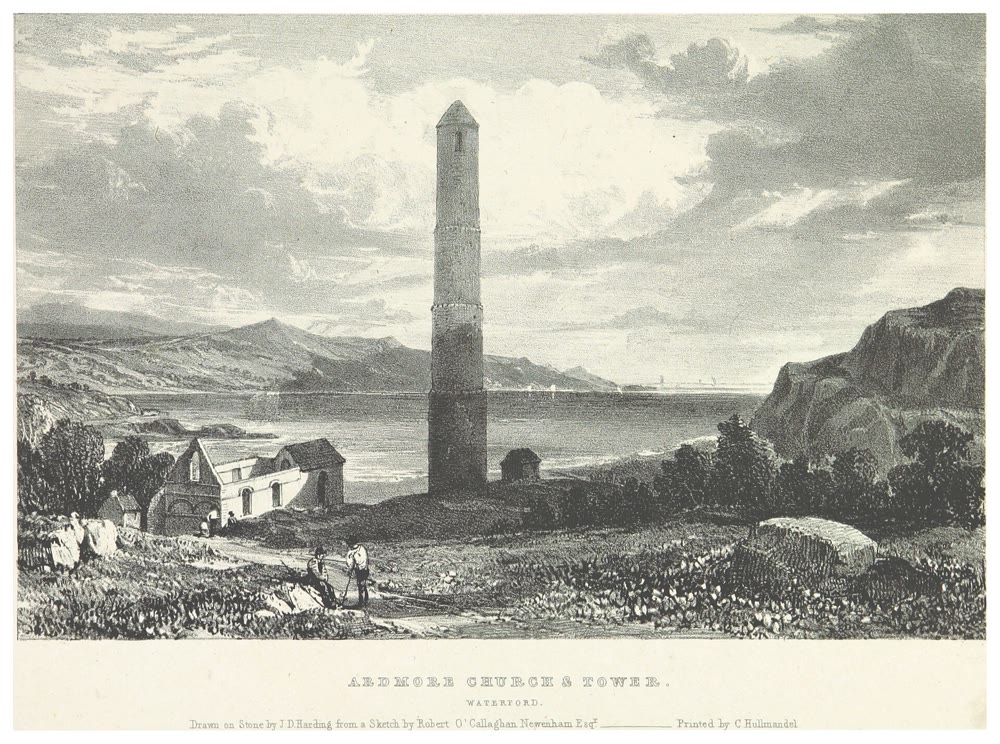
Ardmore church and round tower, drawn on stone by J. D. Harding from a sketch by Robert O’Callaghan Newenham, from Newenham, Picturesque Views of the Antiquities of Ireland, vol. 1 (1830). British Library, public domain, via Wikimedia Commons
Devenish, Co. Fermanagh
On an island in Lower Lough Erne, reachable only by boat, Devenish has a 12th-century tower, says Northern Ireland’s Department for Communities. A carved cornice runs round the top, just under the cap, with four carved human heads looking out to the points of the compass.
Rattoo, Co. Kerry
The only complete round tower in Kerry, Rattoo rises about 29 metres near Ballyduff. During repairs in 1880 and 1881, a sheela-na-gig, a carved female figure, turned up on the inner frame of its north window. You can only view it from outside.
Kells, Cashel and more
The tower at Kells, Co. Meath, where that king was murdered, belonged to the monastery that kept the Book of Kells; Heritage Ireland lists it as closed for conservation works. The Rock of Cashel has one beside its cathedral and Cormac’s Chapel.
Two you can climb: Kildare and Kilkenny
Most towers are empty shells, but two are open to climbers:
- Kildare: at St Brigid’s Cathedral, on the site of St Brigid’s famous foundation. At 33 metres (108 feet) it’s the second highest in Ireland, says the cathedral, with a red sandstone doorway carved with zigzags. Its battlemented top replaced the original cone in the 1730s. It’s open from May to September, by ladder only.
- Kilkenny: at St Canice’s Cathedral, 30 metres (100 feet) high, climbed by internal ladders over seven floors and 121 steps. The cathedral calls it one of only two round towers in Ireland that visitors may climb. Pair it with my 48 hours in Kilkenny.
The round tower as a national symbol
In the late 1700s and early 1800s, the round tower joined the harp and the shamrock as an emblem of Ireland, alongside the wolfhound and the high cross, writes the cultural historian Joep Leerssen of the University of Amsterdam. Overused on 19th-century book covers and souvenirs, the set looked trite by independence, he notes, and a Senate committee chaired by W. B. Yeats rejected all but the harp for the new Irish coins. There’s more on these emblems in my guide to symbols of Ireland.
The O’Connell Tower, Glasnevin
The biggest round tower in Ireland isn’t medieval at all. It rises over the grave of Daniel O’Connell, the Liberator, in Glasnevin Cemetery, Dublin.
O’Connell died in Italy in 1847. The cemetery trust says the tower was completed in 1855, while the National Inventory of Architectural Heritage dates it to 1869, the year his remains were moved into a crypt at its base. The Inventory says it was the only part built of an early Christian-style group conceived by George Petrie.
At 55 metres (180 feet), by the trust’s measure, it’s the tallest round tower in Ireland. A bomb wrecked its staircase in January 1971; nobody was hurt and nobody was ever caught. It stayed closed until April 2018, the Irish Times reported, and visitors can now climb its 198 steps on a ticketed climb.
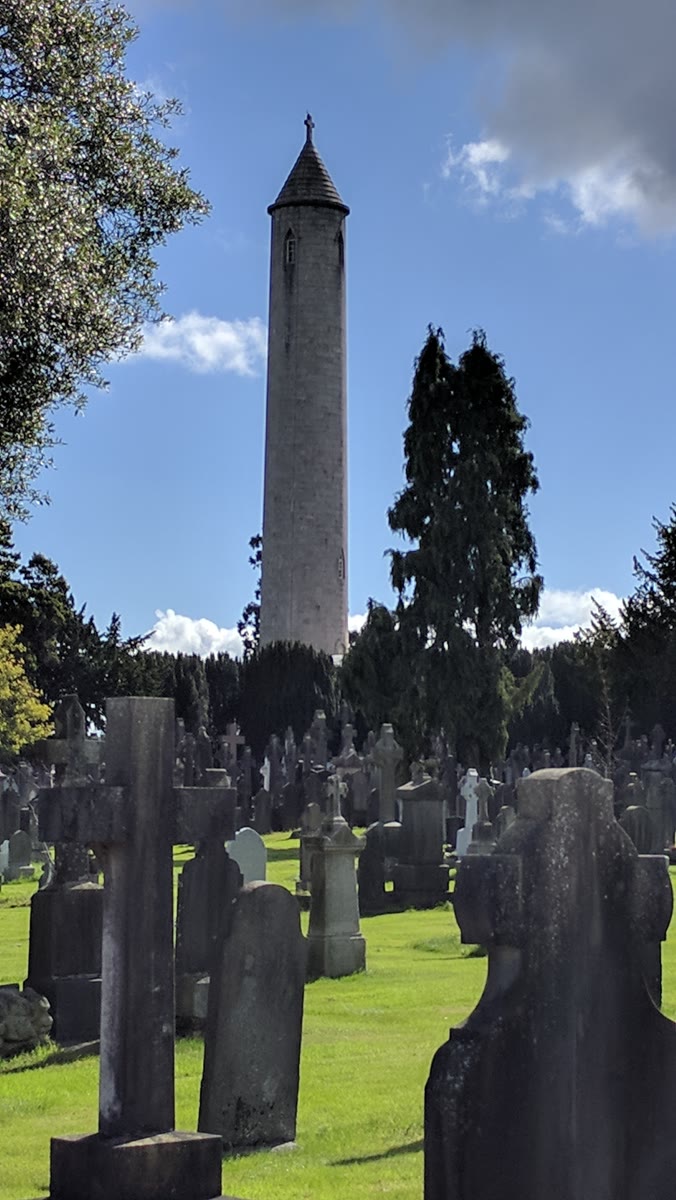
The O’Connell Tower, Glasnevin Cemetery, Dublin. Photo: Spleodrach, CC BY-SA 4.0, via Wikimedia Commons
From Messines to Massachusetts
On 11 November 1998, President Mary McAleese, with Queen Elizabeth II and King Albert II of Belgium present, unveiled a round tower at the Island of Ireland Peace Park at Messines in Belgium. In her speech she remembered the men of the 36th Ulster and 16th Irish Divisions who died there in the First World War. Dublin City Libraries notes the sun lights its interior only at the 11th hour of the 11th day of the 11th month.
The diaspora built them too. In Milford, Massachusetts, the Tipperary-born priest Patrick Cuddihy raised a round tower of local pink granite in St Mary’s Cemetery. It was standing by 1895, Irish Boston reports, and he’s buried at its foot.
Irish round towers FAQ
What were Irish round towers used for?
Mainly as bell towers, as their Irish name, cloigtheach (bell house), suggests. The annals show they also held books, relics and treasures, and people sometimes sheltered inside during attacks.
How many round towers are there in Ireland?
About 65 survive in some form, though some scholars count over 70, and around 13 are complete to their caps.
Why are round tower doors so high off the ground?
Nobody knows for certain. A raised door made a tower harder to break into, but some scholars think it mainly kept the base strong, since the foundations are shallow.
Which is the tallest round tower in Ireland?
Among the medieval towers, Kilmacduagh in Co. Galway, at 34.3 metres. The 19th-century O’Connell Tower in Glasnevin, Dublin, is much taller, at roughly 50 to 55 metres.
Can you climb a round tower?
Yes, at Kildare (May to September) and St Canice’s in Kilkenny, both by ladders, and at the modern O’Connell Tower in Dublin.
Love this? Save it to your Pinterest board for later.
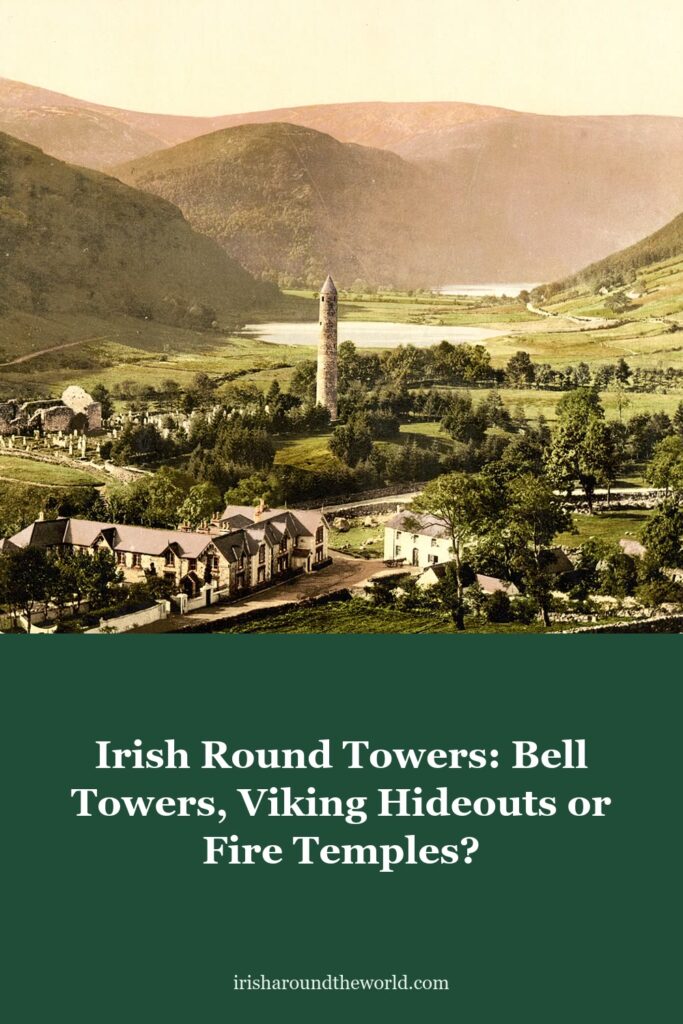
Pin image: Glendalough photochrom by Photoglob Zürich, about 1890 to 1900, Library of Congress. Public domain, via Wikimedia Commons.
A little bit of Ireland in your inbox every Friday ☘️
The free Weekly Dose of Irish: an Irish joke, a Celtic symbol, an Irish fact, a poem and the week’s best articles in one short email. Join 9,600+ readers.
Free. One short email every Friday. Unsubscribe any time.
More Irish heritage reading
- The Celtic Cross: Meaning, History and Ireland’s Great High Crosses
- The Book of Kells: How Ireland’s Greatest Treasure Was Made, Stolen and Saved
- The Rock of Cashel: Where the Devil Spat Out a Mountain (History and How to Visit)
- Skellig Michael: The Impossible Island Monastery, From Monks to Star Wars
- Symbols of Ireland: 12 Irish Symbols and Where You See Them Today
- Glendalough: The Hermit Saint, a Blackbird and Ireland’s Valley of Two Lakes
- Clonmacnoise: The Monastic City on the Shannon Where High Kings Lie Buried
Featured image: Glendalough, Co. Wicklow, photochrom print by Photoglob Zürich, about 1890 to 1900, from the Library of Congress Prints and Photographs Division (ppmsc.09944). Public domain, via Wikimedia Commons.