
“No Irish need apply”, often shortened to NINA, was a line added to some job ads in 19th-century Britain and America. In 2002 the historian Richard Jensen argued that the Irish-American memory of it was largely a myth. In 2015 Rebecca Fried, then 14, published dozens of examples, many for men’s jobs. The ads were real. How common they were, and how many signs hung in windows, is still argued.
Few phrases carry as much weight in Irish-American family history as these four words: No Irish need apply. For generations they’ve stood for the welcome many emigrants got in America, a door shut before they’d even knocked.
Then, in 2002, a retired history professor argued that the famous signs were mostly a myth. Thirteen years later, an eighth-grader in Washington, D.C. went looking in the old newspapers and published her answer in the same academic journal.
I’ve written about the wider story of the Irish diaspora in America before. This one is narrower: one phrase, two researchers and what the evidence shows. Fair warning: neither side gets a clean win.
Jump to:
- What did “No Irish need apply” mean?
- Where did the phrase start?
- The ads in America
- The songs that carried it
- Jensen’s 2002 “myth” argument
- Rebecca Fried’s 2015 answer
- Jensen’s reply
- So what does the evidence show?
- The same argument in Britain
- How memory and history interact
- The bigger Irish-American picture
- Checking a family story yourself
- No Irish Need Apply FAQ
- More Irish heritage reading
What did “No Irish need apply” mean?
It was a line tacked onto the end of a “Wanted” notice, telling Irish people not to bother answering. Most surviving examples are newspaper classified ads, not painted signs.
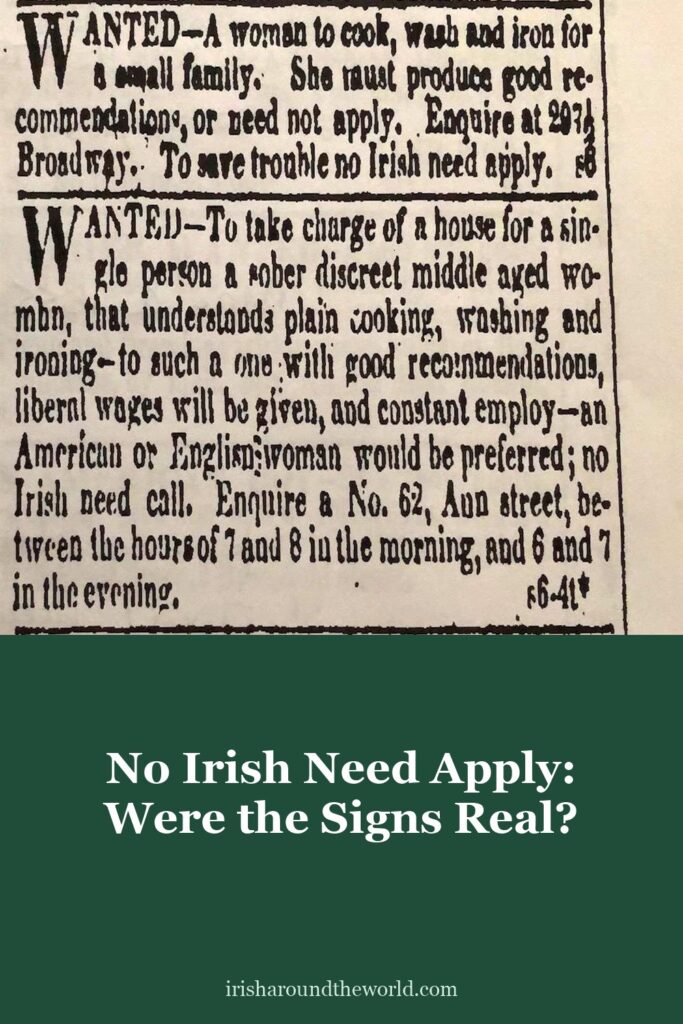
A typical one ran in the New York Evening Post on 8 September 1828. Someone at 297½ Broadway wanted a woman to cook, wash and iron for a small family. The last line: “To save trouble no Irish need apply.”
The ad printed right under it wanted a housekeeper. An American or English woman would be preferred, it said, and “no Irish need call”. Same message, different words.
Where did the phrase start?
The earliest dated examples found so far are British. The word researcher Barry Popik has logged versions in London’s Morning Post in 1809 (see his NINA page): “No Irish people need apply” that July, and “No Irishman need apply” in October.
One old story needs a health warning. London papers hostile to the radical writer William Cobbett claimed in 1809 and 1810 that his Philadelphia newspaper had once advertised for a printer, adding “No damnable Irishman need apply”. These are second-hand reports from his opponents, so treat the story as unproven.
The historian Donald MacRaild searched more than 50 digitised newspapers for a 2013 paper in Labour History Review on NINA in Britain. His finding: it was the Irish who first turned the phrase into politics. From the 1840s they used it as shorthand for any British wrong, real or perceived, against Ireland or the Irish.
The ads in America
The phrase crossed the Atlantic early. Popik lists a New-York Evening Post ad from 26 September 1827 for a cook. It asked for a white, middle-aged American woman and closed “No Irish need apply”. Several more turned up in New York papers within a year.
Nearly every early American example using the phrase is for a cook, maid or nursemaid. That was Irish women’s work: in 1900, the historian Hasia Diner found, 60.5% of Irish-born women in paid work in the US were in domestic service.
Some Americans objected at the time. On 12 July 1830, the New-York Morning Herald said it had been handed several ads with “this insulting appendage” and had refused to print them.
In 1836 a writer in London’s New Monthly Magazine said such ads ran often, but the more usual wording was “Wanted, an English or American”. That says no Irish without saying it. Yet the Irish still made up “the great mass of domestic servants”, the writer added.
The pattern held for decades. In 1868 the Boston Transcript carried an ad for a woman to mind a two-year-old boy in Brookline. It ended, misprint and all, “Postively no Irish need apply.”
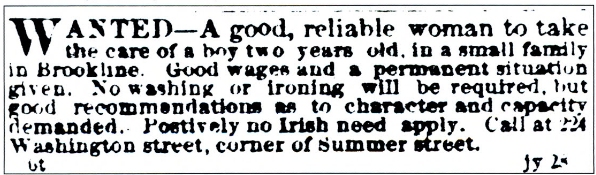
Boston Transcript, 1868 (reproduced in Dennis P. Ryan, A Journey Through Boston Irish History, 1999), via Wikimedia Commons
The songs that carried it
Around 1862, songs called No Irish Need Apply turned up on stage on both sides of the Atlantic. In London, the music hall singers Sam Collins and Mrs F. R. Phillips are both linked to versions from about that year. Nobody is sure whose came first.
In America, the Library of Congress holds a Philadelphia song sheet “written and sung by Miss Kathleen O’Neil”, dated to about 1862. It’s written in the voice of an Irish girl looking for work as a household servant. At the top sits a short “Wanted” notice credited to the London Times of February 1862, ending with the hated line.
Another version, by John F. Poole, was written for the New York variety star Tony Pastor. In the male version Jensen describes, a newly arrived Irishman sees the ad and settles the matter with his fists.
Jensen’s 2002 “myth” argument
Richard Jensen was a professor of history at the University of Illinois at Chicago from 1973 to 1996. In 2002 he published “No Irish Need Apply”: A Myth of Victimization in the Journal of Social History.
He was answering the historian Kerby Miller, whose 1985 book Emigrants and Exiles called the notices “ubiquitous” in America’s big cities.
Jensen used what was then a new tool: searching digitised newspapers by computer. His main points:
- Irish women filled household jobs in huge numbers, even though some ads for maids and cooks carried NINA.
- NINA ads for men were very rare. In 70 years of the New York Times he found only two NINA classifieds, one of them an 1854 Brooklyn ad for a teenage boy.
- Window signs were vanishingly rare, or never existed. A 2005 History News Network post quotes him calling them “as real as leprechauns”.
- The song, not real experience, was the main source of the memory.
- The memory lasted because it helped hold Irish Catholics together against outsiders.
He went further. In his reading, the hiring evidence shows no significant bias against the Irish, and many employers went out of their way to hire them.
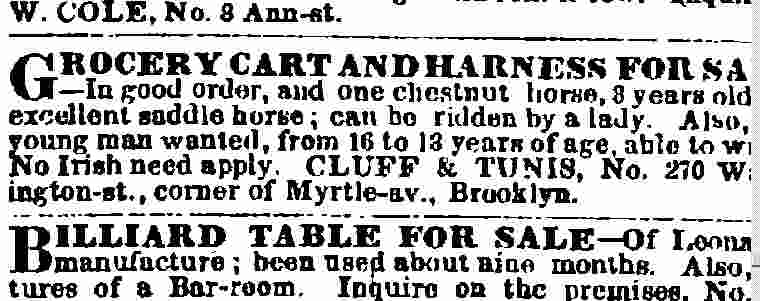
The New York Times, 25 March 1854, via Wikimedia Commons
Rebecca Fried’s 2015 answer
In March 2015, St Patrick’s Day articles stirred the debate up again. One reached Rebecca Fried, an eighth-grader at Sidwell Friends School in Washington, D.C., reportedly through her father. She searched online newspaper archives and quickly found examples.
Kerby Miller, the historian Jensen had criticised, helped her understand how a scholarly article is put together. On 4 July 2015 the Journal of Social History published her paper online, “No Irish Need Deny”. She was 14.
By Jensen’s later count, the paper listed 69 cases, and many were for men. Jobs included store and hotel clerks, bartenders, farm workers, coachmen, bookkeepers, bakers and tailors.
The biggest cluster came from the New York Sun: 15 ads in 1842 alone, Smithsonian magazine reported, and 20 across 1842 and 1843 by Jensen’s count. One, from January 1842, wanted “men and boys to carry pies”. No Irish need apply.
Other cases came from Boston, Philadelphia, Chicago, St Louis and small towns from Kansas to Texas. She also covered NINA in housing ads, lawsuits and Confederate propaganda. Her conclusion: such notices were “sometimes common in some places” in the 19th century, Jensen’s thesis needed revising, and the older view of NINA as widespread fit the evidence better.
The Butte protest of 1909
Fried also cites a protest. On 17 April 1909, the Anaconda Standard reported that a meeting called by the Gaelic League, the Irish-language revival movement, in Butte, Montana, had brought out “200 or 300 Irish-Americans”. They came to discuss a Help Wanted ad, placed in that same paper by a Mrs Miller, that said no Irish need apply.
A committee was named to draft resolutions of protest. One speaker, Michael O’Donoghue, compared the ad to the English writing “No Irish need apply” over their barracks gates, an unsourced story. Whatever its truth, it’s MacRaild’s point in action: by then the phrase was a byword for British oppression as much as a job notice.
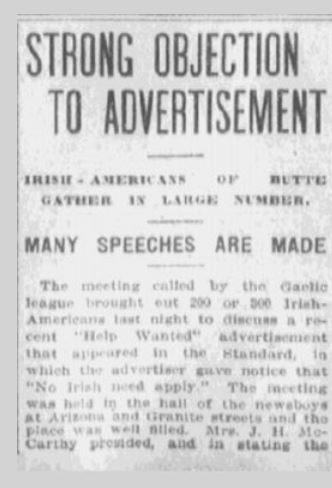
The Anaconda Standard (Montana), 17 April 1909, via Wikimedia Commons
Jensen’s reply
Jensen had praised her hard work in an online comment. But in August 2015, writing on the History News Network, he rejected nearly all her cases.
- He said she had found only two reports of actual signs, from 1883 and 1932, and dismissed nearly all her other cases as misinterpretations.
- He also set aside the 1883 sign, from Port Washington, Ohio. It offered a patronage job cleaning bridge lamps after Republicans swept Democrats from local posts, and nearly all Irish voters were Democrats, he said. Whether that makes it less anti-Irish is a fair question.
- The New York Sun ads, he said, probably came from two employment agencies, which Fried accepted. In his view, she hadn’t shown that the employers behind them wanted Protestants only.
- From 1845 on, he counted only 21 ads for business jobs in her list, spread over nearly nine decades.
- Across the 9.7 million pages of the National Digital Newspaper Program, he calculated, a reader would meet one NINA every 41,000-plus pages.
- Butte, he argued, was an odd place to look for anti-Irish hiring. Citing the historian David Emmons, he said the Irish dominated the Anaconda copper company there, and the local saying was “No English need apply”.
He also conceded a key point. Signs mattered far beyond their number, he argued. Crowds passed shop windows every day, so even a few signs would have shamed Irish people across a whole city.
So what does the evidence show?
- The ads were real. They ran in London from at least 1809 and in American papers from at least 1827 into the early 1900s. Even Jensen found a dozen in 2002.
- Most were for household servants. The surviving record leans heavily towards cooks, maids and nursemaids, so in print it was mostly Irish women being turned away.
- Men’s jobs were affected too. As early as 1819, a New York ad for a coachman said no Irish or coloured man would be engaged. Fried showed real clusters of men’s ads, especially in 1840s New York. How typical they were is the heart of the dispute.
- Window signs are the weak spot. Only a few reports survive. But a card in a window rarely leaves a paper trail, so the silence is hard to read either way.
- The exact phrase undercounts the attitude. Variants like “no Irish need call”, or ads asking for “an English or American”, slip past any search for the famous phrase.
Averages can mislead, too. Spread across 9.7 million pages, NINA looks vanishingly rare. To an Irishman reading the Sun’s want ads in 1842, it wasn’t.
The same argument in Britain
Irish and Caribbean migrants in post-war Britain have long recalled lodging-house signs reading “No Irish, No Blacks, No Dogs”.
Only one photograph of such a sign is known, held by the Archive of the Irish in Britain at London Metropolitan University. As the Irish Times reported in 2024, it was donated in the early 1980s. Its provenance wasn’t recorded, though the archive believes it is genuine.
Sceptics such as the Aberdeen sociologist Steve Bruce argue that if the signs were common, more would survive. The archive’s curator, Dr Tony Murray, points to oral histories and to old documentary footage of a rental notice reading “no coloured, no Irish, no children”. Different country, different century, the same tug-of-war between records and memory.
How memory and history interact
How did a line in the small print become, in memory, a sign in every shop window? A few things probably worked together.
Songs gave it a tune. From the 1860s, people who never saw an ad could sing about one.
Politics gave it a meaning. MacRaild shows the Irish using the phrase against perceived British wrongs from the 1840s. The Butte speakers did the same in 1909.
Memory compresses. Families keep the image and lose the detail. A line in the classifieds becomes a card in a window.
Jensen read the memory as a useful myth that kept a community together. His critics, including the Swarthmore historian Timothy Burke, answered that memories like this rarely come from nothing. On that point, Fried’s evidence seems to back the critics: the memory grew in the telling, but it grew from something real.
The bigger Irish-American picture
NINA is one thread in a bigger story, and it’s easy to overclaim in either direction.
Hostility to Irish Catholics was real. In 1844, nativist mobs in Philadelphia burned St Michael’s and St Augustine’s churches, and the riots that May and July left perhaps 20 people dead, going by the Encyclopedia of Greater Philadelphia’s account.
In the mid-1850s, the Know-Nothing party, openly hostile to Catholics and the Irish, took power in several states. A 2020 economics working paper found that in 1855, Massachusetts towns more exposed to job competition from Irish immigrants, and to deskilling in factories, were more likely to vote Know-Nothing.
Yet, as Jensen stresses, Irish labour was also in heavy demand, on railroads, in mines and mills, and in private households. Citing the historian Kevin Kenny, he says Irish Americans began near the bottom in the 1840s and had caught up with the national average by 1900.
Both things can be true. Prejudice was real, uneven and changed over time. So was the climb. Fried’s paper doesn’t prove the Irish were shut out of America, and Jensen’s doesn’t prove they were welcomed with open arms.
Checking a family story yourself
If your family has a NINA story, you can test it the way Fried did.
- Search free archives such as the Library of Congress’s Chronicling America for the phrase, plus variants like “Irish need not apply”.
- Narrow it to your ancestor’s city and decade, because patterns varied.
- Check where your people actually worked. Census returns list occupations.
- Be wary of old-looking NINA signs sold online. Jensen was already warning about modern fakes in the early 2000s.
For the wider family tree, start with my guides to Irish surnames and ancestry DNA kits. An Irish-born grandparent could even make you eligible for Irish citizenship by descent.
No Irish Need Apply FAQ
Were “No Irish need apply” signs real?
The newspaper ads certainly were, in Britain and America, from at least 1809 into the early 1900s. A few reports of physical signs survive, but how common window signs were is still disputed.
Who is Rebecca Fried?
In 2015 she was an eighth-grader at Sidwell Friends School in Washington, D.C. That July, aged 14, she published “No Irish Need Deny” in the Journal of Social History, documenting dozens of NINA ads.
Were NINA ads mostly for women’s jobs?
Most surviving examples are for cooks, maids and nursemaids, mainly women’s work. Fried also found ads for men, especially in 1840s New York.
Did “No Irish need apply” happen in Britain?
Yes. Versions appear in London ads by 1809, before the first known American examples. Even Jensen accepted that NINA was far more common in Britain.
Love this? Save it to your Pinterest board for later.
A little bit of Ireland in your inbox every Friday ☘️
The free Weekly Dose of Irish: an Irish joke, a Celtic symbol, an Irish fact, a poem and the week’s best articles in one short email. Join 9,600+ readers.
Free. One short email every Friday. Unsubscribe any time.
More Irish heritage reading
- The Irish Diaspora: Influence and Impact on Modern America
- History of St Patrick’s Day: The Real Story and Myths
- The Luck of the Irish: Meaning and Origin of the Phrase
- Irish Myths Debunked: 20 Myths About Ireland
- Irish Surnames: Meanings, Origins and the Top 100 Names
Featured image: job ads in The Evening Post, New York, 8 September 1828, p. 3, via Wikimedia Commons. Public domain.