So what is the poem Red Hanrahan’s Song all about?
In short, Yeats is talking about a fictional character, ‘Red Hanrahan,’ to make a specific point about idealism. Once again, we get a lot of strong images throughout the poem, for example, “The old brown thorn-trees break in two high over Cummen Strand”…
Let’s get to this remarkable poem!

Red Hanrahan’s Song about Ireland
By W.B Yeats
He old brown thorn-trees break in two high over Cummen Strand,
Under a bitter black wind that blows from the left hand;
Our courage breaks like an old tree in a black wind and dies,
But we have hidden in our hearts the flame out of the eyes
Of Cathleen, the daughter of Houlihan.The wind has bundled up the clouds high over Knocknarea,
And thrown the thunder on the stones for all that Maeve can say.
Angers that are like noisy clouds have set our hearts abeat;
But we have all bent low and low and kissed the quiet feet
Of Cathleen, the daughter of Houlihan.The yellow pool has overflowed high up on Clooth-na-Bare,
For the wet winds are blowing out of the clinging air;
Like heavy flooded waters our bodies and our blood;
But purer than a tall candle before the Holy Rood
Is Cathleen, the daughter of Houlihan.
Red Hanrahan’s Song About Ireland: meaning and analysis
Published in In the Seven Woods (1904), this poem is sung by Red Hanrahan, a wandering poet and hedge-school master who appears in Yeats’s Stories of Red Hanrahan. He was partly inspired by the real 18th-century Irish-language poet Eoghan Rua Ó Súilleabháin.
What it means
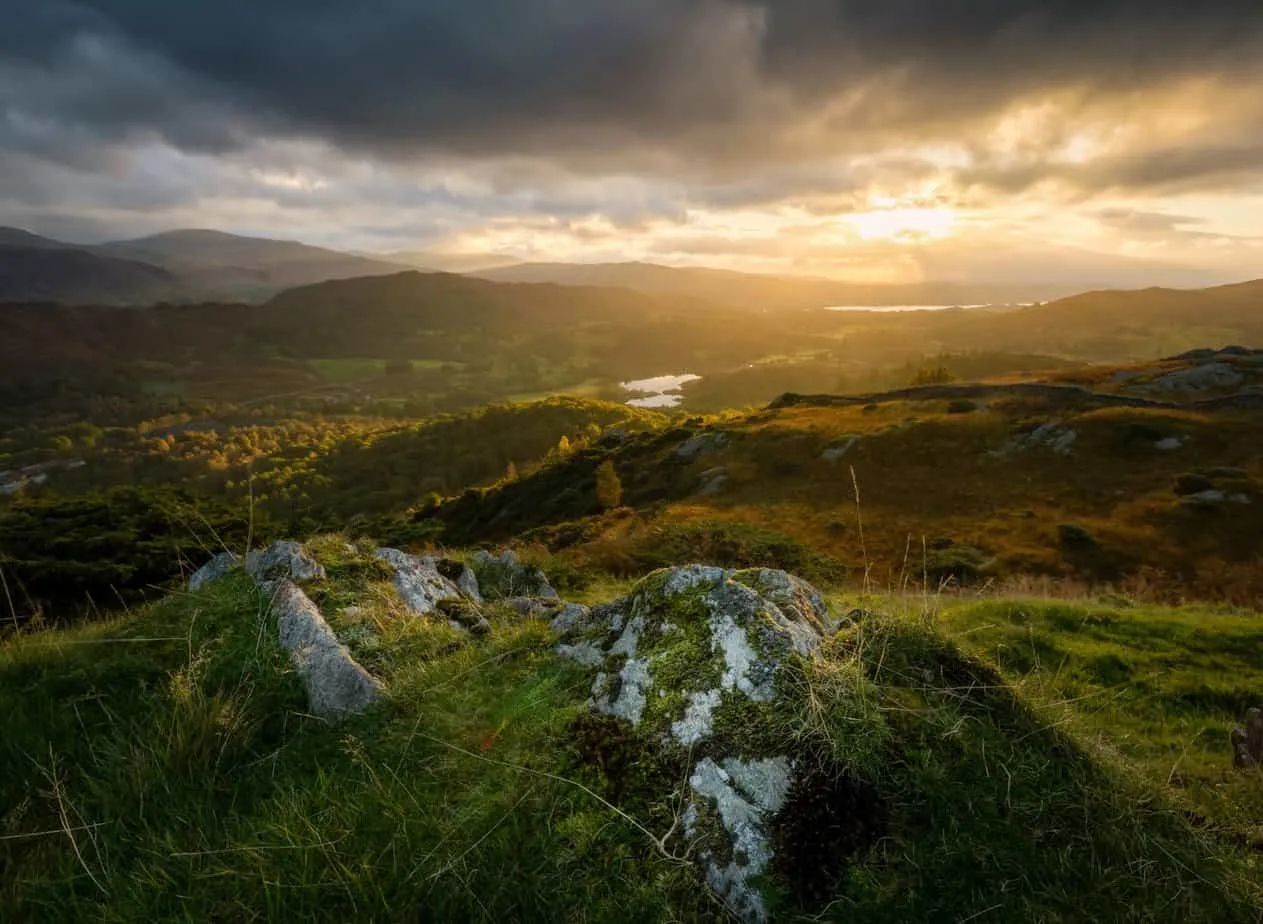
Hanrahan describes storms and dark weather across County Sligo: Cummen Strand, Knocknarea and Clooth-na-Bare. Each stanza ends by praising Cathleen, the daughter of Houlihan. Cathleen ni Houlihan is a traditional personification of Ireland, and the wild landscape, broken by wind and rain, stands for the country’s suffering. Against all that, her purity and the poet’s devotion stay steady.
Two years earlier, in 1902, Yeats and Lady Gregory’s play Cathleen ni Houlihan had cast Maud Gonne in the title role, turning the figure into a powerful symbol of Irish nationalism.
Key themes
- Ireland as a woman
- Nationalism and devotion
- The Sligo landscape
More Irish poems
- The Lake Isle of Innisfree by W. B. Yeats
- Easter, 1916 by W. B. Yeats
- Sailing to Byzantium by W. B. Yeats
- Irish quotes
A little bit of Ireland in your inbox every Friday ☘️
The free Weekly Dose of Irish: an Irish joke, a Celtic symbol, an Irish fact, a poem and the week’s best articles in one short email. Join 9,600+ readers.
Free. One short email every Friday. Unsubscribe any time.
Franz
Sunday 5th of June 2022
Thank you very much for "Red Hanrahan's Song" by W.B.Yeats. It's realy a very powerful poem.