Most fairy forts are ringforts: the round, banked enclosures of early medieval farmsteads, built mainly between about AD 500 and 1100. One scholarly count puts the number built at about 45,000, though more than a third have since been destroyed. Once abandoned, they were credited to the aos sí, the fairy people, and taboos against ploughing them or cutting their bushes probably helped keep many intact. Lone hawthorns carry the same warning. Recorded ringforts are protected by law in the Republic of Ireland.
Drive through almost any part of rural Ireland and you’ll pass one without noticing: a ring of bushes in the middle of a field, or a round, grassy bank the plough swings around. Sometimes a lone hawthorn grows on it, older and more twisted than anything in the hedges.
Locals may call it the fort, the rath or the lios. Plenty will tell you, half joking and half not, to leave it alone. It belongs to the other crowd.
I’ve introduced the fairy people themselves in my guide to Irish mythological creatures. This is the story of their houses: what fairy forts really are, why the fairies got them, and the thorn bush that made headlines around the world in 1999.
Jump to:
- What are fairy forts?
- Lios, ráth and sí: the words and how to say them
- Why were ringforts linked to the fairies?
- Fairy fort beliefs and taboos
- Lone hawthorns: Ireland’s fairy trees
- The Latoon fairy bush and the Ennis bypass
- Did a fairy thorn sink the DeLorean factory?
- Fairy trees and rag trees today
- Are fairy forts protected by law?
- Fairy forts FAQ
- More Irish folklore reading
What are fairy forts?
Most fairy forts are ringforts: a round space enclosed by an earthen bank, with a ditch outside it. Folk tradition gave the name to other mounds and earthworks too. Most ringforts measure 25 to 50 metres (about 80 to 165 feet) across. In the west, a thick stone wall often replaced the bank, and these stone forts are called cashels or cahers.
A National Monuments Service guide, Irish Field Monuments, calls ringforts the most common monuments in the Irish landscape, found in every county. The historical geographer Matthew Stout put the number built at about 45,000 in The Irish Ringfort (1997), the first book devoted to them, as Michael Ryan noted in his review for History Ireland.
Despite the name, they weren’t military forts. They were enclosed farmsteads, built mainly between about AD 500 and 1100, the guide says, with houses of timber or dry stone inside. A family’s wealth was often judged by its cattle, or by the size of its ringfort, notes the Heritage Council’s booklet Farming and Archaeology.
Stout argued most were built and lived in over perhaps three centuries from the 500s, but the dates are still debated. In a 2026 Harvard interview, doctoral researcher Andrew Bair, who surveyed nine forts in the west of Ireland and radiocarbon-dated samples from them, reported Iron Age activity at some and use as late as the 1600s. He plans to publish the results.
Many forts also hide a souterrain, an underground stone passage used for refuge and possibly storage.
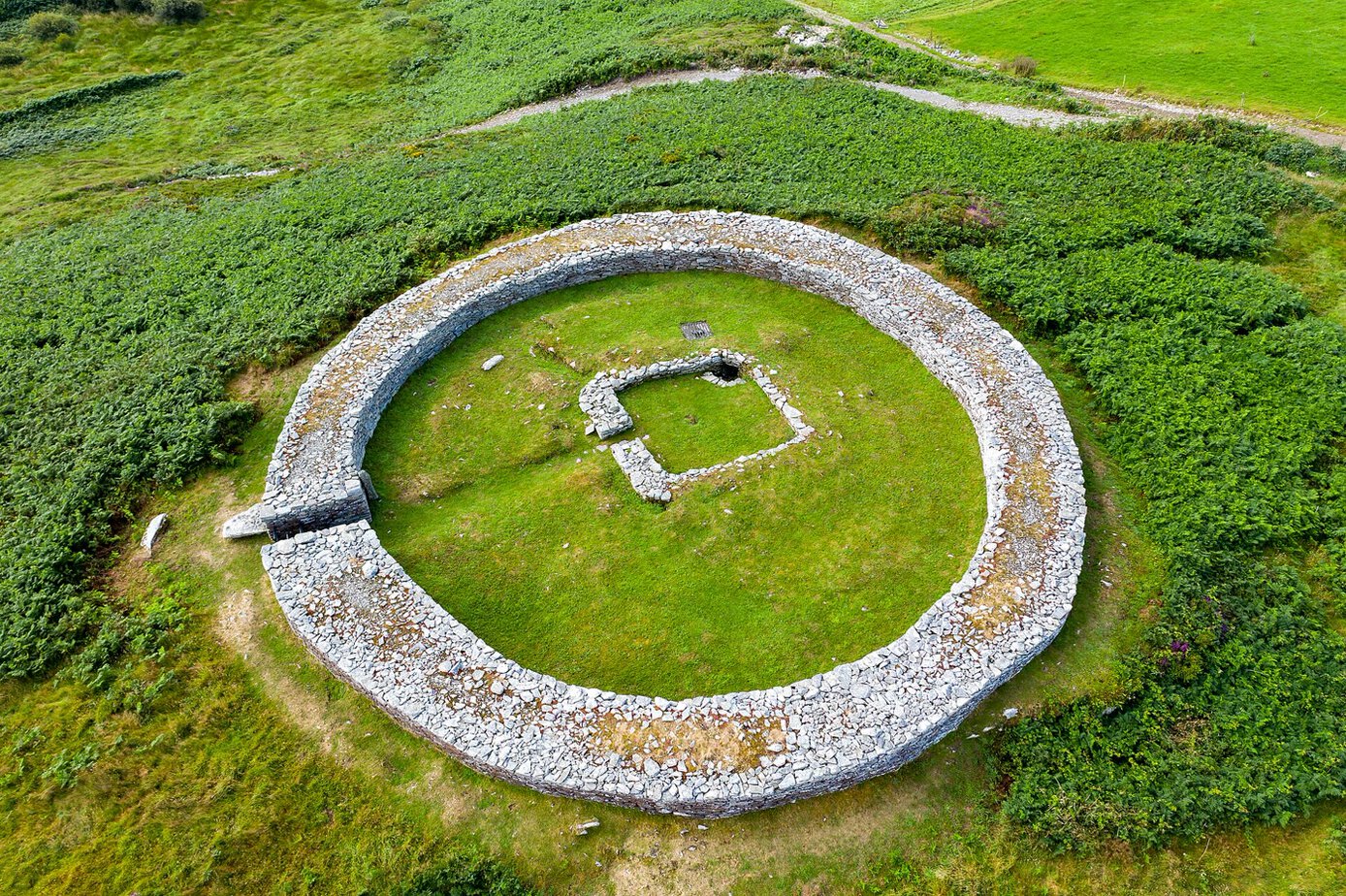
Knockdrum stone fort, a cashel near Castletownshend, Co. Cork, with the footings of a building inside. Photo: Superbass, CC BY-SA 4.0, via Wikimedia Commons
Lios, ráth and sí: the words and how to say them
Irish has several words for these places, and they live on in place names.
- Lios (liss), plural liosanna (LISS-uh-nuh). In early Irish it meant the yard around a house, enclosed by a bank, says the Electronic Dictionary of the Irish Language. Ó Dónaill’s dictionary gives “ring-fort” and “fairy mound”. It’s the Lis in Listowel, Co. Kerry: Lios Tuathail, the fort of Tuathal. And a lios round the moon is a halo.
- Ráth (raw; in Ulster closer to “rawkh”, with the ch of loch), plural ráthanna (RAW-huh-nuh). Strictly the earthen rampart, later the whole fort. In place names it became Rath.
- Dún (doon): a fort or fortress.
- Caiseal (KASH-ul) and cathair (KAH-hir): a stone fort. Cathair also means a city.
- Sí (shee): a fairy mound. Older spellings include sídh and sídhe, and the plural is síthe (SHEE-huh). From it come aos sí (eess SHEE; in Munster, ays SHEE), the people of the mounds; bean sí (ban SHEE), the banshee; and an slua sí (un SLOO-uh SHEE), the fairy host.
- Sióg (SHEE-ohg, as said in Connacht), plural sióga (SHEE-oh-guh): the everyday word for a fairy. Many people called them na daoine maithe (nuh DEE-nyuh MAH-huh), the good people.
Why were ringforts linked to the fairies?
Medieval Irish storytellers put the Otherworld inside mounds. In Mesca Ulad, a tale preserved in the 12th-century Book of Leinster, the poet Amairgen divides Ireland when the sons of Míl arrive. He gives “the part of Eriu that was under ground” to the Tuatha Dé Danann, in W. M. Hennessy’s 1889 translation, and they go into the hills. In another Book of Leinster tale, De Gabáil in t-Sída, it’s the Dagda who shares out the mounds among his people.
Those old fairy mounds (síde, in Old Irish) were often great prehistoric monuments. Medieval tales make Brú na Bóinne, the Newgrange complex, the home of Aengus, one of the Celtic gods, who tricked his way into it: from the Dagda in one tale, from Elcmar in another.
Ringforts were something else. But after the Anglo-Norman invasion began in 1169, most went out of use, the Heritage Council says, though Bair’s dates show some were used far longer. In time, people forgot who had built them.
In the 1930s, schoolchildren collecting folklore were often told the forts were built by “the Danes”, meaning the Vikings. Others said the fairies lived in them. The souterrains became secret tunnels: one account from Rosmead, Co. Westmeath, has one running from a fort to Ballinlough Castle.
Farmers kept finding older objects in their fields, too: Bronze Age axes, arrowheads and spindle whorls. Marion McGarry, writing for RTÉ Brainstorm, notes that these were explained as fairy property, under names like fairy darts, thunderbolts and fairy millstones.
McGarry describes devout Christians who still chose to play it safe with the fairies. In 1999 the folklorist Bairbre Ní Fhloinn of University College Dublin summed it up for The New York Times: “We would all rather be safe than sorry.”
Fairy fort beliefs and taboos
The richest evidence is the Schools’ Collection: folklore written down by Irish schoolchildren in 1937 to 1939, now online at dúchas.ie from the National Folklore Collection at UCD. About 5,600 of its entries are tagged “fairy forts”, and the rules are strikingly similar from county to county:
- Don’t plough or dig the fort, or carry off its earth.
- Don’t cut a bush or tree growing in it. In Rosmead, people said livestock would die or other bad luck follow.
- Don’t build across a fairy path. People sited houses away from fairy gathering places and paths, McGarry writes.
- Keep away at night, above all at Samhain, when the fairies were on the move.
In Arklow, Co. Wicklow, a pupil wrote of a farmer named Kelly who ploughed the fort in his field, thinking it no harm. That night his money was stolen. Next morning his horses were dead, and the year brought theft, fire and ruined crops. The next year he left the fort alone.
At Lisnagloos, near Ballymanagh, Co. Galway, a family dug sand from a fort to build a house, and next morning their horses were found dead.
The forts were places of wonder, too. At Kinnitty, Co. Offaly, people heard music and singing in a fort, saw lights in it and even saw the fairies playing hurling. In Kesh, Co. Sligo, a pupil wrote that the fairies moved from fort to fort on November night, around Halloween, and that red lights were often seen passing between forts on winter nights. There’s more on that in how the Irish invented Halloween.
People could be taken inside, too: that’s the belief behind the changeling.
McGarry suggests this long habit of careful avoidance may be one reason so many ringforts survive in such good shape.
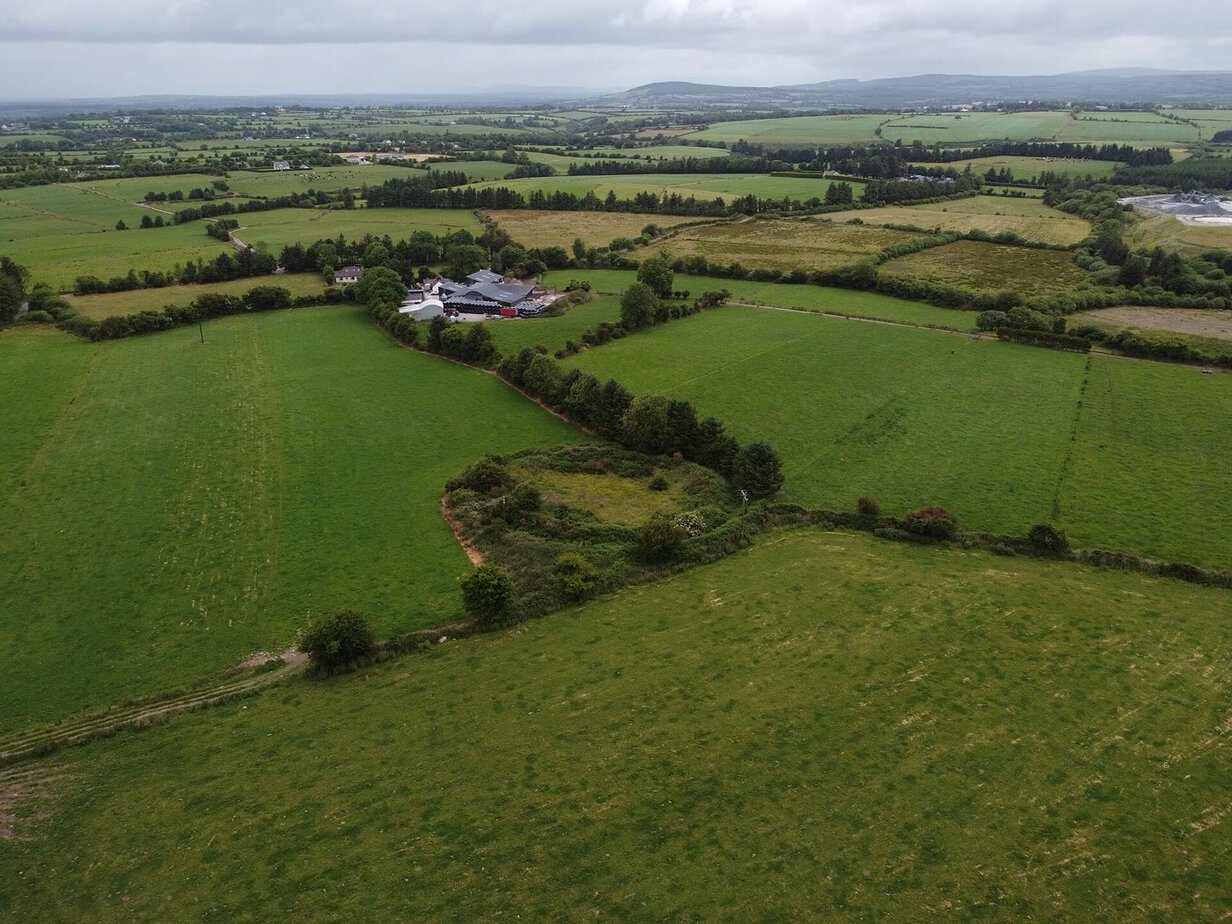
An overgrown circular enclosure, called a fairy fort by the photographer, among grazed fields near Carrigcleena, Co. Cork, a place named after Clíona, a fairy woman of Munster folklore. Photo: Tim Sheerman-Chase, CC BY 2.0, via Wikimedia Commons
Lone hawthorns: Ireland’s fairy trees
The fairy tree is usually a hawthorn, or whitethorn: sceach gheal (shkyakh YAL) in Irish, or simply sceach, a thorn bush. The one to watch is the lone bush: a single thorn standing in a field, often on or beside a fort, that hedge-cutters and ploughs have left alone for generations.
The rules match the forts. In the 1930s, pupils at Tallanstown, Co. Louth, recorded that no one should cut or burn a lone bush, that it sheltered the fairies, and that lights were seen under such bushes late at night.
Another Tallanstown story tells of a lone bush in Co. Meath that stood in the way of new houses. The contractor’s men refused to cut it, and the man who finally did fell very sick and died within a month.
Bretha Comaithchesa, an Irish law text from the 700s, ranks the whitethorn among seven trees it calls “commoners of the wood”, and damaging one carried a fine of a milk cow. But the legal historian Fergus Kelly points out that the hawthorn’s magic stands out mainly in more recent folklore. In the early texts, oak, hazel, yew and rowan are more closely tied to the supernatural.
The blossom has rules of its own. A pupil in Ardfinnan, Co. Tipperary, wrote that bringing whitethorn blossom into the house in May was unlucky, yet in Nenagh a sprig of whitethorn was still hung above the front door on May Eve (30 April). There are more superstitions in my piece on Irish luck.
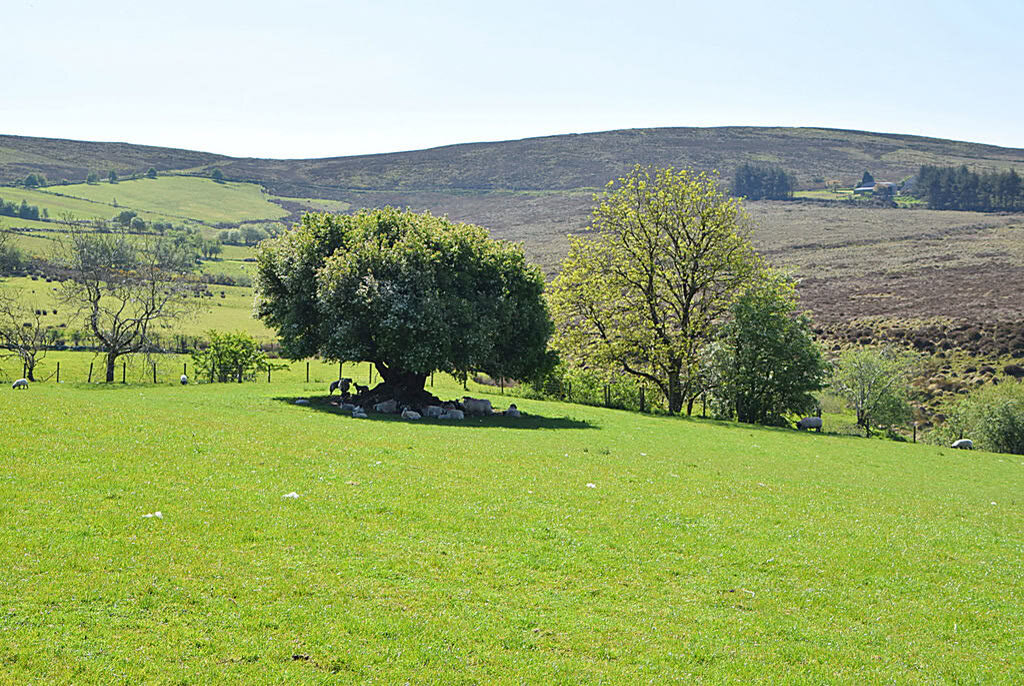
A fairy tree at Bradkeel, near Plumbridge, Co. Tyrone, in May 2025. A local pointed it out to the photographer, who notes that superstition still keeps people from interfering with it. Photo: Kenneth Allen, CC BY-SA 2.0, via Wikimedia Commons (Geograph)
The Latoon fairy bush and the Ennis bypass
Probably Ireland’s most famous fairy tree is a hawthorn at Latoon, near Newmarket-on-Fergus in Co. Clare. In 1999 it stood on the line of the new bypass of Newmarket-on-Fergus and Ennis, the road that now carries the M18 motorway.
The storyteller and folklore collector Eddie Lenihan warned that destroying it could bring misfortune, even death, to people using the road. As The Irish Times reported on 29 May 1999, he said Kerry fairies regrouped under the bush on their way to battle the fairies of Connacht, and their white blood had been seen on the grass there. “It is sacred ground,” he said, “it doesn’t revert to being a normal place.”
The same report quoted the county engineer, Tom Carey: once the bush was surveyed into the detailed plans, the road could be built around it, and the bush kept in the landscaping. The New York Times took up the story that June, and it spread far beyond Ireland.
So did the fairies move a motorway? It depends who you ask. An RTÉ Radio 1 documentary in 2009 said Lenihan’s campaign led the National Roads Authority to alter the route. Carey, writing to The Irish Times in 2014, insisted it was never rerouted: once surveyors fixed its exact position, the bush turned out to lie between the carriageway and a northbound slip road, so it was simply fenced off. Vandals later attacked it with a chainsaw, he added, without success.
Either way, it survived. A 2021 Irish Times article described it still standing between the northbound lane and the slip road.
Latoon wasn’t the first. In 1969, RTÉ’s Newsbeat reported from near Ballintra, Co. Donegal, where the county council had changed its road-widening plans to spare a whitethorn after local protest. Someone cut it down anyway, and it lay where it fell, because nobody would take it for firewood.
Did a fairy thorn sink the DeLorean factory?
The DeLorean sports car, later made famous by Back to the Future, was built at Dunmurry, on the edge of west Belfast, in a factory backed by about £75 million of UK government money, RTÉ reported in 1982. In February that year the company went into receivership.
A popular Northern Ireland legend says a fairy thorn on the site was cut down to make way for the plant. In 2015 a reader told BBC News NI that contractors building it were “said to have cut one down”, and McGarry heard the collapse blamed on a destroyed fairy place as a child. One online version has John DeLorean bulldozing the tree himself. The novelist Sara Baume, writing for a 2015 Dublin exhibition about it, wasn’t sure there was ever a hawthorn.
Treat it as a modern legend. The tree can’t be verified, but the business troubles are on record: by early 1982 only about 3,000 of the 7,000 cars built had been bought and registered in a depressed American market, and 1,100 layoffs had been announced, the Christian Science Monitor reported. The thorn simply makes a better story.
Fairy trees and rag trees today
Some thorns now wear ribbons, a custom best known from holy wells, where visitors tied a strip of cloth to a bush by the water. In Corry, Co. Westmeath, a 1930s pupil wrote that at Bisto Well you left a rag on the bush, and the illness would leave when the rag did.
The habit turns up at famous ancient sites too. On the Hill of Tara, visitors have hung strips of cloth on trees beside the ancient earthworks and even hammered coins into them. In 2019 one of these wishing trees toppled under the weight of its offerings, and visitors were asked to stop, the Irish Examiner reported.
The respect hasn’t gone away. In 2015 the secretary of Ormeau Golf Club in Belfast told BBC News NI that its greenkeepers won’t even trim the club’s fairy thorn. If you want to honour a fairy tree, the old way is simplest: leave it as you found it.
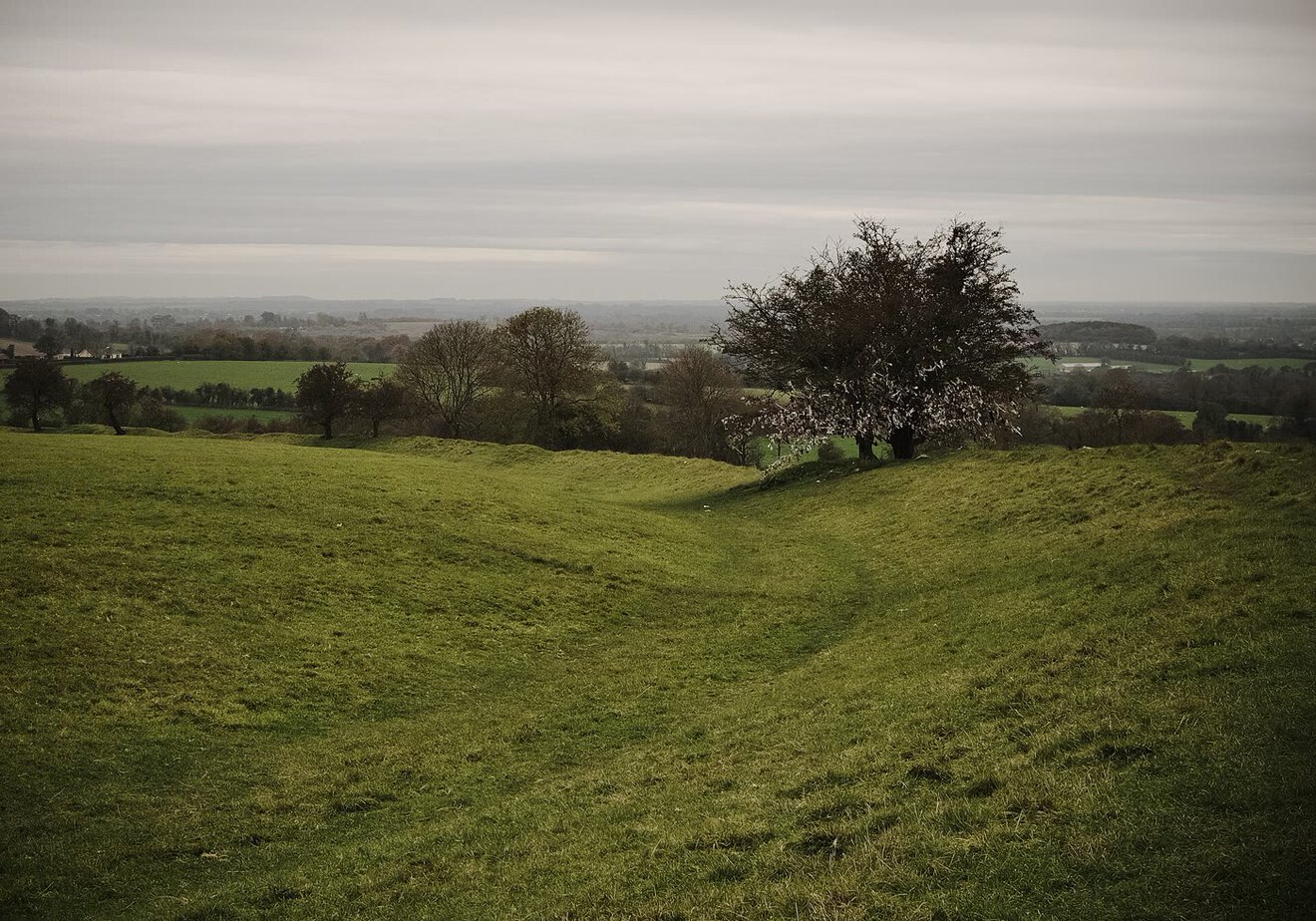
A rag tree beside Ráth na Ríogh, the royal enclosure on the Hill of Tara, Co. Meath, in 2013. Photo: Rob Hurson, CC BY-SA 4.0, via Wikimedia Commons
Are fairy forts protected by law?
In the Republic, yes, most of them are, and not only by the fairies. Ringforts there are listed in the Record of Monuments and Places and protected under the National Monuments Acts 1930 to 2014. Anyone planning work at a recorded monument must give the Minister two months’ written notice, the National Monuments Service says.
A newer law, the Historic and Archaeological Heritage and Miscellaneous Provisions Act 2023, is meant to replace those acts, but as of September 2026 the relevant sections had not commenced. In Northern Ireland, forts scheduled under the Historic Monuments and Archaeological Objects (Northern Ireland) Order 1995 need Scheduled Monument Consent before any works.
The law hasn’t saved them all. Stout estimated that about 37 per cent of ringforts had disappeared since the Ordnance Survey first mapped them, Ryan’s review notes. Prosecutions are rare: The Irish Times reported in 2021 that nine cases had been taken under the National Monuments Acts since 2007, with four convictions.
Curious about a fort near your ancestors’ townland (the small local land units used in Irish records)? The National Monuments Service’s Historic Environment Viewer maps recorded sites. Most forts are on private farmland, so ask the landowner first.
Fairy forts FAQ
What is a fairy fort in Ireland?
Usually an early medieval ringfort: a round farmstead enclosure with an earth bank or stone wall, built mainly between about AD 500 and 1100. Folklore later made them homes of the fairies, and gave the name to some other mounds too.
Is it bad luck to cut down a fairy tree?
Irish tradition says so. Folklore records tell of dead livestock, illness and even death after a fairy tree or bush was cut.
How do you pronounce lios, ráth and sí?
Lios is “liss”, ráth is “raw” (in Ulster, “rawkh”), and sí is “shee”. Aos sí, the fairy people, is “eess SHEE”, or “ays SHEE” in Munster.
Is it illegal to destroy a fairy fort?
Usually, yes. In the Republic, recorded ringforts are protected under the National Monuments Acts: anyone planning work at one must give the Minister two months’ written notice, and offenders can be prosecuted. In Northern Ireland, scheduled forts need Scheduled Monument Consent.
Can you visit a fairy fort?
Yes. Some, like Knockdrum stone fort near Castletownshend, Co. Cork, are in state care and open to all. Most are on private land, so ask permission first.
Love this? Save it to your Pinterest board for later.
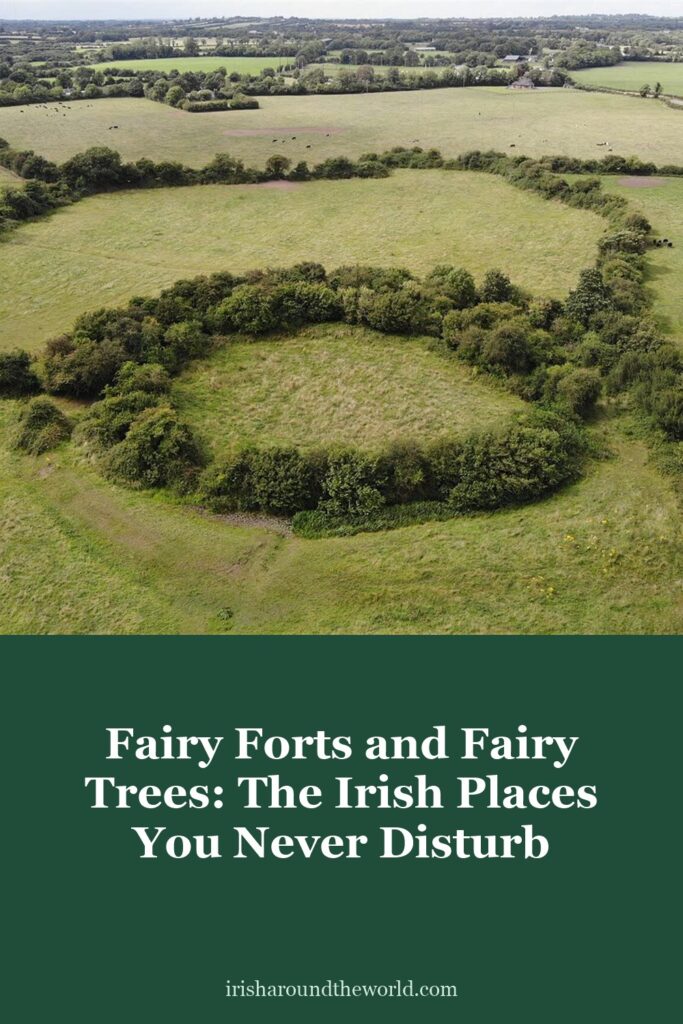
Pin image: ringfort in Kilclone, Co. Meath. Photo: Kmcnamee, CC BY-SA 4.0, via Wikimedia Commons.
A little bit of Ireland in your inbox every Friday ☘️
The free Weekly Dose of Irish: an Irish joke, a Celtic symbol, an Irish fact, a poem and the week’s best articles in one short email. Join 9,600+ readers.
Free. One short email every Friday. Unsubscribe any time.
More Irish folklore reading
- Irish Mythological Creatures: 23 Fairies, Monsters and Death Omens to Know
- Changelings: The Irish Fairy Belief That Led to the Burning of Bridget Cleary
- What Is a Banshee? The Wailing Woman of Irish Folklore and the Families She Follows
- The Host of the Air by W. B. Yeats: Meaning and Analysis
- How the Irish Invented Halloween: Samhain, Turnip Lanterns and Barmbrack
Featured image: aerial view of a ringfort in Kilclone townland, Co. Meath. Photo: Kmcnamee, CC BY-SA 4.0, via Wikimedia Commons.