The Salmon of Knowledge, an bradán feasa in Irish, is the legend of how Fionn mac Cumhaill became wise. The poet Finnéces (often spelled Finnegas) spent seven years watching a pool on the River Boyne for a salmon that would give its eater all knowledge. When it was caught, he told his young pupil to cook it but not taste it. The boy burned his thumb on the fish and sucked it. The poet decided the salmon was meant for the boy and let him eat it; in some folk versions the thumb alone was enough. Ever after, Fionn’s thumb could show him what he needed to know.
A boy is cooking a salmon on the bank of the Boyne. His master, a poet, has waited seven years to catch it, and has warned him not to eat a scrap.
The boy burns his thumb on the fish and sucks it. When the poet hears, he decides the salmon was meant for the boy all along.
That boy grew up to be Fionn mac Cumhaill (FIN muh-KOOL), leader of the Fianna. I’ve told his darkest hour in Diarmuid and Gráinne (GRAWN-yuh). Here’s where it all began, and how a young poet ended up as the giant of the Giant’s Causeway.
Jump to:
- What is the Salmon of Knowledge?
- How to pronounce Fionn mac Cumhaill
- Fionn’s boyhood: the hidden child
- The story of the Salmon of Knowledge
- The thumb of knowledge
- Why a salmon? Hazelnuts, wells and the Boyne
- Where is Féc’s Pool?
- Fionn and the Fianna
- Fionn in other tales
- Finn McCool and the Giant’s Causeway
- Fingal, the Fenians and Finn McCool abroad
- Salmon of Knowledge FAQ
- More Irish mythology
What is the Salmon of Knowledge?
The Salmon of Knowledge is a magical fish in the Fenian Cycle, the medieval tales of Fionn and his warrior band. In Irish it’s an bradán feasa (un BRAD-awn FASS-uh; in Munster and on Aran, bruh-DAWN).
Its oldest known telling is in Macgnímartha Finn, “The Boyhood Deeds of Fionn”. Kuno Meyer, who translated it in 1904, dated the tale to the 12th century. It survives in a single manuscript written in 1453 and 1454, now in Oxford’s Bodleian Library, and that copy breaks off mid-story.
Fionn is far older. The Dictionary of Irish Biography calls him “almost certainly” a god later remade as a human hero, and says his earliest traditions seem to belong to the Boyne valley.
How to pronounce Fionn mac Cumhaill
- In English: Finn McCool, said FIN muh-KOOL.
- In Irish: Fionn is roughly FYUN in Ulster, FIN or FYOON in Connacht, and FYOON in Munster. Cumhaill is COOL: the mh lengthens the vowel.
- What it means: fionn means fair or white, says Ó Dónaill’s dictionary. Cumhaill is the genitive of his father’s name, Cumhall, so mac Cumhaill is “son of Cumhall”.
- Fianna: FEE-uh-nuh, his band of warriors.
- Oisín: UH-sheen or OSH-een, his son. Cork and Kerry say uh-SHEEN, as I explain in how to pronounce Irish boy names.
Fionn’s boyhood: the hidden child
This retelling follows Meyer’s translation, online at University College Cork’s CELT site, in my own words.
A father killed, a son in hiding
Fionn’s father, Cumhall, fought for the leadership of the fían, the warrior band. He died at the battle of Cnucha, now Castleknock in Dublin, at the hands of Goll mac Morna. From then on, Fionn’s family and the sons of Morna were sworn enemies.
Cumhall’s widow, Muirne, was pregnant. She had a son and called him Demne. With the sons of Morna hunting the child, she gave him up to two women warriors, Bodbmall, a druidess, and the Grey One of Luachair, who raised him in secret in the forest of Slieve Bloom.
How Demne became Fionn
A scalp disease left the boy bald, and people called him Demne the Bald.
One day he wandered onto the plain of the Liffey, in today’s Co. Kildare, and beat a whole crowd of youths at hurling, Ireland’s ancient stick-and-ball game. The local chief asked what this stranger looked like. A handsome lad, they told him, and fair, which in the Irish of the day was finn. Then Finn, the chief decided, should be his name.
Fearing for him, his guardians eventually sent him away. After serving kings in Munster without giving his name, he found his uncle Crimall, an old man living in a Connacht wood with survivors of his father’s band.
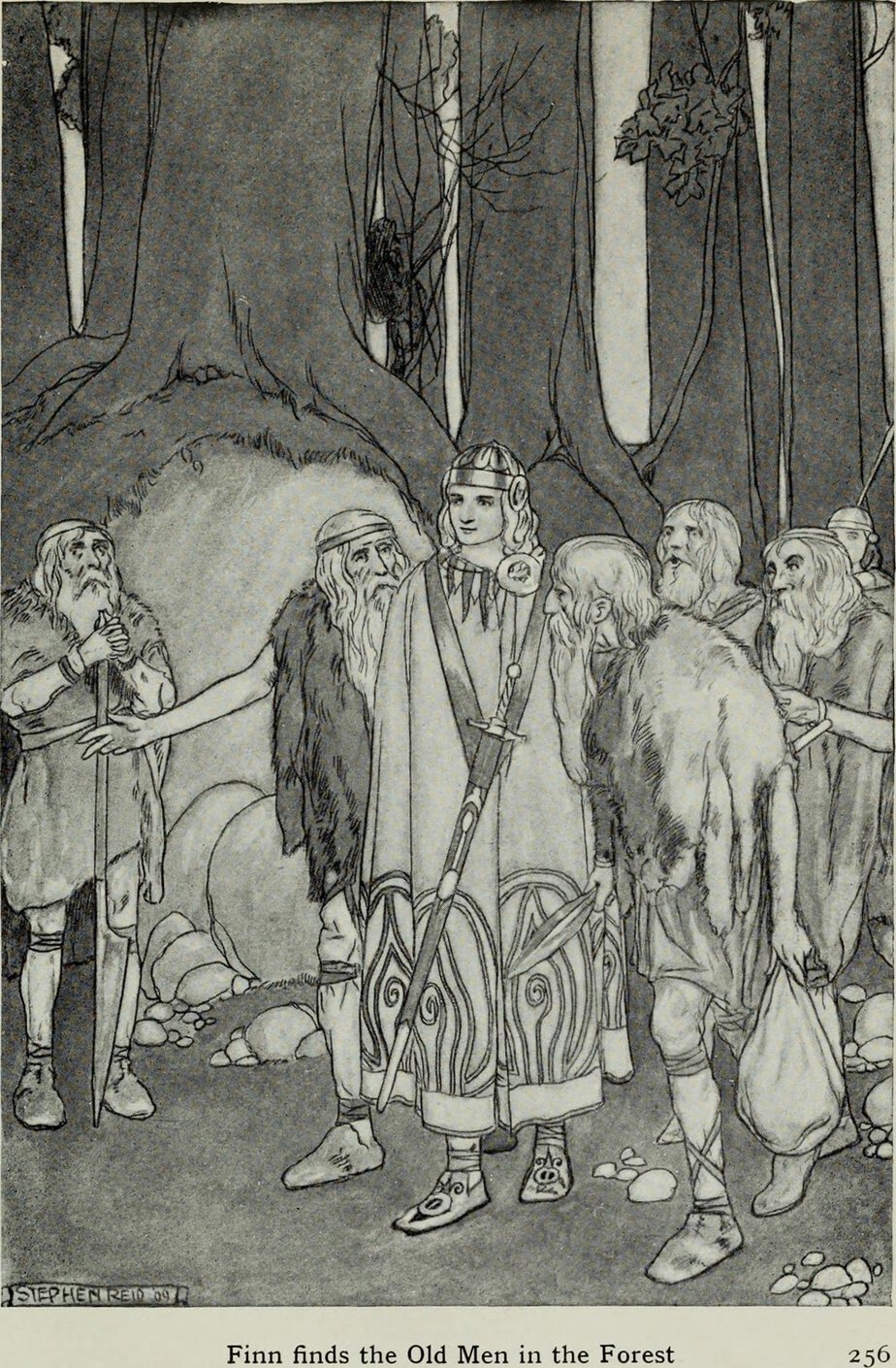
Finn finds the Old Men in the Forest, by Stephen Reid, from T. W. Rolleston, Myths and Legends of the Celtic Race (London, 1911). Public domain, via Wikimedia Commons
Finally he went to study poetry with Finnéces on the Boyne. The text says he dared not stay in Ireland unless he became a poet, for fear of his father’s enemies.
The story of the Salmon of Knowledge
Finnéces (roughly FIN-ay-gas), usually Finnegas or Finegas in English books, means Finn the poet or seer. Éces meant a learned man or poet, and it survives in modern Irish as éigeas (AY-gyus).
For seven years, Finnéces had kept watch over Linn Féic, Féc’s Pool, on the Boyne. A prophecy said that once he ate the salmon of Féc, nothing would be hidden from him.
The burnt thumb
At last the salmon was caught. Finnéces handed it to his new pupil to cook, and forbade him to taste it.
When the boy served it, the poet asked if he had eaten any. No, the boy said. He had only burned his thumb and put it in his mouth.
The poet asked his name. Demne, said the boy. “Finn is thy name, my lad,” the poet replied, in Meyer’s translation. The salmon was the boy’s, the poet said: “verily thou art the Finn.” So he ate it.
Folk versions vary: in one 1930s account from Slane, the burnt finger alone makes the boy wise, and his angry master sends him away.
The three arts of a poet
Fionn then mastered the three skills every poet needed. Meyer tentatively rendered them as illumination of song (teinm laída), knowledge that illuminates (imbas forosna) and extempore incantation (díchetal di chennaib).
To prove his skill, Fionn composed a poem welcoming May. Meyer’s version opens “May-day, season surpassing!”
The thumb of knowledge
From then on, the text says, whenever Fionn put his thumb in his mouth and chanted, whatever he didn’t know was revealed to him.
The thumb is older than this story. Cormac’s Glossary, credited to a king-bishop of Cashel who died in 908, has an anecdote that Meyer dated to the 9th century. Fionn finds a headless body, puts his thumb in his mouth, chants, and knows it is his murdered fool, Lomna.
Sources disagree on how Fionn got the gift:
- The salmon: the Boyne story above, from Macgnímartha Finn.
- A fairy door: a tale Meyer printed from a late medieval law manuscript has Fionn chase Cúldub, a thief who kept stealing the Fianna’s dinner, to the fairy mound of Femen in Co. Tipperary. A woman slams the door on his finger. He sucks it, and inspiration lights him up.
- A tooth: in Acallam na Senórach, written around 1200, Fionn puts his thumb under his dét fis, his tooth of knowledge. The phrase goes back to the 12th-century Book of Leinster.
Why a salmon? Hazelnuts, wells and the Boyne
Macgnímartha Finn never says how the salmon got its wisdom. Other medieval texts fill the gap.
The Dindshenchas, medieval poems explaining place names, say the Boyne rose at Síd Nechtain, where it was called Segais. In one poem, Boann circles the secret well there and three waves burst out and maim her; she flees to the sea, the water chasing her. In another, the well rises and drowns her. Either way, the river took her name. She’s in my guide to the Celtic gods.
The poems on the Shannon add the famous detail. Under the sea lies Connla’s well, and nine hazels drop their nuts into it. The salmon eat the nuts, and the juice forms mystic bubbles that float away down the streams. One poem even calls this wisdom “the magic lore of Segais”, the Boyne’s own source.
Later tellers gave these hazels to Fionn’s salmon. Lady Gregory’s Gods and Fighting Men (1904) says the salmon gave Fionn the wisdom of the hazels. Another Slane boys’ school account, in the Schools’ Collection, has a hazel over a well, forbidden nuts, Boann, and an earthquake that sent the salmon down a stream into Feg’s pool, where Fionn caught it.
Where is Féc’s Pool?
John O’Donovan, quoted by Meyer, placed Linn Féic in a deep stretch of the Boyne near Slane, Co. Meath, whose old name Ferta Fer Féic meant the graves of Féc’s men.
In the Acallam, Fionn’s old comrade Caílte passes Linn Féic on the “bright-streaming Boyne” on his way to meet St Patrick. A few miles downstream lies Brú na Bóinne (broo nuh BOH-nyuh), home of the Newgrange winter solstice.
Fionn and the Fianna
A fían was a roving band of men who hunted and fought, says the Electronic Dictionary of the Irish Language. Fionn led the greatest of them.
The night Fionn saved Tara
The Acallam tells how he won command. Every Samhain (SOW-in), the festival at the root of Halloween, Aillén mac Midgna came out of Sídh Fionnachaidh, the fairy hill that was Lir’s home in the Children of Lir. His music put everyone to sleep, and then he burned Tara, seat of Ireland’s high kings, with a blast of fire from his mouth.
Though only in his tenth year, Fionn kept himself awake by pressing a deadly spearhead to his forehead. He stopped the fire with his cloak, chased Aillén home and killed him. Goll mac Morna, offered the choice of leaving Ireland or serving the son of the man he had killed, put his hand in Fionn’s.
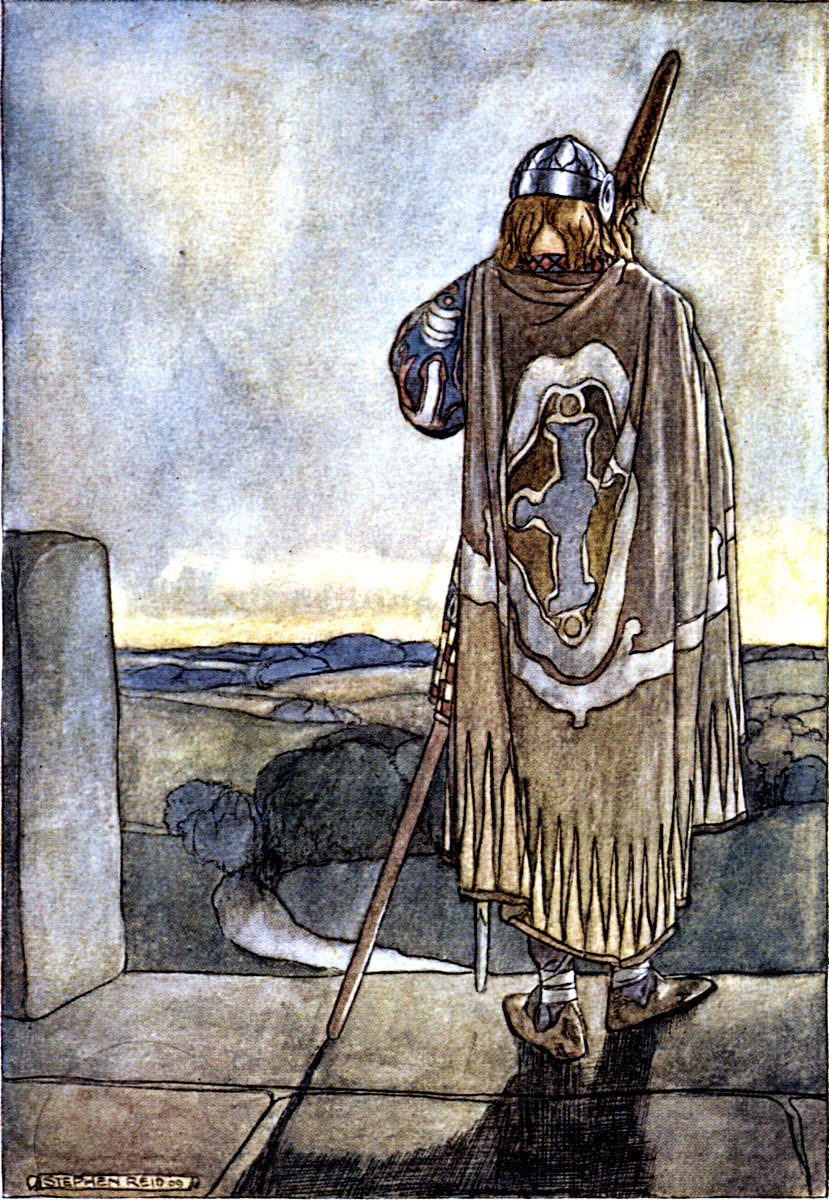
Finn heard far off the first notes of the fairy harp, by Stephen Reid, from T. W. Rolleston, The High Deeds of Finn (1910). Public domain, via Wikimedia Commons
How to join the Fianna
In the 1630s, the historian Geoffrey Keating listed the tests for recruits. A candidate had to:
- become a poet and master twelve books of poetry;
- stand in a pit up past his knees, with just a shield and a stick of hazel, and survive nine warriors’ spears unhurt;
- flee through the woods with the whole Fianna hunting him, without a branch tugging loose one plait of his hair or a dead twig snapping under him;
- pluck a thorn out of his foot mid-sprint.
Fionn’s band included his son Oisín, his grandson Oscar, Diarmuid, Caílte and Goll, plus his hounds Bran and Sceólang.
Fionn in other tales
- Diarmuid and Gráinne: the ageing Fionn’s bride-to-be elopes with Diarmuid, and years later on Ben Bulben Fionn lets him die.
- Oisín in Tír na nÓg (teer nuh NOHG): Niamh (NEEV) of the golden hair takes Fionn’s son to the Land of Youth. He comes home after more than 300 years, touches Irish soil and becomes an old man. The famous version is an 18th-century poem, Laoi Oisín ar Thír na nÓg, plausibly by Micheál Coimín of Co. Clare, says the Dictionary of Irish Biography.
- The Acallam: Caílte, later joined by Oisín, walks Ireland with St Patrick, telling stories of the Fianna. Fenian poems in the same spirit lie behind Austin Clarke’s The Blackbird of Derrycairn.
Ó Dónaill’s dictionary preserves a sad echo: tá sé ina Oisín i ndiaidh na Féinne (taw shay IN-uh UH-sheen ih NEE-uh nuh FAY-nyuh), he’s an Oisín after the Fianna, meaning all his people are gone.
How Fionn died, or didn’t
The Annals of the Four Masters, compiled in the 1630s, put his death in AD 283 at Áth Brea on the Boyne. The Acallam instead places it at the Badger’s Cliff in Luachair Degad, in Munster.
Some folklore says he never died at all. A 1930s Schools’ Collection account from Crummy school, Co. Leitrim, says Fionn and his men lie asleep in a cave on Sheemore until Ireland needs them to win her freedom. A man minding sheep opened the cave’s door and heard snoring, barking hounds and clattering swords, then a voice asking if the time had come yet. He ran.
Finn McCool and the Giant’s Causeway
The medieval Fionn is no giant, though the Acallam’s old Fianna tower over Patrick’s clerics. In the 1630s Keating complained that the Scottish chronicler Hector Boece had made Fionn a giant 15 cubits tall. The old books, Keating insisted, showed he was of ordinary size for his day, and some of his own Fianna were bigger.
The Causeway itself is about 40,000 basalt columns, formed by volcanic activity around 60 million years ago, according to UNESCO. Its giant stories are local folklore, recorded centuries after the medieval Fionn tales were written.
The legend, in more than one version
The best-known version, as the National Trust tells it, has Finn McCool building the causeway to fight a Scottish giant, Benandonner, who tears it up as he flees home.
The Trust also records a different version, which guides at the Causeway were telling visitors in the 1700s and early 1800s, set down in a poem of 1830. In it, Finn builds the causeway to reach a Scottish woman he loves, and his grandmother’s storms keep smashing it. A stooped rock on the Stookans headland is said to be the grandmother, turned to stone.
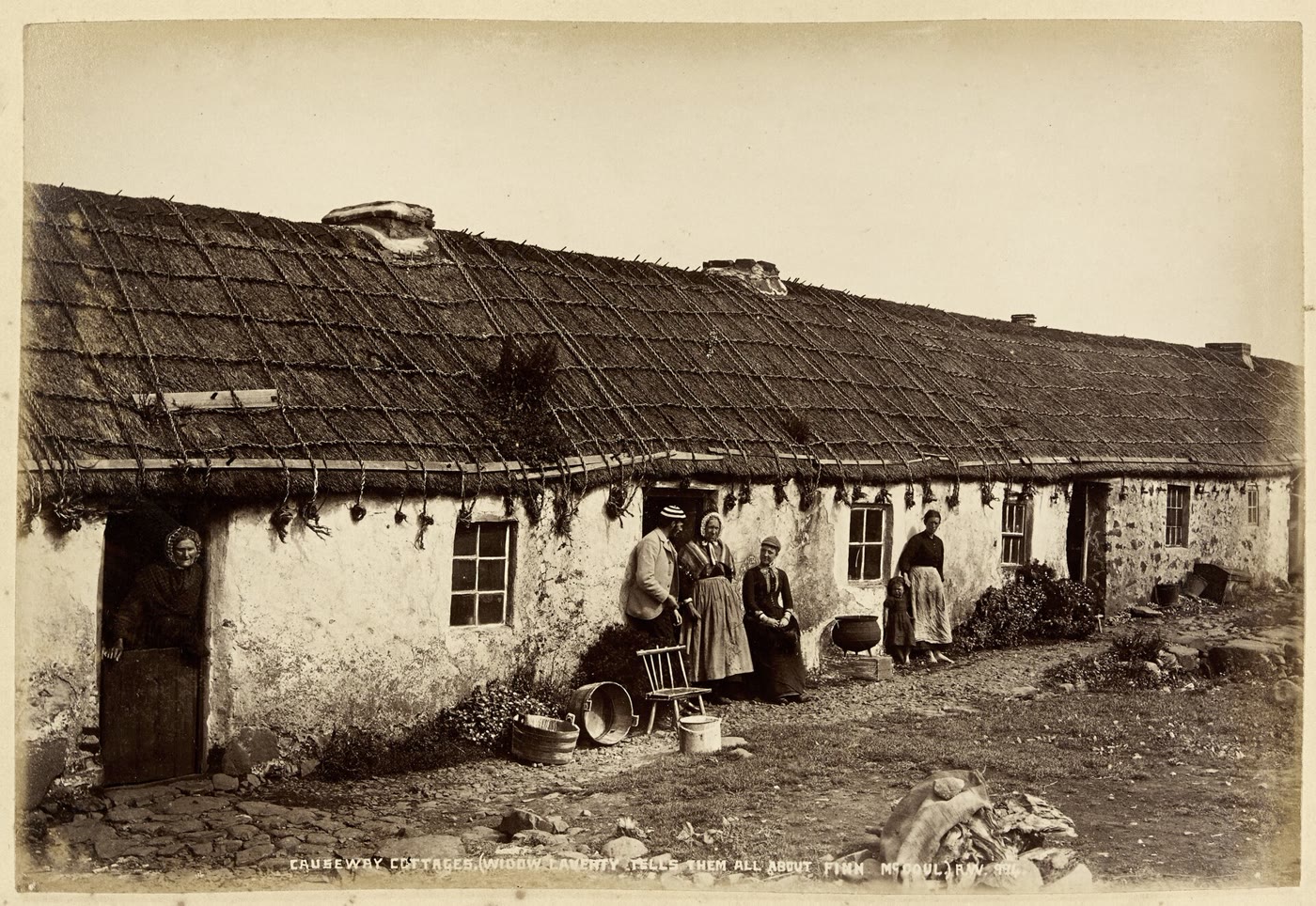
Causeway Cottages (Widow Laverty tells them all about Finn McCoul), photographed by Robert Welch about 1888. Public Record Office of Northern Ireland, via Wikimedia Commons
The famous baby trick is in William Carleton’s “A Legend of Knockmany”, printed in his Tales and Sketches (1845). Fin’s rival there is a giant called Cucullin, a comic Cú Chulainn (koo KHUL-in), though as the folklorist Joseph Jacobs noted, the two heroes supposedly lived two centuries apart. Fin’s wife, Oonagh, bakes iron griddles into the bread and tucks Fin into a cradle as his own baby. Terrified of a father whose baby is this strong, Cucullin then loses the finger that holds all his strength.
And how does Fin know Cucullin is coming? He sucks his thumb. Even in a comic giant tale, the thumb of knowledge survives.
Fingal, the Fenians and Finn McCool abroad
Scotland
Fionn was a Scottish Gaelic hero too. The Book of the Dean of Lismore, compiled in Perthshire between 1512 and 1542, preserves Fenian ballads, says the Digital Archive of Scottish Gaelic.
In 1762, James Macpherson published Fingal, an epic he claimed to have translated from the ancient poet Ossian, that is, Oisín. Samuel Johnson was among the sceptics. Britannica’s verdict: the poems were mostly Macpherson’s own work, though partly built on real Gaelic ballads. Irish scholars were furious that he had claimed Ireland’s heroes for Scotland.
When the naturalist Joseph Banks visited the island of Staffa in 1772, his guide called its great sea cave the cave of Fhinn: Fhinn Mac Coul, Banks wrote, “whom the translator of Ossian’s works has called Fingal”. Fingal’s Cave it became, and its sound later inspired Mendelssohn’s Hebrides Overture, says the National Trust for Scotland.
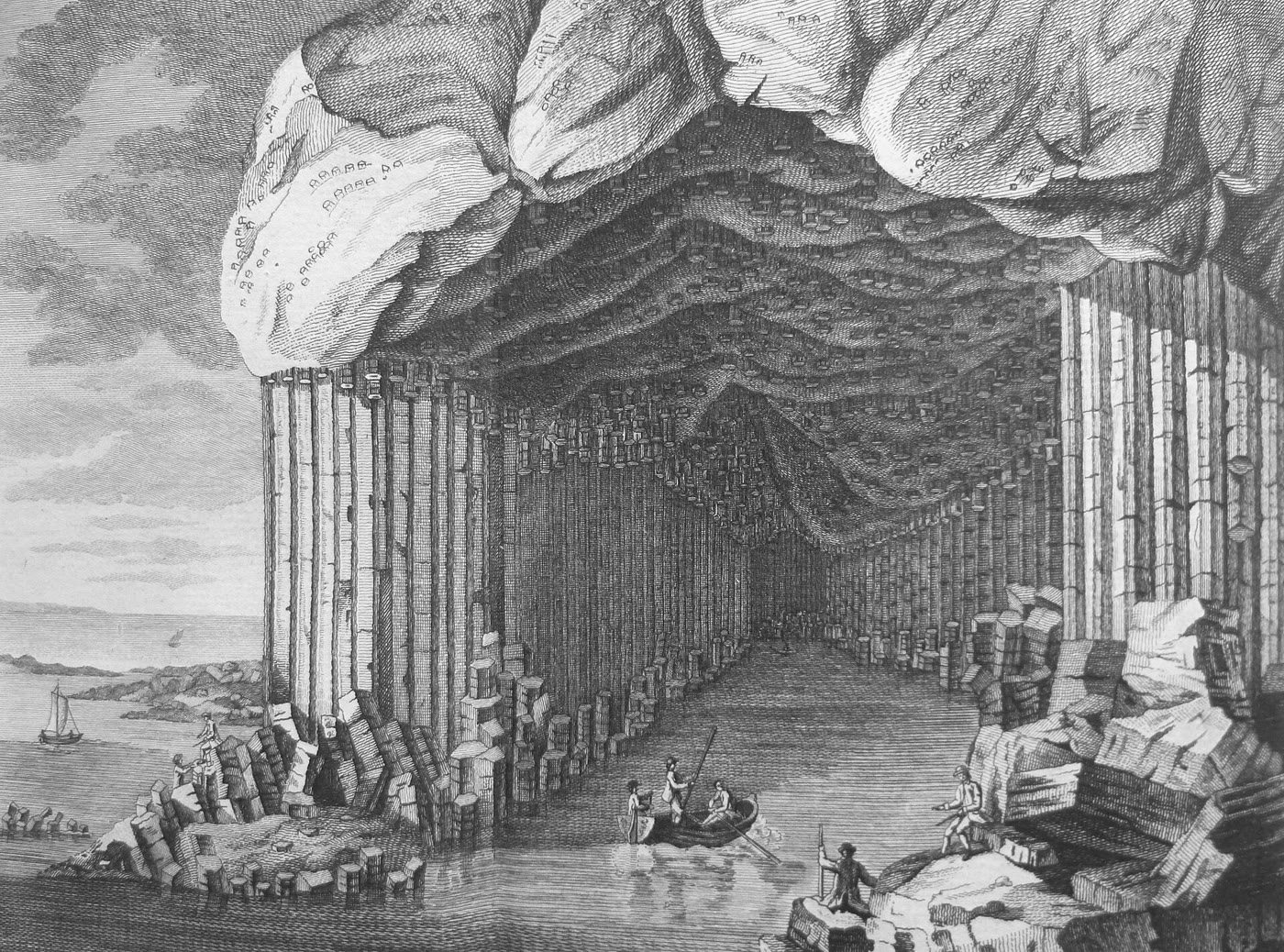
Fingal’s Cave, Staffa, engraved after John Cleveley Jnr for Thomas Pennant, A Tour in Scotland and Voyage to the Hebrides, 1772 (Chester, 1774). Public domain, via Wikimedia Commons
America
John O’Mahony, a Gaelic scholar who published his English translation of Keating’s history in New York in 1857, founded the Fenian Brotherhood in April 1859, naming it after the Fianna, the Dictionary of Irish Biography says. By 1865 it had an estimated 250,000 members, and American Fenians raided British Canada in 1866, 1870 and 1871, Britannica records.
In Ireland, the Fianna’s name lives on in the political party Fianna Fáil (FEE-uh-nuh FAWL).
Salmon of Knowledge FAQ
What is the Salmon of Knowledge?
A magical salmon in the River Boyne that gave all knowledge to whoever ate it. The poet Finnéces waited seven years for it, but young Fionn got the wisdom.
Who ate the Salmon of Knowledge?
Fionn, then called Demne. He got the first taste by accident, through his burnt thumb, and then the poet let him eat the whole fish.
Who was Finnegas?
The poet Finnéces, Fionn’s teacher, whose name means Finn the poet or seer.
Did Finn McCool build the Giant’s Causeway?
No. The columns are volcanic basalt about 60 million years old, and the giant Finn McCool belongs to later folklore, not the medieval tales.
Was Fionn mac Cumhaill a real person?
Probably not. Medieval writers set him in the 3rd century, serving Cormac mac Airt, but many scholars think he began as a god who was later turned into a human hero.
Love this? Save it to your Pinterest board for later.
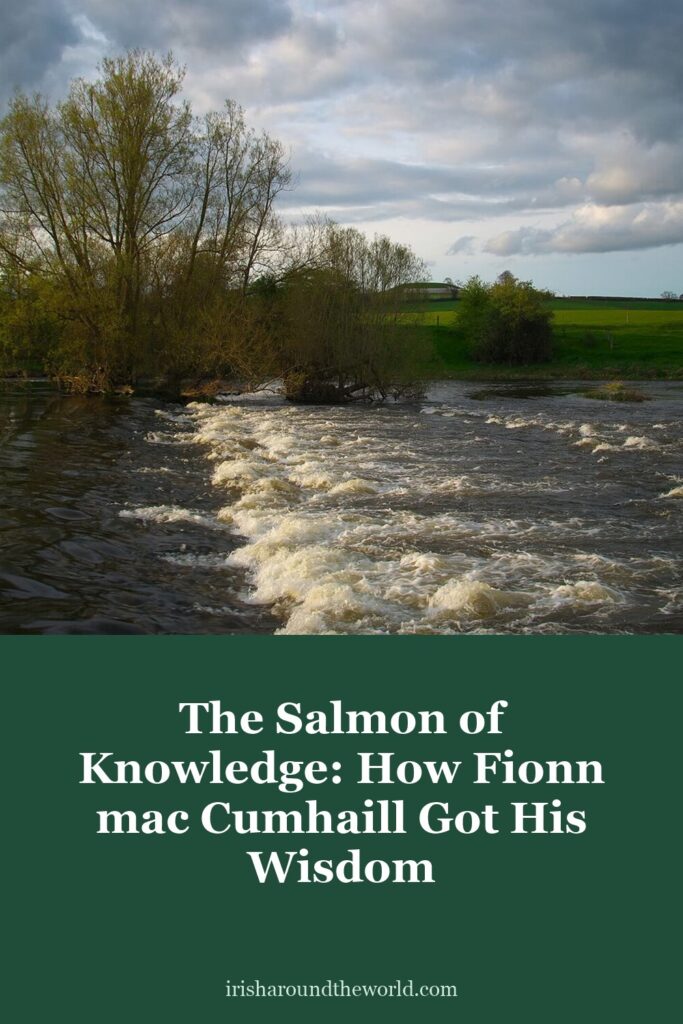
Pin image: the River Boyne near Brú na Bóinne. Photo: Rob Hurson, CC BY-SA 4.0, via Wikimedia Commons.
A little bit of Ireland in your inbox every Friday ☘️
The free Weekly Dose of Irish: an Irish joke, a Celtic symbol, an Irish fact, a poem and the week’s best articles in one short email. Join 9,600+ readers.
Free. One short email every Friday. Unsubscribe any time.
More Irish mythology
- Diarmuid and Gráinne: Ireland’s Great Runaway Love Story
- The Children of Lir: The Irish Legend of Four Swans and 900 Years
- Celtic Gods and Goddesses: 15 Irish Deities and Their Stories
- How to Pronounce Irish Boy Names: Tadhg, Oisín, Eoghan and More
- How the Irish Invented Halloween
Featured image: the River Boyne near Brú na Bóinne, Co. Meath. Photo: Rob Hurson, CC BY-SA 4.0, via Wikimedia Commons.