
Irish Halloween games were mostly about love, luck and death. On Oíche Shamhna, families played snap apple and ducked for apples, set two named nuts on the fire to see if a couple would stay together, and reached out blindfolded for saucers holding a ring, water or clay. Girls ate an apple at the mirror at midnight, hoping to glimpse a future husband. Schoolchildren all over Ireland wrote down their local versions for the Schools’ Collection in 1937 to 1939, and several are still great fun to play.
It’s Halloween night in a country kitchen. Two sticks tied in a cross hang from the rafters, spinning. There’s an apple on one end, a bar of soap on another and a lit candle on a third. Your hands are tied behind your back. Off you go.
That was snap apple, and it was only the start. Later came the nuts on the fire, the saucers and, for the brave, the mirror at midnight.
The folklorist Kevin Danaher, in The Year in Ireland (1972), counted Halloween and May Day as the two great ritual days of the Irish year. I’ve told the bigger story in how the Irish invented Halloween. This is the deep dive on the games: how each worked, where it was recorded, and which ones you can still play.
Jump to:
- Snap Apple Night: the party Maclise painted
- How snap apple and apple ducking worked
- Burning the nuts: will the couple stay together?
- The blindfold and the saucers
- Egg whites, lead and shapes in water
- The apple and the mirror at midnight
- The wet shirt by the fire
- Hemp seed, lime kilns and other dares
- Guising, vizards and mischief night
- Lucky and unlucky: the rules of the night
- Charms in the brack and the colcannon
- How to play Irish Halloween games today
- Irish Halloween games FAQ
Snap Apple Night: the party Maclise painted
In parts of Munster, Halloween simply was Snap Apple Night. Pupils in Emly, Co. Tipperary, and Dromore, near Bantry in Co. Cork, used the name in the late 1930s.
The most famous picture of an Irish Halloween came from such a night. In late October 1832 the young Cork painter Daniel Maclise and the folklore collector Thomas Crofton Croker were guests at the yearly Halloween party of Father Matthew Horgan, Blarney’s antiquarian parish priest.
Maclise’s biographer W. J. O’Driscoll, writing in 1871, says the party mixed well-off guests with the poorest families of the parish, and that Maclise sketched every group in the barn. Back in London he worked fast, and by 1833 Snap-Apple Night was on show at the Royal Academy.
The whole night is there: a lad and a girl snapping at apples on hanging cross-sticks, a boy at a tub, dancers, a crowd by the fire. Strickland’s Dictionary of Irish Artists (1913) says the faces include Croker, Father Horgan, Sir Walter Scott and Maclise’s own sisters. O’Driscoll printed a little verse with his description that mentions melting lead, card reading and a couple “in nuts their true love burning”. The painting is in a private collection.
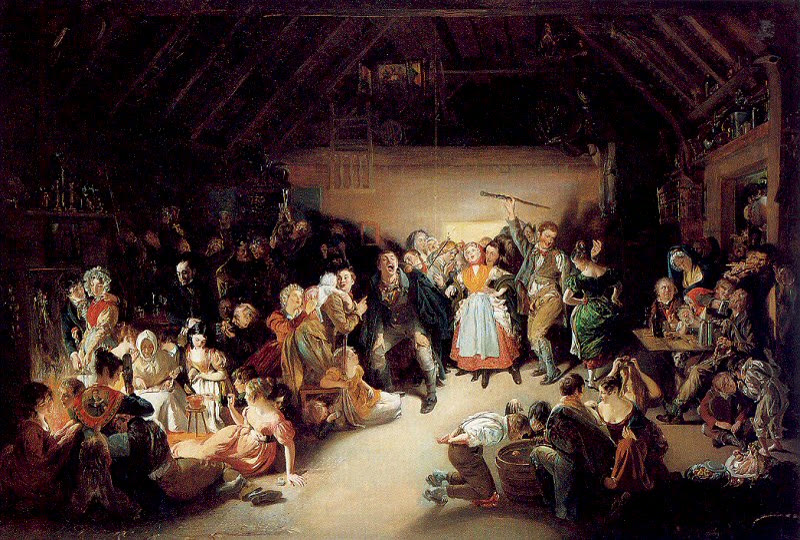
Snap-Apple Night by Daniel Maclise, shown at the Royal Academy in 1833, painted after a Halloween party in Blarney in 1832. Public domain, via Wikimedia Commons
How snap apple and apple ducking worked
One of the earliest detailed accounts comes from the antiquarian Charles Vallancey, in Collectanea de Rebus Hibernicis (1783). On Oíche Shamhna (EE-ha HOW-na), he wrote, people dipped for apples in a tub. They also hung up a cord with a cross-stick, apples at one end and lit candles at the other, set it turning and tried to catch an apple in their mouths.
Vallancey called it all the “remains of Druidism”, a theory he offered no evidence for, but his list of what people actually did is gold.
A century and a half later the game had barely changed. In Mooncoin, Co. Kilkenny, a pupil described crossed sticks hung from the ceiling, carrying two apples, a burning candle and some soap. Hands were tied behind backs, and a bad snap could land you the soap or the candle.
Ducking was the wet version: apples bobbing in a tub, hands behind your back, teeth only. In Clones, Co. Monaghan, whoever lifted a sixpence out of the tub with their teeth kept it.
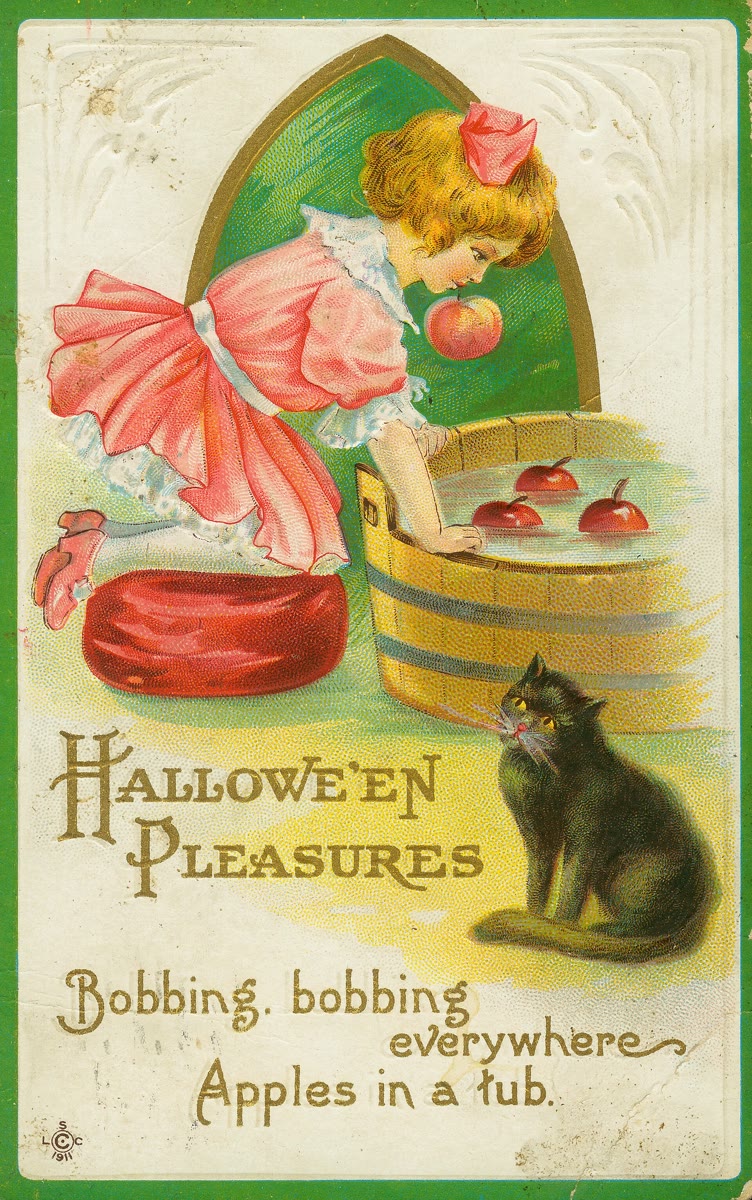
“Hallowe’en Pleasures”, an American postcard of 1911. Missouri Historical Society. Public domain, via Wikimedia Commons
Burning the nuts: will the couple stay together?
This was the courting couple’s game, and the rules were much the same from Cork to Donegal. Two nuts, often hazelnuts (cnó coill in Irish; cnó sounds roughly like “knoh”, or “kroh” in Connacht and Ulster), were named for a lad and a girl and put by the fire. Then everyone watched.
- Rahan, Co. Cork: if the roasted nuts jumped into the fire together, the pair would marry; if they jumped opposite ways, they wouldn’t.
- Tynagh, Co. Galway: leaping together meant a wedding; one leaping after the other meant a parting.
- St Johnstown, Co. Donegal: nuts drifting apart meant separate roads in life, and guests slept with the ashes under their pillows.
- Creeslough, Co. Donegal: a fast burn meant true love, sizzling meant quarrels. The pupil called Halloween Nut-crack Night.
The Creeslough pupil even quoted a couplet from John Gay’s English poem The Shepherd’s Week (1714), where a girl throws “two hazel-nuts” into the flame. Emly used beans instead: black for the man, brown for the woman.
Scotland had the same charm. In the notes to his poem Halloween (1786), Robert Burns says a couple’s nuts either burn quietly together or start apart.
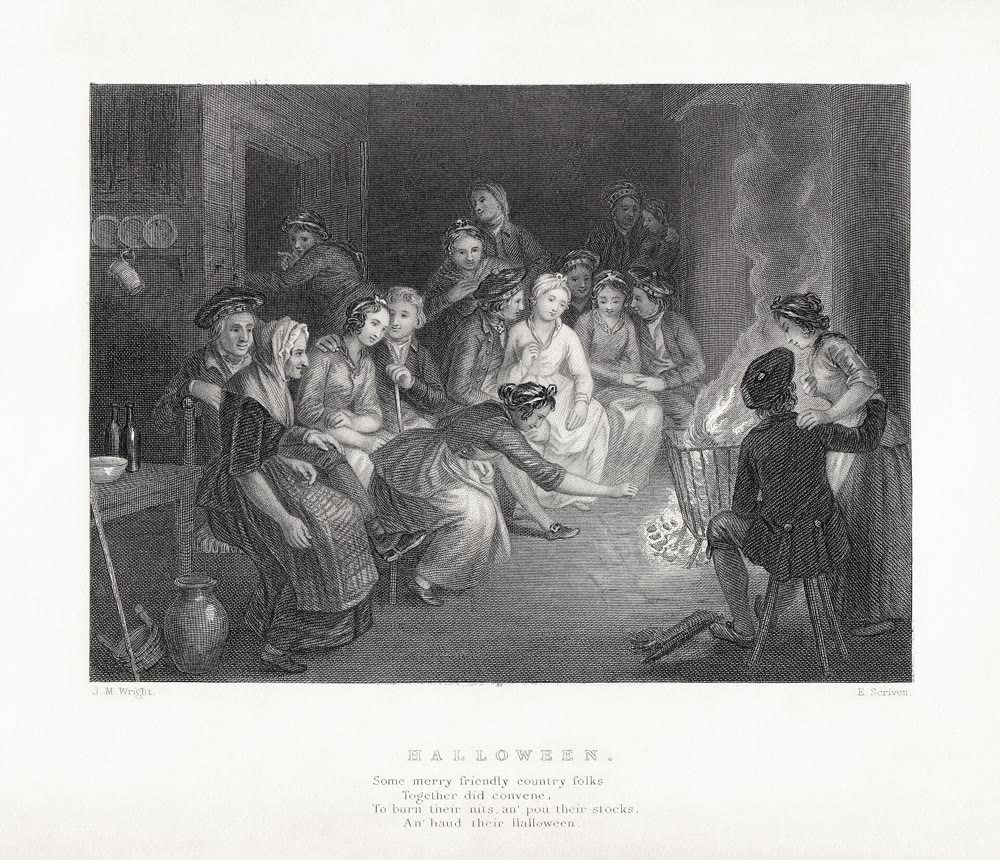
Illustration to Robert Burns’s poem Halloween, drawn by J. M. Wright and engraved by Edward Scriven, about 1841; restoration by Adam Cuerden. Public domain, via Wikimedia Commons
The blindfold and the saucers
Set out saucers, blindfold a player, spin them and let them reach. The Irish for a blindfold or mask is púicín (POO-keen).
In Kilnaleck, Co. Cavan, an 85-year-old man gave a pupil the classic three: water meant crossing the sea, the ring marriage, and clay death before next Halloween. Then come the local twists:
- Ballybunion, Co. Kerry: rosary beads instead of clay. Touch them and you’d be a priest.
- Dromore, Co. Cork: a saucer of wine meant you’d stay at home.
- Rahan, Co. Cork: two cups, sand and water. Sand meant death within the year.
- Clones, Co. Monaghan: six saucers. Earth meant death, water a voyage, nuts a journey over land, the ring a wedding, a thimble hard times and pennies money.
Water nearly always meant going over the sea, which in emigrant Ireland wasn’t entirely a game.
Egg whites, lead and shapes in water
A boy in Ballybunion described the egg test: a hen’s egg white in a glass of water, covered with a plate overnight. If by morning the white had settled into the shape of a ship, you’d cross the water. In Ballinamore, Co. Leitrim, an egg yolk in a bucket of water was meant to show your future spouse’s face.
The riskier version poured melted lead through the wards of a big door key into cold water. In Cloonyquin, Co. Roscommon, the shapes gave a future partner’s initials. In Inchinaneave, Co. Cork, according to a National Folklore Collection blog post, they showed a future husband’s trade. Don’t try it: molten lead is toxic and burns badly.
The apple and the mirror at midnight
This one was for the brave, with an úll (ool), an apple, and a scáthán (SKAW-hawn), a mirror. Women around Clones gave the fullest instructions. Bring a single candle into a pitch-dark bedroom after eleven. Sit at the mirror and eat the apple while you comb your hair, never taking your eyes off the glass. The face of the person you’ll marry should appear behind you.
Details shifted by parish. In Curraghsallagh, Co. Roscommon, girls held the apple between their teeth. In Corrower, Co. Mayo, you ate half the apple facing the mirror and half with your back to it; when you turned round, the face in the glass belonged to your future spouse instead of you.
The English painter John Collier caught the spell in All Hallowe’en (1895): a girl at a candlelit glass, an apple on the table beside her.
It made people nervous. In Burns’s poem a grandmother warns that many who tried it got a fright and were never right again, and the National Folklore Collection finds the same warning in Irish accounts.
A gentler apple game was the peel. In Kiltimagh, Co. Mayo, you peeled an apple in one unbroken strip and threw it over your left shoulder. The letter it made was your future partner’s initial.
The wet shirt by the fire
Vallancey recorded this one too: young women hung a smock before the fire and hid in a corner all night, expecting their future husband’s apparition to slip down the chimney and turn it.
The best Irish account is a ghost story from Ballintra, Co. Donegal, written down in the late 1930s and told as true.
John McCafferty swore the custom was nonsense and set out to prove it. After sunset he scrubbed his shirt in a south-running stream, wrung it out in the devil’s name, draped it over a chair by the fire, and lay awake in the kitchen bed.
At midnight exactly, the likeness of Mary Campbell, the girl he was courting, walked in and reached for the shirt. Before she could turn it, a strange young girl, maybe thirteen, her hair hanging down, shoved Mary aside and turned it herself. Both vanished, and John screamed the house awake.
He married Mary Campbell, but she died and left him a widower. Years later a matchmaker suggested a bride, and John knew her at once: the girl who had turned his shirt. They married. Her brother, the local seanchaí (SHAN-a-khee), or storyteller, remembered a Halloween years before when she fainted during the games and stayed out cold for nearly an hour.
John later told the writer he wouldn’t recommend it to any Christian alive, and that it cured him of Halloween tricks for good.
Hemp seed, lime kilns and other dares
The scariest charms happened outdoors, in the dark, often in the devil’s name. Vallancey describes young women sowing hemp seed, believing that if they looked back they’d see the ghostly figure of the man they’d marry. Burns gives the rhyme as “Hemp-seed, I saw thee” (saw meaning sow).
In Tara Hill, Co. Wexford, girls once sowed flax seed with a similar chant. A woman who was 93 in 1938 said her mother had taken part. One year the girls swapped the true love in the rhyme for the devil and, the story goes, were mowed all the way back to their own door.
- The lime kiln: in Carricknahorna, Co. Donegal, a girl threw a ball of yarn into a lonely lime kiln, kept hold of the end, and called out to ask who was holding it. Her future husband was supposed to answer.
- Raking the rick: in St Johnstown, you raked round a haystack three times at midnight, and your future partner would take the rake. One servant girl swore it was the man of the house. About four months later his wife died, and within a year of that he married the servant.
Guising, vizards and mischief night
Indoors was for fortune-telling. Outdoors belonged to the lads. The food historian Regina Sexton, in History Ireland, notes that girls leaned towards divination while young men went in for mischief, music and collecting.
In Tara Hill they called it vizarding, after the vizard, or mask. Boys and men dressed in odd clothes, hid their hair and carried a stick so nobody could pull off their disguise, then danced or sang at houses where they knew they’d be welcome. In Garryhill, Co. Carlow, disguised young men were paid in nuts and apples, and sometimes hot pennies were thrown down for them to scrabble after. Masks were homemade: the one below, cut from a flour bag, came from Co. Wicklow.
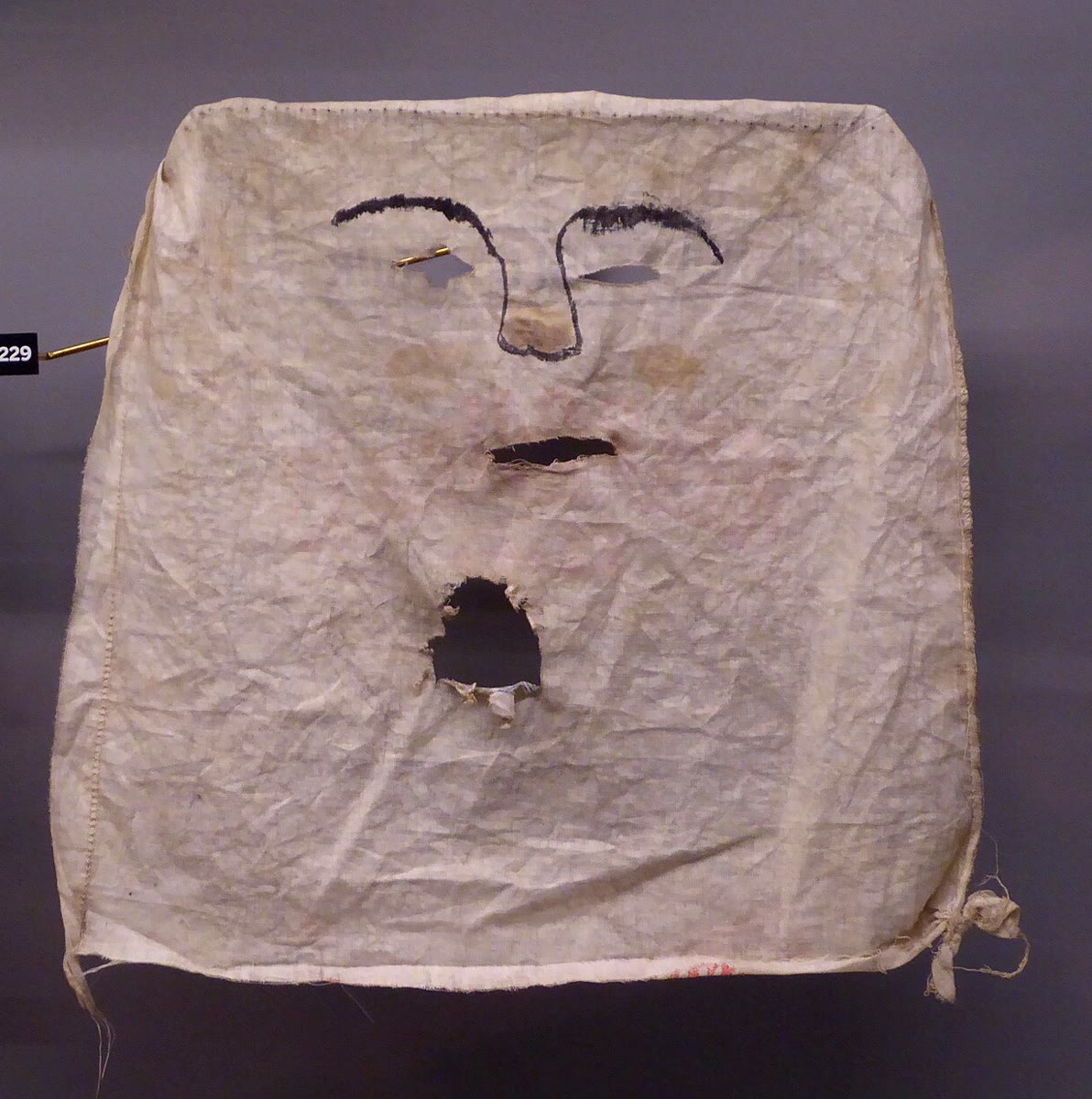
Halloween mask made from a 14 lb flour bag, Co. Wicklow, first half of the 20th century, Horniman Museum, London (21.11.56/25). Photo (cropped): Ethan Doyle White, CC BY-SA 4.0, via Wikimedia Commons
The pranks were seriously ambitious:
- Corravacan, Co. Monaghan: boys tied a door shut from outside, then banged on it with a turnip. Others climbed up and stuffed chimneys with sacks, so the smoke poured back into the house.
- Moville, Co. Donegal: a hollowed cabbage stalk stuffed with hot coals, poked under a door, convinced a family their house was on fire.
- Cloontagh, Co. Longford: lads thumped every door with stolen cabbages. Nobody complained, because it was Halloween.
For the words of the night, see Happy Halloween in Irish.
Lucky and unlucky: the rules of the night
Don’t be out late. In Durrow, Co. Laois, pupils said the fairies of Munster and Connacht played a hurling match that night and might carry off a living person to referee. The fairies were moving house too: see fairy forts and fairy trees.
Feed the dead. In Cannistown, Co. Meath, you swept the floor and left colcannon and water out for the holy souls. Pupils from different families told their teacher the same thing: by morning the water was gone, leaving a single grain of sand.
Read the omens. In Ullinagh, Co. Monaghan, a thimbleful of salt was turned out on a plate for each person; if your heap had collapsed by morning, you’d die before next Halloween. In Ballaghnagearn, in the same county, a marked ivy leaf left in water overnight foretold death if it came out black or bruised.
Mind the blackberries and the cat. After Halloween the púca spoiled the blackberries. And in Ballinamore, if you put the cat out and she came back dry, cattle would be cheap next year; wet, and they’d be dear.
Charms in the brack and the colcannon
The cake tokens varied as much as the saucers. In Emly a medal meant a religious life; in Dromore the stick meant you’d beat your spouse. Sexton lists a dozen tokens, including a thimble for marrying a tailor and a sloe for death. Bake your own with my barmbrack recipe.
Colcannon, cál ceannann (roughly kawl KYAN-un), is potatoes mashed with kale or cabbage, and some districts called Halloween Colcannon Night. In 1937 the cookery writer Florence Irwin said that whatever potato dish an Ulster house made that night, a paper-wrapped wedding ring went into it.
How to play Irish Halloween games today
Several still make a brilliant family night. Just leave out the lead and the devil.
- Snap apple: hang apples on short strings from a door frame or a broom handle across two chairs. Hands behind backs, no candles or soap, and supervise small children.
- Apple ducking: a wide basin of shallow water, and never leave small children alone with it. Fresh water or a bowl each keeps it hygienic. Older children can dive for a coin, Clones style.
- The saucers: water, soil and a ring, plus a coin or a sweet. For little ones, soil can mean a garden full of flowers.
- The apple peel: an adult peels one long strip, the player throws it over the left shoulder, and everyone argues about the letter.
- The egg white: raw egg white in a glass of cold water, covered with a saucer, checked for ships in the morning. Pour it away and wash hands.
- Burning the nuts: adults only, in a guarded fireplace with everyone well back, because hot nuts can crack and spit. Skip it if anyone has a nut allergy.
- The mirror: fun for older kids at a sleepover. Use a torch, not a candle, and don’t push a nervous child.
- The brack ring: wrap it in baking paper, tell everyone it’s there, and cut small children’s slices yourself.
Between rounds, try my Irish Halloween jokes.
Irish Halloween games FAQ
What games did the Irish play on Halloween?
Snap apple, apple ducking, burning nuts in pairs, the blindfold saucers, apple-peel and mirror charms, and tokens in the brack or colcannon. Most foretold marriage, travel, wealth or death.
What is Snap Apple Night?
An old Halloween name in parts of Munster, after the game of biting an apple hung on a spinning stick or string, with your hands behind your back.
What did the blindfold saucers mean?
Usually water meant crossing the sea, a ring marriage and clay death within the year. Local versions added beads for the priesthood, wine for staying home and coins for wealth.
Love this? Save it to your Pinterest board for later.
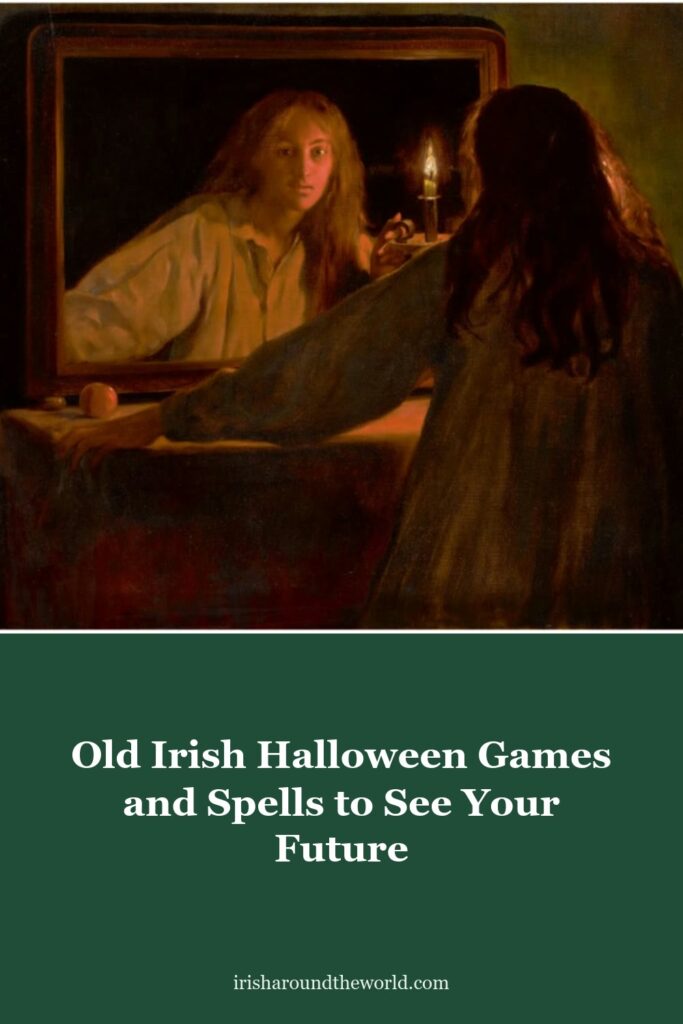
Pin image: All Hallowe’en (1895) by John Collier. Public domain, via Wikimedia Commons.
A little bit of Ireland in your inbox every Friday ☘️
The free Weekly Dose of Irish: an Irish joke, a Celtic symbol, an Irish fact, a poem and the week’s best articles in one short email. Join 9,600+ readers.
Free. One short email every Friday. Unsubscribe any time.
More Irish Halloween reading
- Samhain: The Night the Fairy Mounds Opened and How It Became Halloween
- Stingy Jack: The Irishman Who Tricked the Devil and Gave the Jack-o’-Lantern Its Name
- Bram Stoker: The Bedridden Dublin Boy Who Grew Up to Write Dracula
- Colcannon Recipe: The Irish Halloween Mash That Hides Your Fortune
- How the Irish Invented Halloween: Samhain, Turnip Lanterns, Barmbrack and the Best Festivals in Ireland
- Barmbrack Recipe: The Irish Halloween Bread That Predicts Your Future
- The Púca: Ireland’s Shape-Shifter and Why You Never Eat Blackberries After Halloween
- Fairy Forts and Fairy Trees: The Irish Places You Never Disturb
- Irish Mythological Creatures: 23 Fairies, Monsters and Death Omens to Know
- Happy Halloween in Irish: Oíche Shamhna Shona (Plus 35 Spooky Irish Words)
Featured image: All Hallowe’en (1895) by John Collier, showing the old Halloween charm of looking for a future spouse in the mirror by candlelight. Public domain, via Wikimedia Commons.