
An Irish funeral blessing can be a prayer, a short verse or a few words in Irish. The best known, “May the road rise to meet you”, is an anonymous farewell verse (the earliest printing found so far dates from 1945), built on a real Irish wish for a good journey. The classic Irish words for the dead are Ar dheis Dé go raibh a anam, “may his soul be at God’s right hand” (a hanam for a woman). And to the family, you say “I’m sorry for your trouble”.
If you’re reading this because someone you love has died, I’m sorry for your trouble. That’s what people say at an Irish wake, and nobody has found better words yet.
When you have to choose a reading or fill a sympathy card, it helps to have the right words to hand. Here are the blessings, prayers and Irish phrases used at Irish funerals, with what they mean, how to say them and where each one really comes from. Plenty of verses sold as “old Irish blessings” are neither old nor Irish. Some of the loveliest really are.
Jump to:
- Why “May the road rise” is read at funerals
- Other blessings and prayers, and where they come from
- Irish prayers for the dead, with pronunciation
- Getting the Irish right: him, her and them
- How to say “sorry for your trouble” in Irish
- What to write in an Irish sympathy card
- Short Irish poems for a funeral reading
- The wake, the month’s mind and the anniversary Mass
- Irish funeral blessing FAQ
- More to read
Why “May the road rise to meet you” is read at funerals
This is probably the best-known Irish blessing of all, and it is often printed on memorial cards, usually in this six-line form. No author has ever been traced.
May the road rise up to meet you.
May the wind be always at your back.
May the sun shine warm upon your face,
and the rains fall soft upon your fields.
And until we meet again,
may God hold you in the palm of His hand.
Its first line really is Irish. Go n-éirí an bóthar leat (guh NYE-ree un BOH-har lat) wishes you a good journey, and schoolchildren recorded it as a farewell in the 1930s. The English verse is younger: the earliest we have found so far is from St Patrick’s Day 1945, when Paul E. Fitzpatrick, the New York State Democratic chairman, closed a speech broadcast coast to coast on the Mutual radio network with “this simple, very old-fashioned Irish prayer”. He didn’t claim it as his own, and its author is still unknown. Senator Robert F. Wagner had the speech printed in the appendix to the Congressional Record on 22 March 1945, a year before the printing the quotation researcher Barry Popik found in a Pittsburgh newspaper on St Patrick’s Day, 17 March 1946. Both versions had only the road, the wind and God’s hand; the sun and rain lines came later.
So why a travelling blessing at a funeral? Because it was always a blessing for someone leaving. Beside a coffin, the journey becomes the last one, “until we meet again” becomes a hope of meeting in the next life, and the final line hands the person over to God.
The full story is in my guide to May the road rise up to meet you.
Other blessings and prayers, and where they come from
Eternal rest, the prayer for the dead
The Catholic prayer for the dead is short enough to know by heart:
Eternal rest grant unto him, O Lord,
and let perpetual light shine upon him.
May he rest in peace. Amen.
Change “him” to “her” or “them” as needed. It isn’t Irish in origin: it’s a traditional English translation of the Latin Requiem aeternam, the opening words of the old Mass for the dead, which the Catholic Encyclopedia (1911) traces to a passage in 4 Esdras, a book outside the Bible.
It was prayed in Irish too. In the 1930s, a pupil at Srón school in Co. Kerry wrote down a “Rosary of the Dead”, a folk prayer with no known author, for the Schools’ Collection. The reciter asked: Suaimhneas síoraí tabhair dóibh, a Thiarna (SOO-iv-nyus SHEER-ee TOOR DOH-iv, uh HEER-nuh), “eternal rest give them, O Lord”. A second person answered, beginning Go soilsí orthu an solas síoraí (guh SIL-shee OR-hoo un SUL-us SHEER-ee), “may the eternal light shine on them”. They went back and forth ten times. (The spellings here are modernised.)
Deep peace of the running wave
You’ll often see this printed as “a Gaelic blessing” or “a Celtic blessing”:
Deep peace of the running wave to you.
Deep peace of the flowing air to you.
Deep peace of the quiet earth to you.
Deep peace of the sleeping stones to you!
It’s beautiful, but it isn’t Irish. The lines come from a longer chant in The Dominion of Dreams (1899) by “Fiona Macleod”, pen name of the Scottish writer William Sharp. In the story, a blind wanderer says it over a man tormented in his dreams, as a charm of healing. Whether Sharp heard it somewhere or made it up, nobody knows. He died in 1905, so the words are out of copyright.
“God rest him”: blessing the dead in conversation
Irish speech often blesses the dead as they are mentioned, just as Irish English does with “my father, God rest him”. Ó Dónaill’s Irish-English dictionary renders “m’athair, trócaire air”, my father, mercy on him, simply as “my late father”.
Verses with no known source
Many rhyming verses labelled “Irish blessing” on funeral websites have no Irish original or early printing that anyone has traced. They can still comfort; just leave “ancient” off the card.
Irish prayers for the dead, with pronunciation
Where English says “rest in peace”, the Irish phrases lean much more on faith: they ask God for mercy, or wish the soul a place at God’s right hand or eternal rest, as Peter Weakliam of Dublin City University explains for RTÉ Brainstorm. Here are six, checked against Ó Dónaill’s dictionary on teanglann.ie, each shown for a man.
- Ar dheis Dé go raibh a anam (er yesh JAY guh rev uh AN-um): may his soul be at God’s right hand. RIP.ie translates it simply as “may he rest in peace”. Add dílis (DEE-lish), faithful or dear, or uasal (OO-uh-sul), noble, for extra warmth: Ar dheis Dé go raibh a anam dílis.
- Suaimhneas síoraí dá anam (SOO-iv-nyus SHEER-ee daw AN-um): eternal rest to his soul.
- Go ndéana Dia trócaire ar a anam (guh NAY-nuh JEE-uh TROH-kar-uh er uh AN-um): may God have mercy on his soul. Ó Dónaill gives the plural, Go ndéana Dia trócaire orthu, as “God rest their souls”.
- Beannacht Dé lena anam (BAN-ukht JAY LEN-uh AN-um): God’s blessing with his soul. Ó Dónaill translates it “God rest his soul”.
- Ar shlí na fírinne (er hlee nuh FEER-in-yuh): on the way of truth. Tá siad ar shlí na fírinne, says Ó Dónaill, means “they are gone to their eternal reward”. It’s a gentle way to say someone has died.
- Ní bheidh a leithéid arís ann (nee VEH uh leh-HAYJ uh-REESH awn; in Munster, nee VEG): we won’t see his like again, and the words are the same for a woman. Tomás Ó Criomhthain ended his Blasket memoir An tOileánach (1929) with a version of it (see my Great Blasket Island story).
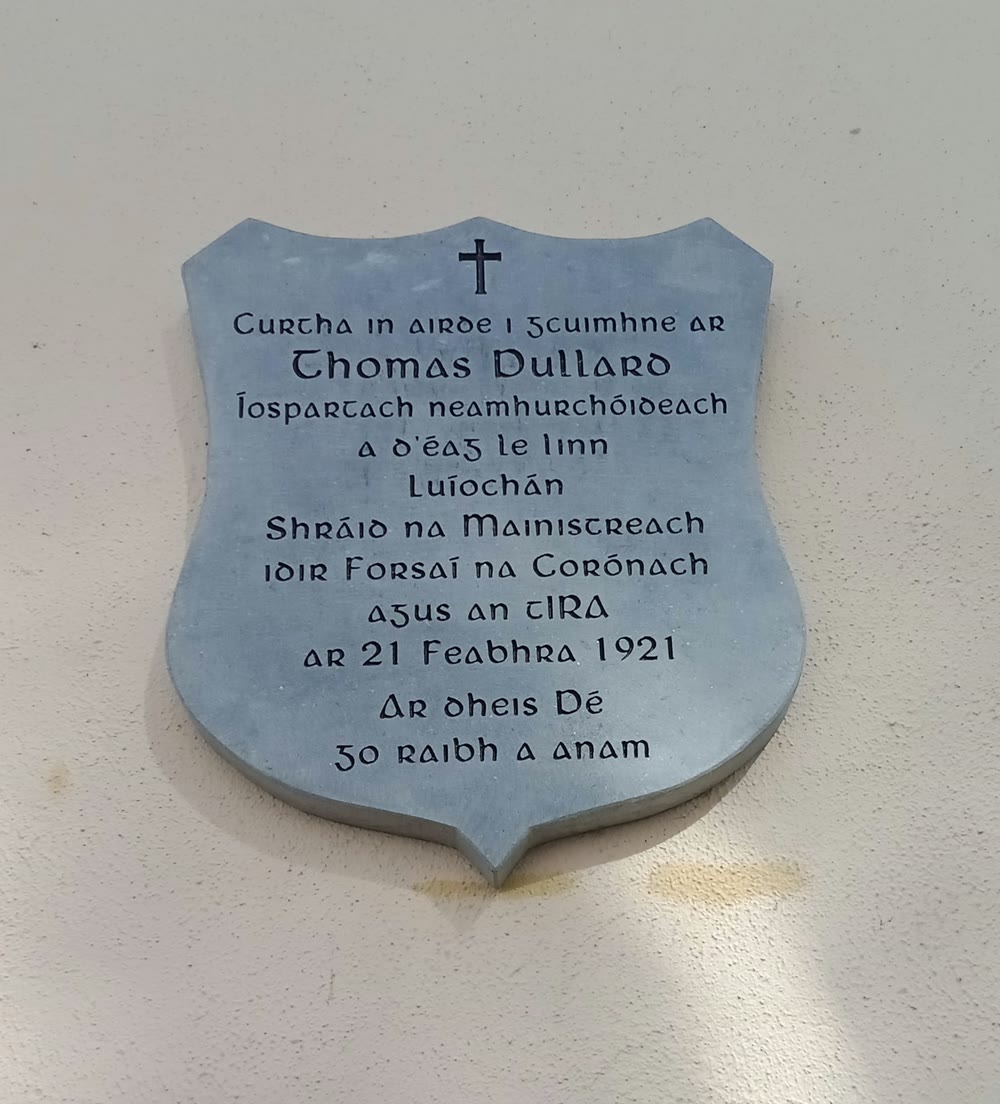
Memorial plaque to Thomas Dullard in Kilkenny city. Photo: A.-K. D., CC BY-SA 4.0, via Wikimedia Commons
You’ll see the words carved on headstones and plaques, like this Kilkenny city memorial to Thomas Dullard, an innocent victim of an ambush in February 1921.
Getting the Irish right: him, her and them
The little word a means “his”, “her” or “their”, and you can only tell which by what it does to the next word. Anam (soul) starts with a vowel, so it changes like this, as RIP.ie’s Irish condolences guide also shows:
- His soul: Ar dheis Dé go raibh a anam (uh AN-um).
- Her soul: Ar dheis Dé go raibh a hanam (uh HAN-um). The h is added because a means “her”.
- Their souls: Ar dheis Dé go raibh a n-anamacha (uh NAN-um-ukh-uh).
The same rule works in the other phrases: dá anam and dá hanam, ar a anam and ar a hanam, lena anam and lena hanam. In the plural, dílis becomes dílse and uasal becomes uaisle.
Mistakes to watch for, especially on a headstone:
- “a h-anam”: no hyphen. The h joins straight on: a hanam.
- “Ar dhéis” or “Ar dheis De”: deis (right hand) has no fada, but Dé (God) must have one. Without it, de is a different word, meaning “of” or “off”.
- “dá hanam” for a man: it means her soul. Some lists online give one form for both; for a man it’s dá anam.
How to say “sorry for your trouble” in Irish
In Ireland, you shake hands with the family and say “I’m sorry for your trouble”. Seamus Heaney remembered old men saying it to him at his little brother’s wake in Mid-Term Break. For what else to do when you call to the house, see my guide to Irish wake and funeral traditions.
In Irish:
- Ní maith liom do thrioblóid (nee mah lum duh HRIB-lohj; in Munster the stress moves to hrib-LOHJ): literally, “I don’t like your trouble”. Ó Dónaill translates it “I am sorry for your trouble”, said to a bereaved person. Ní maith liom do bhris (duh VRISH) uses bris, a loss, instead.
- Tá mé buartha faoi do thrioblóid (taw may BOO-ur-huh fwee duh HRIB-lohj; in Munster, faoi sounds more like “fay”): I’m sorry about your trouble. The Foras na Gaeilge dictionary, focloir.ie, gives it along with Is oth liom do bhris (iss UH lum duh VRISH), I regret your loss.
- Tá brón orm faoi do thrioblóid (taw brohn OR-um fwee duh HRIB-lohj): I’m sorry for your trouble. It’s correct Irish, built on the everyday tá brón orm (I’m sorry), but it isn’t the set phrase the dictionaries give.
- Le comhbhrón ó chroí (leh KOH-vrohn oh KHREE; in Munster, leh koh-VROHN): with heartfelt sympathy. Comhbhrón means condolence, and this one is made for cards.
What to write in an Irish sympathy card
Keep it short; a grieving family may read dozens of cards. Say you’re sorry, use the person’s name, add one memory if you have one, and finish with a blessing.
If you open in Irish, A chara (uh KHAR-uh), “friend”, does the job of “Dear”. It’s a chara, never “a cara”: when you speak to someone in Irish, the a in front softens the next letter, so Máire becomes a Mháire (uh WAW-ruh).
Some lines to borrow or adapt:
- “I’m so sorry for your trouble. Ar dheis Dé go raibh a hanam dílis.” (for a woman)
- “Thinking of you all. Your dad was one of a kind: ní bheidh a leithéid arís ann.”
- “Le comhbhrón ó chroí. Suaimhneas síoraí dá anam.” (for a man)
- “We’re here whenever you need us. Ar scáth a chéile a mhaireann na daoine: people live in each other’s shelter.”
That last line is one of the best-loved Irish proverbs (er skaw uh HAY-luh uh WAR-un nuh DEE-nuh; the ch in chéile is soft, like the h in “hue”). Like Ní bheidh a leithéid arís ann, it isn’t religious, so both suit a family who wouldn’t want a prayer. Add the English if the family don’t speak Irish, and double-check a anam or a hanam.
For a Catholic family, a Mass card is a traditional gift: it tells the family that a priest will say Mass for the person who died. A parish or a religious order can arrange one.
Short Irish poems for a funeral reading
These are by Irish poets and out of copyright, so you can print them in an order of service or on a memorial card.
Lament for Thomas MacDonagh, by Francis Ledwidge
Francis Ledwidge, from Slane in Co. Meath, wrote this for his friend the poet Thomas MacDonagh, executed after the Easter Rising in May 1916. Ledwidge, a soldier in the Royal Inniskilling Fusiliers, was killed by a shell near Boezinghe in Belgium on 31 July 1917, and the poem appeared that year in Songs of Peace, says RTÉ’s guide to Ledwidge. The book titles it simply Thomas McDonagh. It suits anyone who loved birds and fields: two verses grieve, and the last one hopes.
He shall not hear the bittern cry
In the wild sky, where he is lain,
Nor voices of the sweeter birds
Above the wailing of the rain.
Nor shall he know when loud March blows
Thro’ slanting snows her fanfare shrill,
Blowing to flame the golden cup
Of many an upset daffodil.
But when the Dark Cow leaves the moor,
And pastures poor with greedy weeds,
Perhaps he’ll hear her low at morn
Lifting her horn in pleasant meads.
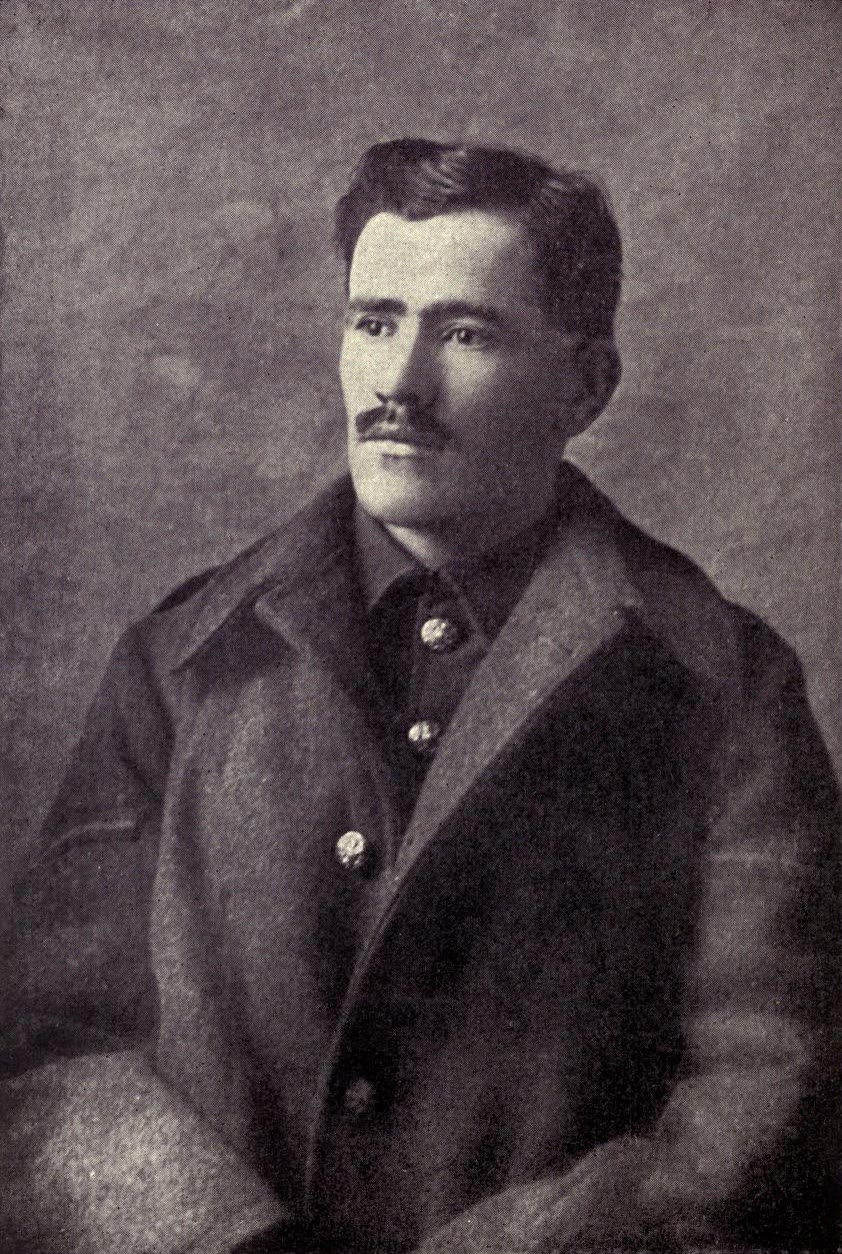
Francis Ledwidge, frontispiece of The Complete Poems of Francis Ledwidge (1919). Public domain, via Wikimedia Commons
More on the poem: Ledwidge’s Lament for Thomas MacDonagh.
Requiescat, by Oscar Wilde
Wilde wrote Requiescat, Latin for “may he or she rest”, for his little sister Isola, who died at Edgeworthstown, Co. Longford, in February 1867, aged nine. When he died in 1900, an envelope of her hair marked “My Isola’s Hair” was found among his things, says the Women’s Museum of Ireland. Her original headstone was lost, and in 2013 the people of Edgeworthstown gave her a new one carved with the poem’s first verse.
First published in his Poems (1881), it’s a lament more than a comfort, best read slowly at the funeral of a girl or young woman.
Tread lightly, she is near
Under the snow,
Speak gently, she can hear
The daisies grow.
All her bright golden hair
Tarnished with rust,
She that was young and fair
Fallen to dust.
Lily-like, white as snow,
She hardly knew
She was a woman, so
Sweetly she grew.
Coffin-board, heavy stone,
Lie on her breast,
I vex my heart alone
She is at rest.
Peace, Peace, she cannot hear
Lyre or sonnet.
All my life’s buried here,
Heap earth upon it.
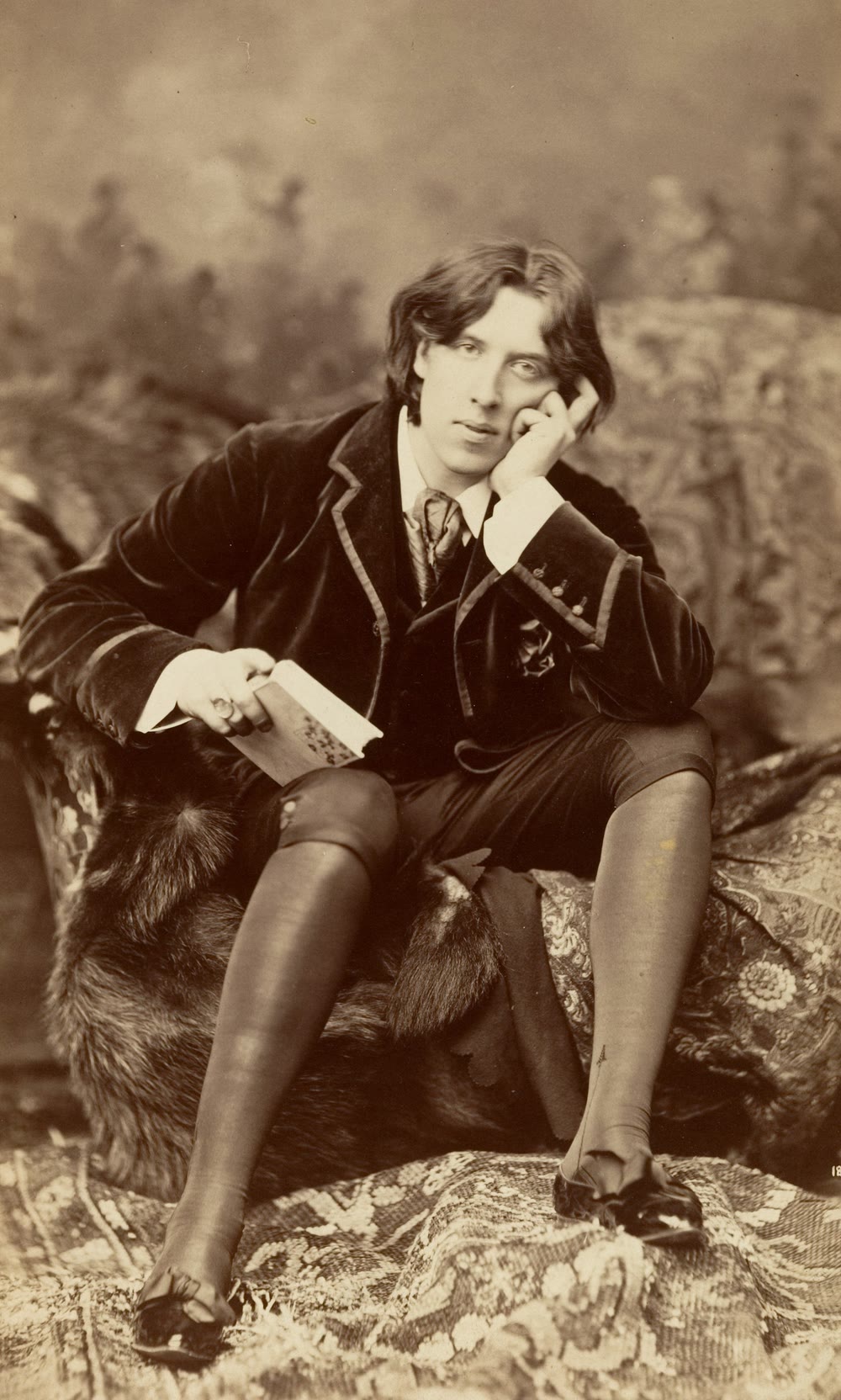
Oscar Wilde, photographed by Napoleon Sarony in 1882. Metropolitan Museum of Art. Public domain, via Wikimedia Commons
The Lake Isle of Innisfree, by W. B. Yeats
For someone who longed for home, or for rest. Yeats recalled in The Trembling of the Veil (1922) that, homesick in London, he heard a little fountain in a Fleet Street shop window, remembered lake water, and the poem followed. Innisfree is a small island in Lough Gill, Co. Sligo. The middle verse works well on its own; here it is as Yeats printed it in his collected Poems (1895):
And I shall have some peace there, for peace comes dropping slow,
Dropping from the veils of the morning to where the cricket sings;
There midnight’s all a glimmer, and noon a purple glow,
And evening full of the linnet’s wings.
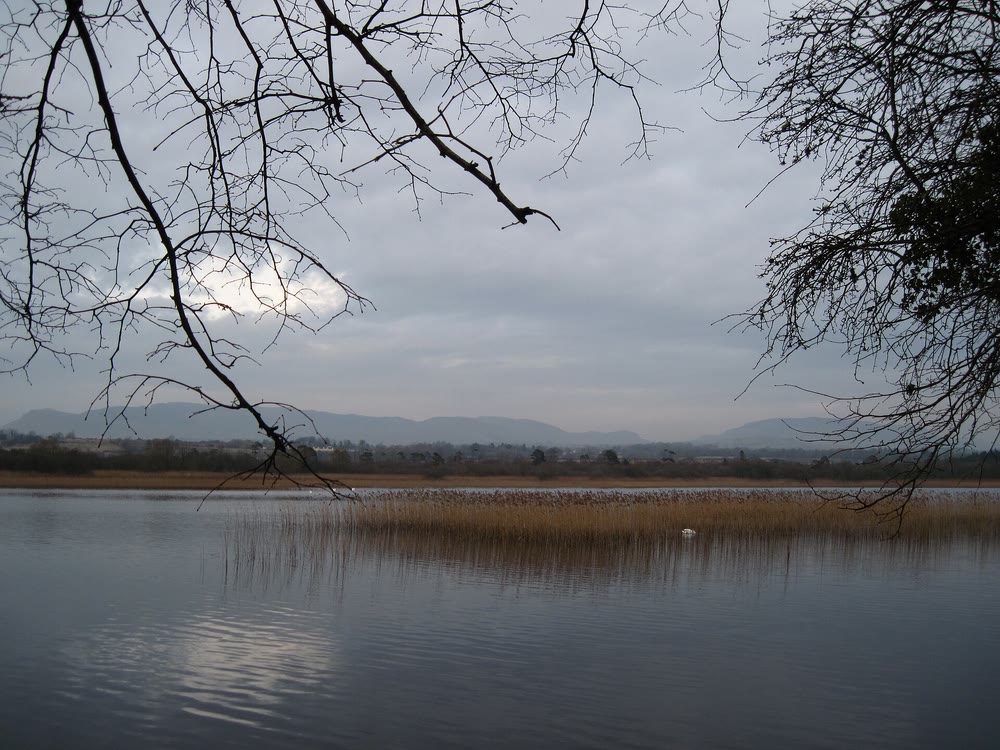
The whole poem is on my page about The Lake Isle of Innisfree.
Other choices
- Joseph Mary Plunkett, I See His Blood Upon the Rose (1911): twelve out-of-copyright lines that find Christ in roses, stars and trees, by the 1916 leader executed after the Rising.
- Seamus Heaney: his poems are in copyright, so don’t print them without permission. At his funeral in 2013, his son Michael told mourners that Heaney’s last words were a text to his wife, Marie, in Latin: Noli timere, “don’t be afraid”.
- John O’Donohue: the Clare-born poet and former priest (1956 to 2008) wrote modern blessings, among them On the Death of the Beloved; his book Benedictus (To Bless the Space Between Us in the US) came out two months before his sudden death. They’re in copyright, so ask permission before printing one; his official website lists his books.
The wake, the month’s mind and the anniversary Mass
These words belong to a longer farewell, told in full in my wake guide. In short:
- The wake: people call to the house or funeral home to pay their respects. Death notices on RIP.ie say where the person is reposing and when the removal to the church will be.
- The funeral: a funeral Mass or service, then burial or cremation. In Davidstown, Co. Wexford, each relative threw a handful of clay into the grave before it was filled in, says a 1930s account in the Schools’ Collection.
- The month’s mind: a Mass held around a month later. The Catholic Encyclopedia describes an ancient custom of special Masses for the dead on the 3rd, 7th and 30th days after a death, and on its anniversary.
- The anniversary Mass: a year on, and often every year after. The Davidstown account calls it a “twelve months’ Memory”.
The old keening, the sung lament over the body, has all but gone; its greatest survivor is Caoineadh Airt Uí Laoghaire, from 1773.
Irish funeral blessing FAQ
What is the best-known Irish funeral blessing?
In English, “May the road rise to meet you”, because its closing hope, “until we meet again”, fits a final goodbye. In Irish, Ar dheis Dé go raibh a anam, may his soul be at God’s right hand.
How do you say “rest in peace” in Irish?
Ar dheis Dé go raibh a anam (er yesh JAY guh rev uh AN-um). Change a anam to a hanam for a woman, or a n-anamacha for two or more people.
What do you say to the family at an Irish funeral?
“I’m sorry for your trouble.” In Irish, Ní maith liom do thrioblóid (nee mah lum duh HRIB-lohj).
Is “Death is nothing at all” an Irish poem?
No. It comes from a sermon by Henry Scott Holland, an English canon, preached at St Paul’s Cathedral in May 1910 while King Edward VII lay in state.
What is a month’s mind?
A memorial Mass held around a month after a death. Families often announce it on RIP.ie.
Love this? Save it to your Pinterest board for later.
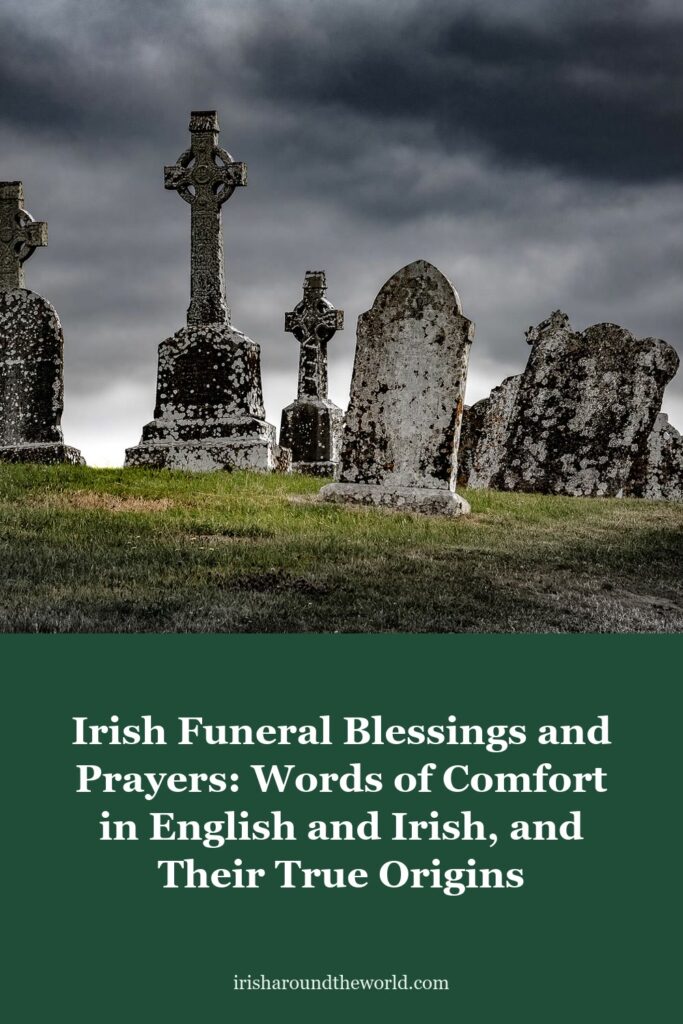
Pin image: Celtic crosses and old headstones at Clonmacnoise, Co. Offaly. Photo: Bernd Thaller, CC BY 2.0, via Wikimedia Commons
A little bit of Ireland in your inbox every Friday ☘️
The free Weekly Dose of Irish: an Irish joke, a Celtic symbol, an Irish fact, a poem and the week’s best articles in one short email. Join 9,600+ readers.
Free. One short email every Friday. Unsubscribe any time.
More to read
- Anam Cara Meaning: the Irish Soul Friend and How to Say It
- May the Road Rise Up to Meet You: Meaning, Full Blessing and Its Surprising Origin
- Irish Wake and Funeral Traditions: Keening, Clay Pipes and What to Say
- Caoineadh Airt Uí Laoghaire: The Greatest Lament in the Irish Language
- Irish Proverbs in Irish: 57 Seanfhocail With Meanings and How to Say Them
- Lament for Thomas MacDonagh by Francis Ledwidge: A Poem for a Fallen 1916 Leader
- Mid-Term Break by Seamus Heaney: The Poem About His Little Brother’s Death
Featured image: Celtic crosses and old headstones at Clonmacnoise, Co. Offaly. Photo: Bernd Thaller, CC BY 2.0, via Wikimedia Commons.