
Michael Collins (1890 to 1922), Mícheál Ó Coileáin in Irish, was the Irish revolutionary leader known as the Big Fellow. A farmer’s son from West Cork, he fought in the GPO in 1916, then ran the Dáil Loan as Minister for Finance and IRA intelligence in the War of Independence. He signed the Anglo-Irish Treaty in December 1921, led the Provisional Government and the National Army in 1922, and was killed in an ambush at Béal na Bláth, Co. Cork, on 22 August 1922, aged 31.
Not the Apollo 11 astronaut who circled the Moon in 1969, and not the Irish whiskey that borrowed the name. When Irish people talk about Michael Collins, they mean a young man from West Cork who was born on 16 October 1890 and never reached his 32nd birthday.
In six years he went from a Welsh internment camp to Minister for Finance, spymaster, Treaty signatory and army commander. Then he was shot dead on a country road in his home county.
Here’s his life. On the Treaty, I’ve stuck to what happened and left the verdict to you.
Jump to:
- Michael Collins, Irish leader: quick facts
- A West Cork childhood
- Nearly ten years in London
- 1916: the GPO, Stafford and Frongoch
- Minister for Finance and the Dáil Loan
- The intelligence war and the Squad
- Bloody Sunday, 21 November 1920
- The Treaty and the “death warrant”
- Kitty Kiernan
- Dublin Castle, the split and civil war
- Béal na Bláth, 22 August 1922
- Who fired the shot? The theories weighed
- Funeral and legacy
- Where to remember him
- Michael Collins FAQ
- More Irish history reading
Michael Collins, Irish leader: quick facts
- Irish name: Mícheál Ó Coileáin (roughly MEE-hawl oh kil-AWN in his own Cork Irish; further north, oh KIL-awn). Online it often loses its fadas, as Micheal O Coileain.
- Born: 16 October 1890 at Woodfield, near Sam’s Cross and Clonakilty, Co. Cork.
- Died: 22 August 1922 at Béal na Bláth, Co. Cork, aged 31.
- Nickname: the Big Fellow, often written the Big Fella.
- Height: a little under six feet, about 1.8 metres, by most accounts.
- Fiancée: Kitty Kiernan of Granard, Co. Longford. They never married.
- Buried: Glasnevin Cemetery, Dublin.
A West Cork childhood
Collins was the youngest of eight children on a farm at Woodfield, about four miles west of Clonakilty. His father, also Michael, was around 75 when his last son was born. He died when the boy was six, and Collins’s mother, Marianne, ran the farm and raised the family.
At Lisavaird National School a teacher, Denis Lyons, inspired him. He also listened to the stories of the blacksmith James Santry, whose grandfather had made pikes for the rebels of 1798, says the Southern Star. Today Clonakilty is just as famous for black pudding, and both turn up in my facts about Cork.
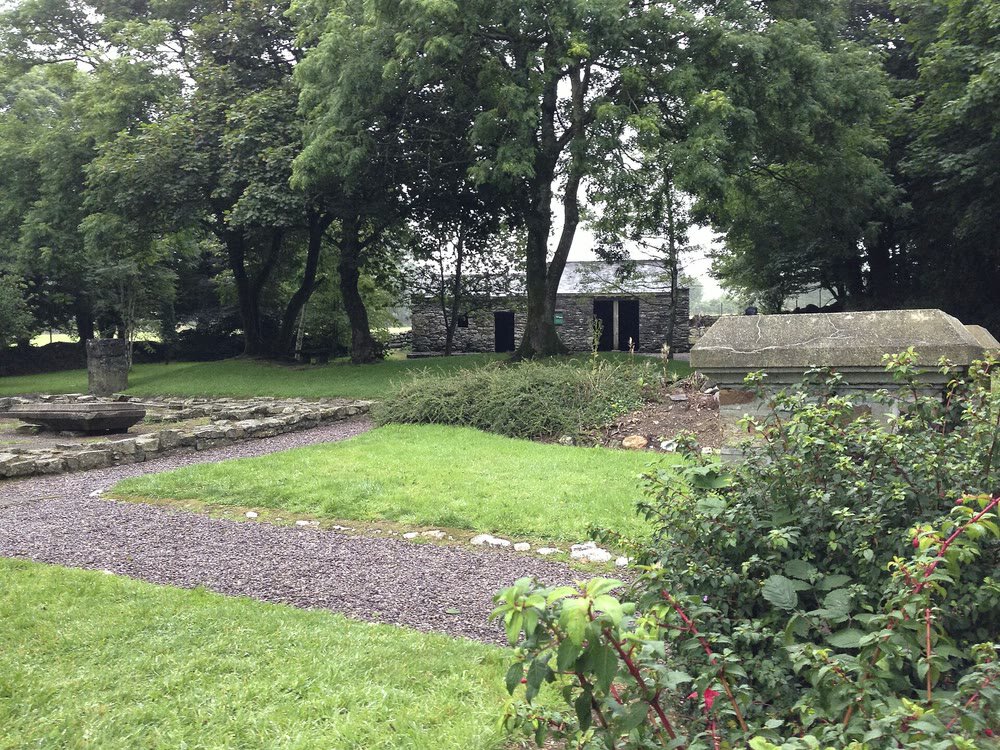
Michael Collins family tree, in brief
- Parents: Michael John Collins (born about 1815) married Marianne O’Brien of Sam’s Cross in 1876.
- Brothers and sisters: Margaret, a teacher; Johnny (Seán), who stayed on at Woodfield; Mary; Hannie, with whom Michael later lived in London; Helena; Patrick; and Katie.
- The family home: soldiers of the Essex Regiment burned the house at Woodfield in April 1921, while Seán and his children lived there.
- Later relatives: Michael had no children; his grandnieces include the former Fine Gael MEP Mary Banotti, who died in 2024, and her sister Nora Owen.
The surname, Ó Coileáin, comes from coileán (KIL-awn; kil-AWN in Munster), a pup or whelp. Father Patrick Woulfe (1923) says the family were driven from Co. Limerick to West Cork in 1178. More in my guide to Irish surnames.
Nearly ten years in London
In 1906, still in his mid-teens, Collins went to London as a boy clerk, working in West Kensington for the Post Office Savings Bank and living with his sister Hannie. Later he worked for Horne and Co., City stockbrokers, then the Board of Trade and the Guaranty Trust Company of New York.
He played hurling for the Geraldines club in Notting Hill and joined the Gaelic League. In November 1909, at Barnsbury Hall in Islington, he took the oath of the Irish Republican Brotherhood (IRB), the secret revolutionary society, says the London Museum. By 1914 he was in the Irish Volunteers too.
In January 1916 he left the Guaranty Trust, telling colleagues he meant to “join up”. He meant Dublin, where the IRB was planning a rising; leaving England also kept him clear of conscription.
1916: the GPO, Stafford and Frongoch
In Dublin, Collins worked as a financial adviser to Count Plunkett. In Easter Week he served in the General Post Office as aide-de-camp to the count’s son, Joseph Mary Plunkett, a signatory of the Proclamation. I’ve told Plunkett’s story in I See His Blood Upon the Rose.
His part in the fighting was small. After the surrender he was shipped to Stafford Gaol and then to an internment camp at Frongoch, in north Wales. My Easter Rising guide covers the week itself.
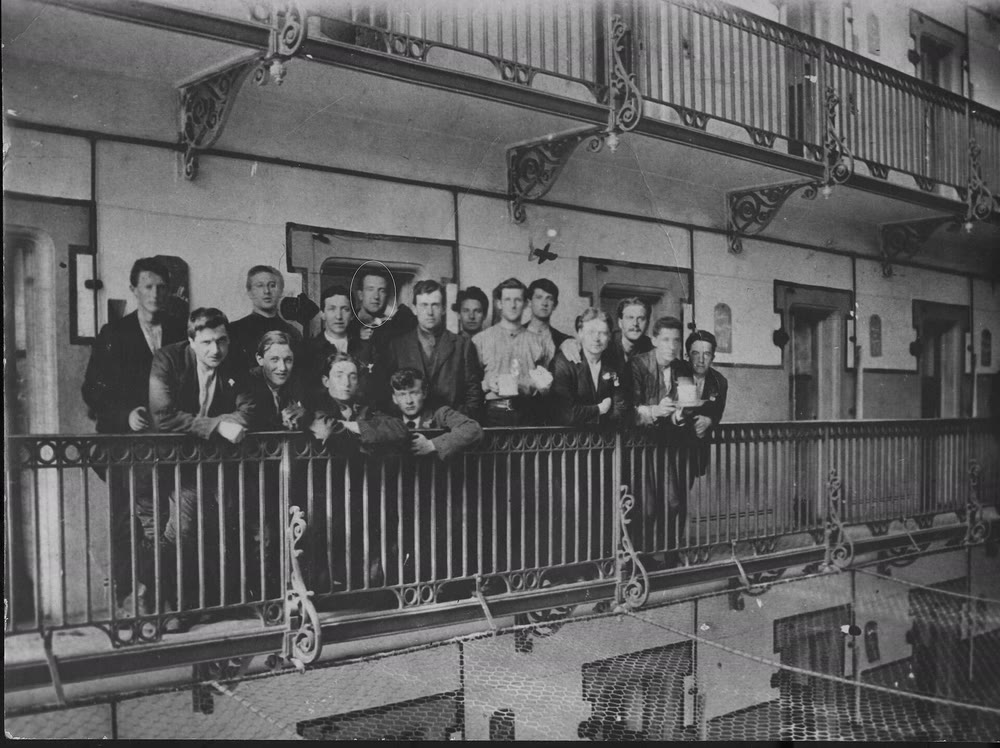
Irish prisoners in Stafford Gaol after the Easter Rising, 1916. Michael Collins is circled, in the back row. Public domain, via Wikimedia Commons
Frongoch made him. He organised Irish classes, Gaelic football and talks on history and military tactics, pushed for better conditions, and came out a leader. He was released at Christmas 1916.
Minister for Finance and the Dáil Loan
In 1917 Kathleen Clarke, widow of the executed Tom Clarke, asked Collins to run the Irish National Aid and Volunteers’ Dependants’ Fund for the families of the dead and imprisoned. The work made him contacts all over Ireland.
In the December 1918 general election, Sinn Féin (shin FAYN, “we ourselves”) won 73 of Ireland’s 105 seats, Collins among them for South Cork. Refusing to sit at Westminster, they met in Dublin as Dáil Éireann (DOYL AIR-un) on 21 January 1919, and on 2 April de Valera named Collins Minister for Finance.
His great task was the Dáil Loan, launched in August 1919. Dublin Castle tried hard to suppress it, but when the internal loan closed on 31 July 1920 it had raised £371,849, well past its £250,000 target, according to Gary Evans’s Maynooth University study.
To sell it, a short film showed Collins and Diarmuid O’Hegarty signing bonds for well-known subscribers, among them Pearse’s mother, outside St Enda’s, the school Pearse had founded. For a table they used the block where Robert Emmet was beheaded in 1803. Harry Boland, who saw it in America, wrote to Collins: “Gee Boy! You are some movie actor.”
The intelligence war and the Squad
Collins was also the IRA’s Director of Intelligence, “the brains of the IRA”, as the National Museum of Ireland puts it. He spent the war mostly at a desk in Dublin rather than in the field, the Irish Examiner notes.
The hardest edge of that work was the Squad, a small full-time unit of gunmen. From 1919 it targeted detectives of the Dublin Metropolitan Police’s G Division, who gathered political intelligence. Its first victim was Detective Sergeant Patrick Smyth, shot in Drumcondra in July 1919.
Republicans saw the G-men as enemy agents in a war; their families and the British authorities saw the killings as murder.
Bloody Sunday, 21 November 1920
Collins sanctioned the plan for Bloody Sunday; the detailed planning was done by the Dublin Brigade’s Dick McKee and Seán Russell. On the morning of Sunday 21 November 1920, IRA men went to eight addresses and shot 19 men, killing 14, says historian Mark Duncan in Century Ireland. The dead were a mix of army officers, recent police recruits and two civilians.
Collins defended that morning’s work, saying there was no crime in destroying, in wartime, “the spy and the informer”. He later accepted that not everyone targeted had been a spy.
That afternoon, Crown forces raided a Dublin against Tipperary football match at Croke Park and opened fire. Fourteen people died, among them the Tipperary full-back Michael Hogan, for whom the Hogan Stand is named.
That night McKee, Peadar Clancy and Conor Clune were killed in Dublin Castle. The authorities said they were shot trying to escape; republicans believed they were tortured and executed.
The Treaty and the “death warrant”
A truce began on 11 July 1921, and on 11 October an Irish delegation walked into 10 Downing Street: Arthur Griffith, Collins, Robert Barton, Éamonn Duggan and George Gavan Duffy, with Erskine Childers as secretary.
On the final night, Lloyd George warned that anyone refusing to sign would be to blame for the war that would follow at once, Barton recorded in his notes. The Irish delegates signed, and Barton timed the end of the conference at 2.20am on 6 December 1921.
The Treaty created the Irish Free State, Saorstát Éireann (SAYR-stawt AIR-un), a dominion like Canada. Members of its parliament would swear an oath that included faithfulness to the King, Britain kept naval facilities at certain ports, and Northern Ireland could opt out, with a Boundary Commission to settle the border.
Did Collins say he had signed his death warrant?
Two versions circulate. In the spoken one, Lord Birkenhead remarked that he might have signed his own political death warrant, and Collins replied that he might have signed his actual one. Barton’s notes record no such exchange; it reaches us through later biographies.
The written one is a letter dated 6 December 1921, attributed to Collins: “early this morning I signed my death warrant.” Historian T. Ryle Dwyer quoted it in 1981. His foreboding is well attested, but the exact words come to us through biographers.
In the Dáil debates that began on 14 December, Collins argued that the Treaty gave not the ultimate freedom but “the freedom to achieve it”. De Valera, the President of the Dáil, led the opposition with Cathal Brugha and Austin Stack. On 7 January 1922 the Dáil approved the Treaty by 64 votes to 57. Three days later Griffith replaced de Valera as President, and the movement split.
Kitty Kiernan
Kitty Kiernan’s family ran the Greville Arms Hotel in Granard, Co. Longford, where Collins lodged during the May 1917 by-election. His close friend Harry Boland courted her too, and proposed in 1921, but she chose Collins.
During the Treaty talks they wrote roughly every second day. On 3 January 1922 Constance Markievicz told the Dáil of a rumour, which she called nonsense, that Collins would marry Princess Mary. He objected that such talk might cause pain “to the lady who is betrothed to me”. They did not announce the engagement formally until March 1922.
In 1925 Kitty married Felix Cronin, then the National Army’s quartermaster general; one of their sons was named Michael Collins Cronin. She died in 1945. Their letters appeared in 1983 as In Great Haste.
Dublin Castle, the split and civil war
On 16 January 1922 Collins led the new Provisional Government into Dublin Castle, where the viceroy, Lord FitzAlan, formally installed them. Legend says that, told he was seven minutes late, he replied that they had waited 700 years. He was in fact far later: the noon handover slipped to 1.45pm. With no press in the room, the exchange can’t be checked.
Collins tried to hold the movement together, agreeing an electoral pact with de Valera on 20 May. But anti-Treaty IRA men held the Four Courts, and after Field Marshal Sir Henry Wilson was shot in London on 22 June and a National Army general was kidnapped, Collins ordered the Four Courts shelled. The guns opened at 4am on 28 June 1922, and the Civil War had begun.
In July he stepped down from Finance to command the National Army. On 12 August Arthur Griffith died suddenly, aged 51; Collins, in uniform, was at his funeral in Glasnevin four days later.
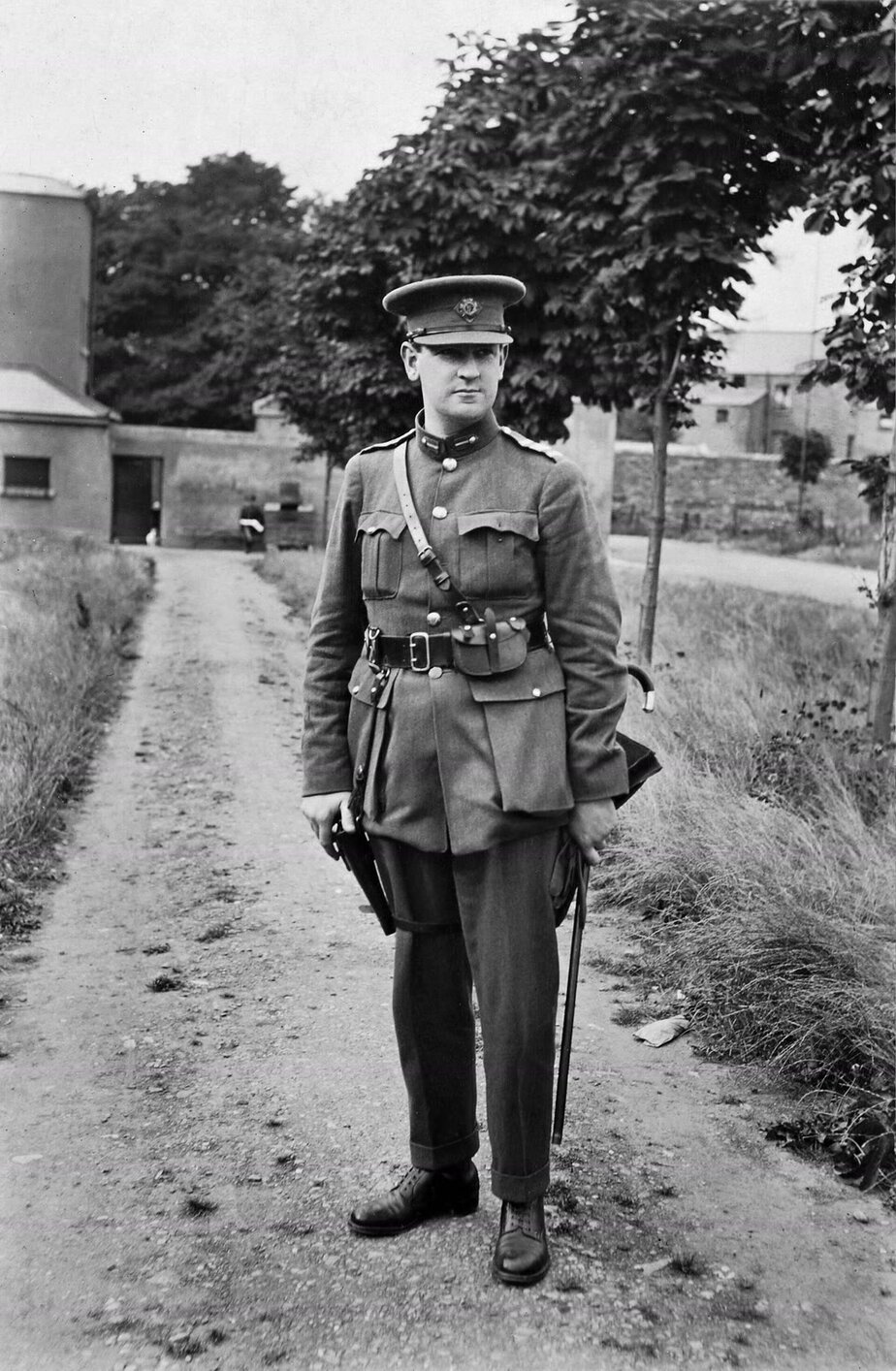
Michael Collins in the uniform of Commander-in-Chief of the National Army, 1922. National Library of Ireland. Public domain, via Wikimedia Commons
Béal na Bláth, 22 August 1922
On 22 August Collins set out early from the Imperial Hotel in Cork to tour West Cork. His convoy was a motorcycle scout, a Crossley tender with soldiers, a yellow Leyland touring car carrying Collins and General Emmet Dalton, and an armoured car called the Slievenamon.
That morning the convoy passed through Béal na Bláth, possibly stopping to ask the way, and Collins was recognised. Anti-Treaty IRA men were gathering nearby for a meeting, and they laid an ambush for his return. He went on to Bandon, Clonakilty, Rosscarbery and Skibbereen, stopping at Sam’s Cross to see family.
By evening most of the ambush party had given up and gone, leaving a handful clearing the road. At about 7.30pm the convoy came back. Dalton ordered the driver on, but Collins had him stop and got out to fight. After about 30 minutes of shooting, he was hit once in the head and died almost at once.
Béal na Bláth (roughly bayl nuh BLAW) is usually explained as the mouth of the flowers, since bláth means blossom. But the official placenames database gives the Irish form as Béal na Blá, with béal meaning a mouth or ford-mouth, and finds no evidence for the flowers; what blá meant is unclear. In English it’s Bealnablath, and you’ll also see Béal na mBláth.
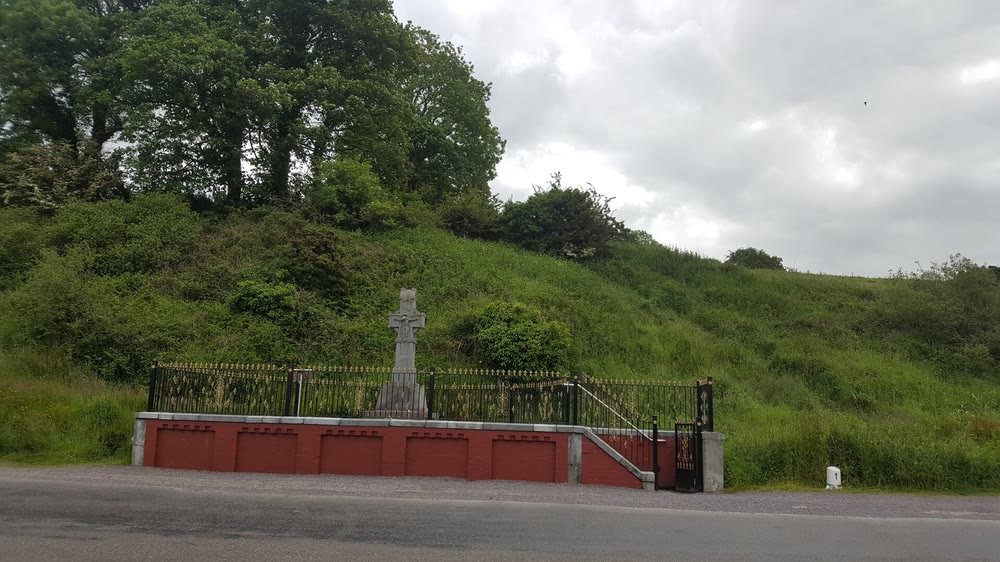
cc-by-sa-4.0; own work by Frabjousone; Wiki Loves Monuments 2019 Ireland; Wikidata Q55045778, Michael Collins Monument, Glannarouge West, Co. Cork; 2048×1152) (CC BY-SA 4.0)
Who fired the shot? The theories weighed
There was no proper post-mortem and no adequate report, notes T. Ryle Dwyer, so a century of argument has filled the gap.
- A stray shot from the ambush party. The general view of historians, a 2019 History Ireland review said: a late shot by a man who didn’t know whom he’d hit, usually named, after Meda Ryan’s research, as Denis “Sonny” O’Neill. An IRA report written two days later, published by historian Brian Hanley in 2010, suggests it happened largely by chance, since most of the ambushers had left.
- A ricochet. The surgeon Oliver St John Gogarty embalmed the body, and in a 1954 autobiography he put the wound down to a ricochet; Eoin Neeson argued the same in 1968. John M. Feehan rejected it in 1981, citing six witnesses who described a small wound in the forehead.
- His own side. Neeson also raised an accidental shot by John McPeak of the armoured car’s crew, who later deserted to the anti-Treaty side with the car. Feehan suggested Dalton killed Collins for the British secret service, but offered no evidence. Hanley says that report points away from Collins’s own men.
- A planned assassination. In The Great Cover-Up (2018), Gerard Murphy argued that an IRB decision marked Collins for death and that many of those involved later lied, though he couldn’t name the gunman. Dwyer was not convinced; the History Ireland reviewer thought it fitted the facts best.
- De Valera. He was in the district that day, and Liam Deasy’s memoir says Deasy told him an ambush was being prepared. Michael Mills, writing in Magill, found no evidence that de Valera lured Collins there or took part in the killing.
In 2022 RTÉ’s documentary Cold Case Collins had a panel chaired by former State Pathologist Marie Cassidy re-examine the evidence. A shot from the ambush party remains the most widely held answer, but nobody can prove who fired it.
Funeral and legacy
His body went back to Cork that night, then by sea to Dublin on the SS Classic. He lay in state in City Hall, where even British soldiers queued to see him, and was buried in Glasnevin on 28 August 1922. RTÉ Archives has photos of the day, when crowds estimated in the hundreds of thousands lined the streets.
The Irish Free State came into being that December. Treaty supporters credit Collins with winning the freedom to achieve freedom; opponents saw the Republic given up. Both views are still held.
Neil Jordan’s 1996 film Michael Collins, with Liam Neeson as Collins and Julia Roberts as Kitty, won the Golden Lion at Venice. It’s in my list of the best Irish movies, and some scenes were filmed at Kilmainham Gaol.
Where to remember him
- Woodfield, Sam’s Cross: the Michael Collins birthplace cottage is a National Monument and an unguided Office of Public Works site. My County Cork guide suggests a night or two around Clonakilty.
- Béal na Bláth: a stone cross marks the ambush site. A commemoration with a guest oration is held there on a Sunday each August.
- National Museum of Ireland, Collins Barracks: the greatcoat he died in, still muddy from Béal na Bláth, is in the Soldiers and Chiefs exhibition.
- Glasnevin Cemetery, Dublin: his grave.
Michael Collins FAQ
How old was Michael Collins when he died?
He was 31, less than two months short of his 32nd birthday.
How tall was Michael Collins?
A little under six feet, or about 1.8 metres, by most accounts.
Why was Michael Collins called the Big Fellow?
Accounts differ. One traces it to Frongoch and a self-assured manner that rubbed some people the wrong way, rather than to his size. Frank O’Connor, who fought on the anti-Treaty side, used it for his 1937 biography, The Big Fellow.
Did Michael Collins have a wife or children?
No. He was engaged to Kitty Kiernan when he died.
Who killed Michael Collins?
An anti-Treaty IRA ambush party at Béal na Bláth. Most historians think a late, stray shot killed him, often attributed to Denis “Sonny” O’Neill, but it has never been proven.
Where is Michael Collins buried?
In Glasnevin Cemetery, Dublin, since 28 August 1922.
Love this? Save it to your Pinterest board for later.
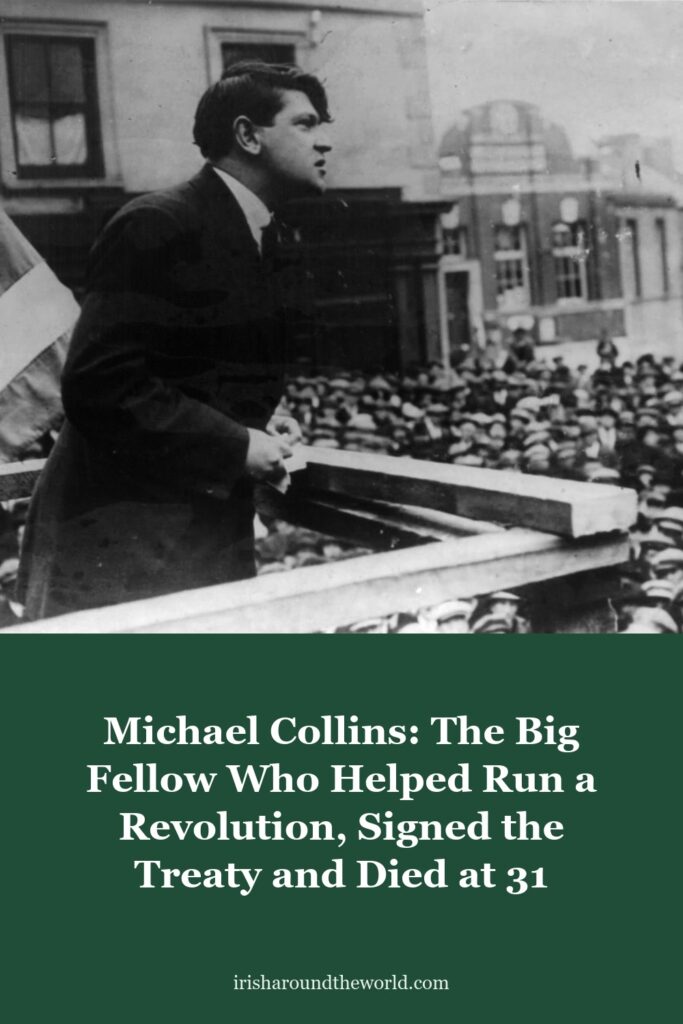
Pin image: Michael Collins addressing a crowd in 1922. Photo: Underwood & Underwood, Library of Congress. Public domain, via Wikimedia Commons
A little bit of Ireland in your inbox every Friday ☘️
The free Weekly Dose of Irish: an Irish joke, a Celtic symbol, an Irish fact, a poem and the week’s best articles in one short email. Join 9,600+ readers.
Free. One short email every Friday. Unsubscribe any time.
More Irish history reading
- The Easter Rising: The 1916 Rebellion That Failed, Then Changed Ireland
- Kilmainham Gaol: Dublin’s Rebel Prison, a Candlelit Wedding and the Stonebreakers’ Yard
- I See His Blood Upon the Rose: Poem, Meaning and Plunkett’s Story
- Facts About Cork, Ireland: Why We Call It the Real Capital
- Irish Surnames: Meanings, Origins and the Top 100 Names in Ireland
- The Best Irish Movies of All Time: Readers’ Top 10 and More to Watch
Featured image: Michael Collins addressing a crowd in 1922, with a tricolour beside him. Photo: Underwood & Underwood, Library of Congress. Public domain, via Wikimedia Commons.