
Irish apple cake is a soft, buttery sponge baked around chunks of sharp Bramley cooking apples, often finished with a crumble, almonds or a crunchy sugar top and served warm with custard, cream or ice cream. This recipe, in metric and US cups, serves 8 to 10 and takes about 1½ hours. In the US, Granny Smiths are the easiest swap for Bramleys, an English apple that has been grown in Co. Armagh, the Orchard County, since 1884.
Those big green cooking apples in Irish kitchens are Bramleys, and their job is the oven. Ask for apple cake in Ireland and you might get a tart, a plate pie or even, in one 1930s account, a cake made with potato. This recipe is the soft modern sponge kind, like Bord Bia’s, with the apples baked right through it. It’s best warm, under custard.
The recipe comes first. After it: why Irish bakers swear by Bramleys, how Armagh became the Orchard County, and the 1930s Halloween suppers where apple cake sat beside the barmbrack.
Jump to:
- Irish apple cake recipe
- Proper custard to pour over it
- Tips, swaps and variations
- Storing and freezing
- Why Irish bakers use Bramley apples
- Armagh, the Orchard County
- Apple cake at Halloween, and older apple lore
- Apple tart vs apple cake vs apple crumble
- Irish apple cake FAQ
- More Irish baking and Halloween reading
Irish apple cake recipe
Prep: 25 minutes | Bake: 50 to 65 minutes | Serves: 8 to 10 | Tin: 23cm (9 inch) springform
Ingredients
For the crumble top
- 60g (½ US cup) plain (all-purpose) flour
- 40g (3 US tbsp) cold butter, diced
- 40g (3 US tbsp) demerara (turbinado) or light brown sugar
For the cake
- 2 large Bramley apples, about 550g (1¼ lb), to give 400g (about 3½ US cups) peeled, cored and chopped apple
- 1 tbsp lemon juice (optional)
- 200g (1⅔ US cups) plain (all-purpose) flour
- 2 tsp baking powder
- 1 tsp ground cinnamon (optional)
- A pinch of salt
- 125g (1 stick plus 1 US tbsp) butter, softened, plus extra for the tin
- 150g (¾ US cup) caster (superfine) or granulated sugar
- 2 large eggs, at room temperature
- 75ml (⅓ US cup) milk
- 1 tsp vanilla extract (optional)
Method
- Heat the oven to 180°C (160°C fan), 350°F, Gas 4. Butter a 23cm (9 inch) springform tin and line the base with baking paper (parchment).
- Make the crumble: rub the butter into the flour with your fingertips until it looks like coarse breadcrumbs, then stir in the sugar. Chill it while you make the cake.
- Peel the apples, core them and cut into chunks of about 1.5cm (½ inch). Toss them with the lemon juice, if using.
- Whisk the flour, baking powder, cinnamon and salt together in a bowl.
- In a large bowl, beat the butter and sugar for 3 to 4 minutes, until pale and fluffy. Beat in the eggs one at a time, adding a spoonful of the flour mix with each, then the vanilla.
- Fold in half the remaining flour mix, then the milk, then the rest of the flour, mixing only until no dry flour shows. Fold in the apples. The batter will be thick.
- Spread it in the tin, level the top and scatter the crumble evenly over it.
- Bake for 50 to 65 minutes, until golden and a skewer pushed into the cake (not a piece of apple) comes out clean. If the top browns too fast, lay a sheet of foil loosely over it for the last 15 minutes.
- Cool in the tin for 15 minutes, then release the sides. Serve warm, with custard, softly whipped cream or vanilla ice cream.
In a deeper 20cm (8 inch) tin, allow 10 to 15 minutes more.
Proper custard to pour over it
Custard powder is fine, but this egg custard takes only 15 minutes and makes about 500ml (2 US cups).
- 300ml (1¼ US cups) whole milk
- 150ml (⅔ US cup) cream: single, double or heavy
- 3 large egg yolks
- 25g (2 US tbsp) caster or granulated sugar
- 1 tsp cornflour (cornstarch)
- 1 tsp vanilla extract
- Heat the milk and cream in a saucepan until steaming, with small bubbles at the edge. Don’t let it boil.
- Whisk the yolks, sugar and cornflour in a heatproof bowl. Pour in the hot milk in a thin stream, whisking all the time.
- Pour it back into the pan and stir over a low heat with a wooden spoon for 5 to 8 minutes, until it coats the back of the spoon and a finger drawn through it leaves a clear line.
- Take it off the heat, stir in the vanilla, and strain it into a warm jug if there are any lumps. The cornflour helps stop it splitting, but keep the heat low.
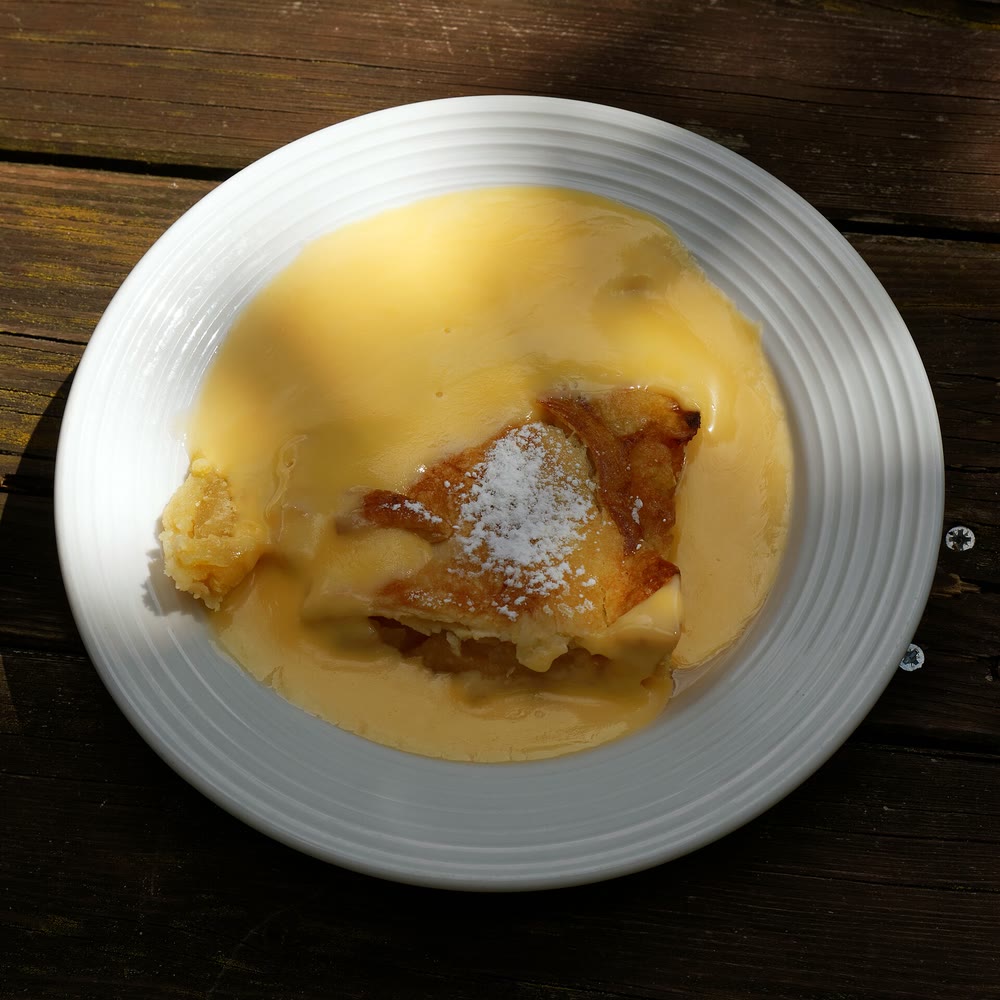
Apple tart with custard, served in a pub garden in Hertfordshire, England. Photo: Acabashi, CC BY-SA 4.0, via Wikimedia Commons
Tips, swaps and variations
Bramleys or Granny Smiths?
Bramleys are ideal, but outside Ireland and Britain they can be hard to find.
In the US, use Granny Smiths. The US Apple Association describes their flavour as very tart, and Penn State Extension lists them among the crisp, firm varieties, so they tend to keep their shape rather than melting. Cut them a little smaller, about 1cm (⅜ inch).
Test the cake, not the apple: a skewer through a soft chunk of Bramley always comes out wet.
Variations
- Apple and blackberry: swap 100g (about ¾ US cup) of the apple for blackberries, folded in last and gently. Frozen ones go in straight from the freezer. Tradition says to pick them before Halloween, for reasons below.
- Almond: Bord Bia’s Bramley apple cake uses almond extract and flaked almonds. Try ½ tsp extract in the batter and a handful of flaked almonds instead of the crumble.
- Sugar top: skip the crumble and scatter 2 tbsp demerara over the batter.
- Gluten-free: swap in the same weight of a gluten-free plain flour blend with xanthan gum, and use gluten-free baking powder.
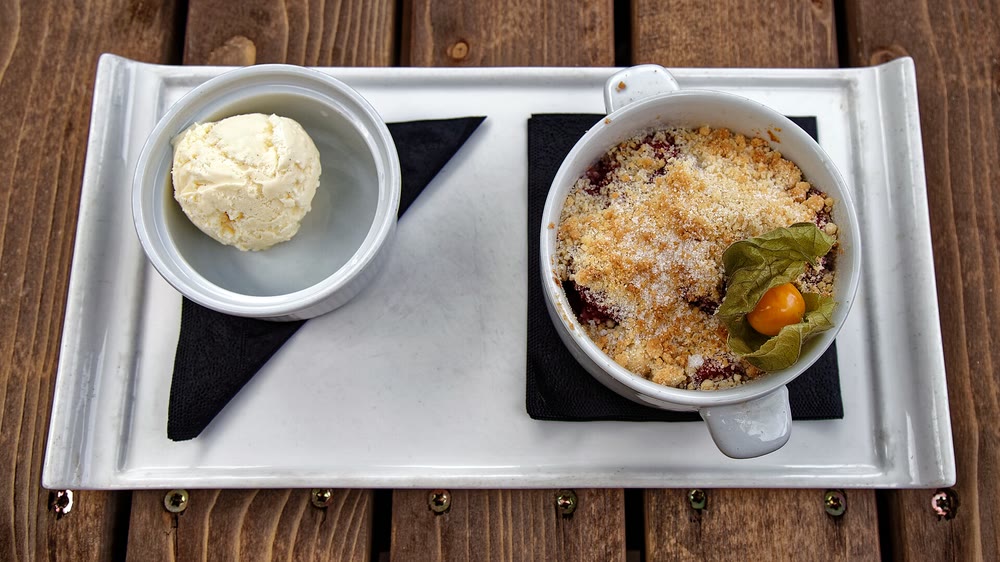
Blackberry and apple crumble with vanilla ice cream. Photo: Acabashi, CC BY-SA 4.0, via Wikimedia Commons
Storing and freezing Irish apple cake
University of Illinois Extension’s advice for fruit pies makes a sensible guide: up to two days at room temperature, lightly covered, and a few days more in the fridge. On a warm day, use the fridge. Warm slices in a low oven before serving.
Custard needs more care. Illinois Extension says custard pies need to go back in the fridge within two hours, so chill leftover custard promptly. The Food Safety Authority of Ireland advises using leftovers within 2 to 3 days.
The cake freezes well, wrapped tightly in cling film and foil. Illinois Extension gives 2 to 4 months for best quality for an unfrosted baked cake. Thaw it in its wrapping, then warm it through.
Why Irish bakers use Bramley apples
An apple in Irish is úll (ool), plural úlla (OO-luh). Ó Dónaill’s Irish dictionary gives úll milis (ool MIL-ish), sweet apple, for an eating apple and úll géar (ool GAYR), sharp apple, for a cooking apple. Online the word sometimes loses its fada and appears as “ull”, but the fada (the accent) is part of the spelling: it makes the vowel long.
The Bramley is the great úll géar. The Royal Horticultural Society describes its flesh as sharp, cooking down to a pale, flavourful purée. The PGI specification for Armagh Bramleys puts that tangy taste down to plenty of malic acid and not much sugar.
The sharpness cuts through the sugar and butter, and the soft apple keeps the crumb moist.
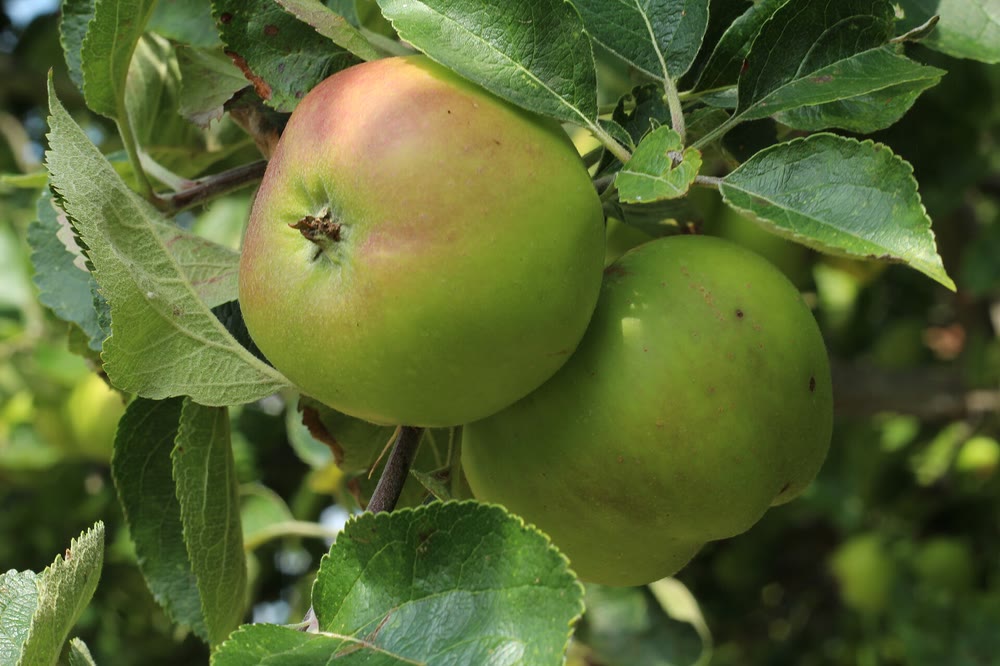
An English apple, born in a garden in Southwell
The Bramley isn’t Irish at all. According to Nottingham Trent University, Mary Ann Brailsford, then a young girl, planted the pip that grew into the original tree in a garden on Church Street in Southwell, Nottinghamshire, some time between 1809 and 1815 (the National Fruit Collection says 1809 to 1813).
More than 40 years later the house had a new occupier, Matthew Bramley. He let Henry Merryweather, a young local nurseryman, take cuttings on one condition: the apple had to carry Bramley’s name. It became Bramley’s Seedling. The first recorded sale came on 31 October 1862, Halloween, when Merryweather sold three of the apples for two shillings.
In 2022 the university, then the tree’s custodian, said incurable honey fungus had long infected it and it was slowly dying.
Armagh, the Orchard County
County Armagh, Ard Mhacha in Irish (roughly ard WAKH-uh, or ard VAKH-uh in Munster), is known as the Orchard County, and its apple story is older than the Bramley.
The Tripartite Life of Patrick, a medieval Irish Life of the saint, says Patrick planted an apple tree at Cengoba, in a place called the field of the doe. In Whitley Stokes’s 1887 translation, the field was afterwards known as Patrick’s orchard. It’s a legend, written down centuries after Patrick’s time, but Armagh’s growers still repeat it, placing Cengoba east of Armagh.
The Bramley arrived in 1884, says the PGI specification drawn up by the growers’ federation, when a Mr Nicholson brought 60 of Merryweather’s Bramley seedlings to Armagh. By 1921 Bramleys covered 7,000 acres and were the county’s main apple.
In March 2012 the EU registered Armagh Bramley Apples as a Protected Geographical Indication (PGI), and the name has been on the UK register too since the end of 2020. Only Bramleys from the old apple-growing parishes in Co. Armagh, Co. Tyrone and part of Co. Londonderry can carry it.
The specification claims the cooler northern climate gives a firmer, denser apple. It also names Apple Blossom Sunday, the last Sunday of May, when the orchards turn pink and white.
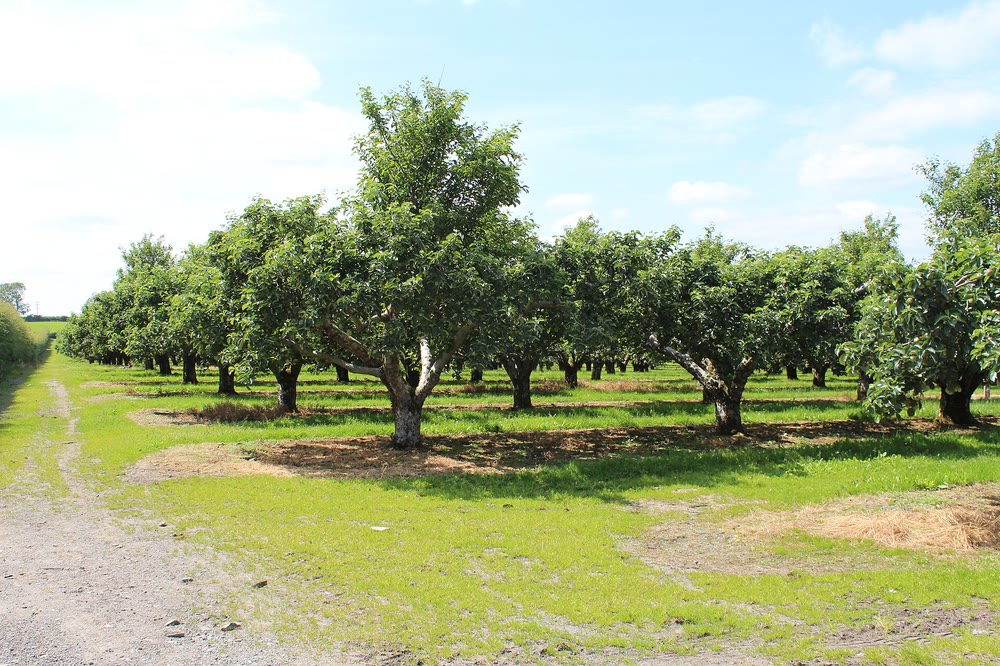
An orchard off the Grange Road, Co. Armagh, in July 2013. Photo: Ardfern, CC BY-SA 3.0, via Wikimedia Commons
Apple cake at Halloween, and older apple lore
Apples were at the heart of the old Irish Halloween, Oíche Shamhna (EE-ha HOW-na), the night that grew out of Samhain. Watch the spelling: you’ll often see “Oíche Samhna” online, but the h after the S is correct.
After the games of snap apple and apple ducking came supper. In the Schools’ Collection, the folklore gathered through Irish schools in 1937 to 1939, apple cake keeps turning up on the table:
- Collon, Co. Louth: a big Halloween supper of apple cake and brack, and whoever found the ring would be married within the year.
- Creevy, Co. Donegal: an old custom of making apple cake, potato cake and boxty on Halloween night. In Corballyquill, Co. Cavan, supper was nearly always brack and apple cake.
- Cregganbaun, Co. Mayo: on November Night (Halloween) the apple cake itself hid a button and a ring. It was cut into one piece for each unmarried person in the house. The ring meant a wedding within twelve months; the button meant never marrying.
The same kinds of charms went into the colcannon and the brack. In Cootehill, Co. Cavan, a little of everything used that night, apple cake included, was left out at bedtime for the souls of the dead, believed freed from Purgatory on Halloween.
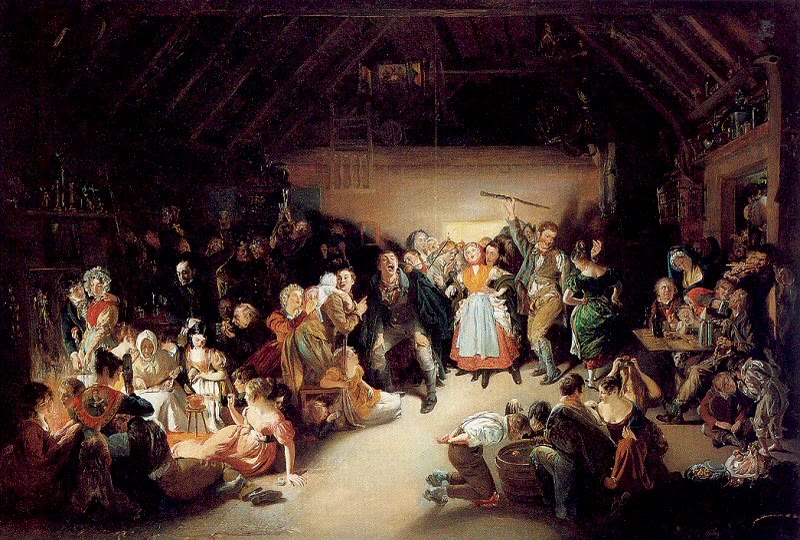
Snap-Apple Night, painted by Daniel Maclise in 1833 after a Halloween party in Blarney, Co. Cork, in 1832. Public domain, via Wikimedia Commons
Why you pick the blackberries before Halloween
For an apple and blackberry cake, gather your sméara dubha (SHMAY-ruh DOO-uh), blackberries, early. W. B. Yeats wrote in 1888 that “After November Eve the blackberries are no longer wholesome”, because the púca (POO-kuh) has spoiled them. Ó Dónaill’s dictionary has a name for him, púca na sméar (POO-kuh nuh SHMAYR), the fruit-destroying pooka. A 1930s account from Kiffa, Co. Cavan, blames the fairies instead.
Apples of the Otherworld
The wild apple tree, aball (roughly AV-ul) in Old Irish, was one of the seven “nobles of the wood” in the tree list of a seventh-century law text, Bretha Comaithcheso. It was valued for its fruit and its bark, notes Maynooth University’s Leigheas project.
In Immram Brain, the Voyage of Bran, Bran wakes to find a silver branch in white blossom beside him and carries it home. In his royal house a woman in strange clothes appears and sings: “A branch of the apple-tree from Emain I bring”, in Kuno Meyer’s 1895 translation. The Dictionary of the Irish Language notes that other texts often call that land Emain Ablach (roughly EV-in AV-lukh), Emain of the apple trees.
In Echtrae Chonnlai, a woman from the Otherworld leaves Connla an apple that keeps him fed for a month and never gets smaller. Both tales are in my guide to Tír na nÓg (teer nuh NOHG).
Apple tart vs apple cake vs apple crumble
- Apple tart: in Ireland, usually a plate pie, with the apples baked between two layers of pastry. Even the dictionaries blur the line: de Bhaldraithe’s English-Irish dictionary translates apple tart as cáca úll (KAW-kuh ool), literally apple cake, and focloir.ie gives toirtín úll (TOR-cheen ool) or císte úll (KEESH-teh ool).
- Apple cake: today, usually a sponge with the apples baked into it, like the recipe above.
- Apple crumble: fruit under a rubbly topping of flour, butter and sugar, with no base at all. For a different take, try the Wonky Spatula’s apple crumble, made with dates, oats and ground almonds.
The 1930s accounts show how loose the names were. In Currans, Co. Kerry, “apple-cake or pie” belonged to Michaelmas, at the end of September, when apples were plentiful. In Corcaghan, Co. Monaghan, apple cake began as a sweet dough of flour, soda, milk and sugar, flattened like a pancake, topped with sliced apples, covered and baked: a close cousin of soda bread.
In Kiffa, Co. Cavan, potato apple cake used potato cake for the pastry and apples and sugar for the filling.
Irish apple cake FAQ
What apples are best for Irish apple cake?
Bramleys, the big, sharp green cooking apples Irish bakers reach for. They melt into soft, tangy pockets.
Can I use Granny Smith apples instead of Bramleys?
Yes. They’re the easiest swap in the US: tart like a Bramley but firmer, so cut them a little smaller.
What is the difference between apple tart and apple cake in Ireland?
An apple tart is apples baked in pastry, usually on a plate. An apple cake today is usually a sponge with apples through it, though older ones used soda dough or even potato.
How do you say apple cake in Irish?
Cake is cáca (KAW-kuh) or císte (KEESH-teh) and apple is úll (ool), so cáca úll or císte úll. Irish dictionaries give the same words for an apple tart.
Love this? Save it to your Pinterest board for later.
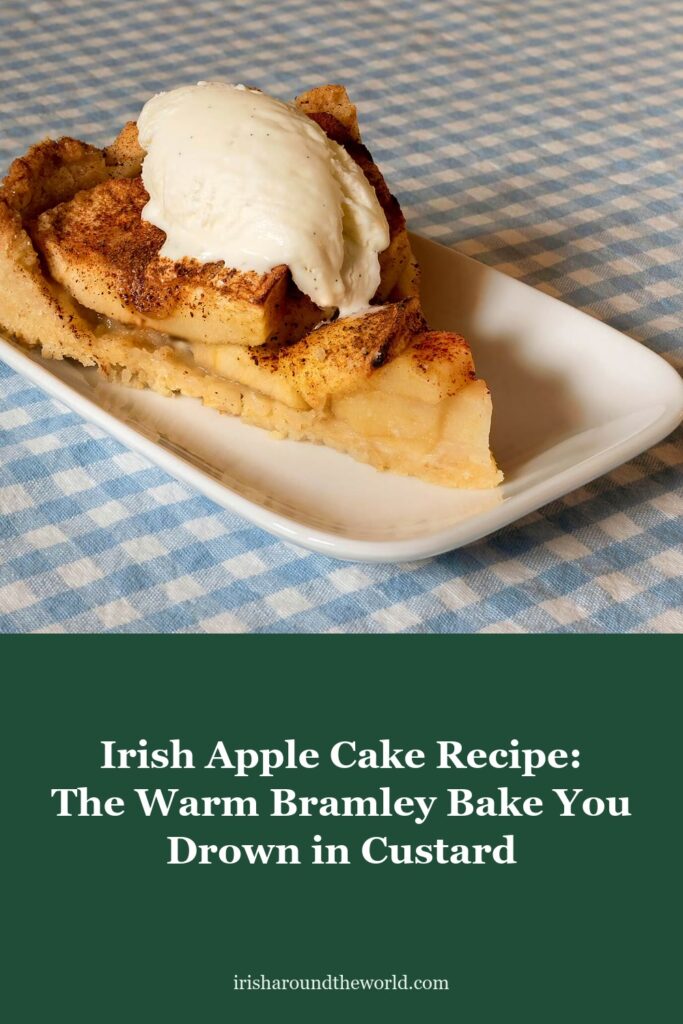
Pin image: A Swedish-style apple bake with vanilla ice cream. Photo: W.carter, CC0, via Wikimedia Commons
A little bit of Ireland in your inbox every Friday ☘️
The free Weekly Dose of Irish: an Irish joke, a Celtic symbol, an Irish fact, a poem and the week’s best articles in one short email. Join 9,600+ readers.
Free. One short email every Friday. Unsubscribe any time.
More Irish baking and Halloween reading
- Barmbrack Recipe: The Irish Halloween Bread That Predicts Your Future
- Colcannon Recipe: The Irish Halloween Mash That Hides Your Fortune
- Irish Halloween Games: Snap Apple, Burning Nuts and the Old Spells to See Your Future Spouse
- The Púca: Ireland’s Shape-Shifter and Why You Never Eat Blackberries After Halloween
- How the Irish Invented Halloween: Samhain, Turnip Lanterns, Barmbrack and the Best Festivals in Ireland
- Easy Apple Crumble Recipe by The Wonky Spatula
Featured image: A Swedish-style apple bake with vanilla ice cream. Photo: W.carter, CC0, via Wikimedia Commons.