
The best-recorded Irish house blessing was spoken, not framed: neighbours called “God save all here”, in Irish Dia sa teach, from the doorstep. Old customs for a new home include carrying in salt and holy water first, bringing bread or a sod of turf, hanging a Brigid’s cross over the door and never moving on a Saturday (“Saturday flit, short sit”). The popular bread, salt and wine blessing, with its three wishes, first turns up in the 1946 film It’s a Wonderful Life, though Irish families really did bring bread and salt into new homes.
A new key in a new door is one of life’s big moments. In Ireland, people marked it with small things: a pinch of salt, a shake of holy water, a few words on the threshold.
Today “Irish house blessings” are printed on plaques, tea towels and cards everywhere, and some are a lot younger than they look. One of the best loved first appears in a Hollywood Christmas film.
Here are the real ones, in English and Irish, with the old moving-in customs and where each blessing comes from.
Jump to:
- Short Irish house blessings for cards and plaques
- Bread, salt and wine: where the blessing comes from
- Old Irish blessings for a home
- “Bless the four corners of this house”
- Irish customs for moving into a new house
- A Brigid’s cross over the door
- The horseshoe over the door
- Building a new house: fairy paths and an odd curse
- Irish housewarming gifts with a story
- Irish house blessing FAQ
- More Irish blessings and customs
Short Irish house blessings for cards and plaques
Each fits on a card or plaque, and each comes with its source, so you know what you’re giving.
In Irish
- Dia sa teach (DEE-uh suh CHAKH, with kh as in loch; Dia sounds closer to JEE-uh in the west and north): God bless all here. The old greeting at the door, listed in Ó Dónaill’s dictionary.
- Go mbeannaí Dia an teach seo (guh MAN-ee DEE-uh un CHAKH shuh): May God bless this house. A simple modern line on the old pattern of Go mbeannaí Dia anseo, God save all here.
- Beannacht Dé ar an teach seo (BAN-ukht JAY er un CHAKH shuh): God’s blessing on this house.
- Níl aon tinteán mar do thinteán féin (neel ayn CHIN-chawn mar duh HIN-chawn fayn): there’s no fireside like your own. The proverb is the Irish for “there’s no place like home”. Tinteán means hearth, and in Munster it sounds closer to tin-TYAWN.
- Céad míle fáilte (KAYD MEE-luh FAWL-cha): a hundred thousand welcomes. Made for a porch sign.
- Bail ó Dhia ar an obair (BAL oh YEE-uh er un OH-bir): God bless the work. Said to anyone at work, so it suits a self-build or a big renovation.
Mind the fadas, the accents. Online you’ll see “Cead mile failte”, but cead without its fada means permission, not a hundred. Tinteán and mbeannaí often lose theirs too.
In English
- “God save all here.” Called from the threshold, as a Westmeath school recorded in the 1930s, and answered with “God save you kindly”.
- “Protect this house and its people / Till the dawn of the day shall be.” From Douglas Hyde’s 1906 translation of an Aran Islands prayer for the fire (more below).
- “Bless the four corners of this house, / And be the lintel blest.” Usually sold as Irish, but it’s by the American poet Arthur Guiterman, collected in 1918. Credit him.
- “May Brigid bless the house wherein we dwell.” The opening of St Brigid’s Blessing, author unknown, in use since at least the 1930s.
The St Patrick’s Day blessings page has a short section of blessings for a home, and good luck in Irish has the lucky wishes.
Bread, salt and wine: where the blessing comes from
You’ll see it on wooden signs and gift baskets, often labelled “old Irish blessing”. Bread so the house never knows hunger, salt so life always has flavour, wine so joy and prosperity last for ever.
That wording comes from It’s a Wonderful Life (1946), Frank Capra’s Christmas film with James Stewart and Donna Reed. About an hour in, George and Mary Bailey help the Martinis, an Italian immigrant family, move into their own new house in Bailey Park. As the family arrives, the Baileys hand over a loaf, salt and a bottle of wine, with a one-line wish for each.
The screenplay is credited to Frances Goodrich, Albert Hackett and Capra, adapting Philip Van Doren Stern’s story The Greatest Gift. No one seems to have found the three-part toast in print before 1946. You’ll read that the scene drew on an Italian custom, but nobody cites an earlier source. The Old Farmer’s Almanac lists the film’s three meanings almost word for word and calls the custom pre-Christian, again without a source.
So is any of it Irish? Two-thirds of it, in a way.
- Bread and salt are an old welcome across much of Europe. In the Slavic world a round loaf with salt still greets guests at weddings and state visits.
- In Ireland, the 1930s Schools’ Collection has it too. In Mullinavat, Co. Kilkenny, a family would leave bread and a pinch of salt on the new floor a week before they moved in. In Kilkerrin, Co. Galway, bread was a very lucky present for people just moved in, and in Tuam a salt box was a common gift.
- Wine turns up in none of the Irish moving-in customs checked for this page.
Call it a film blessing with Irish roots in two of its three gifts. It makes a lovely present either way.
Old Irish blessings for a home
The greeting at the door
The everyday Irish house blessing was never framed. It was said. In Kilbeggan, Co. Westmeath, a 1930s pupil wrote that neighbours called “God save all here” from the threshold. The family inside answered “God save you kindly” or “God and Mary be with you”. In Kilrusheighter, Co. Sligo, it was “God bless all here”.
The prayer for the fire
The last job of the night in an Irish country house was to save the fire, burying a coal or two in the ashes so it would still be alive at dawn. In English this was called raking the fire. Douglas Hyde, later Ireland’s first President, called it keeping “the seed of the fire” in Religious Songs of Connacht (1906).
A short prayer went with it, he wrote, wherever Irish was still spoken, and in Scotland too. One version, taken down by Eoin MacNeill from Martin Folan of Inis Meáin, asks Christ to save the speaker just as the fire is saved. It puts Mary on the roof-top and Brigid in the middle of the house, and sets eight of the mightiest angels on guard. Hyde’s translation ends:
Protect this house and its people
Till the dawn of the day shall be.
The Irish begins Coiglím an tine seo (KIG-leem un CHIN-uh shuh), I save this fire. Coigil means to spare or save, and for a fire, to bank it with ashes.
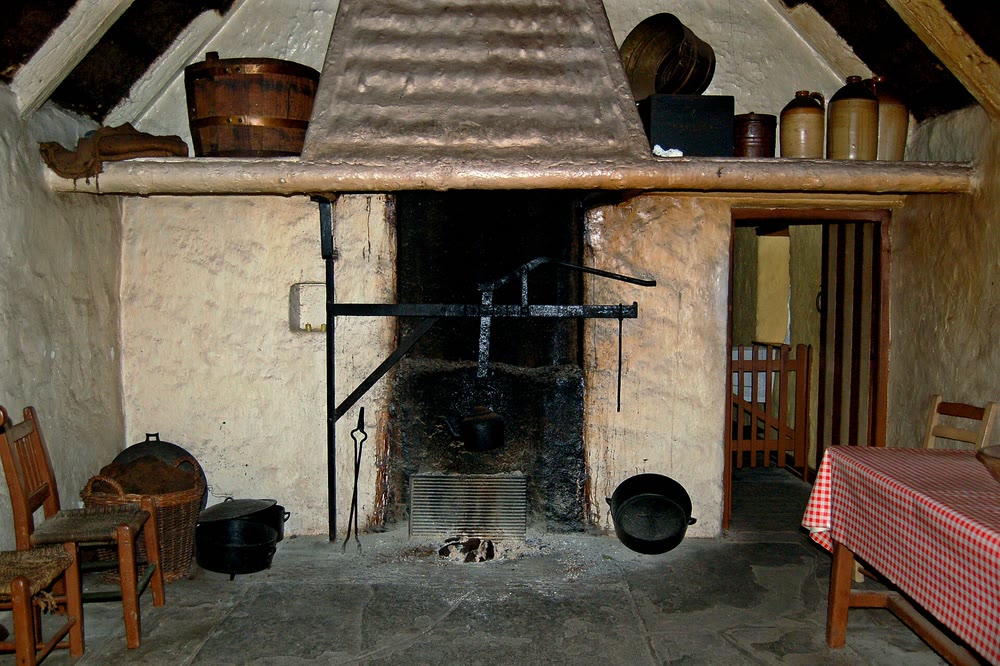
The open hearth in the Mountain Farmhouse at Bunratty Folk Park, Co. Clare. Photo: Joseph Mischyshyn, CC BY-SA 2.0, via Wikimedia Commons
Bedtime prayers and St Brigid’s Blessing
In Rahans, Co. Mayo, a pupil recorded a two-line prayer for bedtime: God bless this house, guard each door, and let angels watch until morning.
In Ballinakill, Co. Laois, a school wrote down a verse titled simply “Old Prayer”. It asks Brigid to bless the house, its fireside and walls, and everyone under its roof. The Irish Catholic Bishops’ Conference now prints it as St Brigid’s Blessing. Nobody seems to know who wrote it.
A priest’s blessing
Many families asked the priest to bless a new home. In Nenagh, Co. Tipperary, a pupil said it wasn’t lucky to move in without having Mass said in the house. In 2018 Archbishop Eamon Martin of Armagh wrote that in Ireland “the practice of blessing homes goes back centuries”, recalling families sprinkling Easter water on homes and outbuildings.
“Bless the four corners of this house”
This may be the most common “Irish house blessing” on plaques, and it isn’t Irish. It’s House Blessing by the American poet Arthur Guiterman (1871 to 1943), collected in his book The Mirthful Lyre (Harper, 1918). It opens:
Bless the four corners of this house,
And be the lintel blest;
And bless the hearth and bless the board
And bless each place of rest;
It goes on to the door, the windows, the roof-tree and the walls, and ends with peace on all. Plaques usually reword it a little, starting “God bless the corners of this house”. The poem is out of copyright, so use it freely, but credit Guiterman. No older Irish source for it has turned up.
It has travelled far. The house prayer in Archbishop Martin’s 2018 Easter message, which he said had come down over many decades, blesses the lintel, the table, the bedrooms, a door open to strangers and family, the windows, the rafters and the walls. That’s Guiterman’s order, almost line for line: it reads like his poem retold in prose.
Two more borrowed blessings:
- Bless This House, the 1927 song, has words by Helen Taylor and music by the Australian composer May Brahe. The Irish tenor John McCormack made it famous in the 1930s.
- “May the roof above us never fall in, and may we friends gathered below never fall out.” Traced to 1912, when it was billed as an old English toast, as the Irish toasts page explains.
For a blessing sung rather than framed, people from 300 churches across Ireland recorded themselves for The Irish Blessing during the pandemic.
Irish customs for moving into a new house
Between 1937 and 1939, schoolchildren across the 26 counties of the Irish Free State collected local lore for the Irish Folklore Commission’s Schools’ Collection, now online at dúchas.ie. Moving house comes up again and again, and the answers vary from place to place.
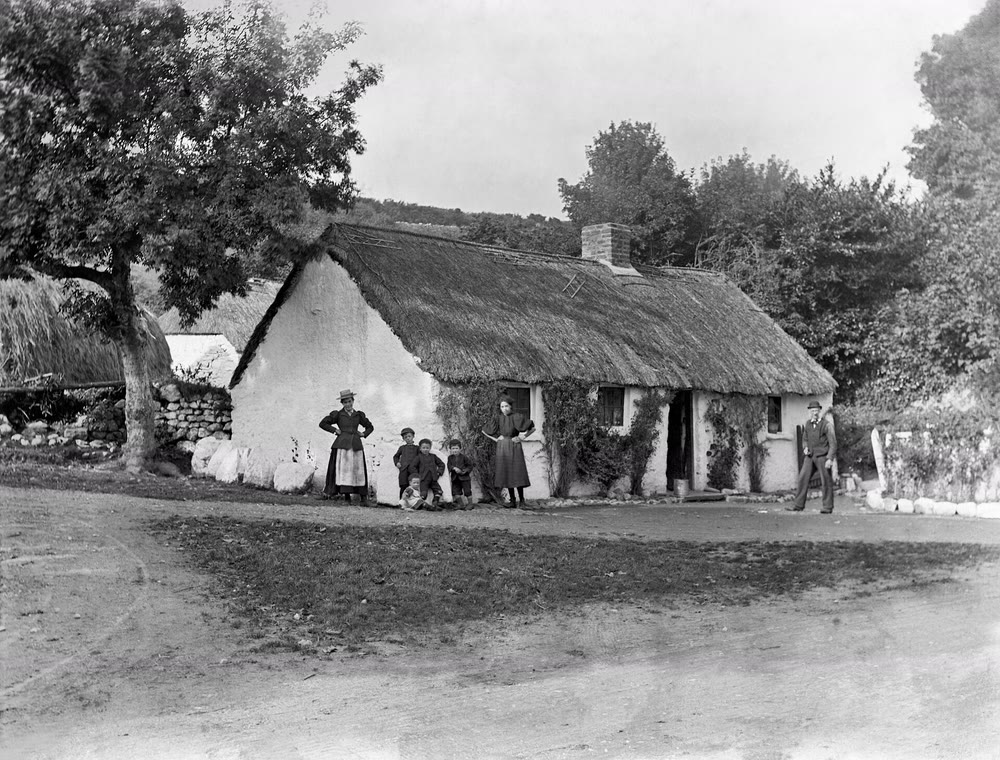
A thatched cottage at the Scalp, near Kilternan on the Dublin and Wicklow border, about 1895. Photo: Robert Augustus Henry L’Estrange, L’Estrange Collection, Queensland University of Technology. CC0, via Wikimedia Commons
Salt and holy water first
Salt led the way through the door. In Gowran, Co. Kilkenny, a 69-year-old man said a teaspoon of salt should go in first, then a bottle of holy water. You sprinkled the salt with the holy water and scattered it around the kitchen.
In Thomastown, Co. Tipperary, the luckiest things to carry in first were holy water, matches and salt. In Tomhaggard, Co. Wexford, it was unlucky to go in without salt. In Tircahan, Co. Cavan, a new house got a sprinkle of salt, then holy water, to keep out spirits.
Holy water is uisce coisricthe (ISH-kuh KUSH-rik-uh) in Irish, and salt is salann (SAL-un).
Bread, turf and the first fire
Bread was a lucky gift in Mullinavat and Kilkerrin, and in Adare, Co. Limerick, a visitor to a new house brought a piece of bread. Others brought fuel: in Srahnamanragh, Co. Mayo, you brought a sod of turf on your first visit. In Callanafersy, Co. Kerry, a woman’s first visit to a new house meant carrying in a sod of turf or something, or a person or animal would die there.
In Collooney, Co. Sligo, a man had to go in first and light the fire, then stand with his back to it as the family came in. You’ll sometimes read that Irish families carried a live coal from the old hearth to the new. The records checked for this page don’t show it, and one Limerick school said the opposite: never bring coal from the old house.
What not to bring
The cat, mostly. Schools in Mayo, Kerry, Tipperary, Kilkenny, Cork and Limerick all warned against taking the cat to a new house. Lurga, Co. Limerick, added the tongs and the coal. In Coachford, Co. Cork, it was unlucky to move the cat or the salt from the old house to the new.
“Saturday flit, short sit”
Flit means move house: move on a Saturday and you won’t stay long. The saying turns up in schools from Donegal down to Meath. In Donore, Co. Meath, it came with a rhyme for choosing the day: “Monday for health, Tuesday for wealth”, with Wednesday the pick of the week and Saturday “no day at all”.
Friday was trickier. Collooney, Thomastown and Adare said Friday was the lucky day to move. Inistioge, Co. Kilkenny, said it was unlucky, and the Meath rhyme gave Friday “for crosses”. Some places avoided May too, from Waterford to west Cork.
A Brigid’s cross over the door
The Brigid’s cross, Cros Bhríde (KROSS VREE-juh) in Irish, often written Cros Bríde, is traditionally woven from rushes or straw on St Brigid’s Eve, 31 January, ready for her feast day on 1 February. One of its main jobs was to guard the house against fire.
In Coralstown, Co. Westmeath, people put a straw cross over the door with a little rhyme about keeping the house safe from fire. In Rush Hall, Co. Laois, a cross over the door saved the house from fire and from evil people coming in. Others hung it over the fireplace, as in Threemilehouse, Co. Monaghan.
A new cross is made every year. In Crowenstown, Co. Westmeath, the old one was kept until the feast came round again, then burned. The Catholic bishops’ blessing for the crosses asks God to bless them and the places where they hang. The St Brigid’s cross guide has the story and how to make one.
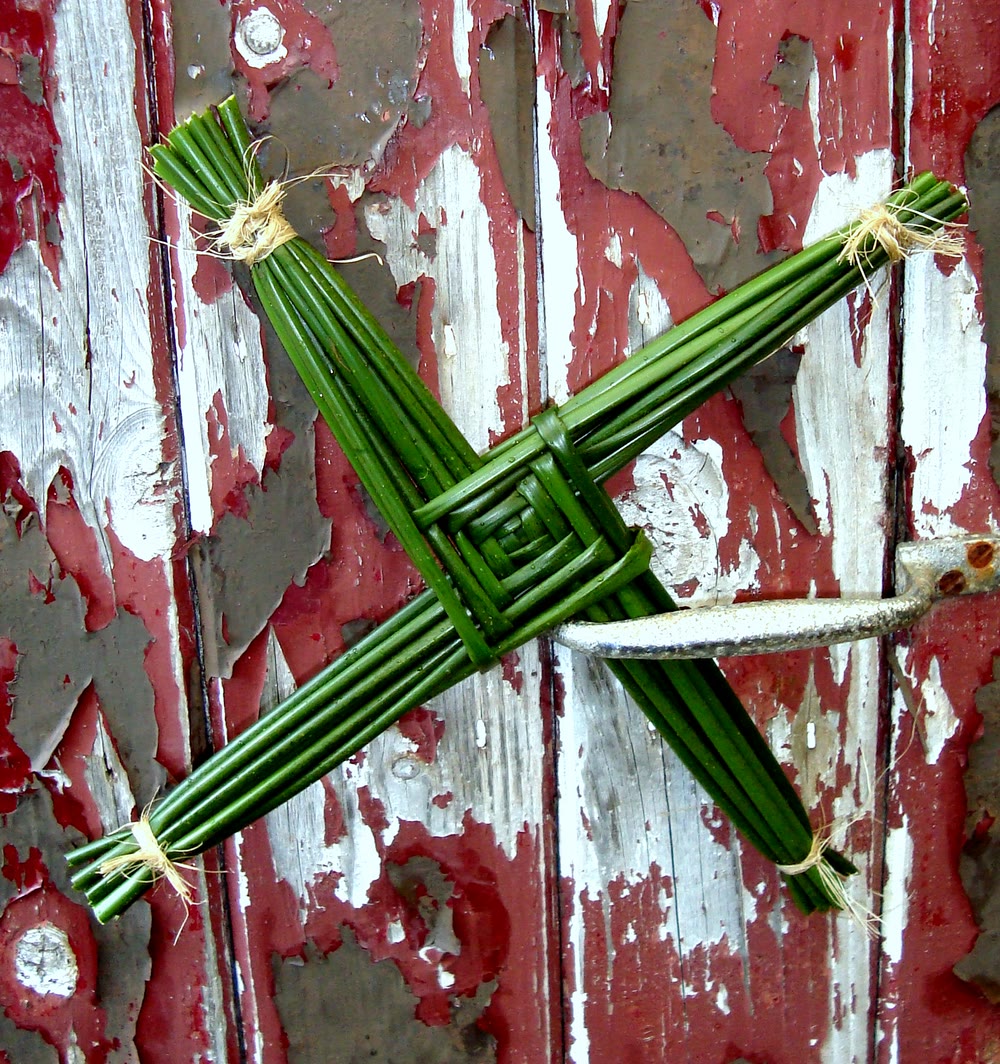
A fresh rush Brigid’s cross (crosóg Bhríde) on a door at Drumnalost, Co. Donegal, on St Brigid’s Day 2010. Photo: louise price, CC BY-SA 2.0, via Wikimedia Commons
The horseshoe over the door
The horseshoe, crú capaill (KROO KAP-il), is the other old luck-keeper at the door. A pupil in Ballinderry, Co. Galway, wrote that Irish people picked up any horseshoe found on the road and hung it over the kitchen door, though nobody could say why. In Kilmore, Co. Leitrim, a horseshoe nailed with horseshoe nails to the jamb of the outer door kept evil spirits away.
Points up or down? Opinions differed. A Ballina, Co. Mayo, school said most people hung it upside down, and that this was wrong because the luck would fall out. Courtmacsherry, Co. Cork, agreed. There’s more lucky lore in the guide to Irish superstitions.
Building a new house: fairy paths and an odd curse
You never built across a fairy path, for fear of the Good People, as the guide to fairy forts explains. In Tircahan, Co. Cavan, a school wrote that a house built on one would never have luck.
Building of any kind was risky there: “That you may build” was a curse. People who built or improved, it was said, always met losses and crosses. When one neighbour lengthened his house, his best cow dropped dead, and the Good People got the blame.
Gowran had a remedy: start building on a Tuesday and put a teaspoon of holy water in each wall so it would never fall. In Newtownanner, Co. Tipperary, a new house or a new floor called for a dance, and a piece of delph (crockery) went under the new floor.
Housewarmings are nothing new either. In Garshooey, Co. Donegal, newly-weds had what locals called a “house-warming” when they set up house (more in Irish wedding traditions). The dictionary Irish for a housewarming is cóisir cheiliúrtha tí (KOH-shir HYEL-yoor-huh CHEE), a house celebration party.
Irish housewarming gifts with a story
For a gift with real roots, follow the old records:
- Salt: a good salt cellar or salt box, the gift Tuam remembered.
- Bread: a loaf of Irish brown bread, warm if you can manage it.
- A Brigid’s cross: best around 1 February, welcome any time.
- A card in Irish: Dia sa teach, or Níl aon tinteán mar do thinteán féin.
- Wine: add a bottle for It’s a Wonderful Life, and say where it came from.
The Irish gifts guide has more ideas, and the bread banged on the door at New Year carries the same old wish against hunger. Just leave the cat behind.
Irish house blessing FAQ
What is a traditional Irish house blessing?
The best recorded is the spoken greeting “God save all here”, Dia sa teach in Irish. Others include the prayer said while banking the fire at night and St Brigid’s Blessing.
Is bread, salt and wine an Irish tradition?
Not as a three-part blessing. That wording first appears in It’s a Wonderful Life (1946). Bread and salt for a new home do appear in Irish folklore records, but wine doesn’t.
How do you say “bless this house” in Irish?
Go mbeannaí Dia an teach seo (guh MAN-ee DEE-uh un CHAKH shuh). For something shorter, use Dia sa teach, God bless all here.
What is a good Irish blessing for a housewarming card?
In Irish, Dia sa teach (God bless all here) or Níl aon tinteán mar do thinteán féin (there’s no place like home). In English, the last two lines of Hyde’s fire prayer.
Is it bad luck to move house on a Saturday?
In Irish folklore, yes: “Saturday flit, short sit” means you won’t stay long. Friday was lucky in some places and unlucky in others.
Where do you hang a St Brigid’s cross?
Traditionally over the door, or over the fireplace, to guard the house against fire. A new one is made each year for 1 February.
Love this? Save it to your Pinterest board for later.
Pin image: danny kearney, CC BY-SA 2.0, via Wikimedia Commons
A little bit of Ireland in your inbox every Friday ☘️
The free Weekly Dose of Irish: an Irish joke, a Celtic symbol, an Irish fact, a poem and the week’s best articles in one short email. Join 9,600+ readers.
Free. One short email every Friday. Unsubscribe any time.
More Irish blessings and customs
- St Patrick’s Day Blessings: 39 Irish Blessings, Prayers and Toasts
- St Brigid’s Cross: Meaning, History and How to Make One
- Irish Grace Before Meals: Table Blessings in Irish and English, and Where They Really Come From
- 300 Churches Across Ireland Sing The Irish Blessing (Get the Tissues)
- Irish New Year Traditions: Bread at the Door, First Footing and More
- Fairy Forts and Fairy Trees: The Irish Places You Never Disturb
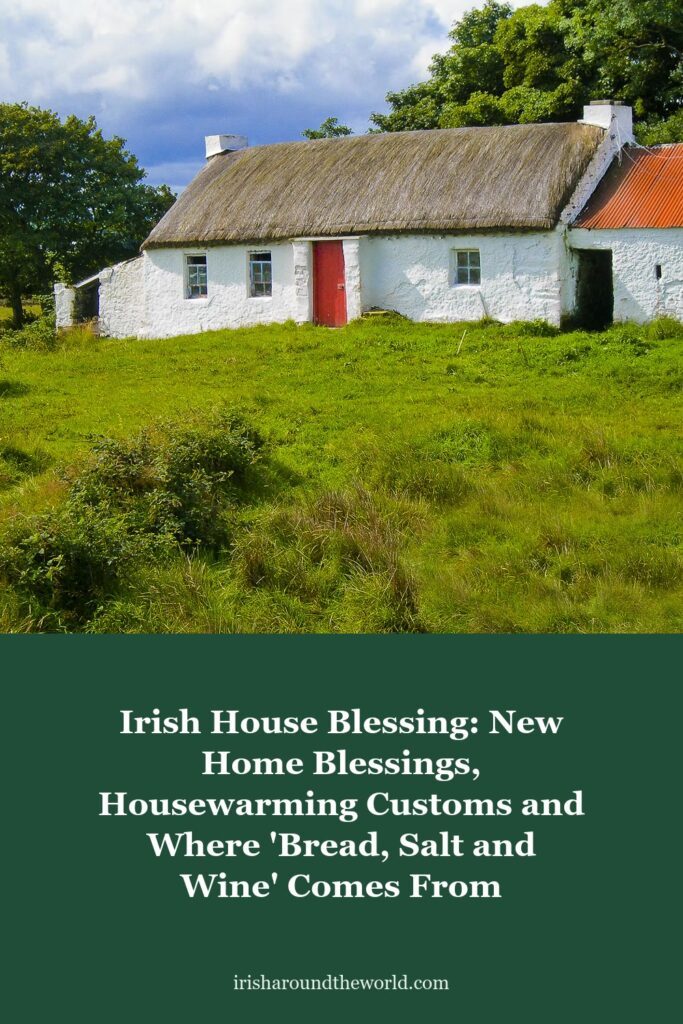
Featured image: A whitewashed thatched cottage with a red door in Co. Donegal. Photo: danny kearney, CC BY-SA 2.0, via Wikimedia Commons.