
Irish brown bread is a wholemeal soda bread: coarse wholemeal flour, bread soda (baking soda), salt and buttermilk, and sometimes oats, wheat bran, wheat germ or a spoonful of treacle. With no yeast, kneading or rising, it’s in the oven within 10 minutes. In Northern Ireland it’s called wheaten bread. This recipe bakes one 900g (2 lb) tin loaf in about an hour.
In Tourism Ireland’s collection of traditional recipes, Jenny’s nan’s brown bread comes with a childhood memory: “the smell of brown bread meant we were having visitors.”
This is that kind of loaf: nutty, crumbly and baked in a tin, the bread Irish people eat with soup, smoked salmon or a pot of tea. Tourism Ireland calls brown bread a household staple right across the island.
The recipe comes first, then US swaps, a Guinness and treacle loaf, the Northern “wheaten” and the wartime “black bread”. For the white loaf with a cross on top, see my Irish soda bread recipe.
Jump to:
- Irish brown bread recipe
- US swaps: Irish wholemeal, treacle and the rest
- Guinness and treacle brown bread
- Can you make it in a bread machine?
- Storing and freezing brown bread
- Wheaten bread: the Northern name
- A short history of Irish brown bread
- Brown bread in Irish
- Irish brown bread FAQ
- More Irish recipes and food history
Irish brown bread recipe (wholemeal soda bread)
Prep: 10 minutes | Bake: 50 to 55 minutes | Makes: 1 loaf, about 14 slices
Ingredients
- 350g (about 3¼ US cups) coarse wholemeal flour (see the US swaps below)
- 75g (a scant ⅔ US cup) plain flour, called all-purpose flour in the US
- 25g (¼ US cup) porridge oats (rolled oats), plus 1 tablespoon for the top
- 15g (¼ US cup) wheat bran
- 15g (2 tablespoons) wheat germ
- 1 level teaspoon bread soda (bicarbonate of soda, called baking soda in the US)
- 1 level teaspoon fine salt
- 1 tablespoon black treacle or unsulphured molasses (optional)
- 425 to 475ml (1¾ to 2 US cups) buttermilk
Method
- Heat the oven to 220°C (425°F), or 200°C with a fan. Grease a 900g (2 lb) loaf tin, about 23 x 13cm (9 x 5 inches), and dust it with flour or line it with baking paper.
- Put the wholemeal flour, bran, wheat germ and oats in a large bowl. Sieve in the plain flour, bread soda and salt, and mix well so the soda is evenly spread.
- If you’re using treacle, stir it into the buttermilk in a jug.
- Make a well in the middle and pour in about 425ml (1¾ cups) of the buttermilk. Stir with a wooden spoon or your hand until there’s no dry flour left, adding a splash more buttermilk if it looks dry. You want a soft, sloppy mixture, much wetter than a white soda dough. Don’t knead it.
- Scrape it into the tin, level the top with a wet spoon and scatter over the extra oats. Run a knife down the middle, about 1cm (½ inch) deep.
- Bake straight away for 15 minutes, then lower the heat to 190°C (375°F), or 170°C fan, for another 35 to 40 minutes.
- Turn the loaf out of the tin and tap the base. If it doesn’t sound hollow, put it back in the oven, out of the tin, for 5 to 10 minutes. A skewer pushed into the middle should come out clean.
- Cool on a wire rack, wrapped in a clean tea towel for a softer crust. Leave it at least 30 minutes before slicing.
Tips
Wet is right. Wholemeal drinks up far more buttermilk than white flour, so the mixture should look more like a thick porridge than a dough you could shape. Once the buttermilk goes in, the soda starts working, so get the tin into the oven fast.
Check the middle. America’s Test Kitchen bakes its brown soda bread until the centre reaches 85°C (185°F). A gummy middle usually means it needed longer, or was cut too soon.
Serve it with salted butter and jam, smoked salmon, a bowl of soup, an Irish stew or a Dublin coddle, or beside a full Irish breakfast.
Variations
- Plain farmhouse loaf: leave out the bran, wheat germ, oats and treacle, and start with about 375ml (1½ cups) buttermilk.
- Seeded: add 3 tablespoons (about 30g) of mixed sunflower, pumpkin and linseeds to the dry ingredients. Don’t panic if the sunflower seeds turn green (see the FAQ).
- Richer, with butter and egg: like Darina Allen’s brown soda bread in the Irish Examiner, rub 15g (1 tablespoon) butter into the flour and use 1 beaten egg plus about 375ml buttermilk.
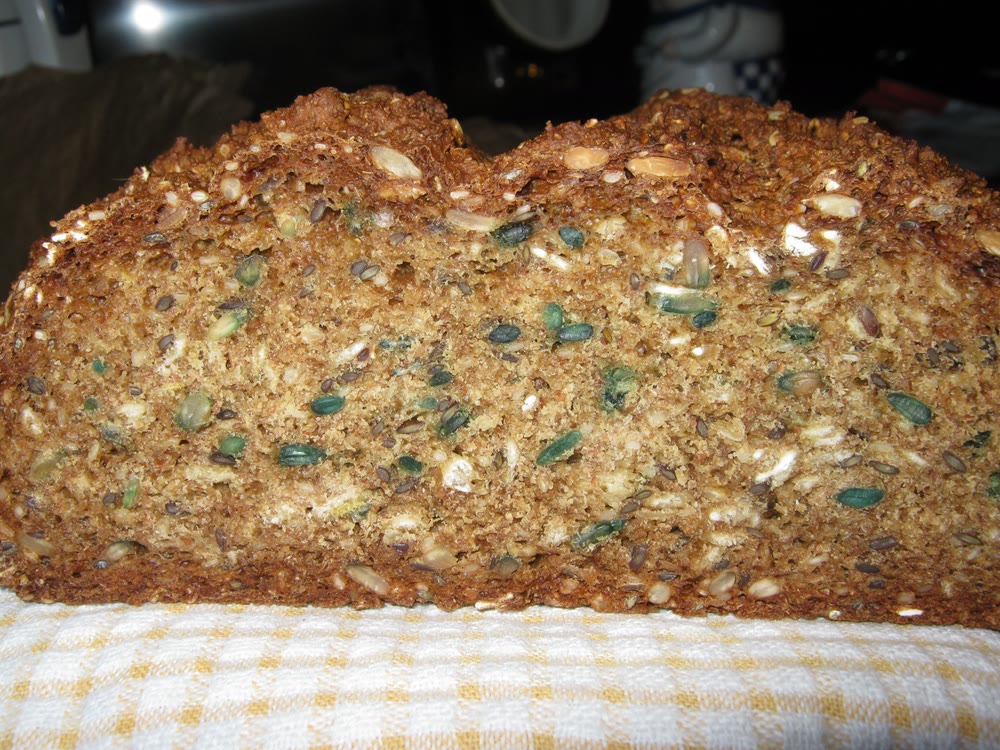
The cut face of a seeded brown soda loaf with oats. Photo: Richard Avery, public domain, via Wikimedia Commons
US swaps: Irish wholemeal, treacle and the rest
Coarse Irish wholemeal, with its big flakes of bran, gives this bread its rough, nutty crumb. Many Irish recipes call for Odlums Coarse Wholemeal, from an Irish miller that traces its roots to 1845.
Standard US whole wheat flour is finer, so America’s Test Kitchen adds extra wheat bran and wheat germ to its Irish brown soda bread for a coarser, nuttier crumb. Two good options:
- Irish-style flour: King Arthur’s Irish-style wholemeal is a coarsely ground, soft whole wheat flour, its own take on the flours used for traditional Irish breads. Use the same weight, about 3¼ US cups for 350g.
- Whole wheat flour plus bran: swap the 350g wholemeal for 300g (about 2⅔ US cups) whole wheat flour, stone-ground if you can find it, plus an extra 50g (about ¾ cup) wheat bran.
The other ingredients, translated:
- Bread soda is baking soda. Don’t use baking powder instead: it’s a different raising agent.
- Black treacle is close to molasses, and Merriam-Webster gives treacle as the chiefly British word for molasses. Use regular unsulphured molasses. Blackstrap is darker and more bitter, so use a little less if it’s all you have.
- Porridge oats are rolled oats. Pinhead oats, which some Irish recipes scatter on top, are steel-cut oats.
- Buttermilk is cultured buttermilk. No buttermilk? See the FAQ.
Keep wheat germ and wholemeal cool. The oils in the germ and bran turn rancid, so keep opened wheat germ in the fridge. Citing the Whole Grains Council, the Tufts Health and Nutrition Letter gives most whole-grain flours 1 to 3 months in a cool pantry and 2 to 6 frozen.
Guinness and treacle brown bread
Nobody seems to have recorded when stout first went into Irish brown bread, so be wary of origin stories. Recipes vary a lot. Odlums publishes a Guinness brown bread made with stout and no buttermilk, while chef Kevin Dundon adds just 100ml of stout to 400ml of buttermilk.
This version sits in the middle, with treacle and melted butter for a dark, moist, slightly sweet loaf. Try it with smoked salmon, cheese or a beef and Guinness stew. More on the stout itself in my Guinness facts.
Prep: 10 minutes | Bake: 50 to 55 minutes | Makes: 1 loaf, about 14 slices
Ingredients
- 350g (about 3¼ US cups) coarse wholemeal flour
- 75g (a scant ⅔ US cup) plain flour
- 40g (a scant ½ US cup) porridge oats, plus extra for the top
- 1¼ level teaspoons bread soda (baking soda)
- 1 level teaspoon fine salt
- 2 tablespoons black treacle or unsulphured molasses
- 30g (2 tablespoons) butter
- 250ml (1 US cup) Guinness or another stout, poured and left to settle
- 175ml (¾ US cup) buttermilk
- Optional: 50g (a scant ½ US cup) chopped walnuts or mixed seeds
Method
- Heat the oven to 200°C (400°F), or 180°C fan. Grease a 900g (2 lb) loaf tin and line it with baking paper, as treacle loaves like to stick.
- Melt the butter and treacle together in a small pan over a low heat. Take it off the heat and stir in the stout, then the buttermilk. It will foam a little.
- Mix the wholemeal flour, oats and walnuts or seeds, if using, in a large bowl. Sieve in the plain flour, bread soda and salt, and mix well.
- Pour in the liquid and stir until there are no dry pockets. It should be wet and sloppy. Don’t beat it.
- Scrape it into the tin, level the top and scatter over some oats.
- Bake for 15 minutes, then lower the heat to 180°C (350°F), or 160°C fan, for another 35 to 40 minutes. If the top darkens too fast, lay a sheet of foil loosely over it.
- Turn it out: a skewer in the middle should come out clean. If not, give it 5 more minutes out of the tin. Cool completely on a wire rack before slicing.
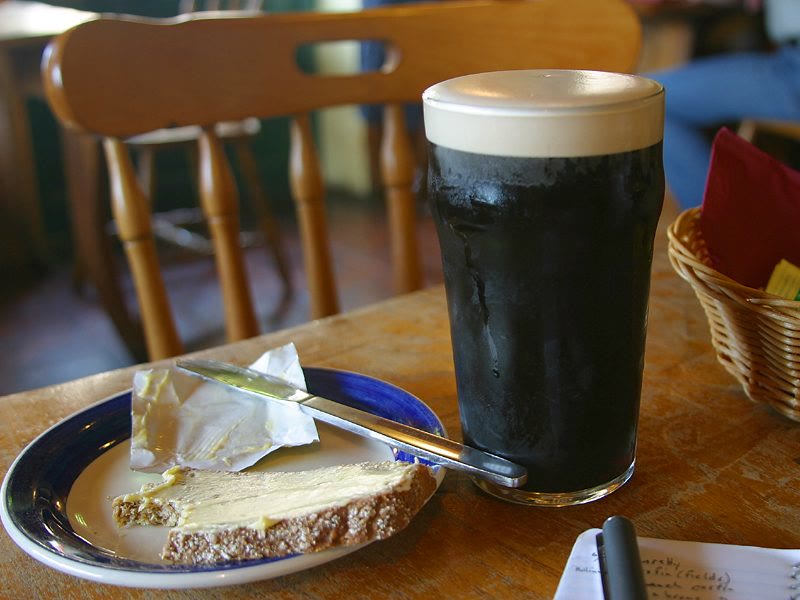
A pint of stout with a slice of buttered brown bread. Photo: Jon Sullivan, public domain, via Wikimedia Commons
Can you make Irish brown bread in a bread machine?
Sometimes. Bread machines are built for yeast dough, with long kneading and rising. Check your manual for:
- A quick bread or cake setting. Welbilt’s bread machine manual, for example, says its Quick/Cake setting is for loaves raised with baking powder or baking soda. Pour the buttermilk and treacle in first, the dry ingredients on top, and help the paddle with a spatula if flour sticks in the corners.
- A bake-only setting. Mix the dough by hand, take the paddle out, scrape the dough into the pan and run the Bake programme.
Test the middle with a skewer at the end. If it’s still sticky, the Welbilt manual suggests more time on Bake, checking every 10 minutes. These quantities suit a pan that takes a 900g (2 lb) loaf.
Storing and freezing brown bread
Brown bread is best within a day or two. Keep it in a clean tea towel or a bread bin, and toast it once it starts to dry out.
It freezes well. Slice it first, so you can toast slices straight from the freezer. University of Illinois Extension says baked quick breads keep their best quality for 2 to 3 months at -18°C (0°F).
Wheaten bread: the Northern name
In Northern Ireland, brown soda bread is more often called wheaten bread, says CCEA, the Northern Ireland curriculum body. It’s baked as a farl, a round cake or a loaf.
Every family had its own recipe, CCEA adds, some with salt and sugar, and treacle is among the extras it lists for soda bread.
Tourism Ireland’s brown bread recipe calls for coarse wheaten meal too. In Irish, wheaten bread is arán cruithneachta (roughly uh-RAWN KRIH-nyukh-tuh), from cruithneacht (KRIH-nyukht), wheat.
Seamus Heaney grew up on Mossbawn farm in Co. Derry, and his poem Mossbawn: Sunlight pictures his aunt Mary busy with her baking.
A short history of Irish brown bread
The oldest Irish soda bread recipe usually quoted, sent to the Newry Telegraph and reprinted in London’s Farmer’s Magazine in 1836, was really a brown loaf: wheaten meal, salt, soda and very sour buttermilk. That’s almost a decade before the Great Famine.
A century later, the Schools’ Collection of 1937 to 1939 recorded home baking, past and present:
- In Wolfhill, Co. Laois, wheaten bread was wheaten meal mixed with buttermilk, soda and salt, baked in baking pots.
- In Swords, Co. Dublin, brown bread was once made from local wheat and meal, mixed with buttermilk, or with water when families without a cow ran short.
- In Ballymahon, Co. Longford, brown bread was made like soda bread, with brown flour instead of white, blessed with the Sign of the Cross and baked on a cake tin for about half an hour.
- In Corderrybane, Co. Monaghan, some families grew their own wheat and had it ground at the mill. Wheaten bread was flour and wheaten meal with soda, salt and buttermilk. “Loaf bread”, made with yeast, was popular, the account adds, but the least nourishing of all.
The Emergency’s “black bread”
During the Second World War, which neutral Ireland called the Emergency, imported wheat ran short. To stretch it, more and more of each grain was milled into flour. The final report of the Commission of Investigation into Mother and Baby Homes gives the extraction rate as 70% before the war, 75% in September 1940, 80% in January 1941 and 95% by March 1941. At times, notes DCU history researcher Kelly Adamson, it reached 100%.
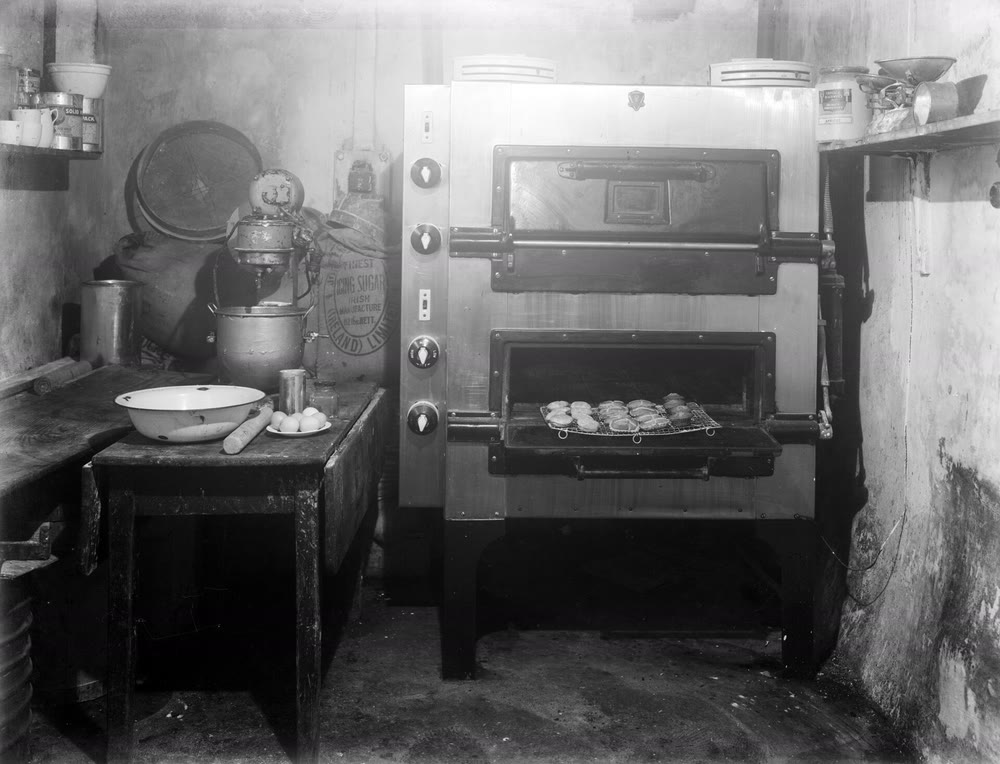
An electric oven at Phelan’s on Broad Street, Waterford, photographed for the ESB in May 1941. Photo: Poole Collection, National Library of Ireland, no known copyright restrictions, via Wikimedia Commons
The result was a coarse, dark loaf people called “black bread”. Writing for RTÉ Brainstorm, Adamson says the phrase was common in everyday speech, and that the censors banned it in January 1941 in case it drew attention to wartime hardship.
It had a hidden cost. High-extraction flour carries more phytic acid, which reduces the calcium the body can absorb. The first report of the National Nutrition Survey later called the unfortified bread an important factor in the high rate of rickets in Dublin, where most cases were among poor children. Extraction rates weren’t lowered until December 1943, and calcium wasn’t added to flour until June 1946.
Brown bread in Irish
- arán donn (roughly uh-RAWN DOWN; in Ulster, AH-run DON): brown bread. Ó Dónaill’s dictionary also gives arán rua (uh-RAWN ROO-uh).
- arán caiscín (uh-RAWN KASH-keen; in Munster, kash-KEEN): wholemeal bread. Wholemeal itself is min chaiscín (min KHASH-keen).
- bláthach (BLAW-hukh): buttermilk.
- triacla (TREE-uh-kluh): treacle.
Watch the fadas: it’s arán, not “aran”, and caiscín, not “caiscin”. And brown is donn; dubh means black.
Irish brown bread FAQ
What is the difference between Irish brown bread and soda bread?
Brown bread is a soda bread too, raised with bread soda and buttermilk, but made mostly with coarse wholemeal flour. In Ireland, “soda bread” on its own often means the white loaf.
Why did the sunflower seeds in my brown bread turn green?
Sunflower seeds are rich in chlorogenic acid, which reacts under alkaline conditions, like those bread soda creates, to form a green pigment, food scientists explained in the journal LWT in 2023. It’s a colour change, not mould.
Is there alcohol in Guinness brown bread?
A little can remain. The USDA’s nutrient retention tables estimate that alcohol stirred into a dish keeps about 35% after 30 minutes’ baking and 25% after an hour. If you need to avoid alcohol completely, use all buttermilk.
Can I make Irish brown bread without buttermilk?
Yes. For every US cup (240ml) you need, University of Illinois Extension suggests 1 tablespoon of lemon juice or vinegar plus enough milk to fill the cup, then a 5-minute rest. This loaf needs 1¾ to 2 cups.
Love this? Save it to your Pinterest board for later.
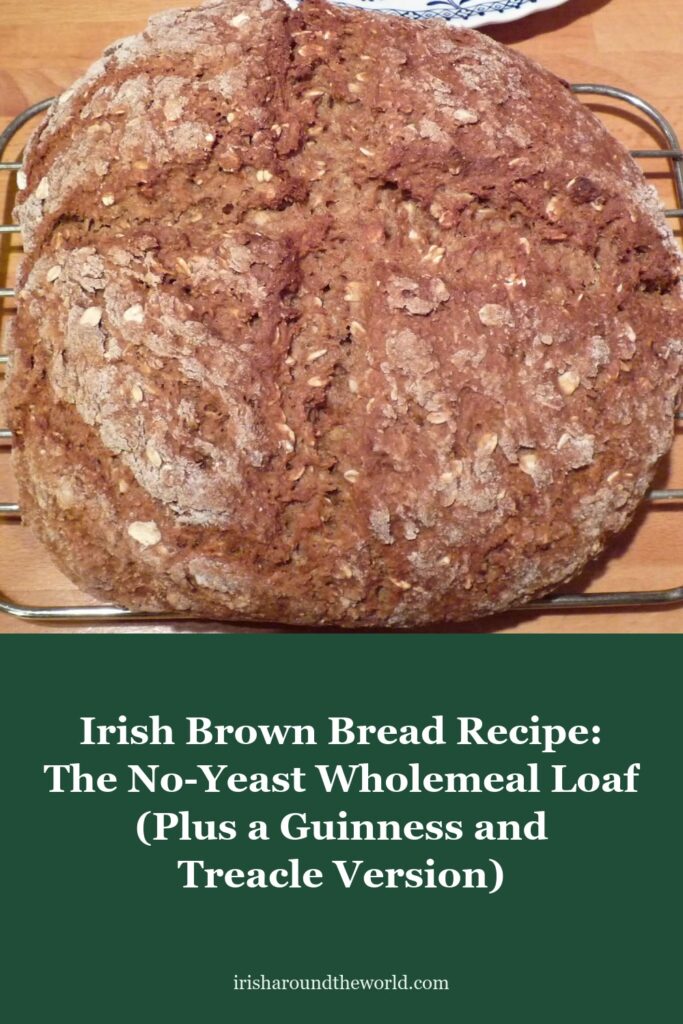
Pin image: A round brown soda loaf topped with oats, cooling on a wire rack. Photo (cropped): Michael Clarke, CC BY-SA 2.0, via Wikimedia Commons
A little bit of Ireland in your inbox every Friday ☘️
The free Weekly Dose of Irish: an Irish joke, a Celtic symbol, an Irish fact, a poem and the week’s best articles in one short email. Join 9,600+ readers.
Free. One short email every Friday. Unsubscribe any time.
More Irish recipes and food history
- Irish Soda Bread Recipe: The 4-Ingredient Loaf With a Cross to Keep the Fairies Away
- Full Irish Breakfast: What Goes on the Plate and How to Get It All Hot at Once
- Irish Stew Recipe: The Real Lamb-and-Potato Stew (and the Great Carrot Argument)
- Beef and Guinness Stew by The Wonky Spatula
- Top 10 Guinness-Drinking Countries (from Guinness) and 10 Guinness Facts
- Mossbawn: Sunlight by Seamus Heaney: The Poem About His Aunt Baking Bread
- The Irish Potato Famine (An Gorta Mór): Ireland’s Great Hunger, 1845 to 1852
Featured image: A round brown soda loaf topped with oats, cooling on a wire rack. Photo (cropped): Michael Clarke, CC BY-SA 2.0, via Wikimedia Commons.