
The best Irish blessing for friends is a short one. Slán agus beannacht (SLAWN AG-us BAN-ukht), “a farewell and a blessing”, suits any card, and Mo sheacht mbeannacht ort (muh HYAKHT MAN-ukht urt) means “my seven blessings on you”. The Irish for friend is cara (KAR-uh); to a friend’s face it’s a chara (uh KHAR-uh). Old Ireland had few blessings made only for friends, and most rhyming “Irish friendship blessings” online are modern and American. Every line below is marked, so you’ll know which is which.
Early in the ninth century, an Irish scholar was working through a Latin commentary on the Psalms. Beside a line about people tested by hard times, a note went in, part Irish and part Latin. In Stokes and Strachan’s 1901 translation it reads: “then friends are known when men are in periculis“, in dangers.
Ireland still says the same thing: Aithnítear cara i gcruatan (AH-nee-chur KAR-uh ih GROO-uh-tun), a friend is recognised in hardship. When the scholar T. F. O’Rahilly gathered his Miscellany of Irish Proverbs in 1922, he wrote: “None of our Irish proverbs can be traced further back in MS. than this.” The oldest Irish saying he could find in a manuscript was about a friend.
Blessings are a different story. The old people blessed friends, neighbours and strangers alike, so very few were made for friends alone, and the verses sold as “Irish friendship blessings” mostly started life in America.
So here are short lines to copy into a card for a birthday, Christmas, a move or a loss, plus toasts, proverbs and the Irish words for friend.
Jump to:
- How each line is marked
- Short Irish blessings for a friend
- How to say friend in Irish
- Birthday blessings for a friend
- Christmas card blessings for a friend
- Blessings for a friend moving away
- Blessings for the loss of a friend
- Irish toasts for friends
- Irish proverbs about friendship
- The “Irish” friendship blessings that aren’t
- Irish blessings for friends FAQ
- More Irish blessings
How each line is marked
- Traditional Irish: a phrase in the Irish language, recorded in a standard dictionary, a folklore archive or an old manuscript, with its source named. “Ó Dónaill” is Niall Ó Dónaill’s Irish-English dictionary of 1977, free on teanglann.ie. A dictionary shows that a phrase is established, not how old it is.
- Traditional: a line in English, written down from Irish people or translated from an early Irish text.
- Seanfhocal (SHAN-uk-ul): a proverb, literally an “old word”.
- Modern Irish: correct everyday Irish, but not an old saying.
- Modern Irish-American: an English verse whose earliest known printing is North American and fairly recent.
- New wording: written for this page, so copy it freely.
Short Irish blessings for a friend
These nine fit any card or text. Write the Irish first and put the English underneath.
- Slán agus beannacht (SLAWN AG-us BAN-ukht): a farewell and a blessing. The best all-round sign-off. Traditional Irish: Ó Dónaill.
- Mo sheacht mbeannacht ort (muh HYAKHT MAN-ukht urt): my seven blessings on you. Ó Dónaill’s English is “Good for you!”, so send it when a friend has done well. Traditional Irish: Ó Dónaill.
- God raise a friend for you. Said to someone in trouble, and written down by Maureen Walker at Gallow school, Co. Meath. Traditional: Schools’ Collection (1938).
- Go méadaí Dia thú, do stór (guh MAY-dee JEE-uh hoo, duh STORE): may God prosper you and increase your store. For the friend who helped you out. Traditional Irish: Ó Dónaill.
- Go maire tú! (guh MAR-uh too): may you live! Long life and congratulations in three words. Traditional Irish: Ó Dónaill.
- Beir bua agus beannacht (ber BOO-uh AG-us BAN-ukht): victory and a blessing. Ó Dónaill gives it as “I send you my best wishes”. Traditional Irish: Ó Dónaill.
- Ár mbeannacht leis an am a bhí (awr MAN-ukht lesh un AWM uh VEE): God be with the good old days. For someone you’ve known for ever. Traditional Irish: Ó Dónaill.
- It’s a cure for sore eyes to see you. P. W. Joyce recorded this as the greeting for a friend you hadn’t met in a long while. Traditional: Joyce, English As We Speak It in Ireland (1910).
- Do chara buan (duh KHAR-uh BOO-un): your constant friend. Sign your name under it. Traditional Irish: Ó Dónaill.
Plenty of these name God, because everyone’s speech once did. For a friend who’d rather leave God out, Slán agus beannacht, Go maire tú and Do chara buan all work.
A word on beannacht: there’s a faint y after the b, and in Munster the stress moves to the end (buh-NAKHT). Irish also changes with who you mean. Ort, tú and thú are for one person. To a couple or a family, say oraibh (OR-iv) and sibh (shiv). For every other occasion, see my 100 Irish blessings.
How to say friend in Irish
The Irish for friend is cara (KAR-uh), and it has love inside it. Alexander MacBain’s etymological dictionary ties the word to the Old Irish verb for “I love”, to Latin carus, dear, and to English charity.
| Irish | Say it | Meaning |
|---|---|---|
| cara | KAR-uh | friend, man or woman |
| a chara | uh KHAR-uh | friend, said to the person; also “Dear” on a letter |
| mo chara | muh KHAR-uh | my friend |
| cairde | KAWR-juh (KAR-juh in Ulster) | friends |
| a chairde | uh KHAWR-juh | friends, said to them |
| cairdeas | KAWR-jus (KAR-jus in Ulster) | friendship |
| cairdeas saoil | KAWR-jus SEEL | lifelong friendship |
| seanchara | SHAN-khar-uh | old friend |
| dlúthchara | DLOO-khar-uh | close friend |
| cara dílis | KAR-uh JEE-lish | true friend |
| an cara is fearr dá bhfuil agam | un KAR-uh iss FAR daw WIL AG-um | my best friend |
| Cairde go deo | KAWR-juh guh JOH | friends forever (correct Irish, but a modern phrase) |
All but the last are in Ó Dónaill or the modern dictionary focloir.ie. Cara stays the same for a woman or a man. For the soul friend, which began as a confessor in the early Irish church, see my guide to anam cara.
A few slips turn up on mugs and tattoos:
- A cara, mo cara: wrong. Both little words soften the c, so it’s a chara and mo chara, with the throaty ch of loch.
- Caras: wrong. The plural is cairde, and “my friends” is mo chairde (muh KHAWR-juh).
- Mo chara to their face: use a chara when you speak to a friend, as in Go raibh maith agat, a chara (guh rev MAH AG-ut, uh KHAR-uh), thank you, friend. Mo chara is for talking about them.
One trap for word lovers: Ó Dónaill has a second cairde, meaning respite or credit. It’s traced to an Old Irish word for a pact, which the ninth-century Psalm notes at the top of this page use for God’s covenant. A treaty, it seems, was a kind of friendship.
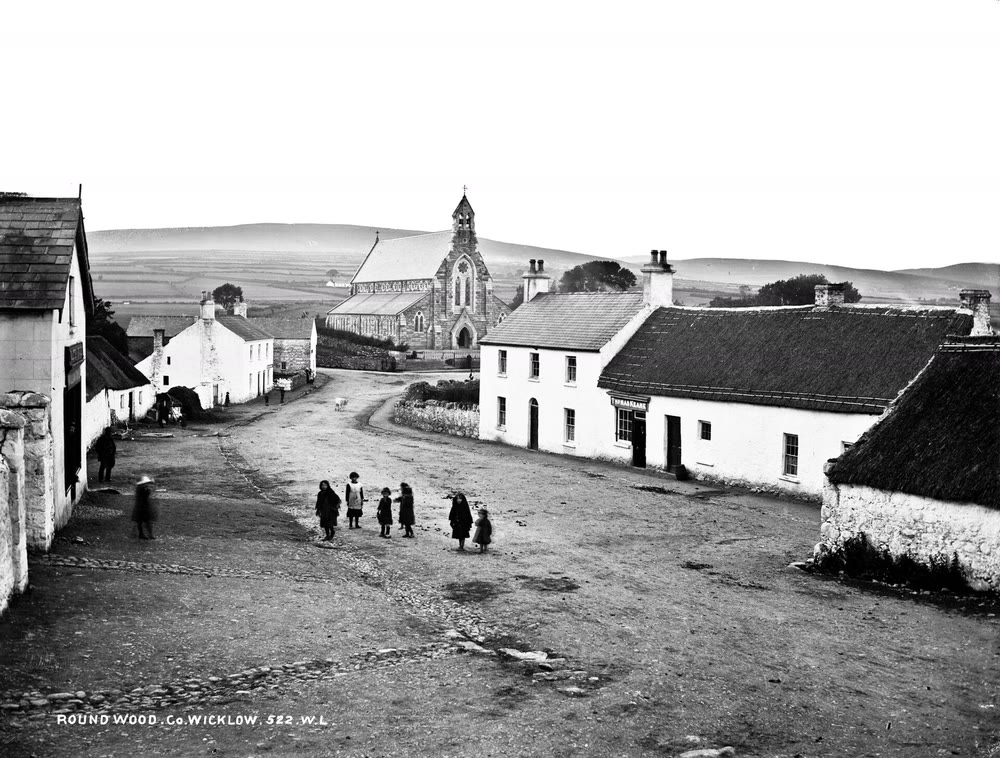
Children in the road at Roundwood, Co. Wicklow, probably in the 1880s. Photo: Robert French, Lawrence Collection, National Library of Ireland, via Wikimedia Commons
Birthday blessings for a friend
- Lá breithe sona duit, a chara (law BREH-huh SUN-uh ditch, uh KHAR-uh): happy birthday, friend. Modern Irish: focloir.ie.
- Go maire tú an lá (guh MAR-uh too un LAW): many happy returns. Traditional Irish: Ó Dónaill.
- Go maire tú an céad (guh MAR-uh too un KAYD): may you live to be a hundred. For a big birthday. Traditional Irish: Ó Dónaill.
- Go maire tú is go gcaithe tú é (guh MAR-uh too iss guh GAH-huh too AY): may you live to wear it. Lovely on a gift tag. Traditional Irish: Ó Dónaill.
- You know all my secrets. May your health last for ever and your memory go first. New wording.
- May you have as many years as you have stories, and may I be there for every retelling. New wording.
There are over a hundred more, old and new, in my Irish birthday blessings.
Christmas card blessings for a friend
If you only send one Irish line this Christmas, make it the third one here. It says all you’d want to say to a friend you don’t see enough.
- Nollaig shona duit, a chara (NUL-ig HUN-uh ditch, uh KHAR-uh): happy Christmas, friend. Traditional Irish: Ó Dónaill.
- Beannachtaí na Nollag ort (BAN-ukh-tee nuh NUL-ug urt): the blessings of Christmas on you. Modern Irish: focloir.ie.
- Go mbeirimid beo ar an am seo arís (guh MER-im-id byoh er un AWM shuh uh-REESH): may we live to see this time next year. In Connacht, Go mbeire muid beo (guh MER-uh mwid byoh). Traditional Irish: Ó Dónaill.
- A candle in the window for you this Christmas, wherever you are. New wording, after the old custom of the Christmas Eve candle.
My Irish Christmas blessings has 20 more.
Blessings for a friend moving away
Ireland has had more practice at this than most places. In 1910 Joyce defined the American wake as “a meeting of friends on the evening before the departure of some young people for America”. These lines suit a move across town or across an ocean.
- Go dté tú slán (guh JAY too SLAWN): may you go safely. Traditional Irish: focloir.ie.
- Go n-éirí d’imirce leat (guh NYE-ree JIM-ir-kuh lat): may your move go well. Imirce covers moving house and emigrating. Traditional Irish: Ó Dónaill, in the plural.
- Mo sheacht mbeannacht leat (muh HYAKHT MAN-ukht lat): my seven blessings go with you. Traditional Irish: Ó Dónaill.
- May the road between your door and mine stay short, whatever the map says. New wording.
- May the road rise up to meet you. The most famous goodbye of all, but just its opening goes back to Irish: Go n-éirí an bóthar leat (guh NYE-ree un BOH-har lat), may your journey go well. Modern Irish-American: earliest printing found, 1945.
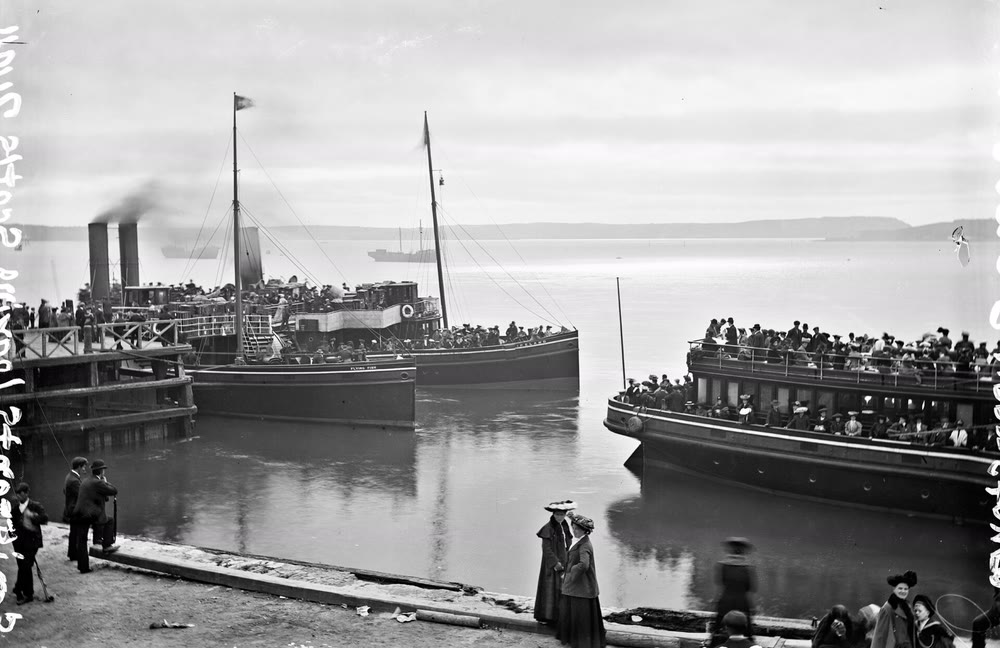
Emigrants leaving by tender from Scott’s Quay, Queenstown (now Cobh), Co. Cork, after 1891 and perhaps around 1900. Photo: Robert French, Lawrence Collection, National Library of Ireland, via Wikimedia Commons
Blessings for the loss of a friend
When a friend dies, the simplest words last longest. Of a person gone for good, whether by death or by leaving, Joyce wrote that people said “God be with him”, which he called “the concentration of human affection and regret, and also a prayer”.
- Dia leis (JEE-uh lesh): God be with him. For a woman, Dia léi (JEE-uh LAY). Traditional Irish: Joyce (1910).
- Ar dheis Dé go raibh a anam (er yesh JAY guh rev uh AN-um): may his soul be at God’s right hand. For a woman, a hanam (uh HAN-um). Traditional Irish: Ó Dónaill.
- Ní bheidh a leithéid arís ann (nee VEH uh leh-HAYJ uh-REESH awn; in Munster, nee VEG): we won’t see their like again. It suits a man or a woman and doesn’t mention God. Traditional Irish: Ó Dónaill, in the plural.
- Níl cara ag cumha ach cuimhne (neel KAR-uh eg KOO-uh okh KIV-nyuh): memory is grief’s only friend. Traditional Irish: Ó Dónaill.
- A good friend has gone on ahead. May the door be open and the fire lit. New wording.
To the family, say “I’m sorry for your trouble”, in Irish Ní maith liom do thrioblóid (nee MAH lum duh HRIB-lohj). Two favourites often passed off as Irish aren’t: “Do not stand at my grave and weep” is American, printed in 1934 under the name Clare Harner, though it’s often credited to Mary Elizabeth Frye, and “Death is nothing at all” comes from a 1910 sermon by the English priest Henry Scott Holland. For what to write in a sympathy card, see my Irish funeral blessings.
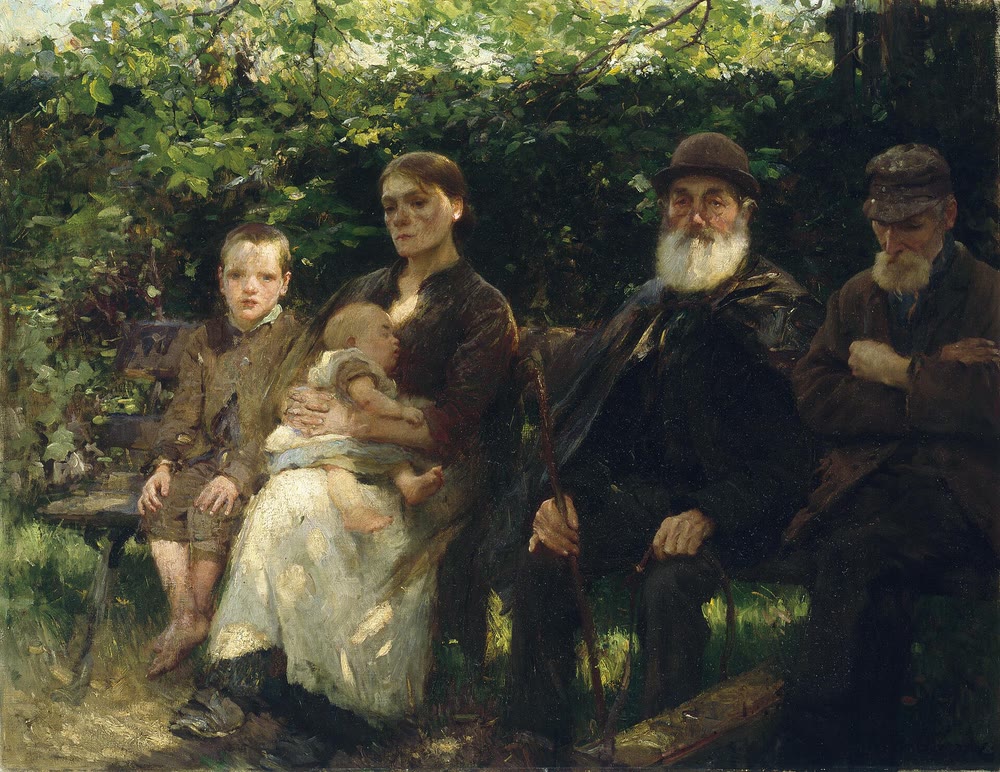
In a Dublin Park, Light and Shade, by Walter Osborne, 1895. National Gallery of Ireland. Public domain, via Wikimedia Commons
Irish toasts for friends
- Sláinte, a chairde (SLAWN-chuh, uh KHAWR-juh): health, friends. Modern Irish.
- Sláinte agus saol chugat (SLAWN-chuh AG-us SEEL HUG-ut): health and long life to you. To a group, chugaibh (HUG-iv). Traditional Irish: Ó Dónaill.
- Croí folláin agus gob fliuch (KREE FUL-awn AG-us GUB FLYUKH): a sound heart and a wet beak. Traditional Irish: Ó Dónaill.
- Slán beo lenar imigh uainn (slawn BYOH LEN-ur IM-ee OO-in): a fond farewell to all who have gone away from us. A fine Irish toast to absent friends. Traditional Irish: Ó Dónaill.
- A fewness of friends around ale. The Triads of Ireland, gathered in the later ninth century by Kuno Meyer’s reckoning, call it one of three fewnesses “better than plenty”. Is that because a small circle is the truest, or because there’s more ale to go round? They don’t say. Traditional: Meyer, The Triads of Ireland (1906).
For a longer night, I’ve checked the origins of 63 Irish toasts.
Irish proverbs about friendship
A proverb doesn’t wish you well. It tells you the truth, which a good friend might also do.
- Aithnítear cara i gcruatan (AH-nee-chur KAR-uh ih GROO-uh-tun): a friend is recognised in hardship. O’Rahilly traced the idea itself to the Book of Ecclesiasticus and the Roman poet Ennius, so it isn’t Ireland’s alone. Seanfhocal: focloir.ie; O’Rahilly, no. 274.
- Is maith an scáthán súil charad (iss MAH un SKAW-hawn SOOL KHAR-ud): a friend’s eye is a good mirror. Seanfhocal: Nicolson (1882), who notes it in Irish too.
- Ní buan cogadh na gcarad (nee BOO-un KUG-uh nuh GAR-ud): a quarrel between friends is soon healed. Perfect for a card that says sorry. Seanfhocal: Ó Dónaill; O’Rahilly, no. 173.
- Ar scáth a chéile a mhaireann na daoine (er SKAW uh HAY-luh uh WAH-run nuh DEE-nuh): people live in each other’s shelter. Seanfhocal: Ó Dónaill, which prints mhaireas.
The early Irish writers could be blunt too. The Triads list three things that get a friend hated: “trespassing, keeping aloof, fecklessness”. In the Instructions of King Cormac, which Meyer translated and dated to the ninth century at the latest, the legendary king recalls “I was gentle in friendship”, then warns that “every one is a friend till it comes to debts”.
There are 160 in all in my Irish proverbs. For the English lines people love to share, try my Irish sayings.
The “Irish” friendship blessings that aren’t
Search for an Irish friendship blessing and these soon turn up. Many are lovely, but the label on them is wrong.
| The line | Where it really comes from |
|---|---|
| “May there always be work for your hands to do…” | The verse with “the hand of a friend” in it. The earliest printing I can find is in a booklet of meditations by Church Women United of Northern California and Northern Nevada, from about 1971, headed “An Irish Blessing”. House Beautiful ran it in July 1973. I’ve found no Irish original. Modern Irish-American. |
| “Always remember to forget the friends that proved untrue…” | From a poem called “Remember”, printed in Pennsylvania in 1936 and credited to Levi Furbush, says Quote Investigator. The first Irish label it found is in Joan Larson Kelly’s gift book Irish Wit & Wisdom (1976), which has the verse above too. Modern Irish-American. |
| “May you always have walls for the winds…” | Barry Popik found it in an Edmonton, Canada, newspaper on St Patrick’s Day 1965, as a greeting from Ireland-born Maimie Boyle. A Pennsylvania paper took it from a St Patrick’s Day card that spring. I’ve found no older Irish source. Modern Irish-American. |
| “May your home always be too small to hold all your friends” | Popik’s earliest find is a reader’s letter in a “Hints from Heloise” column, 1966, and he knows of no Irish source. Modern Irish-American. |
| “May you have warm words on a cold evening…” | In print in America by the mid-1980s. President Reagan gave it at the Speaker’s St Patrick’s Day lunch in 1988. Modern Irish-American. |
| “May the roof above us never fall in…” | Popik traces an older form, “Here’s to the roof we are under”, to two American papers in 1912, one crediting the London Evening Standard, the other headed “Old English Toasts”. The Irish label turns up by 1980. |
| “May the hinges of friendship never grow rusty” | Scottish. Dean Ramsay printed it among toasts in his Reminiscences of Scottish Life and Character. |
| “A best friend is like a four-leaf clover…” | The earliest copies I can find date from about 2001, many of them in American school yearbooks. It’s in no Irish collection I’ve checked, and the Irish emblem has three leaves, not four. |
None of this makes them any less kind. Many have been printed, framed and loved for 50 years or more, and that’s a tradition of its own. Send them gladly. Just don’t call them ancient.
Irish blessings for friends FAQ
What is a good Irish blessing for a friend?
Slán agus beannacht (SLAWN AG-us BAN-ukht), “a farewell and a blessing”, suits any card. For a friend in a hard spot, there’s “God raise a friend for you”, from Co. Meath in 1938.
What does a chara mean?
Friend, said to the person. It also opens letters in Irish, doing the job of “Dear”, so a letter to Seán begins A Sheáin, a chara (uh HYAWN, uh KHAR-uh).
How do you say “my friend” in Irish?
Mo chara (muh KHAR-uh) when you’re talking about them, and a chara (uh KHAR-uh) when you’re talking to them. “My best friend” is an cara is fearr dá bhfuil agam.
What is an Irish blessing for a friend who has died?
Ar dheis Dé go raibh a anam (er yesh JAY guh rev uh AN-um), or a hanam (uh HAN-um) for a woman, wishes the soul a place at God’s right hand. Without God in it, try Ní bheidh a leithéid arís ann.
What is the Irish symbol of friendship?
The Claddagh ring. Its two hands are read as friendship, its heart as love and its crown as loyalty, and it has long been given as a friendship token as well as a wedding ring.
Love this? Save it to your Pinterest board for later.
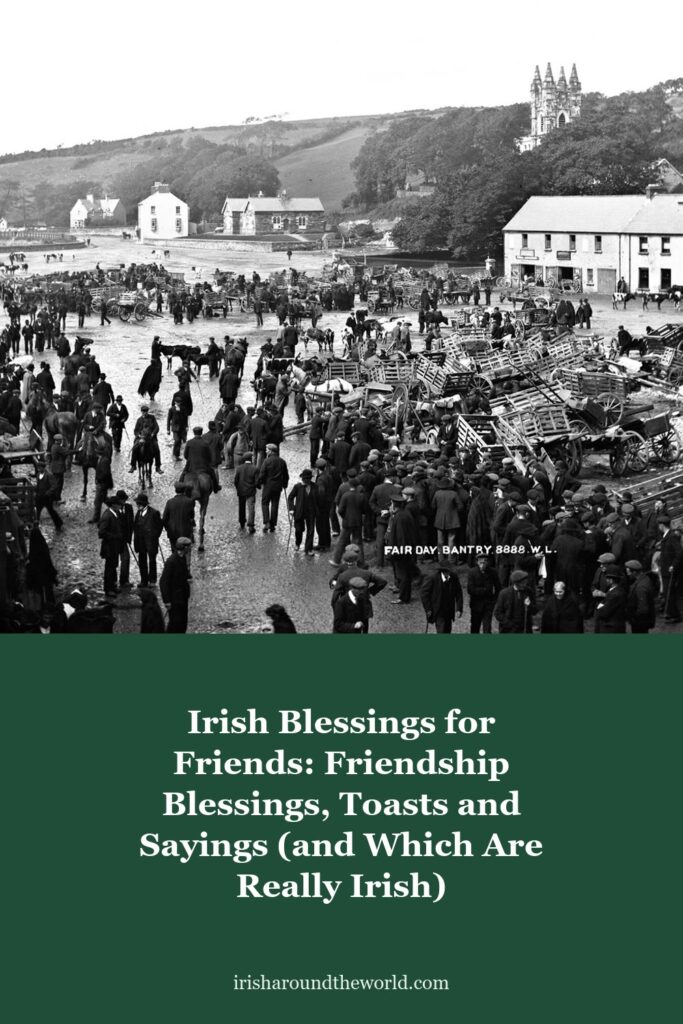
Pin image: Fair Day, Bantry, Co. Cork, perhaps in the 1890s or 1900s. Photo: Robert French, Lawrence Collection, National Library of Ireland, no known copyright restrictions, via Wikimedia Commons
A little bit of Ireland in your inbox every Friday ☘️
The free Weekly Dose of Irish: an Irish joke, a Celtic symbol, an Irish fact, a poem and the week’s best articles in one short email. Join 9,600+ readers.
Free. One short email every Friday. Unsubscribe any time.
More Irish blessings
- Irish Blessings: 100 for Every Occasion, in English and Irish (and Which Are Really Old)
- Anam Cara Meaning: How Ireland’s Soul Friend Went From Confessor to Soulmate
- Irish Proverbs: 160 Old Sayings With Meanings, in English and Irish
- 125 Incredible And Unique Irish Sayings And Irish Blessings
- 63 Irish Toasts for Every Occasion, and Which Ones Are Really Irish
- 100+ Irish Birthday Blessings, Wishes and Toasts (with Irish Translations)
- 20 Irish Christmas Blessings and How to Say Merry Christmas in Irish
- Irish Funeral Blessings and Prayers: Words of Comfort in English and Irish, and Their True Origins
Featured image: Fair Day, Bantry, Co. Cork, perhaps in the 1890s or 1900s. Photo: Robert French, Lawrence Collection, National Library of Ireland, no known copyright restrictions, via Wikimedia Commons.