Anthony Daly is a song by the blind poet Antoine Ó Raifteirí, Raftery in English, about a man hanged at Seefin, near Craughwell, Co. Galway, in April 1820. It mourns Daly as a hero brought down by false oaths, curses the people blamed for his death, and says even the stars and birds grieve. Below are the full public-domain Irish text from Douglas Hyde’s 1903 edition, a plain English translation, the history and notes for Leaving Cert Higher Level Irish in 2027 and 2028.
On a spring day in 1820, a one-eyed carpenter was driven to a hill in east Galway, sitting on his own coffin in a cart. That’s the story Lady Gregory was told in south Galway some eighty years later.
The man was Anthony Daly. Tradition says Raftery stood in the crowd and made a song about the hanging. Part of it survived, and it’s now one of the five extra poems for Higher Level Irish. For the whole course, see my guide to the Leaving Cert Irish poems for 2027 and 2028.
Jump to:
- Anthony Daly at a glance
- The poem in Irish
- English translation, verse by verse
- Who was Anthony Daly?
- The story behind the poem
- Themes
- Imagery, tone and technique
- Key Irish words and phrases
- Exam notes: what an answer could discuss
- Who was Raftery?
- Anthony Daly FAQ
- More Irish poetry reading
Anthony Daly at a glance
- Poet: Antoine Ó Raifteirí (roughly AN-tin-yuh oh RAF-tir-ee), about 1779 to 1835. The exam circular spells him Antaine Raiftearaí.
- Form: a song in the amhrán (OW-rawn) metre, a stressed metre built on repeated vowel sounds. Hyde’s text has six verses of eight lines.
- Exam: Higher Level only, poem (v) of section 3(b), Additional Poetry, for June 2027 and June 2028, in circular 0041/2026. The edition named is Ciarán Ó Coigligh’s Raiftearaí: Amhráin agus Dánta (1987).
The poem in Irish
This is the text Douglas Hyde printed in Abhráin atá Leagtha ar an Reachtúire, or Songs Ascribed to Raftery (Dublin, 1903), pages 128 to 132, set out from the scans on the Internet Archive. Hyde used the old Gaelic letters, where a dot over a consonant does the job of a following h, so a dotted b appears here as bh. Otherwise the spelling is his, from before the modern standard: Gaédhil for Gaeil, díoghaltas for díoltas.
Hyde, Raftery’s first modern editor, pieced the song together from verses held by several men, and he called the result only a fragment.
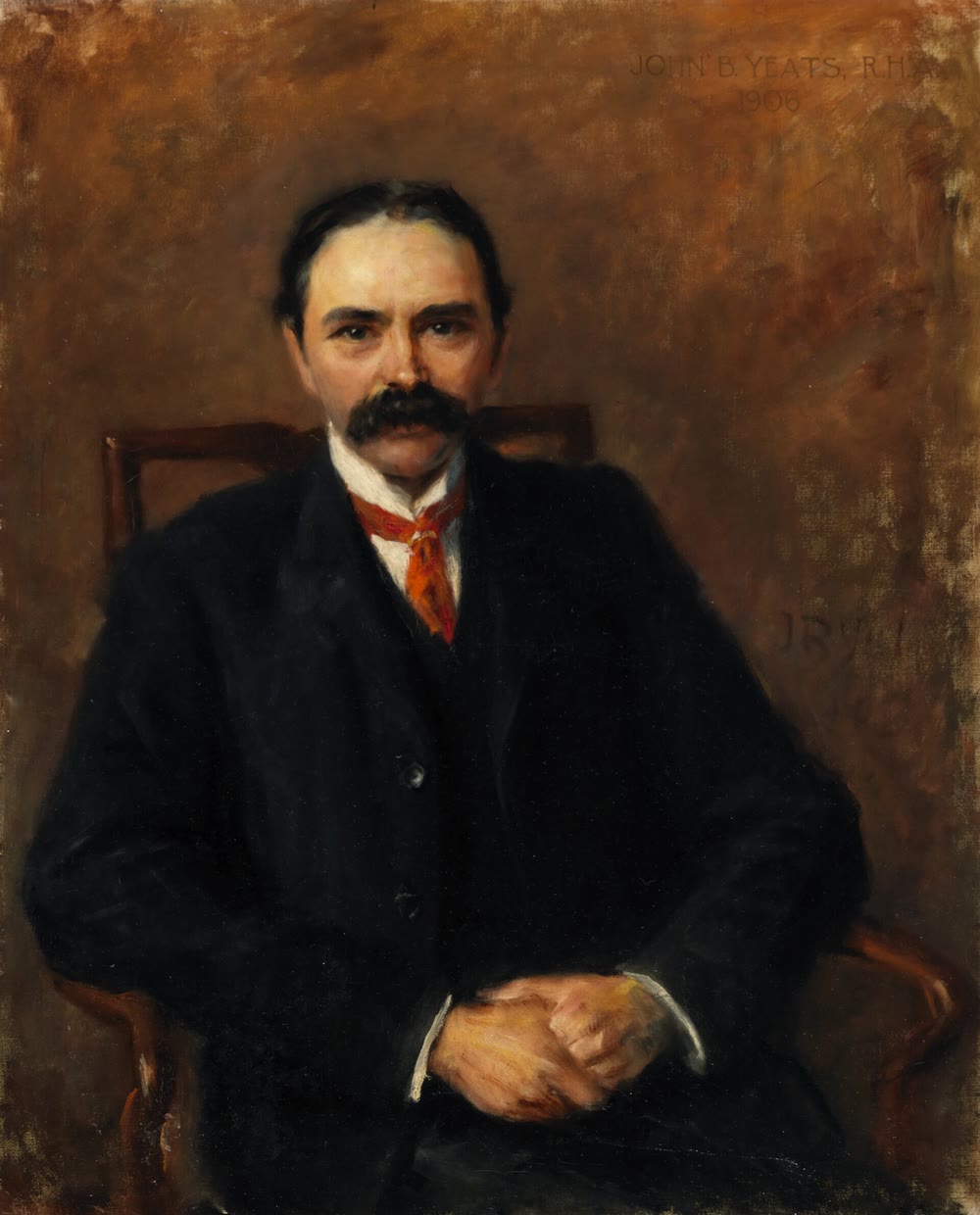
Douglas Hyde, later Ireland’s first President, painted by John Butler Yeats in 1906. National Gallery of Ireland. Public domain, via Wikimedia Commons (CC BY 4.0)
Antoine O Dálaigh
Tráthnóna Aoine an Chéasta,
Bhí na Gaédhil faoi miorsa ag na Gaill,
Comhthrom an laé chéadna,
Do bhí Aon-mhac Mhuire in san gcrann.
Tá súil le Mac Dé ‘gam,
‘Sé mo leun! a’s gan maith ar bith dhó ann,
‘S gur b’é Cullen ‘s a chéile
Chroch Daly, a’s go dtugaid díol ann.
Acht a bhean óg, le m’ raé
Cuirim éag ar an mbaile ‘mbéidhir ann,
Aicid agus éag air,
A’s go n-éirighidh an tuile os a cheann,
Ní peacadh ar bith an méad sin,
A Dhia ghlégil, is é guidhim le fonn
Ar an bhfear do chroch Daly
‘S d’fhágbhaigh a ghaolta ag gol ‘s a chlann.
Is maith díoghaltas Dé
An té d’fhéadfadh fanacht le na am.
Gach peacadh d’á léightear
Go h-éag go bhfairidh (?) ar an dream.
‘S iad an dá Shéimín
Le sgéim do shocruigh an plan,
An méad nach bhfairfidh orra féin
An sgéal céadna go bhfairidh ar a gclainn.
Ó síneadh do ghéaga
Tá an t-aér in a mhuirt os ar gcionn
Ní lasann na réalta
A’s na h-éisg, ní phreabann ar tuinn.
Ní thagann drúcht ar an bhféar
A’s na h-éanlaith, ní labhraid go binn,
Le cúmha do dhiaigh, Daly,
Go h-éag ní thig toradh ar chroinn.
A’s siúd é an fíréan
Nár úmhlaigh ‘s nár ísligh do Ghaill,
Antoine O Dálaigh (a Mhic Dé!)
Gan bhréig do bhídeadh againn gach am.
Acht d’éag sé ‘na Ghaedheal mhaith
Agus d’aon fhear níor chlaon sé a cheann,
A’s gur teann-mionnaidh éithigh
Chroch Daly, agus neart cloinne Gall.
Dá mbéinn-se mo chléireach
Lághach, éadtrom, aigeanta ar pheann,
Is deas do sgríobhfainn do thréithre
I nglan-Ghaedheilge ar leac os do cheann.
Míle a’s ocht gcéad
An sé déag, ‘s an ceathair ‘na cheann,
Ó thuirling Mac Dé
Gur éag Daly, i gCaisleán Suidhe Finn.
The question mark in verse 3 is Hyde’s.
English translation, verse by verse
This translation is ours, kept plain and close to the Irish. Where a line is unclear, I’ve followed Hyde’s literal notes.
Verse 1: Good Friday
On the evening of Good Friday
the Gaels lay at the mercy of the foreigners;
on that very day of the year
Mary’s only son hung on the tree.
I put my trust in the Son of God,
but, my sorrow, it does Daly no good now,
and it was Cullen and his wife
who hanged him. May they pay for it.
Daly’s death is set beside the Crucifixion; the tree is the Cross, as often in Irish. Cullen and his wife are the couple blamed for betraying him. Hyde felt something was amiss here: one source hopes for “a long day”, a reprieve, which he thought made better sense.
Verse 2: The curse on the village
But, young woman, as long as I live
I lay death on whatever village you live in:
sickness and death on it,
and let the flood climb over it.
There’s no sin at all in that,
bright God. This is my eager prayer:
let it fall on the man who hanged Daly,
leaving his kin and children in tears.
The young woman isn’t named; Cullen’s wife is the obvious guess. Irish poets had used curses as weapons for centuries, as my guide to old Irish curses explains.
Verse 3: God’s vengeance
God’s vengeance is good
for anyone who can wait for its hour.
May every evil you could read of
stalk that crowd until they die.
It was the two little Jameses
who schemed and laid the plan,
and whatever of my curse misses them,
may the same fate find their children.
Séimín, Hyde explains, is a scornful pet form of Séamas, James. The poem never says who the two Jameses were.
Verse 4: Nature mourns
Since your limbs were stretched out in death,
the air above us has turned thick and foul.
The stars give no light,
and the fish don’t jump in the waves.
No dew forms on the grass;
the birds don’t sing sweetly.
For grief at losing you, Daly,
no tree will bear fruit again.
Irish uses the same verb for the dead: Ó Dónaill gives bhí sé sínte marbh, he was stretched out dead (more in my guide to the Irish wake). Hyde says Daly went to Seefin on a fine April day with the birds singing, which makes this silence starker.
Verse 5: A true man
And there’s the righteous man
who never bent or bowed to a foreigner,
O Son of God, Anthony Daly,
always one of us, and that’s no lie.
He died a good Gael
and lowered his head to no one,
and it was bold false oaths that hanged Daly,
and the strength of the foreigners’ children.
Here is the poem’s charge: perjury. A fíréan is a just or righteous person.
Verse 6: If I could write
If I were a clerk,
good-natured, nimble and lively with a pen,
I’d write out your fine qualities
in pure Irish on a stone above your head.
One thousand, eight hundred,
sixteen, and four on top of that,
since the Son of God came down
till Daly died at Seefin Castle.
Lady Gregory says Raftery, being blind, never wrote his songs down, so the wish for a pen is touching. The sum gives 1820.
Who was Anthony Daly?
Anthony Daly, Antoine Ó Dálaigh in Irish (roughly AN-tin-yuh oh DAW-lee), was a carpenter and, in Hyde’s words, “a captain of the Whiteboys”.
The Whiteboys, Na Buachaillí Bána (nuh BOO-uh-khil-ee BAW-nuh), first appeared in south-east Tipperary in 1761, writes the historian Eoin Magennis. Named for their white shirts, they swore whole communities to secrecy and fought over tithes, rents and land. Under the first Whiteboy Act of 1765, administering their oaths could be punished by death.
What the records say
The Ennis Chronicle of 15 April 1820 reported Daly convicted at the Galway Assizes of breaking into a house and administering unlawful oaths, and sentenced to hang on Seafin hill on 8 April. Two days later the Clare Journal said he had been hanged at Seafin Hill, near Craughwell, on “Saturday”, with no date.
8 April 1820 was a Saturday, and the English epitaph Hyde printed (an inaccurate copy, he said, of the words on Daly’s tomb) gives the same date, so it’s the likeliest day. Good Friday that year was 31 March; the poem doesn’t say what happened that evening.
In 1906, asked about a Sinn Féin fundraiser for a tombstone on Daly’s grave, the Chief Secretary, James Bryce, told the House of Commons he couldn’t establish Daly’s exact offence. An official letter said “for an attack on a house”, Hansard records, and locally Daly was remembered as a Ribbonman, a member of another secret society of the time.
What folk memory says
Folk memory differs. A man swore that Daly had shot at him. Daly, who had one eye, said that if he had fired he wouldn’t have missed, offered to prove his aim, and said nothing else. He never named the other Whiteboys.
An account written down at Leac Dhearg (Lickerrig) school in the late 1930s, now in the Schools’ Collection, says the shot was fired at a Burke of St Clerans, the family into which Robert O’Hara Burke, of the Burke and Wills expedition, was born in 1821.
He rode to Seefin on his coffin, the story goes, past crowds begging him to run, and Irish soldiers in the guard promised to fire into the air. He made no move to escape. He’s buried at Kilreekill, which Hyde spelled Kilreacle and placed about four miles east of Loughrea.
Was he guilty? Nobody can tell: the court convicted him, and the people who kept his memory believed him innocent.
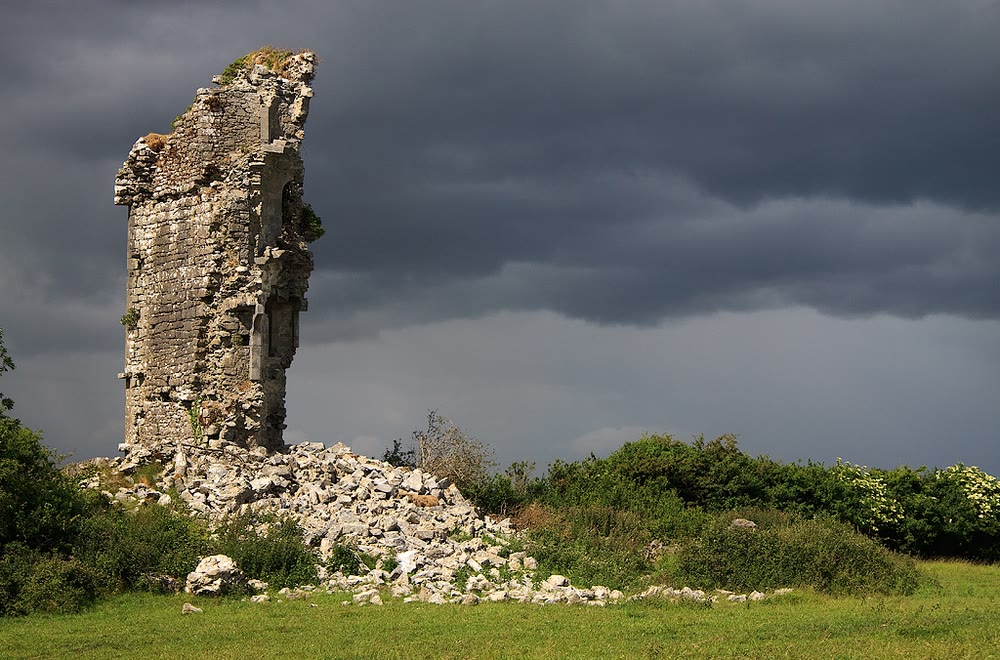
The ruined castle at Seefin, near Craughwell, Co. Galway. Photo: Mike Searle, CC BY-SA 2.0, via Wikimedia Commons
The story behind the poem
Lady Gregory printed the story in Poets and Dreamers (1903). Her informant said a man in Gort had seen the hanging while planting potatoes at Seefin, and that Raftery was there and composed a song on it. Its first verse, he said, praised Daly as a good tree that let none of its branches fall: Daly died without naming his comrades. Hyde never found that verse.
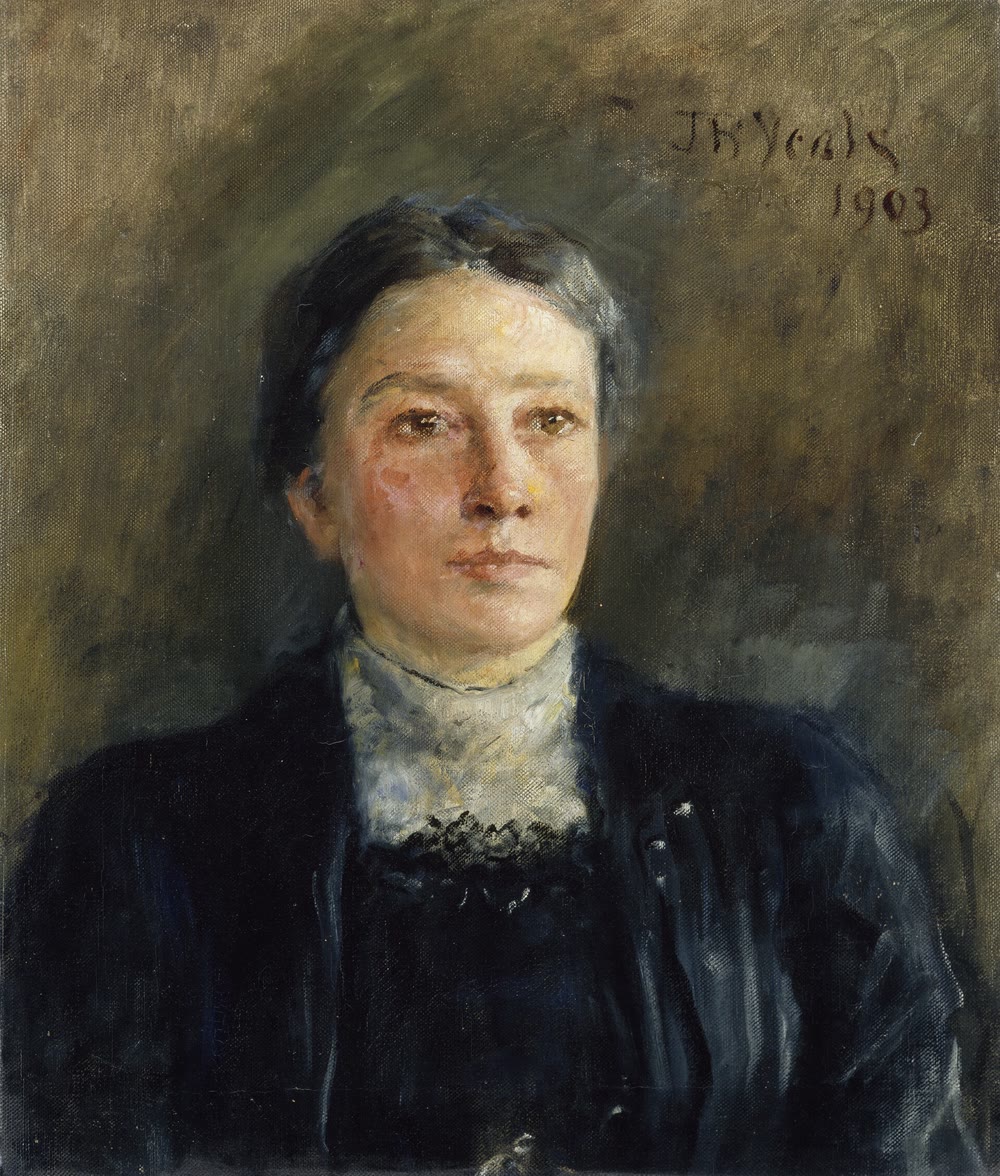
Augusta, Lady Gregory, painted by John Butler Yeats in 1903. National Gallery of Ireland. Public domain, via Wikimedia Commons (CC BY 4.0)
People believed the curse worked. The informers’ family, Gregory was told, lost their land and most of their children. In her prose they are only “the two Z’s”; her translation of the song names Conall and his wife, Hyde’s text has Cullen, and one of his sources has Cellin. A neighbour of hers had heard that grass never grew again at Seefin.
Themes
Betrayal and injustice. The poem blames informers and perjury (mionn éithigh, a false oath). “Chroch Daly”, hanged Daly, opens the last line of verses 1 and 5, and verse 2 repeats it.
Faith and vengeance. Raftery sets Daly beside Christ, then curses and tells God it’s no sin.
Gael and Gall. He frames the case as the native Irish against the foreigner, blaming “the strength of the foreigners’ children”, probably meaning the landowning class of English descent. That’s the poem’s view, and it fits his other songs, which backed Catholic Emancipation and Daniel O’Connell.
Grief and nature. In verse 4 the whole world mourns. Cill Chais grieves the same way, with silent birds.
Heroism and memory. Daly is a fíréan who never bowed. Verse 6 wishes for a gravestone in pure Irish; his tomb carried English verse, and Hyde called the copy he printed “very bad”.
Imagery, tone and technique
- The tree, the Cross and the gallows: crann is a tree, but Ó Dónaill gives an crann céasta for the Cross and crann na croiche for the gallows. Croch is a cross or a gallows, and the verb chroch means hanged. Christ on the tree, Daly on the gallows and the fruitless trees of verse 4 share one word family.
- Curse formulas: cuirim éag ar (I lay death on), go n-éirighidh an tuile (may the flood rise), go dtugaid díol ann (may they pay for it). In Irish, file (FIL-uh) means a poet, and Ó Dónaill also gives “satirist”.
- Sound: Hyde notes that every verse uses the same sounds: an internal rhyme on an “ay” vowel (Chéasta, chéadna, Dé, chéile) and line endings on a vowel before nn, ll or m (Gaill, gcrann, ann). Even the English name Daly, said DAY-lee, fills the “ay” slot.
- Repetition and address: Daly’s name rings through every verse but the third, and Raftery speaks to the young woman, to God and to Daly.
- Tone: grief, fury, desolation, pride, then tenderness.
Key Irish words and phrases
Meanings are checked in Ó Dónaill’s dictionary on teanglann.ie, with Hyde’s spelling in brackets where it differs. The respellings are rough and lean towards Connacht Irish, Raftery’s own.
| Irish | Meaning | Say it |
|---|---|---|
| Aoine an Chéasta | Good Friday, literally Friday of the Crucifixion | EE-nyuh un KHAY-stuh |
| Gael / Gall | an Irish person / a foreigner (historically Norse, Norman or English) | GAYL / GAWL (GOWL in Munster) |
| crann | tree; also the Cross and the gallows | KRAWN (KROWN in Munster) |
| croch, chroch | cross, gallows; hanged | KROKH, KHROKH |
| mo léan (mo leun) | my grief, alas | muh LAYN |
| díoltas Dé (díoghaltas) | God’s vengeance | JEEL-tus JAY |
| cumha (cúmha) | grief, loneliness, parting sorrow | KOO-uh |
| fíréan | a just, righteous person | FEER-ayn |
| mionn éithigh | a false oath, perjury | MYOON AY-hee |
| Suí Finn (Suidhe Finn) | Seefin, usually explained as “Fionn’s seat” | see-FIN |
Spelling watch: Raifteirí and Raiftearaí both end in a fada, though Raifteiri is common online. Older English books call Daly O’Daly.
Exam notes: what an answer could discuss
You’ll answer in Irish, so have the words ready: téama (theme), mothúcháin (feelings), íomhánna (images), mallacht (curse), éagóir (injustice), brathadóir (informer), comhfhuaim (assonance), athrá (repetition) and pearsantú (personification).
- The poet’s feelings: brón (sorrow) in verses 1 and 4, fearg (anger) in 2 and 3, bród (pride) in 5.
- Curse and religion: how can a poem that likens Daly to Christ curse a whole village? Discuss Ní peacadh ar bith an méad sin.
- Nature and the hero: verse 4, image by image, plus fíréan, nár úmhlaigh and Gaedheal maith in verse 5.
- Background: section 4 of the circular says short questions may ask about the poet, the background and the context. Know the 1820 hanging, the Whiteboys, Raftery’s blindness and how the song survived.
- Comparison: Úirchill an Chreagáin, the other pre-1850 poem on the course, also sets the Gael against the foreigner.
One caution: Hyde’s text is not the exam text. Ó Coigligh’s edition may differ in spelling, wording and verse order, so learn the version in your class book and check with your teacher. This is an unofficial study guide.
Who was Raftery?
Antoine Ó Raifteirí came from Killedan (Cill Liadáin), near Kiltimagh in Co. Mayo. He was born on 30 March 1779, according to James Hardiman, who knew him slightly; his editor Ó Coigligh accepts that date, says ainm.ie, though you’ll also see 1784. His father, a weaver from Co. Sligo, came to work for the Taaffe family, and smallpox blinded the boy at about five.
He spent the rest of his life wandering east Galway as a fiddler and poet. About fifty of his compositions survive, some 4,000 lines, writes the scholar Neil Buttimer, among them Anois Teacht an Earraigh and Máire Ní Eidhin. ainm.ie suggests he may have been a Whiteboy or Ribbonman himself. Be careful with Mise Raifteirí an File: scholars now think Seán Ó Ceallaigh composed it, and it was first printed in 1882.
Raftery died near Craughwell around Christmas 1835 and is buried at Killeeneen. On 26 August 1900, Lady Gregory, Hyde, W.B. Yeats and Edward Martyn were there when a stone was placed on his grave.
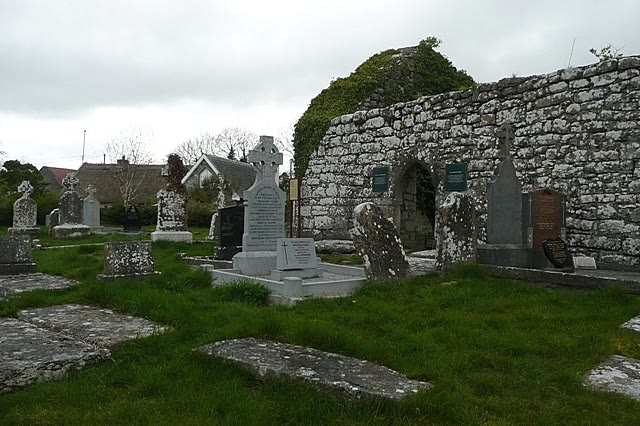
The old church and graveyard at Killeeneen, Co. Galway, where Raftery is buried. Photo: Graham Horn, CC BY-SA 2.0, via Wikimedia Commons
James Stephens made an English version, Anthony O’Daly (1918), which Samuel Barber set for unaccompanied choir. For more, see my guide to famous Irish poets, the great lament Caoineadh Airt Uí Laoghaire, and the poet-teachers of the hedge schools.
Anthony Daly FAQ
What is the poem Anthony Daly about?
Raftery’s lament for Anthony Daly, hanged at Seefin, Co. Galway, in 1820. It blames informers and false oaths, curses them, and praises Daly as a man who never bowed.
When was Anthony Daly hanged?
Most likely on Saturday 8 April 1820: the date the Ennis Chronicle gave for his execution, and the date in the English epitaph Hyde printed.
Is Anthony Daly on the Leaving Cert?
Yes, for Higher Level Irish in June 2027 and June 2028, as one of five Additional Poetry poems. Higher Level students study this poetry or the additional prose.
Did Raftery write Anthony Daly?
Tradition, Hyde and the prescribed edition all give it to him, though Hyde’s title, Songs Ascribed to Raftery, is an honest reminder that these songs survived by word of mouth.
Love this? Save it to your Pinterest board for later.
Pin image: A meadow between Craughwell and Seefin, Co. Galway. Photo: Sarah777, CC BY-SA 2.0, via Wikimedia Commons
A little bit of Ireland in your inbox every Friday ☘️
The free Weekly Dose of Irish: an Irish joke, a Celtic symbol, an Irish fact, a poem and the week’s best articles in one short email. Join 9,600+ readers.
Free. One short email every Friday. Unsubscribe any time.
More Irish poetry reading
- Leaving Cert Irish Poems 2027 and 2028: The Full List, Explained
- Mise Raifteirí an File: The Blind Poet’s Famous Irish Poem
- Anois Teacht an Earraigh by Raifteirí: Irish Text and Meaning
- Caoineadh Airt Uí Laoghaire: The Greatest Lament in the Irish Language
- Cill Chais (Kilcash): The Irish Poem and Its Meaning
- Old Irish Curses: Cursing Stones, the Widow’s Curse and ‘May the Cat Eat You’
- Famous Irish Poets: The Greatest of All Time, in Order
Featured image: A meadow between Craughwell and Seefin, Co. Galway. Photo: Sarah777, CC BY-SA 2.0, via Wikimedia Commons.