
Old Irish curses were wishes of real harm, not swear words. In medieval stories, a poet’s satire could raise blisters on a king’s face. Later, people most feared a wronged widow’s or a priest’s curse, and turned “cursing stones” against enemies at places like Killinagh, Co. Cavan, and Inishmurray, Co. Sligo. Irish still has dozens of curses, from Imeacht gan teacht ort (may you go and never come back) to Mallacht mo chait ort (my cat’s curse on you). The 1951 Mayo curse is a legend, and Mayo finally won the All-Ireland again in July 2026.
Picture a poet on a hilltop at sunrise, a hawthorn at his back, a stone and a thorn in his hand, chanting a king into ruin. That’s how one medieval Irish text says a poet’s curse should be made.
An Irish curse was a wish for real harm, and people believed it could land.
If May the road rise up to meet you is the Irish blessing everyone knows, these are its dark twins, just in time for Halloween. For eejit, gobshite and the rest, see my Irish insults.
Jump to:
- A curse is not a swear word
- Bardic satire: the poems that raised blisters
- The widow’s curse and the priest’s curse
- Cursing stones: Killinagh, Inishmurray and HMS Wasp
- Irish curses in Irish (Gaelic), with translations
- The Mayo curse: a legend from 1951
- Irish curses FAQ
- More Irish folklore reading
A curse is not a swear word
Irish has separate words for the two, though they blur at the edges. A mallacht (MAL-akht; in Munster the stress moves to the end, mal-AKHT) is a curse. Swearing is mionnaí móra (MIN-ee MOH-ruh), literally “big oaths”, and an eascaine (ASK-in-yuh) can be a curse or a swear word.
The 19th-century scholar John O’Donovan wrote that a curse, “once pronounced, must fall in some direction”. If the target deserved it, it struck him. If not, it flew back at the sender, like a wedge that springs out of a log and hits the woodcutter between the eyes.
W. G. Wood-Martin, who quotes him in Traces of the Elder Faiths of Ireland (1902), adds the folk belief that a curse could hang in the air for seven years, hovering over its target like a hawk. Fear of a curse coming home, he says, stopped many rash ones.
Like many Irish superstitions, it shaped manners: Lady Wilde wrote in 1890 that offering your left hand in greeting was unlucky, since the left hand was for cursing.
Bardic satire: the poems that raised blisters
In the early Irish stories, the most feared curse came from a poet. The file (FIL-uh), the trained poet, could praise a patron into glory or mock him into shame, and in the old texts the shaming works like magic. Old Irish called satire áer; modern Irish has aoir (roughly EER, or AIR in Munster).
The first satire in Ireland
Cormac’s Glossary, compiled around 900, quotes a line from a poem by Coirpre against Bres, king of the Tuatha Dé Danann, and calls it the first satire made in Ireland. The saga Cath Maige Tuired tells the story behind it.
Bres put the visiting poet in a dark, cramped hut with no fire and no bed, and fed him three small, dry cakes. Coirpre left next morning without a word of thanks, chanting a verse that wished on Bres no food, no milk, no shelter at night and nothing to pay storytellers with. From that hour, the saga says, Bres only declined.
Three blisters for King Caier
One manuscript of Cormac’s Glossary tells a darker tale. Caier, king of Connacht, had adopted his nephew Néde, a poet. Caier’s queen wanted Néde, and since a blemished king could not stay king, she urged him to satirise her husband. Caier refused Néde nothing, so she named the one thing he was forbidden to part with: a dagger brought from Alba (Scotland).
Néde asked for it, Caier refused, and Néde made a glám dícenn. eDIL, the dictionary of medieval Irish, defines it as a verse curse believed to leave a blister or blemish on its victim’s face.
“Evil, death, short life to Caier!” it begins, in the 1868 English edition. Next morning at the well, Caier found three blisters on his face, red, green and white, named Stain, Blemish and Defect. He fled in shame. When Néde tracked him down a year later, Caier died at the sight of him, and a splinter from the rock he hid under flew up into the poet’s head.
Why Ferdiad fought his foster-brother
Satire even drives the saddest episode of the Táin. Ferdiad won’t fight his foster-brother Cú Chulainn, so in the Book of Leinster version Queen Medb sends druids and satirists to threaten him with satires that would raise three blisters, “Blame, Blemish and Disgrace” in Joseph Dunn’s 1914 translation. In Cecile O’Rahilly’s translation, the blisters would kill him within nine days. Ferdiad goes. He’d rather fall to a spear than to a poem.
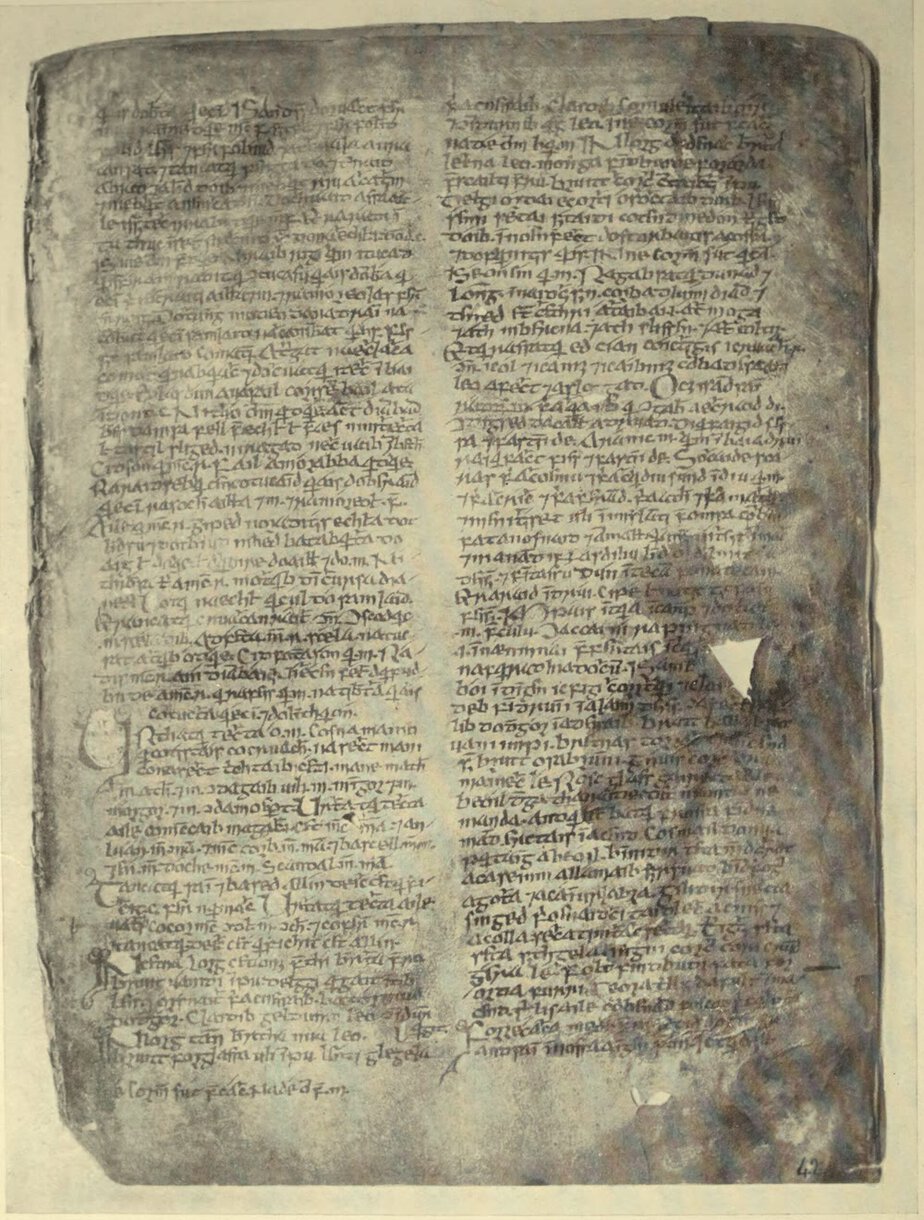
Page 55 of the Book of Leinster, the 12th-century manuscript that holds the longer version of the Táin, from the facsimile plate in Joseph Dunn’s 1914 translation. Public domain, via Wikimedia Commons
The ritual on the hilltop
A Middle Irish treatise on poetry sets out what poets should do when a king refused to pay for a poem. After fasting, the chief poet climbed at sunrise to a hilltop where seven territories met, with six fellow poets and a hawthorn at their backs. Each chanted a verse into a stone and a thorn. If the poets were in the wrong, the hill swallowed them; if the king was, the earth took him, his wife, son, horse, weapons, clothes and hound.
In 1912 the scholar Fred Norris Robinson suggested that some poet with a taste for ritual had invented or embellished it. But the early Irish law tracts show satire was taken seriously: one lists seven kinds that earned compensation, from a nickname that sticks to sneering at someone’s looks.
Rhyming rats to death
Elizabethan writers made a joke of it. Sir Philip Sidney’s Defence of Poesy pointedly spares poetry’s scorners from being “rhymed to death, as is said to be done in Ireland”, and Shakespeare’s Rosalind, buried in love poems in As You Like It, jokes: “I was never so berhymed since Pythagoras’ time, that I was an Irish rat.”
The idea had Irish roots. In a medieval comic tale, retold by Lady Wilde in 1887, the poet Seanchán (SHAN-uh-khawn) satirises the mice that stole his egg, and ten drop dead. Then he blames the cats, and Irusan, king of the cats, carries him off on his back until St Ciarán (KEER-awn) kills the beast with a red-hot iron bar. Irusan even made my list of Irish cat names.
The widow’s curse and the priest’s curse
In later folk belief, the curses people dreaded came from the powerless and the holy. Schoolchildren gathering folklore in the late 1930s for the Schools’ Collection, now on dúchas.ie, heard story after story:
- Tulla, Co. Clare: a grandmother told of a landowner who killed a poor widow’s hens for scratching in his garden. She cursed him, and when he died, feathers grew out through his body.
- Co. Roscommon: a farmer of 65 told of a hard landlord who squeezed every halfpenny from his tenants but feared the widow’s curse, so he never evicted a widow.
- Co. Limerick: an evicted widow cursed her evictors so that nothing bought from them would bring luck. A widow’s curse, the storyteller said, was always expected to come true.
Priests were believed to curse as well as bless, and those stories end with a family dying out or a house falling in:
- Belcarra, Co. Mayo: a man of 80 told of Fr O’Donnell, slandered by gossip from the house where he lodged. Cleared, he left for America, but first cursed the house to stand roofless and empty. The pupil wrote that the ruin still stood.
- Kilmurry, Co. Clare: after a row over fair dues, the priests cursed the Corrys, owners of the fair green, never to have a Corry left in Kilmurry. The family died out.
Ó Dónaill’s dictionary even carries a warning: Ná cuir mallacht Dé ar aon duine (naw kur MAL-akht JAY er ayn DIN-yuh), don’t call God’s curse down on anyone.
Cursing stones: Killinagh, Inishmurray and HMS Wasp
Some curses needed a ritual and a place. At old church sites and holy wells, mostly in the west of Ireland, people turned rounded stones to curse an enemy. To bless, you went deiseal (JESH-al), sunwise. To curse, Wood-Martin says, you went tuathal (TOO-uh-hal), against the sun. Ó Dónaill’s dictionary gives tuathal as anticlockwise, and also as a blunder.
Killinagh, Co. Cavan: St Brigid’s Stones
Near the ruined church of Killinagh, close to Blacklion and Lough MacNean, three boulders sit side by side. Hollows called bullauns dimple their tops, eleven in the largest, and each holds a smooth, rounded stone. Locally they’re St Brigid’s Stones, and the National Monuments Service records that they were once used for cursing. The surveyors add a fair caution: the round stones were probably put there in fairly recent times.
Inishmurray, Co. Sligo: the speckled stones
The most famous set is on Inishmurray, an island off the Sligo coast with an early monastery linked to St Molaise. Inside its stone enclosure, the Cashel, stands an altar heaped with rounded cobbles: the Clocha Breaca (KLUKH-uh BRAK-uh), the speckled stones. Older books spell it Clocha Breacha.
The National Monuments Service counts fifteen cross-carved stones in the set. Eight are still on the island, and most of the rest are in the National Museum of Ireland. The finest carvings may date from the late 800s to the 1000s, which dates the carving, not the cursing.
The cursing is first recorded in 1603, on Captain John Baxter’s map of north-west Ireland: anyone the island’s holy man, Scanlon, turned the speckled stones against “shall dye within that yeare”. Lady Wilde wrote in 1887 that wronged islanders turned the stones while cursing an enemy, who would die or meet disaster within the year. A Scripture reader who carried one off to prove it was superstition, she added, had to bring it back and leave the island.
The stones were said never to count the same twice. The last 46 islanders left in 1948, The Irish Times has reported.
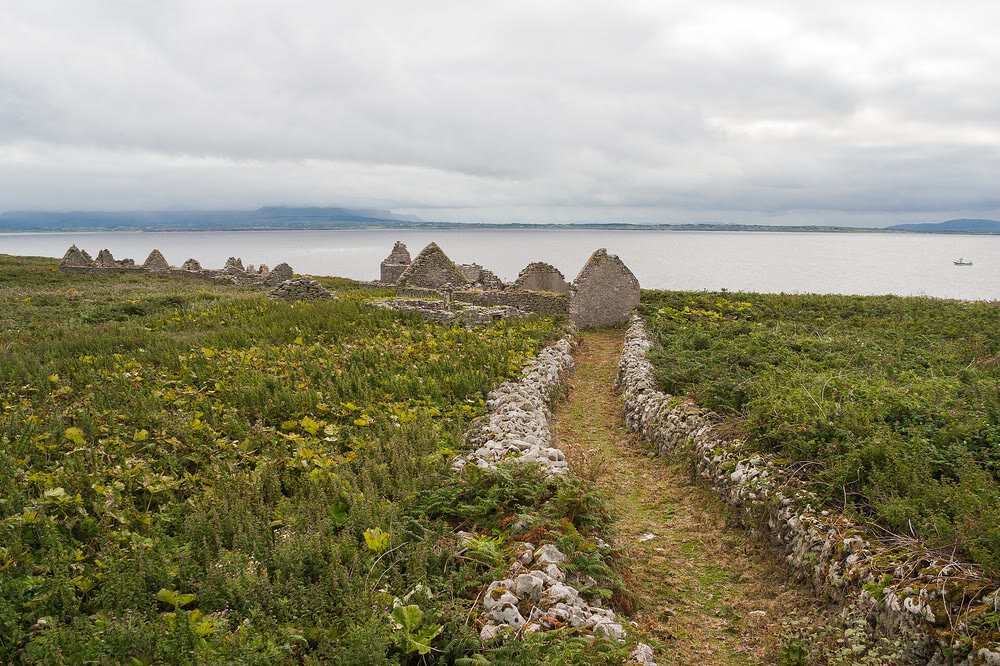
A walled path on Inishmurray, seen from the monastic enclosure known as the Cashel, with ruined stone buildings and Sligo Bay beyond. Photo: Andreas F. Borchert, CC BY-SA 4.0, via Wikimedia Commons
More cursing stones and rituals
- Kilcummin, Co. Mayo: a man of 81 told a 1930s pupil that turning a graveyard stone at night raised a storm to sweep your enemy away. After a woman used it on a neighbour, Ballina priests buried half of it and took the other half away.
- Caher Island, Co. Mayo: people wrongly slandered fasted and prayed to God and St Patrick before sailing out to turn a stone on the church altar, John O’Donovan recorded. Storms were said to follow.
- The Fire of Stones: Wood-Martin describes a curse done at home. You piled river stones on your hearth like turf and prayed your enemy would suffer until they burned, then scattered them into bogs and lakes so the curse would last until they were gathered again.
The wreck of HMS Wasp
Just before 4 a.m. on 22 September 1884, the Royal Navy gunboat HMS Wasp hit the rocks below Tory Island lighthouse, off Donegal. Fifty men drowned and six survived, History Ireland reports. She was on her way to help evict the people of Inishtrahull, but Tory legend says she was coming for them, and the islanders turned their cursing stone and sank her in a calm sea. A court-martial blamed navigational error.
Wood-Martin’s generation called all this pagan survival, but take that label with care. The cursing stones we know sit at Christian sites, some carry crosses, and the Caher Island ritual was a prayer to God and the saints. Cursing wasn’t witchcraft either; for Ireland’s handful of real witch trials, see my guide to Irish witches.
Irish curses in Irish (Gaelic), with translations
In the late 1930s, the boys of Smerwick national school in the Kerry Gaeltacht wrote down 82 curses for the Schools’ Collection. Here are some of the best, in modern standard spelling, checked against Ó Dónaill’s dictionary. Respellings are rough guides.
- Mallacht Dé ort (MAL-akht JAY urt): God’s curse on you.
- Mallacht na baintrí ort (MAL-akht nuh BAN-tree urt): the widow’s curse on you.
- Mallacht mo chait ort (MAL-akht muh KHATCH urt): my cat’s curse on you. It’s on two Smerwick lists, unexplained.
- Imeacht gan teacht ort (IM-akht gon CHAKHT urt): may you go and never come back.
- Fán fada ort (fawn FAD-uh urt): long wandering on you.
- Scread mhaidine ort (shkrad WAJ-in-yuh urt): a morning scream on you, recorded in Clifden, Co. Galway. Ó Dónaill gives “Confound them!”
- Marbhfháisc ort (roughly MAR-uv-awshk urt): literally, a corpse’s binding cloth on you. Ó Dónaill’s polite English is “Bad cess to you!”
- Droch-chríoch ort (drukh KHREE-ukh urt): a bad end to you.
- Go ndéana an diabhal dréimire de chnámh do dhroma (guh NAY-nuh un JOWL DRAY-mir-uh deh khnawv duh GHRUM-uh): may the devil make a ladder of your backbone. Diabhal sounds closer to DEE-ul in Munster.
- Go mbrise an diabhal do dhá chos (guh MRISH-uh un JOWL duh ghaw KHUSS): may the devil break your two legs.
- Go dtuga an diabhal coirce duit (guh DUG-uh un JOWL KUR-kuh ditch): may the devil give you oats. Ó Dónaill reads it as “The devil mend you!” A 1930s version from Killasser, Co. Mayo, adds “and little stones through it”.
- Go n-ithe an cat thú, is go n-ithe an diabhal an cat (guh NIH-huh un KAT hoo, iss guh NIH-huh un JOWL un KAT): may the cat eat you, and may the devil eat the cat.
That last one is the internet’s favourite, and it’s good Irish: go n-ithe is the wishing form of ith, to eat. Online it often loses its hyphen and fadas (“go nithe an cat thu”). But it isn’t in Ó Dónaill’s dictionary, Lady Wilde or Wood-Martin, and a search of the Schools’ Collection finds no trace of it, so take any “ancient” label with a pinch of salt. For a cat curse with real folk pedigree, try Mallacht mo chait ort.
Most Irish curses are more inventive than vicious. For the kinder side of the language, try my Irish proverbs.
The Mayo curse: a legend from 1951
Ireland’s most famous modern curse belongs to Gaelic football. Mayo won the All-Ireland in 1950 and 1951, then waited 75 years for another.
The usual legend says the 1951 team, coming home with the Sam Maguire Cup, passed a funeral in Foxford without showing due respect, and the parish priest cursed them: Mayo would not win again while any of that team lived. Versions differ. ESPN reports that no evidence from the time has ever come to light, and that many researchers think the story only took off decades later, as the defeats piled up.
Between 1989 and 2021, Mayo lost eleven All-Ireland finals, two after replays. In 2013 the Foxford priest Fr Padraig Costello, who has long said there’s nothing in the curse, blessed that year’s team on Foxford’s bridge over the Moy, where the curse was supposedly laid. They lost that final too.
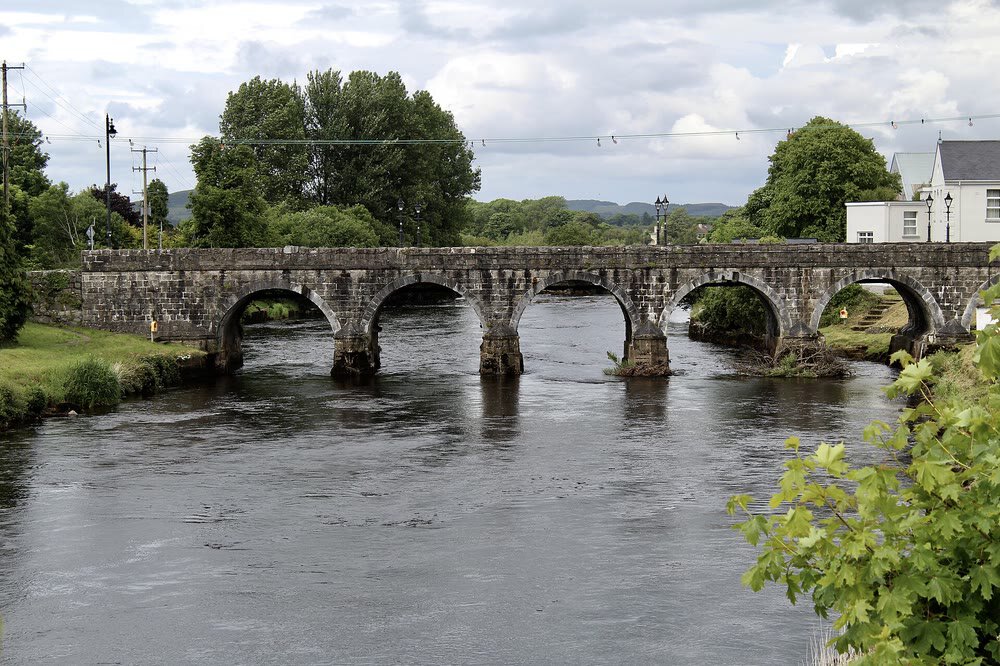
The bridge over the River Moy at Foxford, Co. Mayo, where legend places the 1951 curse. Photo: Western Kerr, CC BY-SA 4.0, via Wikimedia Commons
Paddy Prendergast, the last of the 1951 starting team, died in September 2021 aged 95, two weeks after Mayo lost that year’s final to Tyrone. Dr Mick Loftus, a substitute in 1951 and the last survivor of that panel, died in April 2023.
Then, on 26 July 2026, Mayo beat Kerry 1-20 to 1-17 at Croke Park, RTÉ reported, their first All-Ireland since 1951. Still, The Irish Times noted, the new champions went home by train, bypassing Foxford, and when their coach met a funeral in Balla, it stopped in silence until the funeral had passed.
Believers will point out that the cup came home only after the whole 1951 panel had passed away. Everyone else will point to a very good team.
Irish curses FAQ
What is the Irish word for a curse?
Mallacht (MAL-akht). To curse someone is mallacht a chur ar dhuine. A swear word is an eascaine or a mionn mór.
What is the worst Irish curse?
There’s no official ranking. Lady Wilde thought “the curse of Cromwell on you” the bitterest in English. In folk belief, the most feared were a wronged widow’s curse and a priest’s.
What does “Go n-ithe an cat thú” mean?
May the cat eat you, usually followed by “and may the devil eat the cat”. It’s correct Irish, but hard to trace in older folklore collections.
What is a cursing stone?
A rounded stone, usually at an old church site or holy well, that people turned against the sun while cursing an enemy.
Is the Mayo curse real?
It’s a legend with no evidence from the time, and Mayo won the All-Ireland on 26 July 2026.
Can an Irish curse be lifted?
An undeserved curse was supposed to rebound on the curser, and Wood-Martin wrote that one person’s blessing could soften another’s curse. In Co. Sligo, he recorded, a person cursed with the stones might be laid in a dug grave while three shovelfuls of earth were thrown over him.
Love this? Save it to your Pinterest board for later.
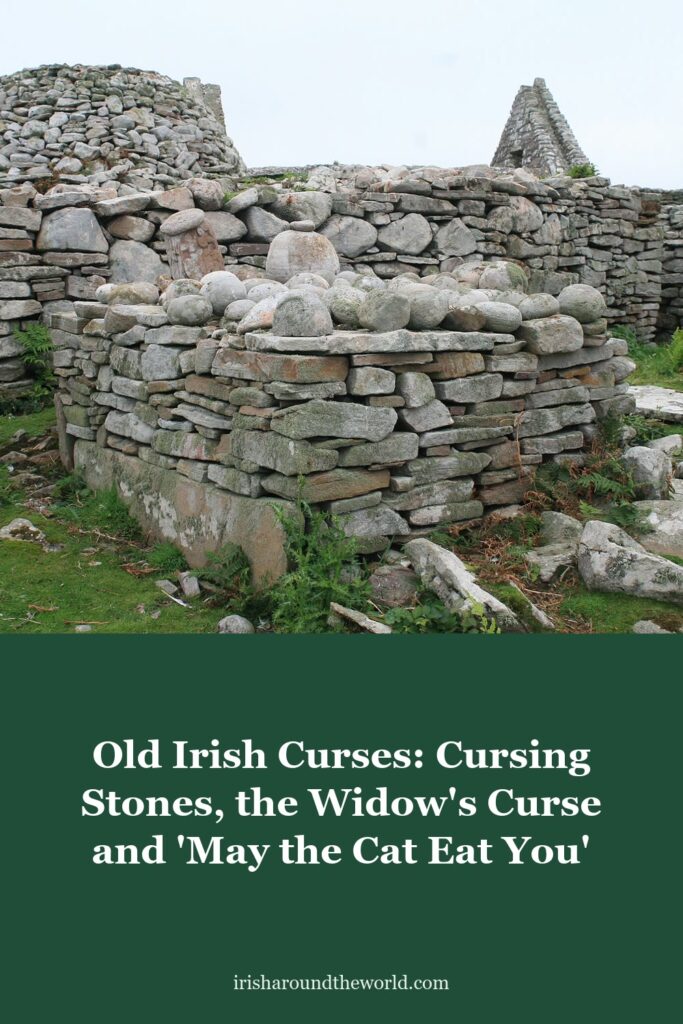
Pin image: The Clocha Breaca cursing stones, Inishmurray, Co. Sligo. Photo: Andreas F. Borchert, CC BY-SA 4.0, via Wikimedia Commons
A little bit of Ireland in your inbox every Friday ☘️
The free Weekly Dose of Irish: an Irish joke, a Celtic symbol, an Irish fact, a poem and the week’s best articles in one short email. Join 9,600+ readers.
Free. One short email every Friday. Unsubscribe any time.
More Irish folklore reading
- The Greatest Irish Insults and Curse Words (and What They Mean)
- The Táin: How a Royal Bedtime Row Over a Bull Started Ireland’s Greatest Epic
- Tuatha Dé Danann: How Ireland’s Old Gods Lost a War and Became the Fairy Folk
- How the Irish Invented Halloween: Samhain, Turnip Lanterns, Barmbrack and the Best Festivals in Ireland
- Irish Mythological Creatures: 23 Fairies, Monsters and Death Omens to Know
Featured image: The Clocha Breaca, the cursing stones of Inishmurray, Co. Sligo, on their altar inside the island’s monastic enclosure. Photo: Andreas F. Borchert, CC BY-SA 4.0, via Wikimedia Commons.