Úirchill an Chreagáin (roughly OOR-hil un KHRAG-awn), The Churchyard of Creggan, is an aisling, or vision poem, by Art Mac Cumhaigh (about 1738 to 1773) of south Armagh. Asleep in Creggan churchyard, the grieving poet is greeted at dawn by a fairy woman’s kiss and invited to a land beyond the foreigners’ power. He mourns the O’Neills, then asks one promise: wherever he dies, he’ll be buried at Creggan. It’s a common poem for Leaving Cert Irish, Ordinary and Higher Level, in 2027 and 2028.
It opens with a strange picture: a man asleep among the graves, kissed at daybreak by a beautiful woman.
It’s the oldest poem named on the new course, and the only common poem composed before 1850, the course’s cut-off for older poetry. It was one of only two or three songs to survive in local memory after Irish faded as the everyday language of Oriel, a region including south Armagh, says the Oriel Arts project. Énrí Ó Muirgheasa, who edited Mac Cumhaigh’s songs in 1916, called it “the national anthem of South Ulster”, notes ainm.ie.
For the full course, see my guide to the Leaving Cert Irish poems for 2027 and 2028.
Jump to:
- Úirchill an Chreagáin at a glance
- The poem in Irish and English
- The aisling and the spéirbhean
- Creggan churchyard and the O’Neills of the Fews
- Who was Art Mac Cumhaigh?
- Themes: loss, exile, death and longing
- Imagery and key phrases
- Leaving Cert exam notes
- Úirchill an Chreagáin FAQ
- More Irish poetry and Leaving Cert reading
Úirchill an Chreagáin at a glance
- The title: úir (oor) is earth or soil (dul san úir means to be buried) and cill (kill) a church or churchyard, says Ó Dónaill’s dictionary; creagán is rocky or stony ground.
- The poet: Art Mac Cumhaigh (art mok KOO-ee), or Art McCooey. The circular spells it Airt Mac Cumhaidh.
- On the course: section 2(a)(v), common prescribed poetry, Ordinary and Higher Level, June 2027 and 2028, in circular 0041/2026. The only source named is Duanaire na hArdteistiméireachta.
Older sources spell it Úrchill or Úir-Chill. Without fadas, uirchill an chreagain is fine for searching but not for the exam.
The poem in Irish and English
No copy in Mac Cumhaigh’s hand survives, and versions differ in spelling, wording and number of verses. Your anthology may print fewer verses, in a different order and spelling, so learn the exam wording from your own book.
Our text is in modern spelling. Verse 1 follows the oldest printing we could read, Lorcán Ó Muireadhaigh’s Amhráin Chúige Uladh (1927), page 36, at the Irish Traditional Music Archive, but with ainnir, a young woman, for its an iníon, the girl. Verses 2 to 9 follow Oriel Arts, edited from Tomás Ó Fiaich’s and Breandán Ó Buachalla’s editions. The translation is ours.
1. The poet
Ag Úirchill an Chreagáin sea chodail mise aréir faoi bhrón,
is le héirí na maidne tháinig ainnir fá mo dhéin le póig;
bhí gríosghrua ghartha aici agus loinnir ina ciabh mar ór,
is gurb é íocshláinte an domhain bheith ag amharc ar an ríon óig.
It was at Creggan churchyard I slept last night, full of sorrow,
and as morning broke, a young woman came to me with a kiss.
Her cheeks were glowing warm, her hair gleamed like gold,
and just to gaze on the young queen would heal the whole world.
2. The spéirbhean
A fhialfhir charthanaigh, ná caitear thusa i néalta bróin,
ach éirigh go tapaidh agus aistrigh liom siar sa ród
go tír dheas na meala nach bhfuair Gallaibh inti réim go fóill,
is gheobhair aoibhneas ar hallaí do do mhealladh le siansa ceoil.
Kind, generous man, don’t let yourself sink in clouds of grief.
Get up quickly and travel west with me along the road
to the fair land of honey, where no foreigner has yet held sway,
and you’ll know delight in halls, charmed by strains of music.
3. The poet
A ríon dheas mhilis, an tú Helen fár treaghdadh slóigh,
nó an de na naoi mná deasa Pharnassus thú a bhí déanta i gcló?
Cad é an tír sa chruinne inar hoileadh thú, a réalt gan cheo,
lenar mhian leat mo shamhailse a bheith ag cogarnach leat siar sa ród?
Sweet, lovely queen, could you be Helen, over whom armies were cut down,
or one of the nine fair women of Parnassus, taking human shape?
What country on earth reared you, star without a mist,
that you’d want the likes of me murmuring with you on the westward road?
4. The spéirbhean
Ná fiafraigh díomsa ceisteanna, óir ní chodlaim ar an taobh seo den Bhóinn;
is síogaí beag linbh mé a hoileadh le taobh Ghráinne Óig;
i mbruíon cheart na n-ollamh bím go follas ag dúiseacht an cheoil;
bím san oíche i dTeamhair is ar maidin i lár Thír Eoghain.
Ask me no questions, for I never sleep on this bank of the Boyne.
I’m a small fairy child, brought up beside Gráinne Óg.
In the poets’ true fairy palace I openly wake the music.
At night I’m in Tara, and by morning in the heart of Tyrone.
5. The poet
‘Sé mo ghéarghoin tinnis gur theastaigh uainn Gaeil Thír Eoghain,
agus oidhrí an Fheadha gan seaghais faoi liag dár gcomhair;
géaga glandaite Néill Fhrasaigh nach dtréigfeadh an ceol,
is a chuirfeadh éideadh fá Nollaig ar na hollaimh a bheadh ag géilleadh dóibh.
My sharp, sore wound is that we have lost the Gaels of Tyrone,
and the heirs of the Fews lie joyless under the stone before us:
the bright branches of Niall Frasach, who would never forsake music,
and who’d give clothes at Christmas to the poets who served them.
6. The spéirbhean
Ó treaghdadh na treabha a bhí in Eachroim is, faraor, fán Bhóinn,
sliocht Íre na flatha a bhéarfadh foscadh do gach draoi gan ghleo,
nach mb’fhearr duit sna liosa agus mise le do thaobh gach nóin
ná saighde Chlann Bhullaí a bheith ag tolladh trí do chroí go deo?
Since the clans were cut down at Aughrim and, alas, at the Boyne,
the race of Ír, princes who’d shelter every man of learning without a murmur,
wouldn’t you be happier in the fairy forts, with me at your side each evening,
than to have the arrows of Clann Bhullaí forever piercing your heart?
7. The poet
Ní dhiúltfainn do chuireadh ar a gcruinníonn na ríthe d’ór,
ach gur cladhartha liom scaradh le mo chairde atá sa tír go fóill;
an céile úd a mheall mé le mo ghealladh tráth a bhí sí óg,
dá dtréigfinn anois í, is feasach dom go mbeadh sí i mbrón.
I wouldn’t turn down your invitation for all the gold that kings could gather,
but it would be a coward’s act to leave my friends still here in the land,
and the wife I won with my promises when she was young:
if I abandoned her now, I’m sure she’d be left grieving.
8. The spéirbhean
Ní shílim gur caraid duit a maireann de do ghaolta beo;
tá tú gan éideadh, gan earra, ach bearránach bocht baoth gan dóigh.
Nach mb’fhearr duitse imeacht le hainnir na maothchrobh méar
ná na tíortha a bheith ag fonóid fá gach rann dá ndearna tú a cheol?
I don’t believe any of your kin still living is a friend to you.
You’ve no clothes and no belongings: a poor, foolish rascal with no prospects.
Wouldn’t you be better off going with the maiden of the soft, tender hands
than having the whole countryside jeer at every verse you ever put to music?
9. The poet
A théagair is a chuisle, más cinniúint duit mé mar stór,
tabhair léagsa is gealladh dom ar maidin sula dtéim sa ród:
má éagaim fán tSionainn, i gCríoch Mhanann nó san Éigipt mhór,
gurb ag Gaeil chumhra an Chreagáin a leagfar mé i gcré faoi fhód.
My darling, my heart’s pulse, if it’s fated that I’m to be your love,
give me your pledge and promise this morning, before I take the road:
if I die by the Shannon, in the Isle of Man or in great Egypt,
it’s among the sweet-smelling Gaels of Creggan I’ll be laid in the clay under the sod.
Notes: some versions have céibh, an older form of ciabh, hair. Bhéarfadh (would give) is Ulster for thabharfadh, and dhiúltfainn (would refuse) a dialect form of dhiúltóinn. Oriel Arts prints meor for méar, finger, keeping the ó rhyme, and léigse for léagsa, a pledge.
The aisling and the spéirbhean
An aisling (ASH-ling) is a vision, and also a vision poem, says Ó Dónaill. In the political aisling of the 1700s, a downcast poet meets a radiant woman, the spéirbhean (SPAYR-van). She usually stands for Ireland and often promises help from France, Spain or the Stuart prince, notes the Doegen Records project at the Royal Irish Academy. The Kerry poet Aogán Ó Rathaille made the form into high art, as my guide to famous Irish poets explains.
Mac Cumhaigh keeps the sleeping poet, the dawn visitor and the question “who are you?”, asked with classical names: Helen of Troy, or one of the nine Muses of Parnassus. Unlike the Munster poets of his day, the Doegen notes point out, he gets no promise of rescue, only an invitation to leave his hard life. Monsignor Réamonn Ó Muirí, editor of the journal Seanchas Ard Mhacha, puts it differently: Mac Cumhaigh’s hope lay with the O’Neills, not the Stuarts.
She’s also plainly a fairy. She calls herself a síogaí linbh (SHEE-uh-gee LIN-iv), which Ó Dónaill translates as an elf-child or changeling, and tempts him with the liosa (LISS-uh), the fairy forts. Yet she talks of Tyrone, the Boyne, Aughrim and the royal seat of Tara, Teamhair (TYOW-er; see my Hill of Tara guide). You can read her as a fairy lover, as Ireland, or as both.
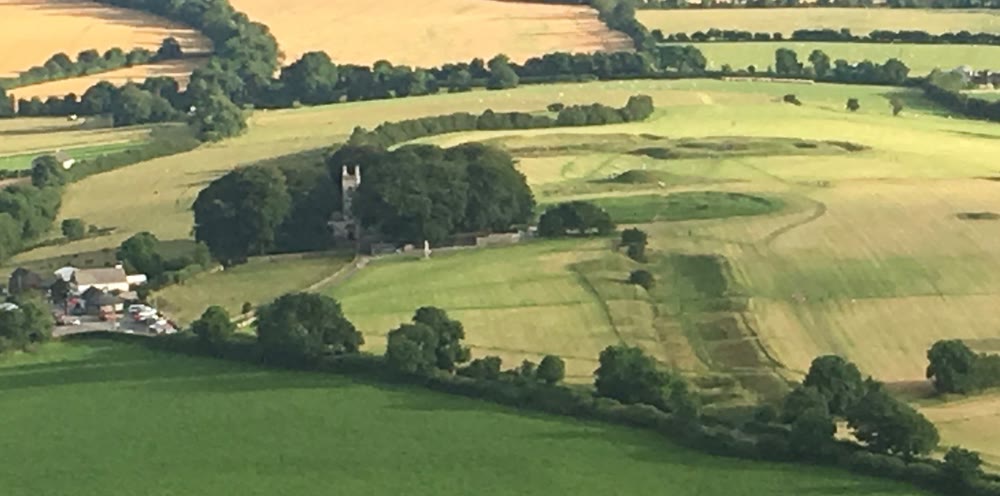
The Hill of Tara, Co. Meath, from a hot-air balloon. Photo: Alison Cassidy, CC BY-SA 4.0, via Wikimedia Commons
Creggan churchyard and the O’Neills of the Fews
Until the early 1600s, south Armagh was largely held by the O’Neills of the Fews, based at Glassdrummond, and the O’Hanlons, writes Monsignor Ó Muirí. The Plantation, the 1641 Rising and the departure of family members to the armies of France and, later, Spain cost them their lands. Sir Henry O’Neill lost the Fews in 1655, says ainm.ie.
Their burial vault is at Creggan, probably beneath an earlier church founded when the O’Neills came to the area around 1450, says the tourism board Visit Mourne Gullion Strangford. Local accounts say its exact spot was forgotten until 1973, when a tractor driver tidying the graveyard for Mac Cumhaigh’s bicentenary found it. On 29 April that year, says Ó Muirí, Conchita O’Neill of Seville, a descendant, unveiled a memorial over it reading 1480 Ó Néill 1820.
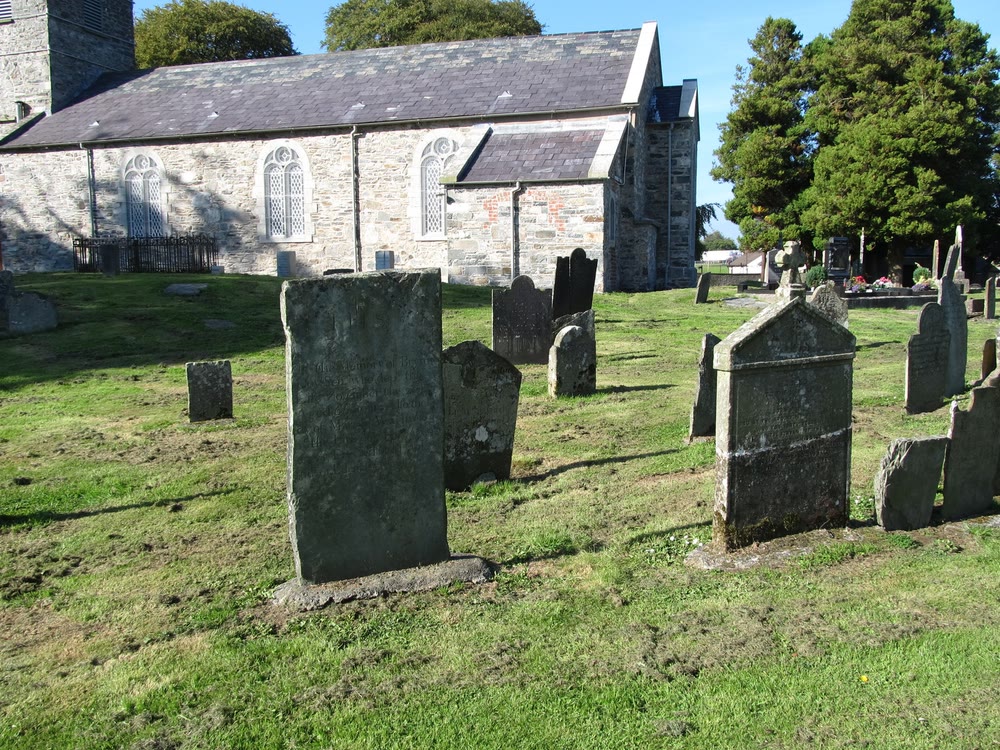
Eighteenth- and nineteenth-century graves in Creggan churchyard, Co. Armagh. Photo: Eric Jones, CC BY-SA 2.0, via Wikimedia Commons (Geograph)
One tradition, documented by the singer Pádraigín Ní Uallacháin, has him composing the poem while sheltering in the vault; another, say the Doegen notes, while leading a horse and manure cart for Rev. Hugh Hill. Neither can be proved.
Three 18th-century poets are buried here, says the tourism board: Mac Cumhaigh, Pádraig Mac a Liondain and Séamus Mór Mac Murphy. A visitor centre at 3 Glassdrumman Road tells their story; check opening times before you go.
Who was Art Mac Cumhaigh?
Mac Cumhaigh was born about 1738 in Creggan parish and grew up in Baile an Achaidh, a townland on the Louth border, says ainm.ie. His father split a 22-acre farm between two sons; Art squandered his share and spent his life labouring and gardening for others.
One employer, Rev. Hugh Hill, Creggan’s Church of Ireland rector, held land the O’Neills had owned until Cromwell’s time, and ainm.ie suggests the poet must have felt the irony. It’s generally accepted, ainm.ie adds, that he learned to read and write English, and his Greek and Roman stories, at a penal-era Catholic school like the hedge schools. People called him Art na gCeoltaí (art nuh GYOAL-tee), Art of the Songs, says the Ulster History Circle.
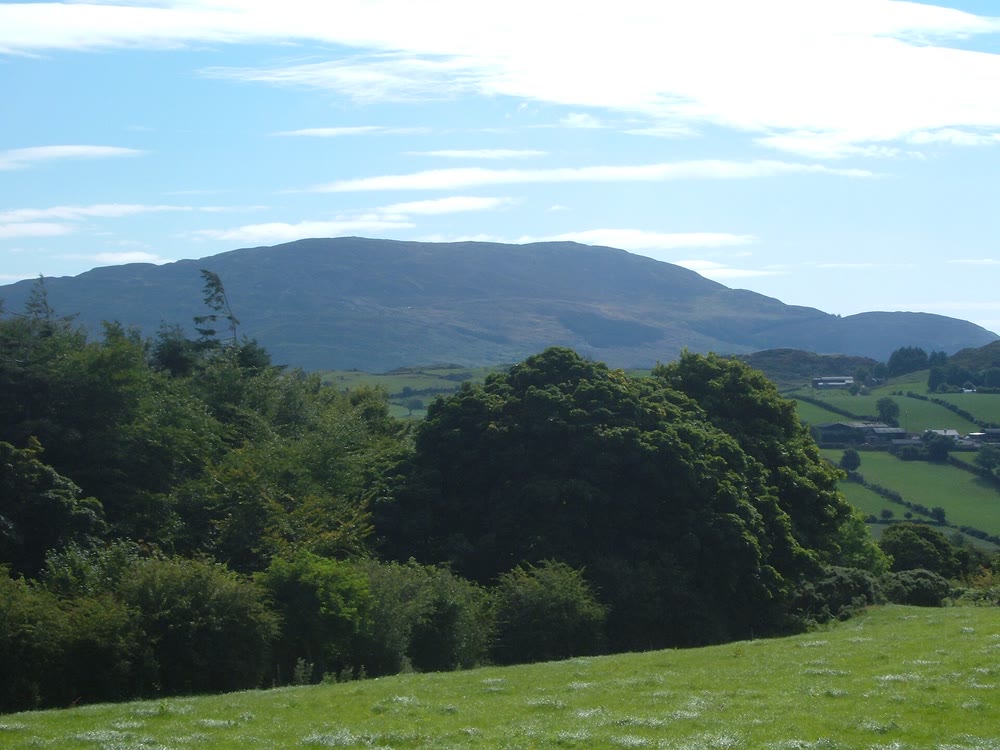
Slieve Gullion in south Armagh, seen from Aughanduff. Photo: Deathpool4 (English Wikipedia), public domain, via Wikimedia Commons
He married a cousin, Mary Lamb, in the Protestant church. The Ulster History Circle says the dispensation they needed was refused; ainm.ie thinks he expected the parish priest, Fr Terence Quinn, to refuse it. Excommunicated, he spent about a year gardening at Howth, near Dublin, then came home and remarried in the Catholic chapel. He had once satirised the priest’s sister, Máire, as Máire Chaoch; now he praised her in a second poem, which his editor, Cardinal Tomás Ó Fiaich, called “patently insincere”.
He died in January 1773, in his mid-30s: on 5 January, says a note in an old copy of an elegy for him, though the Ulster History Circle gives 7 January. Drink was the cause, says ainm.ie. That May in Co. Cork, Art Ó Laoghaire was shot dead, and his widow composed Caoineadh Airt Uí Laoghaire.
No manuscript in his hand survives; tradition says some of his songs ended up as wrapping paper in a Glassdrummond shop. About 25 poems are known, edited by Ó Fiaich in 1973. The Ulster History Circle counts him the last of five Gaelic poets of south-east Ulster, with Séamas Dall Mac Cuarta and Peadar Ó Doirnín among the others.
Themes: loss, exile, death and longing
- The lost Gaelic order: in verse 5 the great families lie under the stone, and with them the patrons who sheltered and clothed poets. Compare Cill Chais, a lament for a fallen great house.
- Defeat: verse 6 names the Jacobite defeats at the Boyne (1690) and Aughrim (1691). Over 7,000 men died at Aughrim, says the National Army Museum.
- Exile and loyalty: the O’Neills went abroad; the spéirbhean offers the poet an otherworldly exile, and in verse 7 he hesitates because of his friends and his wife.
- Death and longing: he begins sleeping among the dead and ends asking, wherever he dies, to be buried among them.
Ó Fiaich didn’t rank Mac Cumhaigh as a great craftsman, ainm.ie reports, but expected this poem to last as long as Irish, because Creggan stands for all Ireland: hope against despair, freedom against bondage, this world against the otherworld. That clash makes a strong frame for a Higher Level answer.
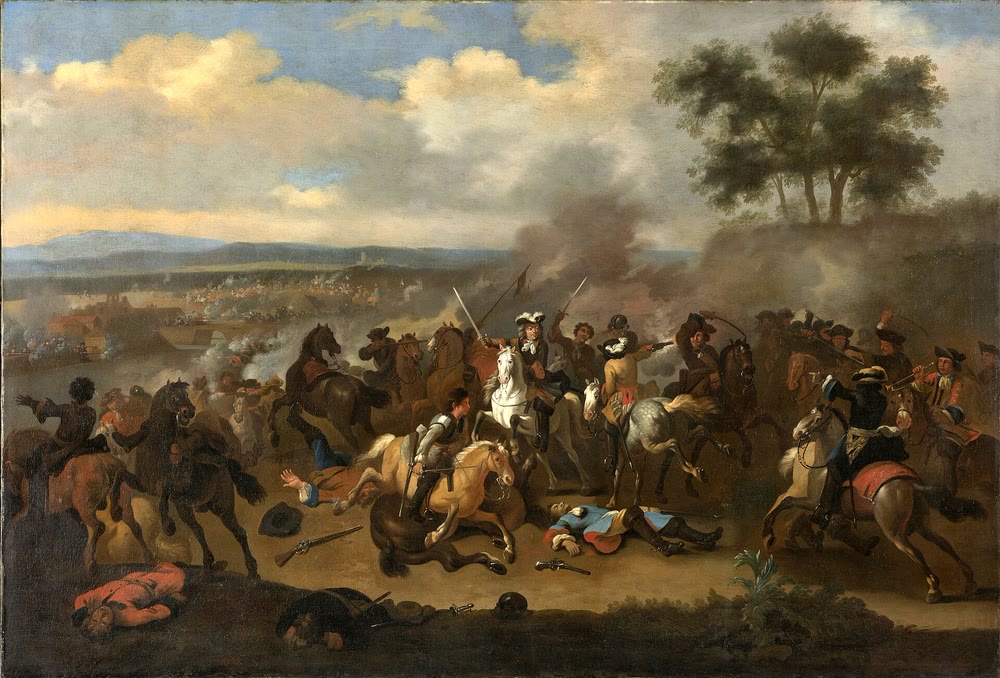
The Battle of the Boyne, 1690, by Jan van Huchtenburg (oil on canvas, painted between 1690 and 1733). Rijksmuseum, Amsterdam. Public domain, via Wikimedia Commons
Imagery and key phrases
Light fights darkness: a glowing woman and a clear star against grief and the gravestone. One contrast is worth quoting: in verse 5 the lords clothe their poets at Christmas; in verse 8 this poet is gan éideadh (gon AY-juh), without clothes, éideadh being an older form of éide. The poem begins and ends in Creggan’s clay.
- íocshláinte an domhain (EEK-hlawn-chuh un DOW-in): the healing balm of the world.
- tír dheas na meala (cheer yass nuh MAL-uh): the lovely land of honey.
- géaga glandaite Néill Fhrasaigh (GAY-guh GLON-datch-uh nayl RASS-ee): the bright branches of Niall Frasach, meaning the O’Neills. Niall, an eighth-century king who died on Iona, was called “of the showers” after a legend of showers of silver, honey and wheat, says the old Dictionary of National Biography.
- saighde Chlann Bhullaí (SYE-juh khlown VUL-ee): the arrows of Clann Bhullaí, the new rulers: the Doegen translation gives the foreign settlers, Oriel Arts the Williamites.
- Gaeil chumhra an Chreagáin (gayl KHOO-ruh un KHRAG-awn): the sweet-smelling Gaels of Creggan, the dead. His 1973 memorial stone at Creggan carries this last line.
- i gcré faoi fhód (ih GRAY fwee ODE; in Ulster, faoi sounds closer to “fee”): in clay under the sod.
Leaving Cert exam notes
Schools take either the five common poems, section 2(a), or at least five of their own, section 2(b), including one from before 1850. At Higher Level, short questions may also cover the author, background and context, says the circular.
On the 2025 Higher Level Paper 2, students answered on one of two printed set poems for 30 marks: 15 for discussion, 6 for technique and 9 for the metre or the poet’s life and work. Check the 2027 format with your teacher.
- Speakers: the poet in verses 1, 3, 5, 7 and 9; the spéirbhean in 2, 4, 6 and 8.
- Metre: amhrán (OW-rawn), which Ó Dónaill defines as a type of stressed metre. Almost every line ends on a long ó: bhrón, póig, ór, óig.
- Terms: téama (CHAY-muh), theme; íomhá (EE-vaw), image; mothúchán (muh-HOO-khawn), feeling; codarsnacht (KOD-ur-snukht), contrast.
Higher Level students taking the additional poetry option can compare Raftery’s Anthony Daly, another pre-1850 poem on the course.
Úirchill an Chreagáin FAQ
What is Úirchill an Chreagáin about?
A poor poet sleeps in Creggan churchyard. At dawn a fairy woman invites him to a happy land beyond the foreigners’ power. He mourns the O’Neills and worries about his wife, then asks her to promise he’ll be buried at Creggan.
What does Úirchill an Chreagáin mean?
The Churchyard, or Graveyard, of Creggan, a parish near Crossmaglen in south Armagh.
Is Úirchill an Chreagáin on the Leaving Cert in 2027?
Yes, for Ordinary and Higher Level in 2027 and 2028, if your school takes the common poems.
Is Úirchill an Chreagáin a song?
Yes. Máire Ní Arbhasaigh (Mary Harvessy) of Crossmaglen sang it for a 1931 recording now in the Doegen Records. The better-known form of the tune took shape in Donegal and was recorded by Clannad, among others, says Oriel Arts.
Love this? Save it to your Pinterest board for later.
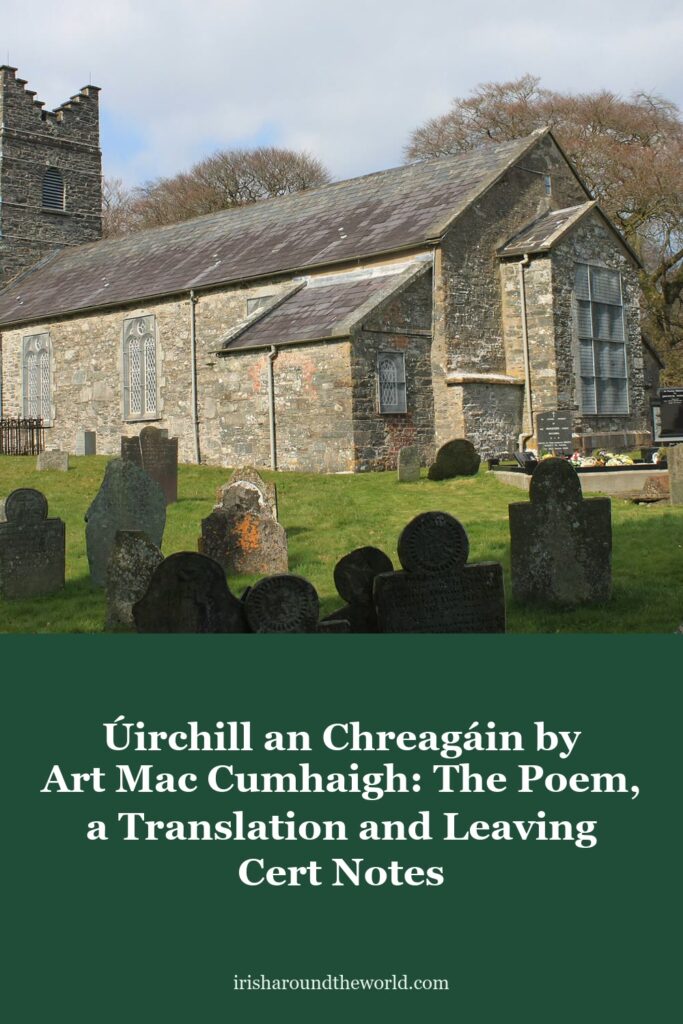
Pin image: Creggan parish church and graveyard, Co. Armagh. Photo: Éóg1916, CC BY 3.0, via Wikimedia Commons
A little bit of Ireland in your inbox every Friday ☘️
The free Weekly Dose of Irish: an Irish joke, a Celtic symbol, an Irish fact, a poem and the week’s best articles in one short email. Join 9,600+ readers.
Free. One short email every Friday. Unsubscribe any time.
More Irish poetry and Leaving Cert reading
- Leaving Cert Irish Poems 2027 and 2028: The Full List, Explained
- Anthony Daly by Raftery: The Poem, a Translation and Notes for Leaving Cert Irish
- Cill Chais (Kilcash): The Irish Poem and Its Meaning
- An Bonnán Buí (The Yellow Bittern): The Irish Poem About a Bird That Died of Thirst
- Caoineadh Airt Uí Laoghaire: The Greatest Lament in the Irish Language
- Fairy Forts and Fairy Trees: The Irish Places You Never Disturb
Featured image: Creggan parish church and graveyard, Co. Armagh, where Art Mac Cumhaigh is thought to lie. Photo: Éóg1916, CC BY 3.0, via Wikimedia Commons.