Ag Tiomáint Siar (Driving West) is a short poem in Irish by Nuala Ní Dhomhnaill about driving over the Conor Pass and down into Dingle, in the West Kerry Gaeltacht. The whole peninsula seems to talk to her in its own language. She sees light on a lake where a shining monster, the Carbuncle, is said to rise every seventh year, and passes a hillock that local story links to the English march on Dún an Óir in 1580, before a scrap of nonsense carries her into town. It’s one of the five Higher Level additional poems, section 3(b), for Leaving Cert Irish in June 2027 and June 2028.
Most of us know a road we could drive in our sleep, one that still finds something new to show us.
For Nuala Ní Dhomhnaill, that road runs over the mountains to Dingle, in Corca Dhuibhne (KOR-kuh GHIV-nyuh), the Irish name for the Dingle Peninsula and its Gaeltacht, where she was partly brought up. In Ag Tiomáint Siar, a monster, a massacre and a nonsense jingle all fit into one short drive.
It’s still in copyright, so the text isn’t here. Instead, you’ll find a plain-English summary, the stories behind it, themes, techniques, key words, exam pointers and where to get the book. For the whole course, see my guide to the Leaving Cert Irish poems.
Jump to:
- Ag Tiomáint Siar at a glance
- What happens in the poem
- The places: a road map of the poem
- The Carbuncle of Loch Geal
- Dún an Óir and the hillock of injustice
- Themes: place, language, memory and going home
- Imagery and techniques
- Tone and feelings
- Key Irish words in the poem
- Exam notes and useful Irish phrases
- Who is Nuala Ní Dhomhnaill?
- Ag Tiomáint Siar FAQ
- More Irish poetry
Ag Tiomáint Siar at a glance
- Title: Ag Tiomáint Siar, roughly eg chum-AWNCH SHEE-ur in Kerry and the rest of Munster; Connacht speakers stress the first syllable, CHUM-awnch. Tiomáint is driving and siar is westwards, so it means driving west.
- Poet: Nuala Ní Dhomhnaill (NOO-luh nee GHOH-nil), born in 1952.
- Where it appears: Pharaoh’s Daughter (The Gallery Press, 1990), a bilingual selection with English versions by thirteen poets; Michael Coady’s is called Driving West. The Irish is also in her collection Feis (An Sagart, 1991).
- Form: roughly 25 lines of free verse, with no rhyme scheme.
- Exam: Higher Level only, poem (iii) of section 3(b), Additional Poetry, for June 2027 and June 2028, in circular 0041/2026.
Spelling it right
Keep the fadas: it’s Tiomáint, not “Tiomaint”, and Ní Dhomhnaill, not “Ni Dhomhnaill” or “Ní Dhomhnail”. The poem’s word for peninsula, leathinis, is a variant of the standard leithinis (LEH-hin-ish) in Ó Dónaill’s dictionary. Leath is half and inis is an island, so a peninsula is a half-island.
What happens in Ag Tiomáint Siar (summary in plain English)
The poem opens with a big claim: “Labhrann gach cúinne den leathinis seo liom” (Nuala Ní Dhomhnaill), every corner of this peninsula speaks to me. In Kerry Irish that’s roughly LOUR-un gokh KOON-yuh den LA-hin-ish shuh lyum. The place has a language of its own, she says, and it’s one she understands.
The woods and the bends of the road seem to court her with whispers and rustling. She has crossed the pass, An Chonair, more times than she could count, yet the road still has new stories for her, and even the rocks along it stand out like words.
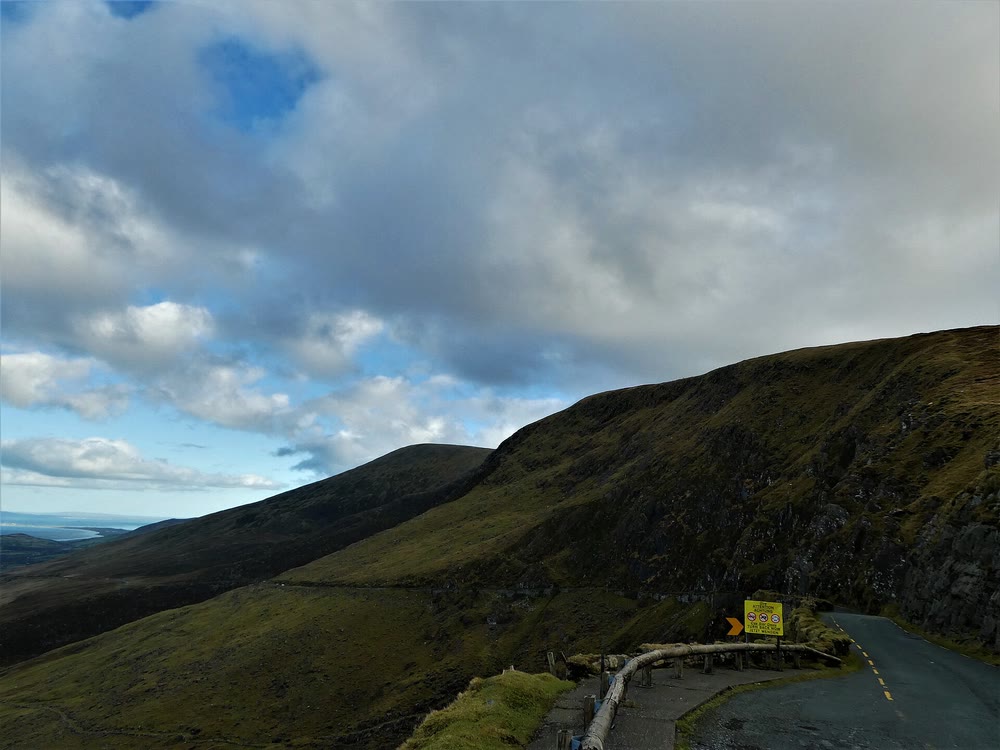
The narrow road over the Conor Pass (An Chonair), with a warning sign in Irish, English and German and Brandon Bay in the distance. Photo: Mucklagh, CC BY-SA 4.0, via Wikimedia Commons
Today there’s light on Loch Geal, a lake near the pass. It glows the way it does when the Carbuncle, a creature of local legend, rises to the surface every seventh year and shakes off her scales. The poem ties those scales to the river shellfish that local people gather to eat.
On her right is Cnocán Éagóir, the hillock of injustice. The poem passes on a story: seven hundred beardless Seáns were killed there once, when the English were marching on Dún an Óir.
Then a scrap of nonsense, half a sentence about white daisies and horse dung, comes up out of the fog. Its jaunty rhythm sweeps her down into Dingle, and the poem ends.
The places: a road map of the poem
Almost every image is pinned to a place with an Irish name.
- An Chonair (un KHUN-ir): the Conor Pass, the mountain road over to Dingle from the north side of the peninsula. It sounds like a man’s name in English, but conair simply means a path or passage. Parts are too tight for two cars to pass, as my Wild Atlantic Way guide warns.
- Loch Geal (lokh GYAL): the bright or shining lake. The naturalist Nathaniel Colgan placed it under the slopes of Mount Brandon, on your left as you go down from the pass towards Cloghane.
- Cnocán Éagóir (k-nuk-AWN AY-gore): cnocán is a hillock, and éagóir means injustice or wrong. The poem puts it on her right as she drives, and doesn’t pin it down any further.
- Dún an Óir (doon un ORE): the fort of the gold, on the western shore of Smerwick Harbour. Ó Dónaill gives promontory fort as one meaning of dún.
- An Daingean (un DANG-un): Dingle itself. Daingean means a fortress or stronghold.
Corca Dhuibhne itself means the people of Duibhne, a name carved on ogham stones near Dingle. For how words like loch, cnoc and dún became English place names, see my guide to Irish place names.
The Carbuncle of Loch Geal
The poem’s strangest image comes from real Kerry folklore, written down by naturalists more than a century ago.
Nathaniel Colgan told the story in The Irish Naturalist in March 1914. In 1883 a local man walking Mount Brandon with the botanist Henry Hart said the pearl shells in a lake under Brandon came from a huge creature known as the Carrabuncle, which shone like silver under the water at night.
When Colgan met the same man in 1888, the story had shifted: now it was a sort of snake living in Lough Geal, which made the water shine and shed shells with gems inside. Connor, who kept the little pub in Cloghane, said it showed itself only once in seven years; the postman said the river’s pearls had dropped off it.
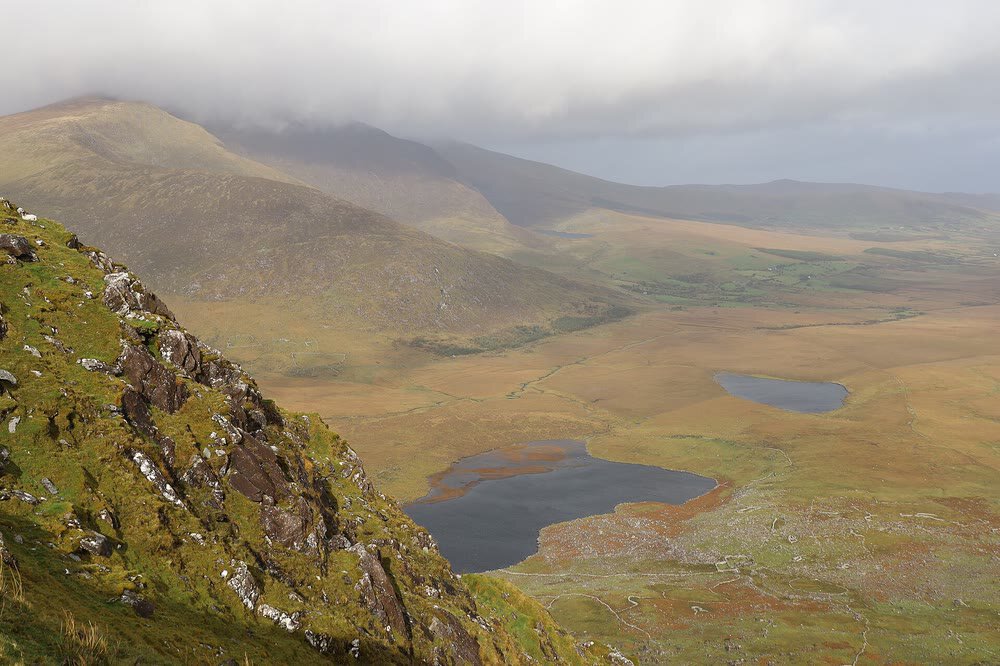
Lakes in the glen below the Conor Pass, on the Cloghane side, where Loch Geal also lies under Mount Brandon. Photo: Nomasoft, CC BY-SA 4.0, via Wikimedia Commons
Connor’s wife remembered men taking pearls from shells she called breallacans, which Colgan identified as the freshwater pearl mussel. So when the poem turns the Carbuncle’s scales into shellfish, it’s following the local story.
Ó Dónaill’s dictionary gives carbuncal for the carbuncle, a gemstone. Colgan wondered whether Spaniards who had been to South America brought the name to Kerry, then called his own digging a “folk-lore wild-goose chase” (Colgan, 1914). Treat that part as guesswork.
The tale even caught the hard-headed naturalist Robert Lloyd Praeger, who admitted in The Way That I Went (1937) that he had been to Lough Geal five times without picking the right date. In her Selected Essays (New Island, 2005), Ní Dhomhnaill calls the Carbuncle a female monster beneath Loch Geal and says a visit to the lake inspired this poem. In her essay A Ghostly Alhambra, she treats such stories as traces of an older, native way of seeing the world that, in her view, the Great Famine all but destroyed.
Meet more lake serpents and water beasts in my guide to Irish mythological creatures.
Dún an Óir and the hillock of injustice
The poem’s dark moment points towards one of the most notorious killings of the Elizabethan wars in Ireland.
In 1580 a force of soldiers in the Pope’s service, mostly Spanish and Italian, landed at Smerwick to back the Earl of Desmond’s rebellion, according to the CAIN archive at Ulster University. They dug in at Dún an Óir, and after a three-day siege the garrison surrendered. Then, on 10 November 1580, the Lord Deputy, Arthur Grey, ordered the killing of as many as six hundred of them. The historian D. Alan Orr calls it a brutal massacre in a 2019 article in the Journal of British Studies.
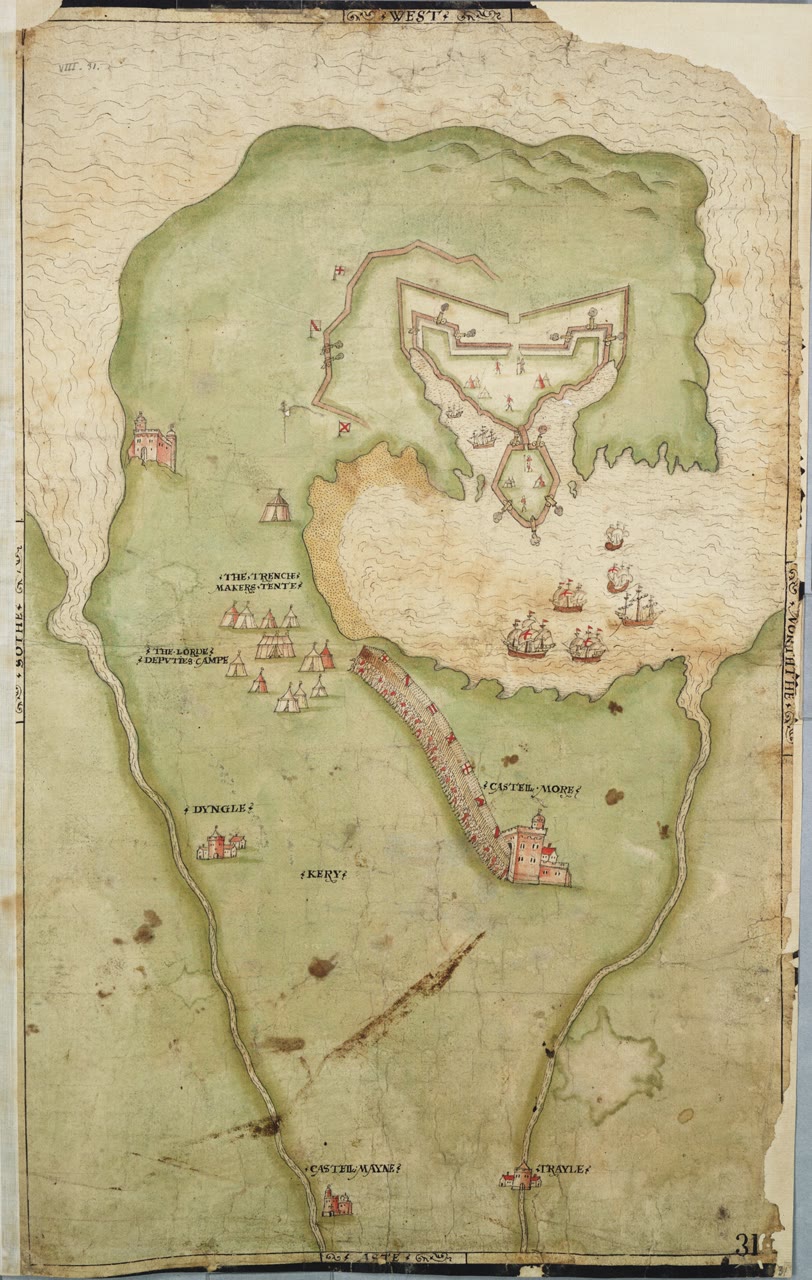
A plan of the attack at Smerwick in 1580: the fort on the headland, ships in the harbour, the Lord Deputy’s camp and a column of English troops leaving Castell More, with Dingle and Tralee marked below. Anonymous, Dartmouth collection, Royal Museums Greenwich. Public domain, via Wikimedia Commons
The English poet Edmund Spenser had become Grey’s private secretary in July 1580, says the Poetry Foundation, and later defended him in A View of the Present State of Ireland (around 1596).
Notice how carefully the poem handles this. It says it’s passing on a story, puts the seven hundred beardless Seáns in quotation marks, like a phrase handed down locally, and places the killing at the hillock during the English march, not at the fort. Historians count up to six hundred dead at Dún an Óir, mostly Spanish and Italian soldiers; the poem doesn’t try to square its story with the records. Beardless suggests young men, little more than boys, but that’s a reading, not something the poem spells out.
Look at the name, too: the hillock is named after a wrong, not a battle or a chieftain. The critic David Gardiner, writing on modern Irish answers to Spenser in Befitting Emblems of Adversity (2001), links this passage to the 1580 siege.
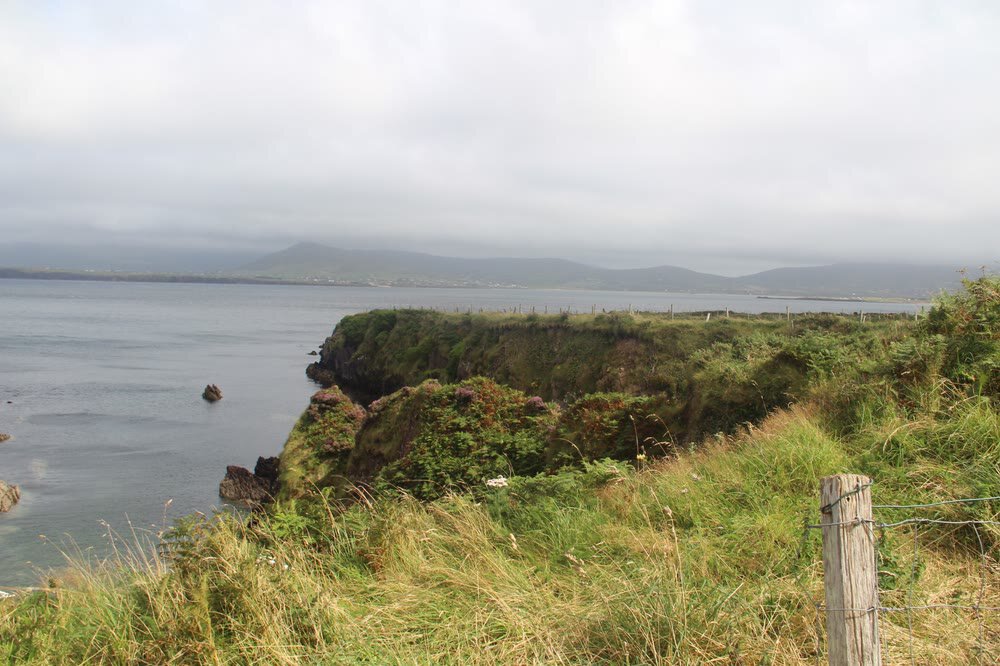
The headland at Dún an Óir, on Smerwick Harbour. Photo: Dáibhí Ó Bruadair, CC BY-SA 4.0, via Wikimedia Commons
Then the poem moves on: no lecture, just a glance to the right.
Themes: place, language, memory and going home
A landscape that speaks Irish
The first line sets out the main theme: the land has its own language, and the poet understands it. Here that language is Irish, the language of the place names, the stories and the poem itself.
Ní Dhomhnaill writes in Irish and leaves the English versions to other poets. Talking to Medbh McGuckian, quoted by the Poetry Foundation, she said Irish has no prejudice against the otherworld. Here a lake monster sits beside a road map without fuss.
Every place has a story
Irish has a word for the lore of places: dinnseanchas (roughly DEEN-shan-ukh-us), which Ó Dónaill glosses simply as topography. Donna Potts, in Contemporary Irish Poetry and the Pastoral Tradition (2011), links Ní Dhomhnaill’s place poems to that tradition. Here, knowing a place means knowing what happened there, or what lives there.
Going west, going back
Siar means westwards, but Ó Dónaill also gives it the meaning back, so this drive west is also a trip back into memory, folklore and history. It reads like a homecoming, too, since she grew up partly in this Gaeltacht. She never says home, but the poem’s easy familiarity says it for her.
Humour and the everyday
Just as the poem turns serious, a daft jingle about daisies and horse dung barges in. Patricia Craig, reviewing Pharaoh’s Daughter for the Times Literary Supplement, noticed how Ní Dhomhnaill’s poems slide from old myth to something quirkier and more modern, the Poetry Foundation notes. Here a jewelled monster gives way to horse dung.
Imagery and techniques (teicníochtaí fileata)
- Personification (pearsantú, par-sun-TOO): the peninsula talks, and the woods and the road court her and whisper.
- Simile (samhail, SOW-il): the rocks are like words; the lake glows the way it does when the Carbuncle rises.
- Exaggeration (áibhéil, AW-vayl): a thousand trips over the pass isn’t a real count. It shows how well she knows the road.
- Place names (logainmneacha; one is a logainm, LUG-an-im): five named places give the poem its map and its stories.
- Contrast (codarsnacht, KUD-ur-snukht): light and wonder on the lake against death and injustice on the hillock, on the same short drive; legend against horse dung.
- Sound (fuaimfhoclaíocht, onomatopoeia): the Irish words for whispering and rustling murmur and hiss as you say them.
- Tense: nearly everything is in the present, so we ride along with her. The one verb in the simple past is maraíodh (roughly mur-EE-ukh), were killed: the autonomous form, the saorbhriathar, with no killer named. It’s the moment history breaks into the drive.
- Structure: one long movement in the order of a real journey, from the big opening claim to the arrival in Dingle.
- Kerry Irish: Munster forms such as féinig for féin (own) and deineann for déanann (does).
Tone and feelings (mothúcháin)
The tone is warm and playful, with one shadow passing over it. Look for grá (GRAW), love, for the place and its language; iontas (EEN-tus), wonder, at the shining lake; a brief brón (BROHN), sorrow, at Cnocán Éagóir; greann (roughly GROWN), humour, in the courting road and the jingle; and bród (BROHD), pride, in knowing this place inside out.
Key Irish words in Ag Tiomáint Siar
Meanings are from Ó Dónaill’s Foclóir Gaeilge-Béarla on teanglann.ie, with respellings that lean towards Kerry Irish.
- tiomáin (chum-AWN): drive. Tiomáint is driving.
- siar (SHEE-ur): westwards; also back.
- labhair (LOUR): speak.
- suirí (sir-EE): courting, wooing.
- cogarnaíl (KUG-ur-neel): whispering, a variant of cogarnach.
- sioscarnach (SHISK-ur-nukh): rustling, whispering, a variant of siosarnach.
- léas (LAYSS): a ray or gleam of light.
- gainne (GAN-yuh), plural gainní: scales, as on a fish.
- sliogán (shlig-AWN): shell; shellfish.
- féasóg (fay-SOAG): beard.
- díchéillí (DEE-hay-lee): senseless, foolish.
- nóinín (noh-NEEN): daisy.
- giodam (GID-um): giddiness, friskiness, jauntiness.
- scuab (SKOO-ub): sweep; also a brush.
Exam notes and useful Irish phrases
Circular 0041/2026 names Pharaoh’s Daughter (The Gallery Press, 1990) as the text. Higher Level students study either one prose work from 3(a) or all five 3(b) poems; you may study both, but only one section is answered in the exam. The other 3(b) poems are Trén bhFearann Breac by Colm Breathnach, Eanáir 1991 by Biddy Jenkinson, Dijeridiú by Louis de Paor and Anthony Daly by Raftery.
The circular also allows short Higher Level questions on a writer’s life, background and context, so learn the poet as well as the poem. Ní Dhomhnaill’s Mo Ghrá-sa (idir lúibíní) was on the course up to 2026, and in June 2026 it came with questions on nature imagery, its brackets and the poet, according to the Institute of Education’s review of the paper. Nobody can predict 2027, but prepare:
- the main theme, and how the poet gets it across;
- two or three images and techniques, with a short quote for each;
- the feelings, and where they change;
- the stories behind Loch Geal and Dún an Óir;
- Ní Dhomhnaill’s life and work;
- your own response to the poem.
Useful Irish phrases for your answer
- Is é príomhthéama an dáin ná an grá atá ag an bhfile dá ceantar dúchais. (The main theme of the poem is the poet’s love for her home place.)
- Úsáideann an file pearsantú: labhraíonn an leithinis léi ina teanga féin. (The poet uses personification: the peninsula speaks to her in its own language.)
- Tá codarsnacht ghéar idir áilleacht na háite agus an t-ár a rinneadh ag Dún an Óir. (There’s a sharp contrast between the beauty of the place and the slaughter at Dún an Óir.)
- Léiríonn an dán go bhfuil an teanga agus an áit fite fuaite ina chéile. (The poem shows that the language and the place are woven together.)
Who is Nuala Ní Dhomhnaill?
Ní Dhomhnaill was born in Lancashire, England, in 1952, to Irish parents. The Poetry Foundation says both were doctors, serving Irish mining families there, and that she spoke Irish at home. At five she moved to an aunt’s home in Co. Kerry.
She grew up between the Dingle Gaeltacht and Nenagh, Co. Tipperary, and studied Irish and English at University College Cork, where she became one of a group of poets writing in Irish for the magazine Innti.
Her first collection, An Dealg Droighin, came out in 1981, followed by Féar Suaithinseach (1984), Feis (1991) and Cead Aighnis (2000), among others. English readers know her through bilingual books such as Pharaoh’s Daughter (1990) and The Astrakhan Cloak (1992), translated by Paul Muldoon.
She joined Aosdána in 1981, and from 2001 to 2004 she was the second Ireland Professor of Poetry, according to the Ireland Chair of Poetry. Later holders include Paula Meehan.
She’s on my list of famous Irish poets. For the Blasket Island writers of her peninsula, see my Great Blasket Island guide, and for another drive west, Paul Durcan’s Going Home to Mayo, Winter, 1949.
Ag Tiomáint Siar FAQ
What is Ag Tiomáint Siar about?
The poet drives over the Conor Pass into Dingle. The landscape seems to speak to her, and she sees light on a lake with a legendary monster and passes a hillock tied in local story to the English march on Dún an Óir, before a silly jingle carries her into town.
What does Ag Tiomáint Siar mean in English?
Driving West. Tiomáint means driving and siar means westwards, though siar can also mean back.
Who translated Ag Tiomáint Siar into English?
The poet Michael Coady, whose version, Driving West, is in Pharaoh’s Daughter.
Is Ag Tiomáint Siar on the Leaving Cert in 2027?
Yes, for Higher Level Irish in June 2027 and June 2028, as one of five Additional Poetry poems. It isn’t on the Ordinary Level course.
What is the Carbuncle in Ag Tiomáint Siar?
A shining lake creature from Kerry folklore, said to live in Loch Geal near the Conor Pass and to rise every seventh year. Local people told naturalists in the 1880s that the river’s pearls came off it.
Where can I read the full poem?
In Pharaoh’s Daughter, the book named on the Department’s list. In November 2026 The Gallery Press listed its edition as out of stock, but Wake Forest University Press still listed its 1993 edition. The Irish is also in Feis (An Sagart, 1991).
Love this? Save it to your Pinterest board for later.
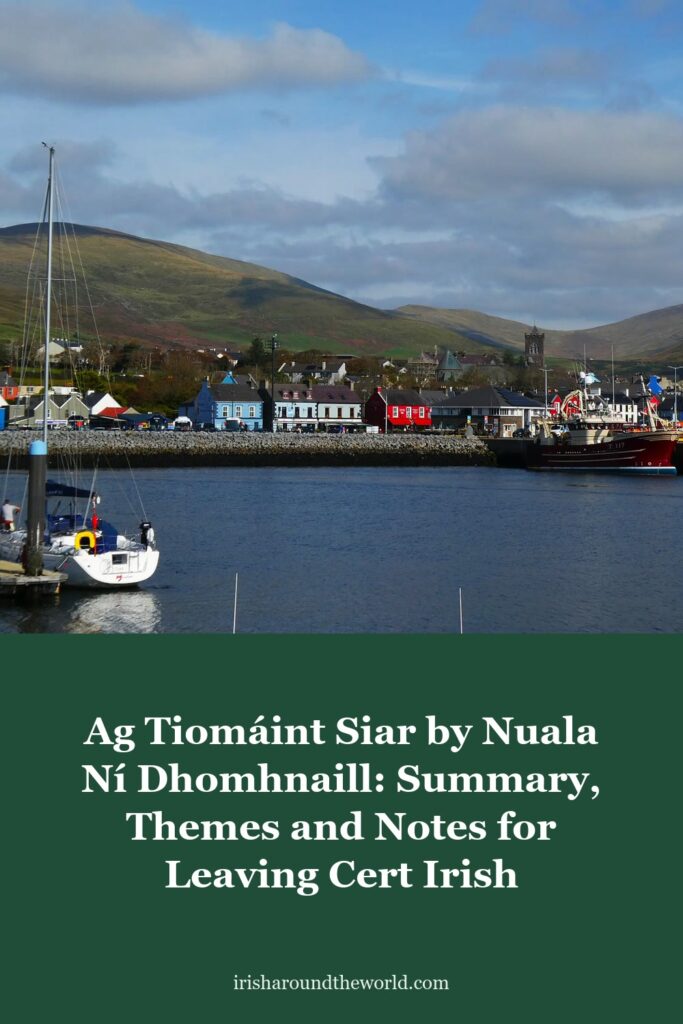
Pin image: Dingle harbour and town, with the hills towards the Conor Pass behind. Photo: Maoileann, CC BY-SA 4.0, via Wikimedia Commons
A little bit of Ireland in your inbox every Friday ☘️
The free Weekly Dose of Irish: an Irish joke, a Celtic symbol, an Irish fact, a poem and the week’s best articles in one short email. Join 9,600+ readers.
Free. One short email every Friday. Unsubscribe any time.
More Irish poetry
- Leaving Cert Irish Poems 2027 and 2028: The Full List, Explained
- Anthony Daly by Raftery: The Poem, a Translation and Notes for Leaving Cert Irish
- Famous Irish Poets: The Greatest of All Time, in Order
- Going Home to Mayo, Winter, 1949 by Paul Durcan: Poem and Meaning
- Irish Mythological Creatures: 23 Fairies, Monsters and Death Omens to Know
- Irish Place Names Meaning: What Bally, Kil, Drum, Knock and Your County’s Name Really Mean
- Great Blasket Island: Why Ireland’s Most Westerly Village Was Abandoned
Featured image: Dingle harbour and town, with the hills towards the Conor Pass behind. Photo: Maoileann, CC BY-SA 4.0, via Wikimedia Commons.