
Shancoduff is a 16-line poem by Patrick Kavanagh about his family’s hill farm in the townland of Shancoduff, beside his birthplace near Inniskeen, Co. Monaghan. He shows off his cold, north-facing hills and turns them into his own Alps, until passing cattle drovers decide that whoever owns such poor land, a poet of all people, must have nothing. It ends with him asking whether that hurts. First published in 1937, it is on the Leaving Cert English course for June 2027 at Higher and Ordinary Level. Kavanagh is not on the 2028 list.
Some poets need mountains. Patrick Kavanagh made do with a few wet hills in south Monaghan, and turned them into one of his best-loved poems.
Shancoduff is short, funny and a little bit sore. A young farmer boasts about his rushy hills, then overhears what strangers really think of them. In her 1991 study of his poetry, Antoinette Quinn, later his biographer, called it the poem where the farmer and the poet in him came together perfectly. At the Kavanagh Weekend in Inniskeen in 2014, President Michael D. Higgins said he agreed with her, and read the poem aloud.
It’s on the Leaving Cert English course for June 2027. The poem is still in copyright, so I won’t print it here: read it on the website of the Patrick and Katherine Kavanagh Trust, the charity that holds the rights to his work. Here’s a plain-English summary, the real place, the references, themes, techniques and exam notes.
Jump to:
- Shancoduff at a glance
- What happens in the poem
- The real Shancoduff
- Key words and references explained
- Themes: pride, poverty and doubt
- Imagery and techniques
- Is Shancoduff a sonnet?
- Tone and mood
- Exam notes for Leaving Cert 2027
- Who was Patrick Kavanagh?
- Shancoduff FAQ
- More Kavanagh and Leaving Cert poetry
Shancoduff at a glance
- Title: Shancoduff, said roughly as it’s spelt (shan-koh-duff), is a real townland near Inniskeen. It’s one word, with a double f.
- Poet: Patrick Kavanagh (1904 to 1967), born at Mucker in the parish of Inniskeen.
- When: written in the 1930s; The Dublin Magazine printed it first, in 1937, says the Museum of Literature Ireland. It wasn’t collected in a book until 1960, Quinn notes.
- Length: 16 lines in three stanzas of five, five and six lines.
- Where to read it: the Kavanagh Trust’s website, his Collected Poems edited by Antoinette Quinn (Allen Lane, 2004), or your class anthology.
What happens in Shancoduff (summary in plain English)
The poem moves in three steps: the hills as the poet sees them, as his playground, and as other people see them.
Stanza 1: hills that never see the sunrise
The poet’s hills face north, towards Armagh, so they never see the sun come up. Then comes a joke from the Bible. Lot’s wife was turned into salt for looking back, but she would have been safe, he says, if she’d had as little curiosity as his hills. They’re content just to watch the dawn light up a chapel at Glassdrummond in the distance.
Stanza 2: his own Alps
In March the hills hang on to bright patches he calls shillings, while the sun goes looking for them like someone going through pockets. These small hills are his Alps, and he has climbed his own Matterhorn: not with ropes and ice axes, but lugging hay to three freezing calves in a field below the big fort at Rocksavage.
Stanza 3: what the drovers say
Sleety winds blow through the rushes on the slopes, which he pictures as beards. Cattle drovers taking shelter at a spot called the Featherna Bush glance up and ask who owns land so poor that even the birds of wet ground, the water-hen and the snipe, seem to have abandoned it. The answer, a poet, settles it for them: the owner can’t have a penny.
The poet is listening. The poem closes on a question: “I hear, and is my heart not badly shaken?” (Patrick Kavanagh, Shancoduff)
The real Shancoduff: a hill farm near Inniskeen
Shancoduff is a townland of about 52 hectares (128 acres) in the civil parish of Donaghmoyne, barony of Farney, Co. Monaghan, according to townlands.ie. Its neighbours include Mucker, where Kavanagh was born, and Kednaminsha, where he went to school.
Its official Irish name, on the Placenames Database of Ireland (logainm.ie), is An Seanchuach Dubh (un SHAN-khoo-ukh DUV; dubh is closer to “doo” in Ulster Irish). Sean means old and dubh black. In Ó Dónaill’s dictionary cuach can be a cuckoo or a bowl, and the name’s grammar points to the bowl, perhaps for a hollow. So the blackness of the poem’s opening line may be hiding in the name itself.
Locals tell it with a grin. In The Irish Times in October 2017, Frank McNally, who grew up a few miles away, recalled Art Agnew, a Kavanagh weekend regular, warning women never to wed a farmer whose townland has “Duff” in it: dubh is black, and black land looks north and gets no sun. A joke, but it fits.
In the mid-1920s (1926, says an EBSCO reference biography), Kavanagh’s parents bought him the small farm at Shancoduff, near the family home at Mucker. McNally notes that it had seven hilly fields, one of them so wet that Kavanagh compared its soil to putty.
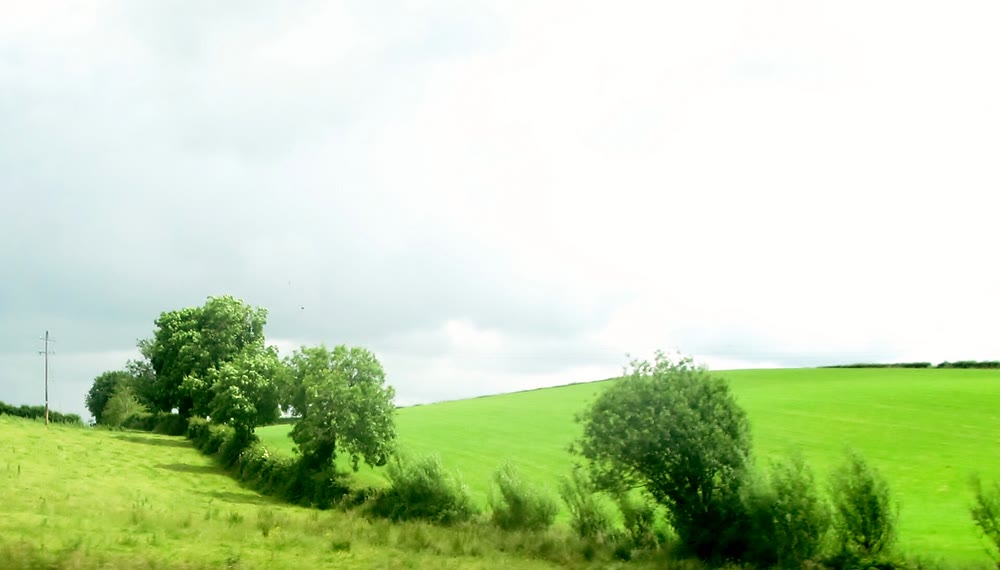
A drumlin field near Shancoduff, east of the L4620 road outside Inniskeen, Co. Monaghan. Photo: Eric Jones, CC BY-SA 2.0, via Wikimedia Commons
The view in the poem is real too. Glassdrummond is about 9 km (6 miles) north-north-east of Shancoduff as the crow flies, across the border near Crossmaglen in south Armagh. Its Catholic church, St Brigid’s, is most likely the chapel Kavanagh means.
This is south Monaghan’s drumlin country, which, the Patrick Kavanagh Centre in Inniskeen says, looks much as it did in his lifetime. You can walk it on the Centre’s Kavanagh Trail.
Key words and references in Shancoduff, explained
- Armagh: the neighbouring county to the north, now in Northern Ireland. Quinn points out that Armagh and the chapel give the poem a quiet Catholic feel, never preachy.
- Lot’s wife: in Genesis 19, Lot’s family flee the doomed city of Sodom, told not to look back. His wife looks back and becomes a pillar of salt (Genesis 19:26).
- incurious: not interested in finding out anything new (Cambridge Dictionary). In people it’s a fault; in these hills, Kavanagh jokes, it’s a virtue.
- shillings of March: shillings were coins in Ireland before decimal money. One natural reading is that they are patches of light, water or frost that the north-facing slopes keep in their hollows while the weak March sun hunts for them.
- the Alps and the Matterhorn: Europe’s great mountain range and one of its most famous peaks, above Zermatt in Switzerland. The University of Zurich’s Switzerland in Irish Poetry project includes Shancoduff because the Alps are its yardstick.
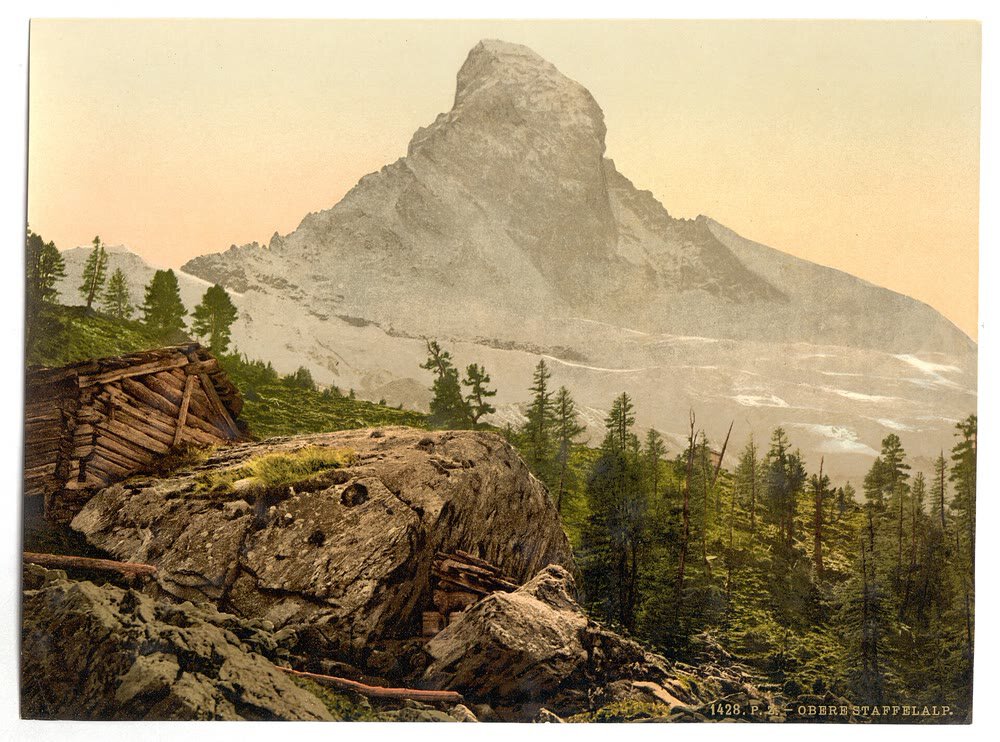
The Matterhorn above the Upper Staffelalp near Zermatt, Switzerland. Photochrom print, about 1890 to 1900, Detroit Publishing Co. catalogue. Library of Congress. Public domain, via Wikimedia Commons
- sheaf of hay and perishing calves: winter work on a small farm. Perishing is informal English for extremely cold (Cambridge Dictionary), and the word’s main meaning, to die, hangs over the three calves too.
- Big Forth of Rocksavage: a forth is a fort, here an old ringfort, one of the round earthen enclosures behind Ireland’s fairy fort beliefs. In Irish it’s a lios (liss) or ráth (raw). An entry from Inniskeen school in the Schools’ Collection (1937 to 1939) records a local tradition that Mass was said in Penal times on a large fort in the Rocksavage district, afterwards called the Mass Fort. It may be Kavanagh’s fort, but the poem doesn’t say.
- rushy beards: rushes, luachair (LOO-uh-khir) in Irish, grow thickly on wet, poor land.
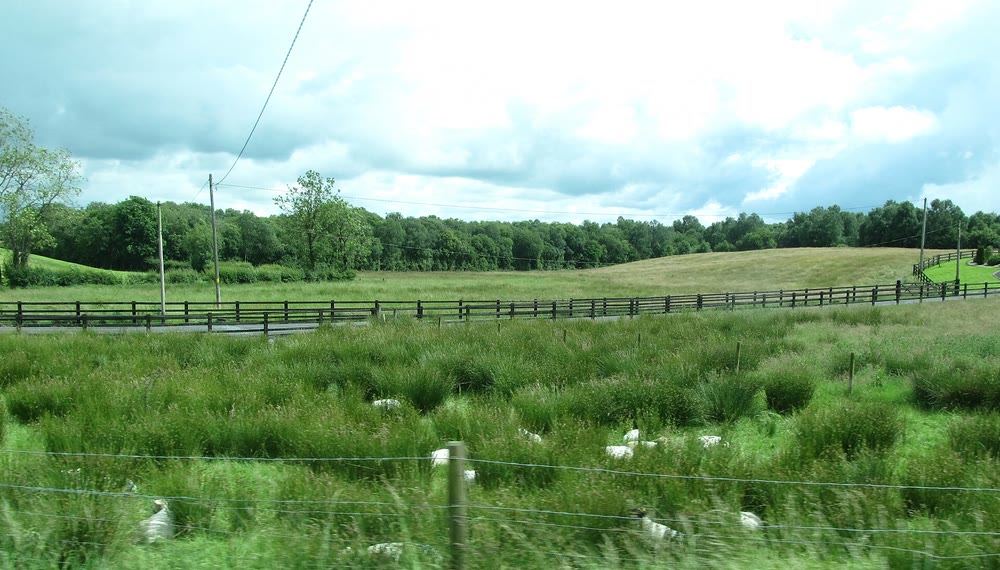
Rushy grazing land at Dunelty, west of Inniskeen, about a kilometre south of Shancoduff. Photo: Eric Jones, CC BY-SA 2.0, via Wikimedia Commons
- cattle-drovers: men whose job was moving cattle from place to place (Cambridge Dictionary).
- the Featherna Bush: Kavanagh doesn’t explain it. It seems to be a local name for a spot where the drovers could shelter.
- water-hen and snipe: two birds of wet ground. The waterhen, now usually called the moorhen, is cearc uisce (KYARK ISH-kuh) in Irish, and the snipe is naoscach (NEESS-kukh; NAYSS-kukh in Munster), say Ó Dónaill’s dictionary and focloir.ie.
- hungry hills: hungry soil is poor, barren soil, a sense Merriam-Webster gives. The drovers say them for those: Kavanagh lets them speak in their own voice.
Themes in Shancoduff: pride, poverty and doubt
Pride in a poor place
Count how often he calls them his: his black hills, his Alps. In the Ireland of Kavanagh’s youth, as President Higgins put it in 2014, the fields you owned marked your standing. These hills are wet, cold and nearly worthless, but they are his, and he talks about them with stubborn affection.
The farmer and the poet
The farmer knows about hay, calves and rushes; the poet sees Lot’s wife and the Matterhorn in a few fields. Quinn argued that his inside knowledge of life on a small farm gives the poem its weight, and that there isn’t one abstract idea in it.
How other people see us
The drovers judge land by what it produces, and to them a poet can’t make a living. Quinn adds that Kavanagh was right to expect a cold welcome for his local poems: most critics ignored Inniskeen Road: July Evening, and two anthologists passed over Shancoduff.
The small world is big enough
Imagination turns a few drumlins into the Alps. In an editorial in Kavanagh’s Weekly on 24 May 1952, Kavanagh set out his famous distinction: the provincial mind waits for the big city to tell it what to think, while the parochial mind is sure its own parish matters, socially and artistically. The Museum of Literature Ireland’s online exhibition on Kavanagh and his magazines quotes the passage. Shancoduff, published 15 years earlier, already puts the idea into practice.
Imagery and techniques in Shancoduff
- Personification: the hills look north, feel happy and hoard coins; the sun searches pockets; the winds stroke the rushes like beards.
- Hyperbole and mock-heroic comedy: calling small hills the Alps, and a walk with hay for the calves a climb of the Matterhorn, is deliberately over the top. Kavanagh plays the same game in Epic, where a row over a field is set beside Homer’s Iliad.
- Biblical allusion: Lot’s wife, who looked back, in a poem about hills that never look anywhere but north.
- Place names: Armagh, Glassdrummond, Rocksavage, the Featherna Bush and Shancoduff itself. Naming real places is a way of claiming them, and of saying they deserve a poem.
- Contrast: the poet’s love against the drovers’ scorn; dark hills against white dawn; the grand Alps against three cold calves.
- Direct speech and dialect: the drovers’ own words make the scene sound overheard.
- Sound: s and sh sounds whisper through the line about the sleety winds and the rushes. The poem barely rhymes, so the only full end rhyme, forsaken and shaken near the close, clicks shut like a lock.
- Rhetorical question: the poem ends by asking, not telling, and leaves us to decide how he feels.
Structure and form: is Shancoduff a sonnet?
No. It has 16 lines in three stanzas of five, five and six, and no regular rhyme scheme. The lines are long and loose, close to the rhythm of speech.
It does have something like a sonnet’s turn: two stanzas of the poet’s view, then a swing round to the strangers’ view. That shift from inside to outside is the heart of the poem. Compare Inniskeen Road: July Evening and Epic, which are sonnets, as are later canal-bank poems such as Lines Written on a Seat on the Grand Canal.
Tone and mood
- Proud and affectionate as he shows off his hills.
- Playful: the jokes about Lot’s wife and the Matterhorn are meant to make us smile.
- Exposed when outsiders mock what he loves.
- Uncertain at the end. You can hear real hurt in the final question, or a wink, as if he knows his hills are worth more than the drovers think.
Quinn summed up the new poetic personality in this poem as “affectionate, playful, vulnerable” (Antoinette Quinn, Patrick Kavanagh: Born-Again Romantic). Those three words make a good spine for an answer on tone.
Exam notes for Leaving Cert English 2027
Shancoduff is prescribed in circular 0021/2025 (27 February 2025), the Department of Education’s list for the June 2027 exam:
- Higher Level: Kavanagh is one of eight poets, with Elizabeth Bishop, Emily Dickinson, John Donne, Derek Mahon, Paula Meehan, Adrienne Rich and W.B. Yeats, and you should know six or more poems by each. His ten are Inniskeen Road: July Evening, Shancoduff, The Great Hunger (Section I), Advent, A Christmas Childhood, Epic, Canal Bank Walk, Lines Written on a Seat on the Grand Canal, The Hospital and On Raglan Road.
- Ordinary Level: Shancoduff and A Christmas Childhood are his two poems on the list of 36.
- 2028: Kavanagh isn’t on either list in circular 0024/2026, so for now 2027 is his year.
Shancoduff was also on the 2025 course. That year the Higher Level Paper 2 asked students to discuss how Kavanagh’s simple, careful language produces strong insights into nature and human nature, seen from the point of view of his own parish. Shancoduff suits that kind of question well.
On the 2025 papers, poetry was worth 70 marks at both levels: 20 for the unseen poem and 50 for prescribed poetry. At Ordinary Level, six prescribed poems were printed on the paper and students answered on one. Nobody can predict the 2027 paper, but it makes sense to prepare:
- the two views of the hills, the poet’s and the drovers’, and why the poem needs both;
- three or four images (the north-facing hills, the shillings, the Alps, the rushy beards) and what each suggests;
- your reading of the last line, with a reason;
- Kavanagh’s background: the farm, Inniskeen, and his double life as farmer and poet.
Poems to compare it with
- Inniskeen Road: July Evening: the same 1930s world, and the same poet standing apart from his neighbours.
- Epic: another local scene blown up to heroic size, half in fun.
- Stony Grey Soil: not on the course, but a useful contrast, because there he curses the Monaghan land instead of teasing it.
Practice questions
My own practice questions, not past questions:
- What impression of the poet’s land do you get from the first two stanzas?
- How do you think the poet feels at the end? Explain your answer.
- Kavanagh finds the extraordinary in ordinary rural life. Discuss, with reference to Shancoduff and at least one other poem.
Sitting Leaving Cert Irish as well? See my guide to the Leaving Cert Irish poems for 2027 and 2028.
Who was Patrick Kavanagh?
Kavanagh was born at Mucker, in the parish of Inniskeen, on 21 October 1904. His father, James, was a small farmer and a cobbler, and his mother was Bridget Quinn. Of nine children he was the fourth, and he spent his first 35 years on the family farm, says the Patrick Kavanagh Centre. He left Kednaminsha National School in 1916, after sixth class.
His first poems appeared in newspapers in 1928, and in 1931 he set out on foot for Dublin to see George Russell (Æ), who had published him in The Irish Statesman. Ploughman and Other Poems came out from Macmillan in 1936, says the Kavanagh Trust’s biography, and the Centre notes that he was still farming then.
He moved to Dublin in 1939. The Great Hunger (1942), A Soul for Sale (1947) and the novel Tarry Flynn (1948) followed. In 1954 he lost a libel case against the Dublin paper The Leader. In 1955 he had a lung removed because of cancer, and recovery brought what the Trust calls a personal and poetic renewal. Come Dance with Kitty Stobling appeared in 1960 and his Collected Poems in 1964.
In April 1967 he married Katherine Barry Moloney, and that 30 November he died in Dublin. He’s buried in Inniskeen, beside the former St Mary’s Church where he was baptised, now the Patrick Kavanagh Centre.
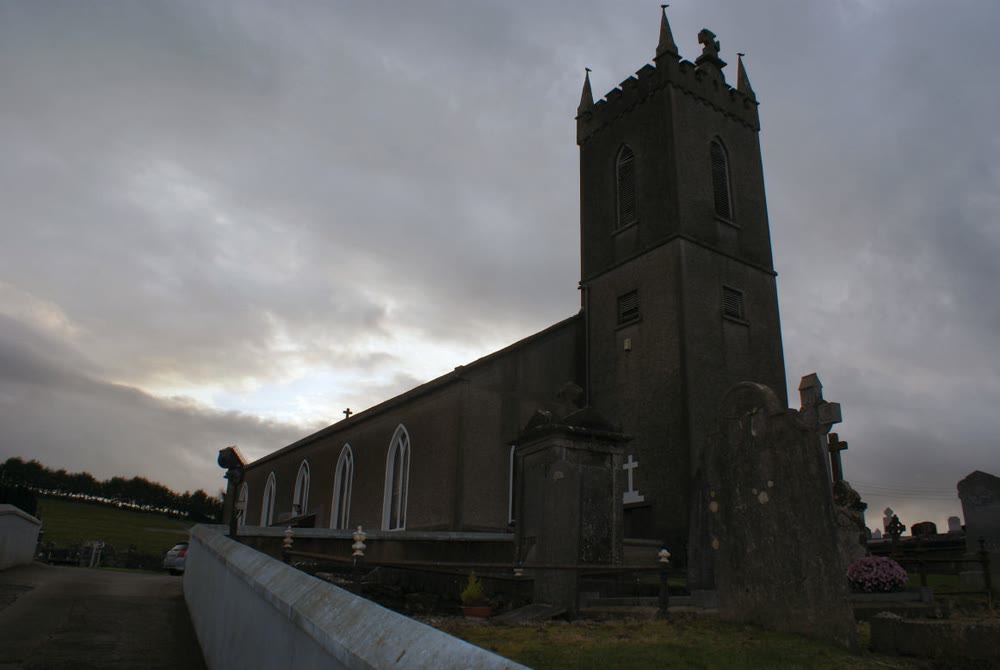
The Patrick Kavanagh Centre in Inniskeen, Co. Monaghan, in the former St Mary’s Church, built around 1820. Photo: Cathar11, CC0, via Wikimedia Commons
For more Kavanagh, read On an Apple-Ripe September Morning and Pegasus.
Shancoduff FAQ
What is Shancoduff about?
Kavanagh describes the cold, north-facing hills of his family’s farm with pride and humour, calling them his Alps, until cattle drovers decide that their poet owner must be poor.
Is Shancoduff a real place?
Yes. It’s a townland near Inniskeen in south Co. Monaghan, beside Mucker, where Kavanagh was born. His parents bought a small farm there for him in the mid-1920s.
What does Shancoduff mean?
Its official Irish name is An Seanchuach Dubh: sean means old, cuach a bowl or cup, and dubh black, so something like the old black bowl, perhaps describing a hollow. Logainm.ie gives no official translation.
Why does Kavanagh call his hills black?
They face north, so the sun never rises over them and they stay dark and cold. The townland’s Irish name also contains dubh, black.
Is Shancoduff on the Leaving Cert in 2027?
Yes, at both Higher and Ordinary Level. Kavanagh isn’t on the 2028 list.
Where can I read the full poem?
On the Kavanagh Trust’s website, in his Collected Poems, or in your school anthology. The Museum of Literature Ireland’s online exhibition also has the poet Eiléan Ní Chuilleanáin reading it.
Love this? Save it to your Pinterest board for later.
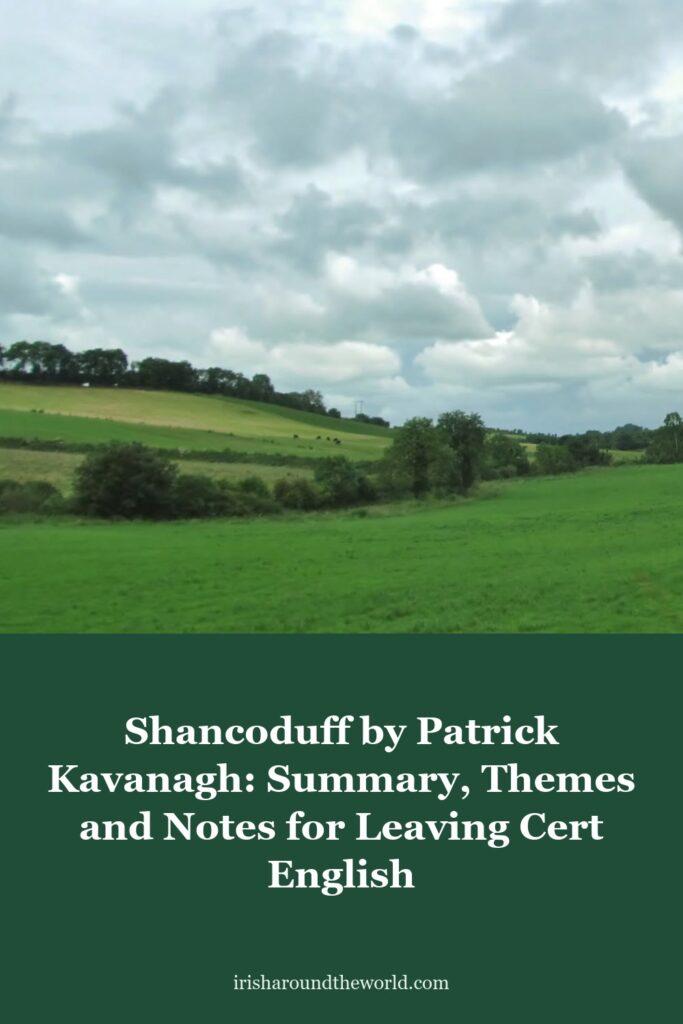
Pin image: Drumlin farmland south-west of Inniskeen, Co. Monaghan, a short way south of Shancoduff. Photo: Eric Jones, CC BY-SA 2.0, via Wikimedia Commons
A little bit of Ireland in your inbox every Friday ☘️
The free Weekly Dose of Irish: an Irish joke, a Celtic symbol, an Irish fact, a poem and the week’s best articles in one short email. Join 9,600+ readers.
Free. One short email every Friday. Unsubscribe any time.
More Kavanagh and Leaving Cert poetry
- Inniskeen Road: July Evening by Patrick Kavanagh, Meaning & Analysis
- A Christmas Childhood by Patrick Kavanagh: Poem and Meaning
- Epic by Patrick Kavanagh: The Sonnet About a Row Over a Field
- The Hospital by Patrick Kavanagh: Summary, Themes and Notes for Leaving Cert English
- Lines Written on a Seat on the Grand Canal by Patrick Kavanagh
- Stony Grey Soil by Patrick Kavanagh: The Poem That Curses His Monaghan Farm
- On an Apple-Ripe September Morning: Kavanagh’s Threshing Morning Explained
- Pegasus by Patrick Kavanagh: Poem and Meaning
- Paula Meehan Poems for Leaving Cert English 2027 and 2028: Summaries and Themes
- Leaving Cert Irish Poems 2027 and 2028: The Full List, Explained
- Fairy Forts and Fairy Trees: The Irish Places You Never Disturb
Featured image: Drumlin farmland south-west of Inniskeen, Co. Monaghan, a short way south of Shancoduff. Photo: Eric Jones, CC BY-SA 2.0, via Wikimedia Commons.