
The Hospital is a sonnet by Patrick Kavanagh about the Dublin chest hospital where surgeons removed one of his lungs in 1955, after he was diagnosed with cancer. Looking back a year later, he says he fell in love with its plain ward, its gravel yard and the ordinary sights around it, and he argues that a poet’s job is to name everyday things with love before time carries them off. It is one of ten Kavanagh poems prescribed for Higher Level Leaving Cert English in the June 2027 exam.
Most people would rather forget a stay in hospital. Patrick Kavanagh wrote a love poem about his.
In 1955 he lost a lung to cancer surgery. The Hospital looks back on that time, and instead of pain or fear it offers praise: for bare concrete, a row of cubicles and a gravel yard. It’s one of his clearest statements of what poetry is for.
The poem is still in copyright, so I won’t print it here. You can read it on the Patrick Kavanagh Trust website; his widow, Katherine, left the rights to his work to trustees in her will. Here’s a plain-English guide instead.
Jump to:
- The Hospital at a glance
- The background: a lung operation and a summer by the canal
- What happens in the poem
- The Rialto Bridge: Dublin, not Venice
- Form and structure: a Petrarchan sonnet
- Themes
- Imagery, techniques and tone
- Key words and phrases explained
- Leaving Cert exam notes
- Who was Patrick Kavanagh?
- The Hospital FAQ
- More Patrick Kavanagh poems
The Hospital at a glance
- Poet: Patrick Kavanagh, 1904 to 1967, from Inniskeen, Co. Monaghan.
- Written: it looks back on his spring 1955 hospital stay from about a year later, so probably around 1956.
- Form: a Petrarchan (Italian) sonnet: 14 lines, rhyming ABBAABBA CDECED.
- Course: Leaving Cert English, Higher Level only, for the June 2027 exam.
- Where to read it: the Patrick Kavanagh Trust website, or Collected Poems, edited by Antoinette Quinn (Allen Lane, 2004).
The background: a lung operation and a summer by the canal
The early 1950s were hard years for Kavanagh. In 1952 The Leader, a Dublin paper, published a profile that cast him as a drunk and a sponger. He sued for libel, and when the case reached court in February 1954, he lost.
Then came illness. A cancer diagnosis followed in 1955, and on 31 March, according to the RTÉ Archives, surgeons at the Rialto Hospital in Dublin removed a lung and a rib. The poem itself just says a chest hospital. (One Irish Times reviewer says St Kevin’s, forerunner of today’s St James’s Hospital, but RTÉ and Antoinette Quinn’s biography, as cited by the Ricorso database, say the Rialto.)
Within months he was talking about it on the radio. In Hospital Notebook, broadcast on 4 September 1955, he recalls the run-up to the operation and jokes about the struggle to get your last words written down.
The summer after the operation was warm, and he spent much of it convalescing beside the Grand Canal, close to Baggot Street Bridge. Something shifted there. In a 1959 essay for the Jesuit journal Studies, From Monaghan to the Grand Canal, he called 1955 the year of his hegira, the word for the Prophet Muhammad’s journey from Mecca to Medina, used here to mean a new start (read an extract).
In Self Portrait, a talk broadcast on Irish television on 30 October 1962, he went further. He described being born again as a poet on the stretch of canal between Baggot Street and Leeson Street bridges, and said little he had written before really counted as poetry.
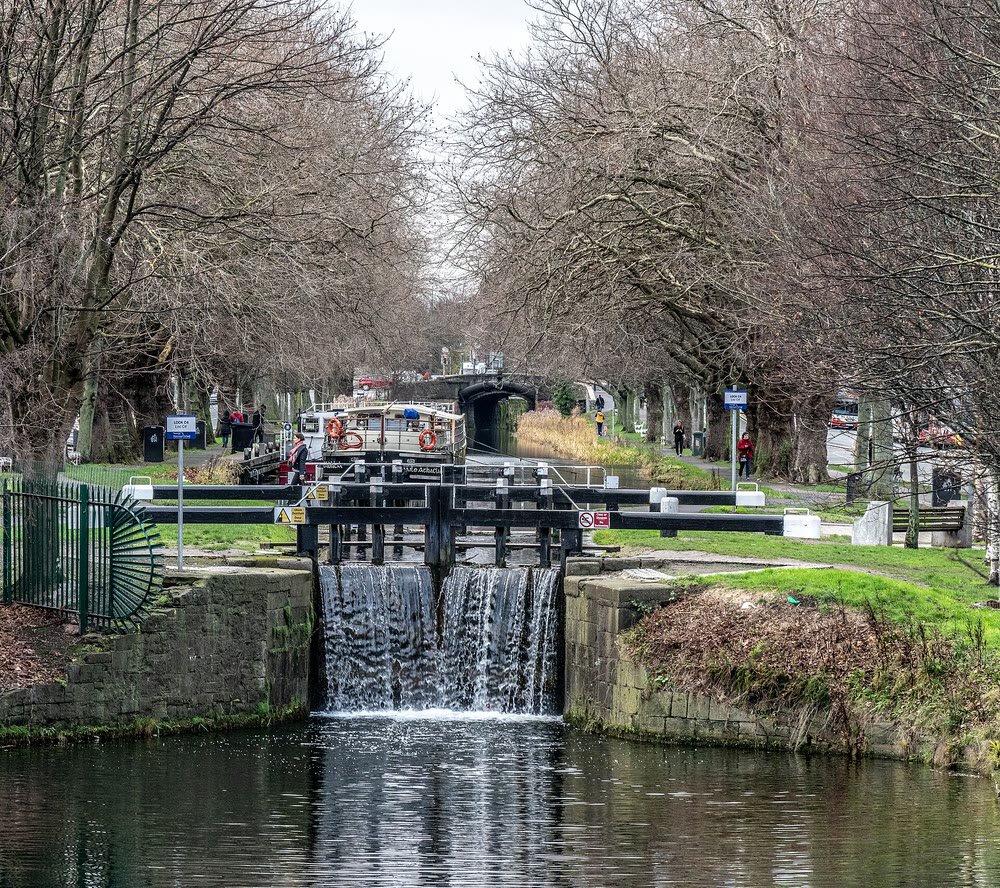
Lock C4 on the Grand Canal, seen from Baggot Street Bridge, Dublin, in December 2018. Kavanagh spent the summer of 1955 recovering on the canal banks near here. Photo: William Murphy, CC BY-SA 2.0, via Wikimedia Commons
The poems that grew out of that time, including Canal Bank Walk and Lines Written on a Seat on the Grand Canal, are quieter and more grateful than his earlier satires. The Hospital belongs with them.
What happens in The Hospital (summary in plain English)
The first eight lines. The speaker tells us that a year earlier he fell in love with a ward in a chest hospital. It was built for use, not beauty: a line of square cubicles, bare concrete, wash basins, the sort of room that would make anyone with refined taste wince. And that’s before he mentions the man in the next bed, who snored.
But love, he says, shuts nothing out. Even the most commonplace things can feel its warmth. He follows a corridor down a stairway to a gravel yard, and for him that yard became an adventure that never ran dry.
The last six lines. The poem turns. This, he says, is the effect love has on things, and he gives three examples: the Rialto Bridge, a main gate that a lorry had knocked out of shape, and a seat behind a shed where the sun gathered.
Then he states his belief. The key line, “Naming these things is the love-act and its pledge” (Patrick Kavanagh, The Hospital), says that simply naming ordinary things in a poem is an act of love, and a promise. The closing lines add that a poet must set down the mystery of love honestly, with no showy nonsense, and catch the intense, passing moment before time carries it off.
Notice what is missing: no cancer, no surgery, no pain, no fear of death. What remains is gratitude.
The Rialto Bridge: Dublin, not Venice
The Rialto Bridge in the poem isn’t the famous one in Venice. It’s a canal bridge in Dublin 8, and it gave its name to Rialto, the district where Kavanagh was treated.
Its proper name is Harcourt Bridge, after the first Earl of Harcourt, chairman of the Grand Canal Company. According to Dublin City Council’s historian in residence, Catherine Scuffil, the stone bridge that replaced an early timber crossing was thought to resemble the Ponte di Rialto in Venice. The name dates from 1795 and later spread to the whole neighbourhood.
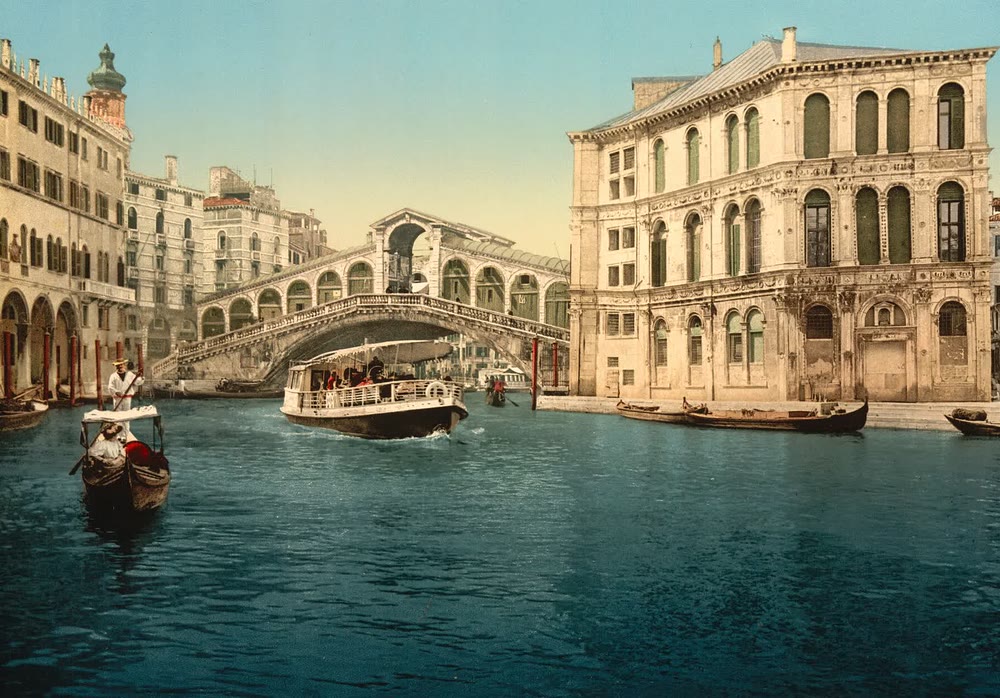
The Grand Canal with the Rialto Bridge, Venice, a photochrom print made between 1890 and 1900. Dublin’s Rialto Bridge was nicknamed after this one. Library of Congress. Public domain, via Wikimedia Commons
The bridge has changed since Kavanagh’s day. Dublin City Council dates its rebuilding and widening to 1939. The stretch of canal underneath, part of the old main line to the harbour at James’s Street, was infilled in the 1970s, and since 2004 the Luas Red Line has run along the old canal bed and through the arch. The water his bridge crossed is gone, which gives his wish to rescue passing things from time an extra edge.
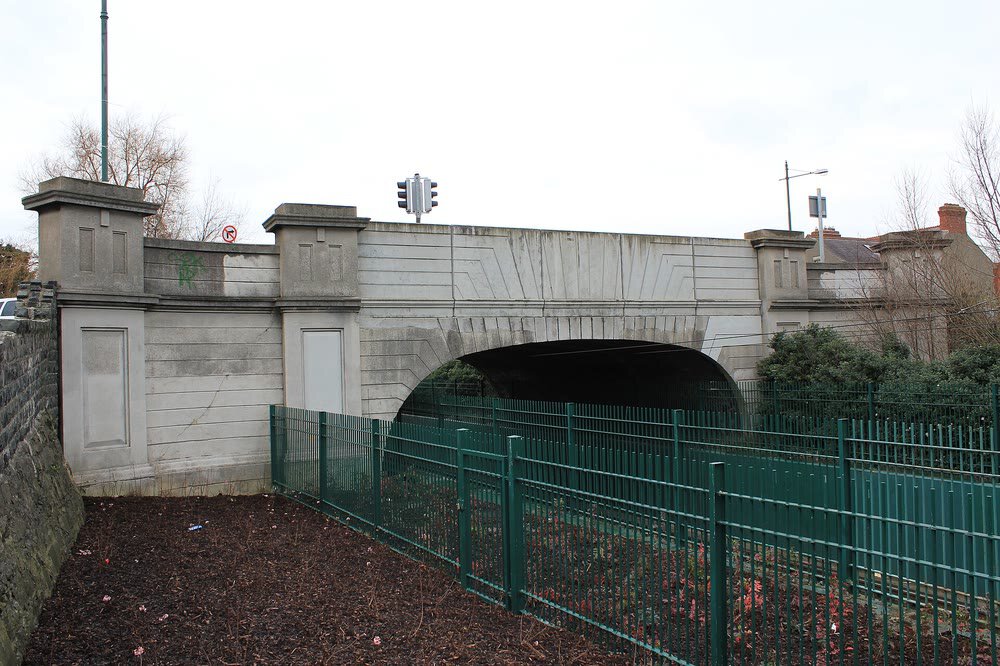
Rialto Bridge, properly Harcourt Bridge, in Dublin 8 in 2012. The canal under it was filled in during the 1970s, and the Luas Red Line now runs through the arch. Photo: Deitel55, CC BY-SA 3.0, via Wikimedia Commons
Form and structure: a Petrarchan sonnet
The Hospital is a Petrarchan, or Italian, sonnet, the form named after the 14th-century poet Petrarch. It’s a love-poem form by tradition, which is part of the joke: Kavanagh keeps the love but swaps the beloved for a hospital ward.
- Octave (lines 1 to 8): the puzzle. He claims to love an ugly, practical building and piles up evidence of how unlovely it was.
- Volta (the turn, line 9): the sestet announces that we’re about to see what love does, and a colon launches a list.
- Sestet (lines 9 to 14): the answer: three named things, then a statement of what poetry should do.
- Rhyme: ABBAABBA CDECED: a textbook Petrarchan octave, followed by a freer sestet. Several rhymes only nearly chime, such as ward and yard or Bridge and pledge, which keeps the sound relaxed. The one exact rhyme in the sestet pairs suntrap with claptrap, a comic chime that looks deliberate.
- Line length: long, loose lines, closer to talk than to strict iambic pentameter.
- Enjambment: the octave’s last sentence runs over the line break as he goes down the stairs, so we go down to the yard with him.
Canal Bank Walk is also a sonnet, and so is Epic. The Poetry Foundation notes that Richard Murphy, reviewing Kavanagh’s Collected Poems (1964) for the New York Times Book Review, picked out these sonnets as the most affirming work Kavanagh had done.
Themes
Love changes how we see
Love here isn’t romance. It’s a way of looking at the world: warm, attentive and generous. Look at things like that, Kavanagh says, and nothing is too plain to be loved.
The ordinary made special
The poem celebrates ordinary things: concrete, basins, a gravel yard, a damaged gate, a sunny seat. None is beautiful in the usual sense, which is why he chose them. In Self Portrait he argued that small, casual, everyday things count for more in art than grand public subjects. You’ll find the same idea in Advent, where wonder comes back through plain country things.
Poetry as naming
The big claim is that naming is a form of love. To put a real, specific thing into a poem, the Rialto Bridge rather than just “a bridge”, is to honour it and promise to remember it. Kavanagh had been naming his own places for years, from the hills of Shancoduff to the townlands in Epic and the country road in Inniskeen Road: July Evening. Here he explains why. Reviewing the Collected Poems in the London Review of Books in 2005, the poet Nick Laird counted The Hospital, with Epic, among Kavanagh’s confident short poems that double as manifestos.
Time and the passing moment
The last line asks the poet to rescue the passing moment from time. A sunny afternoon behind a shed, a hospital stay that ended: putting them in a poem keeps them. It’s a cousin of carpe diem, seize the day, but turned towards memory rather than pleasure.
Rebirth, gratitude and the sacred
A man who had just lost a lung, and a libel case, chooses to praise the place where he was operated on. Kavanagh was a Catholic, and words like love-act and pledge carry a hint of vows and sacraments. Finding grace in the humblest things links the poem to Advent and Canal Bank Walk.
Imagery, techniques and tone
- Listing and concrete imagery: both halves are lists of things you could touch or photograph. The octave lists what makes the ward ugly; the sestet lists what love made precious. Same method, opposite effect.
- Personification: love is a woman with her own heat, which gives an abstract idea a warm, human presence.
- Paradox: falling in love with a ward; an endless adventure in a gravel yard. The contradictions make us look twice.
- Humour: the snoring neighbour, the gate bent by a lorry and the word claptrap stop the poem turning solemn.
- Diction: plain, even slangy words (lorry, suntrap, claptrap) sit beside big abstract ones (inexhaustible, mystery, transitory). That mix is Kavanagh’s style in miniature.
- Sound: the soft s and sh sounds of seat, shed and suntrap slow the eleventh line down, like a lazy, warm afternoon.
The tone moves from wry to earnest. The octave is amused and self-mocking; he knows how odd it sounds to love a hospital. The sestet is warmer and firmer, ending close to a manifesto. Underneath are affection, wonder and unspoken gratitude.
Key words and phrases explained
Definitions follow the Cambridge English Dictionary where one is needed.
| Word or phrase | Meaning | Why it matters |
|---|---|---|
| functional | made for use rather than looks | sets up the joke: who falls for a practical building? |
| cubicles | small spaces closed off by walls or curtains inside a bigger room | a ward of identical, boxed-in beds |
| debarred | shut out; to debar is to stop someone by rule | love excludes nothing |
| banal | boring, ordinary and unoriginal | the same word turns up in the opening lines of Canal Bank Walk |
| inexhaustible | so plentiful it can never run out | an endless adventure in a gravel yard is a paradox |
| suntrap | a place that catches plenty of sun and warmth | a small comfort in hospital life |
| love-act and its pledge | an act of love, and a promise | naming is both; the words hint at vows |
| claptrap | silly talk that means nothing | poetry must be honest, not showy |
| passionate transitory | what is intense but brief | the fleeting moments a poem can keep |
Leaving Cert exam notes
The Hospital is prescribed for Higher Level English in June 2027 in the Department of Education’s circular 0021/2025, published on 27 February 2025. Kavanagh is one of eight Higher Level poets that year, with Elizabeth Bishop, Emily Dickinson, John Donne, Derek Mahon, Paula Meehan, Adrienne Rich and W. B. Yeats.
His ten listed poems are Inniskeen Road: July Evening, Shancoduff, The Great Hunger (Section I), Advent, A Christmas Childhood, Epic, Canal Bank Walk, Lines Written on a Seat on the Grand Canal, The Hospital and On Raglan Road. The circular says students should have covered six or more poems by each poet.
- Ordinary Level: The Hospital isn’t on the Ordinary Level list. The Kavanagh poems for Ordinary Level in 2027 are Shancoduff and A Christmas Childhood.
- 2028: Kavanagh isn’t on the 2028 course. Circular 0024/2026, dated 2 March 2026, lists eight Higher Level poets for 2028, and he doesn’t appear anywhere in it.
- The paper: in Section III of Higher Level Paper 2, you answer one question on an unseen poem (20 marks) and one on the prescribed poetry (50 marks). In both 2024 and 2025, that section offered a choice of five poets.
- Kavanagh in 2025: he came up on the 2025 Higher Level paper, with a statement about how his plain language gives deep insight into nature and people from a local, parochial angle. Nobody can predict 2027, so prepare several poets.
How to use The Hospital in an answer
Pair The Hospital with Canal Bank Walk and Lines Written on a Seat for the 1955 rebirth; with Advent and A Christmas Childhood for wonder at plain things; and with Epic, Inniskeen Road and Shancoduff for naming local places. Set against The Great Hunger (1942), it shows how far his outlook travelled.
Points you could make
- Kavanagh finds beauty where no one else would look, turning an ugly ward into something loved.
- The structure mirrors the argument: ugliness in the octave, love’s transformation in the sestet.
- The poem sums up his view of poetry: naming is love, and a poem preserves the passing moment.
- Illness is left out entirely, which makes the gratitude more striking once you know the background.
- It shows his faith in the local. In Kavanagh’s Weekly in 1952 he rated being parochial, trusting your own small world, above being provincial, looking elsewhere for approval.
In the exam, back up each point with a short quotation from the poem.
Who was Patrick Kavanagh?
Kavanagh came from Mucker, a townland in Inniskeen parish, Co. Monaghan, where he was born on 21 October 1904. His father, James, made shoes and worked a small farm. He left Kednaminsha National School in 1916, after sixth class, and farmed at home until his mid-thirties, teaching himself poetry.
His debut collection, Ploughman and Other Poems, appeared in 1936. Dublin became home in 1939; The Great Hunger, his bleak long poem of rural frustration, followed in 1942, and the novel Tarry Flynn in 1948.
After the libel case and the operation came his late flowering. Longmans brought out Come Dance with Kitty Stobling and Other Poems in May 1960, a Poetry Book Society choice, and Collected Poems arrived in 1964. In April 1967 he married Katherine Barry Moloney, his companion of many years. He died in Dublin that 30 November, and the couple lie together in Inniskeen.
Dublin remembers him by the water: since 1991 a life-size figure of the poet, unveiled by President Mary Robinson, has sat on a bench on the canal bank.
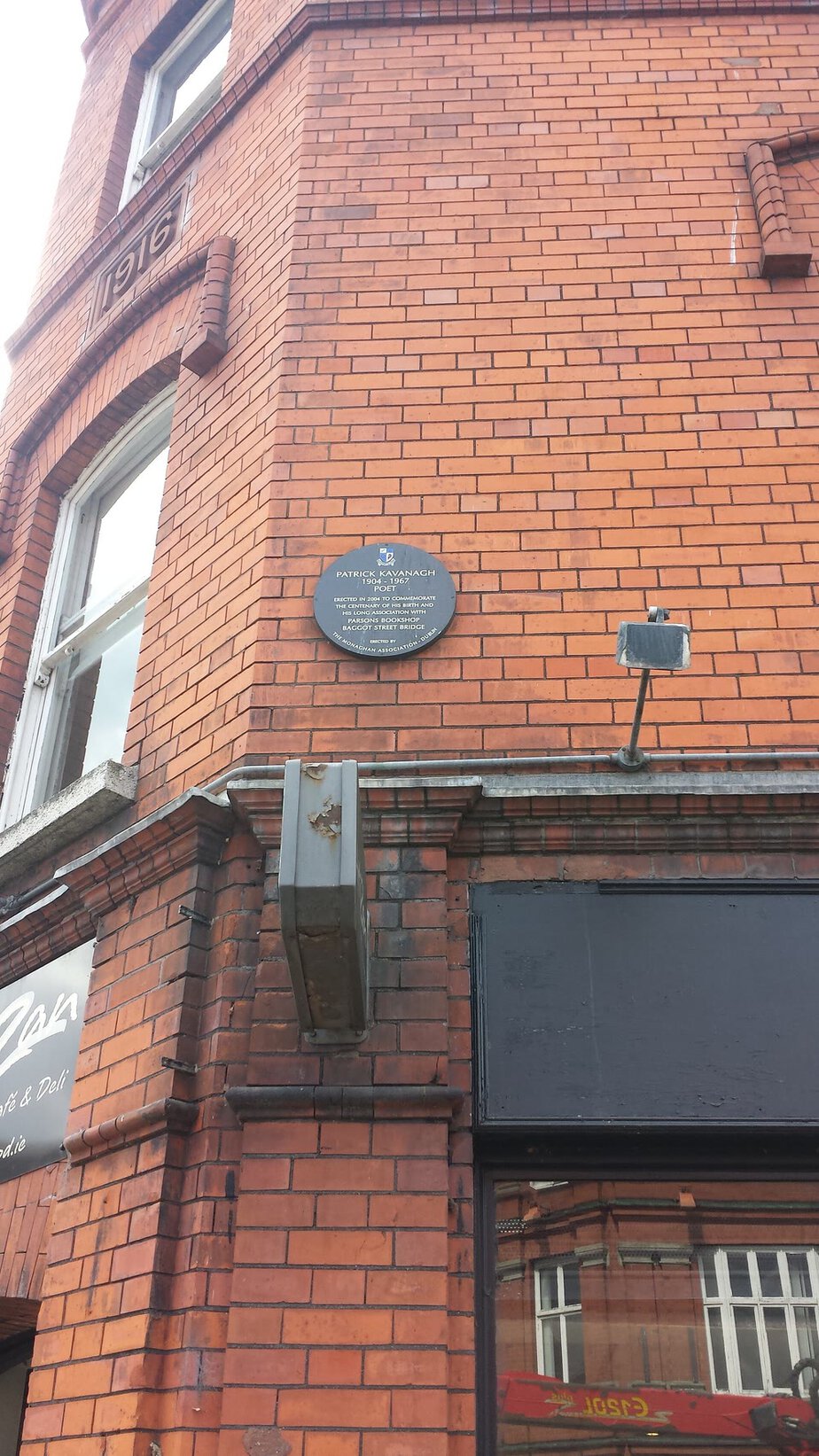
A plaque put up by the Monaghan Association, Dublin, in 2004 for the centenary of Kavanagh’s birth, marking his long association with Parsons Bookshop at Baggot Street Bridge. Photo: Kinsie84, CC BY-SA 4.0, via Wikimedia Commons
He’s on my list of famous Irish poets, and his On Raglan Road, recorded by The Dubliners, is still hugely popular.
The Hospital FAQ
What is The Hospital by Patrick Kavanagh about?
It’s about the Dublin chest hospital where Kavanagh had a lung removed in 1955. He says he fell in love with its plain ward and the ordinary things around it, and argues that naming such things in a poem is an act of love that saves them from time.
Is The Hospital a sonnet?
Yes. It’s a Petrarchan, or Italian, sonnet: 14 lines split into an octave and a sestet, rhyming ABBAABBA CDECED, with the turn at line 9.
Which hospital is Kavanagh writing about?
The poem only says a chest hospital. The RTÉ Archives name the Rialto Hospital in Dublin, where he had his operation on 31 March 1955, which fits the Rialto Bridge he names in the sestet.
What does Kavanagh mean by the passionate transitory?
Transitory means lasting only a short time. Kavanagh uses it as a noun for the passing moment, and passionate makes it intense. The poet’s job is to catch such moments and keep them in words.
Is The Hospital on the Leaving Cert in 2027?
Yes, at Higher Level only, as one of ten Kavanagh poems in circular 0021/2025. It isn’t on the Ordinary Level list.
Is Patrick Kavanagh on the Leaving Cert in 2028?
No. The 2028 list in circular 0024/2026 doesn’t include Kavanagh at either level, so you only need The Hospital if you sit Higher Level English in June 2027.
Where can I read the full poem?
On the Patrick Kavanagh Trust website, or in Collected Poems, edited by Antoinette Quinn, or Paul Muldoon’s Selected Poems (2022).
Love this? Save it to your Pinterest board for later.
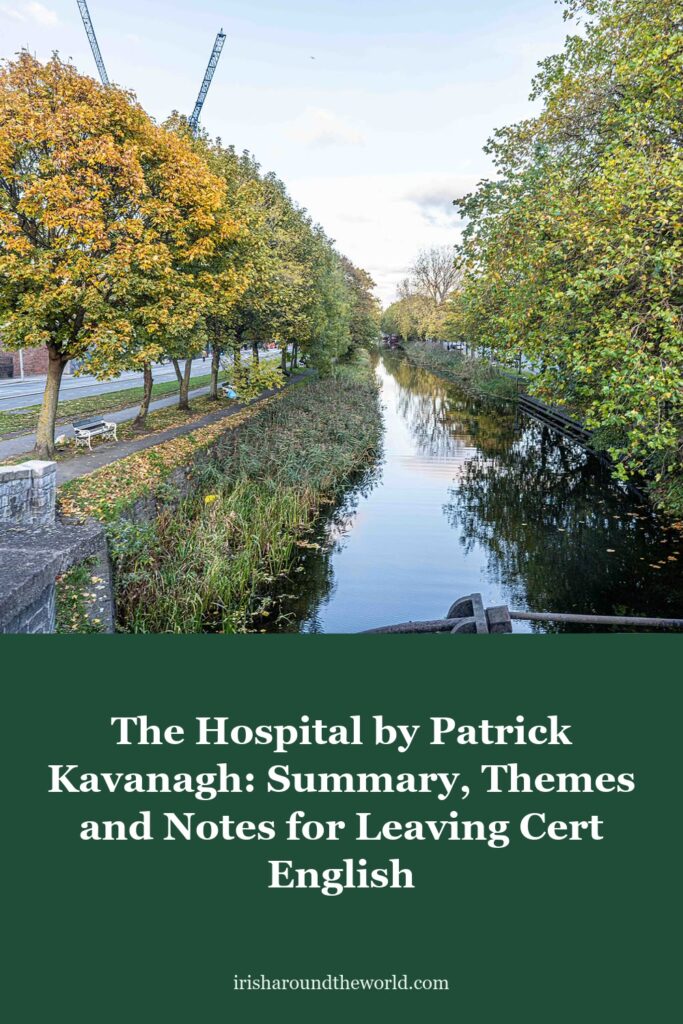
Pin image: The Grand Canal between Baggot Street and Leeson Street bridges, Dublin, October 2019. Photo: William Murphy, CC BY-SA 2.0, via Wikimedia Commons
A little bit of Ireland in your inbox every Friday ☘️
The free Weekly Dose of Irish: an Irish joke, a Celtic symbol, an Irish fact, a poem and the week’s best articles in one short email. Join 9,600+ readers.
Free. One short email every Friday. Unsubscribe any time.
More Patrick Kavanagh poems
- Canal Bank Walk by Patrick Kavanagh: Meaning and Analysis
- Lines Written on a Seat on the Grand Canal by Patrick Kavanagh
- Shancoduff by Patrick Kavanagh: Summary, Themes and Notes for Leaving Cert English
- Advent by Patrick Kavanagh: Poem and Meaning
- Epic by Patrick Kavanagh: The Sonnet About a Row Over a Field
- A Christmas Childhood by Patrick Kavanagh: Poem and Meaning
- Inniskeen Road: July Evening by Patrick Kavanagh, Meaning & Analysis
- The Great Hunger by Patrick Kavanagh: Summary, Meaning and Facts
- On Raglan Road by Patrick Kavanagh: Meaning, Story and Song
Featured image: The Grand Canal between Baggot Street and Leeson Street bridges, Dublin, the stretch where Kavanagh spent the summer of 1955, photographed in October 2019. Photo: William Murphy, CC BY-SA 2.0, via Wikimedia Commons.