Diarmuid and Gráinne is one of Ireland’s great love stories, from the Fenian Cycle. Gráinne, daughter of the High King Cormac mac Airt, is promised to the ageing Fionn mac Cumhaill. At the betrothal feast she drugs the guests and puts a geis, a binding demand, on the young warrior Diarmuid to run away with her. Fionn hunts them across Ireland for years. Peace comes, but Diarmuid is gored by a magic boar on Ben Bulben, and Fionn twice lets the healing water spill.
It’s a royal betrothal feast at Tara, and the bride-to-be has a jewelled golden goblet carried from guest to guest. Her husband-to-be drinks, then her father the High King, then her mother, and each falls fast asleep. Only a few young warriors stay awake, and she turns to one of them with a demand he isn’t allowed to refuse.
That’s how Ireland’s most famous runaway love story begins. You’ll also see it spelled Diarmuid and Grainne, or Dermot and Grania in older books.
I’ve written about Aengus Óg, the god who keeps rescuing the lovers, in my guide to the Celtic gods. Here’s the whole tale, plus the stone “beds” named after the couple and how old the story really is.
Jump to:
- What is the story of Diarmuid and Gráinne?
- The feast at Tara and the geis
- Diarmuid’s love spot
- The pursuit across Ireland
- Diarmuid and Gráinne’s beds
- The boar of Ben Bulben
- What happened to Gráinne?
- How old is the story?
- Deirdre, Tristan and Iseult
- Diarmuid and Gráinne FAQ
- More Irish mythology
What is the story of Diarmuid and Gráinne?
It belongs to the Fenian Cycle, the stories of Fionn mac Cumhaill (FIN mac COOL) and the Fianna, his band of warrior huntsmen. The fullest version is a long Irish prose tale, Tóraigheacht Dhiarmada agus Ghráinne, “The Pursuit of Diarmuid and Gráinne”. Britannica sees the elopement as the moment the Fianna begin to fall apart.
- Gráinne (GRAWN-yeh): daughter of Cormac mac Airt, legendary High King at Tara.
- Diarmuid Ua Duibhne (DEER-mid): one of Fionn’s finest warriors.
- Fionn mac Cumhaill: leader of the Fianna, a widower whom Gráinne calls older than her own father.
- Aengus Óg: god of the Brugh on the Boyne, and Diarmuid’s foster-father.
- Oisín and Oscar: Fionn’s son and grandson, and Diarmuid’s friends.
My retelling follows Standish Hayes O’Grady’s 1857 translation of the Irish text, noting where versions differ. University College Cork’s Irish Sagas site has extracts in Irish and English.
The feast at Tara: a sleeping draught and a geis
Fionn has been alone since his wife Maighneis died, and he can’t sleep. His men suggest the High King’s daughter. Asked what she thinks, Gráinne answers coolly: if Fionn is good enough as a son-in-law, he’s good enough as a husband.
At the betrothal feast she puts a sleeping draught in the jewelled goblet, and most of the hall nods off.
Oisín, Oscar, Diarmuid and a few others stay awake. Gráinne offers herself to Oisín, who refuses. Diarmuid refuses too, out of loyalty to Fionn. So she binds him: in O’Grady’s translation, “under bonds of danger and of destruction” to take her away before the sleepers wake.
What is a geis?
A geis (GESH, plural geasa) is a bond or taboo. The Electronic Dictionary of the Irish Language gives two senses: a prohibition whose breaking brought disaster, and a solemn command laid on someone, with misfortune threatened if they refused. The old romances mostly use the second.
Diarmuid’s friends all tell him to keep his geis and go, though one warns it will be the death of him.
Why Diarmuid?
Gráinne once watched a hurling match at Tara from her sunny bower. When the Fianna’s team was losing, Diarmuid grabbed a hurley (a hurling stick), joined in and won the game. She has loved him ever since.
Fionn holds the keys of Tara, so she slips out by a small gate. Diarmuid is under another geis never to use one, so he vaults the rampart on his spear shafts. Worse, Diarmuid was meant to be guarding Fionn’s bride that night, as Fionn bitterly reminds him later.
Diarmuid’s love spot (ball seirce)
Folk tradition adds a magic reason for Gráinne’s choice: the ball seirce (bal SHER-keh), or love spot. In his 1857 notes, O’Grady describes a mole on Diarmuid’s face whose sight “acted as a philtre on all women who looked upon it”. Tradition, he adds, still called him Diarmuid na mBan, Diarmuid of the women.
Patrick Kennedy put the spot on his shoulder in 1866. In a version told on Islay, Scotland, in 1859 and printed by J. F. Campbell, Diarmuid keeps his cap pulled down over it. When the hounds fight at a feast after Fionn’s wedding, Diarmuid pushes his cap up while parting them, and Gráinne sees the spot.
How Diarmuid got the love spot
A Galway folktale collected by Douglas Hyde, summarised by T. W. Rolleston in 1911, explains it. Diarmuid and three comrades shelter in a strange house with an old man, a young woman, a sheep and a cat. The sheep beats them all, until the cat leads it away with ease. The old man explains that the sheep stood for the World, and the cat for Death.
That night the young woman turns each man away, saying she belonged to them once. She is Youth. Diarmuid gets a parting gift: a touch on the forehead, so no woman will see him without loving him.
The pursuit across Ireland
The lovers cross the Shannon at Athlone and hide in a wood near Loughrea, Co. Galway, inside an enclosure with seven doors. The Fianna find them and surround it.
Then Aengus Óg arrives unseen, wraps Gráinne in his mantle and carries her off. Diarmuid refuses to hide. He leaps the stockade and meets them later near Limerick.
Signs for Fionn, and a splash of water
At first Diarmuid keeps his distance. At their camps he leaves Fionn a spit of uncooked meat, and later seven raw salmon, as signs that he hasn’t slept with Fionn’s betrothed.
Gráinne has other ideas. Crossing a patch of wet ground, she is splashed up the leg and murmurs that the water is more daring than Diarmuid. He takes the hint. O’Grady printed this scene in Irish in 1857 but left it untranslated: the English is a row of asterisks.
The rowan tree and the giant
Pregnant, Gráinne craves berries from a magic rowan tree of the Tuatha Dé Danann. Three of its berries would turn a man of 100 back into a man of 30. A one-eyed giant, the Searbhán Lochlannach, guards it.
Diarmuid kills the giant with his own iron club, and the lovers take over the giant’s treetop bed. Then Fionn sits beneath it to play fidchell, a board game usually translated as chess, against Oisín.
Whenever Oisín is stuck, Diarmuid drops a berry onto the right piece. Oisín wins three times, and Fionn knows who is helping. Diarmuid kisses Gráinne three times in plain view, Aengus spirits her away again, and Diarmuid leaps clear over his enemies’ heads.
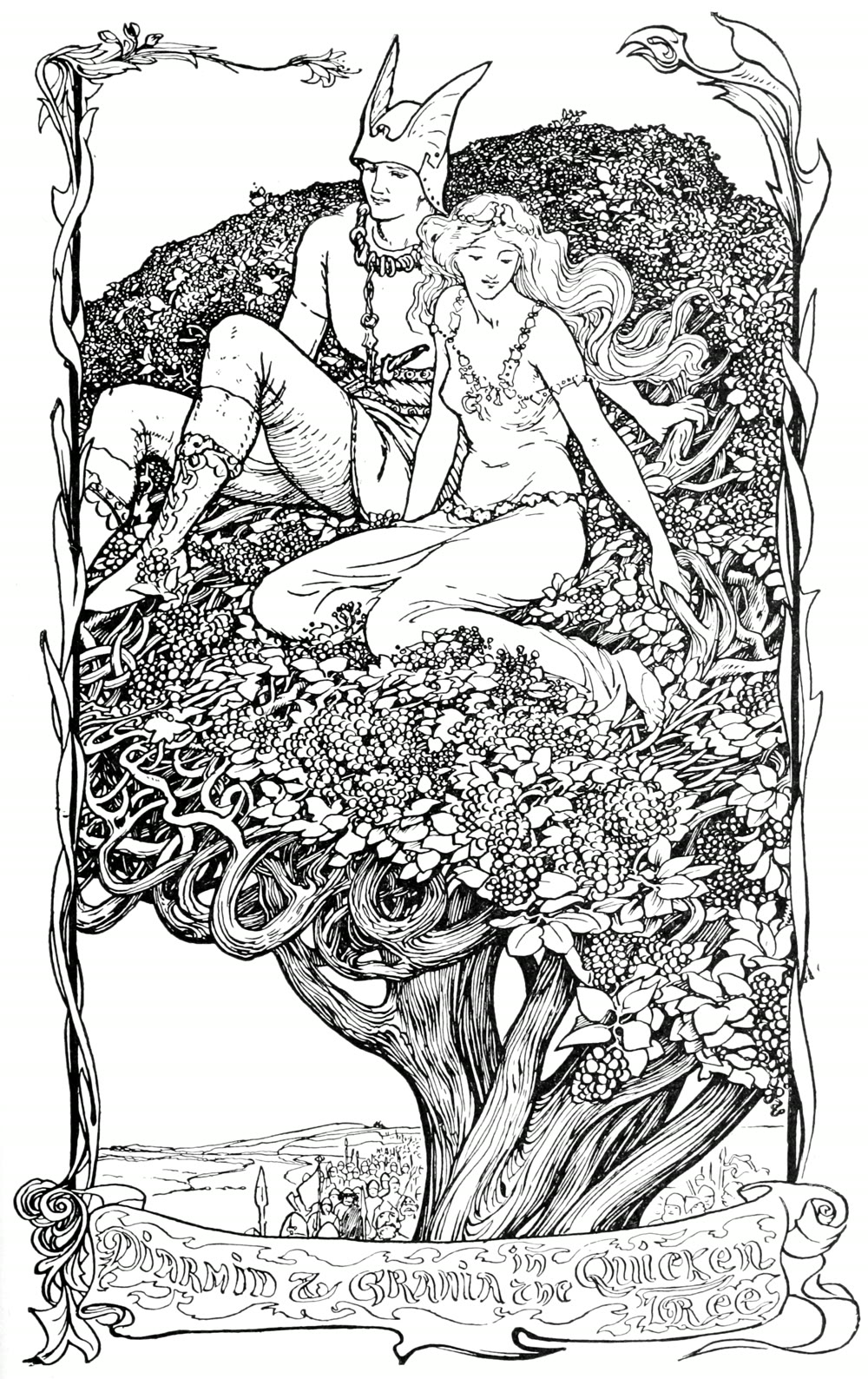
Diarmid and Grania in the Quicken Tree, by Henry Justice Ford, from Andrew Lang (ed.), The Book of Romance (1902). Public domain, via Wikimedia Commons
Diarmuid and Gráinne’s beds: the dolmens
All over Ireland, ancient stone tombs are known locally as Leaba Dhiarmada agus Ghráinne, Diarmuid and Gráinne’s bed. Folklore says the lovers slept in them on the run. The Dictionary of Irish Biography notes that many prehistoric sites came to bear the lovers’ name, and O’Grady mentioned “numerous” such stones in 1857.
A 1930s Schools’ Collection account from Aille, Co. Galway tells how the tired couple slept on two flat stones side by side on a local farm, still called their bed.
Far older than the legend
The stones were standing for millennia before anyone told this story. For a sense of their age, Poulnabrone portal tomb in the Burren dates to about 3800 BC and held the remains of more than 20 people, according to the Burren Geopark. Wedge tombs, the last type built, date from about 2500 to 2000 BC, say Heritage Ireland and the Geopark.
Darby’s Bed, Co. Limerick
On Duntryleague Hill near Galbally stands a passage tomb known locally as Darby’s Bed (Darby was an old English form of Diarmuid). A Ballyhoura Country Walks leaflet, hosted by Limerick City and County Council, repeats the folklore that the lovers rested there, and Heritage Ireland lists the site as a National Monument.
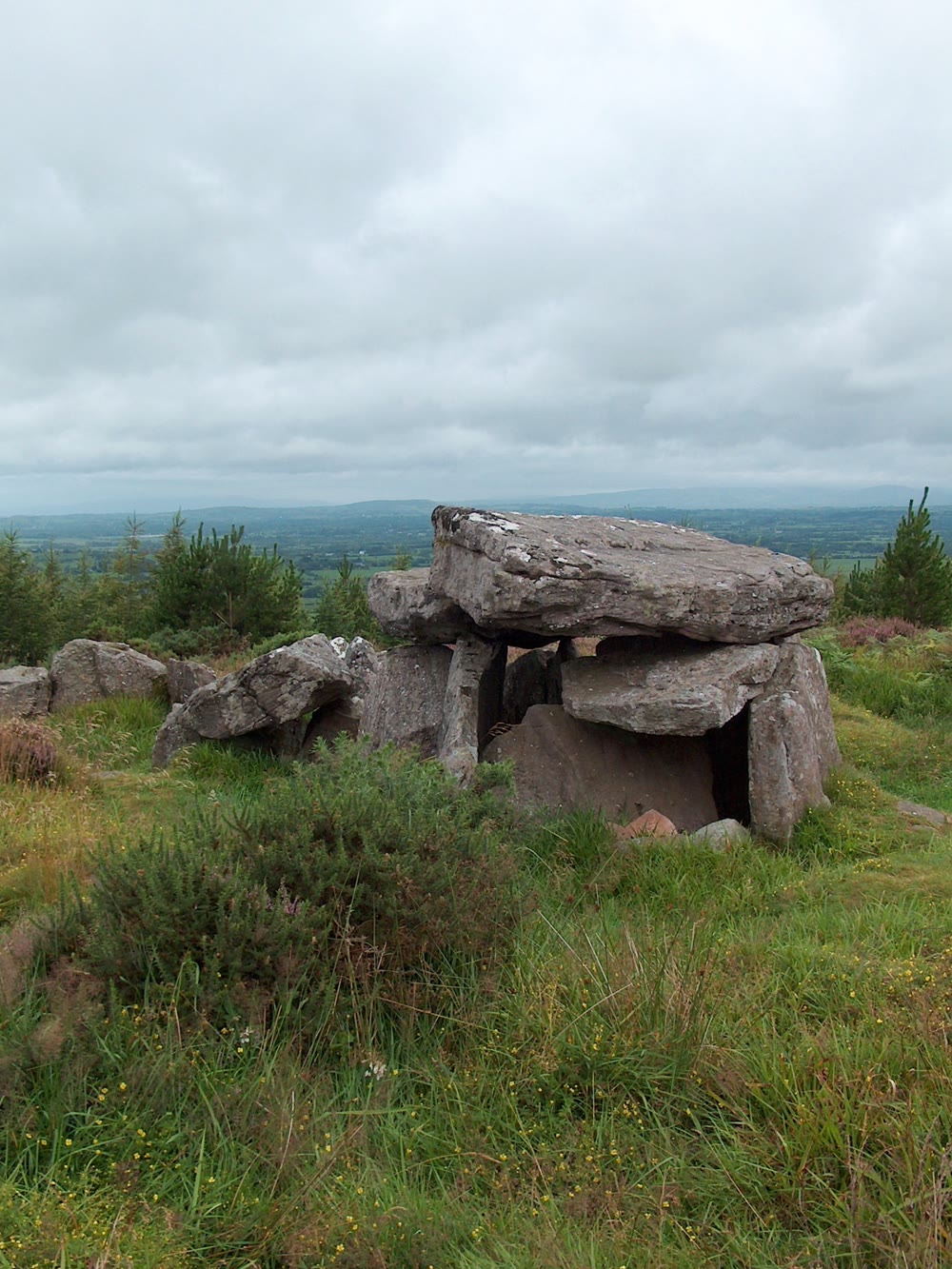
Megalithic tomb at Duntryleague, Co. Limerick, known locally as Darby’s Bed. Photo: Neil Theasby, CC BY-SA 2.0, via Wikimedia Commons (geograph.org.uk); link “Wikimedia Commons” in the caption to the file page
The boar of Ben Bulben and the water that spilled
After 16 years on the run, Aengus brokers a peace. Cormac gives Fionn his other daughter, and the lovers settle at Ráth Ghráinne in Céis Chorainn (Keshcorran), Co. Sligo, where they raise four sons and a daughter.
Years later Fionn comes to a feast at their home. One night Diarmuid hears a hound baying. Twice Gráinne holds him back. At daybreak he goes, ignoring her advice to take his great sword, the Moralltach.
The boar’s curse
On the summit of Beann Ghulbain, which O’Grady identifies as Ben Bulben, Diarmuid finds Fionn alone. His men, Fionn says, are chasing the wild boar of the mountain, and he reminds Diarmuid of his geis never to hunt a pig.
When Diarmuid was a child, his father crushed a boy to death between his knees: Diarmuid’s half-brother, his mother’s son by Roc, Aengus’s steward. Roc struck the dead child with a magic wand and turned him into a boar with neither ears nor tail, fated to live as long as Diarmuid and to kill him.
The boar charges. Diarmuid’s spear can’t pierce its hide and his sword snaps. The beast carries him on its back down to the falls at Assaroe and up again, then throws and gores him. With the broken sword’s hilt, Diarmuid kills it.
Water from Fionn’s hands
Anyone who drinks water from Fionn’s cupped hands is healed. Dying, Diarmuid reminds Fionn of the times he saved his life and asks for a drink. Fionn claims there’s no well. Diarmuid points to one nine paces away.
Fionn lets the water trickle away between his fingers. On the second trip he thinks of Gráinne and spills it again. Oscar swears that only one of them will leave the hill if Fionn doesn’t hurry. On the third trip, Fionn arrives just as Diarmuid dies.
Aengus carries the body on a golden bier to his home on the Boyne. Unable to revive him, he says he will give the body a soul so that they can talk each day. That home, the Brugh, is usually identified with Newgrange, which you can watch light up in my guide to the Newgrange winter solstice.
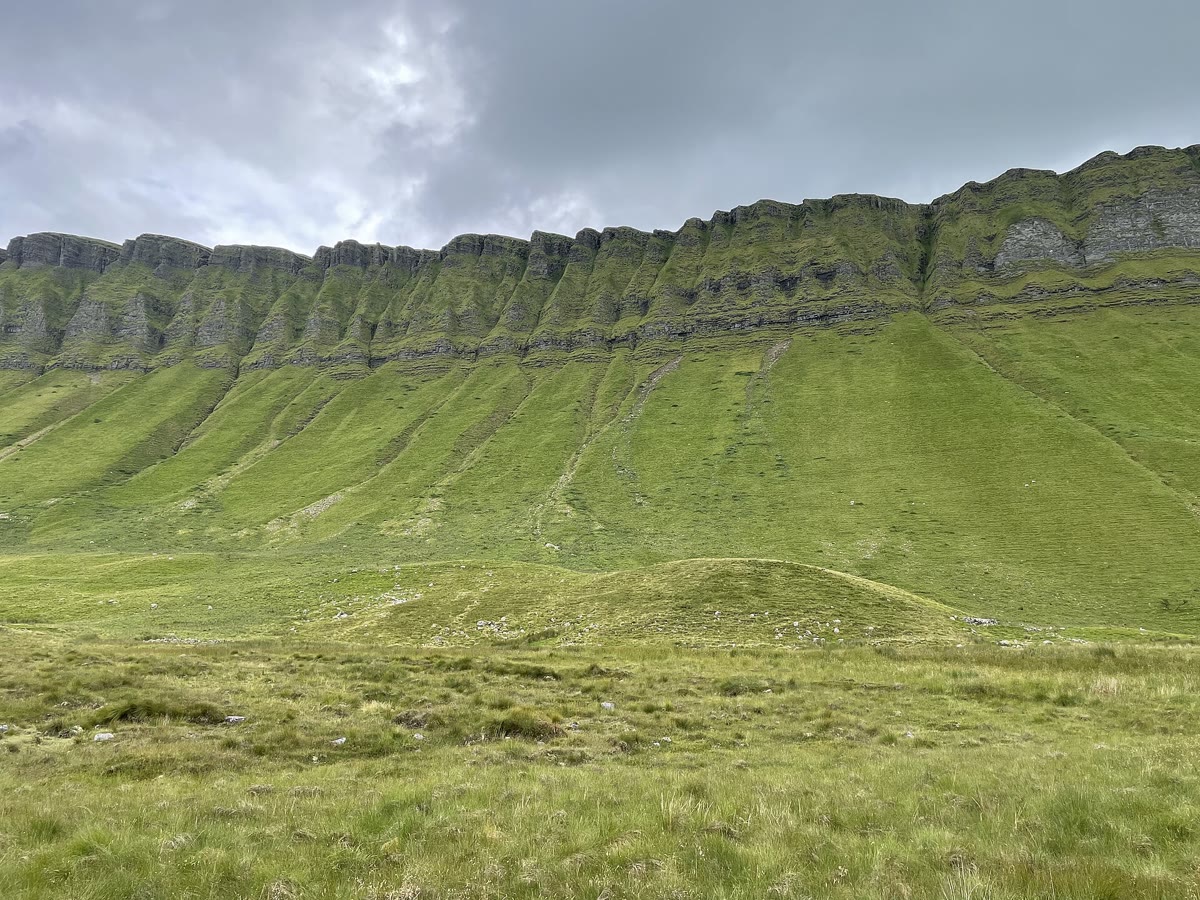
Ben Bulben, Co. Sligo, the Beann Ghulbain of the legend. Photo: Jonny Lavery, CC BY-SA 4.0, via Wikimedia Commons; link “Wikimedia Commons” in the caption to the file page
W. B. Yeats chose his own grave in Drumcliff churchyard, below the mountain, in his late poem Under Ben Bulben.
A different death in Scotland
Scotland loved the story too, and the Campbells claimed Diarmuid as an ancestor. In the Lay of Diarmaid, preserved in the Book of the Dean of Lismore from the early 1500s, Diarmuid kills the boar first. Fionn has him pace out its length against the lie of its bristles, and a poisonous bristle pierces his foot.
Later Scottish tellers gave him a mole on the sole, his one weak spot, like Achilles’ heel. And O’Grady found the measuring version common in Ireland too, as Donald Meek points out in his notes on the Lay of Diarmaid.
What happened to Gráinne?
In O’Grady’s text, Gráinne first sends her sons away to train as warriors and avenge their father. Then Fionn comes courting. She sends him off with a sharp tongue, but he keeps at it until she gives in. When the two arrive together, the Fianna jeer, and she hangs her head.
Other versions differ. In the 1859 Islay telling, where Gráinne also turns on Diarmuid, the Fianna find two separate beds, realise Diarmuid was innocent, and burn Gráinne. The Dictionary of Irish Biography notes that the 1999 dance show Dancing on Dangerous Ground gave the story a happy ending instead.
How old is the story of Diarmuid and Gráinne?
- By the 900s: a tale called “The Elopement of Gráinne, daughter of Cormac, with Diarmuid” was already known to trained poets. Only its title survives.
- Medieval fragments: an early verse in Gráinne’s voice speaks of a man for whom she would give the whole world. A short tale edited by Kuno Meyer in 1897 has her marry Fionn, hate him and leave him.
- Late 1100s: Acallam na Senórach, the great Fenian collection, mentions the spot on Beann Ghulbain where the magic pig killed Diarmuid.
- 1300s: the poet Gearóid Iarla, Earl of Desmond (died 1398), links the elopement and the death.
- The prose tale: possibly assembled in the 1300s, but its oldest surviving manuscript dates from 1651. Nessa Ní Shéaghdha, its standard editor (Irish Texts Society, 1967), estimated that at least 41 copies survive, mostly from the 1700s and 1800s.
In the Irish revival, Lady Gregory retold it in Gods and Fighting Men (1904), and W. B. Yeats and George Moore wrote a play, Diarmuid and Grania, staged in Dublin in 1901.
Diarmuid and Gráinne, Deirdre, and Tristan and Iseult
The plot may sound familiar. In the Ulster Cycle, home of Cú Chulainn, Deirdre is promised to the old king Conchobar, runs off with young Naoise, and he is killed after a treacherous peace. Rolleston found the two outlines almost identical, though very different in tone.
Then there’s Tristan and Iseult, the medieval romance of a young knight who loves the Irish princess promised to his uncle, King Mark. The parallels are striking:
- An ageing ruler, a young bride and a hero torn between love and loyalty.
- Lovers living rough in the forest, the jealous ruler on their trail.
- A sign of chastity: Diarmuid’s uncooked meat, and the bare sword found between the sleeping Tristan and Iseult.
- The splash of water. In Eilhart’s German Tristan, the hero’s neglected wife makes almost the same joke, a parallel already noticed in the 1800s.
Who borrowed from whom? In 1913, Gertrude Schoepperle argued that the Tristan romance preserves an old Irish elopement tale like this one. In 1955, James Carney argued the reverse: that an Irish writer reshaped the story under Tristan’s influence, perhaps adding Fionn’s fatal failure to heal Diarmuid. Neither case can be proved, and both may simply draw on older patterns.
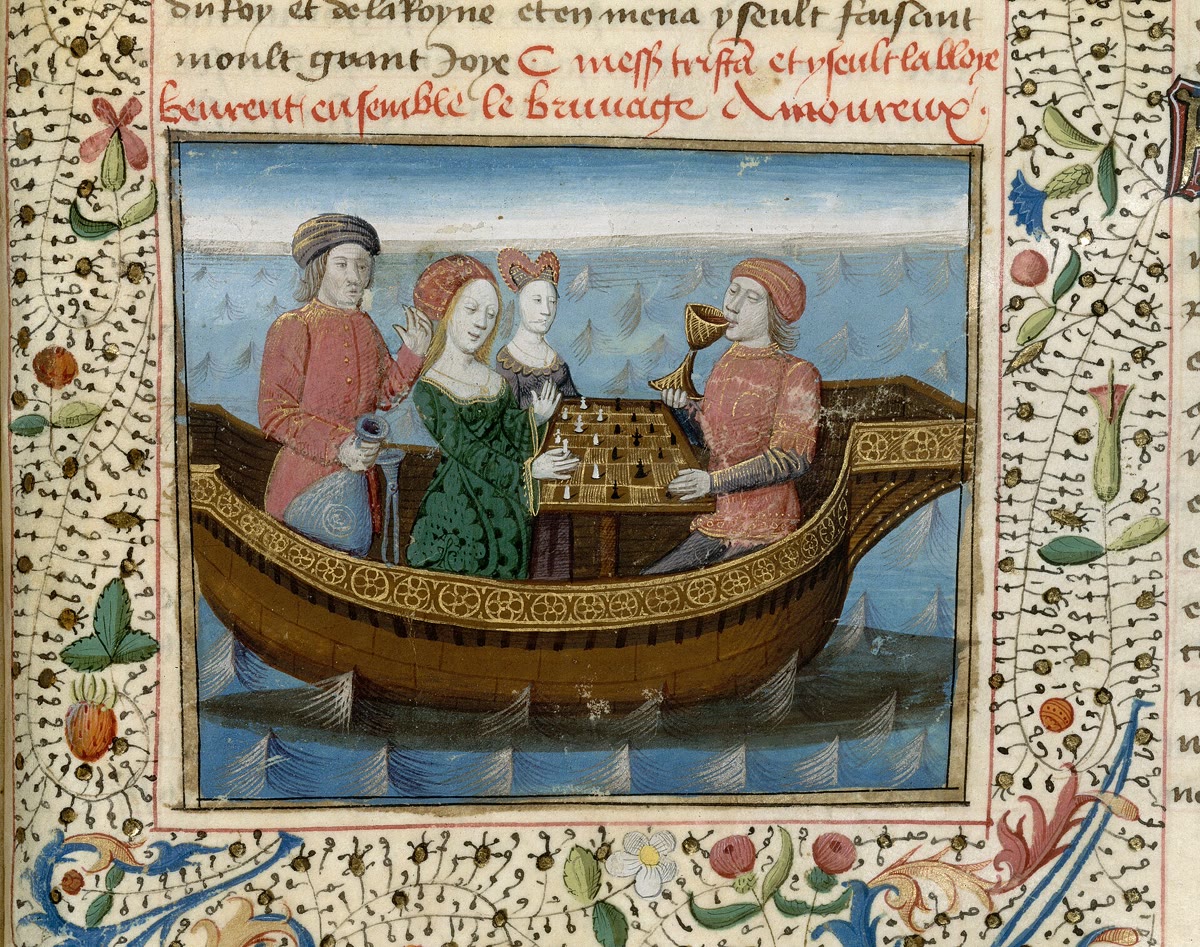
Tristan and Iseult drink the love potion, from a Lancelot du Lac compilation made by Micheau Gonnot, about 1470. Bibliothèque nationale de France. Public domain, via Wikimedia Commons
Diarmuid and Gráinne FAQ
Who were Diarmuid and Gráinne?
Legendary lovers of the Fenian Cycle. Gráinne, the High King’s daughter, was promised to the old warrior Fionn mac Cumhaill but eloped with his young follower Diarmuid.
How did Diarmuid die?
An enchanted boar gored him on Ben Bulben. Water from Fionn’s cupped hands would have healed him, but Fionn spilled it twice.
What is Diarmuid’s love spot?
The ball seirce, a magic mark that made women fall for him at first sight. In a Galway folktale, Youth herself put it on his forehead.
What is Diarmuid and Gráinne’s bed?
A local name for many ancient stone tombs, where folklore says the lovers slept. Most were built between about 3800 and 2000 BC, long before the legend.
Is Diarmuid and Gráinne older than Tristan and Iseult?
The elopement was known in Ireland by the 900s, before the oldest surviving Tristan romances of the later 1100s. But both stories probably circulated long before they were written down, and scholars still argue over which influenced the other.
Love this? Save it to your Pinterest board for later.
Pin photo: Benbulben by Superbass, CC BY-SA 4.0, via Wikimedia Commons.
A little bit of Ireland in your inbox every Friday ☘️
The free Weekly Dose of Irish: an Irish joke, a Celtic symbol, an Irish fact, a poem and the week’s best articles in one short email. Join 9,600+ readers.
Free. One short email every Friday. Unsubscribe any time.
More Irish mythology
- Celtic Gods and Goddesses: 15 Irish Deities and Their Stories
- Oengus and Áine: Ireland’s Deities of Love
- Cú Chulainn, the Legendary Hound of Ulster
- Irish Mythological Creatures: 23 Fairies and Monsters
Featured image: Ben Bulben, Co. Sligo, seen from the shore. © Superbass / CC BY-SA 4.0 (via Wikimedia Commons).