Grace O’Malley (Gráinne Ní Mháille, about 1530 to about 1603) was a real Gaelic sea captain from Clew Bay in Co. Mayo. The English called her a pirate. She raided and traded along the west coast, and in September 1593 she met Elizabeth I, traditionally at Greenwich Palace, to free her son. Much of what is told about her, including the Granuaile haircut story, is legend.
Grace O’Malley is the pirate queen everyone has heard of. She is also one of the easiest Irish figures to get wrong.
The internet is full of “facts” about her, and a good few have no paper behind them.
So here is the version I can stand over. What the records say, what tradition says, and where you can still find her in Mayo today.
Before we get into the detail, here is her story in short, told the way I tell it on our Facebook page:
Jump to:
- Who was Grace O’Malley?
- Why was she called Granuaile?
- Two husbands and a castle on the water
- Was she really a pirate?
- Sir Richard Bingham and the hard years
- Grace O’Malley and Queen Elizabeth I
- Grace O’Malley facts: record or legend?
- Her son at Kinsale, and her death
- Granuaile in song, stage and stone
- Where to find Grace O’Malley in Mayo
- Grace O’Malley FAQ
- More Irish reading
Who was Grace O’Malley?
She was born Gráinne Ní Mháille around 1530. Nobody recorded the exact year, so treat any hard “1530” with care.
Her father was Eoghan O’Malley, usually called Dubhdara (“black oak”). He was lord of Umhall, the country around Clew Bay, roughly the modern baronies of Murrisk and Burrishoole in Co. Mayo.
Her mother was Margaret, also an O’Malley. The Dictionary of Irish Biography (DIB) says Grace was their only child.
She had one half-brother, born outside the marriage, Domhnall an Píopa (“of the pipe”).
Many sites say she was born on Clare Island, but that isn’t recorded. Her biographer Anne Chambers says she grew up at Belclare and on Clare Island.
The O’Malleys were a sea family. They fished, traded and took tolls from boats in their waters. Their motto was Terra Marique Potens: “powerful by land and sea”.
Why was she called Granuaile?
Granuaile (roughly GRAWN-ya-wail) is the English spelling of Gráinne Mhaol. Mhaol means bald, or cropped.
The famous story goes like this. Her father would not bring her on a voyage to Spain, as her long hair would catch in the ropes. So she cut it all off and went anyway.
That’s a legend. The DIB treats it as an anecdote, and nothing from her lifetime backs it.
Anne Chambers has a duller theory. Locally, Ní Mháille was pronounced something like “Maille”, and that may simply have drifted into “Mhaol”. Another suggestion is Gráinne Umhaill, Gráinne of Umhall.
Two husbands and a castle on the water
Dónal of the War
Around 1546 she married Dónal an Chogaidh Ó Flaithbheartaigh, “Dónal of the War” O’Flaherty. His family ruled Iar Connacht, west of Lough Corrib. They had three children: Eoghan, Murchadh and a daughter, Margaret (Méadhbh in some accounts).
In 1564 Elizabeth gave the O’Flaherty lordship to Dónal’s rival, Murchadh na dTuadh, “of the battleaxes”. About a year later Dónal was ambushed and killed in a feud with the Joyces.
The fight was over Hen’s Castle on Lough Corrib, which tradition says she held against them. Afterwards she went home and based herself on Clare Island.
Iron Richard and Rockfleet
Around 1566 she married Richard an Iarainn Burke, “Iron Richard”. The name is usually linked to iron works on his lands.
His lands ran along the north shore of Clew Bay. One of his castles was Carraig an Chabhlaigh, “rock of the fleet”, now called Rockfleet or Carrickahowley.
Grace made it her base. It’s a four-storey tower house on an inlet of Clew Bay. At high tide the sea touches the walls, which suited a woman with ships.
Their son Theobald was born around 1567. He became Tibbot na Long, “Tibbot of the ships”, because by tradition he was born at sea.
The story that Barbary pirates attacked the ship the next day, and Grace got up from childbed to fight them off, is tradition.
The one-year marriage
You’ll read that she married Richard for one year only, under Gaelic law. Then she locked him out of Rockfleet and shouted “Richard Burke, I dismiss you.”
That’s tradition. The records show the pair acting together in the 1570s and early 1580s. They stayed allies until Richard died in 1583.
Was she really a pirate?
To English officials, yes. To the O’Malleys, she was doing what sea lords did.
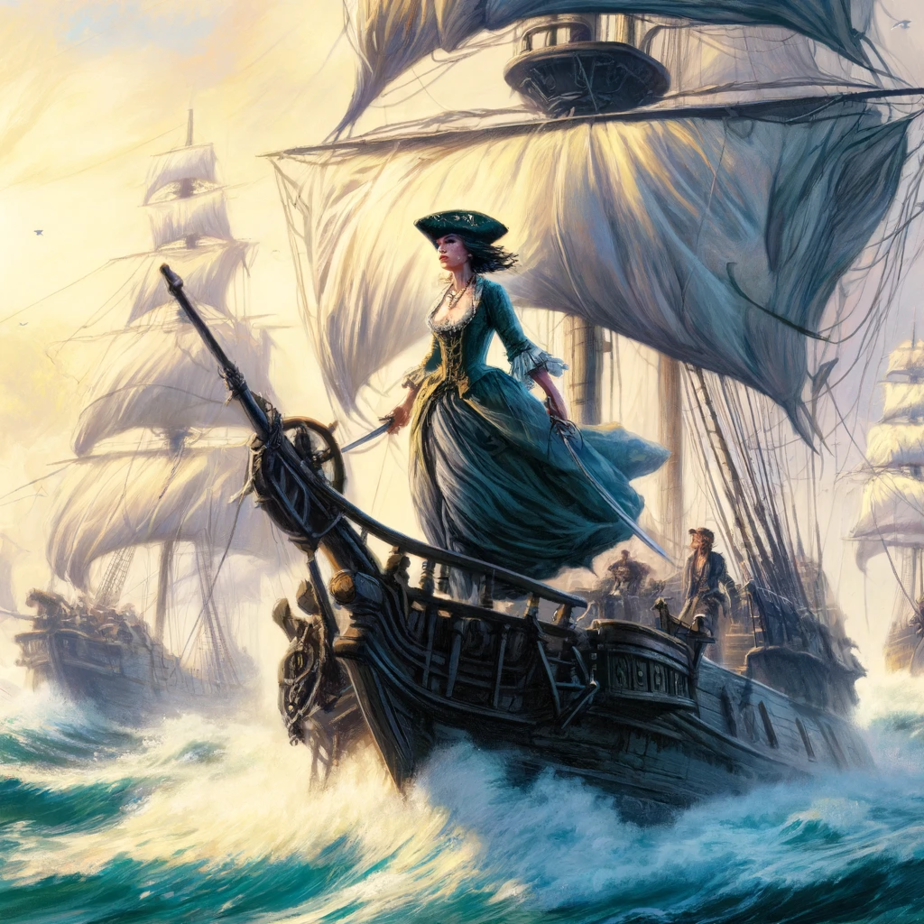
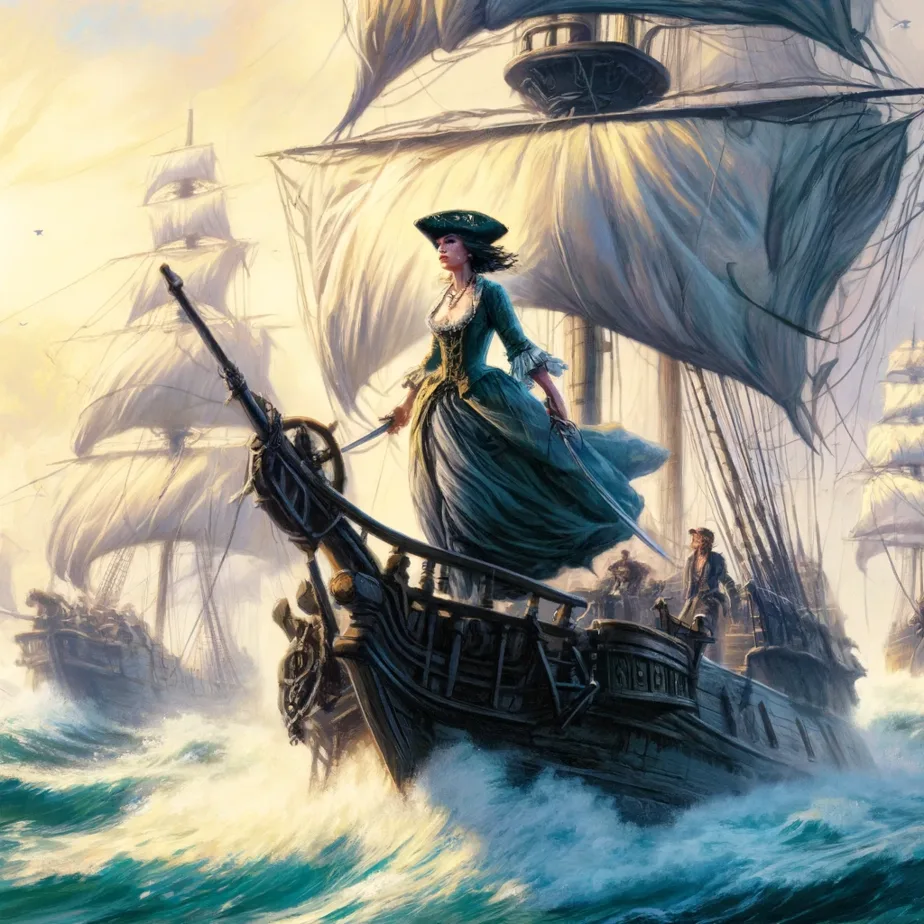
An artist’s impression only. No portrait of Grace survives. She sailed oared galleys, and the hat and dress are about 150 years too late.
She commanded galleys, long boats with oars and a sail that could work in shallow water. She raided coasts and ships, carried goods, and charged others for safe passage.
In 1577 (some accounts say 1576) the Lord Deputy, Sir Henry Sidney, met her at Galway. He later wrote that she was “a most famous femynyne sea captain”. He says she offered him three galleys and 200 fighting men.
Chambers says she took Sidney and his son Philip around Galway Bay, and charged them for it. I like her already.
In 1577 or 1578 she was captured by the Earl of Desmond. She spent about 18 months in custody, in Limerick and then Dublin, before she was released.
In October 1582, at a gathering at the governor’s house, one observer wrote that “Grany O’Maly thinketh herself to be no small lady.” He was not wrong.
The Howth Castle story
The best-loved Grace story is set at Howth, near Dublin. Tradition says she called to the castle looking for hospitality. The gates were shut because the family were at dinner.
So she carried off a young heir of the family. She gave him back on one condition. The gates would stay open at dinner, and a place would be set for the unexpected guest.
Howth Castle has told it as “tradition has it”, dating the visit to around 1576. It says a place is still traditionally set.
Most versions say she was on her way home from Elizabeth. She didn’t meet the queen until 1593. Lovely story, shaky dates.
Sir Richard Bingham and the hard years
In 1584 Sir Richard Bingham became governor of Connacht. Grace was high on his list.
In 1586 his brother, Captain John Bingham, arrested her. Bingham threatened to hang her. A relative stood pledge for her, and she was let go.
In July 1586, Bingham’s soldiers killed one of her O’Flaherty sons, Eoghan in most accounts.
She fled north to the O’Neills and O’Donnells in Ulster. She was later pardoned, but the trouble did not stop.
In the years after, she was accused of backing a rising in Mayo and of raiding along the coast.
Bingham later called her “nurse to all rebellions in the province for this forty years”. From him, I suspect she took that as a compliment.
Grace O’Malley and Queen Elizabeth I
Why she went to London
In 1593 Bingham arrested her son Tibbot and her half-brother Domhnall an Píopa. Grace was now in her early sixties.
In the summer of 1593 she petitioned Elizabeth directly. She said she had only taken up arms to defend herself. Then she sailed to London to make her case in person.
The 18 articles
Before she saw the queen, Lord Burghley sent her 18 written questions, known as the “Articles of Interrogatory”. She answered every one.
They asked about her family, her marriages, her lands and how Gaelic law treated women. Anne Chambers, who studied them, says the answers survive in the English State Papers.
The meeting with the queen
In September 1593 she was received by Elizabeth, traditionally at Greenwich Palace. Grace was about 63. Elizabeth turned 60 that month.
Soon afterwards Elizabeth wrote to Bingham, ordering an inquiry into Grace’s complaints. Chambers cites that letter, which confirms the meeting took place.
The outcome was a win. Tibbot and Domhnall were released. Grace was allowed to keep her “maintenance by land and sea”.
The legends of the meeting
Then come the stories.
- They spoke in Latin because neither had the other’s language. Chambers argues Grace understood English.
- Guards found a dagger hidden in her clothes.
- She blew her nose in a lace handkerchief and threw it in the fire.
- She refused a title because one queen could not make another a noble.
None of these appears in the records. Enjoy them, but keep them out of the homework.
Grace O’Malley facts: record or legend?
| Story | Verdict |
|---|---|
| Cut off her hair to go to sea | Legend |
| Tibbot born at sea | Tradition, widely accepted |
| Barbary pirates attacked the next day | Tradition |
| “Richard Burke, I dismiss you” | Legend |
| Kidnapped the Howth heir | Family tradition, date unclear |
| Met Elizabeth I, September 1593 | Documented (the Greenwich setting is tradition) |
| Answered 18 written questions | Documented (State Papers) |
| Spoke Latin with the queen | Tradition only |
| Buried on Clare Island | Believed, not proven |
Her son at Kinsale, and her death
Here’s the part the legend leaves out. Grace is held up as a symbol of resistance to England, but the 1590s were messier than that.
During the Nine Years’ War, she and her sons are recorded on the crown’s side at times. Survival came first.
Tibbot na Long went further. He fought on the English side at the Battle of Kinsale in December 1601. He was later knighted, and in 1627 he was made Viscount Mayo.
He died in 1629 and is buried at Ballintubber Abbey in Co. Mayo. Grace’s line continues through him. The Brownes, who owned Westport House until 2017, are among her descendants.
Grace herself is generally thought to have died around 1603, most likely at Rockfleet, aged about 73. That is the same year Elizabeth died.
Where she lies isn’t certain either. Tradition says she was buried on Clare Island. Heritage Ireland says she is believed to rest in the island’s abbey, among the O’Malley tombs.
Granuaile in song, stage and stone
After her death, Grace became a symbol. In 18th-century aisling poems, Ireland appears to the poet as a woman in a vision. Granuaile became one of the names poets and ballad makers gave her.
Patrick Pearse put her into the song “Óró sé do bheatha ‘bhaile”. It is usually traced to an older Jacobite song. Pearse added verses where Gráinne Mhaol sails home with fighting men to free Ireland. It was sung by the Volunteers around 1916.
In the mid-1980s Shaun Davey released Granuaile, an orchestral suite with Rita Connolly singing.
Morgan Llywelyn’s 1986 novel Grania led to a Broadway musical, The Pirate Queen, from the writers of Les Misérables. It opened in April 2007 and closed that June after 85 performances. The critics were not kind.
For the real history, the key modern study is Anne Chambers’ biography, Granuaile. It first came out in 1979, and it has been reissued many times since.
A bronze statue of Grace by the sculptor Michael Cooper stands in the grounds of Westport House.
Where to find Grace O’Malley in Mayo
Most of her world is around Clew Bay, on the Wild Atlantic Way. Opening times and access change, so check before you travel.
- Rockfleet Castle, near Newport. Her tower house on the water. Heritage Ireland has listed it as closed to visitors during conservation works. You can still see it from the outside.
- Clare Island. The ferry leaves Roonagh Pier near Louisburgh and takes about 15 to 20 minutes. Roonagh is about 30 km west of Westport.
- Clare Island Abbey. A small Cistercian church with rare medieval wall paintings and O’Malley tombs. Check Heritage Ireland for how to get in.
- Murrisk Abbey, at the foot of Croagh Patrick. The O’Malleys built it for the Augustinians in 1457.
- Westport House, now run as Westport Estate. It was built by her descendants on the site of an O’Malley castle. Check what is open before you go.
- Granuaile Centre, Louisburgh. A small local centre about Grace. Phone ahead before you travel.
Grace O’Malley FAQ
Was Grace O’Malley a real person?
Yes. She appears again and again in the English State Papers of the 1500s. Many of the best-known stories about her are legend, though.
Did Grace O’Malley really meet Queen Elizabeth I?
Yes, in September 1593, by tradition at Greenwich Palace. Elizabeth’s letter to Bingham soon afterwards confirms the meeting. The story that they spoke Latin is tradition only.
Why was Grace O’Malley called Granuaile?
Granuaile comes from Gráinne Mhaol, “bald” or “cropped” Gráinne. The legend says she cut her hair to go to sea. Her biographer thinks it more likely grew from the local sound of her surname.
How did Grace O’Malley die?
Nobody recorded the cause. She is generally thought to have died around 1603, probably at Rockfleet Castle, aged about 73. Elizabeth I died that same year.
Where is Grace O’Malley buried?
She is believed to be buried in the Cistercian abbey on Clare Island, among the O’Malley tombs. There is no proof, and no grave clearly marked as hers.
Does Grace O’Malley have descendants today?
Yes. The Browne family, who owned Westport House until 2017, descend from her through Tibbot na Long.
More Irish reading
- St Brendan the Navigator, another Irish sailor of legend
- The Wild Atlantic Way, where Clew Bay sits
- Irish surnames and where they come from
- Irish girl names and how to say them
- The Claddagh ring, from Galway’s old trading coast
- Facts about Ireland
- Croagh Patrick: Ireland’s Holy Mountain, Where Pilgrims Still Climb Barefoot
A little bit of Ireland in your inbox every Friday ☘️
The free Weekly Dose of Irish: an Irish joke, a Celtic symbol, an Irish fact, a poem and the week’s best articles in one short email. Join 9,600+ readers.
Free. One short email every Friday. Unsubscribe any time.