Croagh Patrick (Cruach Phádraig, “the Reek”) is a 764 m (2,507 ft) mountain above Clew Bay in Co. Mayo, known as Ireland’s holy mountain. A 7th-century account says St Patrick fasted on its summit for 40 days. Thousands climb it on Reek Sunday, the last Sunday in July, some of them barefoot, to a chapel built on the summit in 1905. From Murrisk, the climb takes most people three to four hours.
From Westport, it looks almost too perfect: a grey cone rising above Clew Bay, often wearing a cap of cloud. On the last Sunday of July, a thin line of people winds all the way to the top, and some of them are in their bare feet.
This is Croagh Patrick, Ireland’s holy mountain. Christians have prayed on its summit since at least the early Middle Ages, and some scholars think people were climbing it long before Patrick.
I’ve written about the real story of St Patrick. Here’s his mountain: the legends, the pilgrimage, what archaeologists found on top, the gold nobody was allowed to mine, and how to climb it safely.
Jump to:
- What is Croagh Patrick?
- St Patrick’s 40 days on the summit
- Reek Sunday: the pilgrimage
- Older than Patrick? Lughnasa and the harvest
- What archaeologists found on the summit
- The gold in the holy mountain
- Climbing Croagh Patrick today
- The National Famine Memorial at Murrisk
- Clew Bay and the view from the top
- Croagh Patrick FAQ
- More Irish heritage reading
What is Croagh Patrick?
Croagh Patrick rises 764 m (2,507 ft) over the south shore of Clew Bay, about 8 km (5 miles) from Westport. It isn’t even Mayo’s highest mountain (Mweelrea, at 814 m, is), but it’s by far the best known.
Its Irish name is Cruach Phádraig (KROO-ukh FAW-drig), Patrick’s stack. Ó Dónaill’s dictionary gives cruach as a stack or rick of corn, hay or turf, and also as a mountain stack. Locally it’s just the Reek, the same word you hear in Kerry’s MacGillycuddy’s Reeks, Na Cruacha Dubha in Irish.
Its older name was Cruachán Aigle. The Dindshenchas, the medieval lore of place names, explains it with a killing: Aigle, son of Derg, was slain there by his uncle Cromderg, and the hill, once called Cruachán Garbrois, took his name.
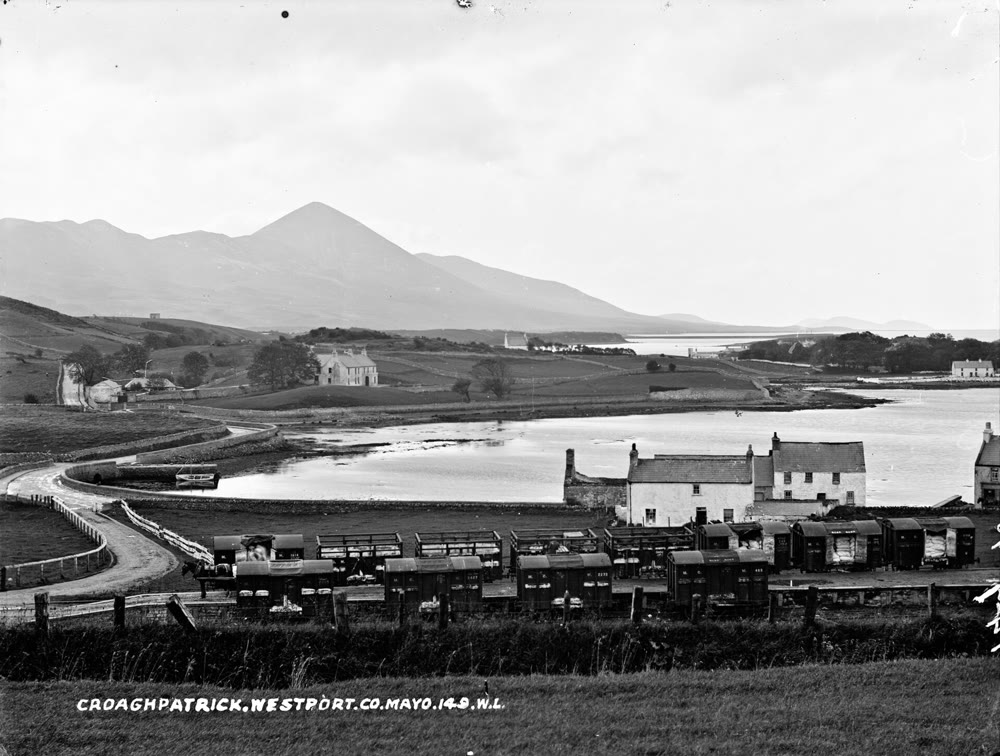
Croagh Patrick from near Westport, Co. Mayo, between 1865 and 1914. Photo: Robert French, Lawrence Collection, National Library of Ireland, via Wikimedia Commons
St Patrick’s 40 days on the summit
The oldest written account comes from Tírechán, a 7th-century Irish bishop who wrote notes on Patrick’s travels in Latin, some two centuries after the saint’s time. They survive in the Book of Armagh. Here is his story, retold in my own words from the Latin text.
Patrick came to Mons Egli, as the Latin names the mountain, meaning to fast there for 40 days and 40 nights, as Moses, Elijah and Christ had done. On the way, his charioteer Totmáel died on the plain between the mountain and the sea, which Tírechán calls Muiresc Aigli. Murrisk, where the climb starts today, still carries the name. Patrick buried him, piled stones around the grave and promised to visit it at the end of time.
Then he climbed to the summit and stayed for 40 days and nights. So many birds plagued him that sky, land and sea were hidden from him. The text breaks off there, then resumes: God had told all the saints of Ireland, past, present and to come, to climb this mountain, the highest in the west, and give the Irish their blessing, so that Patrick would see the harvest of his mission.
The fast is usually dated to Lent in 441, but Tírechán gives no year, and the Annals of Ulster don’t mention the mountain under 441. Treat the date as tradition.
Black birds, a bell and a bargain with an angel
The Tripartite Life of Patrick, a later Life written mostly in Irish, turns the story into high drama. In Whitley Stokes’s 1887 edition, Patrick stays on the mountain without food or drink from the Saturday before Lent until Easter Saturday.
At the end of the 40 days, black birds fill the mountain until he can’t tell heaven from earth. Cursing psalms fail. He rings his bell so loudly that all Ireland hears it, then flings it at them and knocks a piece out of it. He weeps until his chasuble is soaked, and no demon comes to Ireland for seven years, seven months, seven days and seven nights.
An angel comforts him and brings white birds to sing. Then the bargaining starts. Each time the angel grants another favour, such as more souls freed from hell, and tells him to leave, Patrick refuses to go until he is blessed. The angel promises that the sea will cover Ireland seven years before the Last Judgement. Patrick holds out for more: on that day, he himself must judge the Irish.
Finally, the angel brings word that everything is granted, and Patrick goes down to celebrate Easter at Aughagower. A keeper from Patrick’s household, the Life adds, still guards the mountain: people hear his bell, but he is never found.
And the snakes?
Neither Tírechán nor the Tripartite Life puts snakes on the mountain. They arrive in the late 12th century, in the Life of Patrick by Jocelin, a monk of Furness Abbey in England. In his version, Patrick herds every venomous creature in Ireland to this mountain and drives them over the edge into the ocean.
Ireland had no snakes to banish anyway, as my list of myths about Ireland explains. In the 1930s, a Schools’ Collection pupil from Lankill, Co. Mayo, wrote that Patrick drove the serpents down the mountain into a lake, where they drowned. A Carrowniskey account sent them to Lough Derg in Donegal, which is why, it said, the water there is brown.
Reek Sunday: the pilgrimage
The big day is Reek Sunday, the last Sunday in July. In 2027, that’s 25 July.
Under the year 1113, the Annals of Ulster record that a ball of fire, probably lightning, killed thirty people who were fasting on the mountain on the night of St Patrick’s feast. In 1432, Pope Eugene IV granted an indulgence to pilgrims who visited St Patrick’s chapel on the mountain on the Sunday before 1 August, the last Sunday in July, and gave alms for its repair. The place drew “a great multitude”, says the calendar of papal letters.
Around 1456, Hugh O’Malley founded an Augustinian friary at Murrisk, dedicated to St Patrick, and it became the starting point of the pilgrimage, Heritage Ireland says. Older routes came from the east, among them Tóchar Phádraig (TOH-khur FAW-drig), a 35 km (22-mile) pilgrim road from Ballintubber Abbey that walkers still follow on the day before Reek Sunday.
More than 16,000 climbed in 1915, many arriving on twenty special trains, RTÉ’s Century Ireland project recorded. RTÉ News put the 1965 crowd at 60,000. In 2025, OSV News reported more than 6,000. Across the whole year, Westport Parish says, over 120,000 people make the climb.
Until the 1970s, many pilgrims climbed through the night, with Mass on the summit. The Castlebar-born journalist Tom Gillespie recalls that the church moved the climb into daylight, partly because of the all-night drinking in Westport’s pubs. Many still set off before dawn, some barefoot as a penance. Smaller pilgrimages are held on Garland Friday, the Friday before Reek Sunday, and on 15 August.
The summit chapel
The little white chapel on the summit was built in 1904 and 1905 for John Healy, Archbishop of Tuam, to designs by the Dublin architects W. H. Byrne and Son. Healy dedicated it on 30 July 1905, that year’s Reek Sunday, the Dictionary of Irish Architects records. It was renovated in 1962. An earlier chapel had been demolished in penal times, the Catholic Encyclopedia says, but the pilgrims never stopped coming. On Reek Sunday, Mass is said there every hour from early morning.
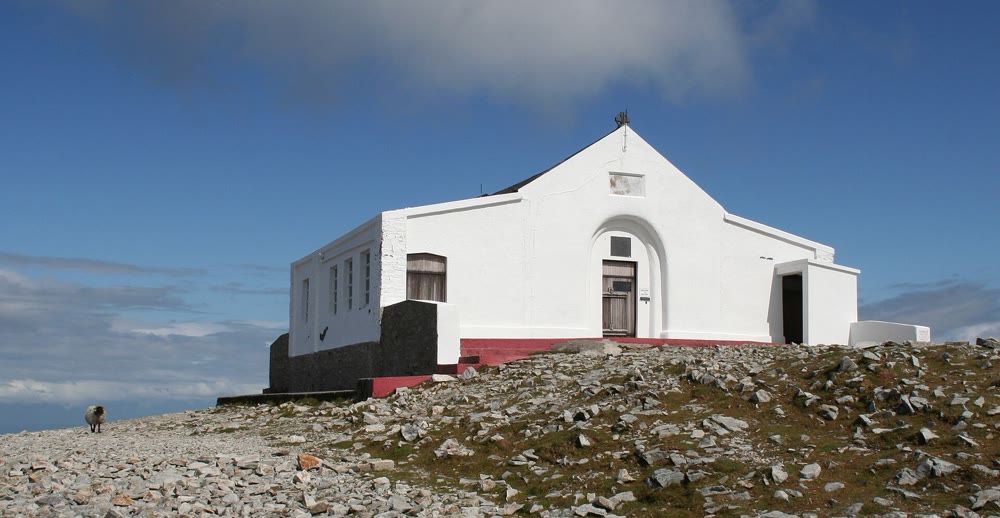
St Patrick’s chapel on the summit of Croagh Patrick, built in 1905. Photo: Störfix, CC BY-SA 3.0, via Wikimedia Commons
The three stations
Pilgrims traditionally make three stations, praying as they walk sunwise around each spot:
- Leacht Benáin (lyakht BEN-awn), a cairn at the foot of the cone: seven Our Fathers, seven Hail Marys and the Creed, walking around it seven times.
- The summit: prayers on your knees, fifteen circuits of the chapel, then seven circuits of Leaba Phádraig (LAB-uh FAW-drig), Patrick’s Bed, where pilgrims now leave rosary beads and photos.
- Reilig Mhuire (REL-ig WIR-uh), Mary’s graveyard, often spelled Roilig Mhuire, well down the western side: seven circuits of each stone mound, then seven of the whole enclosure. Westport Parish says it’s hard to find and rarely completed now.
The Black Bell
Every year, Sir William Wilde wrote in 1867, the Gerarty family from near Ballinrobe carried an old iron bell up the Reek on Garland Sunday. In the oratory, pilgrims paid a penny to kiss the Clog Dubh, the Black Bell, or twopence to pass it three times around their bodies against rheumatism. Local belief held it was once pure silver, an angel’s gift, blackened by the demons Patrick drove off the mountain. When the crowds thinned, its keeper sold it to pay his passage to America, and Wilde acquired it for the Royal Irish Academy.
Older than Patrick? Lughnasa and the harvest
The date is a clue. Lughnasa, the harvest festival named after the god Lugh, fell on 1 August, as my guide to the Celtic gods explains. Ó Dónaill’s dictionary still lists Domhnach Chrom Dubh, Crom Dubh’s Sunday, as the last Sunday in July. Elsewhere it was Garland Sunday or Bilberry Sunday, a day for climbing hills and picking fraughans.
In 1942, the Irish Folklore Commission sent out a questionnaire titled Domhnach Crom Dubh or Garland Sunday, and the replies filled 1,073 pages, the National Folklore Collection notes. The folklorist Máire MacNeill built them into The Festival of Lughnasa (1962), which examined 195 sites. She argued that many late-July gatherings on hills and at lakes and wells were survivals of Lughnasa, and the Croagh Patrick pilgrimage was the best known of them.
In the folklore, Crom Dubh is usually a pagan chief whom Patrick defeats or converts. MacNeill saw an older myth behind him: a dark god guarding the harvest until Lugh won it, with Patrick later taking Lugh’s role.
It’s a persuasive theory, but it is a theory, built mostly on folklore recorded in modern times. Even the Celtic scholar Anne Ross, who praised the book in a 1967 review, allowed that its evidence could be read in more than one way.
The landscape adds weight. South-east of the mountain lies the Boheh Stone, an outcrop with more than 250 carved motifs, mostly cup-and-ring marks, which Heritage Ireland believes date to around 3800 BC. On clear evenings around 18 April and 24 August, the setting sun, seen from the stone, seems to settle on the summit of Croagh Patrick and then roll down its side. Gerry Bracken noticed the effect in the early 1990s, the Irish Times recalls. Whether the carvers chose the rock for that reason can’t be proved.
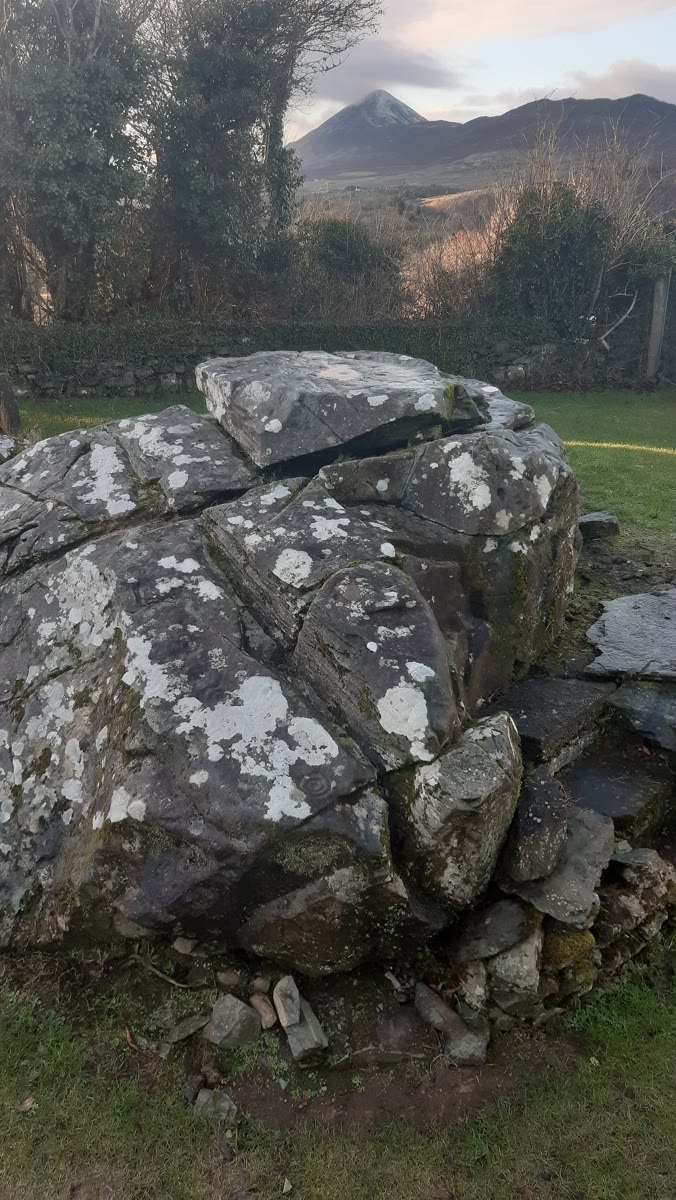
The Boheh Stone, with Croagh Patrick on the skyline. Photo: Ridiculopathy, CC0, via Wikimedia Commons
What archaeologists found on the summit
In August 1994, a team of six, three of them archaeologists, began climbing to the top every day for a seven-week dig directed by Gerry Walsh of Mayo County Council. Just east of the 1905 chapel, they uncovered a small building of dry-laid stone, probably an oratory.
Its walls showed signs of corbelling, so from outside it may have looked like an upturned boat, like the Gallarus Oratory in Co. Kerry. Its door faced east, perhaps for shelter from the south-westerly gales. Inside lay a thick spread of charcoal, with medieval pottery, bronze pins and worked flints.
The oratory has been radiocarbon dated to between AD 430 and 890, according to Museums of Mayo. That range takes in Patrick’s century, but it spans 460 years, so it can’t place him there. The diggers also found a hillfort rampart encircling the summit, which Museums of Mayo takes as a sign the mountain mattered long before Christianity.
The gold in the holy mountain
In the 1980s, prospectors found gold in Croagh Patrick. A small company, Burmin, held a licence to explore on the mountain’s western side, and drilling in 1988 pointed to a worthwhile deposit, The Northern Miner reported.
Local people pushed back. Paddy Hopkins, a retired Westport man, founded the Mayo Environmental Group, organised a big public rally and brought the botanist David Bellamy over to support the campaign, his Mayo News obituary recalls. In May 1989, the Archbishop of Tuam, Joseph Cassidy, wrote in the Irish Times under the headline “Croagh Patrick: its wealth is not in gold”. By May 1990, the government had decided to stop exploration and mining on the mountain, as Dáil questions that month show.
When gold turned up on Inishturk, off the Mayo coast, in late 1989, islanders opposed to prospecting took heart from the Croagh Patrick campaign, RTÉ News reported in 1990.
Climbing Croagh Patrick today
Most people start from the car park at Murrisk, a natural stop on the Wild Atlantic Way, where there’s a visitor centre with toilets. Without a car, take Bus Éireann’s 450 from Westport, about 20 minutes.
The path climbs to the shoulder, runs along a ridge and then tackles the cone, steeper than 35 degrees in places. Since late 2020, a €1 million project has rebuilt much of the path, and stone steps laid by hand now climb the cone where walkers once scrambled over loose scree.
The safety advice, in short:
- Wear hiking boots with ankle support. Mayo Mountain Rescue doesn’t advise going barefoot; if you do, carry your boots.
- Bring layers and rain gear. The summit can be 7 to 8 degrees colder than the car park.
- Carry food and water for three to four hours, and a fully charged phone.
- Check the Met Éireann forecast before you set out.
- Take the descent slowly. Many injuries happen coming down the cone.
Dogs aren’t allowed, there are no toilets on the mountain and the path crosses working farmland. In an emergency, call 112 or 999 and ask for Mountain Rescue.
The National Famine Memorial at Murrisk
Across the road from the car park stands the National Famine Memorial, John Behan’s bronze Coffin Ship, with skeletal figures twined through its rigging. President Mary Robinson unveiled it on 20 July 1997, University College Dublin’s Famine memorials survey records. Its plaque honours all who died, suffered or emigrated in the Famine of 1845 to 1850, and the victims of every famine. There’s more in my guide to the Irish potato famine.
Clew Bay and the view from the top
On a clear day, the summit looks down on Clew Bay and its scattered green islands. They’re drumlins, low hills of glacial debris shaped by the ice and later drowned as the sea rose, the National Parks and Wildlife Service explains. Clare Island stands at the mouth of the bay.
This was O’Malley country. Grace O’Malley, the so-called pirate queen, sailed out of Clew Bay in the 1500s, and her O’Malley kin had founded the friary at Murrisk.
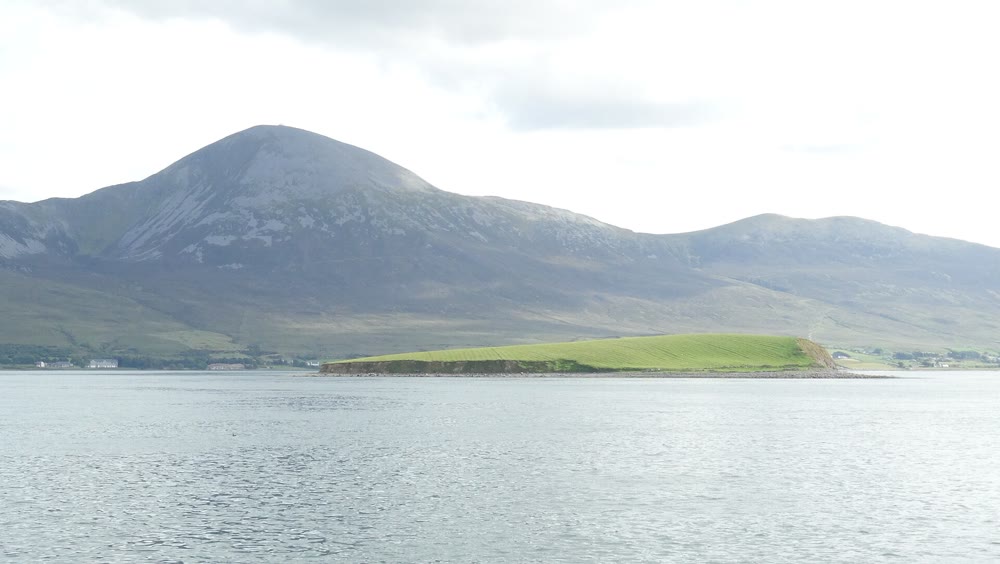
Inishdaugh, one of the low islands of Clew Bay, with Croagh Patrick behind. Photo: Colin Park, CC BY-SA 2.0, via Wikimedia Commons
Croagh Patrick FAQ
How high is Croagh Patrick?
764 m (2,507 ft). It isn’t the highest mountain in Co. Mayo, though: Mweelrea, at 814 m, is.
How long does it take to climb Croagh Patrick?
Most people take three to four hours up and down from Murrisk. Allow longer on Reek Sunday, when the path is crowded.
When is Reek Sunday?
The last Sunday in July. In 2027 it falls on 25 July.
Did St Patrick really fast on Croagh Patrick?
Nobody can prove it. The earliest account was written about two centuries after him.
Did St Patrick drive the snakes off Croagh Patrick?
No. The National Museum of Ireland has found no fossil evidence of snakes in Ireland, and the tale first appears in Jocelin’s Life of Patrick, about 700 years after the saint.
Why do people climb Croagh Patrick barefoot?
As a penance. Mayo Mountain Rescue advises boots, and asks anyone who goes barefoot to carry them.
Love this? Save it to your Pinterest board for later.
Pin image: Adapted from a photo by Vicuna R, CC BY-SA 2.0, via Wikimedia Commons.
A little bit of Ireland in your inbox every Friday ☘️
The free Weekly Dose of Irish: an Irish joke, a Celtic symbol, an Irish fact, a poem and the week’s best articles in one short email. Join 9,600+ readers.
Free. One short email every Friday. Unsubscribe any time.
More Irish heritage reading
- The History of St Patrick’s Day: The Real Story (and Why Patrick Wasn’t Irish)
- Skellig Michael: The Impossible Island Monastery, From Monks to Star Wars
- Grace O’Malley: The Irish Pirate Queen Who Met Elizabeth I Face to Face
- The Irish Potato Famine (An Gorta Mór): Ireland’s Great Hunger, 1845 to 1852
- Celtic Gods and Goddesses: 15 Irish Deities and Their Stories
- Wild Atlantic Way Route: Map, Best Stops and 7, 10 and 14-Day Itineraries
- The St Patrick Snakes Legend: Ireland Never Had Any. So Where Did the Story Come From?
Featured image: Croagh Patrick seen from Ben Lugmore, Co. Mayo, with the summit chapel on top. Photo: Vicuna R, CC BY-SA 2.0, via Wikimedia Commons.