Happy birthday in Irish is Lá breithe sona duit (law BREH-huh SUN-uh ditch), literally “a happy day of birth to you”. To two or more people, say Lá breithe sona daoibh (law BREH-huh SUN-uh deev). Breithlá sona duit (BREH-law SUN-uh ditch) is just as correct. For “many happy returns”, say Go maire tú an lá (guh MAR-uh too un LAW). To add a pet name, put a little a in front: Lá breithe sona duit, a ghrá means “happy birthday, my love”. It’s sona, not shona, and it fits the usual birthday tune exactly.
Maybe it’s your mother’s 80th or a grandchild’s first birthday, and you’d love a line of Irish on the card. Or the candles are lit and you want the room to sing it as Gaeilge.
The Irish for happy birthday is short and easy to say. The catch is that it’s often misspelled online, and most of the mistakes come down to one little letter h.
Here’s how to say it, write it and sing it, to Mam, Dad, Granny or your love, plus the old wishes that go with it and the birthday customs that really are Irish. Every Irish word here was checked in the two standard dictionaries, Ó Dónaill’s Irish-English dictionary (on teanglann.ie) and Foras na Gaeilge’s English-Irish one (on focloir.ie).
Jump to:
- How to say happy birthday in Irish
- How to pronounce Lá breithe sona duit
- Lá breithe or breithlá? And why it’s sona, not shona
- Saying it to more than one person
- Happy birthday, my love: saying it to someone special
- Many happy returns and other Irish birthday wishes
- How to sing Happy Birthday in Irish
- Irish birthday card messages
- Irish birthday customs: what’s real and what isn’t
- Common misspellings and how to fix them
- Happy birthday in Irish: FAQ
- More Irish language reading
How to say happy birthday in Irish
Here’s the everyday greeting, word by word:
| Irish | Say it | Meaning |
|---|---|---|
| Lá | law | day |
| breithe | BREH-huh | of birth. It’s a form of breith (breh), birth. |
| sona | SUN-uh | happy, lucky, fortunate |
| duit | ditch | to you, said to one person |
Irish puts the describing word after the noun, so “happy” comes after “day of birth”.
The New English-Irish Dictionary from Foras na Gaeilge gives two translations of “Happy Birthday!”: Lá Breithe Sona! and Breithlá Sona! (BREH-law SUN-uh). Add duit for one person. For everyday hellos and goodbyes, see my list of Irish greetings.
How to pronounce Lá breithe sona duit
Say it slowly at first: law, BREH-huh, SUN-uh, ditch. The th in breithe is a soft h, as in “ahead”, and duit really does sound like the English word ditch.
Each of the three main dialects colours the words a little:
- Connacht (Galway and Mayo): close to the respelling above. The o in sona is short, like the u in “put”.
- Munster (Kerry, Cork and Waterford): the o in sona is more open, like the o in “hot” in an Irish or British accent, and duit can sound rounder, closer to “dutch”.
- Ulster (Donegal): lá is lighter, nearer “lah”, and in parts of Donegal it moves towards the a in “bad”, drawn out.
You’ll also hear dhuit, with a soft, throaty gh at the start: roughly GHITCH, or GHUTCH in Munster. It’s a softened form used in speech. On a card, the standard spelling is duit.
To hear it, teanglann.ie has recordings of lá, breithe, sona and breithlá in all three dialects.
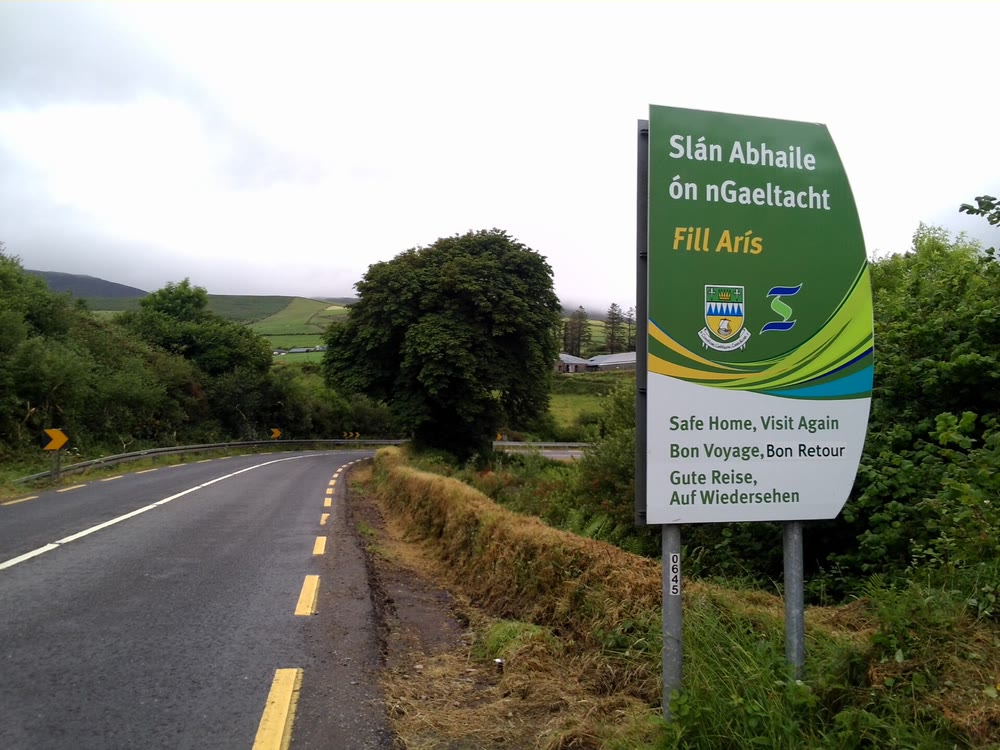
Slán abhaile ón nGaeltacht, fill arís (slawn uh-WAL-yuh ohn NGAYL-tukht, FILL uh-REESH): “safe home from the Gaeltacht, come back again”, on the N86 between Dingle and Tralee, Co. Kerry. Photo: Roger W. Haworth, CC BY-SA 4.0, via Wikimedia Commons
Lá breithe or breithlá? And why it’s sona, not shona
Both are right. Breithlá is one word, birth plus day, just like the English “birthday”. Lá breithe is “day of birth”. Focloir.ie lists them side by side, even for a birthday card: cárta lá breithe or cárta breithlae (KAWR-tuh law BREH-huh, KAWR-tuh BREH-lay). The ending changes to -lae in phrases like that.
Now the h. Sona means happy, and also lucky or fortunate. In Irish, an adjective that follows a feminine noun usually softens, and in writing that means adding an h:
- Nollaig (Christmas) is feminine, so it’s Nollaig shona (NUL-ig HUN-uh), “happy Christmas”. Ó Dónaill gives it exactly that way.
- Lá (day) is masculine, so sona stays as it is: lá breithe sona.
- Breithlá is masculine too: breithlá sona.
Breith, birth, happens to be feminine, but the adjective describes lá, the day, not the birth. So it’s Lá breithe sona, never Lá breithe shona.
The h changes the sound too: sh before o is said like an English h, so shona is HUN-uh, the Christmas form. There’s more on that one in my guide to Merry Christmas in Irish.
Saying it to more than one person
Duit is “to you” when you’re talking to one person. For twins or a shared party, use daoibh (deev), “to you all”:
- Lá breithe sona daoibh (law BREH-huh SUN-uh deev)
- Breithlá sona daoibh (BREH-law SUN-uh deev)
For a social media post about someone, use do (duh), “to”, and mo (muh), “my”. Mo adds an h too:
- Lá breithe sona do mo mham (law BREH-huh SUN-uh duh muh WAM): happy birthday to my mum.
- Lá breithe sona do mo dhaid (law BREH-huh SUN-uh duh muh GHADJ): happy birthday to my dad.
Happy birthday, my love: saying it to someone special
Talking directly to a person, Irish puts a little word, a (uh), in front of the name or pet name. That a adds an h to most consonants, so “my love” is a ghrá. Without the h, a grá means “her love”.
Add it after the greeting: Lá breithe sona duit, a ghrá (law BREH-huh SUN-uh ditch, uh GHRAW), “happy birthday, my love”. For something more romantic, try a ghrá mo chroí (uh GHRAW muh KHREE), “love of my heart”. There are more pet names in my guide to I love you in Irish.
| To | Irish | Say it |
|---|---|---|
| My love | a ghrá | uh GHRAW |
| Darling | a stór | uh STORE |
| My dear (literally “heart”) | a chroí | uh KHREE |
| Friend | a chara | uh KHAR-uh |
| Mum, Mammy | a Mham, a Mhamaí | uh WAM, uh WAM-ee (Munster: uh VAM) |
| Dad, Daddy | a Dhaid, a Dhaidí | uh GHADJ, uh GHADJ-ee |
| Granny | a Mhamó | uh WAM-oh |
| Grandad | a Dhaideo | uh GHAJ-oh |
| Son | a mhic | uh VICK |
| Daughter | a iníon | uh IN-een (Munster: uh in-EEN) |
- Stór starts with st, which never takes the h, so it stays a stór. Iníon starts with a vowel, so it doesn’t change either.
- Mamó keeps its fada, but the dictionaries spell Daideo without one. My guide to Irish names for grandma and grandpa has the whole family.
- For a son, a mhic is the textbook form; focloir.ie also gives a mhac (uh WOCK).
Names soften the same way: Máire becomes a Mháire (uh WAW-ruh). Men’s names often change their ending too, so focloir.ie writes Seán as a Sheáin (uh HYAWN). Names starting with a vowel stay as they are: a Aoife (uh EE-fuh).
Many happy returns and other Irish birthday wishes
Irish has its own birthday wishes, and several are built on mair (mar), “to live”. Ó Dónaill’s dictionary records them, most under mair:
- Go maire tú an lá (guh MAR-uh too un LAW): many happy returns of the day; literally, “may you live the day”.
- Go maire tú an céad (guh MAR-uh too un KAYD; in Munster, KEE-ud): may you live to be a hundred.
- Go maire tú i bhfad (guh MAR-uh too ih WOD): long life to you.
- Fad saoil duit (FOD SEEL ditch; in Munster, SAYL): long life to you. The fuller version is Fad saoil duit in aice na sláinte (FOD SEEL ditch in AK-uh nuh SLAWN-chuh), “long life and good health to you”.
- Sláinte agus saol chugat (SLAWN-chuh AG-us SEEL HUG-ut): health and long life to you, a toast for raising a glass. More in my guide to saying cheers in Irish.
- Go mbeirimid beo ar an am seo arís (guh MER-uh-mij BYOH er un AWM shuh uh-REESH): may we live to see this time next year. You’ll also see go mbeire muid…, with muid (mwij), the everyday word for “we”.
For longer blessings and toasts, see my 100+ Irish birthday blessings.
How to answer
If someone wishes you Go maire tú an lá, the reply Ó Dónaill gives is Go maire tú do shláinte (guh MAR-uh too duh HLAWN-chuh), “may you enjoy good health”. Or simply say go raibh maith agat (guh rev MAH AG-ut), as in my guide to thank you in Irish.
How to sing Happy Birthday in Irish
Lá breithe sona duit has six syllables, the same as “Happy birthday to you”, so it fits the tune note for note. The Irish version simply repeats the wish:
- Line 1: Lá breithe sona duit
- Line 2: Lá breithe sona duit
- Line 3: Lá breithe sona, a … plus the name, softened as above: a Mháire, a Mhamó, a chara.
- Line 4: Lá breithe sona duit
The little a in line 3 takes the place of “dear”. For twins or a group, sing daoibh instead of duit. To finish with a cheer, focloir.ie gives hip, hip, hurá! (hip hip hoo-RAW).
Where the tune comes from
The tune is American. Mildred Hill composed it and her sister Patty wrote the words of the original, a classroom greeting called Good Morning to All, while Patty ran a kindergarten training school in Louisville, Kentucky. The melody was first copyrighted in 1893. From the 1910s, songbooks set it to birthday words, and by 1935 it was the standard birthday song, says a 2010 history from the US Copyright Office.
Warner/Chappell, which in 1988 bought the company claiming the rights, charged fees for commercial uses such as films, reportedly about $2 million a year. Then, in Marya v. Warner/Chappell Music, Judge George H. King in Los Angeles ruled on 22 September 2015 that the 1935 copyright it relied on covered only particular arrangements of the tune, never the birthday words. In June 2016 he approved a $14 million settlement that put the song in the US public domain, AFP reported.
In the EU, copyright usually runs 70 years after the last author’s death. Mildred Hill died in 1916 and Patty in 1946, so any European rights had run out by 2017. The song is now generally treated as free to sing.
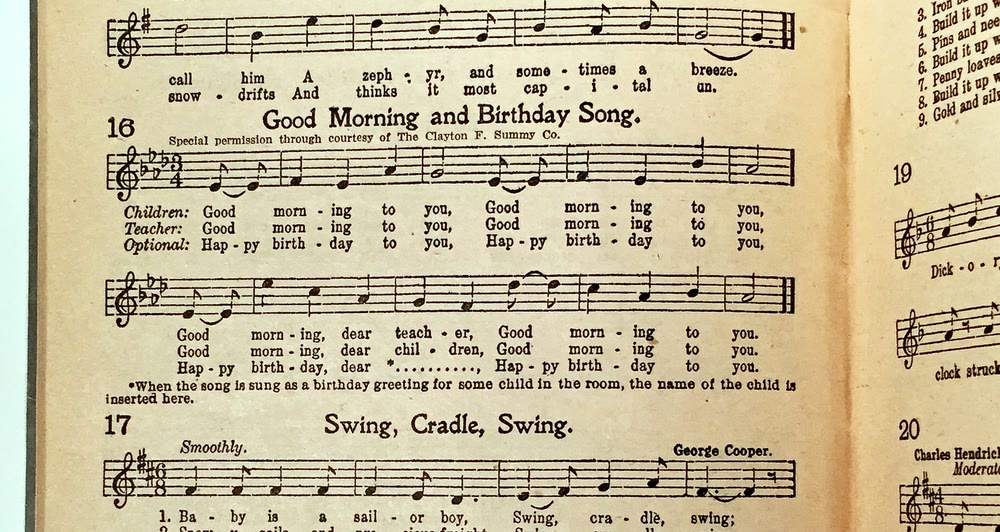
The tune as “Good Morning and Birthday Song” in The Everyday Song Book (1922), printed by permission of the Clayton F. Summy Co., with the birthday words as an optional verse. Public domain, via Wikimedia Commons
Irish birthday card messages, with English meanings
Short is best. Copy every fada exactly (it slopes up to the right, as in café) and add the English underneath.
| Irish | Say it | Meaning |
|---|---|---|
| Lá breithe sona duit, a Mham! | law BREH-huh SUN-uh ditch, uh WAM | Happy birthday, Mum! |
| Lá breithe sona duit, a Mhamó | law BREH-huh SUN-uh ditch, uh WAM-oh | Happy birthday, Granny |
| Lá breithe sona duit, a stór. Le grá, … | law BREH-huh SUN-uh ditch, uh STORE. leh GRAW | Happy birthday, darling. With love, … |
| Go maire tú an lá! | guh MAR-uh too un LAW | Many happy returns! |
| Go maire tú an céad! | guh MAR-uh too un KAYD | May you live to be a hundred! |
| Bíodh an-spraoi agat! | BEE-ukh AN-spree AG-ut | Have a great time! |
| Gach rath ort! | gakh RAH urt | Every success to you! |
| Le gach dea-ghuí | leh gakh JA-ghee | With every good wish |
| Beannachtaí | BAN-ukh-tee | Best wishes |
For a friend facing a big year, my guide to good luck in Irish has more ways to wish someone well.
For a late card
- Lá breithe sona duit, más go mall féin é (law BREH-huh SUN-uh ditch, MAWS guh MAWL fayn ay): happy birthday, even if it’s late.
- Is minic a bhí cú mall sona (iss MIN-ik uh VEE KOO MAWL SUN-uh): an old proverb in Ó Dónaill, “a lagging hound was often lucky”. In other words, better late than never.
Birthday party words
- cáca lá breithe (KAW-kuh law BREH-huh): birthday cake
- coinneal (KIN-yul): a candle. The plural is coinnle.
- bronntanas (BROWN-tuh-nus; in Connacht, BROON-tuh-nus): a present
- cóisir lá breithe (KOH-shir law BREH-huh): a birthday party
- achainí (AKH-uh-nee; in Munster, akh-uh-NEE): a wish, as in focloir.ie’s achainí a dhéanamh, to make a wish
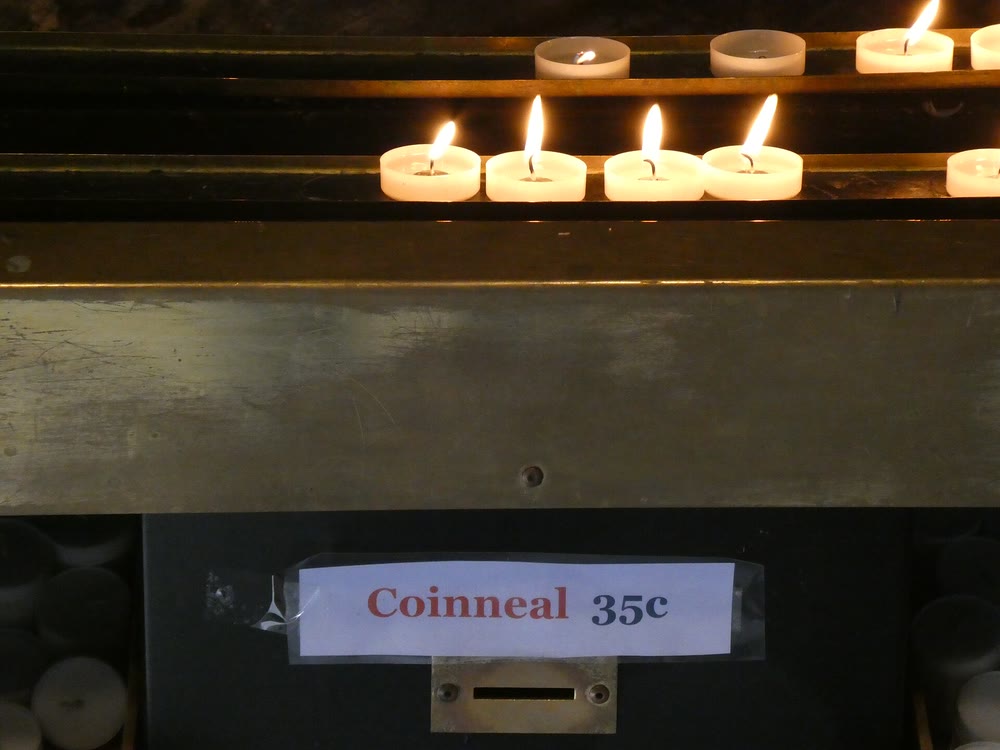
Coinneal, a candle: lit tea lights above a price sign in a church in Dingle, Co. Kerry. Photo: Mucklagh, CC BY-SA 4.0, via Wikimedia Commons
Irish birthday customs: what’s real and what isn’t
A message from the President at 100
Ireland’s best-documented birthday custom is an official one. Since 1940, when Douglas Hyde was President, the State has marked 100th birthdays with a gift, the Centenarian Bounty, and a message from the President wishing the centenarian a happy birthday. The gift is now €2,540, says the President’s website; the first was £5.
Since 2000, centenarians also receive a commemorative coin, newly designed each year, with a letter signed by the President, on their 101st birthday and every birthday after it. Irish citizens born anywhere on the island of Ireland who live abroad can apply through an Irish embassy or consulate, so it’s worth knowing if a parent or grandparent is nearing 100 in Boston or Sydney. The application must be completed in the person’s lifetime.
Hyde, fittingly, had co-founded the Gaelic League in 1893 to revive the Irish language.
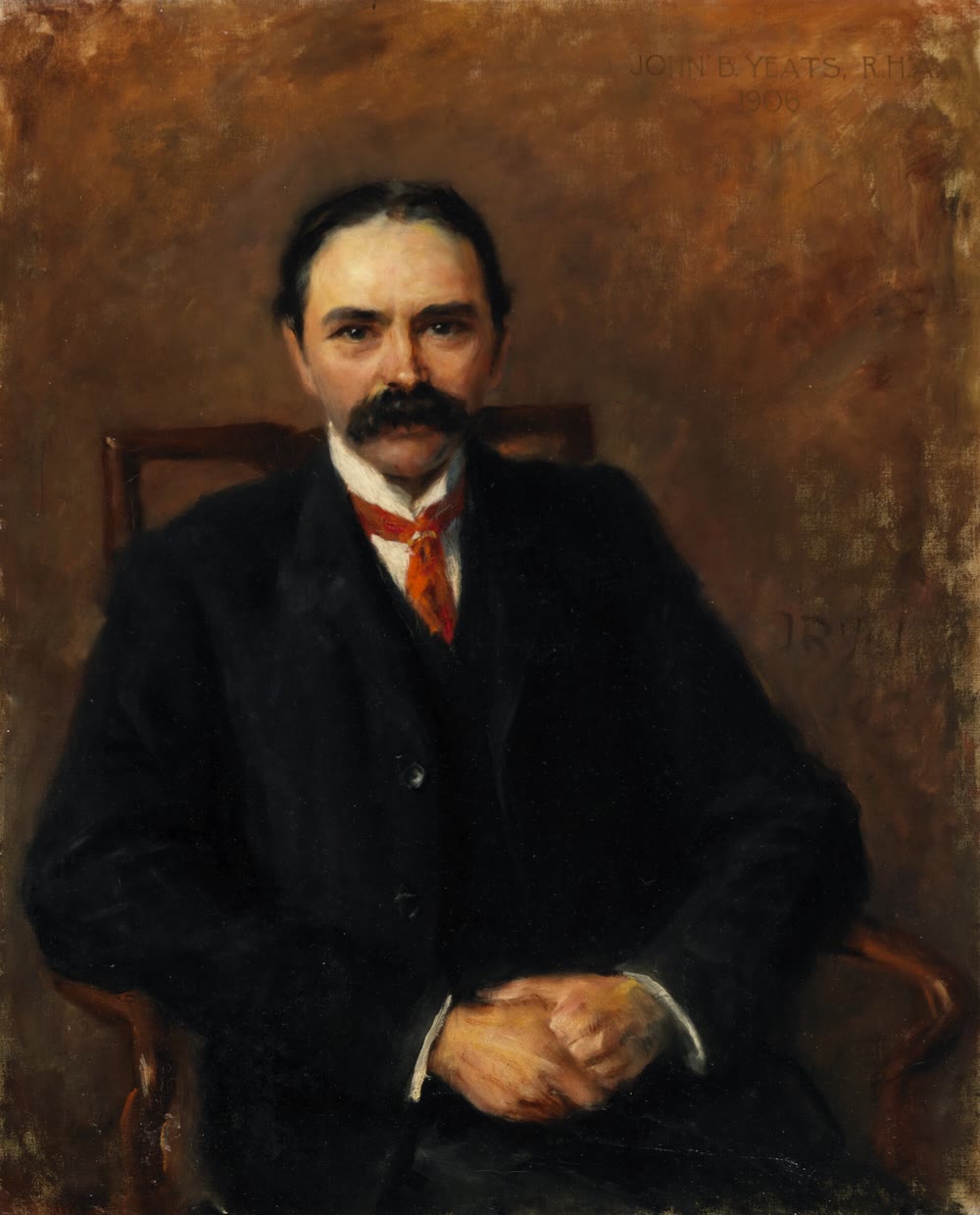
Douglas Hyde in 1906, painted by John Butler Yeats, father of the poet W. B. Yeats. National Gallery of Ireland. Public domain, via Wikimedia Commons (CC BY 4.0)
Old beliefs about the day you were born
Old Irish folk belief cared about when you were born, and Whit Sunday, Domhnach Cincíse (roughly DOW-nukh KING-kee-shuh), was one of the unluckiest days of all. Ó Dónaill defines a cincíseach (KING-kee-shukh) as a person or animal born at Whitsuntide, and also as an ill-starred person.
Such children were thought fated to “kill or be killed”, writes Ailbe Van Der Heide of the National Folklore Collection in a UCD Cultural Heritage Collections article. To cheat the prophecy, a baby might be given a worm or a fly to crush in its hand, or have a green sod laid on its head as a mock burial.
Other births were luckier. The same article notes that a baby born at night could see the fairies and ghosts, a child born with a caul was safe from drowning, and a seventh son or seventh daughter was believed to have a cure.
Friday had a doubtful name too: Ó Dónaill records Deir siad nach bhfuil an Aoine sona (jer SHEE-ud nokh WIL un EE-nyuh SUN-uh), “they say that Friday is not lucky”. More in my guide to Irish superstitions.
The bumps and butter on the nose
Two “Irish birthday traditions” turn up on list after list online. The first is the bumps: friends seize the birthday boy or girl by the wrists and ankles and swing them down towards the floor, a bump for every year of age and an extra one for luck. It’s real, but not only Irish. The reference publisher Chambers describes it as common across the UK and Ireland, and Scots have their own version, “the dumps”. Nothing I’ve found ties it to older Irish folk tradition, so think of it as a shared playground custom.
The second, buttering the birthday person’s nose so bad luck slides off, has no documented roots in Ireland that I could find. Chambers places it in Nova Scotia and Newfoundland, and Dale Jarvis, a folklorist with Heritage NL in Newfoundland, has gathered memories of it from Atlantic Canada and across the United States. Some of those families credit Scottish ancestors and some credit Irish ones, but nobody has documented where it began.
Common misspellings and how to fix them
- Lá breithe shona or Breithlá shona: write sona. Shona belongs with feminine nouns, as in Nollaig shona.
- Breith la shona dhuit: breithlá is one word with a fada, and sona has no h. Write Breithlá sona duit.
- La breithe: always Lá. The fada makes the vowel long, “law”.
- Lá breithe sona tú: tú means “you”, not “to you”. Write duit.
- a Mam, a Daid, a grá: add the h when you’re talking to the person: a Mham, a Dhaid, a ghrá.
- a Dhaideó and a Mhamo: it’s the other way round. Daideo has no fada; Mamó does.
- “Gaelic”: not a misspelling, but Irish people normally call their language Irish in English and Gaeilge (GAYL-gyuh) in Irish, and the Constitution names it the Irish language. Gaelic is also the usual name for Scottish Gaelic, a sister language, where happy birthday is co-là breith sona dhut, says the dictionary Am Faclair Beag.
Happy birthday in Irish: FAQ
How do you say happy birthday in Irish?
Lá breithe sona duit (law BREH-huh SUN-uh ditch). To two or more people, say Lá breithe sona daoibh (deev).
Is it Lá breithe sona or Lá breithe shona?
Sona. Lá is masculine, so the adjective doesn’t take an h. Shona is right after feminine nouns, as in Nollaig shona.
How do you say happy birthday, my love, in Irish?
Lá breithe sona duit, a ghrá (law BREH-huh SUN-uh ditch, uh GHRAW).
How do you say happy birthday, Mom, in Irish?
Lá breithe sona duit, a Mham (uh WAM). For Mammy, say a Mhamaí (uh WAM-ee).
How do you say happy birthday to a friend in Irish?
Lá breithe sona duit, a chara (uh KHAR-uh). Cara means friend, and it softens to a chara when you’re speaking to them.
How do you say happy birthday in Gaelic?
If you mean Irish, it’s Lá breithe sona duit. In Scottish Gaelic, it’s co-là breith sona dhut.
What does “as Gaeilge” mean?
“In Irish”. Ó Dónaill gives Abair as Gaeilge é (AH-bir oss GAYL-gyuh ay), “say it in Irish”, so happy birthday as Gaeilge is simply Lá breithe sona duit.
How do you say many happy returns in Irish?
Go maire tú an lá (guh MAR-uh too un LAW). The traditional reply is Go maire tú do shláinte, “may you enjoy good health”.
Love this? Save it to your Pinterest board for later.
Pin image: A birthday cake with lit letter candles. Photo: Annie Spratt, CC0, via Wikimedia Commons
A little bit of Ireland in your inbox every Friday ☘️
The free Weekly Dose of Irish: an Irish joke, a Celtic symbol, an Irish fact, a poem and the week’s best articles in one short email. Join 9,600+ readers.
Free. One short email every Friday. Unsubscribe any time.
More Irish language reading
- 100+ Irish Birthday Blessings, Wishes and Toasts (with Irish Translations)
- 25 Irish Greetings and Birthday Wishes (With Pronunciation)
- I Love You in Irish: How to Say It, 27 Pet Names and Nana’s Old Words
- Irish Names for Grandma and Grandpa: Mamó, Móraí, Daideo and More (With Pronunciation)
- Thank You in Irish: How to Say Go Raibh Maith Agat (and What It Really Means)
- Good Luck in Irish: Ádh Mór, Go nÉirí Leat and 30 Ways to Wish Someone Luck
Featured image: A birthday cake with lit letter candles. Photo: Annie Spratt, CC0, via Wikimedia Commons.