The everyday Irish name for grandma is Mamó (MAM-oh, or mam-OH in Munster), and for grandpa it’s Daideo (DAJ-oh), which the dictionaries spell without a fada. Móraí (MORE-ee) is another child’s word for grandmother. The formal words are seanmháthair (SHAN-waw-hir), literally “old mother”, and seanathair (SHAN-ah-hir), “old father”, with máthair mhór and máthair chríonna as alternatives. In English, Irish grandchildren say Granny, Nana, Nanny or Nan, and Grandad or Grandda. A great-grandmother is a sin-seanmháthair (SHIN-shan-waw-hir).
There’s a baby on the way, and somebody has asked the big question: what do you want to be called?
If your people came from Ireland, an Irish name is a lovely answer. The trouble is that the internet is full of “Gaelic grandma names” that are misspelled, mispronounced, or not Irish at all.
So here are the real ones: the Irish words for grandma and grandpa, how to say them, where you’ll hear which, what Irish grandchildren call their grandparents in English, the words for great-grandparents, and how to put it all on a birthday card. I checked each Irish word against two dictionaries that Foras na Gaeilge publishes online: Ó Dónaill’s Irish-English dictionary on teanglann.ie and the New English-Irish Dictionary on focloir.ie.
Jump to:
- Irish names for grandma and grandpa at a glance
- Mamó: the everyday word for Granny
- Móraí: a child’s word for grandmother
- Seanmháthair, máthair mhór and máthair chríonna
- Irish names for grandpa: Daideo, seanathair and Grandda
- Granny, Nana and Nan: the English names Irish families use
- Great-grandparents and grandchildren in Irish
- Which name should I choose?
- Saying it in Irish: cards and first words
- “Gaelic grandma names” that aren’t Irish
- Finding your own grandmother’s Ireland
- Irish names for grandma: FAQ
- More Irish family and language reading
Irish names for grandma and grandpa at a glance
The respellings are rough guides, because Irish has three main dialects. You can hear a native speaker from each one say mamó on teanglann.ie, and the same site has recordings of the other words in this table.
| Irish | Say it | Meaning |
|---|---|---|
| Mamó | MAM-oh (Munster: mam-OH) | Granny, grandma. The everyday word. |
| Móraí | MORE-ee | Grandma, a child’s word. |
| Seanmháthair | SHAN-waw-hir (Munster: SHAN-vaw-hir) | Grandmother. Literally “old mother”. |
| Máthair mhór | MAW-hir WORE (Munster: MAW-hir VORE) | Grandmother. Literally “big” or “great mother”. |
| Máthair chríonna | MAW-hir HREE-nuh | Grandmother. Críonna means old, and also wise. |
| Daideo | DAJ-oh (Munster: dah-JOH) | Grandad, grandpa. |
| Seanathair | SHAN-ah-hir | Grandfather. Literally “old father”. |
| Athair mór | AH-hir MORE | Grandfather. Literally “big father”. |
| Athair críonna | AH-hir KREE-nuh | Grandfather. Críonna means old, and also wise. |
| Seantuismitheoirí | SHAN-tish-mih-hore-ee | Grandparents. |
Two tips: the th in máthair and athair sounds like an h, and the ch in chríonna is a breathy h, like the start of “huge”.
Mamó: the everyday Irish word for Granny
If you learn only one, make it Mamó. Ó Dónaill’s dictionary translates it simply as “Granny”, and focloir.ie offers it for grandma, granny, nan and nana.
The fada (the accent) on the ó makes it a long “oh”. Munster speakers put the stress on that long vowel: mam-OH. In Connacht and Ulster Irish the first syllable generally takes the stress, MAM-oh, but the long ó still takes its time, so the two halves can sound fairly even. Either is fine.
It’s also the word chosen by An Gúm, the Irish-language publishing house of Foras na Gaeilge, for its Irish editions of Eric Hill’s Spot board books. Spot becomes Bran, and the titles are Bran agus a Mhamó and Bran agus a Dhaideo: Bran and his granny, and Bran and his grandad.
Spelling: keep the fada. Without it, Mamo has a short o. You’ll also see Maimeo (MAM-yoh), which the long-running Transparent Language Irish blog gives as another spelling. Neither Ó Dónaill nor focloir.ie lists it, so for anything engraved or printed, Mamó is the safer choice.
In an English-speaking family, use it just as you’d use Granny: “Give that to Mamó”, “Thanks, Daideo”. The same blog, writing about families in North America, says that may be fine; the Irish grammar matters most if the grandchildren will be raised as Irish speakers.
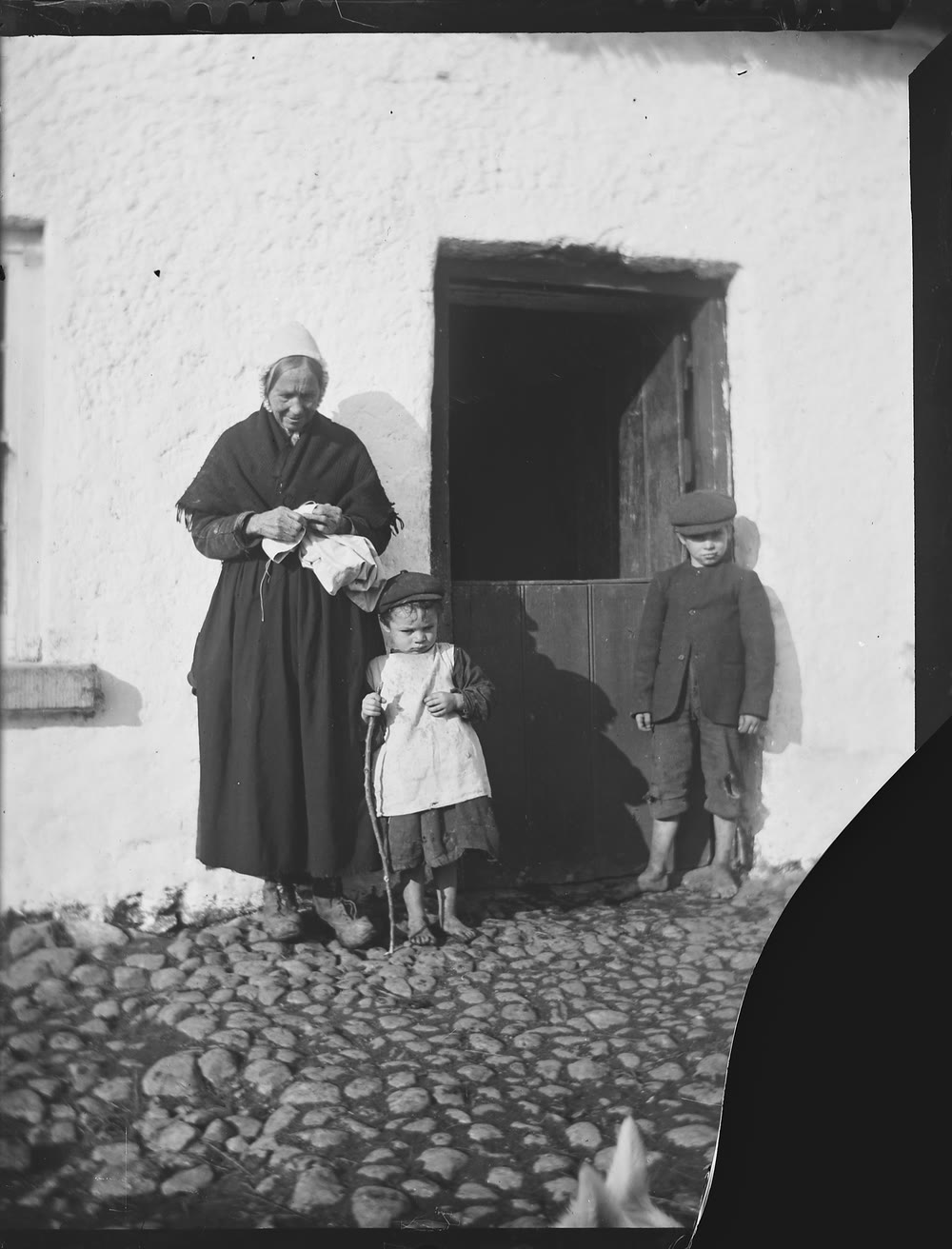
An older woman and two small boys at a cottage door, about 1900. Photo: the Dillon family of Clonbrock, Co. Galway, Clonbrock Photographic Collection, National Library of Ireland (CLON492). No known copyright restrictions, via Wikimedia Commons
Móraí: a child’s word for grandmother
Móraí (MORE-ee) is the other informal choice. Ó Dónaill labels it a child’s name for grandmother, and focloir.ie gives it alongside mamó for nan or nana. The r is a quick tap of the tongue, closer to the middle of an American “better” than to an American r.
You’ll read online that it’s a pet form of máthair mhór, “great mother”. That’s plausible, but neither dictionary says where the word comes from, so treat it as a nice story rather than a fact.
Is Mamó or Móraí more common? I couldn’t find anyone who has counted. Both are genuine and both are in the dictionaries, so choose the one whose sound you love.
Seanmháthair, máthair mhór and máthair chríonna: the formal words
These are the words you’d use about your grandmother rather than to her: “my grandmother came from Mayo”, not “Thanks, Grandmother”. As the Transparent Language blog points out, children don’t usually address their grandparents with them.
Seanmháthair
Seanmháthair joins sean (SHAN), old, and máthair (MAW-hir), mother. Note that sean has no fada. With one, Seán, it’s the man’s name.
The word is very old. Around the middle of the 700s, Irish scholars wrote notes in their own language between the lines and in the margins of a Latin copy of St Paul’s letters, now kept in Würzburg, Germany. In 2 Timothy 1:5, Paul recalls the faith of Timothy’s grandmother Lois and his mother Eunice. Above the Latin words for “in your grandmother”, one glossator wrote the Old Irish it senmathir, which means the same thing. Another note on that verse adds that the faith of Timothy’s mother and grandmother was perfect.
The Würzburg glosses are one of the earliest large collections of writing in Irish, so this word for grandmother has been on the page for more than 1,200 years. You can read both notes, Wb. 29d11 and 29d13, in Adrian Doyle’s online edition of the Würzburg glosses.
Máthair mhór
Máthair mhór (MAW-hir WORE; in Munster, VORE) is literally “big mother” or “great mother”. Mór means big or great, not grand in the sense of fancy. The Transparent Language blogger, Róislín, says this is the form she has mostly heard in Donegal, and athair mór is the matching word for grandfather.
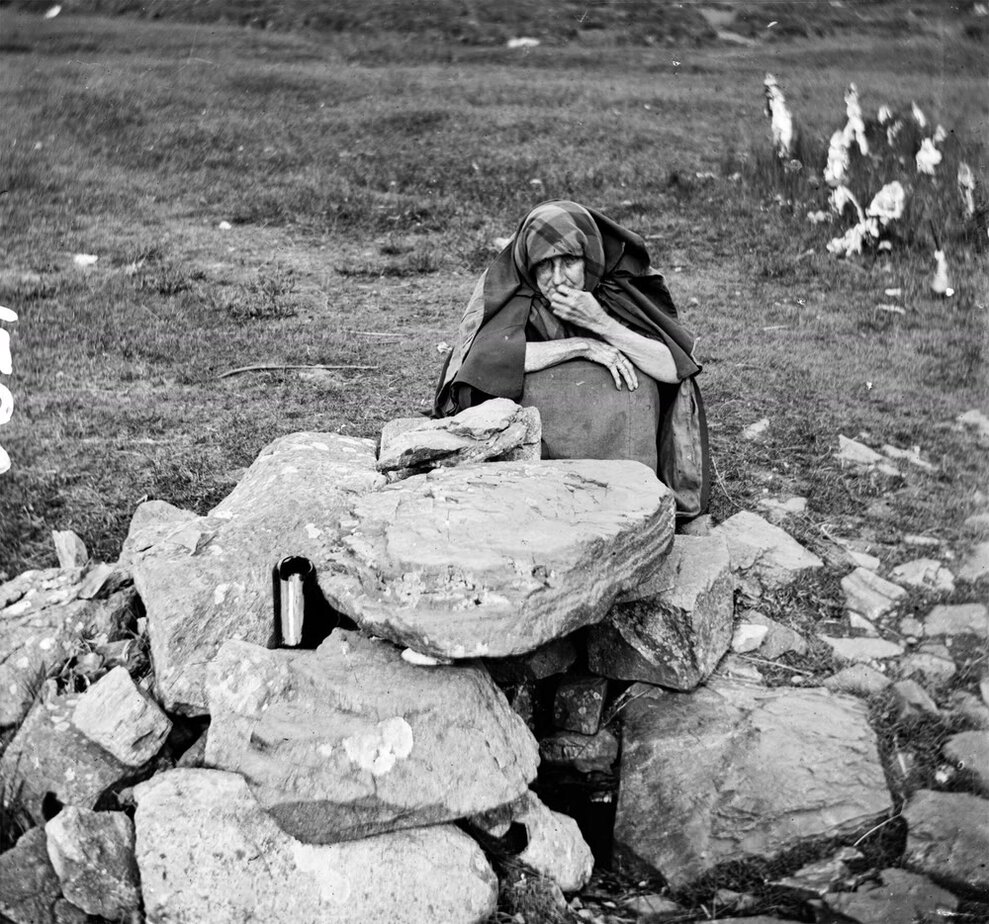
An old woman at Doon Well, a holy well near Kilmacrenan, Co. Donegal, photographed between 1860 and 1883. National Library of Ireland (STP_1720). No known copyright restrictions, via Wikimedia Commons
Máthair chríonna
Máthair chríonna (MAW-hir HREE-nuh; in Ulster, closer to HREE-uh-nuh) uses críonna. Ó Dónaill glosses críonna as wise or prudent, then grown-up, then old, and it files máthair chríonna under “old”. So the strict sense is “old mother”, the same idea as seanmháthair, though in Irish, as in life, age and wisdom keep close company. In a reply to readers, Róislín links máthair chríonna and athair críonna to Kerry and Cork.
It doesn’t mean “mother of my heart”, whatever some gift sites say. The Irish for heart is croí (KREE), a different word altogether, as in mo chroí (muh KHREE), my heart.
Irish names for grandpa: Daideo, seanathair and Grandda
Daideo is the cosy word, Ó Dónaill’s “grand-dad”. Say DAJ-oh: two syllables, not three, and the middle d is a soft “j” sound. Munster speakers stress the end, dah-JOH.
There’s no fada. Daideó, with an accent on the o, is all over the internet, but Ó Dónaill and focloir.ie both spell it daideo. At the end of an Irish word, eo usually sounds like a long “oh” already, as in go deo (guh JOH), forever.
Close by in the dictionary is daidí (DAJ-ee), daddy, and Ó Dónaill’s entry has a seasonal bonus: Daidí na Nollag (DAJ-ee nuh NUL-ug), Father Christmas, or literally “Daddy of Christmas”.
The formal words follow the same pattern as for grandmothers. Seanathair (SHAN-ah-hir), “old father”, goes back to Old Irish senathair. Athair mór (AH-hir MORE) is the partner of máthair mhór, and athair críonna (AH-hir KREE-nuh) pairs with máthair chríonna.
In English you’ll hear Grandad, Grandpa and Grandda, also spelled Granda. The Dictionary of the Scots Language records grandda in Scotland and in Ulster, and explains it as grand- plus Da, the familiar word for Dad.
Granny, Nana and Nan: the English names Irish families use
Almost 1.9 million people told Ireland’s 2022 census that they could speak Irish, but only one in ten of them said they spoke it very well. So in most Irish homes, as in most Irish-American ones, grandparents go by English names.
No survey covers the whole island. In Northern Ireland, a 2022 UK poll for the phone maker emporia, reported by Who Do You Think You Are? Magazine, found Granny (43%) and Nanny (39%) far ahead of Nan (4%), even though Nan was the top name across the UK as a whole. It was a poll of 2,000 adults, so the Northern Ireland figures rest on a small sample.
Granny has deep roots in Irish English. In 1910 the historian P. W. Joyce, in his book English As We Speak It in Ireland, recorded a jibe used in Derry against rich men whose families had made their money smuggling poitín from Inishowen: “your granny was a Dogherty who wore a tin pocket”. The tin pocket was for hiding the whiskey.
Joyce also heard an educated Dublin grandmother comfort a crying grandchild by asking “What did they do to you on me?” That “on me” comes straight from Irish, where ar, “on”, marks something done to your cost. To a granny, a hurt to the child is a hurt to her.
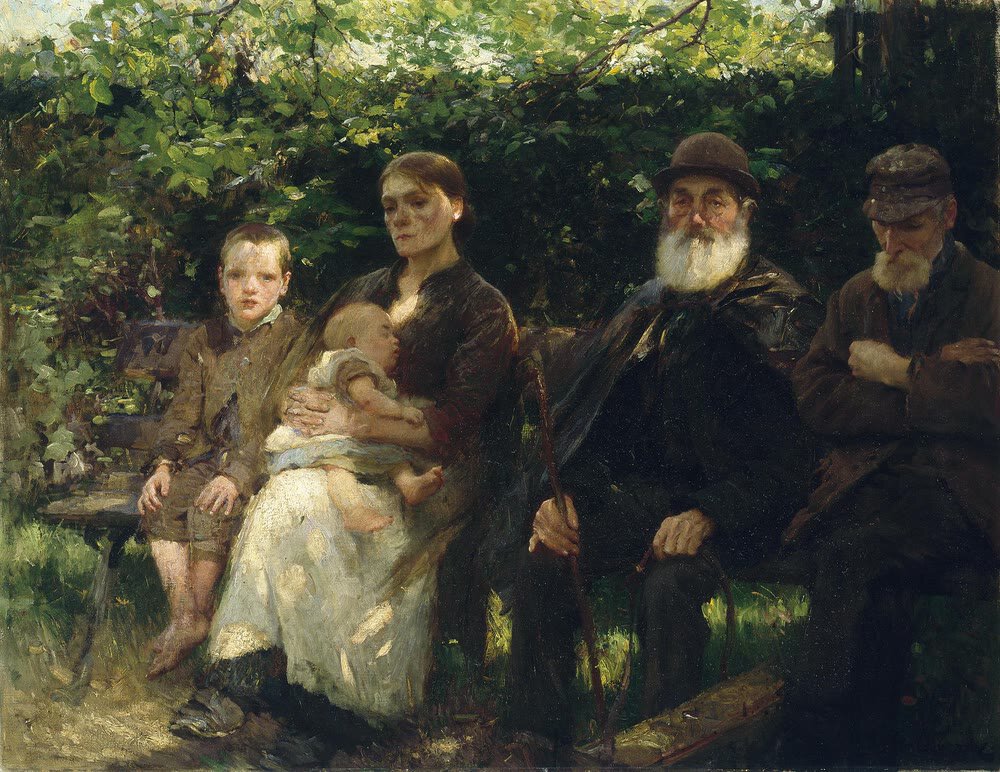
In a Dublin Park, Light and Shade, by Walter Osborne, about 1895. National Gallery of Ireland. Public domain, via Wikimedia Commons
Great-grandparents and grandchildren in Irish
Irish builds great-grandparents with the prefix sin- (SHIN), which Ó Dónaill defines as “great-” in words for ancestors. Double it for great-great.
- Sin-seanmháthair (SHIN-shan-waw-hir): great-grandmother.
- Sin-seanathair (SHIN-shan-ah-hir): great-grandfather.
- Sin-sin-seanmháthair (SHIN-shin-shan-waw-hir): great-great-grandmother.
Scottish Gaelic works the same way, with sinn-seanmhair for great-grandmother. Neither Irish dictionary has a nursery word for a great-granny, so if Mamó is already taken, the family will need to get creative. One grammatical option is Mamó Mhór (MAM-oh WORE), “big Mamó”, on the pattern of máthair mhór, but that’s a family invention, not a traditional word.
Going the other way, a grandchild is a garpháiste (GAR-fawsh-chuh), and grandchildren are garpháistí (GAR-fawsh-chee). A grandson is a garmhac (GAR-wock; Munster GAR-vock), and a granddaughter is a gariníon (GAR-in-een). The gar- at the front is a prefix Ó Dónaill glosses as “near, close”.
Focloir.ie also gives a lovely way to say “her grandchildren”: clann a clainne (klan uh KLAN-yuh), “the children of her children”. When James Joyce’s grandson was born in 1932, he marked it with a short poem, Ecce Puer.
Which name should I choose?
If you’re the one deciding, here’s what’s worth weighing.
- Say it out loud first. Try “Go to Mamó” and “Móraí’s here!” in your own voice. You’ll be hearing it across kitchens and playgrounds for years.
- Think in pairs. Mamó and Daideo are the matching set, the pair An Gúm uses for its Spot books. Móraí and Daideo work together too.
- Solve the two-grannies problem. Róislín of the Transparent Language blog says she is often asked for an Irish word for grandma, mostly by grandmothers themselves, and sometimes because the other side of the family has already claimed “Grandma”. An Irish name tells everyone which granny is which.
- Keep a family name if there is one. If your own grandmother was Granny or Nana, passing that name down is its own kind of heritage.
- Get the spelling right in print. Put the fada on Mamó and Móraí and leave it off Daideo. After that, relax: a toddler may rename you anyway.
- Choosing the baby’s name too? See my guides to pronouncing Irish girl names and Ireland’s most popular baby names.
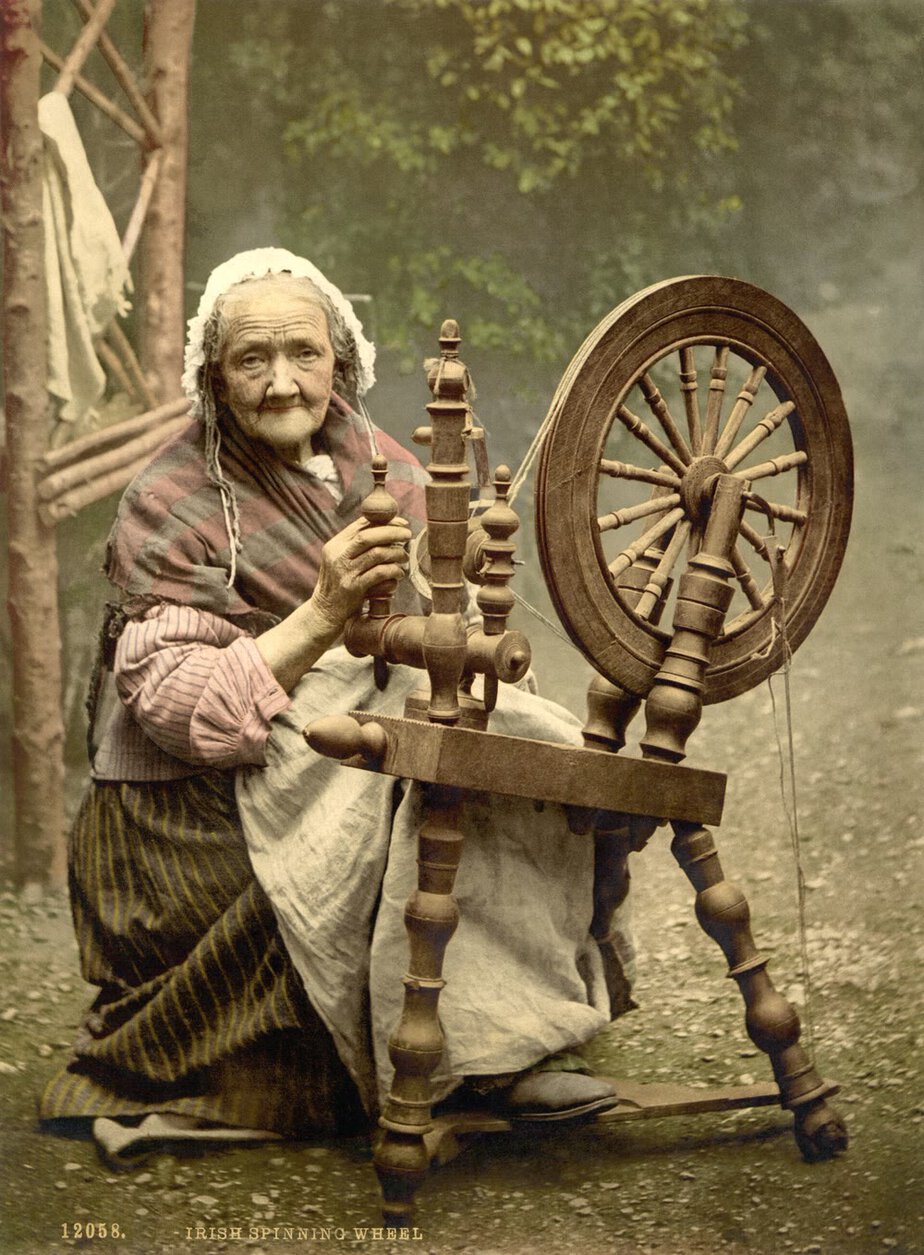
Irish spinning wheel: a photochrom print published by the Detroit Publishing Co. in the 1890s. Library of Congress. Public domain, via Wikimedia Commons
Saying it in Irish: cards and first words
When you speak directly to someone in Irish, you put a small word, a (uh), before the name and soften its first letter. Mamó becomes a Mhamó, Móraí becomes a Mhóraí and Daideo becomes a Dhaideo. An English-speaking family can skip this, but it’s a nice touch in a card.
- A Mhamó! (uh WAM-oh), a Mhóraí! (uh WORE-ee), a Dhaideo! (uh GHAJ-oh): Granny! Grandad! The gh is a soft, throaty sound, and in Munster the mh sounds more like a v.
- Mo mhamó (muh WAM-oh): my granny.
- Lá breithe sona duit, a Mhamó (law BREH-huh SUN-uh ditch, uh WAM-oh): Happy birthday, Granny.
- Nollaig shona duit, a Dhaideo (NUL-ig HUN-uh ditch, uh GHAJ-oh): Happy Christmas, Grandad.
- Tá grá agam duit, a Mhóraí (taw GRAW AG-um ditch, uh WORE-ee): I love you, Grandma.
- Do Mhamó agus do Dhaideo (duh WAM-oh AG-us duh GHAJ-oh): To Granny and Grandad, for the envelope.
- Le grá ó do gharpháistí (leh GRAW oh duh GHAR-fawsh-chee): With love from your grandchildren.
For more, my Irish birthday blessings include the toast wishing someone a long life, “grey and combing your grandchildren’s hair”. For pet names such as a stór and a chroí, see I love you in Irish, and if the new arrival has inspired you to start learning, here’s how to learn Irish online.
“Gaelic grandma names” that aren’t Irish
Search for Gaelic grandmother names and you’ll find lists, mugs and T-shirts that mix up three languages. Here’s how to sort them.
- Nain: Welsh, not Irish. It’s the North Wales word for grandmother, while South Wales says mam-gu. The University of Wales dictionary, Geiriadur Prifysgol Cymru, marks hen nain (great-grandmother) as northern speech and hen fam-gu as southern.
- Seanmhair and seanair: Scottish Gaelic, a sister language. LearnGaelic gives seanmhair for grandmother and seanair for grandfather. In Irish, they’re seanmháthair and seanathair.
- “Máthair chríonna means mother of my heart”: no. Críonna means old or wise, and heart is croí.
- Daideó: the dictionaries spell it daideo, with no fada.
- Maimeó: the one reliable source I found for this form, the Transparent Language blog, writes it Maimeo, with no fada, and the dictionaries use Mamó.
- Seanmhathair or seanmathair: missing the fada, the h, or both. Write seanmháthair.
- Oma and Nonna: lovely names, but German and Italian. They still turn up on some “Irish grandma name” lists.
- “Gaelic” itself: in Ireland the language is usually called Irish, or Gaeilge (GAYL-gyuh). Scottish Gaelic, Gàidhlig, is a related but separate language, so a “Gaelic” name online could come from either.
Finding your own grandmother’s Ireland
Between 1937 and 1939, more than 50,000 pupils in about 5,000 primary schools across the 26 counties of what was then the Irish Free State gathered local lore for the Schools’ Collection. They wrote down what they heard from parents, neighbours and, very often, grandparents. One essay from Carrowmore, Co. Mayo, is called Bread in My Grandmother’s Day.
The Schools’ Collection on dúchas.ie can be searched by person and by place, so look up your family’s parish: you may find the home cures and old beliefs your own great-grandmother grew up with. My guide to Irish superstitions explains many of them.
Two more things worth knowing. Your surname may have a story of its own, which my guide to Irish surnames can help with. And if you were born in Ireland, North or South, your grandchildren may be able to claim Irish citizenship through you; my guide to Irish citizenship by descent explains the Foreign Births Register.
Irish names for grandma: FAQ
What do Irish people call their grandmother?
In English, Granny, Nana, Nanny and Nan are all common, and a 2022 poll put Granny first in Northern Ireland. In Irish, it’s Mamó or Móraí, with seanmháthair as the formal word.
How do you say grandma in Irish?
Mamó (MAM-oh, or mam-OH in Munster). Focloir.ie gives it for grandma, granny, nan and nana.
What is the Irish word for grandpa?
Daideo (DAJ-oh), with no fada. The formal word for grandfather is seanathair (SHAN-ah-hir).
How do you pronounce Móraí?
MORE-ee, with a light, tapped r. The aí sounds like “ee”.
What is great-grandmother in Irish?
Sin-seanmháthair (SHIN-shan-waw-hir). A great-grandfather is a sin-seanathair (SHIN-shan-ah-hir).
Is Nana an Irish name?
Nana is an English pet name, not an Irish-language word, though it’s used in Ireland as elsewhere. For an Irish-language version, focloir.ie translates nan and nana as mamó or móraí.
What is the Gaelic word for grandmother?
In Irish, seanmháthair, or Mamó for granny. In Scottish Gaelic, seanmhair.
Love this? Save it to your Pinterest board for later.
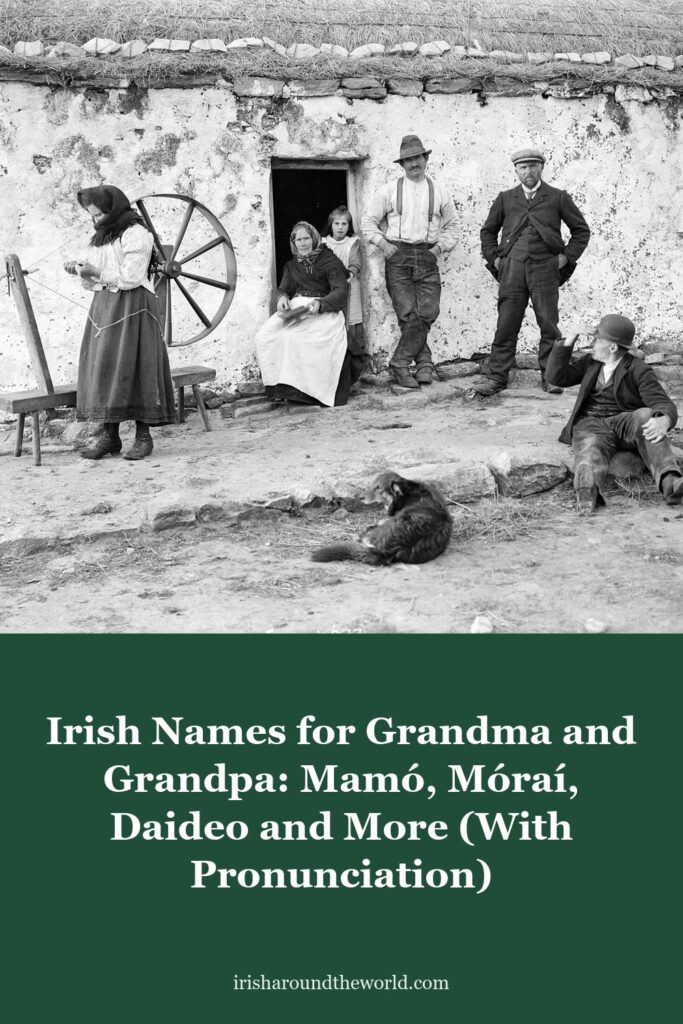
Pin image: A family outside a thatched cottage, about 1900, from the Eason Collection at the National Library of Ireland (Eas 4077). No known copyright restrictions, via Wikimedia Commons
A little bit of Ireland in your inbox every Friday ☘️
The free Weekly Dose of Irish: an Irish joke, a Celtic symbol, an Irish fact, a poem and the week’s best articles in one short email. Join 9,600+ readers.
Free. One short email every Friday. Unsubscribe any time.
More Irish family and language reading
- I Love You in Irish: How to Say It, 27 Pet Names and the Film That Misspelled One
- 100+ Irish Birthday Blessings, Wishes and Toasts (with Irish Translations)
- How to Pronounce Irish Girl Names: Aoife, Caoimhe, Fiadh, Róisín and More
- Irish Citizenship by Descent: How to Claim It Through a Grandparent (2026)
- Irish Surnames: Meanings, Origins and the Top 100 Names in Ireland
- 101 Irish Mammy Sayings You Probably Heard Growing Up In Ireland
Featured image: A family outside a thatched cottage, about 1900, from the Eason Collection at the National Library of Ireland (Eas 4077). The library’s own notes wonder whether the older woman in the doorway is the grandmother. No known copyright restrictions, via Wikimedia Commons.