Seamus Heaney (1939 to 2013) was an Irish poet who won the Nobel Prize in Literature in 1995. He was born on 13 April 1939 at Mossbawn, his family’s farm near Castledawson in County Derry, Northern Ireland, the eldest of nine children. Best known for poems such as Digging and Mid-Term Break and for his translation of Beowulf, he died in Dublin on 30 August 2013 and is buried in Bellaghy, close to where he grew up.
Seamus Heaney’s poems are full of things you could hold in your hand: a spade, a tin of blackberries, a bucket of peeled potatoes. He was a farmer’s son from south Derry who came to be counted among the great poets of the 20th century, and he never stopped writing about home.
This site has pages on more than 15 of his poems. Start here: his life in order, the text he sent his wife before he died, and which poems to read first.
Jump to:
- How do you say Seamus Heaney?
- Mossbawn: a farm childhood in County Derry
- His brother Christopher and Mid-Term Break
- St Columb’s College and Queen’s University Belfast
- Teacher, husband, father: the Belfast years
- Death of a Naturalist (1966)
- The Troubles and the bog poems
- Glanmore and Dublin: the move south
- Harvard, Oxford and Field Day
- Irish, not British: the Open Letter
- The 1995 Nobel Prize
- Beowulf, Sweeney and the translations
- Famous Seamus: the stroke and the last books
- His death, funeral and last words
- His grave and epitaph in Bellaghy
- Visiting Seamus Heaney HomePlace
- Which Heaney poems to read first
- Heaney poems on this site, by collection
- Seamus Heaney FAQ
- More Irish poetry reading
How do you say Seamus Heaney?
Say SHAY-mus HEE-nee. Seamus is an Irish form of James, spelled Séamas in standard modern Irish (Séamus is common too) and said the same way.
Heaney always wrote his name without the fada (the accent on the é), so plain Seamus is correct for him; Seamus Heany and Shamus Heaney are mistakes.
Mossbawn: a farm childhood in County Derry
Heaney was born on 13 April 1939 at Mossbawn, a farm near Castledawson in the townland of Tamniarn, says the Dictionary of Irish Biography (DIB). Bellaghy is often given as his birthplace, but the family only moved to The Wood, a farm outside Bellaghy, in 1953.
He was the eldest of nine: seven boys and two girls. His father, Patrick, worked about fifty acres, but cattle-dealing was his real love, and he was a man of few words. His mother, Margaret Kathleen McCann, came from a family of linen-mill workers and was far readier to speak her mind. Heaney believed that pull between silence and speech lay at the root of his poetry.
His father’s sister, Mary, lived with them too. She is the woman baking in the sunlit kitchen of Mossbawn: Sunlight, the poem at the head of North (1975).
In his Nobel lecture he recalled the 1940s farmhouse: three crowded, thatched rooms, a horse stabled behind a bedroom wall, and passing trains that made the drinking water shiver in its bucket. From 1944 to 1951 he went to Anahorish Primary School, which took Catholic and Protestant children alike.
The farm’s name fascinated him. In an essay collected in Preoccupations (1980), he explained that moss is a Scots word for bog, probably brought over by the Planters, and bawn was the English settlers’ name for a fortified farmhouse (the Irish word bábhún, roughly BAW-woon, means a walled enclosure). But at home they said “Moss bann”, and bán (BAWN) is Irish for white. So the name might just as well mean the white moss: bog cotton. Two traditions in one word.
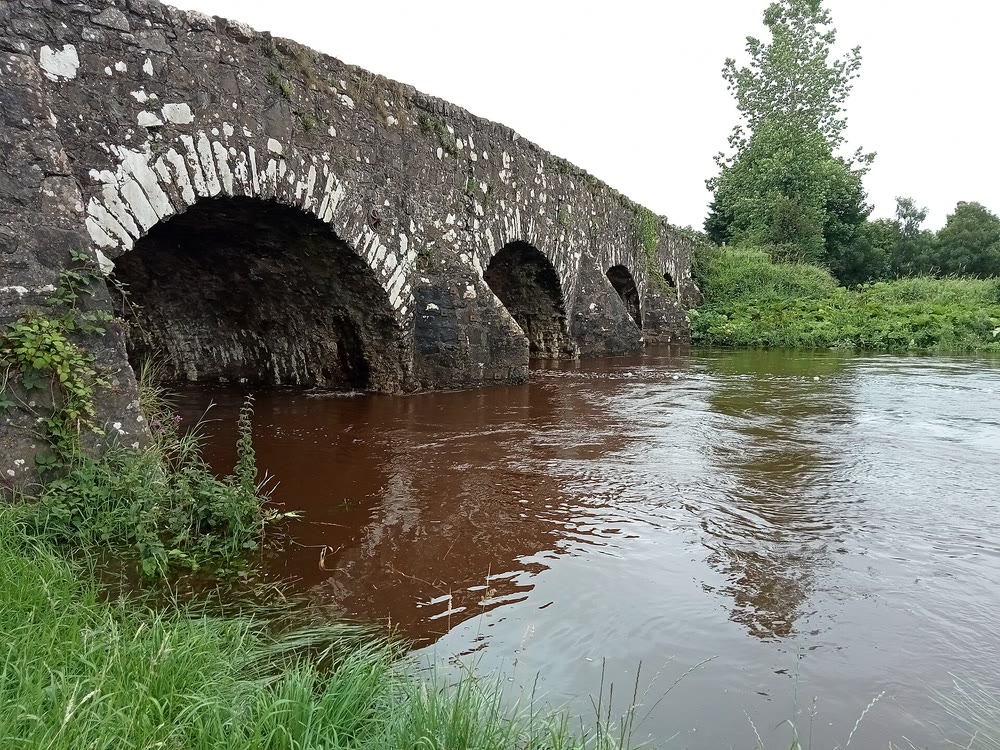
The River Moyola in flood at Curran Bridge, Co. Derry. The Moyola runs past Castledawson, near Heaney’s birthplace, on its way to Lough Neagh. Photo: JohnDMichael111, CC BY-SA 4.0, via Wikimedia Commons
His brother Christopher and Mid-Term Break
In February 1953, Heaney’s little brother Christopher, aged four, was hit by a car near Mossbawn and killed, says Seamus Heaney HomePlace. Seamus, then 13, was away at boarding school in Derry and came home for the funeral.
He turned those days into Mid-Term Break. It’s told with almost no comment, down to a last line that gives the size of the coffin: “A four-foot box, a foot for every year.” It’s number three in the reader-voted list behind my top 100 Irish poems.
He returned to Christopher more than fifty years later in The Blackbird of Glanmore (2006). Today the brothers lie yards apart in Bellaghy.
St Columb’s College and Queen’s University Belfast
At 12, a scholarship won through the eleven-plus took Heaney to St Columb’s College in Derry city, a Catholic boarding school 40 miles from home. (It’s St Columb’s, not St Columba’s, a common slip.) He boarded there from 1951 to 1957 and was taught Latin and Irish, two languages that run all through his work. The writer Seamus Deane was a classmate, and John Hume, the future Nobel Peace laureate, was two years older.
In 1957 he went to Queen’s University Belfast, graduating in 1961 with first-class honours in English. He signed his student poems Incertus, Latin for “uncertain”.
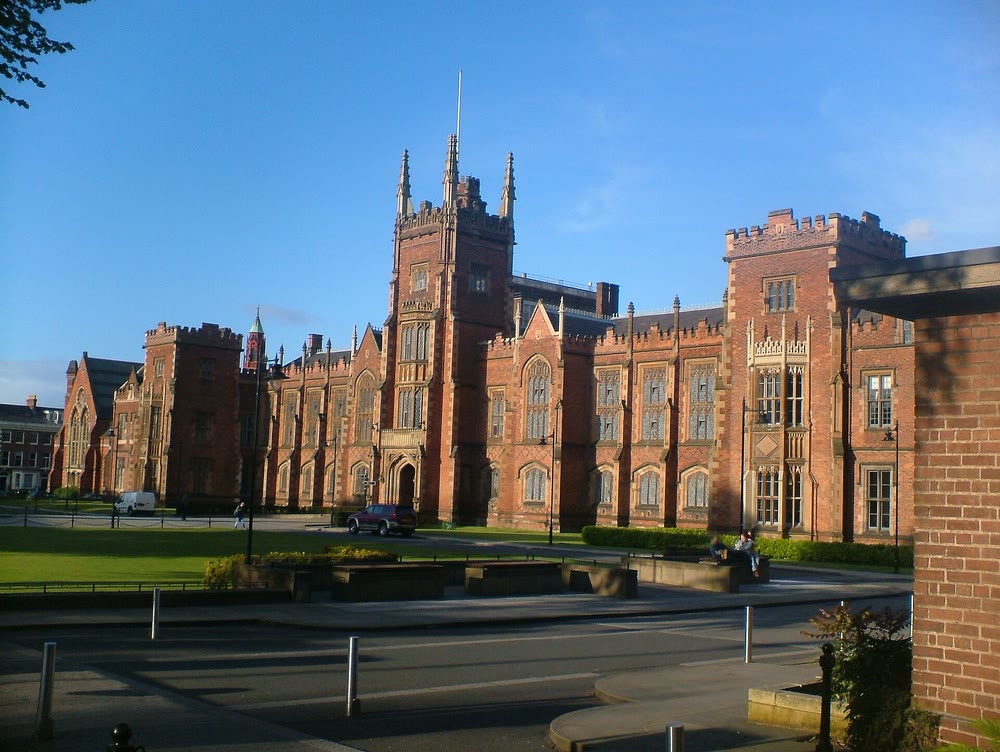
The Lanyon Building at Queen’s University Belfast, where Heaney studied from 1957 to 1961 and later lectured. Photo: Fasach Nua, public domain, via Wikimedia Commons
Teacher, husband, father: the Belfast years
His lecturers urged him to try for postgraduate study at Oxford. Instead he trained at St Joseph’s, a Belfast teacher-training college, then taught for a year at a Ballymurphy school whose headmaster, the writer Michael McLaverty, encouraged him.
He went back to St Joseph’s as a lecturer, then lectured at Queen’s from 1966 to 1972. He joined the Belfast Group, a writers’ workshop led by Philip Hobsbaum, an English poet and critic, and in December 1964 the London weekly New Statesman printed three of his poems in one issue: Digging, Scaffolding and Storm on the Island.
In 1962, at St Joseph’s, he met Marie Devlin, a teacher from Ardboe on the Tyrone shore of Lough Neagh, and they married in 1965. Marie Heaney is a writer too: her Over Nine Waves (1994) retells the old Irish legends. They had three children: Michael (born 1966), Christopher (1968) and Catherine Ann (1973).
Death of a Naturalist (1966): the first book
After a slim Belfast pamphlet, Eleven Poems (1965), Faber and Faber published Death of a Naturalist in 1966, commissioned by the Faber editor Charles Monteith. It was widely praised and won several prizes.
Digging opens it, as it opens every later selection of his poems: he watches his father dig, thinks of his grandfather cutting turf, and settles on the pen as his own spade. The rest is the farm seen close up, from frogspawn in the flax-dam to his father at the plough.
Door into the Dark followed in 1969, with The Forge and Requiem for the Croppies, his poem for the rebels of 1798.
The Troubles and the bog poems
Heaney’s fame grew just as Northern Ireland slid into conflict. He took part in the civil rights movement, and in October 1968 the BBC magazine The Listener printed Old Derry’s Walls, his angry article on the policing of a civil rights march in Derry.
The bog-body poems began with a book. In 1969 he read The Bog People by the Danish archaeologist P. V. Glob, with its photographs of Iron Age bodies found in the bogs of Jutland, many apparently killed in ritual. Heaney saw in them an image for the old, tribal killings of his own place. The first was The Tollund Man, in Wintering Out (1972); North (1975) added Punishment and The Grauballe Man.
Many readers admired their nerve, but some reviewers, Conor Cruise O’Brien among them, felt North came too close to a nationalist reading of history. The DIB also notes that the Windeby body Heaney took for a girl in Punishment was probably a young man.
Field Work (1979) brought the killing closer to home. Casualty mourns Louis O’Neill, a fisherman who drank in the pub run by Heaney’s father-in-law and was killed in a pub bombing in the aftermath of Bloody Sunday in 1972. The Strand at Lough Beg is an elegy for his cousin Colum McCartney, killed in a sectarian murder.
Glanmore and Dublin: the move south
After a year as a visiting lecturer at the University of California, Berkeley, Heaney resigned from Queen’s in 1972 to write full-time. The family moved to Glanmore Cottage, a gate lodge in Co. Wicklow rented from the Canadian scholar Ann Saddlemyer, who sold it to them in 1988.
Four years there gave him most of North and a good share of Field Work. In 1975 he went back to teaching at Carysfort College in Dublin, where he became head of English, and in 1976 the family settled in Sandymount on Dublin Bay, their home for the rest of his life.
Harvard, Oxford and Field Day
Heaney first taught at Harvard in 1979, and from 1982 he spent one term a year there. In December 1984 Harvard named him Boylston Professor of Rhetoric and Oratory. He gave up that chair in the mid-1990s (sources give 1995, 1996 or 1997) and became the Ralph Waldo Emerson Poet in Residence until 2006, Harvard says.
From 1989 to 1994 he was also Oxford Professor of Poetry, an elected post that meant three public lectures a year. They became The Redress of Poetry (1995).
In 1981 he joined the board of Field Day, the Derry theatre company set up by Brian Friel, the playwright, and the actor Stephen Rea. In 1990 it staged The Cure at Troy, his version of Sophocles’ Philoctetes, whose lines about the moment when “hope and history rhyme” have been quoted by Mary Robinson, Bill Clinton and many others.
Irish, not British: the Open Letter
Heaney was born in Northern Ireland, part of the United Kingdom, but he thought of himself as Irish. In 1982 Blake Morrison and Andrew Motion’s anthology The Penguin Book of Contemporary British Poetry gave his work pride of place.
The next year he answered with An Open Letter, a Field Day pamphlet in light, rhyming verse that politely declined the label British. The line everyone remembers is “My passport’s green”.
The DIB calls its terms genial. People born in Northern Ireland can identify as British, Irish or both, a right later written into the 1998 Good Friday Agreement. Heaney chose Irish.
The 1995 Nobel Prize in Literature
On 5 October 1995 the Swedish Academy announced that Heaney had won the Nobel Prize in Literature; he and Marie were on holiday in Greece. The prize citation praised work of “lyrical beauty and ethical depth” that honours the small miracles of everyday life and a past that is still alive.
He was the fourth Irish-born writer to win it, after W. B. Yeats (1923), George Bernard Shaw (1925) and Samuel Beckett (1969). His Nobel lecture in Stockholm on 7 December, Crediting Poetry, moves from the Mossbawn kitchen to St Kevin of Glendalough, who knelt so still that a blackbird nested in his outstretched hand.
The prize brought joy at first, he later told the poet Dennis O’Driscoll, then a slowly growing burden of demands. His next collection, The Spirit Level (1996), was named Whitbread Book of the Year.
Beowulf, Sweeney and the translations
Sweeney Astray (Field Day, 1983) is his version of the medieval Irish tale Buile Suibhne (roughly BWIL-uh SIV-nyuh, the frenzy of Suibhne), about a king who is cursed by a cleric and lives on, mad, like a bird in the trees.
He began Beowulf for the American publisher Norton in the mid-1980s, gave up after about a hundred lines, returned to it in 1995 and finished it in 1999. Where the Old English opens with Hwæt, Heaney opens with a plain “So.”, the way his older relatives launched into a story. In January 2000 it was named Whitbread Book of the Year, narrowly beating Harry Potter and the Prisoner of Azkaban.
He also translated the Old Irish poem Pangur Bán, and his version of Book VI of Virgil’s Aeneid came out after his death, in 2016.
Famous Seamus: the stroke and the last books
In Ireland he was widely known as Famous Seamus, as PBS NewsHour noted in 2011. In 1998 he was made a Saoi (SEE, a wise one or master) of Aosdána (roughly EES-daw-nuh, or AYS-daw-nuh in Munster), the highest honour Ireland’s academy of artists gives. Yet HomePlace says his kindness is remembered as much by people who met him in the Bellaghy chip shop as by world figures.
District and Circle (2006) won the T. S. Eliot Prize. That August he had a stroke, and his engagements were cancelled for a year. He recovered, and Human Chain (2010), his last collection, won the Forward Prize for Best Collection, with poems reaching back to his parents and forward to his grandchildren. In December 2011 he gave the heart of his papers to the National Library of Ireland; he and his son Michael drove them there in the family car.
His death, funeral and last words
Seamus Heaney died suddenly, after a short illness, at the Blackrock Clinic in Dublin on Friday 30 August 2013. He was 74. His funeral Mass was held on Monday 2 September at the Sacred Heart Church in Donnybrook, near the family home. The poet Paul Muldoon gave the eulogy, and the mourners included President Michael D. Higgins, Brian Friel and all four members of U2, RTÉ reported.
At the funeral, his son Michael revealed his father’s last words. Minutes before he died, Heaney had texted Marie in Latin: Noli timere, which Michael translated as “Don’t be afraid”. The DIB says he sent it on his way into the operating theatre. Reports of Michael’s exact phrasing vary a little (his “beloved” Latin in some, his “favourite” Latin in RTÉ’s), but every account has the same two words.
Some papers misspelled the phrase nolle timere, which isn’t correct Latin; the writer Andrei Codrescu noted on NPR that The Times of London was one. Noli timere (roughly NO-lee ti-MAY-reh) comes from the Latin Bible: an angel says it to Joseph in Matthew’s Gospel, and Jesus to Simon Peter in Luke’s. Which verse, if any, he had in mind is unknown.
His grave and epitaph in Bellaghy
That evening he was buried in St Mary’s churchyard, Bellaghy, as he had wished, in a new grave a few yards from the family plot where Christopher lies. A lone kilted piper led the cortege through Bellaghy when it arrived from Dublin, the Irish Times put the crowd at almost 3,000, and after the burial Liam O’Flynn on uilleann (ILL-un) pipes and Neil Martin on cello played a lament.
His headstone carries the line “Walk on air against your better judgement”, from his poem The Gravel Walks in The Spirit Level. He had used the same words in his Nobel lecture. Compare the epitaph Yeats wrote for his own grave at Drumcliffe, at the end of Under Ben Bulben.
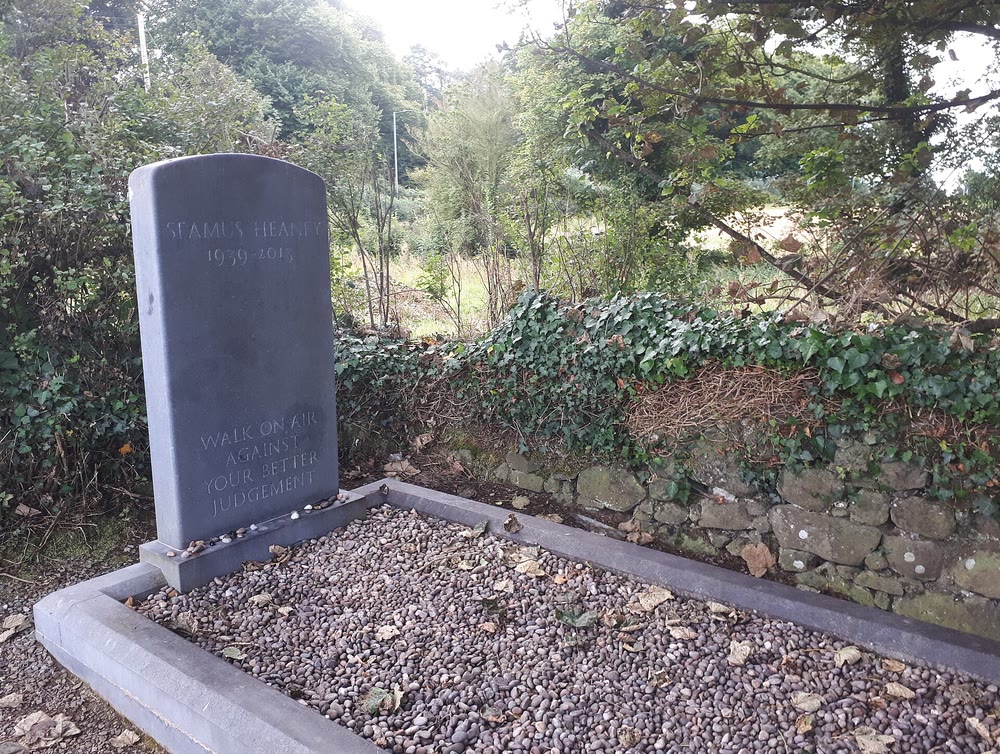
Seamus Heaney’s grave in St Mary’s churchyard, Bellaghy, with his epitaph from The Gravel Walks. Photo: 1TWO3Writer, CC0, via Wikimedia Commons
Visiting Seamus Heaney HomePlace in Bellaghy
Seamus Heaney HomePlace opened in September 2016 at 45 Main Street, Bellaghy, between his two childhood homes, Mossbawn and The Wood, and within a few hundred yards of his grave. It marked its 10th anniversary in September 2026. These details are from the HomePlace website in October 2026; check before you travel.
- Opening hours: Monday to Saturday, 10am to 5pm; Sunday, 1pm to 5pm.
- Exhibition tickets: adult £12, children 8 and over £7.50, children 7 and under free, family (2 adults and up to 3 children) £29, concession £8.
- Time needed: about 90 minutes. There’s a lift, two free car parks and a café.
- Getting there: about 30 minutes’ drive from Belfast International Airport, or two and a half hours from Dublin.
Look for his ink-stained wooden school desk from Anahorish, a recreation of his Dublin study and the fax machine that brought news of the Nobel Prize. The 191-seat theatre is called the Helicon, a name HomePlace links to his poem Personal Helicon.
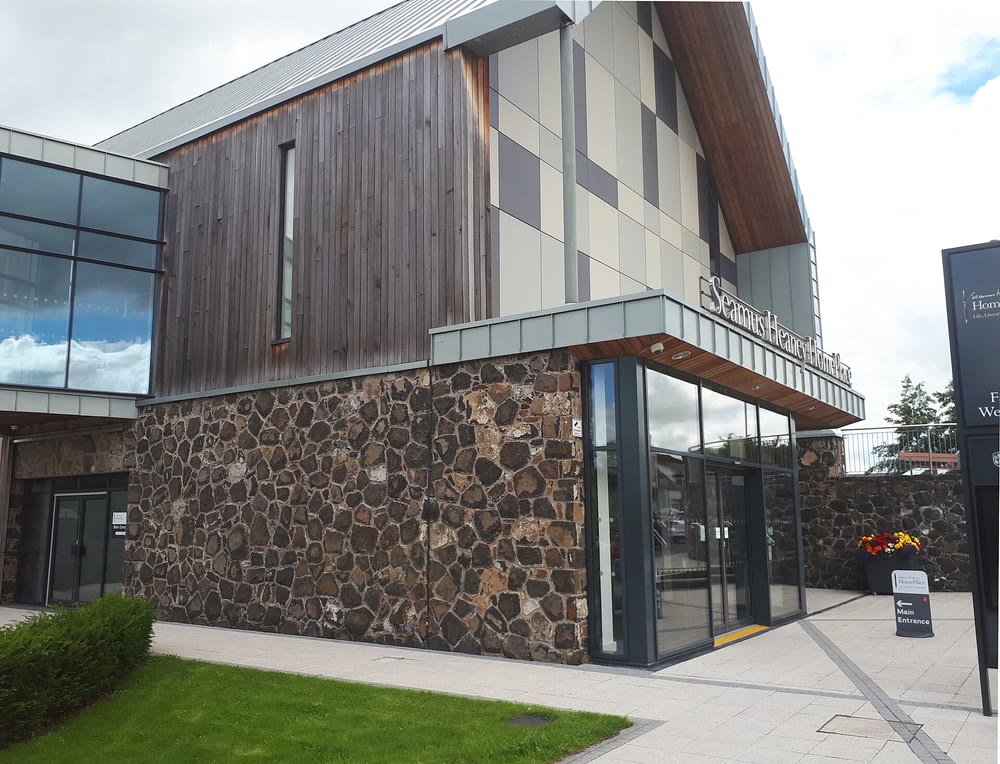
In Dublin, the National Library of Ireland’s free exhibition Seamus Heaney: Listen Now Again shows his manuscripts, letters and writing desk at the Bank of Ireland Cultural and Heritage Centre on Westmoreland Street (Monday to Saturday, 10am to 4pm, no booking needed). It’s listed as running until 2027.
Which Seamus Heaney poems should you read first?
Start with these short, much-loved poems, all in the list below:
- Digging: his statement of purpose, first in every selection.
- Mid-Term Break: his brother’s death, in just 22 lines.
- Blackberry-Picking and Follower: childhood on the farm, and a father growing old.
- Mossbawn: Sunlight: a farm kitchen, an aunt baking, and love at its plainest.
- Clearances: sonnets for his mother; the potato-peeling one won an RTÉ poll for Ireland’s favourite poem in 2015.
- Postscript: a drive along the Clare coast.
- Scaffolding: a short love poem couples choose for weddings.
For a whole book, try Opened Ground (1998), his poems from 1966 to 1996, or 100 Poems (2018), chosen by his family. My ranked shortlist is the 12 best Seamus Heaney poems.
Heaney poems on this site, by collection
Death of a Naturalist (1966)
- Digging
- Death of a Naturalist
- Blackberry-Picking
- Follower
- Mid-Term Break
- Scaffolding
- Personal Helicon
Door into the Dark (1969)
North (1975)
Later collections
- Casualty (Field Work, 1979)
- Station Island (Station Island, 1984)
- Clearances (The Haw Lantern, 1987)
- Seeing Things: a guide to the 1991 collection
- Postscript (The Spirit Level, 1996)
- Pangur Bán (his translation of the Old Irish poem about a monk and his cat)
Seamus Heaney FAQ
When and where was Seamus Heaney born?
On 13 April 1939, at Mossbawn, his family’s farm outside Castledawson in County Derry, Northern Ireland.
Why did Seamus Heaney win the Nobel Prize?
The Swedish Academy cited poems of “lyrical beauty and ethical depth” that honour the small miracles of everyday life and a past that is still alive.
What were Seamus Heaney’s last words?
A text to his wife, Marie, sent minutes before he died: Noli timere, Latin for “Don’t be afraid”. Their son Michael revealed it at the funeral.
Where is Seamus Heaney buried?
In St Mary’s churchyard, Bellaghy, Co. Derry, under the epitaph “Walk on air against your better judgement”.
Was Seamus Heaney Irish or British?
He was born in Northern Ireland, part of the UK, but identified as Irish, as his 1983 verse pamphlet An Open Letter made clear.
Love this? Save it to your Pinterest board for later.
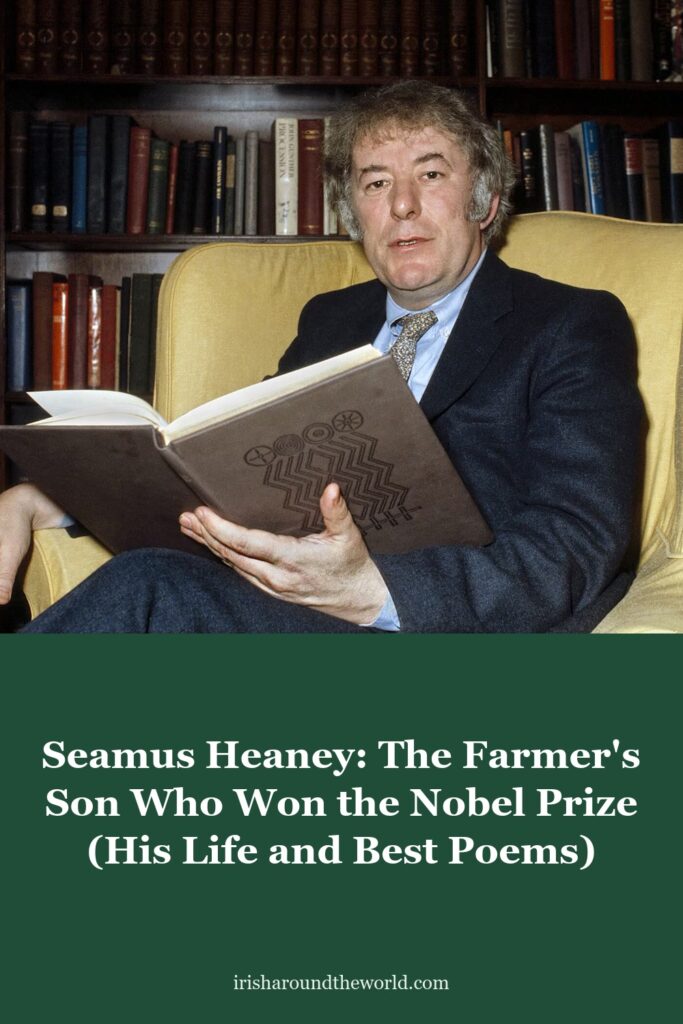
Pin image: Seamus Heaney in New York, November 1982. Photo: Bernard Gotfryd, Library of Congress Prints and Photographs Division (no known copyright restrictions), via Wikimedia Commons.
A little bit of Ireland in your inbox every Friday ☘️
The free Weekly Dose of Irish: an Irish joke, a Celtic symbol, an Irish fact, a poem and the week’s best articles in one short email. Join 9,600+ readers.
Free. One short email every Friday. Unsubscribe any time.
More Irish poetry reading
- 12 Best Seamus Heaney Poems Everyone Should Read
- Famous Irish Poets: The Greatest of All Time, in Order
- Top 100 Irish Poems Ranked, With an Analysis of Each Poem
- Under Ben Bulben by W.B. Yeats: The Poem That Wrote His Own Epitaph
- Glendalough: The Hermit Saint, a Blackbird and Ireland’s Valley of Two Lakes
Featured image: Seamus Heaney in New York, November 1982. Photo: Bernard Gotfryd, Library of Congress Prints and Photographs Division (no known copyright restrictions), via Wikimedia Commons.