
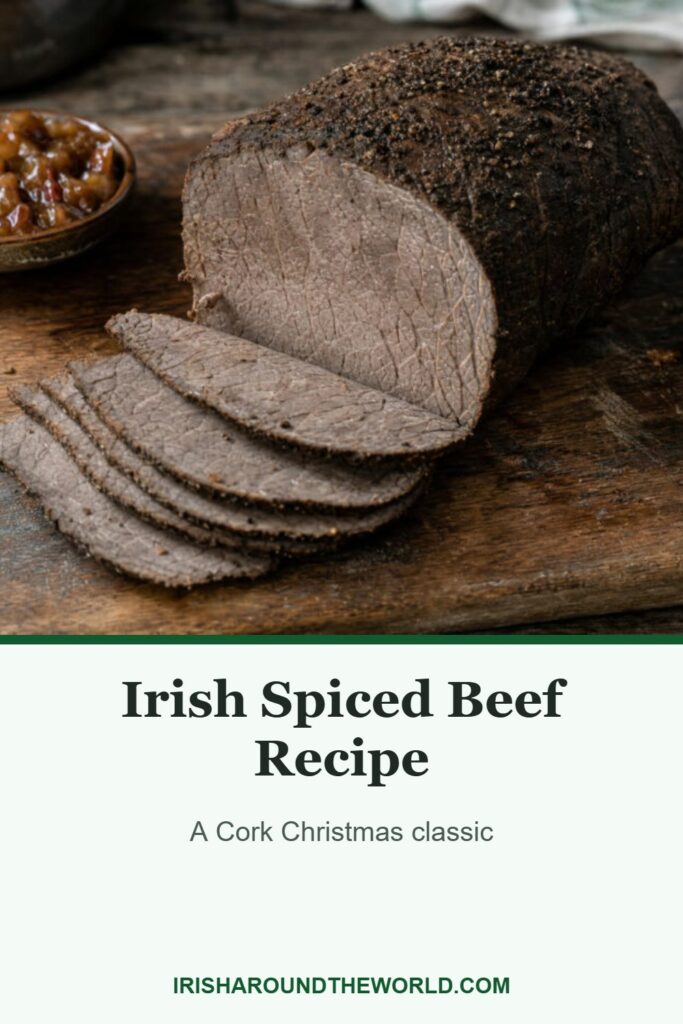
Spiced beef is Ireland’s Christmas cold cut, and Cork’s above all. It is a beef joint cured with salt, brown sugar and spices such as allspice, pepper, cloves and juniper, then simmered, pressed and sliced thinly. To cook a bought one, bring it slowly to the boil from cold, then simmer gently for 40 to 50 minutes per kilo (18 to 23 minutes per lb).
In plenty of Cork homes, Christmas isn’t quite Christmas without a spiced beef in the fridge. In the rest of Ireland it’s more of a regional treat. Abroad, it’s the thing Cork people miss and struggle to explain.
Below is what spiced beef is, why it belongs to Cork and how to cook a bought joint. Then there’s a home-cured recipe for anyone far from the English Market, written to current food safety advice.
Jump to the home-cured spiced beef recipe
What is spiced beef?
Spiced beef is a joint of beef cured with salt, sugar and spices. The usual spices are allspice, black pepper and cloves, often with juniper. The cured beef is simmered or slow-braised, pressed, and usually eaten cold in very thin slices.
Butchers use lean cuts such as topside, silverside, rump, eye of the round or brisket. Most Cork butchers keep their own spice mix, and the good ones keep it to themselves.
It’s linked with Christmas, but Darina Allen of Ballymaloe notes that the English Market in Cork sells it all year round. It isn’t only Irish, either. The food writer Elizabeth David traced spiced beef in English cookery back several centuries. It’s far less common in England now, while Cork kept it going.
James Joyce put “a round of spiced beef” on the supper table at the Misses Morkan’s dance in The Dead, held around the Feast of the Epiphany. That’s 6 January, which in Ireland is also Nollaig na mBan, or Women’s Christmas.
If you want the bigger picture of the Irish Christmas table, my guide to Irish Christmas traditions, food and dinner covers the rest of the menu.
Why is spiced beef a Cork thing?
Cork spent a couple of centuries salting beef for the world. The spice is the part with the shakier history.
Cork’s salt beef trade
In the 1660s, the Cattle Acts stopped Ireland sending live cattle to England. That pushed Irish farmers towards slaughtering and salting beef for export instead. Cork, with its big, safe harbour, became a centre of that provisions trade.
The historian Gillian O’Brien has written about how far it reached. By 1750, she writes, Cork had a growing international market for its butter, beef and pork. Much of the salt beef was eaten on slave ships sailing from Africa to the West Indies, and on the sugar plantations there.
O’Brien also quotes a 1764 letter from a visitor, J. Bush. He said that between Michaelmas and Christmas so much beef was killed in Cork that a stranger would take it for “the slaughter-house of Ireland”. Cork has been called worse.
Where the spice comes in
The story told in Cork, and repeated by the city’s Echo newspaper, is that ships trading with the West Indies brought spices back. From there, salted beef picked up a Christmas spicing that ordinary families could afford once a year.
Allspice, also called pimento or Jamaica pepper, is a Caribbean spice, and it’s in almost every spiced beef recipe. But nobody has documented a direct line from the ships to the butcher’s counter, so treat it as a likely tale rather than settled fact.
The English Market
According to Cork City Council, the Corporation opened a covered meat market on the Grand Parade in 1788. The “English” name came later. After 1840 the new council opened St Peter’s Market, which became known as the Irish Market.
Today the English Market is the best-known place to buy spiced beef. It’s also one of the best things to do in the city, as my list of things to do in Cork will tell you.
Where to buy spiced beef
The best-known name is Tom Durcan, whose stall sits beside the fountain in the English Market. Georgina Campbell’s Ireland Guide says it sells over a ton of spiced beef every Christmas. Like most butchers, he keeps his spice mix to himself.
In December 2024, Cork’s Echo reported that the Associated Craft Butchers of Ireland had named his spiced beef the best in Ireland, for the second time. It has also won Blas na hÉireann gold. The Ireland Guide says his cure starts in October and runs for “at least a month, maybe two”.
O’Mahony’s Butchers, also in the English Market, sells it too. SuperValu also sells uncooked joints in Ireland. Outside Ireland it’s hard to find, which is why the home recipe further down exists.
How to cook spiced beef you’ve bought
If you have a bought, uncooked joint, this is the bit you need. Always check the label first, because the butcher knows their own cure best.
Cooking times by weight
Tom Durcan’s advice is 40 minutes per kilo if you’ll eat it cold, and 50 minutes per kilo to eat it warm. Most butchers time it from when the water simmers.
| Weight of joint | To eat cold | To eat warm |
|---|---|---|
| 1kg (2.2 lb) | 40 minutes | 50 minutes |
| 1.5kg (3.3 lb) | 1 hour | 1 hour 15 minutes |
| 2kg (4.4 lb) | 1 hour 20 minutes | 1 hour 40 minutes |
| 2.5kg (5.5 lb) | 1 hour 40 minutes | 2 hours 5 minutes |
| 3kg (6.6 lb) | 2 hours | 2 hours 30 minutes |
Eoin O’Mahony told the Irish Examiner he allows a little longer, 45 minutes per kilo plus 20 minutes. SuperValu says 50 minutes per kilo with the lid on.
Step by step
- Unwrap the joint and weigh it. Leave any string on.
- Soak it only if the label tells you to. Durcan’s instructions don’t mention soaking. If yours do, soak it in cold water in the fridge.
- Put the beef in a pot and cover it with cold water. Bring it slowly to the boil.
- Turn it down to a gentle simmer, with just a few lazy bubbles. Cook it for the time in the table.
- If you have a meat thermometer, check the thickest part has reached 75°C (167°F) before it comes off the heat. That’s the figure safefood gives for cooked joints.
- Durcan advises letting it cool in the cooking liquid so it stays moist. A big joint cools slowly, though, so give it no more than 30 minutes, then lift it out onto a rack.
- Let the steam come off for up to 30 minutes. To eat it cold, wrap it and get it into the fridge within 2 hours of cooking. Press it overnight if you want neat slices, as in the recipe below.
Spiced beef recipe (home-cured, no saltpetre)
This is a short, refrigerated spice cure with no saltpetre and no nitrite. The salt and sugar per kilo are close to Martin Dwyer’s recipe, and the cooking time is in line with Ballymaloe’s.
The fridge temperatures, cooking temperature and storage times follow safefood, the FSAI and USDA advice. No official body sets a time for a home cure without nitrite, so this one stays within the USDA’s 3 to 5 days for raw beef roasts.
Because there’s no nitrite, the cooked beef will be grey-brown inside, not pink. That’s normal, and it doesn’t mean anything has gone wrong.
Prep: 20 minutes | Cure: 3 to 5 days in the fridge | Cook: 2 to 2½ hours | Cool: up to 1 hour | Press: 8 to 12 hours | Serves: 8 to 10 as a cold cut
Pot: 4 to 5 litres (4¼ to 5¼ US quarts), about 20 to 24cm (8 to 9½ inches) across. Press: 900g (2lb) loaf tin, about 23 x 13cm (9 x 5 inches). Fridge: 0 to 4°C (32 to 39°F).
Ingredients
- 1.5kg (3 lb 5 oz) beef topside or silverside, in one compact piece, trimmed of excess fat. In the US ask for top round or bottom round. Brisket also works.
- 60g (just over 2 oz, about 3 US tbsp plus 1 tsp) fine sea salt or table salt, not flaky salt
- 45g (1½ oz) dark brown sugar, about 3⅓ US tbsp packed, or the same weight of demerara sugar
- 15g (½ oz) whole allspice berries, also sold as pimento
- 15g (½ oz) whole black peppercorns
- 10g (⅓ oz) juniper berries
- 1 tsp whole cloves (about 2g)
- Optional: ¼ tsp ground nutmeg or mace (about 0.5g)
- For the pot: 1 onion, halved, 1 carrot and 1 bay leaf (all optional)
- About 2 to 2.5 litres (8½ to 10½ US cups) cold water
- Cotton kitchen string
Method
- Buy the beef fresh and start the cure the same day. Put a fridge thermometer on the bottom shelf and check it reads 0 to 4°C (32 to 39°F).
- Grind the allspice, peppercorns, juniper and cloves coarsely in a spice grinder or with a pestle and mortar. Mix them with the salt, sugar and nutmeg, if using.
- Pat the beef dry and put it in a snug glass or ceramic dish, or a food-safe zip bag. Rub the cure firmly over every surface, ends included. Wash your hands, board and worktop afterwards.
- Cover the dish, or seal the bag, and put it on the bottom shelf of the fridge so it can’t drip onto anything. Leave it for 3 to 5 days, no longer, and never past the use-by date on the beef.
- Once a day, turn the beef and spoon or rub the juices that collect back over it. The salt draws liquid out of the meat, so this brine is expected.
- On cooking day, wipe or brush off the spices with kitchen paper. If you want it less salty, soak it in a bowl of cold water in the fridge for an hour, not under a running tap. Clean the sink, the bowl and your hands afterwards. Pat the beef dry and tie it into a neat, firm roll with cotton string every 3 to 4cm (1¼ to 1½ inches).
- Put the beef in a 4 to 5 litre (4¼ to 5¼ US quart) pot with the onion, carrot and bay leaf. Cover it with cold water by about 2.5cm (1 inch). Bring it slowly to the boil and skim off any scum.
- Turn the heat down to a bare simmer and put the lid on. Cook for about 2 to 2½ hours, until a skewer slides into the centre easily and the thickest part reads at least 75°C (167°F). A firmer joint may need up to 3 hours. That’s longer than the butchers’ times for a bought joint and in line with Ballymaloe’s 2 to 3 hours. Go by the skewer and the thermometer, not the clock.
- Take the pot off the heat. After 30 minutes, lift the beef out onto a rack and let the steam come off for up to 30 minutes. Then wrap it in baking paper and foil and sit it in a 900g (2lb) loaf tin, about 23 x 13cm (9 x 5 inches), on a plate.
- Lay a board or a second loaf tin on top and weigh it down with about 1.5 to 2kg (3¼ to 4½ lb) of tins. Put it on the bottom shelf of the fridge straight away, well within 2 hours of cooking. Press it overnight, 8 to 12 hours.
- Snip off the string. Slice the beef as thinly as you can, across the grain, with a long sharp knife. Serve it cold. Keep leftovers wrapped in the fridge at 5°C (41°F) or below and eat within 3 days, or freeze sliced for up to 2 to 3 months.
Tips
Weigh, don’t guess. Spoon measures for whole spices and different salts vary a lot. Kosher salt flakes take up far more room than fine salt, so a tablespoon of each weighs very differently. A cheap digital scale is worth it here.
The fridge, not a cool place. Older Irish recipes say to cure the beef in a “cool place” or a cold larder. Official advice now is a fridge at 5°C (41°F) or below. The USDA’s limit is 40°F (4°C), so this recipe aims for 4°C or colder.
Don’t stretch the cure. Butchers cure for a month or two, but they use commercial cures and controlled cold rooms. A home cure without nitrite should stay at 3 to 5 days.
Oven method. Put the tied beef in a covered casserole with water halfway up the meat. Cook it at 140°C (120°C fan, 275°F, gas mark 1), Martin Dwyer’s temperature, for about 3 to 3½ hours. It’s done when it’s tender and 75°C (167°F) in the middle, then cool and press it as in steps 9 and 10.
Want it pink? Pink needs nitrite.
If you want to use a curing salt, use only Cure #1, also sold as Prague Powder #1 or Insta Cure #1 (6.25% sodium nitrite). For this 1.5kg joint, use 2.8g, weighed on jeweller’s scales. That’s roughly a level ½ tsp.
Take the same 2.8g off the plain salt, so you use 57g of salt. Mix the cure evenly into the salt before it goes near the meat. Never swap in Cure #2, saltpetre or Morton Tender Quick, because their strengths differ.
European “nitrite curing salt” (Nitritpökelsalz or sel nitrité) is a different, much weaker product meant to replace all the salt. Never use Cure #1 at the rate a European recipe gives for it. Label the tub and keep it away from children.
The manufacturers’ US rate is 2.5g per kilo. This recipe uses a little less, about 1.9g per kilo, to stay within the EU limit for nitrite in meat products. In 3 to 5 days the pink may only reach the outer part of a thick joint. Store and eat it exactly like the grey version.
Spiced beef without saltpetre, and why yours will be grey
Almost every old spiced beef recipe uses saltpetre, which is potassium nitrate. It turns the meat pink and helps it keep. Even the Ballymaloe recipe now carries a note that saltpetre is regarded as a health hazard.
The amounts matter. Martin Dwyer’s recipe uses ½ oz of saltpetre for a 6lb joint. That’s about 35 times the current EU limit for nitrate added to uncooked cured meat. According to the FSAI, EU rules don’t allow added nitrate at all in heat-treated meat products.
Saltpetre is also hard to buy now. It’s listed as a reportable explosives precursor under EU rules, so many chemists no longer stock it. Fair enough. Nobody needs a Christmas dinner that ends with a visit from the Gardaí, the Irish police.
So the recipe above leaves it out. Without nitrite, cured beef cooks to a grey-brown colour, the same as New England’s “grey” corned beef. The USDA explains that nitrite is what fixes the pink. Grey doesn’t mean it’s gone off, and pink in a nitrite-cured beef doesn’t mean it’s raw.
How to serve spiced beef at Christmas
Cold, sliced as thin as you can manage, is the classic. Ballymaloe suggests serving it with chutneys or in sandwiches. Brown bread and butter with a sharp fruit chutney is a popular pairing.
Tom Durcan’s own favourite is cold spiced beef on buttered crusty white bread with caramelised Spanish onions. That’s hard to argue with.
In many Cork homes it comes into its own on St Stephen’s Day (26 December) and the days after. Turkey sandwiches get tired fast, and spiced beef sandwiches don’t. Families do this differently, so don’t take it as a rule.
If you’d rather have it warm, cook it for the “warm” time in the table and slice it thicker. One fair warning, though. Spiced beef is a salty, cured meat, so if you’re watching your salt, a few thin slices go a long way.
How long does spiced beef keep?
Some older recipes say spiced beef keeps for three or four weeks in the fridge. That claim depends on heavy saltpetre cures. Don’t apply it to the home version above.
Treat home-cured spiced beef like any cooked meat. Keep it wrapped in the fridge at 5°C (41°F) or below and eat it within 3 days, as safefood advises for leftovers. For longer, slice it, wrap it well and freeze it.
For a bought joint, keep it in the fridge and cook it by the use-by date. Once cooked, follow the same 2-hour and 3-day rules. If you reheat leftovers, get them piping hot, 75°C (167°F) in the middle. Reheat leftovers once only.
Spiced beef FAQ
Is spiced beef the same as corned beef?
They’re cousins. Both are salt-cured beef, and some Cork butchers start spiced beef from corned silverside. Spiced beef adds sugar and spices such as allspice, pepper and cloves, and it’s usually pressed and eaten cold.
How long do you cook spiced beef per kg?
Tom Durcan says 40 minutes per kilo to eat it cold, or 50 minutes per kilo to eat it warm, at a gentle simmer. O’Mahony’s Butchers allows 45 minutes per kilo plus 20 minutes. Always check the label first.
Do you soak spiced beef before cooking?
Usually not. Tom Durcan’s cooking instructions don’t include soaking. If your butcher’s label says to soak it, do it in cold water in the fridge.
Do you eat spiced beef hot or cold?
Either works, as Darina Allen says. Cold and thinly sliced is the classic. To eat a bought joint warm, simmer it for 50 minutes per kilo and slice it thicker.
Can you freeze spiced beef?
Yes. Slice the cooked beef, wrap it well and freeze it for up to 2 to 3 months, as the USDA suggests for cooked corned beef. Thaw it in the fridge.
Can you cook spiced beef in Guinness?
Some people simmer it in stout, but none of the butchers’ instructions above call for it. Good Food Ireland notes that some recipes add stout, but says it isn’t needed if the spice is right. If you want beef and stout together, try a beef and Guinness stew.
More Irish Christmas reading
- Irish Christmas Traditions, Food and Dinner
- Irish Christmas Cake Recipe
- How to Say Merry Christmas in Irish
- 10 Irish Christmas Blessings
- Nollaig na mBan, the Irish Tradition of Women’s Christmas
- Facts About Cork
- Barmbrack Recipe
Love this? Save it to your Pinterest board for later.
A little bit of Ireland in your inbox every Friday ☘️
The free Weekly Dose of Irish: an Irish joke, a Celtic symbol, an Irish fact, a poem and the week’s best articles in one short email. Join 9,600+ readers.
Free. One short email every Friday. Unsubscribe any time.