Irish words with no English translation include aiteall, a bright break between showers; meitheal, a crew of neighbours working together; cumha, the ache of homesickness; and dúchas, the heritage you inherit. Here are 20 of them, with pronunciation and examples. Irish has no single words for yes and no, either, and some viral “untranslatable Irish words” are really Scottish Gaelic.
Every language has words that won’t fit neatly into another. Irish has plenty, and they say a lot about the life the language grew out of: changeable weather, small farms, long nights by the fire and a great deal of leaving home.
I’ve covered the words that crossed into English in my guide to English words from Irish, and the English that Irish people actually speak in Irish slang words and phrases. This list goes the other way: 20 Irish words with no English translation, or at least no single English word.
Each one is checked in Ó Dónaill’s Irish-English dictionary on teanglann.ie. Pronunciations are rough guides, with the stressed syllable in capitals. In the respellings, kh is the throaty sound in Scottish loch, and gh is a softer, voiced version of it. Munster Irish often stresses a long vowel later in the word, so play the teanglann.ie recordings, where they exist, to hear all three dialects.
Jump to:
- What makes an Irish word “untranslatable”?
- Irish words for feelings
- Words for Irish weather
- Neighbours, night visits and storytellers
- Two words for a drink
- Words from folklore and belief
- A word for sarcasm: mar dhea
- Why Irish works this way
- Fake and garbled “untranslatable Irish words”
- Irish words with no English translation: FAQ
- More Irish words and sayings
What makes an Irish word “untranslatable”?
Strictly speaking, nothing is untranslatable: any word can be explained. What these words lack is a single English word that does the same job, so the dictionary needs a phrase, or several meanings, to pin them down.
Some are everyday words. Others belong to a fading rural world of turf-cutting, fairs and fireside visiting, which makes them worth knowing all the more.
Irish words for feelings
1. Cumha (KOO-uh)
Cumha is the sorrow of separation. Ó Dónaill gives loneliness, homesickness and the sadness of parting, and the newer English-Irish dictionary on focloir.ie offers cumha for both homesickness and nostalgia. In Ulster the word is cumhaidh (KOO-ee).
Example: Bhí cumha orm i ndiaidh an bhaile: I was homesick, literally “there was cumha on me after home”. Ó Dónaill’s entry has a line that sums it up: Níl cara ag cumha ach cuimhne, longing has no friend but memory.
2. Uaigneas (OO-ig-nus)
Uaigneas is loneliness, with an edge English doesn’t have. Ó Dónaill lists solitude and privacy, and also the fear of being alone: the eerie feeling of a dark road or an empty house. A lonely place, áit uaigneach (awtch OO-ig-nukh), can be remote and a little spooky at the same time.
Example: Cuireann an seanteach sin uaigneas orm: that old house gives me a lonesome, eerie feeling.
3. Aduantas (AD-oon-tus)
Aduantas is the uneasy feeling that comes over you in strange surroundings, part fear and part loneliness. Anyone who has spent a first night in a new country knows it.
Example: Bhí aduantas orm an chéad oíche i Nua-Eabhrac: I felt lost and uneasy my first night in New York.
4. Beochaoineadh (BYOH-kheen-yuh)
Literally a “live keen”. Beo means alive, and caoineadh is the keen, the lament once wailed over the dead. Ó Dónaill defines beochaoineadh as a lament for someone who has gone away.
It’s the feeling behind the American wake, the all-night farewell for emigrants that was also called a live wake.
5. Sceitimíní (SHKETCH-ih-mee-nee)
Sceitimíní is rapturous, can’t-sit-still excitement. The word is always plural, and in Munster you’ll hear sketch-ih-MEE-nee.
Example: Tá sceitimíní ar na páistí: the children are giddy with excitement, literally “there are raptures on the children”.
6. Dúchas (DOO-khus)
Dúchas may be the biggest word on this list. Ó Dónaill’s entry runs from heritage and birthright to your native place, a natural bond with someone, and your inborn nature. It’s everything you inherit, from land to temperament.
A talent you have ó dhúchas (oh GHOO-khus) comes to you naturally, through your people. A native speaker is a cainteoir dúchais (KAN-chor DOO-khish), and a homeland is a tír dhúchais (cheer GHOO-khish). The proverb Is treise dúchas ná oiliúint means nature is stronger than nurture. Fittingly, the National Folklore Collection’s website is called dúchas.ie.
Words for Irish weather
7. Aiteall (ATCH-ul)
An aiteall is a dry, bright break between showers: the moment the rain stops and you dash out to bring in the washing. English needs a sentence for it. Irish needs one word.
Example: Tá sé ina aiteall, téimis amach! It’s cleared up for a bit, let’s head out!
8. Clagarnach (KLAG-ur-nukh)
Clagarnach is a clatter, and Irish weather gives it plenty of work. Ó Dónaill gives clagarnach bháistí (KLAG-ur-nukh WAWSH-tchee) for pelting rain: a downpour you hear drumming on the roof before you see it. English has words for heavy rain and words for noise, but none for both at once.
Example: Bhí an bháisteach ag clagarnach ar an díon: the rain was clattering on the roof.
Neighbours, night visits and storytellers
9. Meitheal (MEH-hul)
A meitheal is a working party of neighbours who turn out together. A meitheal bhuana (MEH-hul WOO-uh-nuh) was a reaping crew, and a meitheal mhóna (MEH-hul WOH-nuh) a team cutting turf, the peat that people burned on the fire.
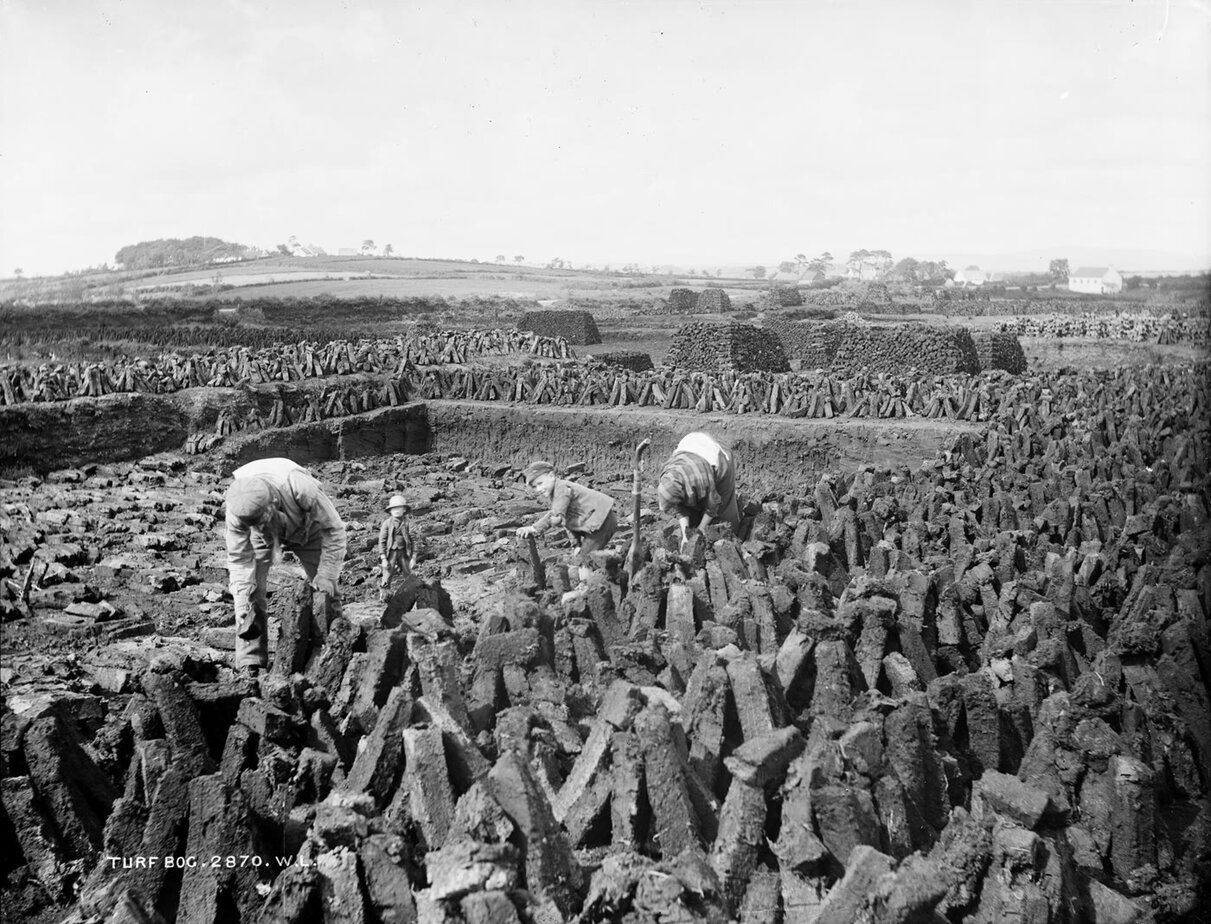
Footing turf (standing peat sods upright to dry) on a bog, probably near Ballymena, Co. Antrim, probably in the 1880s. Lawrence Collection, National Library of Ireland (L_ROY_02870), via Wikimedia Commons
The idea is far from dead. Tusla, Ireland’s Child and Family Agency, calls its early-help model for families Meitheal, after the old custom of neighbours coming together to save the crops.
10. Bothántaíocht (BOH-hawn-tee-ukht)
From bothán, a cabin: going from house to house for company and a chat. Ó Dónaill even has a name for the people given to it, lucht na mbothán (lukht nuh MOH-hawn), literally “the cabin people”.
11. Airneán (AR-nyawn)
Airneán is visiting by night: staying up late by a neighbour’s fire for talk and company, or working on into the small hours. A teach airneáin (chakh AR-nyawn) was a house where neighbours gathered through the long nights. Ulster speakers say airneál.
12. Seanchaí (SHAN-uh-khee)
A seanchaí is more than a storyteller. Ó Dónaill gives two senses: in literary use, a keeper of tradition and a historian, and a reciter of old lore, the traditional storyteller. English borrowed the word as shanachie.
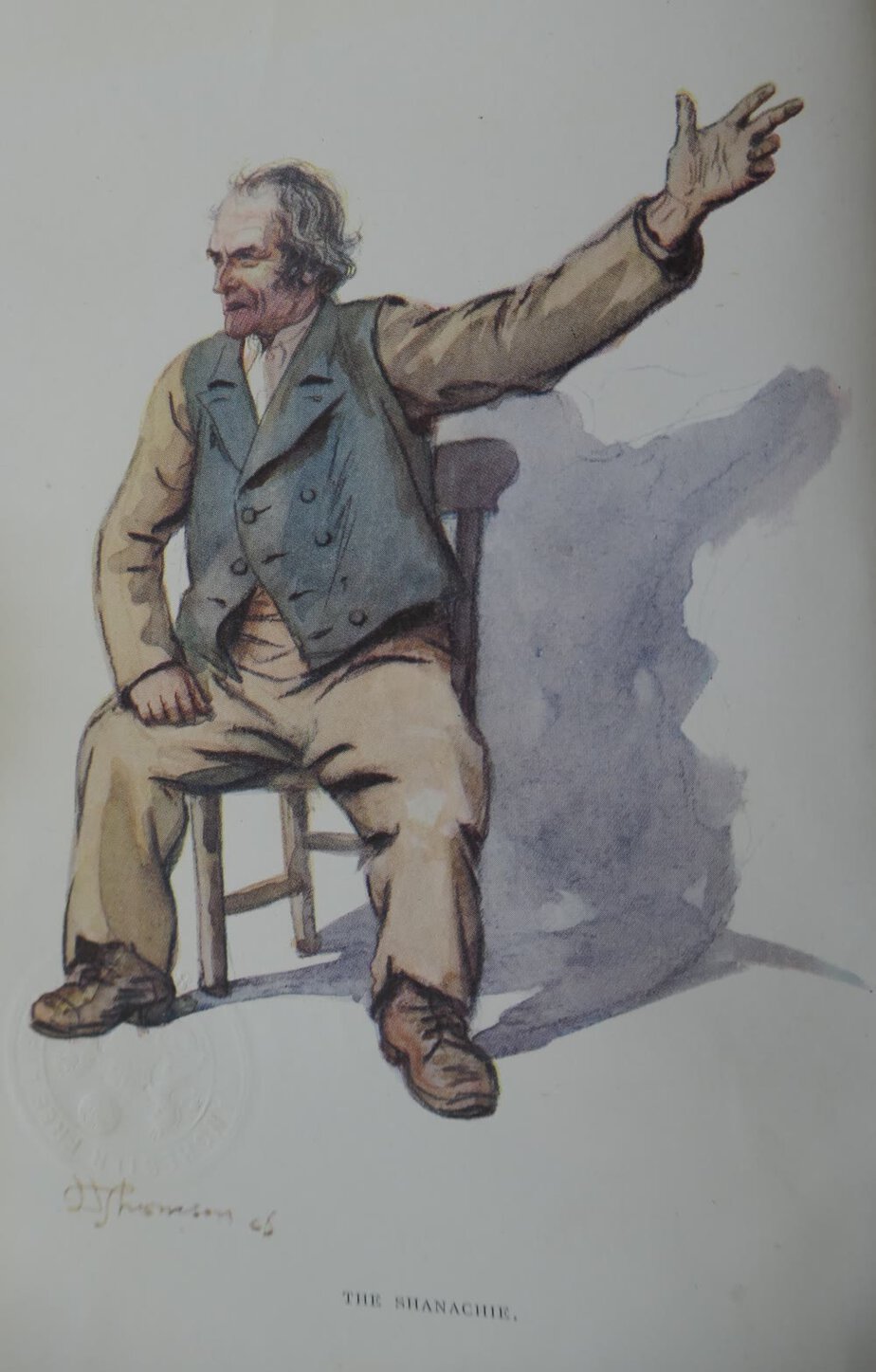
The Shanachie, by Hugh Thomson, frontispiece to Stephen Gwynn, The Fair Hills of Ireland (Dublin: Maunsel, 1906). Public domain, via Wikimedia Commons
J. M. Synge’s The Aran Islands (1907) describes one, old Pat Dirane of Inis Meáin, who came to talk with him day after day. Peig Sayers of the Great Blasket Island was another.
Example: Ba sheanchaí iontach é: he was a wonderful storyteller.
13. Fámaire (FAW-mir-uh)
Ó Dónaill’s meanings include an idler or stroller and, in everyday speech, a seaside or summer visitor, or any tourist. It can also mean anything huge, so a fámaire bréige (FAW-mir-uh BRAY-gyuh) is what the dictionary calls a “whacking lie”.
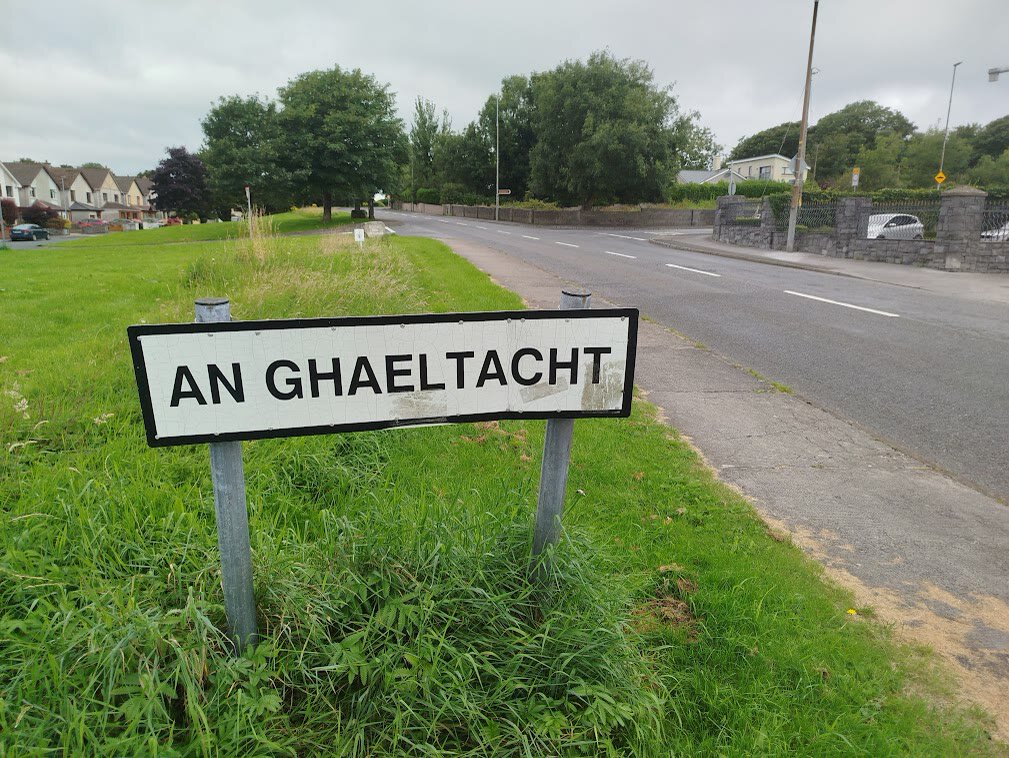
If you visit the Gaeltacht (GAYL-tukht), the Irish-speaking districts, in August, this word is about you.
Example: Tá na fámairí ar ais sa Ghaeltacht: the summer visitors are back in the Gaeltacht.
Two words for a drink
14. Deoch an dorais (jokh un DOR-ish)
Literally “the drink of the door”: the last one before you leave, one for the road. Ó Dónaill translates it with the old English term stirrup-cup. A proverb puts things in the right order: Is túisce deoch ná scéal, a drink comes before the news.
Example: Beidh deoch an dorais againn: we’ll have one for the road.
15. Béaláiste (BAY-lawsh-tchuh)
A béaláiste is a drink taken to seal a bargain, the liquid half of a handshake on a deal. English needs a whole phrase for it.
Words from folklore and belief
16. Féar gortach (fair GOR-tukh)
Literally “hungry grass” (in Munster, féar sounds closer to FEE-ur). In folklore, anyone who stepped on a patch of it was struck with hunger and weakness.
The Schools’ Collection, the folklore that Irish schoolchildren gathered in 1937 to 1939 for the National Folklore Collection, has many accounts of it. A schoolgirl near Buncrana, Co. Donegal, naming her 86-year-old grandfather as her source, wrote that people got féar gorta, as it was also called, on the way home from fairs and markets, and couldn’t walk on until they had eaten. Anyone heading to Clonmany past a “hungry stone” between Onisk and Glasmullen carried oat bread, just in case.
Ó Dónaill also uses féar gortach as a name for quaking-grass, and records Tháinig féar gortach orm for “I was overcome with hunger”.
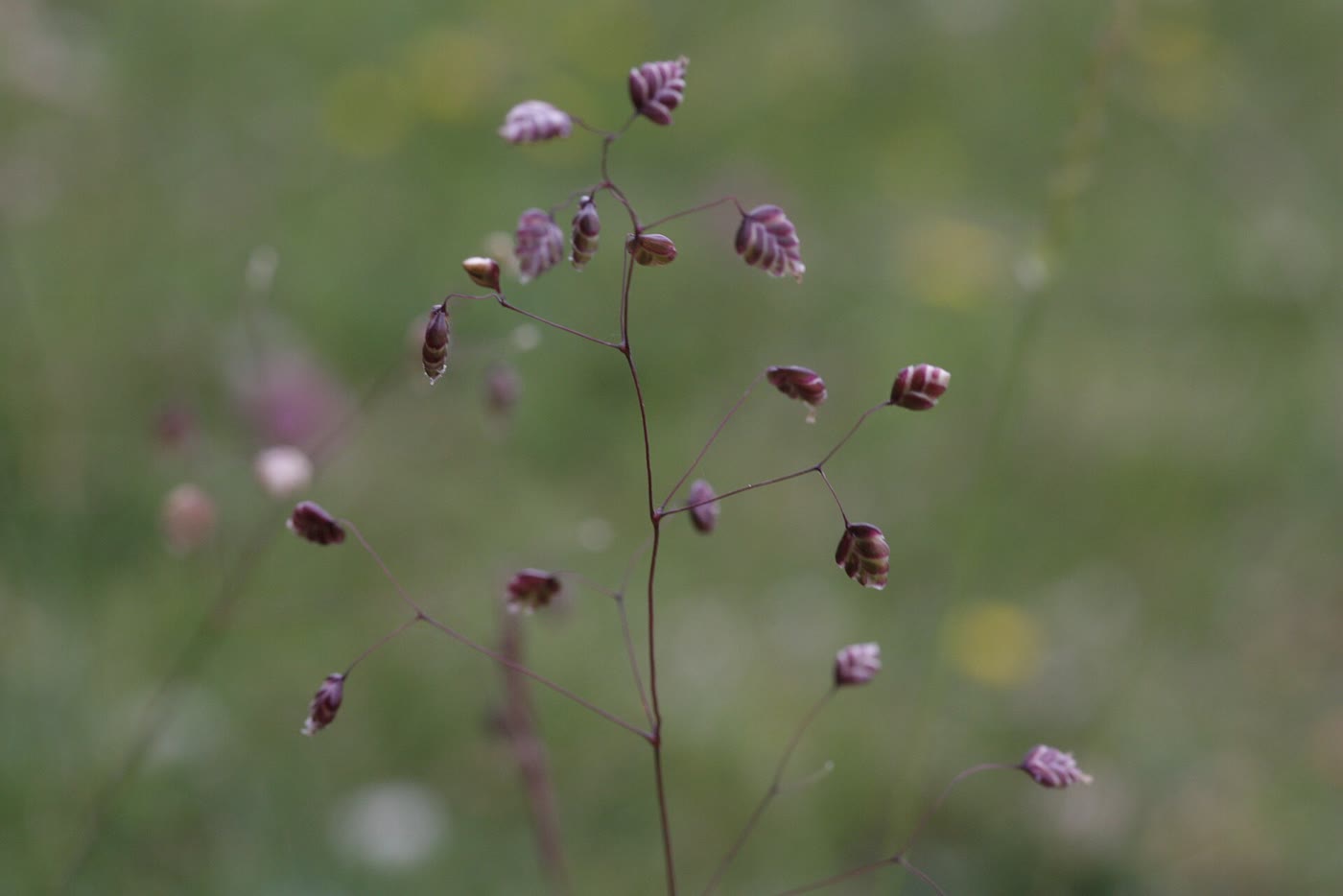
Quaking grass (Briza media), which Ó Dónaill also calls féar gortach. Photo: john shortland, CC BY 2.0 (https://creativecommons.org/licenses/by/2.0/), via Wikimedia Commons
17. Fóidín mearaí (FOH-jeen MYAR-ee)
The stray sod. A fóidín is a little sod of earth, and the fóidín mearaí is a spot of ground that leads anyone who steps on it astray. Dul ar an bhfóidín mearaí, going onto the stray sod, can also mean simply losing your bearings.
Another Schools’ Collection account, from Trim, Co. Meath, tells of a stray sod on a grazing farm a mile outside the town. A man who stepped on it at about nine one night walked until seven the next morning, when the farm’s herdsman found him worn out. Had he turned his coat inside out, the herdsman told him, the spell would have broken.
Example: Chuaigh mé ar an bhfóidín mearaí (KHOO-uh may er un WOH-jeen MYAR-ee): I got completely lost.
18. Piseog (PISH-ohg)
English has superstition, but a piseog is more active than a belief. Ó Dónaill’s first sense is a charm or spell, something you cast. In the plural, piseoga are superstitious practices: things people did, not just things they believed. Irish English, the English spoken in Ireland, kept the word as pishogue, which Dictionary.com dates to the 1820s. In Munster the stress falls on the end: pish-OHG.
Example: Níl ann ach piseoga: it’s nothing but pishogues, old superstitious nonsense.
19. Deiseal (JESH-ul) and tuathal (TOO-uh-hul)
Deiseal is the right-hand way round, following the sun: clockwise, the lucky direction. Tuathal is the reverse, against the sun, and so the wrong way. Ó Dónaill notes that people said Deiseal! to someone who sneezed or was choking, much like “bless you”.
Tuathal can also mean a blunder. Example: Rinne mé tuathal: I made a mess of it. English borrowed deiseal, mainly through Scotland, as deasil, but you’ll hardly ever hear it.
A word for sarcasm
20. Mar dhea (mar YAH)
Mar dhea means “supposedly”, “so-called” or “yeah, right”, with a raised eyebrow built in. Ó Dónaill translates it with the old English forsooth. It crossed into Irish English as moryah, which the Collins dictionary lists as a cry of annoyance or disbelief.
Example: Tá sé tinn, mar dhea: he’s sick, supposedly.
Why Irish works this way
Some gaps go deeper than vocabulary: Irish builds its sentences differently, and a few English basics don’t exist in it at all.
There’s no single word for yes or no
Irish answers a question by echoing its verb. Ask An bhfuil tú críochnaithe? (are you finished?) and the answer is Tá (taw), roughly “I am”, or Níl (neel), “I’m not”. The English-Irish dictionary on focloir.ie gives a different reply for each kind of question, from Beidh (will be) to Is ea, often shortened to sea (shah).
You can hear it in Irish English, too. Ask an Irish person “Are you coming?” and you may well get “I am”. The linguist Gili Diamant has argued that this way of answering may come from Irish.
Nobody “has” anything
Irish has no everyday verb “to have”. Things are “at” you instead, so I love you, tá grá agam duit, is literally “love is at me for you”. There’s more in my guide to Irish sayings about love.
Feelings sit on you
Feelings, hunger and fear are things that come on you. Tá brón orm (taw brohn UR-um), I’m sorry, is literally “sorrow is on me”, and tá ocras orm (taw UK-rus UR-um) is “hunger is on me”.
That’s why so many words above are nouns. You don’t feel homesick in Irish: cumha comes on you, sceitimíní come on the children, and aduantas comes on the stranger.
Two ways to say goodbye
English uses the same goodbye whoever is leaving. Irish has two. The person leaving says slán agat (slawn AG-ut), “safe at you”, to the one staying. The one staying says slán leat (slawn lat), “safe with you”, to the one going, as the focloir.ie entry for goodbye sets out.
Slán means safe or healthy, which is why slán abhaile (slawn uh-WAL-yuh) means safe home.
Fake and garbled “untranslatable Irish words”
Online lists of untranslatable Irish words are often lovely, but the same mistakes keep turning up. Here are the common ones, corrected.
Scottish Gaelic words labelled as Irish
Sgriob is often shared as the Irish word for the itch on your upper lip just before a sip of whiskey. It isn’t Irish in that sense. Irish has a related word, scríob (shkreeb), a scrape or scratch, but Ó Dónaill gives it no itchy-lip meaning. Sgrìob is Scottish Gaelic, and in Edward Dwelly’s Scottish Gaelic dictionary it mostly means a scratch, a furrow or a trip. One sense is an itchy lip, which superstition read as a sign of a coming kiss or a coming dram.
Camhanaich, offered as the Irish for early-morning twilight, is Scottish Gaelic too, a form of camhanach, twilight. In Irish, daybreak is breacadh an lae (BRAK-uh un LAY).
Meanings that grew in the telling
Síobhraí appears on some lists as a ghostly, mystical mist. Ó Dónaill doesn’t back that up. Síobhra is another spelling of síofra, which he defines as an elf, a sprite or a changeling child, so síobhraí would be fairies, not fog. There’s more on them in my guide to changelings.
Spéirbhean gets sold as a woman as lovely as the whole sky. It’s literally “sky woman”, but Ó Dónaill simply gives a beautiful woman.
Anam cara and mo chuisle
Standard Irish writes anam cara as one word, anamchara (AN-um-khar-uh), and “my soul friend” is m’anamchara (MAN-um-khar-uh), not mo anam cara. In Ó Dónaill it means a spiritual adviser. The soulmate sense took off after John O’Donohue’s 1997 book Anam Cara.
Mo chuisle (muh KHISH-luh, or muh KHUSH-luh in Ulster), “my pulse”, is an old way of saying darling. Cuisle means a vein or pulse, and mo (my) softens the next consonant by adding an h. The boxer’s robe in Clint Eastwood’s Million Dollar Baby reads Mo Cuishle, as the American Film Institute catalog records. The Irish is mo chuisle.
Craic isn’t originally Irish
Craic (krak) tops nearly every list, yet it began as English and Scots crack, meaning news or chat. Irish respelled it, and English later took the Irish spelling back. Ó Dónaill’s 1977 dictionary glosses craic as a crack, conversation or chat, or a cracked person, with no mention of fun. More in my guide to English words from Irish.
Mind the fadas
A missing accent can change everything. Féar gortach is hungry grass, but fear gortach (far GOR-tukh) is a hungry man.
Irish words with no English translation: FAQ
What Irish word has no English equivalent?
Plenty. Aiteall (a bright spell between showers), meitheal (neighbours working together), cumha (homesick sorrow) and dúchas (heritage and inborn nature) are four of the best.
What is the Irish word for homesick?
Cumha. Tá cumha orm means I’m homesick, literally “there’s cumha on me”. It’s wider than homesickness, though: cumha also covers loneliness and the sorrow of parting. In Ulster it’s cumhaidh.
Does Irish have words for yes and no?
Not as such. You answer with the verb: Tá (taw) or Níl (neel), meaning “I am” or “it is”, “I’m not” or “it isn’t”, depending on the question.
How do you say “one for the road” in Irish?
Deoch an dorais (jokh un DOR-ish), literally “the drink of the door”.
Love this? Save it to your Pinterest board for later.
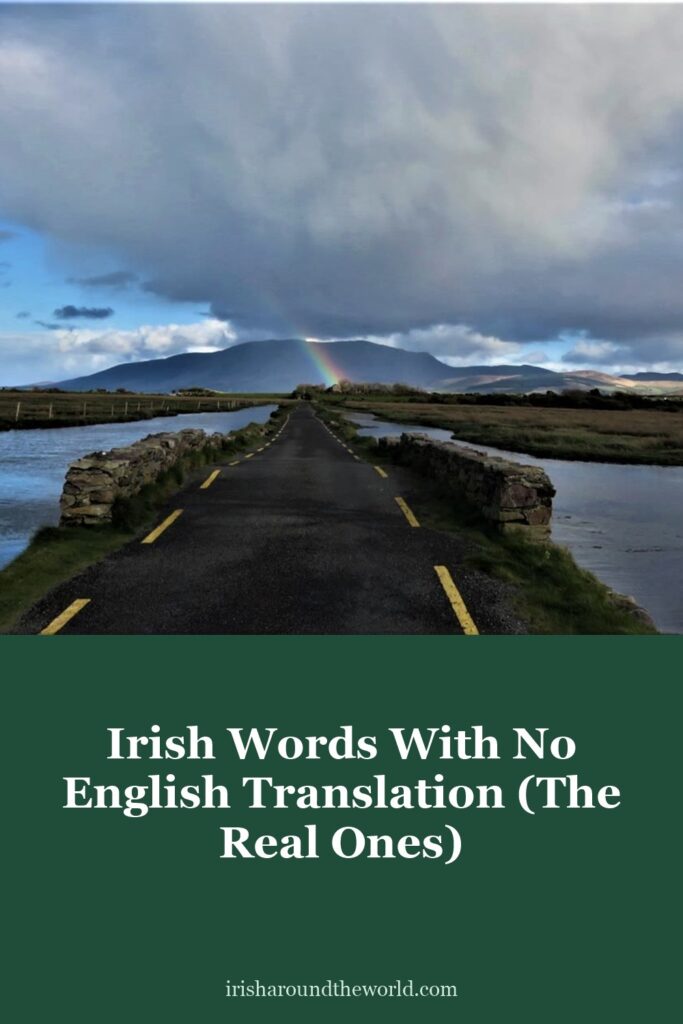
Pin image: the Dingle Way near Castlegregory, Co. Kerry. Photo: Maoileann, CC BY-SA 4.0, via Wikimedia Commons.
A little bit of Ireland in your inbox every Friday ☘️
The free Weekly Dose of Irish: an Irish joke, a Celtic symbol, an Irish fact, a poem and the week’s best articles in one short email. Join 9,600+ readers.
Free. One short email every Friday. Unsubscribe any time.
More Irish words and sayings
- English Words From Irish: 27 You Use Every Day (and the Famous Fakes)
- Irish Slang Words and Phrases: What They Really Mean
- Irish Proverbs in Irish: 57 Seanfhocail With Meanings and How to Say Them
- Irish Sayings About Love: Phrases, Blessings and Quotes in Irish
- How to Learn Irish Online: The Best Free and Paid Options
Featured image: a rainbow over the Dingle Way near Castlegregory, Co. Kerry, the kind of bright break between showers that Irish calls an aiteall. Photo: Maoileann, CC BY-SA 4.0, via Wikimedia Commons.