
Irish scones are light, round and only lightly sweet. This recipe uses self-raising flour, cold butter, an egg and buttermilk, with a pinch of bread soda. Bake them plain, with sultanas, or brown with wholemeal flour, and eat them warm with butter, jam and whipped cream. It makes 10 to 12 scones in about 30 minutes, with US swaps.
A plate of warm scones has been greeting visitors in Irish kitchens for a long time. A 1930s account from Rathcarran, Co. Meath, says that when people had visitors coming, they made special bread, pancakes and scones. In Glenbrohane, Co. Limerick, buttermilk scones were described as “a great treat”.
This Irish scones recipe makes that kind of scone. The recipe comes first, in metric and US cups, then the variations, the tricks for a tall rise, the jam-or-cream question and the history.
Bake a batch for Mother’s Day, for St Patrick’s Day, or for whoever you call Granny, Nana or Mamó (MAM-oh; mam-OH in Munster). There are more Irish names for grandma here.
Jump to:
- Irish scones recipe
- How to get tall, light scones
- Fruit, brown, soda and cheese scones
- For US bakers: self-raising flour and buttermilk
- Storing and freezing scones
- Jam, cream or butter?
- Irish vs English (and American) scones
- Where scones come from
- How to say scone, in English and Irish
- Irish scones FAQ
- More Irish baking
Irish scones recipe (plain buttermilk scones)
Prep: 15 minutes | Bake: 12 to 15 minutes | Makes: 10 to 12 scones with a 6cm (2½-inch) cutter
Ingredients
- 450g (about 3¾ US cups) self-raising flour, plus extra for dusting (US bakers, see the swap below)
- ½ level teaspoon bread soda (bicarbonate of soda, called baking soda in the US)
- ½ teaspoon fine salt
- 40g (3 tablespoons) caster sugar, called superfine sugar in the US
- 85g (6 US tablespoons, ¾ stick) cold butter, cut into small cubes
- 1 large egg
- About 275ml (1 US cup plus 2 tablespoons) buttermilk, plus a little for brushing
Method
- Heat the oven to 220°C (425°F), or 200°C with a fan. Line a baking sheet with baking paper (parchment) or dust it with flour.
- Sieve the flour, bread soda and salt into a big, wide mixing bowl, then stir in the sugar.
- Add the cold butter and rub it in with your fingertips, lifting the flour as you go, until the mix looks like breadcrumbs with a few bigger flakes. Work quickly so the butter stays cold.
- Beat the egg in a jug and stir in 250ml (1 US cup) of the buttermilk.
- Make a well in the middle of the flour and pour in most of the egg mixture. Mix with a table knife, or one hand held like a stiff claw, drawing the flour in from the sides. Add the rest, and a splash more buttermilk if needed, until no dry flour is left. The dough should be soft and slightly sticky.
- Tip it onto a floured worktop and fold it over on itself two or three times, no more. With floured hands, pat it out about 2.5 to 3cm (1 to 1¼ inches) thick.
- Dip a 6cm (2½-inch) cutter in flour and press it straight down through the dough without twisting. Set the scones close together on the sheet. Press the scraps together gently and cut again.
- Brush just the tops with buttermilk or beaten egg. Bake for 12 to 15 minutes, until well risen and golden, and the bases sound hollow when tapped.
- Cool on a wire rack for a few minutes. For soft tops, cover them with a clean tea towel. Eat warm.
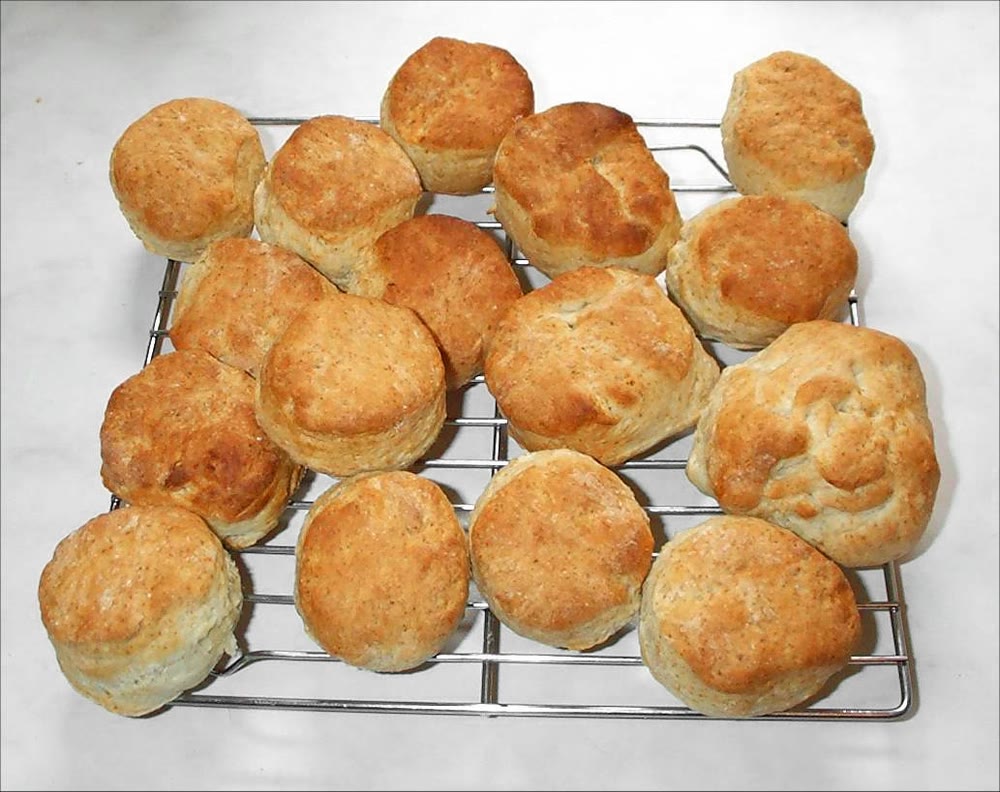
How to get tall, light scones
1. Keep the butter cold. King Arthur Baking, the Vermont flour company, calls for very cold butter in half-inch dice. It also chills the shaped scones in the freezer, for up to half an hour, before they go in the oven, which it says makes them more tender and flakier.
2. Wet dough, light hands. Chef Mark Moriarty, writing in The Irish Times, says to handle the mix as little as possible: working it develops the gluten and makes it more like bread. Odlums, the Irish flour brand, tells bakers to work quickly once the buttermilk goes in and to aim for a soft, slightly wet dough.
3. Pat, don’t roll thin. Thin dough makes flat scones. Darina Allen of Ballymaloe Cookery School pats her soda scone dough about 3cm thick.
4. Never twist the cutter. America’s Test Kitchen’s advice for a tall, even rise is to push a sharp cutter straight down and not twist it. The usual explanation is that twisting pinches the cut edge shut, so that side can’t rise.
5. Bake them close together, in a hot oven. Set close together, scones bake with soft sides; a little space gives crisper edges, King Arthur’s guide says. Brush just the tops, for colour.
Fruit, brown, soda and cheese scones
Fruit scones (sultana or raisin scones)
Stir 100g (⅔ US cup) sultanas or raisins into the buttery crumbs before you add the liquid. For plumper fruit, soak it in hot tea for 15 minutes, then drain it and pat it dry, a little like the tea-soaked fruit in a barmbrack.
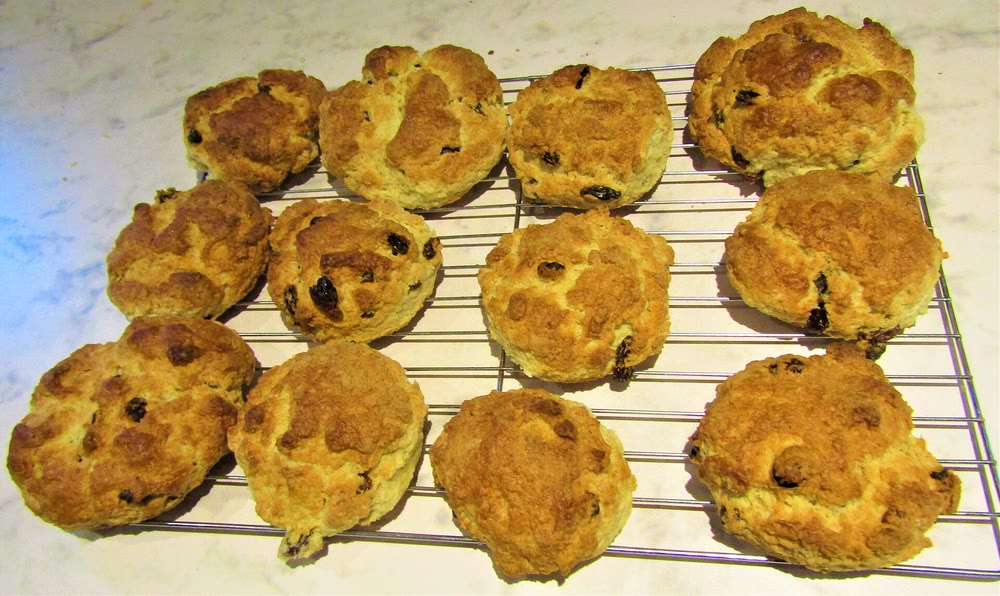
Home-baked fruit scones cooling on a rack in Trimingham, Norfolk. Photo: Kolforn (Wikimedia), CC BY-SA 4.0, via Wikimedia Commons
Brown wholemeal scones
Use 225g (about 2 US cups) coarse wholemeal flour and 225g (a scant 2 US cups) self-raising flour. Raise the bread soda to 1 level teaspoon, because plain wholemeal has no raising agent of its own. Swap the caster sugar for 1 tablespoon soft brown sugar, or leave it out.
Wholemeal drinks up more liquid, so expect to need 3 or 4 tablespoons more buttermilk. Scatter porridge oats over the brushed tops and bake for 15 to 18 minutes. In Ireland you can also buy self-raising wholemeal flour: use it instead of plain wholemeal and keep the soda at ½ teaspoon. In the US, use the coarsest whole wheat flour you can find; my Irish brown bread recipe has more US flour swaps. Brown scones are lovely with seafood chowder.
Old-style soda scones
Soda scones are simply white soda bread dough, with no butter, egg or sugar, cut into rounds or other shapes. Make the dough from my Irish soda bread recipe and pat it about 3cm (1¼ inches) thick. For St Patrick’s Day, Darina Allen cuts hers with a shamrock cutter, as she wrote in the Irish Examiner. She brushes the tops with buttermilk or egg wash, dips them in oatmeal, or in oats mixed with grated Cheddar, and bakes them at 230°C (450°F) for 5 minutes, then at 200°C (400°F) for about 10 more.
Cheese scones
Leave out the sugar. Once the butter is rubbed in, stir in 100g (about 1 US cup) grated mature Cheddar and a pinch of mustard powder or cayenne, and sprinkle a little more cheese on top.
For US bakers: self-raising flour, buttermilk and sultanas
Self-raising flour. Irish self-raising flour is plain flour with raising agents mixed in: the ingredients on a bag of Odlums are wheat flour and raising agents, with no salt listed. King Arthur’s home-made version of American self-rising flour is 1 cup (120g) all-purpose flour, 1½ teaspoons baking powder and ¼ teaspoon salt, whisked well.
Irish self-raising has no salt, so for this recipe just whisk 3¾ cups all-purpose flour with 1 tablespoon plus 2½ teaspoons baking powder, and keep the recipe’s ½ teaspoon of salt. If you buy US self-rising flour, which usually contains salt, skip the recipe’s salt.
King Arthur’s all-purpose flour has more protein (11.7%) than its self-rising flour (8.5%), so with the swap you may need a splash more buttermilk, and the scones will be slightly less tender.
Buttermilk. Use cultured buttermilk. No buttermilk? Put 1 tablespoon of lemon juice or white vinegar in a 1-cup measure, fill it with milk and leave it for 5 to 10 minutes, as the University of Maine Cooperative Extension suggests.
Sultanas. Golden raisins are the nearest US match.
Storing and freezing scones
Scones are best the day they’re baked. Keep leftovers in an airtight tin for a day or two and warm them in a low oven.
Freezing baked scones: cool them completely, then bag them. Baked quick breads hold their best quality for 2 to 3 months in a freezer at -18°C (0°F), says University of Illinois Extension.
Freezing unbaked scones: King Arthur freezes shaped, unbaked scones on a tray until solid, then wraps them airtight. Bake them from frozen, adding a couple of minutes. In its test, scones kept well for three weeks but lost some rise by five, so use them within a month.
Jam, cream or butter? How to serve Irish scones
Split them while warm and add butter and jam. For a treat, add softly whipped cream. Odlums serves its buttermilk scones with whipped cream, and Mark Moriarty’s Irish Times suggestion for St Brigid’s Day is a warm scone with butter, jam and a cup of tea, a cupán tae (KUP-awn TAY).
Thick clotted cream belongs to the cream tea of Devon and Cornwall, and so does the argument over the order: jam first in Cornwall, cream first in Devon. In March 2018, Time reported, Lanhydrock, a National Trust house in Cornwall, advertised its Mother’s Day tea with a photo of the cream spread first. Cornish critics were outraged, and staff got #jamfirst pins.
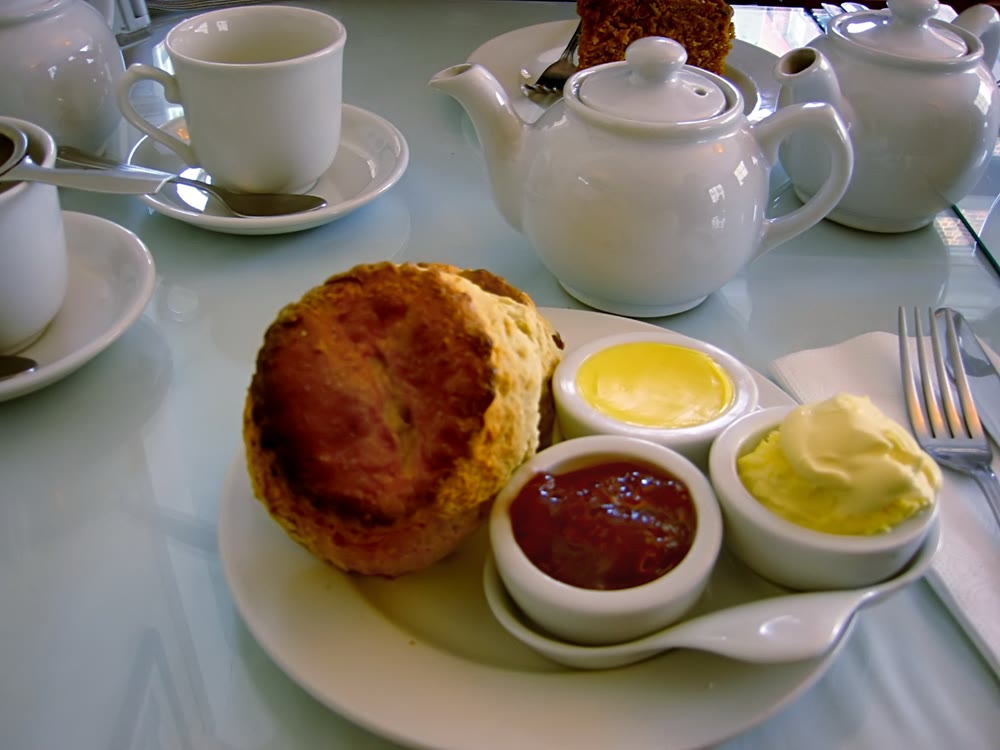
An English cream tea in Brighton: a scone with butter, jam and clotted cream. Photo: Jeremy Keith, CC BY 2.0, via Wikimedia Commons
Irish vs English (and American) scones
Irish and English scones are one family. If there’s an Irish signature, it’s the buttermilk, often with a pinch of bread soda alongside it. That habit goes back to the farmhouse churn, since making butter leaves buttermilk behind.
In 1938, 12-year-old Hugh Warren of Skirteen, near Monasterevin, Co. Kildare, wrote down what his grandfather told him about churning. The buttermilk went into soda bread and scones, or to the pigs, and some people drank it because they believed it was good for the skin.
King Arthur Baking describes British-style scones as plain, barely sweet and usually round, with perhaps a few currants or raisins. American scones are often triangles: sweeter, packed with fruit, nuts or chocolate, sometimes glazed, and crumblier.
Irish scones sit firmly on the British side. An Irish buttermilk scone is closer to an American buttermilk biscuit, though biscuits, King Arthur notes, usually have no egg and more fat.
Where scones come from
Scone started out as a Scots word. The Dictionary of the Scots Language finds it in 1513 as skonn, a four-cornered cake, and traces it to the Middle Dutch schoonbrot, fine bread. The Oxford Companion to Food is more cautious about that origin.
The old Scottish scone was a big round of wheat or barley flour, cooked on a girdle (the Scots word for a griddle) or a flat iron plate, then usually cut into three-cornered pieces. So the triangle isn’t an American invention after all. The word passed into general English in the 19th century, the dictionary says.
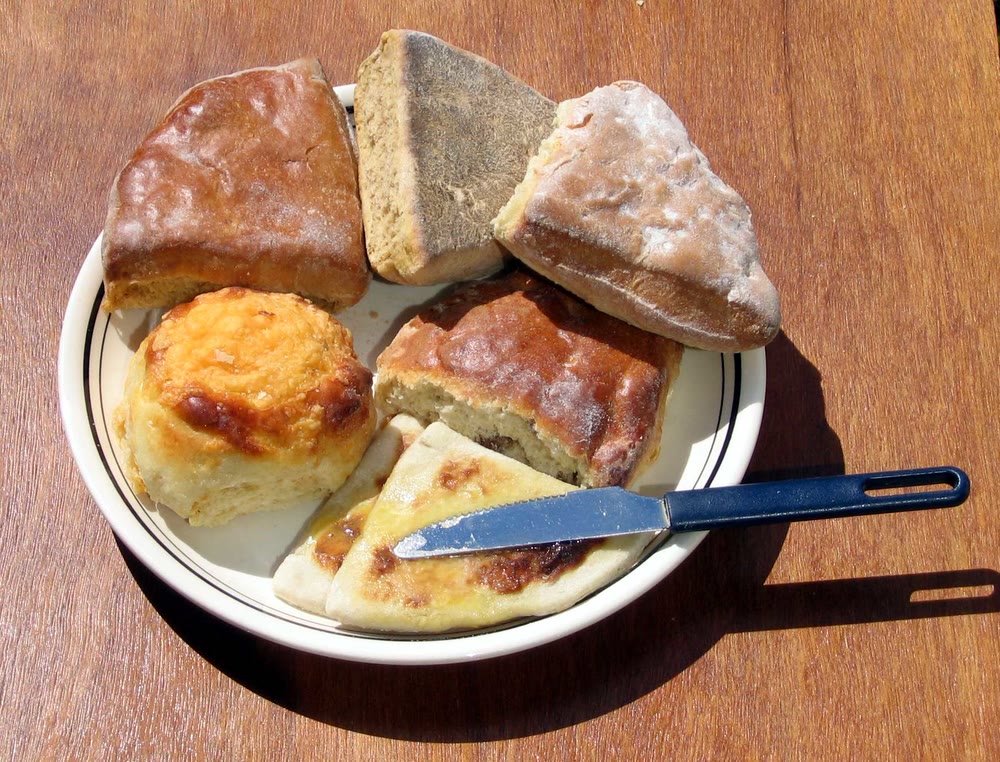
Scones from a baker’s shop in Scotland: buttered tattie (potato) scones, a cheese scone, flat treacle scones, a milk scone and a fruit scone. Photo: Dave souza (User:Dave souza at Wikipedia), CC BY-SA 2.5, via Wikimedia Commons
The Oxford Companion to Food notes that scones can be raised with bicarbonate of soda and a sour-milk acid, just as Irish farmhouse bakers did with buttermilk.
Scones in Irish kitchens in the 1930s
The Schools’ Collection, the folklore Irish schoolchildren gathered in 1937 to 1939, mentions scones again and again:
- In Milford, Co. Donegal, griddle scones and pot-oven scones were among the commonest breads.
- In Dromore, Co. Donegal, baked cakes were always called scones, sometimes said “scauns”.
- In Castleisland, Co. Kerry, an account from Mrs Ellen Daly, aged 89, describes cream scones, made with cream in place of milk.
- In Errigal Trough, near Emyvale, Co. Monaghan, small scones about two inches across, with a cross on top, were made at Shrove time or in Lent.
- In Kilbeggan, Co. Westmeath, parents once invited a daughter’s suitor to the house on St Valentine’s night and had sweet cakes ready for him. These love scones were made with flour and eggs, sugar and caraway seed. By the 1930s, the custom had died out locally.
Seamus Heaney caught a kitchen like these in his poem Mossbawn: Sunlight (1975), about his aunt Mary baking at the family farm in Co. Derry. As she rests, there’s “the scone rising / to the tick of two clocks”.
How to say scone, in English and Irish
Rhyme it with “gone” or with “cone”? The Oxford Companion to Food gives “skon” for Scotland and the north of England and “skoan” for the south.
Ireland splits too. In 2016, the Irish Post reported a map drawn from the University of Cambridge’s English Dialects App. It found the “cone” rhyme dominant across the Republic, while in parts of the Belfast area, 90 to 95 per cent of people rhymed scone with “gone”. The paper suggested Scottish settlers as the likely reason. App users chose to take part, so it’s a rough picture, not a census.
In Irish:
- scóna (SKOH-nuh), plural scónaí (SKOH-nee): scone, in Foras na Gaeilge’s English-Irish dictionary. Watch the fada: it’s scóna, not “scona”.
- bonnóg (BUN-ohg; buh-NOHG in Munster): a bannock or scone, in Ó Dónaill’s Irish-English dictionary.
- toirtín (TOR-cheen): a small scone or cake.
- bláthach (BLAW-hukh): buttermilk.
Irish scones FAQ
What is the difference between Irish and English scones?
Very little. Both are usually round and only lightly sweet, and Irish home recipes very often use buttermilk. Clotted cream belongs to the English West Country; Irish recipes tend to pair scones with whipped cream, or simply butter and jam.
Why are my scones flat?
The usual causes are a dry or overworked dough, dough patted too thin, a twisted cutter, an old raising agent or an oven that isn’t hot enough.
Can I make Irish scones with milk instead of buttermilk?
Yes. Leave out the bread soda, which needs an acid like buttermilk to work, and add the milk gradually, as it’s thinner than buttermilk. Or sour some milk with lemon juice, as in the US section above, and keep the soda.
Can you freeze scone dough?
Yes. Freeze the cut, unbaked scones on a tray, then wrap them airtight. Bake from frozen, adding a couple of minutes, and use within a month.
How do you say scones in Irish?
One scone is a scóna (SKOH-nuh), and scones are scónaí (SKOH-nee).
Love this? Save it to your Pinterest board for later.
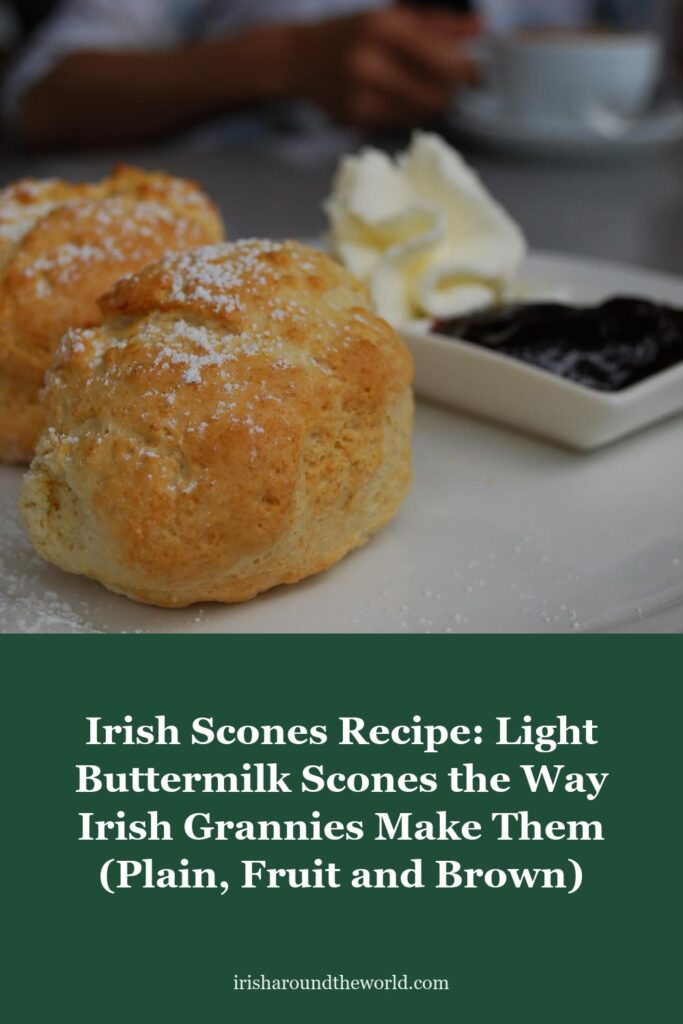
Pin image: Two scones with whipped cream and jam. Photo: Alpha from Melbourne, Australia, CC BY-SA 2.0, via Wikimedia Commons
A little bit of Ireland in your inbox every Friday ☘️
The free Weekly Dose of Irish: an Irish joke, a Celtic symbol, an Irish fact, a poem and the week’s best articles in one short email. Join 9,600+ readers.
Free. One short email every Friday. Unsubscribe any time.
More Irish baking
- Irish Soda Bread Recipe: The 4-Ingredient Loaf With a Cross to Keep the Fairies Away
- Irish Brown Bread Recipe: The No-Yeast Wholemeal Loaf (Plus a Guinness and Treacle Version)
- Barmbrack Recipe: The Irish Halloween Bread That Predicts Your Future
- Irish Apple Cake Recipe: The Warm Bramley Bake You Drown in Custard
- Blarney Stones Recipe: The Easy Irish Traybake
- Mossbawn: Sunlight by Seamus Heaney: The Poem About His Aunt Baking Bread
- Irish Names for Grandma and Grandpa: Mamó, Móraí, Daideo and More (With Pronunciation)
Featured image: Two scones with whipped cream and jam. Photo: Alpha from Melbourne, Australia, CC BY-SA 2.0, via Wikimedia Commons.