Irish seafood chowder is a creamy fish and potato soup made with several kinds of seafood, usually including a smoked fish, mussels and prawns. The base is fish stock with onion, leek and celery, finished with milk and cream. It’s a fixture on pub menus around the Irish coast and usually comes with brown bread and butter. This recipe serves 6 as a starter or 4 as a main and takes about an hour, with a slow cooker method too.
Order chowder in an Irish pub and you’re unlikely to get New England’s clam chowder. What usually arrives is a creamy, smoky bowl packed with chunks of fish, a few mussels and prawns, and brown bread with proper butter on the side.
The recipe comes first, then the story behind the bowl. For the bread, see my Irish brown bread recipe.
Jump to:
- Irish seafood chowder recipe
- US shopping notes
- Slow cooker seafood chowder
- Storing, reheating and freezing
- Serve it with brown bread
- Irish chowder vs New England clam chowder
- Where the word chowder comes from
- How old is Irish seafood chowder?
- Kinsale and Galway: the fishing towns behind the bowl
- Irish words for the chowder pot
- Seafood chowder FAQ
- More Irish recipes and reading
Irish seafood chowder recipe
Aishling Moore, the head chef and a co-owner of Goldie in Cork, writes in the Irish Examiner that smoked fish is “non-negotiable” in her chowder, that a good one mixes several kinds of seafood, and that potatoes give it body.
Prep: 20 minutes | Cook: 40 minutes | Serves: 6 as a starter, 4 as a main
Ingredients
- 40g (3 US tbsp) butter
- 1 onion, finely chopped
- 1 leek, white and pale green parts, halved and thinly sliced
- 2 celery sticks, finely diced
- 2 tbsp plain (all-purpose) flour, optional (see tips)
- 125ml (½ US cup) dry white wine, or extra stock
- 750ml (3 US cups) fish stock
- 400g (14 oz) floury potatoes, such as Rooster in Ireland or russets in the US, peeled and cut into 1.5cm (½ inch) cubes
- 1 bay leaf and 2 or 3 sprigs of thyme
- 250ml (1 US cup) whole milk
- 200ml (a generous ¾ US cup) cream (heavy cream in the US)
- 250g (9 oz) natural (undyed) smoked haddock, skinned and cut into 2.5cm (1 inch) chunks
- 250g (9 oz) skinless salmon, hake or cod fillet, cut into 2.5cm (1 inch) chunks
- 500g (1 lb) live mussels
- 150g (5 oz) raw peeled prawns (shrimp in the US), or Dublin Bay prawn tails
- A small bunch of parsley or dill, chopped, plus chives to serve
- A squeeze of lemon juice, salt, and white or black pepper
Method
- Melt the butter in a large, heavy pot over a medium-low heat. Add the onion, leek and celery with a pinch of salt, cover and cook gently for 8 to 10 minutes, until soft but not browned.
- Stir in the flour, if using, and cook for a minute. Add the wine and bubble it for a minute or two, until reduced by half.
- Add the stock gradually, stirring, then the potatoes, bay leaf and thyme. Bring to the boil, partly cover and simmer for 10 to 12 minutes, until the potatoes are just tender.
- Meanwhile, scrub the mussels under cold water and pull off any beards. Throw away any with cracked shells, and any open ones that don’t close when you tap them.
- Put the mussels in a separate pan with 3 tablespoons of water, cover and cook over a high heat for 3 to 4 minutes, shaking the pan, until they open. Discard any that stay shut. Strain the juices through a fine sieve into the chowder and shell most of the mussels, keeping a few whole to garnish.
- Pour the milk and cream into the chowder and bring it back to a gentle simmer. Don’t let it boil hard.
- Add the smoked haddock and the other fish and poach gently for 3 minutes. Add the prawns and cook for 2 minutes more, until they’re pink and opaque and the fish flakes easily. Stir in the mussels to warm through.
- Remove the bay leaf and thyme. Taste before adding salt, as smoked fish is salty, then season with pepper, lemon and the herbs. Serve with brown bread and butter.
Tips
Natural smoked fish. Eric Matthews, then head chef of Chapter One in Dublin, warned in a 2020 Irish Times recipe to avoid orange, dyed fish. Natural smoked haddock is pale cream.
Flour or no flour? Mark Moriarty thickens his Irish Times chowder with a flour roux. The West Cork chef Carmel Somers wrote in the same paper that chowder should never have flour, only potatoes. Skip it for a lighter bowl.
Don’t overcook the seafood. The US Food and Drug Administration says most seafood should reach 63°C (145°F). Without a thermometer, look for fish that separates easily with a fork, prawns that turn pearly and opaque, and mussels that open.
Make it ahead. Moore cooks it as far as the potatoes in advance, then brings it back to the boil and adds the seafood just before serving.
Variations
- Smoky bacon: fry 2 or 3 chopped rashers (bacon slices) before the onions, as Somers does.
- Seaweed: Somers adds a little carrageen, which also thickens the pot.
US shopping notes
Smoked haddock is sometimes sold in the US as finnan haddie, a name Merriam-Webster traces to Findon, a village in Scotland. Smoked cod or pollock work too. Hot-smoked salmon or trout is already cooked, so flake it in for the last minute.
Prawns: Irish menus say prawns where Americans say shrimp. Dublin Bay prawns are a different animal: Nephrops norvegicus, also sold as Norway lobster, scampi or langoustine. Bord Iascaigh Mhara (BIM), Ireland’s seafood development agency, has called it the country’s most valuable seabed fishery. Large raw shrimp are fine.
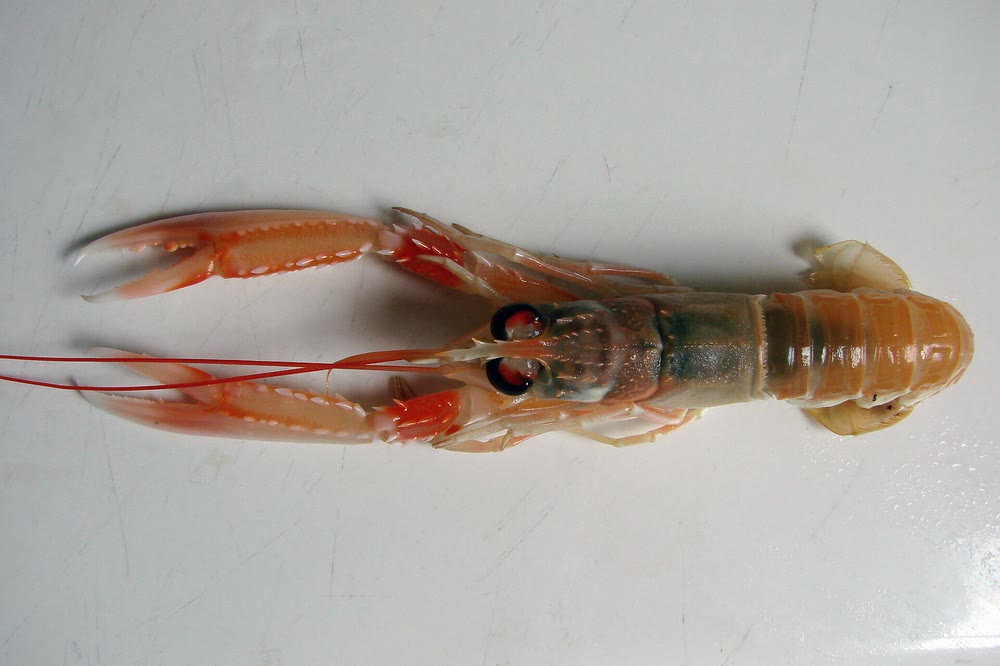
A Dublin Bay prawn, also called a Norway lobster or langoustine. Photo: Vassil, public domain, via Wikimedia Commons
Mussels: farmed, rope-grown mussels, usually sold in mesh bags, need little cleaning. Frozen cooked mussels just need heating through at the end.
Stock: fish or seafood stock, or bottled clam juice diluted with water, as it’s salty.
Cream: use heavy cream, or half-and-half for a lighter bowl. For potatoes that hold their shape, swap the russets for Yukon Golds.
Slow cooker seafood chowder
Seafood needs minutes, not hours, so slow-cook only the base.
- For more flavour, first soften the onion, leek and celery in the butter in a pan and bubble the wine for a minute.
- Tip the vegetables into the slow cooker with the potatoes, herbs and just 500ml (2 US cups) of stock: safefood, the all-island food safety body, says slow cookers need about a third less liquid.
- Cook on low for 4 to 5 hours, or high for about 2 hours, until the potatoes are tender. Keep the lid on; lifting it lets the temperature drop.
- Turn to high and stir in the warmed milk and cream: safefood says to add milk at the end. To thicken, add 1 tablespoon of cornflour (cornstarch) mixed with 1 tablespoon of cold water.
- Add the fish and cook on high for 15 to 25 minutes, adding the prawns for the last 10, until the fish flakes easily. Cook the mussels on the stove and add them with their strained juices.
Thaw frozen seafood in the fridge overnight first. At a party, the FDA says hot seafood out for over 2 hours should sit on a heat source, such as a slow cooker, or be thrown away.
Storing, reheating and freezing
Leftovers keep for 2 to 3 days in the fridge, says the Food Safety Authority of Ireland. Reheat them once only, to at least 70°C (158°F), until steaming hot.
Chowder with potatoes doesn’t freeze well: Penn State Extension says frozen cooked potatoes turn watery when reheated. Freeze only the stock and vegetable base, and add the potatoes, cream and seafood on the day.
Serve it with brown bread
Moore serves hers with soda bread and salted Irish butter; Matthews suggested Guinness bread. The classic is a nutty brown soda loaf, ready in just over an hour with my Irish brown bread recipe. For a white loaf, try this Irish soda bread recipe.
Irish chowder vs New England clam chowder
- New England clam chowder: clams, salt pork or bacon, onion, potatoes and milk or cream, with crackers.
- Manhattan clam chowder: clams in a tomato broth, no dairy. In 1939 a Maine legislator wrote a bill to outlaw it.
- Irish seafood chowder: mixed fish, usually one smoked, plus mussels and prawns, with leek and celery in the base and brown bread on the side.
The earliest known chowder recipe, a 1751 poem in the Boston Evening Post, layers onions, pork, fish, herbs and biscuit, then adds claret. As Anne Ewbank noted in Atlas Obscura, there isn’t a drop of milk, a potato or a clam in it.
Where the word chowder comes from
Merriam-Webster traces chowder to the French chaudière, a kettle or its contents, from the same Late Latin root as cauldron. Alan Davidson’s Oxford Companion to Food says the term was used in North America by the 1730s and may well come from the iron pots early French settlers carried to Canada’s Maritime Provinces.
Atlas Obscura cites the food writer John F. Mariani: most scholars credit Breton fishermen on the Canadian coast, though a rival theory points to jowder, said to be Cornish dialect for a fishmonger.
In Irish, Ó Dónaill’s dictionary gives seabhdar (roughly SHOW-der, the SHOW rhyming with cow), which sounds very like the English.
How old is Irish seafood chowder?
Nobody knows exactly, but the evidence suggests it’s younger than you might think. Search the transcribed pages of the Schools’ Collection, the folklore recorded by Irish schoolchildren from 1937 to 1939, and colcannon turns up in more than 300 of them. Chowder doesn’t turn up once (dúchas.ie, October 2026; not every page is transcribed yet). Nor does it appear in food historian Máirtín Mac Con Iomaire’s 2006 paper, The History of Seafood in Irish Cuisine and Culture.
What came before
Ireland did cook fish with potatoes. Salted ling was Friday food inland and a winter staple on the southern and western coasts, Mac Con Iomaire notes, and Florence Irwin’s Irish Country Recipes (1937) has a one-pot dish of salt ling and potatoes.
Shellfish gathered on the shore was cnuasach mara (roughly KNOO-uh-sukh MAR-uh; in Connacht and Ulster the cn sounds like cr), “sea pickings”. It was known as bia bocht (BEE-uh BUKHT), poor man’s food, he writes, and starving people went to the coast looking for food during the Famine. Ó Dónaill’s dictionary even names the pot for cooking shellfish: pota cnuasaigh (roughly POT-uh KNOO-uh-see).
Meatless Fridays, fast days and Lent brought fish to the table, and inland those were often the only days it was available, Mac Con Iomaire writes, until the late 1960s, when Catholics were allowed meat on Fridays after Vatican II. In the strictest old Lent, dairy was off the table too, wrote Marion McGarry for RTÉ Brainstorm, so a creamy chowder wouldn’t have passed.
The modern bowl
Mac Con Iomaire links seafood festivals to the tourism push of the 1950s, and seafood restaurants such as the King Sitric in Howth opened in 1971. BIM dates the modern Irish mussel industry to the early 1970s. Most farmed mussels grow on ropes hung in the water, which keeps them free of grit.
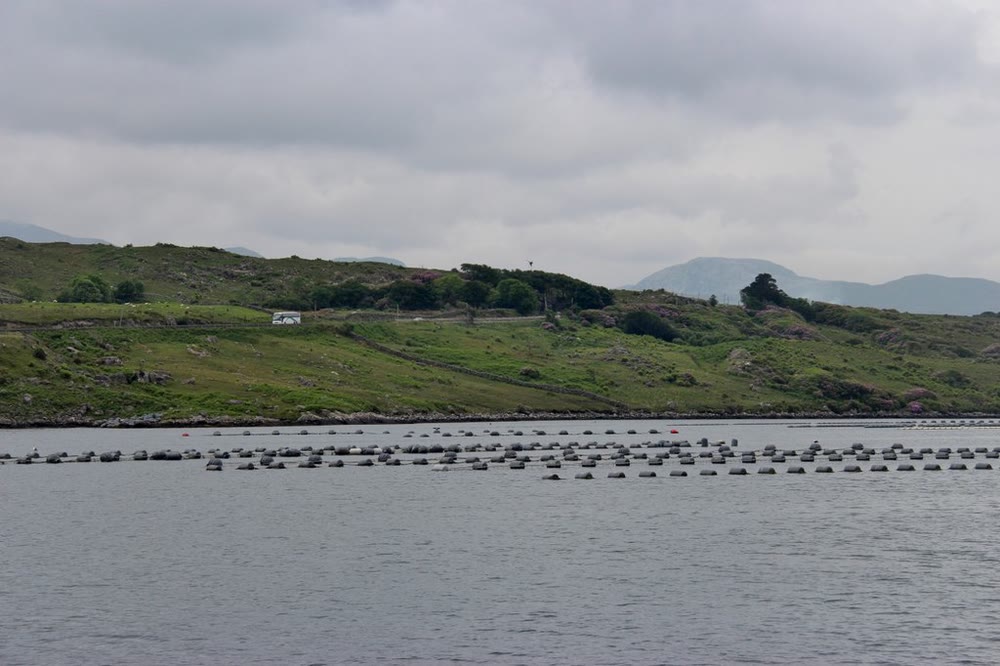
Mussel farm in Killary Harbour, on the Galway and Mayo border. Photo: Alan Reid, CC BY-SA 2.0, via Wikimedia Commons (Geograph)
Kinsale and Galway: the fishing towns behind the bowl
There’s no official Kinsale or Galway chowder recipe, whatever a menu says, but both towns have long fishing histories and food scenes built on them.
Kinsale, Co. Cork
Kinsale is Cionn tSáile in Irish (roughly kyoon TAWL-yeh). Like many Irish place names, it describes the landscape: the scholar John O’Donovan explained it around 1840 as the “head of salt water”. From the 1860s, its spring mackerel fishery drew boats from as far away as the Isle of Man.
Local restaurant owners formed the Kinsale Good Food Circle in 1976 and held the first Kinsale Gourmet Festival in 1977. In the 2010s the Circle also ran an All-Ireland Chowder Cook-Off. In 2017, the Southern Star reported, around 1,000 people tasted chowders from some 25 chefs and voted for the Beara Coast Hotel in Castletownbere. Its team was invited to judge a chowder contest in Kinsale’s twin town, Newport, Rhode Island.
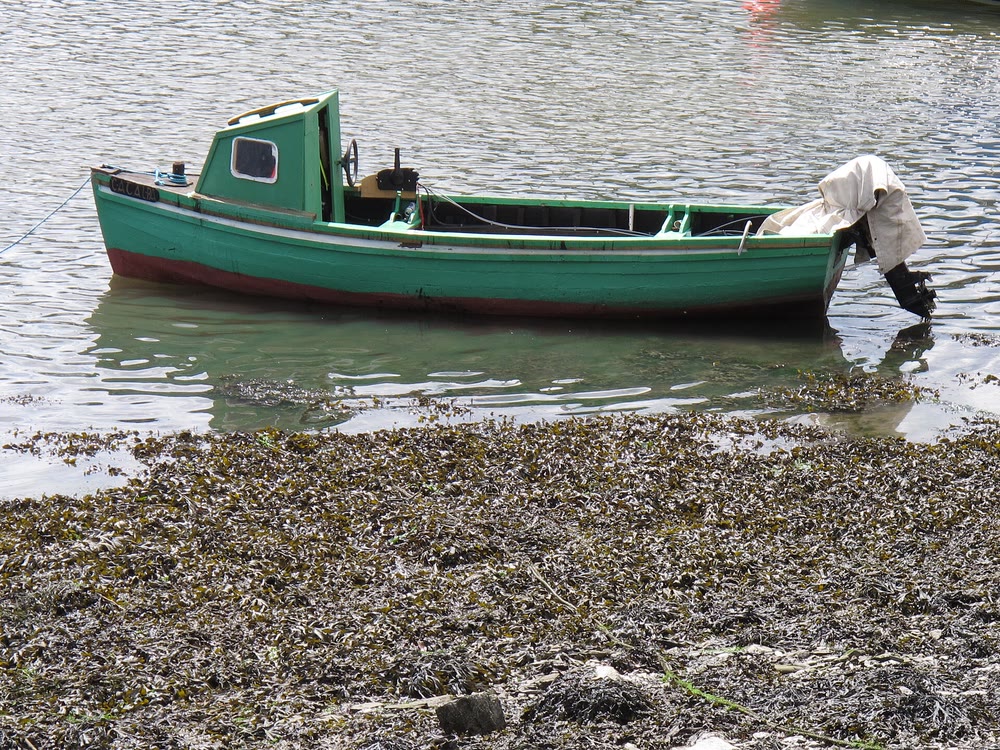
A small fishing boat in Kinsale Harbour, Co. Cork. Photo: David Hawgood, CC BY-SA 2.0, via Wikimedia Commons (Geograph)
Kinsale is the southern end of the Wild Atlantic Way; see also things to do in County Cork.
Galway and the Claddagh
The Claddagh, An Cladach (un KLAD-ukh), “the shore”, was a village of thatched houses just outside Galway’s medieval walls. Galway City Council describes it as home to Irish-speaking fishing families, headed by an elected king. It gave its name to the Claddagh ring.
Women often sold the catch. Nan O’Toole, born in the Claddagh in 1877, sold the fish her husband Michael landed at the corner of Eglinton Street. Her cottage’s contents are now in Galway City Museum. The village was declared unhealthy in 1927, and its thatched homes were gradually replaced.
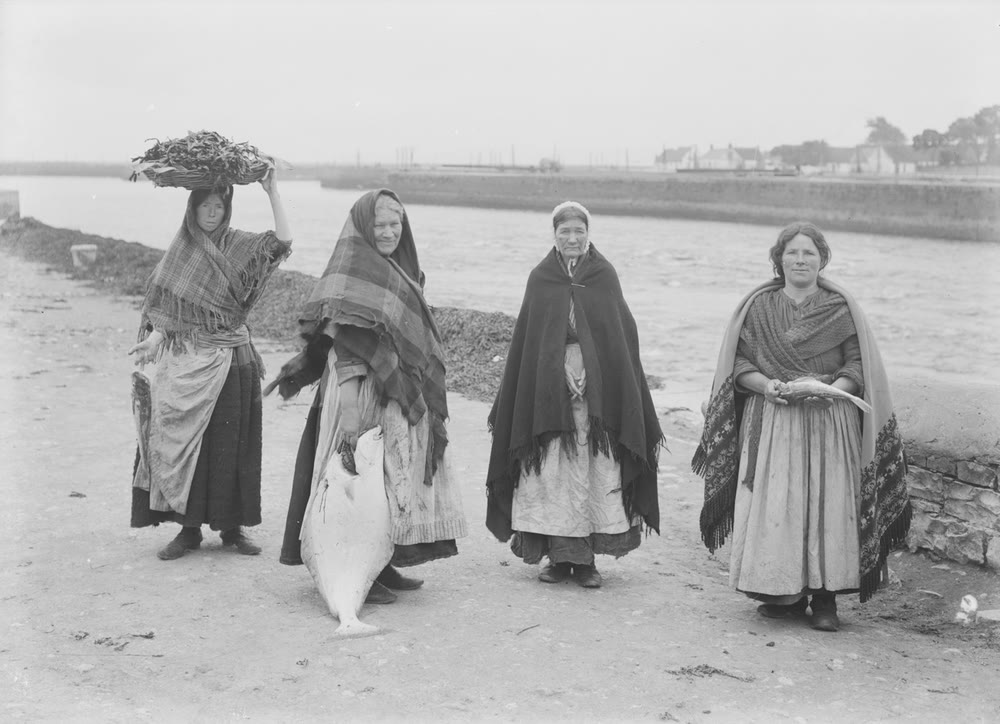
Fishwives on their way to the fish market by the Spanish Arch in Galway, about 1905, with Claddagh Quay across the river. National Library of Ireland, no known copyright restrictions, via Wikimedia Commons
Galway has held oyster festivals since 1954, Mac Con Iomaire notes; the Galway International Oyster and Seafood Festival marked its 72nd year in September 2026. See also things to do in Galway.
Irish words for the chowder pot
You’ll often see these online without their accents (fadas), as bradan or cadog. The fadas change the sound, so keep them.
- seabhdar (SHOW-der): chowder
- bia mara (BEE-uh MAR-uh): seafood
- cadóg (KAD-ohg; kuh-DOHG in Munster): haddock
- bradán (BRAD-awn; bruh-DAWN in Munster): salmon
- diúilicín (roughly DYOO-lih-keen): mussel
- cloicheán (KLIH-hawn; klih-HAWN in Munster): prawn
- arán donn (roughly uh-RAWN DOWN; in Ulster, AH-run DON): brown bread
Seafood chowder FAQ
What is Irish seafood chowder made of?
Fish stock, onion, leek, celery, potatoes, milk and cream, plus mixed seafood: usually smoked haddock, salmon or white fish, mussels and prawns.
What fish is best for seafood chowder?
A mix. Use one natural smoked fish, such as haddock or pollock, one firm fish such as salmon, hake or cod, and shellfish such as mussels and prawns.
Can you make seafood chowder in a slow cooker?
Yes. Slow-cook the vegetables, potatoes and stock, then add warm milk, cream and the seafood on high for the last 15 to 25 minutes.
Love this? Save it to your Pinterest board for later.
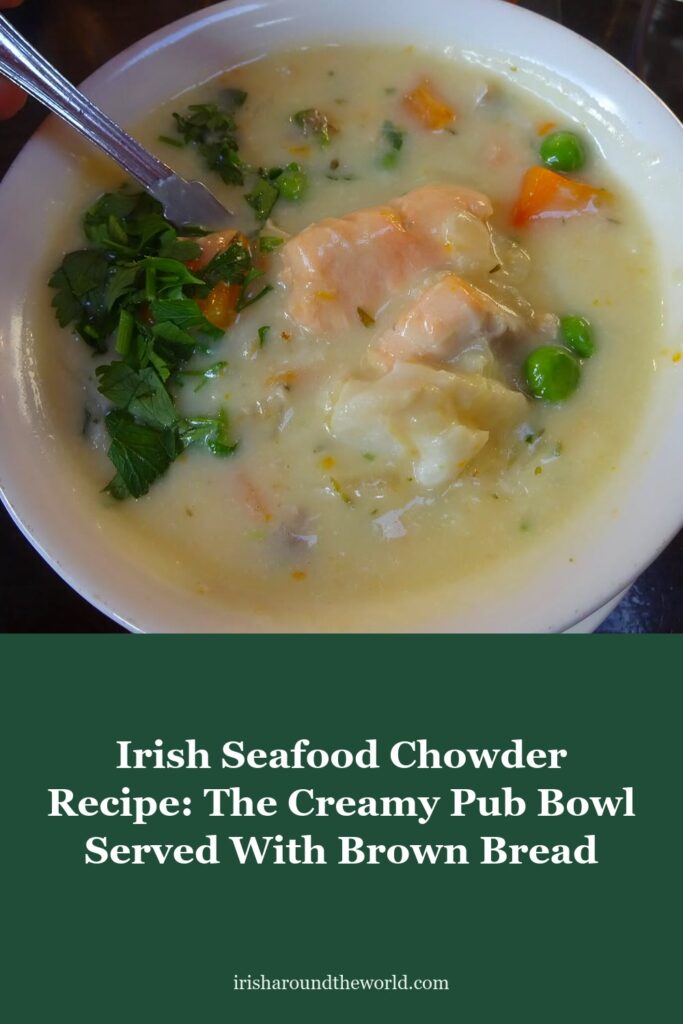
Pin image: A bowl of seafood chowder with chunks of salmon and white fish, carrots, peas and parsley. Photo: Benreis, CC BY 3.0, via Wikimedia Commons
A little bit of Ireland in your inbox every Friday ☘️
The free Weekly Dose of Irish: an Irish joke, a Celtic symbol, an Irish fact, a poem and the week’s best articles in one short email. Join 9,600+ readers.
Free. One short email every Friday. Unsubscribe any time.
More Irish recipes and reading
- Irish Brown Bread Recipe: The No-Yeast Wholemeal Loaf (Plus a Guinness and Treacle Version)
- Irish Soda Bread Recipe: The 4-Ingredient Loaf With a Cross to Keep the Fairies Away
- Colcannon Recipe: The Irish Halloween Mash That Hides Your Fortune
- Irish Stew Recipe: The Real Lamb-and-Potato Stew (and the Great Carrot Argument)
- Dublin Coddle Recipe: The Saturday-Night Sausage Stew of Old Dublin
- Claddagh Ring Meaning: Which Hand, Heart In or Out, and the Galway Legend Behind It
- Wild Atlantic Way Route: Map, Best Stops and 7, 10 and 14-Day Itineraries
Featured image: A bowl of seafood chowder with chunks of salmon and white fish, carrots, peas and parsley. Photo: Benreis, CC BY 3.0, via Wikimedia Commons.