
In Irish, grace before meals is altú roimh bhia (AL-too riv VEE-uh). The everyday version is Beannaigh sinn, a Thiarna, the Irish form of “Bless us, O Lord”. The oldest-sounding folk grace is Bail na gcúig arán, a blessing on the five loaves and two fishes, which Douglas Hyde printed in 1906. After the meal comes Moladh leis an Rí nach gann, “praise to the King who is never scant”. Many “old Irish table blessings” sold online have no known source at all.
On Thursday 26 November 2026, American families will sit down to Thanksgiving dinner, and plenty will pause first to say grace. If your family came from Ireland, grace may well have been said at your grandparents’ table. Further back, in Irish-speaking districts, it was said in Irish, and some of those graces survive.
Irish has a lovely link here. Altú, the word for grace at meals, also means thanksgiving, and the New English-Irish Dictionary gives Lá an Altaithe (law un AL-tuh-huh) for the American holiday. Below are graces, blessings and toasts in Irish and English, with plain pronunciations and honest notes on where each one comes from.
Jump to:
- What does altú mean?
- The five loaves grace
- Beannaigh sinn: the everyday Irish grace
- Bless us, O Lord, and other graces called Irish
- Grace after meals in Irish
- St Brigid’s lake of ale
- The stranger at the table
- Thanksgiving and the Choctaw gift
- Toasts to end the meal
- Which grace should you say?
- Irish grace FAQ
- More Irish blessings and traditions
What does altú mean?
Ó Dónaill’s dictionary, free on teanglann.ie, gives altú two senses: thanksgiving, and grace at meals. Say it AL-too, or al-TOO in Munster. Grace before a meal is altú roimh bhia (AL-too riv VEE-uh), and grace after it is altú tar éis bia (AL-too tur AYSH BEE-uh).
Ó Dónaill also keeps two phrases that show how ordinary the custom was. A deoch altaithe (JUKH AL-tuh-huh) is a drink at the end of a meal. And ocras tar éis altaithe (UK-rus tur AYSH AL-tuh-huh), “hunger after thanksgiving”, meant a lean diet: you’d given thanks and were still hungry.
The five loaves grace: Bail na gcúig arán
For an Irish grace with real roots, choose this one. It asks that the blessing on the five loaves and two fishes, which fed the five thousand in the Gospels, should fall on your own food.
Douglas Hyde, the scholar who later became Ireland’s first President, printed it in 1906 in The Religious Songs of Connacht. He gave it as Michael MacRury of Co. Mayo had it, and said he’d heard it himself in Co. Roscommon. In modern spelling:
Bail na gcúig arán agus an dá iasc,
mar a roinn Dia ar na cúig mhíle fear.
Rath ón Rí a rinne an roinn
ar ár gcuid is ar ár gcomhroinn.
Say it: BAL nuh GOO-ig uh-RAWN AH-gus un daw EE-usk, mar uh RIN JEE-uh er nuh KOO-ig VEE-luh FAR. RAH own REE uh RIN-yuh un RIN, er awr GWIDJ iss er awr GOH-rin.
Hyde’s own translation (1906):
The good of the five loaves and of the two fishes as God divided them on the five thousand men.
Luck from the king who made the division
On our share and on our co-division.
Ó Dónaill’s dictionary glosses the phrase ár gcuid agus ár gcomhroinn as “our food and our apportionment of it”.
How old is it? Nobody knows who composed it. Hyde thought it “must be very old” because its last two lines keep perfectly to a strict metre of the old bardic poets. That’s an educated guess, not a date.
It was still said in 1931, when Seán Mag Uidhir of Co. Cavan recited a version at Queen’s University Belfast for a Royal Irish Academy recording scheme. You can hear his short recording on the Doegen Records website. And Cumann na Sagart (KUM-un nuh SAG-urt), an association of priests that promotes Irish in the life of the Church, still prints a version today.
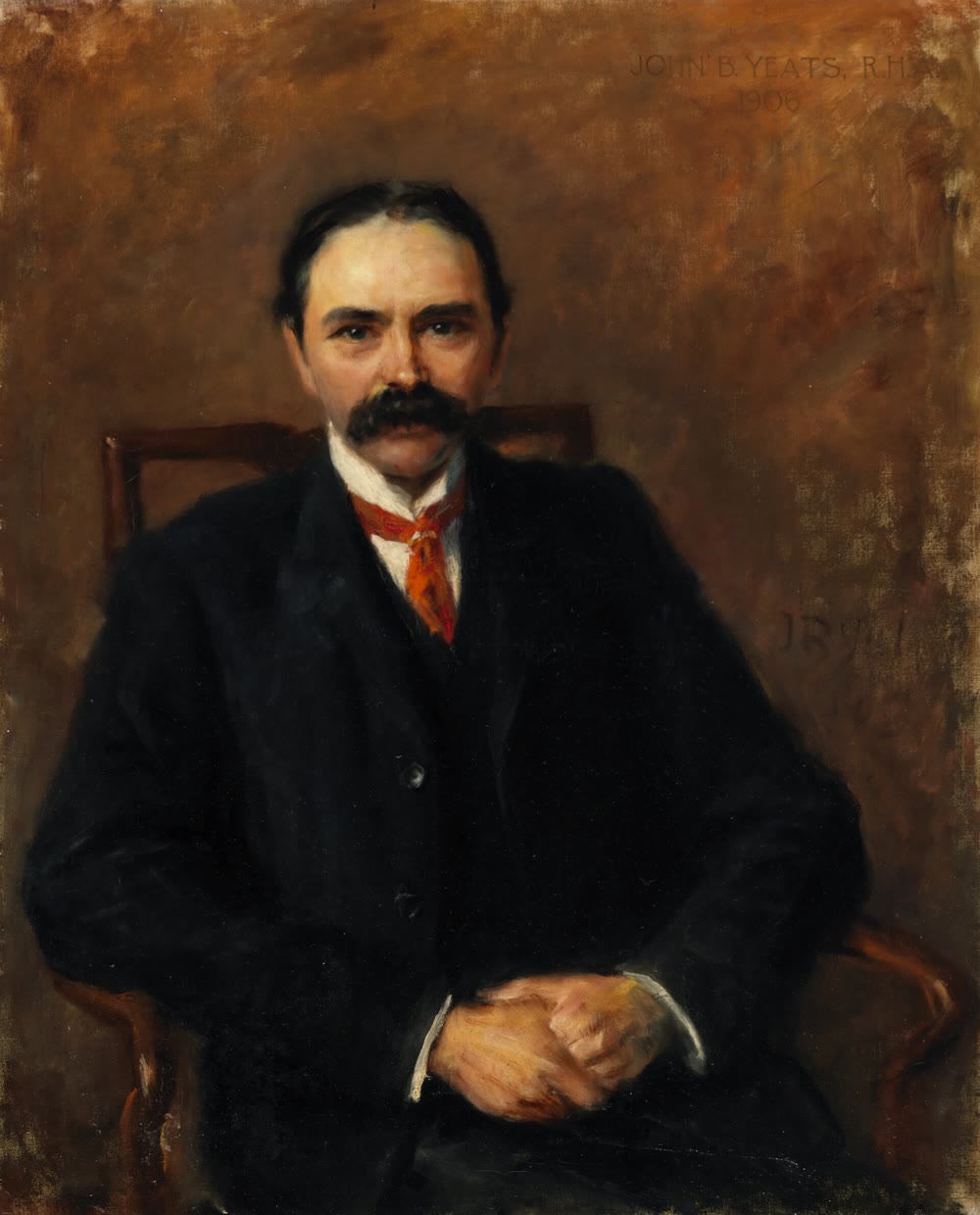
Douglas Hyde, painted by John Butler Yeats in 1906, the year The Religious Songs of Connacht appeared. National Gallery of Ireland. Public domain, via Wikimedia Commons
Beannaigh sinn: the everyday Irish grace
Two short graces begin Beannaigh sinn, “bless us”. Irish church publications still print both, and neither has a known author.
Beannaigh sinn, a Dhia: bless our food and drink
Intercom, the pastoral magazine of the Irish Catholic Bishops’ Conference, printed this one on its Irish-language page in October 2019:
Beannaigh sinn, a Dhia,
beannaigh ár mbia is ár ndeoch.
Ós tú a cheannaigh sinn go daor,
saor sinn ó gach uile olc.
Say it: BAN-ee shin, uh YEE-uh, BAN-ee awr MEE-uh iss awr NYUKH. Ohs TOO uh HYAN-ee shin guh DEER, SEER shin oh gokh IL-eh ULK. (In Munster, beannaigh sounds closer to BAN-ig.)
In English: Bless us, O God, bless our food and our drink. Since you bought us at a dear price, free us from every evil. Traditional, author unknown; you’ll meet small variations in wording.
Beannaigh sinn, a Thiarna: Bless us, O Lord, in Irish
This is the Irish version of the standard Catholic grace, as the parish of Rathdrum in Co. Wicklow prints it:
Beannaigh sinn, a Thiarna,
agus na bronntanais seo uait,
a bhfuilimid le glacadh
ó do rath, trí Chríost ár dTiarna.
Amen.
Say it: BAN-ee shin, uh HEER-nuh, AH-gus nuh BROON-tun-ish shuh OO-itch, uh WIL-im-id leh GLOCK-uh oh duh RAH, tree KHREEST awr DEER-nuh. AH-men.
In English: Bless us, O Lord, and these gifts from you, which we are about to receive from your bounty, through Christ our Lord. Amen. The translator isn’t named.
Two slips to watch for. When you speak to someone, Tiarna becomes a Thiarna and Dia becomes a Dhia, so “a Tiarna” is wrong. And ár, with the fada, means “our”; ar without it usually means “on”.
Bless us, O Lord, and other graces called Irish
Bless us, O Lord, and these thy gifts, which we are about to receive from thy bounty, through Christ our Lord. Amen.
This is the standard Catholic grace in English, and many Irish families say it. It isn’t Irish in origin, though. It’s an English form of the Latin grace Benedic, Domine, and St Catharine’s College, Cambridge, which still says grace in Latin, notes that its words were in use as a blessing by the eighth century.
Plenty of short rhyming graces are sold on plaques and tea towels as “old Irish blessings”. Many have no traceable source, so enjoy them as sentiments rather than heirlooms. The same thing happened to the most famous blessing of all: only the first line of May the road rise up to meet you can be traced to Irish.
One much-loved “Celtic” grace is Scottish, not Irish: the rune of hospitality, in which a lark sings that Christ often comes in a stranger’s guise. The Rev. Kenneth Macleod said he took it down from his aunt in the Hebrides, and a copy in Patrick Geddes’s papers is dated 1910. How much of the familiar English wording is his own is hard to say.
Grace after meals in Irish
The old habit was to give thanks twice, before food and after it, as Intercom’s 2019 page notes. Here is the grace after meals that Intercom printed, and that Cumann na Sagart prints today:
Moladh leis an Rí nach gann,
moladh gach am le Dia,
céad moladh agus buíochas le hÍosa Críost
ar son ar itheamar is a n-íosfaimid de bhia.
Say it: MUL-uh lesh un REE nokh GAHN (GOWN in Munster), MUL-uh gokh AHM leh JEE-uh, KAYD MUL-uh AH-gus BWEE-uh-khus leh HEE-suh KREEST, er SUN er IH-uh-mur iss uh NEES-fuh-mid deh VEE-uh.
In English: Praise to the King who is never scant, praise to God at all times, a hundred praises and thanks to Jesus Christ for all the food we have eaten and all we will eat. Traditional, author unknown. (Here the ar before itheamar means “all that”.)
Not every grace was so devout. In the 1930s, two pupils at Cloonturk school in Co. Leitrim wrote down a pair of jokes for the Schools’ Collection. In the first, a Confirmation boy can’t say grace, so the bishop asks what his father says before meals: a warning to go easy with the butter. In the second, a father’s grace after meals is a complaint that his belly is bursting. Folklorists class the first as an international joke type, “Grace before Meat”.
St Brigid’s lake of ale
The most joyful Irish table poem isn’t a grace at all. Attributed to St Brigid of Kildare, it imagines a heavenly feast with Jesus among the guests. Eugene O’Curry, the great 19th-century scholar of Irish manuscripts, printed it from a manuscript in Brussels in 1861, believing it ancient.
Later scholars class its language as Middle Irish, roughly the 10th to 12th centuries; David Greene edited it in the journal Celtica. So it was most likely written in her name, centuries after her death.
Here are two of the seven verses in O’Curry’s public-domain translation:
I should like a great lake of ale
For the King of the Kings;
I should like the family of Heaven
To be drinking it through time eternal.I should like cheerfulness
To be in their drinking;
I should like Jesus,
Too, to be here (among them).
Ale runs all through Brigid’s legends: in the Life of Brigit in the Book of Lismore, she turns a pail of water into “choice ale” after Easter for Bishop Mel and her nuns. Modern versions, some promising a “lake of beer”, are still in copyright, so they aren’t printed here. There’s more on the saint in my St Brigid’s Day guide.
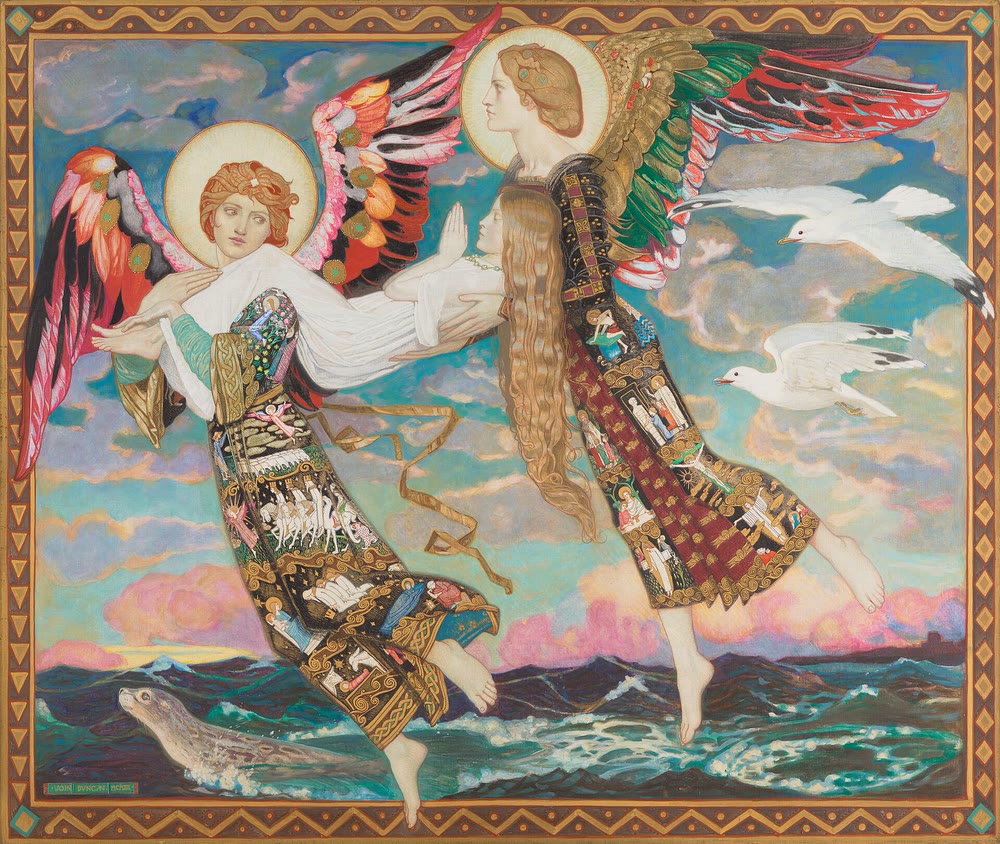
Saint Bride (Brigid), by the Scottish painter John Duncan, 1913. National Galleries of Scotland. Public domain, via Wikimedia Commons
The stranger at the table: Irish hospitality
Grace thanks God for the food; old Ireland also expected you to share it. Early Irish law recognised a special role for this, the briugu, or hospitaller: a wealthy landowner, says the Electronic Dictionary of the Irish Language, whose public duty was unlimited hospitality to all comers. One legal commentary wants a man on every road out of his house, so no traveller passes without an invitation.
At Christmas 1351, the Annals of the Four Masters record, William O’Kelly, king of Uí Maine in Connacht, invited the learned of Ireland, and “travellers, the poor and the indigent” too. Ó Dónaill still lists Fáilte Uí Cheallaigh (FAWL-cha ee HYAL-ee), “O’Kelly’s welcome”, as a byword for a generous one, though I can’t prove the phrase began with that feast.
Then there’s céad míle fáilte (KAYD MEE-luh FAWL-cha), “a hundred thousand welcomes”. Mind the fada: céad is a hundred, but cead means permission. And a proverb for any Irish table: Den fháilte an fhéile (den AWL-cha un AY-luh), “generosity makes the welcome”. There are more in my Irish proverbs.
The table laid for Mary and Joseph
The clearest Irish version of a place kept for the stranger belongs to Christmas Eve. In the 1930s, a teacher in Conna, Co. Cork, added a note to a pupil’s folklore copybook: once the older people went to bed, the house was readied for Joseph, Mary and the Child, with the door left unbolted, the fire built up with a new log and three chairs set around the hearth. Even then, the note says, the custom was nearly gone there.
In Boyle, Co. Roscommon, a pupil wrote that after the Christmas Eve supper the table was laid again and the doors left unlocked for Our Lady, said to visit every house that night. There’s more in my Irish Christmas traditions.
I couldn’t find good evidence for a general Irish rule of keeping an empty place at every meal. But one extra place at Thanksgiving, for whoever turns up, is very much in the spirit of all this.
Thanksgiving and the Choctaw gift
Thanksgiving is American, not Irish: the US National Archives dates the yearly holiday to Lincoln’s 1863 proclamation, and the fourth Thursday to a 1941 law. But 32.4 million US residents claimed Irish ancestry in 2024, says the Census Bureau, so Irish America fills plenty of those tables. Their story is in my guide to how the Irish shaped modern America.
And here’s a story to tell between grace and the turkey. After the Indian Removal Act of 1830, the Choctaw Nation was forced from Mississippi to Indian Territory, now Oklahoma. They were the first nation removed, and thousands died on what a Choctaw chief called a “trail of tears and death”.
In March 1847, with news of Ireland’s famine arriving, a meeting at Skullyville, beside the Choctaw Agency, raised money for the starving Irish. The Choctaw Nation’s newspaper, the Biskinik, and The Irish Times both give the gift as $170.
The earliest report I found gives a different figure. The Arkansas Intelligencer, reprinted in Niles’ National Register on 1 May 1847, said the meeting raised $710 from “agents, missionaries, traders, and Indians”, with the Choctaw giving a considerable share. The Cherokee Nation gave too, and together the two nations sent more than $800, write Padraig Kirwan and LeAnne Howe for RTÉ.
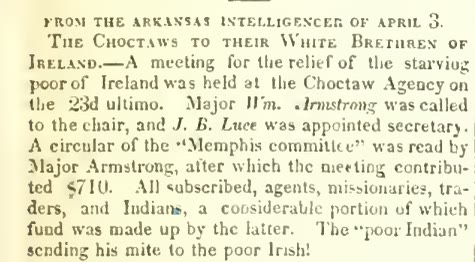
The Arkansas Intelligencer’s report of the Choctaw Agency meeting, reprinted in Niles’ National Register, 1 May 1847. Public domain, via Wikimedia Commons
As the historian Anelise Hanson Shrout puts it in that piece, it is “difficult to imagine a people less well-positioned to act philanthropically”.
Ireland remembered. In Bailick Park, Midleton, Co. Cork, Alex Pentek’s sculpture Kindred Spirits, nine towering steel eagle feathers that curve up around an empty bowl, was unveiled in June 2017 with Choctaw Chief Gary Batton there. And in 2020, Irish donors poured money into a Navajo and Hopi pandemic relief fund, most of them citing the Choctaw gift, RTÉ reports.
The wider story is in my guide to the Irish Potato Famine. This Thanksgiving, a line of thanks for the Choctaw would not be out of place in your grace.
Toasts to end the meal
Remember the deoch altaithe, the drink at the end of a meal? Here are some Irish ways to raise it:
- Sláinte (SLAWN-cha): “health”, the standard Irish toast. Here’s how to say cheers in Irish properly.
- Go méadaí Dia do stór (guh MAY-dee JEE-uh duh STORE): “may God increase your store”, a fine thank-you to whoever fed you.
- Nár lagaí Dia thú (nawr LAG-ee JEE-uh HOO): “may God not weaken you”, or as Ó Dónaill puts it, “more power to you”. Perfect for the cook.
- Deoch an dorais (JUKH un DUR-ish): the drink of the door, the last before guests head home.
Or this toast Hyde got from his friend Philip Waldron of Drombaun, Co. Mayo, in his 1906 translation:
A health let us drink. Our glass we clink it,
May the King of the Graces to us be near.
We will drink this glass as Patrick would drink it,
With a grace made salt by a mingled tear,
Without sadness or sorrow or passion or pain,
None knowing to-morrow that we were here.
Hyde explained the last line: by tomorrow, nobody will remember we were ever here. My guide to Irish toasts has 63 more, for weddings, wakes and birthdays.
Which grace should you say?
With children: keep it short and let a child lead. Go raibh maith agat, a Dhia, as an mbia seo (guh rev MAH AG-ut, uh YEE-uh, oss un MEE-uh shuh) is a simple line built from everyday Irish: “Thank you, God, for this food”. Older children can learn Beannaigh sinn, a Dhia, with its handy daor and saor rhyme.
At a mixed-faith or non-religious table: the graces above are Christian prayers, so invite everyone to add their own words, or simply thank the cooks with go raibh maith agaibh (guh rev MAH AG-iv, thank you to more than one person) and raise a glass with sláinte. When Pope Francis urged believers back to grace in Laudato Si’ (2015), part of his case was honouring the people whose work brought us the food, and that part needs no creed.
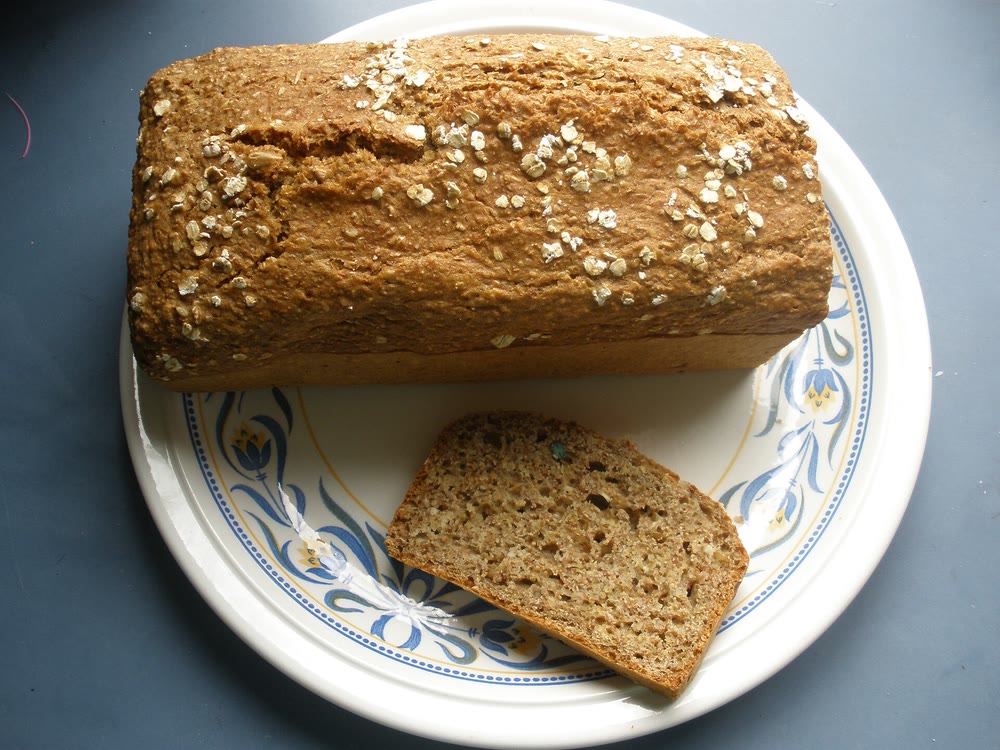
A simple Thanksgiving order: a grace in Irish, then its English meaning; a word for anyone missing; the Choctaw story over the gravy; Moladh leis an Rí nach gann after; sláinte to finish.
Irish grace FAQ
What is the traditional Irish grace before meals?
The oldest-sounding is Bail na gcúig arán agus an dá iasc, the five loaves grace Douglas Hyde printed in 1906. The everyday one is Beannaigh sinn, a Thiarna, the Irish “Bless us, O Lord”.
How do you say grace in Irish?
Grace before a meal is altú roimh bhia (AL-too riv VEE-uh). “They said grace” is dúirt siad an t-altú roimh bhia (DOORT SHEE-ud un TAL-too riv VEE-uh).
How do you say Thanksgiving in Irish?
Lá an Altaithe (law un AL-tuh-huh), the day of thanksgiving. Altú, the same word, is grace at meals.
Is “May the road rise up to meet you” a grace?
No. It’s a blessing for a journey, and only its first line can be traced to Irish.
Did the Choctaw really send money to Ireland in 1847?
Yes. A meeting at the Choctaw Agency in March 1847 raised famine relief for Ireland: $170 by the Choctaw Nation’s count, or $710 from Choctaw people and others, according to a report at the time.
Love this? Save it to your Pinterest board for later.
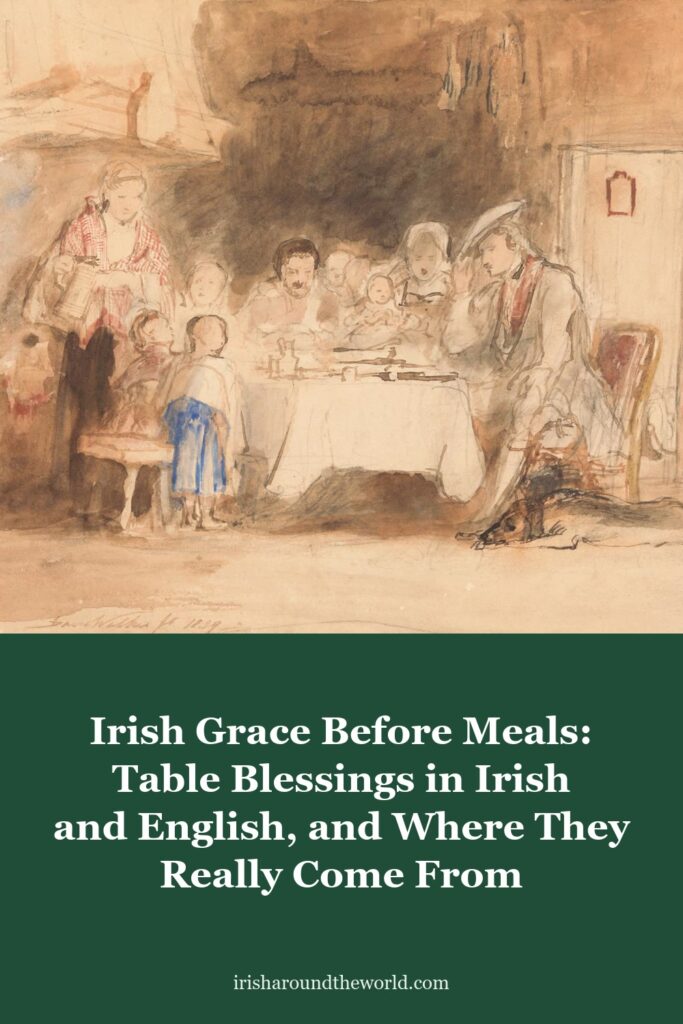
Pin image: Grace Before Meat by David Wilkie, 1839. Yale Center for British Art, CC0, via Wikimedia Commons
A little bit of Ireland in your inbox every Friday ☘️
The free Weekly Dose of Irish: an Irish joke, a Celtic symbol, an Irish fact, a poem and the week’s best articles in one short email. Join 9,600+ readers.
Free. One short email every Friday. Unsubscribe any time.
More Irish blessings and traditions
- Full Irish Breakfast: What’s In It and How to Cook It
- 20 Irish Christmas Blessings and How to Say Merry Christmas in Irish
- 63 Irish Toasts for Every Occasion, and Which Ones Are Really Irish
- How to Say Cheers in Irish: Sláinte, Meaning and Pronunciation
- May the Road Rise Up to Meet You: Meaning, Full Blessing and Its Surprising Origin
- The Irish Potato Famine (An Gorta Mór): Ireland’s Great Hunger, 1845 to 1852
- St Brigid’s Day: Imbolc, the Goddess, the Saint and How Ireland Celebrates 1 February
- 18 Irish Christmas Traditions, From the Candle in the Window to the 12 Pubs
- Irish Proverbs in Irish: 57 Seanfhocail With Meanings and How to Say Them
Featured image: Grace Before Meat, a watercolour sketch of a family bowing their heads over the table, by David Wilkie, 1839. Yale Center for British Art, CC0, via Wikimedia Commons.